
What Is Inventory Management: Australian SMEs Guide
What is inventory management - Learn what inventory management means for your SME. Discover simple tips to track stock, cut costs, and improve order accuracy
Ansh Malhotra

Inventory management is the system a business uses to decide what to stock, how much to hold, and when to reorder. In Australia, business inventories were about $235.4 billion in 2026, and business inventories fell 0.2% quarter-on-quarter in Q2 2026 after rising 0.7% in Q1 2026, showing how quickly stock decisions can change the cash position. ABS inventory methodology treats inventory as materials, work in progress and finished goods owned by a business, wherever those goods are held.
A quiet warehouse can still be expensive. Pallets don't need to move to consume cash. The money left in slow-moving products can't pay suppliers, reduce an overdraft or fund the next purchase order, and Australian operators are dealing with both excess stock and empty shelves at the same time.
Table of Contents
The Cash Hiding in Your Stockroom
Tuesday morning is quiet at a fictional Melbourne specialty bike shop. The showroom looks tidy, but the back room is crowded with last season's components, duplicate accessories and boxed products bought for a promotion that never produced the expected demand.
The owner sees $180,000 of stock on the balance sheet. That number feels reassuring until the BAS is due, the overdraft is humming and a supplier's early-payment discount expires. The business has enough assets on paper, but not enough liquid cash to take the discount or fund the next fast-selling range.
The shop's annual stock-to-sales ratio is 38%, well above the 20% to 25% range assumed in the scenario. That gap represents more than untidy shelving. It signals that purchasing has outrun demand and that working capital is sitting in products earning nothing until they sell.

Cash rule: Treat every box as money with a shelf life, a storage burden and an opportunity cost.
The Australian Bureau of Statistics records inventories at book value at quarter-end and includes stock held away from the business premises. Its Business Indicators program covers industries including manufacturing, wholesale, retail, and accommodation and food services, so stock isn't merely a warehouse concern. It affects valuation, profit measurement, cash flow and national economic reporting. ABS Business Indicators methodology also explains that smaller businesses aren't directly surveyed for inventory data in the same way as larger businesses, with estimates derived from sales information and an inventory-to-sales ratio.
That accounting treatment makes the operator's problem clear. The stockroom is part of the balance sheet, and the balance sheet is connected to the bank account. If you want to understand the wider working-capital impact, review this guide to the cash conversion cycle. The first question isn't whether the warehouse is full. It's whether the stock is producing enough margin and velocity to justify the cash trapped inside it.
What Inventory Management Really Means for a Small Business
Inventory management is the system a business uses to decide what to stock, how much to hold, when to reorder, and when to walk away from a SKU. That system has to connect operations with finance, not leave purchasing to instinct and bookkeeping to month-end.
The business.gov.au guidance on suppliers and stock frames the practical job as organising, tracking and controlling trading stock so the business knows what it has, what it needs to order and when to restock. It distinguishes between periodic counting and perpetual records updated when purchases and sales occur. Its reorder-point logic is straightforward: expected demand during lead time plus safety stock.
Four operating blocks
Stock: Record what you own, including raw materials, work in progress and finished goods. Value it consistently, normally using landed cost rather than a supplier's headline price.
Flow: Control receiving, put-away, picking, packing, dispatch and returns. A correct purchase order is useless if the team receives the wrong quantity or leaves stock unrecorded in a staging area.
Demand signals: Use sales history, seasonality, customer commitments, open quotes and supplier lead times. A forecast that ignores committed orders is incomplete.
Finance: Match purchase orders to the cash-flow forecast, review aged stock, write down items that won't recover their recorded value and track gross margin by SKU.
A Brisbane electrical wholesaler might see strong demand for one cable range, weak demand for another and a supplier lead time that varies. The sales team flags upcoming projects, purchasing checks available cash, the warehouse confirms actual stock and finance tests the margin. Those inputs produce one decision, not four disconnected reports.
Inventory management isn't stocktaking, software or procurement on its own. It's the decision loop connecting demand, supply, operations and cash.
For businesses selling through marketplaces or fulfilment networks, these same controls apply across multiple locations and channels. Practical Amazon FBA inventory management tips can help operators think through replenishment, ageing stock and channel visibility. The team summary should be simple: stock the right items, hold the right quantity, reorder at the right time and stop funding the wrong products.

Core Strategies That Decide How Much Cash You Tie Up
The right strategy depends on the cost of being wrong. A dated food product needs rotation. A slow industrial component may justify a buffer. A volatile imported item can punish a purchasing policy that looks efficient in a spreadsheet.
FIFO, or first-in, first-out, moves older stock before newer stock. FEFO, first-expiry, first-out, goes further by prioritising the earliest expiry date. Both protect margin where age reduces value, including food, cosmetics, pharmaceuticals and products that become obsolete quickly.
Economic order quantity uses the formula EOQ = √(2DS/H), where demand, ordering cost and holding cost determine the theoretical order size. It can discipline purchasing, but it breaks down when demand is volatile, minimum order quantities dominate the decision, or supplier pricing changes faster than the model.
Just-in-time reduces stock held between supply and demand. The discipline is attractive, but pure JIT leaves little room for Australian freight disruption, long import lead times or a single-source supplier. Most SMEs need a controlled buffer, not a heroic assumption that every delivery will arrive exactly when promised.
Safety stock absorbs demand and lead-time variation. A common calculation is z-score × demand standard deviation × lead time, but the output should be tested in dollars. A buffer that protects sales while consuming too much cash isn't automatically good management.
Strategy | Cash Tied Up | Stockout Risk | Best Fit for AU SME |
|---|---|---|---|
FIFO or FEFO | Moderate, because stock is rotated rather than necessarily reduced | Lower risk from expiry and obsolescence | Food, dated products and fast-depreciating ranges |
EOQ | Can reduce ordering and holding waste when inputs are stable | Moderate if demand assumptions are weak | Predictable wholesale or manufacturing demand |
JIT | Low on-hand stock | Higher when suppliers or freight are unreliable | Local, dependable supply with short lead times |
Safety stock | Higher than pure JIT, but targeted | Lower for priority SKUs | Imported, seasonal or service-critical products |
For operators managing equipment, parts or assets that must remain traceable, durable asset identification solutions can support the physical control layer. The finance decision remains separate: keep a buffer where lost sales are costly, and remove stock where the buffer only protects poor purchasing.
The KPIs That Tell You If Your Stock Is Working
A stock report can be accurate and still fail the business. The useful question is whether inventory is converting into sales and margin quickly enough to justify its cost.
Inventory turnover equals cost of goods sold divided by average inventory. It shows how often the business sells and replaces its stock over the measurement period. Days inventory outstanding converts that result into time, which makes the cash consequence easier to discuss with owners and lenders. The inventory days calculation guide is useful when translating turnover into a working-capital conversation.
Stock-to-sales ratio compares inventory value with sales over a consistent period. A rising ratio can mean demand has weakened, purchases are arriving too early or the business is carrying an unproductive range.
GMROII, or gross margin return on inventory investment, compares gross margin with the average inventory investment needed to generate it. A high-margin item can still be a poor use of cash if it barely moves. A lower-margin item may deserve space if it turns reliably and supports customer relationships.
Stockout rate measures the share of demand or order lines that cannot be fulfilled because the item isn't available. Use one definition consistently. Counting customer complaints won't produce a reliable operational measure.
KPI | Formula | Benchmark for AU SMEs | Cash Impact |
|---|---|---|---|
Inventory turnover | COGS ÷ average inventory | Compare by category and business model | Low turnover leaves cash in slow movers |
Stock-to-sales ratio | Inventory value ÷ sales | Track the trend and investigate increases | A rising ratio can signal overbuying |
GMROII | Gross margin ÷ average inventory investment | Rank SKUs against one another | Shows which stock earns its shelf space |
Stockout rate | Unfulfilled demand ÷ total demand | Keep the definition stable and review regularly | Lost sales and emergency freight can follow |
Don't mix sales in one calculation with COGS in another. Don't wait for an annual review if a monthly or weekly view would expose a deteriorating range sooner. A finance owner should also convert extra days into dollars by multiplying the daily cost of sales by the added inventory days. That turns an abstract ratio into a balance-sheet decision.
A KPI only earns its place when someone changes a purchase, markdown, supplier conversation or replenishment rule because of it.
Why Most Stockouts and Overstocks Are the Same Problem
A business can run out of its best seller while carrying shelves of dead stock because both outcomes come from the same weak decision system. The operator has poor demand signals, unreliable lead times or inaccurate item records, then compensates with broad purchasing rather than targeted replenishment.
The evidence is stark. A 2026 survey of 400 operators found that 44% experienced stockouts at least monthly, while 44.8% identified inaccurate inventory data as a top challenge and 52% ranked supplier reliability as the leading issue. These findings are reported in the 2026 State of Inventory Management survey.
The customer damage arrives quickly. 34% of consumers cancelled an online order because of stock shortages, while 80% of online shoppers and 88% of in-store shoppers said they'd turn to competitors when stock was unavailable, according to the same source. The commercial issue isn't limited to an unhappy customer. The business loses the sale while still carrying unrelated stock that may never convert.
The capital loop
The pattern usually looks like this:
The business buys too much of uncertain or poorly classified SKUs.
Cash becomes trapped in slow movers.
The same cash isn't available for targeted safety stock on priority products.
A bestseller runs out because the supplier lead time was wrong or the record was inaccurate.
The operator places an urgent order, pays more for freight and still carries the original dead stock.
The fix isn't to buy more. It is to improve the quality of the inputs. Clean SKU records, separate committed demand from speculative demand, measure supplier lead-time variance and review stock by velocity and margin.
For practical guidance on inventory management and stockout prevention, focus on the connection between availability and record accuracy. Forecasting doesn't need to be perfect. It needs to be honest enough to distinguish a product that deserves protection from one that is consuming cash without earning it.
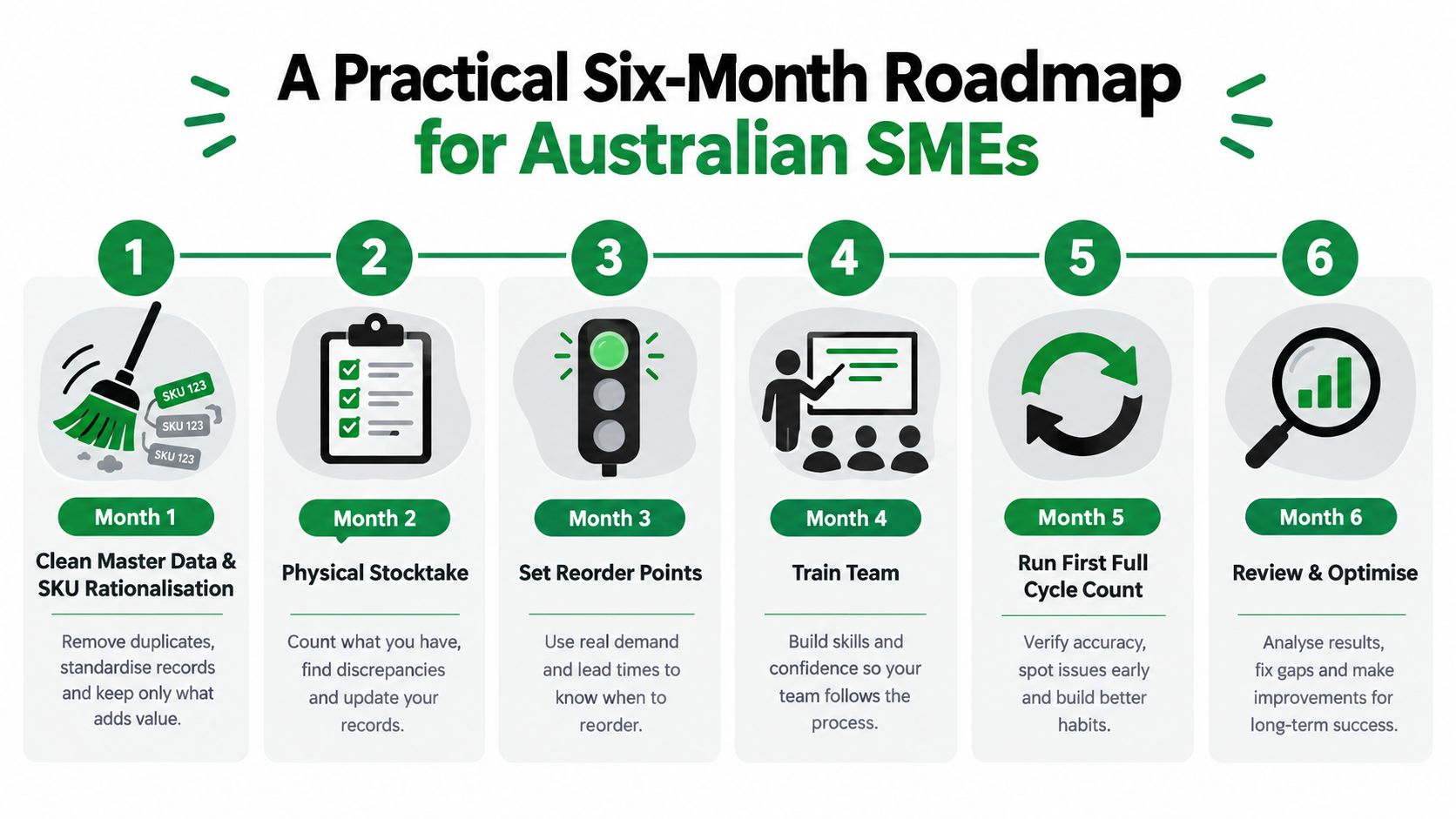
A Practical Six-Month Roadmap for Australian SMEs
A five-to-fifty-person inventory business doesn't need to begin with a large ERP project. It needs a clean baseline, disciplined decisions and a weekly review that links stock movement to cash.
Start with facts, not automation
Month one is data cleanup. Remove duplicate SKUs, standardise descriptions and units, confirm supplier codes and complete a physical stocktake. Reconcile the count to the accounting records. Until the file reflects what is on the floor, every reorder point is fiction.
Month two is classification. Group products by velocity, gross margin contribution and cash tied up. ABC analysis is useful here, but don't classify only by sales volume. A low-volume product with high margin or critical customer importance may deserve different treatment.
Month three is replenishment control. Set reorder points using expected demand during lead time plus safety stock. Use actual supplier performance, including delays and partial deliveries, rather than the lead time printed on an old price list.
Release cash deliberately
Month four targets the highest-value decisions. Identify the SKUs consuming the most cash and set an action for each one: sell through, return, bundle, substitute, discount or stop buying. Don't spread management attention evenly across the catalogue.
Month five is supplier pressure. Review minimum order quantities, payment terms, delivery reliability and freight consolidation. Ask suppliers whether smaller, more frequent orders or staged deliveries can reduce the cash peak without creating unacceptable stockout exposure.
Month six turns the work into a routine. Dashboard turnover, stock-to-sales, GMROII and stockout rate. Hold a weekly review with purchasing, sales, warehouse and finance. Each meeting should end with named actions, owners and purchase decisions.
The operating sequence matters more than the software brand. Watch this short inventory management explainer after the baseline is ready, then apply the principles to your own stock file rather than copying a generic template.
Choosing the Right Technology Without Overbuying
Technology should remove manual errors and speed up decisions. It shouldn't hide weak records behind a polished dashboard.
A periodic system can suit a small café, boutique or low-SKU operator where regular counts are manageable. A perpetual system becomes more valuable when sales occur across channels, stock moves between locations or the cost of a record error is high. POS, barcode scanning and inventory software can update records after each sale or purchase, but only if staff scan consistently.
Match the tool to the operating problem
Business Stage | Typical Stock Value | Recommended System | Approx. Monthly Cost (AUD) | Key Benefit |
|---|---|---|---|---|
Simple single-site operator | Not specified | POS with periodic counts | Not specified | Low complexity |
Growing retailer or wholesaler | Not specified | MYOB or Xero with a stock add-on | Not specified | Accounting and stock visibility |
Multi-channel operator | Not specified | Standalone perpetual inventory platform | Not specified | Channel and location control |
Complex mid-market business | Not specified | ERP such as Cin7, Unleashed or NetSuite | Not specified | Integrated purchasing, stock and finance |
Don't buy an ERP because the business feels busy. Buy it when the cost of disconnected purchasing, inventory and accounting data exceeds the cost and implementation risk of integration. A cloud tool can be enough for a simple operator. A growing wholesaler may need accounting plus purpose-built inventory. A complex manufacturer may need deeper production, warehouse and purchasing controls.
Before paying for automation, establish unique SKU codes, reliable units of measure, barcode labels, scanners where needed, receiving procedures and staff ownership. Otherwise, software will automate bad master data at greater speed.
For teams exploring artificial intelligence, start with the AI inventory management framework, including data readiness, accounting or ERP integration and a controlled pilot on a high-variance SKU group. The first technology purchase should solve the largest cash leak, not satisfy a desire for more features.
How a Virtual CFO Turns Stock Control Into Real Cash
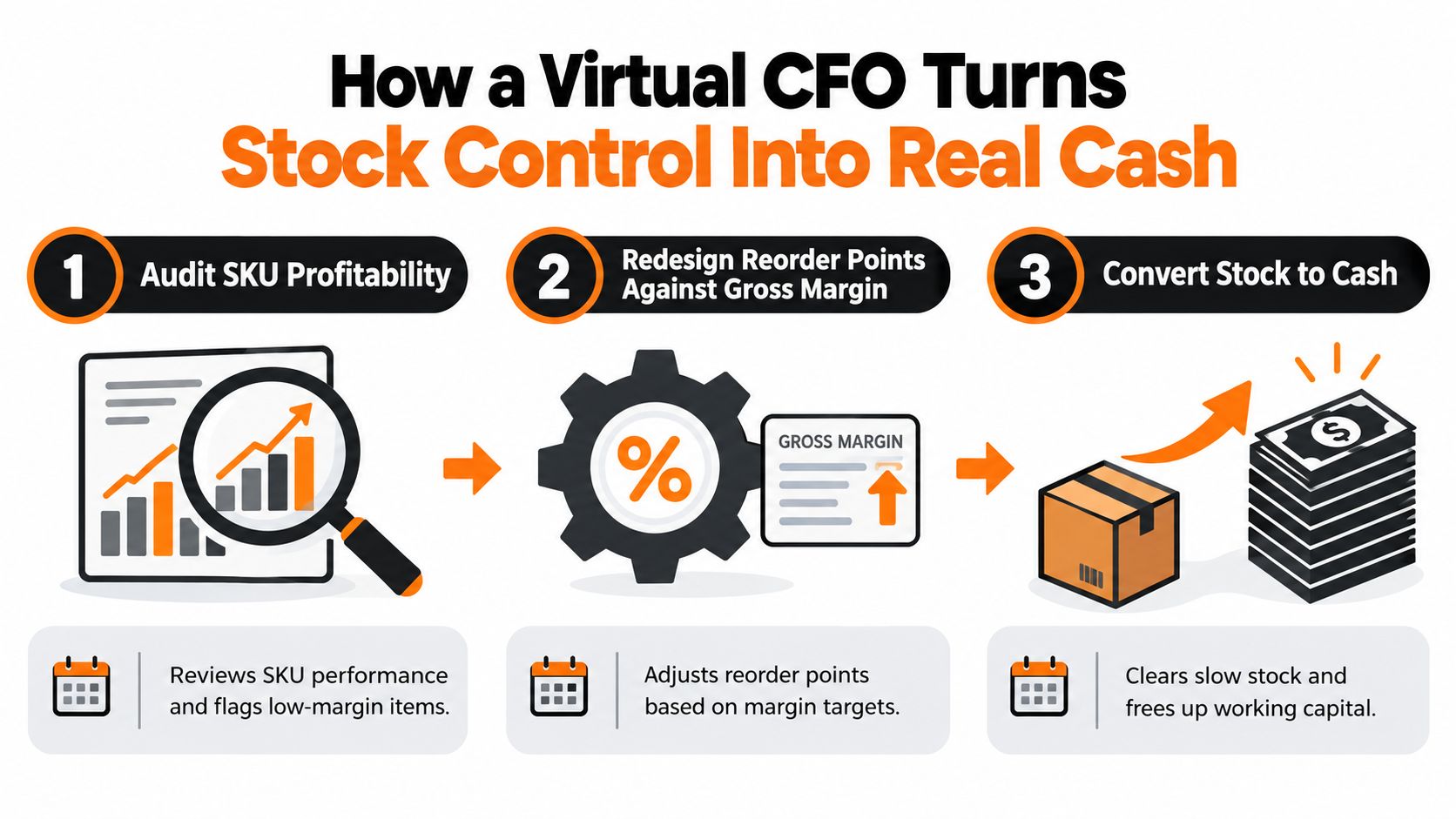
A virtual CFO earns their fee by changing decisions, not by producing another report. In an inventory-heavy SME, that means reviewing the stock file alongside the cash forecast, margin report, supplier ledger and sales pipeline.
The weekly work is practical:
Audit SKU profitability: Separate gross margin from gross contribution after freight, discounts, returns and handling.
Rebuild reorder points: Set replenishment rules against demand, supplier performance and the margin value of availability.
Model safety stock in dollars: Show the owner what each buffer costs and which products deserve that investment.
Review ageing stock: Identify items that need a markdown, return, bundle, write-down or purchasing stop.
Renegotiate supplier terms: Use order history and demand visibility to seek better payment timing, minimum quantities or staged deliveries.
Connect the warehouse to tax and reporting
Inventory decisions affect more than operations. The ABS explains that national accounts adjust book-value inventory changes to distinguish physical stock changes from price effects. At business level, consistent valuation still matters for profit reporting, margin analysis and working-capital decisions.
A finance partner also helps operators keep stock records aligned with BAS, GST and broader tax reporting obligations. The correct treatment depends on the business and its circumstances, so the operator should confirm tax positions with their accountant rather than rely on a warehouse report alone.
The result should appear in operating measures: fewer unnecessary purchase orders, tighter inventory days, better turns, cleaner ageing and more cash available for suppliers or growth. No responsible adviser should promise a fixed improvement without seeing the stock file, margins, lead times and sales pattern first.
Nexist works with Australian SMEs on cash-flow management, inventory reviews, forecasting, KPI reporting, stocktakes, cycle counts, ageing analysis and reorder-point guidance. If stock is absorbing cash you need elsewhere, visit Nexist to request a finance-led review of your inventory and working-capital decisions.
inventory management, Australian SMEs, stock control, cash flow, virtual CFO

" width="24px"/><g d="M 0 24.129 L 0 0.129 L 24 0.129 L 24 24.129 Z M 0 24.129 L 0 0.129 L 24 0.129 L 24 24.129 Z M 24 3 C 24 1.344 22.656 0 21 0 L 3 0 C 1.344 0 0 1.344 0 3 L 0 21 C 0 22.656 1.344 24 3 24 L 21 24 C 22.656 24 24 22.656 24 21 Z M 6.883 8.375 L 2.863 8.375 L 2.863 20.467 L 6.883 20.467 Z M 4.899 2.545 C 3.524 2.545 2.625 3.449 2.625 4.634 C 2.625 5.795 3.496 6.724 4.846 6.724 L 4.872 6.724 C 6.273 6.724 7.146 5.795 7.146 4.634 C 7.12 3.449 6.274 2.545 4.899 2.545 Z M 16.747 8.09 C 14.614 8.09 13.659 9.263 13.124 10.086 L 13.124 8.374 L 9.105 8.374 C 9.159 9.508 9.105 20.466 9.105 20.466 L 13.124 20.466 L 13.124 13.713 C 13.124 13.352 13.15 12.99 13.257 12.732 C 13.547 12.01 14.209 11.262 15.319 11.262 C 16.773 11.262 17.355 12.372 17.355 13.996 L 17.355 20.466 L 21.374 20.466 L 21.374 13.532 C 21.374 9.818 19.391 8.09 16.747 8.09 Z" fill="transparent" height="24.12890599668026px" id="dSFdkJotL" width="24px"><path d="M 0 24 L 0 0 L 24 0 L 24 24 Z" fill="transparent" height="24px" id="wscNJE44G" transform="translate(0 0.129)" width="24px"/><g d="M 0 24.129 L 0 0.129 L 24 0.129 L 24 24.129 Z M 24 3 C 24 1.344 22.656 0 21 0 L 3 0 C 1.344 0 0 1.344 0 3 L 0 21 C 0 22.656 1.344 24 3 24 L 21 24 C 22.656 24 24 22.656 24 21 Z M 6.883 8.375 L 2.863 8.375 L 2.863 20.467 L 6.883 20.467 Z M 4.899 2.545 C 3.524 2.545 2.625 3.449 2.625 4.634 C 2.625 5.795 3.496 6.724 4.846 6.724 L 4.872 6.724 C 6.273 6.724 7.146 5.795 7.146 4.634 C 7.12 3.449 6.274 2.545 4.899 2.545 Z M 16.747 8.09 C 14.614 8.09 13.659 9.263 13.124 10.086 L 13.124 8.374 L 9.105 8.374 C 9.159 9.508 9.105 20.466 9.105 20.466 L 13.124 20.466 L 13.124 13.713 C 13.124 13.352 13.15 12.99 13.257 12.732 C 13.547 12.01 14.209 11.262 15.319 11.262 C 16.773 11.262 17.355 12.372 17.355 13.996 L 17.355 20.466 L 21.374 20.466 L 21.374 13.532 C 21.374 9.818 19.391 8.09 16.747 8.09 Z" fill="transparent" height="24.12890599668026px" id="sTpjGo1tb" width="24px"><path d="M 0 24 L 0 0 L 24 0 L 24 24 Z" fill="transparent" height="24px" id="s7ffpmKOD" transform="translate(0 0.129)" width="24px"/><g d="M 24 3 C 24 1.344 22.656 0 21 0 L 3 0 C 1.344 0 0 1.344 0 3 L 0 21 C 0 22.656 1.344 24 3 24 L 21 24 C 22.656 24 24 22.656 24 21 Z M 6.883 8.375 L 2.863 8.375 L 2.863 20.467 L 6.883 20.467 Z M 4.899 2.545 C 3.524 2.545 2.625 3.449 2.625 4.634 C 2.625 5.795 3.496 6.724 4.846 6.724 L 4.872 6.724 C 6.273 6.724 7.146 5.795 7.146 4.634 C 7.12 3.449 6.274 2.545 4.899 2.545 Z M 16.747 8.09 C 14.614 8.09 13.659 9.263 13.124 10.086 L 13.124 8.374 L 9.105 8.374 C 9.159 9.508 9.105 20.466 9.105 20.466 L 13.124 20.466 L 13.124 13.713 C 13.124 13.352 13.15 12.99 13.257 12.732 C 13.547 12.01 14.209 11.262 15.319 11.262 C 16.773 11.262 17.355 12.372 17.355 13.996 L 17.355 20.466 L 21.374 20.466 L 21.374 13.532 C 21.374 9.818 19.391 8.09 16.747 8.09 Z" fill="transparent" height="24.000006px" id="D0ecaHEcW" transform="translate(0 0)" width="24px"><path d="M 24 3 C 24 1.344 22.656 0 21 0 L 3 0 C 1.344 0 0 1.344 0 3 L 0 21 C 0 22.656 1.344 24 3 24 L 21 24 C 22.656 24 24 22.656 24 21 Z" fill="rgb(55, 184, 218)" height="24.000006px" id="IPLFE6zXx" width="24px"/><path d="M 4.02 0 L 0 0 L 0 12.092 L 4.02 12.092 Z" fill="rgb(255, 255, 255)" height="12.09201px" id="FWhtzAyuY" transform="translate(2.863 8.375)" width="4.02px"/><path d="M 2.274 0 C 0.899 0 0 0.904 0 2.089 C 0 3.25 0.871 4.179 2.221 4.179 L 2.247 4.179 C 3.648 4.179 4.521 3.25 4.521 2.089 C 4.495 0.904 3.649 0 2.274 0 Z" fill="rgb(255, 255, 255)" height="4.17876px" id="VmOsKv4kO" transform="translate(2.625 2.545)" width="4.52095px"/><path d="M 7.641 0 C 5.509 0 4.554 1.173 4.019 1.996 L 4.019 0.284 L 0 0.284 C 0.053 1.419 0 12.376 0 12.376 L 4.019 12.376 L 4.019 5.623 C 4.019 5.262 4.045 4.9 4.151 4.642 C 4.442 3.92 5.103 3.172 6.214 3.172 C 7.667 3.172 8.25 4.282 8.25 5.907 L 8.25 12.376 L 12.269 12.376 L 12.269 5.442 C 12.269 1.728 10.286 0 7.641 0 Z" fill="rgb(255, 255, 255)" height="12.37626px" id="n1XUbhaq0" transform="translate(9.105 8.09)" width="12.268830000000001px"/></g></g></g></g></svg>)