
Cash Flow Forecast vs Budget: The SME Guide
Master the cash flow forecast vs budget debate. Learn how Australian SMEs use both tools to manage liquidity, plan growth, and avoid cash traps.
Ansh Malhotra

You've hit your sales target, the profit line looks healthy, and yet you're checking the bank account before approving payroll. A customer hasn't paid on time, a supplier wants cash before dispatch, stock is absorbing funds, and GST or PAYG instalments are approaching. The annual budget says the business is working. The bank balance says the timing is dangerous.
That tension is the practical difference between a cash flow forecast vs budget. A budget tells you what you want the business to achieve. A forecast tells you whether cash is likely to be available when the bills fall due. Australian founders need both, but they must stop using one as a substitute for the other.
Feature | Annual budget | 13-week cash flow forecast |
|---|---|---|
Primary question | What should the business earn and spend? | Will cash be available when obligations fall due? |
Main focus | Strategic targets, margins and resource allocation | Timing of receipts, payments and liquidity |
Time horizon | Usually a financial-year planning view | Rolling near-term view |
Update pattern | Reviewed against actual performance | Updated frequently with actual cash results |
Best decision use | Growth, pricing, hiring and investment | Payroll, tax, suppliers and short-term commitments |
Table of Contents
The Profitable but Cash-Poor Trap
A wholesale business can sell strongly through a busy period and still become financially vulnerable. Revenue is recorded, margins appear acceptable, and the budget supports another purchasing cycle. But the business pays suppliers before customers settle invoices, buys stock ahead of demand, and carries tax obligations that don't wait for every debtor to pay.
The founder sees profit and assumes the business can afford expansion. The forecast sees a different sequence: cash leaves for inventory, receipts arrive later than expected, and tax payments create another immediate outflow. Nothing has to go wrong with the underlying product or demand for the bank balance to tighten.
A service firm faces the same trap in a different form. It may sign new work and build a profitable forward pipeline, while wages and contractors must be paid before milestone invoices are collected. Growth increases the gap between delivery and collection. The budget celebrates the additional revenue, but only the forecast shows whether the business can fund the work while waiting for payment.
Practical rule: Profit explains whether the model can work. Cash flow explains whether the business can keep operating while it works.
The distinction matters because a budget is a plan, not a bank statement. It can support decisions about hiring, marketing, equipment and target margins, but it won't tell you the exact week a delayed receivable collides with payroll. A rolling cash view makes that timing visible.
Founders dealing with delayed payments, supplier pressure or stock commitments should also review these small business cash flow problems before treating a profitable budget as proof of financial safety. For practical habits around monitoring movements and organising cash information, Ledgerly's cash flow tips provide a useful operational reference.
The answer isn't to abandon the budget. It's to give each document the job it can perform. Use the budget to decide where the business is going, and the forecast to decide what it can safely do now.
Defining the Budget and the Forecast
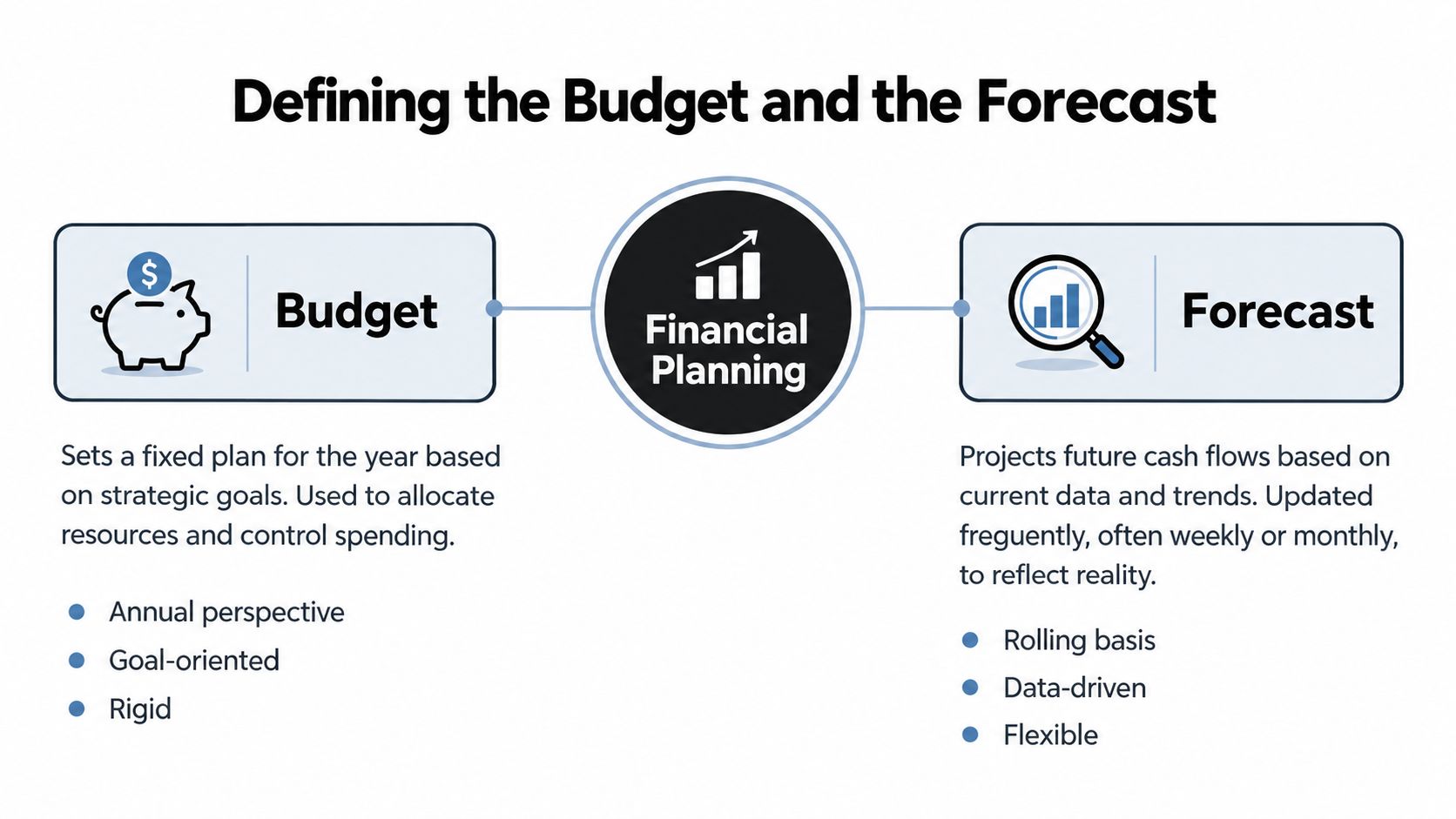
Business Queensland draws a clear line between the two tools. A budget is a spending plan based on what the business wants to happen, while a forecast predicts what is likely to happen using past and present financial information, as set out in its guidance on budgets and forecasts.
That distinction is more than terminology. A budget starts with intent. You decide the revenue outcome, the resources required and the spending limits that support the strategy. A forecast starts with evidence. You examine expected receipts, actual payment behaviour, known bills and the timing of obligations, then project the resulting cash position.
What belongs in the budget
The budget should translate your operating plan into financial targets. It normally includes fixed costs and expected variable costs, with the Australian Taxation Office specifically identifying items such as rent, insurance, utilities, wages, equipment and taxes including PAYG instalments and GST in cash-flow budgeting guidance.
That means the budget shouldn't stop at sales and gross margin. If your plan depends on hiring, stock purchases or new equipment, those commitments need to be visible alongside their expected financial effect. The budget gives managers a controlled framework for deciding whether a proposed expense supports the intended outcome.
What belongs in the forecast
The forecast is narrower and more immediate. Business Queensland's cash-flow method calls for the opening balance, monthly inflows, monthly outflows, net cash flow and closing balance. Business Victoria explains that businesses often choose a monthly forecast period and then compare estimated cash flows with actual results after the period ends, as outlined in its cash flow forecasting guidance.
Business.gov.au describes a cash flow forecast as an estimate of future sales and costs used to assess whether income will cover costs. The practical test is therefore liquidity, not accounting profit. A forecast can show a cash squeeze even when the budget remains attractive.
For founders who want a broader explanation of how the documents work together, this budgeting and forecasting planning guide from Book Tech LLC is a useful supplementary resource. Keep the boundary clear: the budget sets the desired financial path, while the forecast tests whether current cash timing can support it.
Building the 13-Week Rolling Forecast
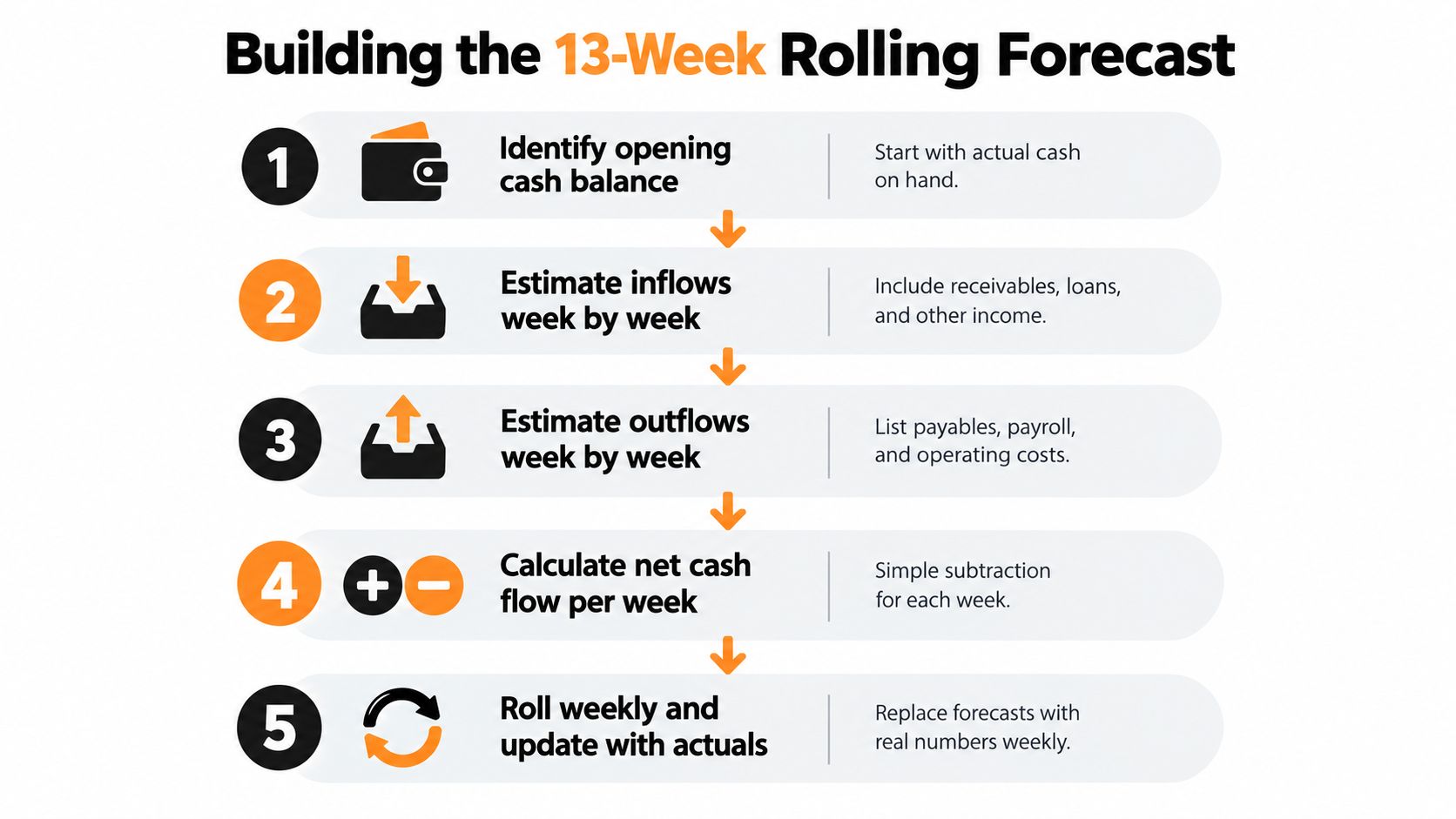
A 13-week rolling cash flow forecast is the most useful near-term control for many Australian SMEs because it turns a broad annual plan into a week-by-week view of liquidity. Australian advisory and CPA-linked guidance commonly uses this horizon to map payment timing over the next quarter, while the government method provides the underlying structure of opening cash, inflows, outflows, net movement and closing cash.
Start with cash you can access. Don't use an accounting profit figure or an invoice total as a substitute for the opening balance. Reconcile the relevant bank accounts, identify restricted funds, and record the amount available at the start of the first forecast week.
Build receipts around timing
List customer receipts by the week you expect the money to clear, not the date you issued the invoice. Separate contracted receipts from assumptions. A signed order, an overdue invoice and a sales opportunity shouldn't carry the same confidence level.
Review your receivables ledger and mark expected payment dates realistically. If a customer regularly pays later than its stated terms, the forecast should reflect behaviour rather than optimism. Sales pipeline information supports, but doesn't replace, cash analysis. Executives who need a stronger view of sales assumptions can use this pipeline analysis resource for executives as a complementary planning reference.
Build outflows from commitments
Enter payroll, supplier bills, rent, insurance, debt repayments, software, planned purchases and operating costs in the week they leave the account. Include GST and PAYG instalments in the relevant payment periods, following the ATO's guidance that tax obligations belong in the cash-flow budgeting cycle.
Inventory deserves its own line rather than being buried in a general purchases category. A stock order can consume cash well before the resulting sale produces a receipt. Record deposits, balance payments, freight and other cash commitments so the forecast exposes the full funding requirement.
Roll, compare and replace
Calculate each week's net cash flow by subtracting outflows from inflows. Add that result to the opening balance to produce the closing balance, then carry the closing figure into the next week.
At each review, replace estimates for completed periods with actual bank movements. Investigate the variance instead of overwriting it. If customers are paying later, supplier terms have changed or stock receipts are arriving earlier, the next forecast should reflect those facts. A practical cash flow forecast template can help organise the model, provided the team maintains it with disciplined actuals.
Comparing Strategic Targets and Tactical Reality
The budget and forecast answer different management questions, so comparing them on a single definition of “accuracy” creates confusion. The budget is judged against strategic performance. The forecast is judged against cash timing and the reliability of its assumptions.
A budget is valuable when the founder is deciding whether to enter a market, add capacity, change pricing or approve a major cost. It establishes the expected relationship between revenue, direct costs, overhead and margin. It also gives the team a benchmark for explaining why actual performance differs from the intended plan.
A forecast is valuable when the question is more immediate: can the business meet payroll, settle a supplier, fund a stock delivery or pay a tax obligation when due? It focuses on liquidity. It won't tell you whether a planned investment has attractive long-term returns unless you connect it back to the budget and operating strategy.
Feature | Annual Budget | 13-Week Cash Flow Forecast |
|---|---|---|
Purpose | Set expected outcomes and spending boundaries | Test near-term cash availability |
Perspective | Strategic and performance-oriented | Tactical and liquidity-oriented |
Inputs | Sales plan, cost structure and investment priorities | Bank balance, expected receipts, bills and tax timing |
Strength | Supports margin, resource and growth decisions | Identifies upcoming cash pressure |
Blind spot | Can miss the timing of actual receipts and payments | Can miss whether activity creates sustainable profit |
Management response | Adjust strategy, targets or spending plans | Accelerate collections, defer outflows or arrange funding |
Where the budget earns authority
The budget should lead decisions about the shape of the business. If a proposed hire doesn't support the target margin or operating plan, the budget should challenge it. If a marketing campaign produces revenue but weak contribution after fulfilment and support costs, the budget should expose that problem.
Budget-versus-actual analysis also matters. A resource such as budget vs actual analysis helps the founder distinguish a temporary timing difference from a structural problem in pricing, volume or cost control.
Where the forecast takes control
The forecast should lead decisions about immediate solvency. A profitable month doesn't authorise spending if the forecast shows that cash will fall below a safe operating level before expected receipts arrive. The forecast protects the business from timing risk that an annual target cannot see.
The strongest finance rhythm keeps both views visible. The budget tells you whether the decision makes strategic sense. The forecast tells you whether you can fund it without placing core obligations at risk.
Resolving Conflicts Between the Two Models
When the models disagree, don't average them into a comfortable story. Identify the reason for the conflict, then apply a clear decision rule.
Suppose the budget supports a large seasonal inventory purchase because the expected sales and margin justify it. The forecast shows cash falling sharply while the stock is paid for and customer receipts remain uncertain. In that situation, the forecast overrides the budget for the immediate funding decision. You can still support the strategic plan, but you may need to split the order, negotiate supplier terms, reduce the initial range or secure funding before committing.
Inventory is a classic cash trap because the business can recognise commercial potential without holding spendable cash. Review the expected sell-through, supplier payment schedule and customer collection timing together. If the forecast can't support the order and there isn't a credible funding plan, the budget's sales target isn't enough evidence to proceed.
Tax timing requires the same discipline. The ATO advises businesses to include GST and PAYG instalments in cash-flow budgets and to update the budget as income and expenses change. If the budget says the business can afford a new initiative but the forecast reaches a tax-payment period with insufficient liquidity, protect the tax obligation first. Delay discretionary spending, accelerate collections and reassess the investment once the cash position is stable.
Use these decision rules
Protect mandatory obligations first. Payroll, tax, critical suppliers and debt commitments take priority over discretionary growth spending when the forecast shows a shortfall.
Separate timing from economics. If the project is profitable but cash arrives later, solve the funding and collection problem. Don't pretend the timing risk doesn't exist.
Treat stock as cash committed. Don't approve a purchase solely because the budget includes the expected sales. Test the payment schedule and the forecast closing balance.
Require a funding plan. A debt facility, owner contribution or staged supplier arrangement must be explicit. “Sales will cover it” isn't a funding plan.
Let the budget overrule temporary anxiety only with evidence. If the forecast dip comes from a deliberate investment and the business has enough committed liquidity to meet obligations, preserve the strategic spend and monitor the forecast closely.
When the budget is green and the forecast is red, cash wins until you can explain the gap and fund it safely.
The reverse conflict also matters. A short-term cash surplus doesn't prove that the business has a sound model. You might collect a large invoice while margins deteriorate, or postpone essential maintenance to make the bank balance look stronger. In those cases, the budget should challenge the apparent comfort and force a review of underlying profitability.
Core Metrics and the Review Cadence
A forecast becomes useful when the team explains its errors and changes behaviour. Updating a spreadsheet without reviewing the assumptions creates a newer version of the same guess.
Use a short weekly meeting to inspect the rolling cash view. Compare the prior forecast with actual receipts and payments, identify the cause of each meaningful variance, and update the forward weeks. Business Victoria's guidance supports comparing estimated cash flows with actual results, while the ATO recommends keeping cash-flow budgets current as income and expenses change.

Watch the cash conversion points
AR ageing shows whether invoices are becoming harder to collect and whether the forecast relies on optimistic receipt dates. Review overdue accounts by customer, owner and promised payment date.
AP terms reveal how much flexibility suppliers provide. A change from credit terms to payment before dispatch can shift the forecast materially, even if the purchase price stays unchanged.
Inventory profile shows where cash is sitting in stock, including slow-moving or excess items. A healthy margin doesn't release cash until the inventory sells and the customer pays.
Track resilience, not just balance
Runway in weeks gives the founder a practical view of how long available cash may support operations under the current forecast. It should be read alongside expected receipts, committed outflows and the assumptions behind both.
Facility headroom shows how much approved funding remains available if the forecast identifies a temporary gap. Treat headroom as a contingency, not as permission to avoid fixing weak collection, purchasing or margin discipline.
The budget review should sit at a different level. Compare actual revenue, direct costs and overhead with the annual plan, then decide whether the variance reflects timing, volume, price or permanent cost change. Don't force the forecast to explain strategic performance, and don't ask the budget to manage weekly liquidity.
Building a Unified Finance Engine
The answer to cash flow forecast vs budget isn't choosing a winner. A founder needs one operating rhythm in which the budget sets the destination, the forecast tests the road conditions and actual results improve both models.
Start with a shared chart of accounts and consistent treatment of GST, PAYG, payroll, inventory and supplier commitments. Connect bank data, invoicing, bills and payroll where practical, then assign an owner to review exceptions. Automation can reduce rekeying, but it won't decide whether a delayed customer receipt is credible or whether an inventory purchase deserves approval.
The finance engine should produce three linked views:
Strategic plan: The budget sets revenue, margin, cost and investment expectations.
Liquidity control: The rolling forecast maps expected receipts and payments against accessible cash.
Performance feedback: Budget-versus-actual and forecast-versus-actual reviews explain what changed and improve the next decision.
This approach changes the founder's role. Instead of checking the bank account reactively, you see upcoming pressure early enough to collect debtors, renegotiate supplier timing, stage purchases or arrange funding. You also retain the strategic discipline to reject revenue that doesn't produce acceptable margin or cash.
A virtual CFO can help build the model, establish review ownership and turn variance analysis into operating actions. Nexist, for example, supports Australian founders with forecasting, cash-flow management, performance reporting, KPIs, bookkeeping and related finance operations, giving the business a structured way to connect strategic targets with weekly cash decisions.
Don't wait for a tax deadline, supplier escalation or missed payroll to reveal that the budget was doing the forecast's job. Build both views, review them on different cadences and make the conflict rules explicit.
If your budget looks profitable but your bank balance still creates doubt, visit Nexist to discuss a practical finance engine built around cash-flow forecasting, budget analysis and clear weekly decisions. Bring your current budget, bank position and upcoming commitments, and use the conversation to identify where cash is trapped and what needs to change first.
cash flow forecast, business budget, SME finance, cash management, virtual CFO

" width="24px"/><g d="M 0 24.129 L 0 0.129 L 24 0.129 L 24 24.129 Z M 0 24.129 L 0 0.129 L 24 0.129 L 24 24.129 Z M 24 3 C 24 1.344 22.656 0 21 0 L 3 0 C 1.344 0 0 1.344 0 3 L 0 21 C 0 22.656 1.344 24 3 24 L 21 24 C 22.656 24 24 22.656 24 21 Z M 6.883 8.375 L 2.863 8.375 L 2.863 20.467 L 6.883 20.467 Z M 4.899 2.545 C 3.524 2.545 2.625 3.449 2.625 4.634 C 2.625 5.795 3.496 6.724 4.846 6.724 L 4.872 6.724 C 6.273 6.724 7.146 5.795 7.146 4.634 C 7.12 3.449 6.274 2.545 4.899 2.545 Z M 16.747 8.09 C 14.614 8.09 13.659 9.263 13.124 10.086 L 13.124 8.374 L 9.105 8.374 C 9.159 9.508 9.105 20.466 9.105 20.466 L 13.124 20.466 L 13.124 13.713 C 13.124 13.352 13.15 12.99 13.257 12.732 C 13.547 12.01 14.209 11.262 15.319 11.262 C 16.773 11.262 17.355 12.372 17.355 13.996 L 17.355 20.466 L 21.374 20.466 L 21.374 13.532 C 21.374 9.818 19.391 8.09 16.747 8.09 Z" fill="transparent" height="24.12890599668026px" id="dSFdkJotL" width="24px"><path d="M 0 24 L 0 0 L 24 0 L 24 24 Z" fill="transparent" height="24px" id="wscNJE44G" transform="translate(0 0.129)" width="24px"/><g d="M 0 24.129 L 0 0.129 L 24 0.129 L 24 24.129 Z M 24 3 C 24 1.344 22.656 0 21 0 L 3 0 C 1.344 0 0 1.344 0 3 L 0 21 C 0 22.656 1.344 24 3 24 L 21 24 C 22.656 24 24 22.656 24 21 Z M 6.883 8.375 L 2.863 8.375 L 2.863 20.467 L 6.883 20.467 Z M 4.899 2.545 C 3.524 2.545 2.625 3.449 2.625 4.634 C 2.625 5.795 3.496 6.724 4.846 6.724 L 4.872 6.724 C 6.273 6.724 7.146 5.795 7.146 4.634 C 7.12 3.449 6.274 2.545 4.899 2.545 Z M 16.747 8.09 C 14.614 8.09 13.659 9.263 13.124 10.086 L 13.124 8.374 L 9.105 8.374 C 9.159 9.508 9.105 20.466 9.105 20.466 L 13.124 20.466 L 13.124 13.713 C 13.124 13.352 13.15 12.99 13.257 12.732 C 13.547 12.01 14.209 11.262 15.319 11.262 C 16.773 11.262 17.355 12.372 17.355 13.996 L 17.355 20.466 L 21.374 20.466 L 21.374 13.532 C 21.374 9.818 19.391 8.09 16.747 8.09 Z" fill="transparent" height="24.12890599668026px" id="sTpjGo1tb" width="24px"><path d="M 0 24 L 0 0 L 24 0 L 24 24 Z" fill="transparent" height="24px" id="s7ffpmKOD" transform="translate(0 0.129)" width="24px"/><g d="M 24 3 C 24 1.344 22.656 0 21 0 L 3 0 C 1.344 0 0 1.344 0 3 L 0 21 C 0 22.656 1.344 24 3 24 L 21 24 C 22.656 24 24 22.656 24 21 Z M 6.883 8.375 L 2.863 8.375 L 2.863 20.467 L 6.883 20.467 Z M 4.899 2.545 C 3.524 2.545 2.625 3.449 2.625 4.634 C 2.625 5.795 3.496 6.724 4.846 6.724 L 4.872 6.724 C 6.273 6.724 7.146 5.795 7.146 4.634 C 7.12 3.449 6.274 2.545 4.899 2.545 Z M 16.747 8.09 C 14.614 8.09 13.659 9.263 13.124 10.086 L 13.124 8.374 L 9.105 8.374 C 9.159 9.508 9.105 20.466 9.105 20.466 L 13.124 20.466 L 13.124 13.713 C 13.124 13.352 13.15 12.99 13.257 12.732 C 13.547 12.01 14.209 11.262 15.319 11.262 C 16.773 11.262 17.355 12.372 17.355 13.996 L 17.355 20.466 L 21.374 20.466 L 21.374 13.532 C 21.374 9.818 19.391 8.09 16.747 8.09 Z" fill="transparent" height="24.000006px" id="D0ecaHEcW" transform="translate(0 0)" width="24px"><path d="M 24 3 C 24 1.344 22.656 0 21 0 L 3 0 C 1.344 0 0 1.344 0 3 L 0 21 C 0 22.656 1.344 24 3 24 L 21 24 C 22.656 24 24 22.656 24 21 Z" fill="rgb(55, 184, 218)" height="24.000006px" id="IPLFE6zXx" width="24px"/><path d="M 4.02 0 L 0 0 L 0 12.092 L 4.02 12.092 Z" fill="rgb(255, 255, 255)" height="12.09201px" id="FWhtzAyuY" transform="translate(2.863 8.375)" width="4.02px"/><path d="M 2.274 0 C 0.899 0 0 0.904 0 2.089 C 0 3.25 0.871 4.179 2.221 4.179 L 2.247 4.179 C 3.648 4.179 4.521 3.25 4.521 2.089 C 4.495 0.904 3.649 0 2.274 0 Z" fill="rgb(255, 255, 255)" height="4.17876px" id="VmOsKv4kO" transform="translate(2.625 2.545)" width="4.52095px"/><path d="M 7.641 0 C 5.509 0 4.554 1.173 4.019 1.996 L 4.019 0.284 L 0 0.284 C 0.053 1.419 0 12.376 0 12.376 L 4.019 12.376 L 4.019 5.623 C 4.019 5.262 4.045 4.9 4.151 4.642 C 4.442 3.92 5.103 3.172 6.214 3.172 C 7.667 3.172 8.25 4.282 8.25 5.907 L 8.25 12.376 L 12.269 12.376 L 12.269 5.442 C 12.269 1.728 10.286 0 7.641 0 Z" fill="rgb(255, 255, 255)" height="12.37626px" id="n1XUbhaq0" transform="translate(9.105 8.09)" width="12.268830000000001px"/></g></g></g></g></svg>)