
What Is Cash Flow Statement
What is cash flow statement. Learn what is a cash flow statement, how it works in Australia, and why it reveals the real liquidity behind your profit. Practical
Ansh Malhotra

A cash flow statement is a report that tracks the actual cash moving in and out of a business across operating, investing, and financing activities under AASB 107. In Australian SMEs, that matters because profit can look healthy while cash is delayed by late payments, GST timing, and wages or suppliers falling due before customers pay.
You can be profitable on paper and still feel squeezed at the bank. A founder might look at a strong month, then open internet banking and see there's barely enough to cover the next supplier bill, payroll, or BAS payment. That gap is exactly why the cash flow statement sits at the centre of real-world decision-making.
Table of Contents
The Cash Flow Question Every Founder Asks
A Melbourne founder can see a healthy profit and loss statement, then check the bank account and find too little to cover the next bill. Sales have met target, margins look sound, and the accountant calls the business “profitable”. The practical question is simpler: where is the cash?
Cash often sits in the timing gap. Customers have not paid, stock was purchased earlier, GST or PAYG withholding is due, or wages and supplier invoices have already left the account. The cash flow statement tracks those actual cash movements across a period and sorts them into operating, investing, and financing activities under AASB 107, as set out by the Australian Accounting Standards Board.

Why the timing gap matters in Australia
For an Australian SME, customer terms, GST lodgements, PAYG withholding, payroll, and supplier due dates rarely match the month's sales. A business can therefore look busy and profitable while its bank balance is under pressure. The statement helps control that timing risk by showing whether trading generates cash, growth absorbs it, or outside funding is carrying the gap.
When preparing current or forecast cash-flow statements, businesses also need to be clear about whether figures include or exclude GST, as noted in Australian government guidance. That makes the report useful for planning, not merely a record of past transactions.
Practical rule: if money has not moved, it does not belong in the cash flow statement, even when the sale or expense already appears in the profit and loss.
The same timing idea appears in ecommerce payback metrics, where the question is how long cash takes to return after an investment. For a founder, that view can expose a late-payment squeeze early enough to adjust collection, purchasing, or funding decisions.
Profit on Paper vs Cash in the Bank
Two businesses can post the same profit and live very different lives. One looks strong in the accounts but keeps bumping into overdraft limits. The other may carry slightly thinner margins, yet the bank balance climbs because the cash cycle is cleaner.
Two identical profits, two different realities
Imagine both businesses finish the year with $200k in profit on paper. Business A sells on 60-day terms, holds 90 days of stock, and pays suppliers in 14 days. Business B takes deposits upfront, turns stock in 30 days, and pays suppliers in 45 days. The profit is the same, but the cash story isn't.
Metric | Business A (Profit-Only Optimised) | Business B (Cash-Optimised) |
|---|---|---|
Profit on paper | Same as Business B | Same as Business A |
Customer payment timing | Slow collection | Cash arrives earlier |
Stock holding | Long | Tight |
Supplier timing | Bills due quickly | Bills paid later |
Bank balance | Tight, often under pressure | More stable and predictable |
Funding need | Higher reliance on overdraft | Lower reliance on short-term debt |
The lesson is simple. Profit follows accrual accounting, which records revenue when it's earned and expenses when they're incurred. Cash flow follows timing, which asks when money enters or leaves the bank. That's why a profitable business can still struggle to pay suppliers, landlords, lenders, or the ATO.
For a deeper accounting comparison, the profit and loss statement guide is a useful companion, because it shows the profit side of the picture that the cash flow statement later reconciles to reality.
Why lenders and regulators care about cash
Banks don't lend against vibes. Landlords want rent paid on time. The ATO cares about what's available for BAS, GST, and PAYG obligations. That's why the cash flow statement matters more than a headline profit figure when the business is under pressure.
Cash is the control layer. Profit tells you the business model can work, cash tells you whether it can survive the timing.
The statement sits between the P&L and the bank account. It explains why a business can be “up” in profit but “down” in liquidity, and it gives founders a way to fix the gap before it becomes a crisis.
The Three Buckets Inside a Cash Flow Statement
A founder checking the bank balance needs more than one reading. AASB 107 groups cash movements into three streams feeding one closing balance: operating, investing, and financing. Together, they show whether timing pressure comes from customer payments, business investment, or funding decisions. The Australian standard sets out this structure, while the Australian Government's guidance on setting up a cash flow statement provides a practical reference.
Operating activities
Operating activities track the cash engine that keeps an Australian SME trading. They include customer receipts and payments to suppliers, employees, landlords, utilities, and the ATO. GST payments and PAYG withholding belong here as well.
This category exposes timing risk in the local cash conversion cycle. A retailer may record a sale today while waiting for a customer to pay, then face supplier invoices, GST, or PAYG obligations before that receipt arrives. Positive operating cash flow generally indicates that ordinary trading is producing cash. A profitable month with weak operating cash flow deserves closer attention.
Investing activities
Investing activities cover longer-term assets and investments. A shop fit-out, delivery van, packing equipment, or the sale of old equipment belongs in this category. Changes in term deposits can also appear here when they function as investments rather than cash equivalents.
Growth can make investing cash flow negative. Buying equipment may reduce the bank balance now while increasing capacity later. The statement helps separate that deliberate investment from a shortfall caused by slow-paying customers.
Financing activities
Financing activities show how the business obtains or returns funding. Owner contributions, drawings, director loans, loan drawdowns, repayments, and interest are recorded here. Repeated borrowing to cover wages, suppliers, or tax payments can indicate that operating cash is not keeping pace with trading obligations.
The statement reconciles opening cash with closing cash. Start with the cash held at the beginning of the period, add or subtract movements from all three categories, and arrive at the ending balance.
Practical rule: everyday trading belongs in operating. Buying or selling an asset that lasts belongs in investing. A change in funding belongs in financing.
A growing SME may have positive operating cash flow and negative investing cash flow, while financing reflects planned borrowing or owner funding. The useful question is whether each movement matches the business decision behind it. Once transactions are sorted this way, the statement becomes a dashboard for late payments, GST and PAYG timing, asset purchases, and funding pressure, rather than a compliance document alone.
Direct vs Indirect Method Explained Simply
The two methods answer the same question, but they get there differently. One starts with actual cash receipts and payments. The other starts with profit and adjusts it back to cash.
Side by side
Feature | Direct Method | Indirect Method |
|---|---|---|
Starting point | Cash received and cash paid | Net profit |
What it shows | Real cash from customers, suppliers, wages, tax payments | Adjustments for non-cash items and working capital |
Data source | Bank and transaction detail | Profit and loss plus balance sheet movements |
Typical user | Teams wanting high visibility into cash moves | Most SMEs, accountants, lenders |
Preparation effort | More manual | Easier to automate in reporting systems |
The direct method is easier to read because it lists the actual cash coming in from customers and the cash going out to suppliers and staff. For a founder, it feels intuitive, because it mirrors the bank account. The downside is that it takes more manual work to prepare properly.
The indirect method begins with net profit and then adjusts for non-cash items like depreciation and for working capital movements like receivables, inventory, and payables. That's why most Australian SMEs see it in Xero, MYOB, or QuickBooks reports, because those systems can build it from existing accounting data without re-entering every payment line.
A consulting firm turning over $500,000 might use the indirect method like this. Start with profit, add back depreciation, then adjust for invoices still unpaid by clients and bills not yet settled to arrive at operating cash. The exact figures will vary, but the structure stays the same.
The indirect method dominates because it's efficient. It reuses the books you already keep, it supports compliance, and it gives lenders a familiar view of how profit becomes liquidity.
If your accountant says the business is profitable but the bank balance disagrees, the indirect method is where the truth gap usually shows up first.
A Worked Example for an Australian Small Business
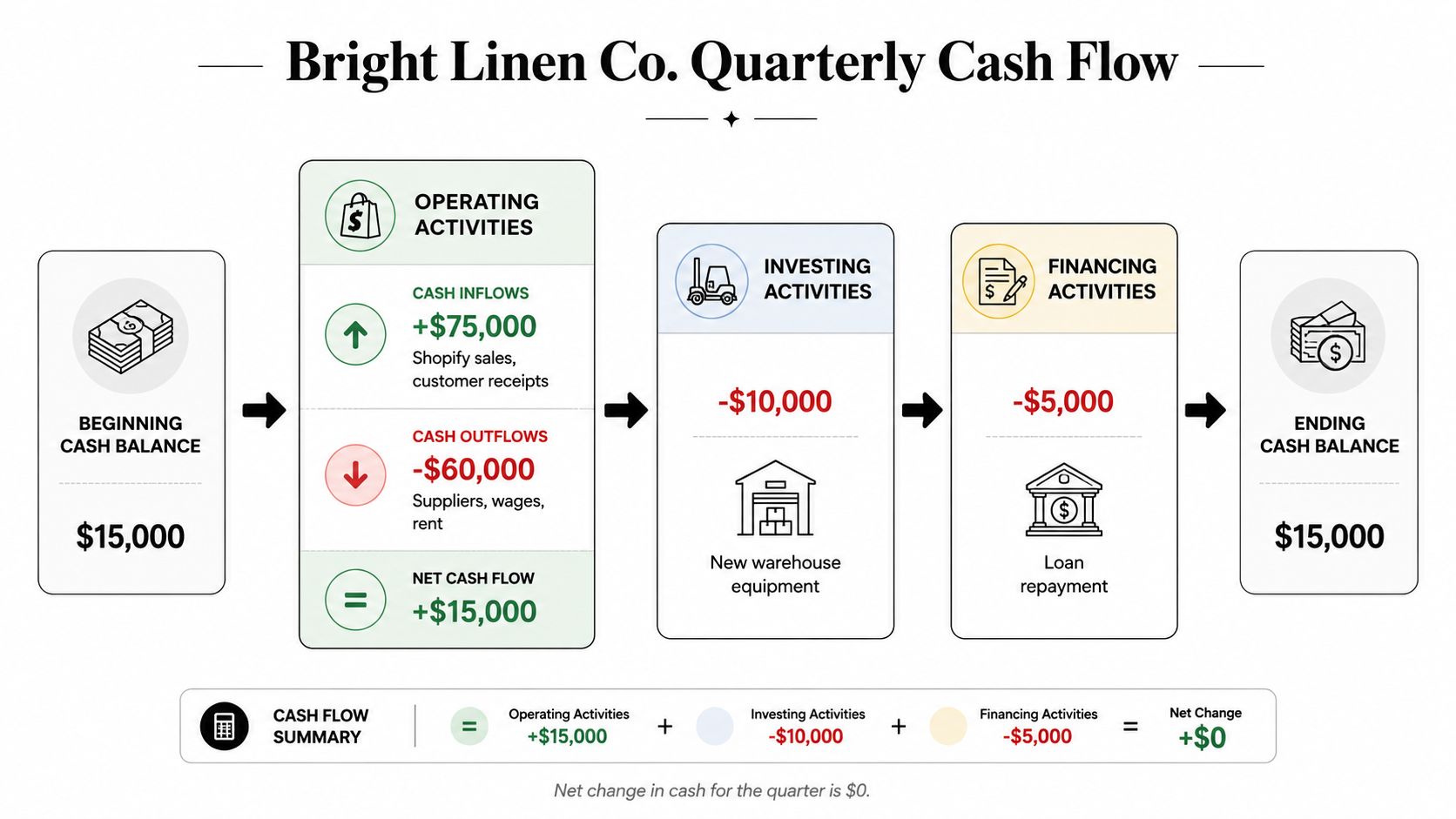
Bright Linen Co. is a fictional Australian ecommerce brand with a warehouse, four staff, and Shopify sales. Its quarterly numbers make sense on paper, yet the bank balance still needs careful reading. That's exactly where the cash flow statement earns its keep.
Operating cash
Bright Linen Co. starts with net profit, then adds back depreciation on packing equipment because it reduced profit without using cash in the quarter. It then adjusts for rising accounts receivable as wholesale orders grow, because more invoices are waiting to be paid. GST collected from customers and GST paid to the ATO also affect the timing of cash, which is why tax handling matters so much in the operating section.
Investing cash
The business buys a forklift for $12,000. That sits in investing, because it's a longer-term asset purchase rather than an everyday trading cost. This is the kind of cash outflow that can make a fast-growing business look weaker in the short term, even when the decision makes sense operationally.
Financing cash
Bright Linen Co. repays $20,000 on a chattel mortgage and adds $5,000 from the owner. Both items belong in financing, because they relate to how the business is funded rather than how it trades. The repayment reduces cash, while the owner contribution replenishes it.
Here's the key point. A profitable quarter can still show weak or negative operating cash if customers are paying slowly, stock is building, or tax timing is awkward. When the ending bank balance disappoints, founders should look first at receivables, inventory, and tax liabilities before blaming sales performance.
This example is illustrative, not advice. The shape matters more than the exact line items, because it shows how the indirect method turns profit into actual liquidity movement.
Red Flags Australian Founders Should Watch
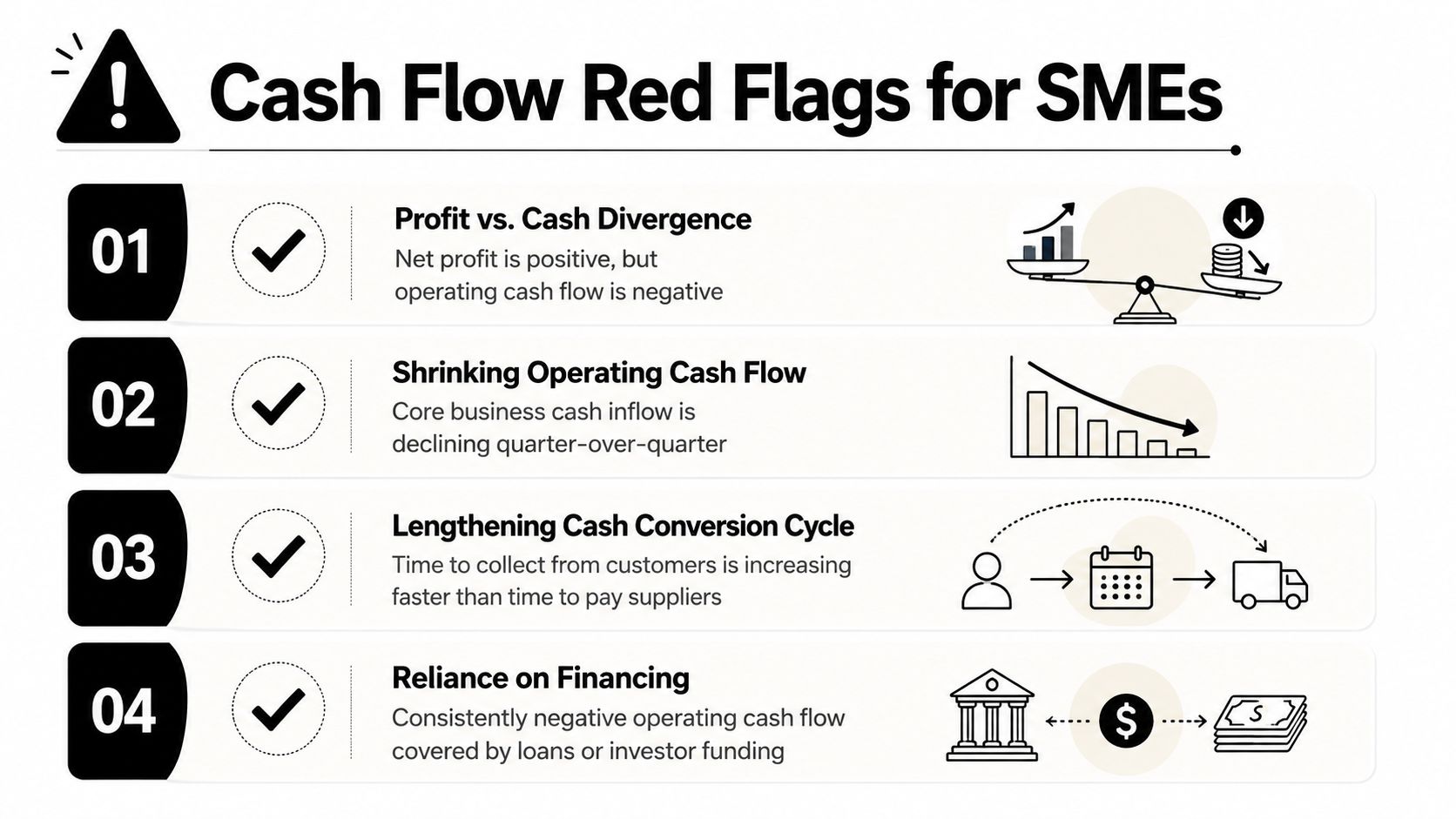
A café may report a profitable month while its bank account cannot cover the next BAS payment. That gap is the warning a cash flow statement helps expose. For Australian SMEs, it works as a timing-risk control, showing whether trading cash, customer payments, stock, tax obligations, or funding are putting pressure on liquidity.
Watch the lines, not just the result
A shrinking operating cash flow deserves attention even when profit remains positive. Customers may be paying later, inventory may be absorbing cash, or supplier payments may be postponed. The P&L can still look healthy while the business has less money available for wages, GST, or ordinary bills.
The local cash conversion cycle shows how timing can stretch. It rose from 58 days in FY21 to 71 days in FY24, then eased to 62 days in FY25 in KPMG's Australian Working Capital Trends analysis. For a founder, that movement represents more time between paying for inputs and collecting customer cash.
Accounts receivable is another early warning. The typical small business waited 24.1 days to be paid after invoicing in the March quarter 2026, while invoices were settled 6.9 days late. Nearly 80% of SMBs reported a cash-flow impact in the prior 12 months in the Australian small business cash-flow late payments report. If receivables grow faster than revenue, sales are increasing without converting promptly into bank cash.
The tax and funding traps
GST and PAYG can create a mismatch between reported profit and available cash. A business might invoice strongly, record a profit, and still face a BAS payment before customers have paid. The ATO has also started shifting around 3,500 small businesses with a history of non-payment, late lodgment, or incorrect reporting to monthly GST reporting. It warns that moving super payments to align with wages may affect cash flow in its small business cash flow guidance.
Owner loans and repeated overdraft drawdowns deserve the same scrutiny. They may cover a short timing gap, but recurring use suggests financing is supporting day-to-day trading. Read the statement by category: operating cash shows whether the business funds its work, while financing cash shows whether external money is filling the shortfall. That distinction helps a founder address the cause rather than repeatedly patch the balance.
Practical Levers to Improve Your Cash Position
A sale only helps once the money reaches the bank. For an Australian SME, practical cash improvements usually come from routine operating choices, then become visible in the cash flow statement under operating, investing, or financing activities. The cash conversion cycle guide provides a useful working-capital view of the time between paying suppliers and collecting customers.
Lever | Specific Action | Cash Flow Line Affected | Typical SME Impact |
|---|---|---|---|
Receivables | Tighten terms, request deposits, automate reminders, use debtor finance when needed | Operating | Cash arrives sooner and overdue balances shrink |
Payables | Negotiate supplier timing, stagger payments, align BAS planning with GST timing | Operating | Cash stays in the business longer without changing profit |
Inventory | Order more tightly, clear dead stock, review sell-through weekly | Operating and investing | Less cash trapped in stock |
Pricing | Reprice low-margin work, add surcharges for long terms, reset value-based fees | Operating | More cash generated from the same effort |
The levers that move first
Receivables often offer the quickest improvement. A deposit, firmer invoice terms, and timely reminders shorten the gap between delivering work and receiving cash. Debtor finance can cover a timing gap for some businesses, provided customers remain reliable and the financing cost fits the margin.
Product businesses should examine inventory next. Slow-moving stock and over-ordering tie up money that could pay wages, suppliers, GST, or PAYG obligations. A weekly sell-through review helps identify which products deserve further cash and which should be cleared.
Payables need judgement. Extending terms without agreement can strain a supplier relationship or interrupt deliveries. Agreed payment dates, matched to expected customer receipts, can give the business breathing room while leaving reported profit unchanged.
Keep forecasting simple and live
A rolling 13-week cash forecast updated weekly gives a founder a practical view of upcoming supplier peaks, BAS dates, super payments, and quieter sales weeks. Set a bank-balance threshold that triggers action, and keep tax and super amounts in a separate buffer so those commitments are not mistaken for spendable cash.
The forecast should connect to the statement, not sit apart from it. Compare expected receipts with actual collections, record when supplier payments leave the bank, and investigate each material timing difference. That routine turns late customer payments or an expanding stock balance into an early warning, rather than a surprise at month-end.
Use platform data carefully when sales and settlements sit in different systems. The aim is not a larger dashboard. It is a current view of cash, so an Australian founder can adjust purchasing, collection activity, or payment timing before a shortfall becomes a funding problem.
Turning the Statement Into a Decision Tool
A cash flow statement earns its place when it becomes a monthly decision routine, not a report opened after the financial year ends. An Australian founder can review clean figures, ask focused questions, and act on timing risk while there is still time to adjust.
Four questions to ask every month
Is operating cash flow positive?
If trading uses more cash than it generates, identify the cause. Customer payments may be late, stock may be absorbing funds, or GST and PAYG payments may have landed in the same period.Is the gap between profit and operating cash flow widening?
A growing gap often points to receivables, inventory, or tax timing. Profit can look healthy while the local cash conversion cycle keeps money outside the bank account.Which customers or suppliers are stretching the cycle?
One slow-paying customer or a supplier payment peak can change the month's position. Review the underlying invoices and payment dates, rather than treating the total as an abstract figure.Do we have runway, and for how long?
Review the next 30, 60, and 90 days. Liquidity pressure often builds through several ordinary commitments, including wages, supplier invoices, BAS obligations, and quieter sales periods.
Map each answer back to the operating, investing, or financing categories in AASB 107. The categories connect the report to specific decisions, such as following up overdue receipts, delaying a purchase, or arranging funding before the bank balance becomes restrictive.
A cash flow forecast template can provide a simple structure for comparing expected receipts and payments with actual bank movements. For ecommerce businesses, Amazon SP API financials illustrates how trading information may be brought into financial review. The control comes from checking settlement timing, GST and PAYG dates, and supplier commitments together.
Practices such as Nexist's cash-flow diagnostics show founders how to surface gaps between reported profit and available cash before they become crises. The useful outcome is a clear priority: collect earlier, purchase differently, preserve a tax buffer, or arrange funding.
Review the statement alongside the live forecast each month. That comparison turns a retrospective accounting report into a timing-risk control tool for weekly decisions.
cash flow statement, cash flow, AASB 107, SME finance, virtual CFO
" width="24px"/><g d="M 0 24.129 L 0 0.129 L 24 0.129 L 24 24.129 Z M 0 24.129 L 0 0.129 L 24 0.129 L 24 24.129 Z M 24 3 C 24 1.344 22.656 0 21 0 L 3 0 C 1.344 0 0 1.344 0 3 L 0 21 C 0 22.656 1.344 24 3 24 L 21 24 C 22.656 24 24 22.656 24 21 Z M 6.883 8.375 L 2.863 8.375 L 2.863 20.467 L 6.883 20.467 Z M 4.899 2.545 C 3.524 2.545 2.625 3.449 2.625 4.634 C 2.625 5.795 3.496 6.724 4.846 6.724 L 4.872 6.724 C 6.273 6.724 7.146 5.795 7.146 4.634 C 7.12 3.449 6.274 2.545 4.899 2.545 Z M 16.747 8.09 C 14.614 8.09 13.659 9.263 13.124 10.086 L 13.124 8.374 L 9.105 8.374 C 9.159 9.508 9.105 20.466 9.105 20.466 L 13.124 20.466 L 13.124 13.713 C 13.124 13.352 13.15 12.99 13.257 12.732 C 13.547 12.01 14.209 11.262 15.319 11.262 C 16.773 11.262 17.355 12.372 17.355 13.996 L 17.355 20.466 L 21.374 20.466 L 21.374 13.532 C 21.374 9.818 19.391 8.09 16.747 8.09 Z" fill="transparent" height="24.12890599668026px" id="dSFdkJotL" width="24px"><path d="M 0 24 L 0 0 L 24 0 L 24 24 Z" fill="transparent" height="24px" id="wscNJE44G" transform="translate(0 0.129)" width="24px"/><g d="M 0 24.129 L 0 0.129 L 24 0.129 L 24 24.129 Z M 24 3 C 24 1.344 22.656 0 21 0 L 3 0 C 1.344 0 0 1.344 0 3 L 0 21 C 0 22.656 1.344 24 3 24 L 21 24 C 22.656 24 24 22.656 24 21 Z M 6.883 8.375 L 2.863 8.375 L 2.863 20.467 L 6.883 20.467 Z M 4.899 2.545 C 3.524 2.545 2.625 3.449 2.625 4.634 C 2.625 5.795 3.496 6.724 4.846 6.724 L 4.872 6.724 C 6.273 6.724 7.146 5.795 7.146 4.634 C 7.12 3.449 6.274 2.545 4.899 2.545 Z M 16.747 8.09 C 14.614 8.09 13.659 9.263 13.124 10.086 L 13.124 8.374 L 9.105 8.374 C 9.159 9.508 9.105 20.466 9.105 20.466 L 13.124 20.466 L 13.124 13.713 C 13.124 13.352 13.15 12.99 13.257 12.732 C 13.547 12.01 14.209 11.262 15.319 11.262 C 16.773 11.262 17.355 12.372 17.355 13.996 L 17.355 20.466 L 21.374 20.466 L 21.374 13.532 C 21.374 9.818 19.391 8.09 16.747 8.09 Z" fill="transparent" height="24.12890599668026px" id="sTpjGo1tb" width="24px"><path d="M 0 24 L 0 0 L 24 0 L 24 24 Z" fill="transparent" height="24px" id="s7ffpmKOD" transform="translate(0 0.129)" width="24px"/><g d="M 24 3 C 24 1.344 22.656 0 21 0 L 3 0 C 1.344 0 0 1.344 0 3 L 0 21 C 0 22.656 1.344 24 3 24 L 21 24 C 22.656 24 24 22.656 24 21 Z M 6.883 8.375 L 2.863 8.375 L 2.863 20.467 L 6.883 20.467 Z M 4.899 2.545 C 3.524 2.545 2.625 3.449 2.625 4.634 C 2.625 5.795 3.496 6.724 4.846 6.724 L 4.872 6.724 C 6.273 6.724 7.146 5.795 7.146 4.634 C 7.12 3.449 6.274 2.545 4.899 2.545 Z M 16.747 8.09 C 14.614 8.09 13.659 9.263 13.124 10.086 L 13.124 8.374 L 9.105 8.374 C 9.159 9.508 9.105 20.466 9.105 20.466 L 13.124 20.466 L 13.124 13.713 C 13.124 13.352 13.15 12.99 13.257 12.732 C 13.547 12.01 14.209 11.262 15.319 11.262 C 16.773 11.262 17.355 12.372 17.355 13.996 L 17.355 20.466 L 21.374 20.466 L 21.374 13.532 C 21.374 9.818 19.391 8.09 16.747 8.09 Z" fill="transparent" height="24.000006px" id="D0ecaHEcW" transform="translate(0 0)" width="24px"><path d="M 24 3 C 24 1.344 22.656 0 21 0 L 3 0 C 1.344 0 0 1.344 0 3 L 0 21 C 0 22.656 1.344 24 3 24 L 21 24 C 22.656 24 24 22.656 24 21 Z" fill="rgb(55, 184, 218)" height="24.000006px" id="IPLFE6zXx" width="24px"/><path d="M 4.02 0 L 0 0 L 0 12.092 L 4.02 12.092 Z" fill="rgb(255, 255, 255)" height="12.09201px" id="FWhtzAyuY" transform="translate(2.863 8.375)" width="4.02px"/><path d="M 2.274 0 C 0.899 0 0 0.904 0 2.089 C 0 3.25 0.871 4.179 2.221 4.179 L 2.247 4.179 C 3.648 4.179 4.521 3.25 4.521 2.089 C 4.495 0.904 3.649 0 2.274 0 Z" fill="rgb(255, 255, 255)" height="4.17876px" id="VmOsKv4kO" transform="translate(2.625 2.545)" width="4.52095px"/><path d="M 7.641 0 C 5.509 0 4.554 1.173 4.019 1.996 L 4.019 0.284 L 0 0.284 C 0.053 1.419 0 12.376 0 12.376 L 4.019 12.376 L 4.019 5.623 C 4.019 5.262 4.045 4.9 4.151 4.642 C 4.442 3.92 5.103 3.172 6.214 3.172 C 7.667 3.172 8.25 4.282 8.25 5.907 L 8.25 12.376 L 12.269 12.376 L 12.269 5.442 C 12.269 1.728 10.286 0 7.641 0 Z" fill="rgb(255, 255, 255)" height="12.37626px" id="n1XUbhaq0" transform="translate(9.105 8.09)" width="12.268830000000001px"/></g></g></g></g></svg>)