What Is Working Capital: An Australian SME Guide
What is working capital - Learn what working capital is and how it impacts your Australian SME's cash flow, growth, and financial health in 2026
Ansh Malhotra

Working capital is the cash tied up in day-to-day operations, calculated as Inventory + Receivables minus Payables. In Australia, the median cash conversion cycle reached 62 days in FY25, which shows how long cash can remain trapped before the business gets it back.
You can be sitting on strong margins, a healthy order book and a profitable month, yet still checking the bank balance before approving payroll. An ecommerce founder may have cash sitting in unsold stock. A wholesale operator may have delivered orders that customers haven't paid for. At the same time, suppliers still expect payment on their agreed dates.
That is the practical meaning of working capital. It isn't just a balance-sheet figure. It determines whether your business can fund stock, wages, tax, freight and growth without constantly leaning on an overdraft.
Table of Contents
The Real Meaning of Working Capital for Founders
Profit on paper, pressure in the bank
Suppose your Australian wholesale business has sold more product than ever. The gross margin looks respectable, but a large product order arrived before the sales landed and several customers are overdue. On Monday morning, the accounting software says you're profitable. The bank account says you need to delay a purchase or call the lender.
That gap is working capital pressure. Working capital is the cash absorbed by normal trading activity, particularly inventory, customer invoices and supplier bills. The more cash your operations consume before customers pay, the more funding your business needs just to keep moving.
The textbook definition, current assets minus current liabilities, is useful but incomplete. It can tell you whether the balance sheet has more short-term assets than short-term obligations. It can't tell you whether those assets are usable today. A warehouse full of slow-moving stock and a ledger full of overdue invoices may inflate current assets while doing very little to pay this week's bills.
The Australian benchmark founders should watch
KPMG's analysis of more than 500 Australian public companies found that the median cash conversion cycle moved from 58 days in FY21 to 71 days in FY24, before improving to 62 days in FY25 (KPMG's Australian working capital analysis). That isn't a target every SME should copy, but it gives founders a useful domestic reference point.
A 62-day cycle means a typical business is funding operations for roughly two months between paying for inputs and collecting customer cash. Inventory-heavy SMEs can sit under greater pressure. KPMG's FY25 data placed small companies under AU$100 million in revenue at a median cycle of 80 days, after reaching 103 days in FY23 (KPMG's Australian working capital trends report).
Practical rule: Don't ask only whether the business is profitable. Ask how many days your cash is funding every sale.
A virtual CFO earns their fee by finding the delay behind that number. Faster invoicing, better purchasing, cleaner stock decisions and properly negotiated supplier timing can release cash without requiring more sales. Revenue growth matters, but growth that lengthens the cycle can make a successful business harder to fund.
The Working Capital Formula Broken Down
The standard calculation is simple:
Working capital = Current assets − Current liabilities
Current assets include cash, receivables and inventory. Current liabilities include supplier payables and other short-term obligations. For day-to-day management, founders usually need a more operational view:
Working capital tied up in trading = Inventory + Accounts Receivable − Accounts Payable
Business Victoria describes the working capital cycle as the period between paying for stock or work-in-progress and recovering cash from customers, which makes it a liquidity measure rather than a passive balance-sheet residual (Business Victoria's working capital cycle guide).
What each line means in practice
Take a Melbourne coffee roaster supplying cafes.
Inventory: Green beans, packaging and finished coffee sitting in the warehouse. That stock has been paid for, or will need to be paid for, before it becomes a customer payment.
Accounts receivable: Wholesale invoices issued to cafes that have received the product but haven't paid yet.
Accounts payable: Unpaid supplier invoices for beans, cartons, freight or other inputs.
An ecommerce business faces the same mechanics. Its inventory might be phones, clothing or homewares. Its receivables may come from trade customers or payment processors. Its payables may include manufacturers, freight providers and packaging suppliers.
If stock on hand is poorly recorded, a suitable inventory tool for a small business can help the owner understand what has been purchased, sold and left sitting on the shelf. The software won't fix a buying decision by itself, but it can give the finance team a more reliable view of cash tied up in stock.
Net working capital versus the ratio
Net working capital is the dollar amount left after current liabilities are deducted from current assets. The working capital ratio, also called the current ratio, is calculated as current assets divided by current liabilities.
A ratio above 1.0 can look comfortable, but it may hide stale inventory. If most current assets are products that won't sell soon, the business still can't use them to pay wages or suppliers without discounting or waiting.
Consider a simple transaction. You place a $5 stock order, record a $5 customer receivable and owe a supplier $5. Until the customer pays, the business has funded the movement of goods without receiving cash. The sale may contribute to reported profit, but the cash remains tied up in the operating cycle.
The Cash Conversion Cycle and the Three Days Metrics
The cash conversion cycle, or CCC, turns working capital into a practical operating scoreboard. It measures the time between paying suppliers for inventory or inputs and collecting cash from customers.
The formula is:
CCC = Days Inventory Outstanding + Days Sales Outstanding − Days Payable Outstanding
A founder doesn't need to treat these metrics as an accounting exercise. Each one points to a manager or process that can change cash timing.
Days Sales Outstanding, or DSO: The average time customers take to pay after invoicing. A higher DSO means receivables remain unpaid for longer.
Days Inventory Outstanding, or DIO: The average time stock remains on hand before sale. A higher DIO means more cash sits in products, materials or work-in-progress.
Days Payable Outstanding, or DPO: The average time the business takes to pay suppliers. A higher DPO generally provides more supplier-funded time, provided the business respects its contracts and relationships.
KPMG's FY25 Australian medians were 46 days for DSO, 68 days for DIO and 52 days for DPO (KPMG's Australian working capital trends). Those figures produce the 62-day median cash conversion cycle. Your business doesn't need to match each median, but it should know why it sits above or below them.
Cash Conversion Cycle Metrics at a Glance
Metric | Formula | What It Measures | FY25 Australia Median |
|---|---|---|---|
Days Sales Outstanding | Average receivables ÷ credit sales × days | Time customers take to pay | 46 days |
Days Inventory Outstanding | Average inventory ÷ cost of sales × days | Time stock remains unsold | 68 days |
Days Payable Outstanding | Average payables ÷ purchases or cost of sales × days | Time taken to pay suppliers | 52 days |
Cash Conversion Cycle | DIO + DSO − DPO | Operating funding gap | 62 days |
For a deeper explanation of the calculation and its practical uses, see this guide to the cash conversion cycle. The important management point is straightforward: rising DSO or DIO extends the cycle, while a commercially sustainable increase in DPO shortens it.
Track the CCC weekly or monthly, but don't stop at the headline. A stable overall result can still conceal deteriorating receivables offset by a temporary supplier extension. The three components tell you where the cash leak sits.
Why Australian SMEs Feel the Cash Pinch
A Melbourne wholesale distributor can look successful while its cash position deteriorates. Orders are rising, margins remain acceptable and the owner is preparing for a product refresh. Customers, however, start paying later, while the business buys additional stock before the new range launches.
Suppose DSO moves from 38 to 71 days over eighteen months and inventory rises at the same time. That founder doesn't experience the problem as a financial ratio. They experience it as an overdraft that never seems to reduce, even after a strong sales month.
The cash impact can be material. McGrathNicol's 2025 Working Capital Report covered 278 ASX-listed companies with a combined market capitalisation of $2.09 trillion. It found that 53% improved cash flow by shortening their working capital cycle, releasing $8.2 billion of previously locked-up cash (McGrathNicol's 2025 Working Capital Report).
The same report found that a 0.4-day increase in average Days Working Capital locked up an additional $754 million across the companies reviewed (McGrathNicol's 2025 Working Capital Report). That doesn't mean an SME can apply the listed-company figure directly. It does show that small timing movements can carry a large cash consequence.
Why Australia makes the problem harder
Australian operators often need to manage structural pressures that don't appear in a basic profit forecast:
Long-haul supplier lead times: Longer freight routes encourage larger orders and safety stock, increasing DIO.
Supplier payment expectations: Small suppliers may require payment within agreed short terms, limiting the benefit of DPO.
GST timing: Quarterly remittance can create a predictable cash demand that founders overlook when reading monthly profit.
Seasonal retail peaks: Buying ahead of a busy period can drain cash well before the resulting sales are collected.
The result is a business that can be both commercially sound and financially stretched. The right response isn't automatically more borrowing. First identify whether customers, stock or payment timing is consuming the overdraft.
Founders dealing with this pattern can also use this practical guide to small business cash flow problems. The fix starts with tracing the cash movement, not blaming sales or assuming the bank balance will catch up.
How Working Capital Looks Across Different Industries
Working capital depends heavily on the operating model. A retailer buys stock before sale. A professional services firm may deliver work before invoicing. A tradie can often invoice progressively, while a manufacturer funds raw materials and work-in-progress across a longer production process.
That means industry comparisons can help, but they shouldn't become excuses. Use them to ask where your cash is trapped, then compare your own trend against your previous periods and commercial reality.
Working Capital Benchmarks by Australian Industry FY25 medians
The supplied Australian benchmark data does not provide verified FY25 industry-specific DSO, DIO, DPO or CCC ranges. Those figures shouldn't be presented as facts. Instead, use the operating patterns below as a diagnostic guide.
Industry | DSO | DIO | DPO | Cash Conversion Cycle |
|---|---|---|---|---|
Retail and ecommerce | Customer payment timing is the focus | Stock is usually the main pressure point | Supplier terms influence buying capacity | Driven mainly by stock velocity and payment timing |
Wholesale and distribution | Trade account collection can be material | Product breadth can create slow-moving stock | Terms vary by supplier power and volume | Often pressured by both receivables and inventory |
Hospitality and trade services | Deposits and progress billing can reduce exposure | Consumables and job materials still need control | Supplier timing can support short jobs | Usually shaped more by billing discipline than stock |
Professional services | Retainers and milestone invoices determine timing | Usually limited physical inventory | Contractor and software terms matter | Can widen when billing follows delivery too slowly |
Manufacturing | Customer terms can extend the funding gap | Raw materials and work-in-progress absorb cash | Supplier terms partly offset production funding | Influenced by production length, stock and collections |
Inventory-heavy businesses generally need more cash per dollar of revenue than service businesses because they fund products before sale. Professional firms can also create avoidable pressure when they underprice retainers or wait until a project is finished before billing. A mid-margin tradie with deposits and progress claims may collect sooner than a high-margin consultancy that invoices late.
The useful benchmark isn't the industry label. It's the answer to one question: which operating decision keeps your cash unavailable for the longest?
Start with DIO for stock-led businesses, DSO for invoice-led businesses and DPO where supplier terms are negotiated. If all three are drifting in the wrong direction, the business needs a coordinated working capital plan rather than a single collection campaign.
How a Virtual CFO Actually Improves Working Capital
A bookkeeper records transactions and keeps the ledger organised. A virtual CFO uses that information to change decisions, owners and deadlines. The distinction matters because a clean set of accounts won't automatically stop a buyer ordering excess stock or a salesperson accepting weak payment terms.
A practical working capital review should assign each lever to someone and measure the result.
Invoicing speed
Send invoices when the work or shipment is complete, not when someone remembers at the end of the week. For new or larger orders, consider deposits and staged billing where the commercial arrangement supports them.
This week's actions:
Invoice immediately: Remove the gap between delivery and invoice issue.
Set clear terms: Use payment terms that match your funding capacity and customer expectations.
Automate reminders: Create reminders before and after the due date, with a named person responsible for escalation.
Protect the relationship: A defined credit process is kinder than allowing overdue accounts to become an awkward personal negotiation.
Inventory turns
Don't treat every SKU as equally important. Classify stock by value, demand and margin, then focus management attention on the items capable of consuming the most cash.
Review slow-moving and obsolete stock regularly. Consolidate purchases where supplier economics justify it, but don't accept a volume discount that leaves you holding products customers won't buy. Rebuild reorder points from actual demand rather than sales optimism.
Supplier terms
Ask suppliers for terms that reflect your order volume, delivery pattern and relationship. A longer term can improve DPO, but it must be negotiated rather than imposed.
Early payment discounts deserve a proper comparison with the cost of using cash elsewhere. Paying early is sensible when the benefit outweighs the financing cost and doesn't create a payroll or tax squeeze. Paying every supplier immediately, just because the invoice has arrived, is not a cash strategy.
Cash forecasting
Use a rolling 13-week cash flow model, updated at least weekly. Separate expected receipts, stock purchases, supplier payments, wages, tax and debt service so the owner can see which operating decision creates the next shortfall.
A useful forecast shows the bank balance before the bank balance becomes a crisis. It also gives the founder time to negotiate terms, delay a purchase, chase a debtor or arrange funding on sensible conditions.
Tools and support such as virtual CFO services can help connect forecasting, KPI reporting and working capital actions. The value comes from implementation, not from adding another spreadsheet to the finance folder.
The Profit Versus Cash Trap Founders Fall Into
Revenue growth can worsen cash flow. That statement sounds wrong until you follow the timing.
A customer order can increase reported sales before the customer pays. An inventory purchase can use cash before the product is sold. Freight, warehousing and production costs may arrive before the related invoice becomes collectible. The P&L records economic activity according to accounting rules, while the bank account records when money moves.
Two scenarios that expose the gap
Scenario | P&L Profit | Cash Position | Why They Diverge |
|---|---|---|---|
Fast-growing inventory business | Profit can rise as sales are recognised | Cash can tighten as stock purchases and receivables grow | The business funds stock and customer terms before collection |
Service business with upfront billing | Profit may be modest during a delivery period | Cash can look strong after deposits or advance payments | Customers fund part of the work before costs are incurred |
The first business is profitable but broke. It may have healthy margins, yet every new order requires additional stock and more customer funding. If the CCC widens, growth consumes cash faster than the owner can generate it.
The second business can appear cash-rich while profit remains under pressure. Deposits improve liquidity, but they don't prove the underlying service is priced correctly or that future delivery costs are covered.
Sales growth answers whether customers are buying. Working capital management answers whether you can afford to fulfil those sales.
Inventory-heavy founders often misread the stock balance as proof of strength. Stock is only useful working capital when it can be sold at an acceptable price and within a commercially sensible timeframe. Otherwise, it is a funding commitment with storage, handling and markdown risk attached.
Treat CCC as an early-warning signal separate from revenue and EBITDA. If DIO or DSO rises while sales look healthy, investigate immediately. The cash leak is structural, so a marketing push usually won't repair it.
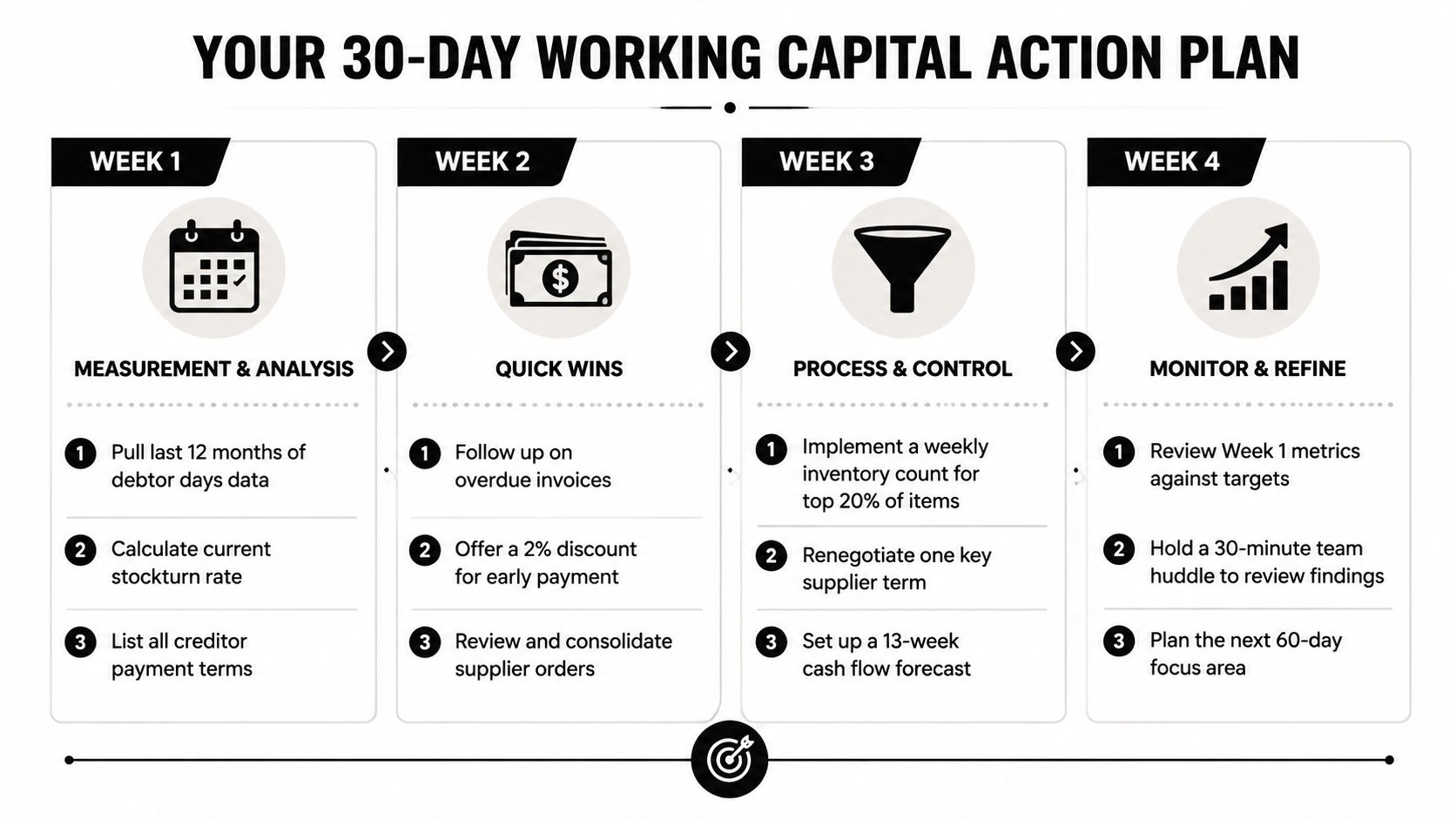
Your 30-Day Working Capital Action Plan
You don't need a large transformation project to start. You need four weeks of disciplined measurement and ownership.
Week one, measure the operating reality
Pull the past year's debtor days, stock movement and creditor terms from your accounting and inventory systems. Calculate your current DSO, DIO, DPO and CCC, then compare the result with the 62-day FY25 Australian median cited earlier.
Don't rely on a single month. Look for movement, unusual customer balances, stock that hasn't moved and suppliers you're paying earlier than agreed.
Week two, collect cash already earned
Issue outstanding invoices, contact overdue customers and confirm every disputed balance. Add deposits or staged billing to suitable new orders, then create an escalation path for accounts that remain unpaid.
The aim isn't to pressure every customer indiscriminately. It is to stop the business giving unsecured funding to customers without making a deliberate commercial decision.
Week three, attack trapped stock
List slow-moving SKUs and identify products that should be discounted, bundled, returned, placed on consignment or removed from future purchasing. Review reorder points against actual demand and separate essential stock from optimistic buying.
Use the week to challenge one purchasing habit. For example, require approval for a large order that isn't supported by sales history or a confirmed customer commitment.
Week four, control the forward cash position
Review supplier terms, negotiate with the relationships that justify it and stop paying earlier than required without a clear benefit. Build a weekly rolling cash forecast that shows working capital movements separately from fixed operating costs.
Bring in a virtual CFO when the cycle stays above your comfort level, the overdraft remains under stress, growth is accelerating or you're preparing to raise capital. DIY works for one isolated issue. It becomes unreliable when receivables, stock, supplier terms and forecasting need to move together.
Nexist helps Australian founders review DIO, DSO, DPO and the cash conversion cycle, then connect those numbers to forecasting, reporting and practical cash-control actions. Visit Nexist to arrange a working capital review and identify where your next cash release is most likely to come from.
working capital, cash flow, cash conversion cycle, virtual CFO, Australian SMEs

" width="24px"/><g d="M 0 24.129 L 0 0.129 L 24 0.129 L 24 24.129 Z M 0 24.129 L 0 0.129 L 24 0.129 L 24 24.129 Z M 24 3 C 24 1.344 22.656 0 21 0 L 3 0 C 1.344 0 0 1.344 0 3 L 0 21 C 0 22.656 1.344 24 3 24 L 21 24 C 22.656 24 24 22.656 24 21 Z M 6.883 8.375 L 2.863 8.375 L 2.863 20.467 L 6.883 20.467 Z M 4.899 2.545 C 3.524 2.545 2.625 3.449 2.625 4.634 C 2.625 5.795 3.496 6.724 4.846 6.724 L 4.872 6.724 C 6.273 6.724 7.146 5.795 7.146 4.634 C 7.12 3.449 6.274 2.545 4.899 2.545 Z M 16.747 8.09 C 14.614 8.09 13.659 9.263 13.124 10.086 L 13.124 8.374 L 9.105 8.374 C 9.159 9.508 9.105 20.466 9.105 20.466 L 13.124 20.466 L 13.124 13.713 C 13.124 13.352 13.15 12.99 13.257 12.732 C 13.547 12.01 14.209 11.262 15.319 11.262 C 16.773 11.262 17.355 12.372 17.355 13.996 L 17.355 20.466 L 21.374 20.466 L 21.374 13.532 C 21.374 9.818 19.391 8.09 16.747 8.09 Z" fill="transparent" height="24.12890599668026px" id="dSFdkJotL" width="24px"><path d="M 0 24 L 0 0 L 24 0 L 24 24 Z" fill="transparent" height="24px" id="wscNJE44G" transform="translate(0 0.129)" width="24px"/><g d="M 0 24.129 L 0 0.129 L 24 0.129 L 24 24.129 Z M 24 3 C 24 1.344 22.656 0 21 0 L 3 0 C 1.344 0 0 1.344 0 3 L 0 21 C 0 22.656 1.344 24 3 24 L 21 24 C 22.656 24 24 22.656 24 21 Z M 6.883 8.375 L 2.863 8.375 L 2.863 20.467 L 6.883 20.467 Z M 4.899 2.545 C 3.524 2.545 2.625 3.449 2.625 4.634 C 2.625 5.795 3.496 6.724 4.846 6.724 L 4.872 6.724 C 6.273 6.724 7.146 5.795 7.146 4.634 C 7.12 3.449 6.274 2.545 4.899 2.545 Z M 16.747 8.09 C 14.614 8.09 13.659 9.263 13.124 10.086 L 13.124 8.374 L 9.105 8.374 C 9.159 9.508 9.105 20.466 9.105 20.466 L 13.124 20.466 L 13.124 13.713 C 13.124 13.352 13.15 12.99 13.257 12.732 C 13.547 12.01 14.209 11.262 15.319 11.262 C 16.773 11.262 17.355 12.372 17.355 13.996 L 17.355 20.466 L 21.374 20.466 L 21.374 13.532 C 21.374 9.818 19.391 8.09 16.747 8.09 Z" fill="transparent" height="24.12890599668026px" id="sTpjGo1tb" width="24px"><path d="M 0 24 L 0 0 L 24 0 L 24 24 Z" fill="transparent" height="24px" id="s7ffpmKOD" transform="translate(0 0.129)" width="24px"/><g d="M 24 3 C 24 1.344 22.656 0 21 0 L 3 0 C 1.344 0 0 1.344 0 3 L 0 21 C 0 22.656 1.344 24 3 24 L 21 24 C 22.656 24 24 22.656 24 21 Z M 6.883 8.375 L 2.863 8.375 L 2.863 20.467 L 6.883 20.467 Z M 4.899 2.545 C 3.524 2.545 2.625 3.449 2.625 4.634 C 2.625 5.795 3.496 6.724 4.846 6.724 L 4.872 6.724 C 6.273 6.724 7.146 5.795 7.146 4.634 C 7.12 3.449 6.274 2.545 4.899 2.545 Z M 16.747 8.09 C 14.614 8.09 13.659 9.263 13.124 10.086 L 13.124 8.374 L 9.105 8.374 C 9.159 9.508 9.105 20.466 9.105 20.466 L 13.124 20.466 L 13.124 13.713 C 13.124 13.352 13.15 12.99 13.257 12.732 C 13.547 12.01 14.209 11.262 15.319 11.262 C 16.773 11.262 17.355 12.372 17.355 13.996 L 17.355 20.466 L 21.374 20.466 L 21.374 13.532 C 21.374 9.818 19.391 8.09 16.747 8.09 Z" fill="transparent" height="24.000006px" id="D0ecaHEcW" transform="translate(0 0)" width="24px"><path d="M 24 3 C 24 1.344 22.656 0 21 0 L 3 0 C 1.344 0 0 1.344 0 3 L 0 21 C 0 22.656 1.344 24 3 24 L 21 24 C 22.656 24 24 22.656 24 21 Z" fill="rgb(55, 184, 218)" height="24.000006px" id="IPLFE6zXx" width="24px"/><path d="M 4.02 0 L 0 0 L 0 12.092 L 4.02 12.092 Z" fill="rgb(255, 255, 255)" height="12.09201px" id="FWhtzAyuY" transform="translate(2.863 8.375)" width="4.02px"/><path d="M 2.274 0 C 0.899 0 0 0.904 0 2.089 C 0 3.25 0.871 4.179 2.221 4.179 L 2.247 4.179 C 3.648 4.179 4.521 3.25 4.521 2.089 C 4.495 0.904 3.649 0 2.274 0 Z" fill="rgb(255, 255, 255)" height="4.17876px" id="VmOsKv4kO" transform="translate(2.625 2.545)" width="4.52095px"/><path d="M 7.641 0 C 5.509 0 4.554 1.173 4.019 1.996 L 4.019 0.284 L 0 0.284 C 0.053 1.419 0 12.376 0 12.376 L 4.019 12.376 L 4.019 5.623 C 4.019 5.262 4.045 4.9 4.151 4.642 C 4.442 3.92 5.103 3.172 6.214 3.172 C 7.667 3.172 8.25 4.282 8.25 5.907 L 8.25 12.376 L 12.269 12.376 L 12.269 5.442 C 12.269 1.728 10.286 0 7.641 0 Z" fill="rgb(255, 255, 255)" height="12.37626px" id="n1XUbhaq0" transform="translate(9.105 8.09)" width="12.268830000000001px"/></g></g></g></g></svg>)