
How to Improve Cash Flow for Australian SMEs in 2026
Learn how to improve cash flow with a practical Australian SME playbook covering quick wins, forecasting, AR/AP fixes and a 30/60/90-day action plan.
Ansh Malhotra

Australian SMBs absorb an average late-payment loss of nearly AU$29,000 a year. The fastest way to improve cash flow is to shorten the gap between delivering work and collecting cash, then control the stock and supplier commitments that keep working capital trapped.
That's the point most generic advice misses. Cash flow isn't an accounting trick, and it isn't solved by cancelling a few software subscriptions. It's a working-capital discipline that determines whether profitable sales become money in the bank or remain unpaid invoices, excess stock and awkward supplier conversations.
Australian payment data makes the problem difficult to dismiss. One 2025 survey found that 63% of Australian SMBs spend time chasing payments, losing an average of 1.5 hours per week, or about 78 hours a year, on collections. The same research reported average monthly losses of AU$1,328.15 from late payments, while separate Australian-focused research reported an average loss of AU$2,408 per month, nearly AU$29,000 annually. (Pursuing Payments 2025 report)
The practical answer is direct. Invoice immediately, set terms you can enforce, chase overdue accounts through a defined sequence, stop buying slow stock, and forecast cash every week. The sections below turn those principles into an operating plan for Australian SMEs.
Table of Contents
Why Cash Flow Breaks for Australian SMEs
Australian SMEs can lose nearly AU$29,000 annually to late payments, based on average losses of AU$2,408 per month. That figure captures the cash shortfall, not the founder time spent chasing it. (Airwallex and Censuswide research)
The first leak is usually the gap between completing work and receiving payment. Xero small-business data cited in 2022 found that 48% of invoices issued by Australian small businesses in 2021 were paid late, 10% arrived more than a month after the due date, and payment averaged 6.4 days late. The annual cost to the sector was about A$1.1 billion. (Australian late-payment statistics)
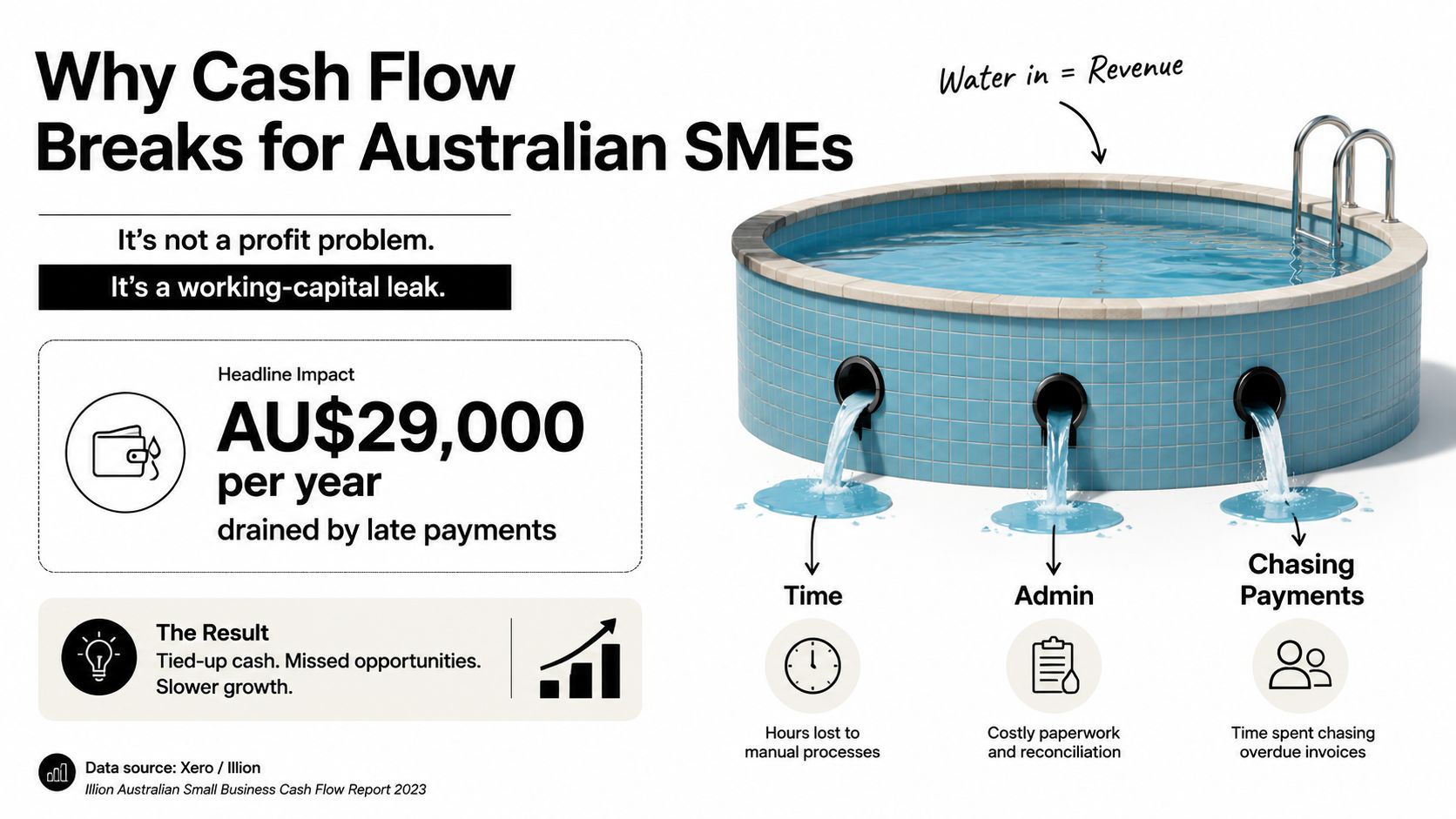
The three mechanical leaks
Receivables drift. The work is complete, but the invoice goes out late or sits in an approval queue. Profit appears in the accounts while the bank balance stays flat. In 2025, 41% of Australian SMBs receiving late payments waited more than 14 days past the due date on average, and 17% waited over a month. (Pursuing Payments 2025 report)
Inventory stalls. Retailers, wholesalers and ecommerce operators can show healthy sales while cash remains tied up in slow, seasonal or discounted stock. Australian small-business research identified declining revenue, low cash reserves and seasonal fluctuations as major causes of cash-flow pressure. UNSW also highlighted stock timing as an overlooked working-capital issue. (UNSW analysis of Australian small-business cash flow)
Supplier terms mismatch. Paying suppliers before customers pay turns growth into a cash drain. ASBFEO data cited in Australian payment-delay reporting found that only 13% of big businesses paid bills in fewer than 20 days, while 24% took more than 120 days to pay small-business suppliers.
Fix the timing gap before trimming minor expenses. A cancelled subscription saves a small recurring amount. Faster collections can release cash without reducing gross margin.
Founders often hear “raise prices” or “cut subscriptions” before anyone reviews debtor ageing, stock cover and payment terms. Those actions may help, but they are secondary. If staff spend each week chasing invoices, structured SMS campaigns from YipSMS Inc. can support reminders, provided the message, timing and customer relationship are managed properly.
Diagnose Your Cash Flow in One Afternoon
Don't choose a cash-flow tactic from instinct. Start with a short diagnostic that shows where cash is stuck. Pull the last twelve months of data from Xero, MYOB or QuickBooks, then work from invoices, stock records and the balance sheet rather than relying on the profit and loss report alone.
Calculate the three operating indicators
Debtor days show how long customers take to pay:
Debtor days = Trade receivables ÷ credit sales × days in the period
Use credit sales for the same period as your receivables balance. Split unpaid invoices into 0 to 30, 31 to 60, 61 to 90, and 90-plus days. The ageing buckets show whether the issue is a few large accounts, a broad policy failure or an old debt problem.
Stock cover in days shows how long current inventory would last at the existing rate of use:
Stock cover = Inventory ÷ cost of goods sold × days in the period
For a service business with no meaningful inventory, mark this as not applicable. For a retailer or wholesaler, calculate it by category as well as across the whole business. A blended figure can hide cash trapped in a single slow-moving product group.
Current ratio tests short-term balance-sheet pressure:
Current ratio = Current assets ÷ current liabilities
A business can be profitable and still struggle if receivables and stock aren't liquid enough to cover upcoming obligations.
Add the cash-flow view
Operating cash flow should isolate cash generated by normal trading:
Operating cash flow = Cash received from customers − cash paid for operating expenses and suppliers
Free cash flow then accounts for capital expenditure:
Free cash flow = Operating cash flow − capital expenditure
Use these figures to reconcile the bank movement. If the reported profit is positive but operating cash flow is weak, investigate receivables, stock purchases, tax, drawings and one-off payments.
Metric | Healthy SME Target | Red Flag Threshold | What It Signals |
|---|---|---|---|
Debtor days | Keep customer collection aligned with agreed terms | Above 45 days | Cash is trapped in receivables |
Stock cover | Match buying to demand and supplier lead times | Above 90 days | Working capital is sitting in stock |
Current ratio | Maintain enough current assets to cover near-term liabilities | Under 1.2 | Short-term payment pressure |
A worked example makes the diagnostic useful. Suppose a trade business generates AU$1.2 million in annual revenue, carries debtor days above the red-flag threshold, has stock cover above the warning level and records a current ratio below the target. That combination points to a timing problem, not automatically a pricing problem. The owner should age the debt, identify stock that hasn't moved and list liabilities due before expected customer receipts.
Finish the afternoon with one page containing the three measures, the aged-debt total, the slow-stock total and the next thirteen weeks of known commitments. That page becomes the baseline for every decision that follows.
Cut the Late-Payment Drag First
Receivables tightening is usually the cleanest first move because collecting an existing invoice releases cash without requiring another sale or a margin sacrifice. Australian Xero data found 48% of invoices were paid late, with late payments costing small businesses about A$1.1 billion per year across the sector. (Xero cash-flow research)
The process needs more than polite reminders. Set a collection standard that starts before the due date and escalates after it.
Build a collection system that people follow
Issue the invoice on the day of service. Don't batch invoices at month-end. The customer can't pay an invoice that hasn't been sent.
Use shorter terms where the relationship allows it. Move suitable customers to 14-day terms, and use staged billing for work that runs over several weeks.
Take deposits on larger jobs. For jobs over AU$2,000, request a deposit or progress payment where commercially and contractually appropriate. This prevents your business from financing the customer's project.
Offer a controlled early-payment incentive. A discount between 1.5% and 2% may be appropriate for selected accounts, but calculate the cost before applying it broadly. Don't give away margin to customers who already pay on time.
Run a weekly aged-debt call list. Every overdue account needs an owner, a next action and a date. “We emailed them” isn't a collection strategy.
Automate reminders. Xero and Stripe can support invoice reminders and payment options. Configure reminders around your actual terms, then personally intervene when an account reaches the escalation point.
Collection discipline beats collection heroics. A founder shouldn't need to make an uncomfortable call only after the bank balance becomes critical.
The time cost is material. The 2025 Pursuing Payments research found that Australian SMBs spending time chasing payments lost an average of 1.5 hours per week, or about 78 hours a year, on collections. (Pursuing Payments 2025 report) Put a value on that founder time and include it in the business case for automation or delegated accounts-receivable work. A structured accounts receivable management process should make the next action obvious for every debtor.
Don't jump to invoice factoring because collections feel uncomfortable. Factoring can provide speed, but it can also make an existing margin and customer-discipline problem more expensive. First fix invoice timing, terms, deposits, credit limits and escalation. Then assess external finance against a forecast, not panic.
Choose Your Next Working-Capital Lever
Choose the lever that matches the cash leak. A trade business with overdue invoices should not liquidate useful stock. A retailer carrying excess inventory will not solve its problem by sending more payment reminders to customers who already pay at checkout.
Use this matrix to rank the opportunity. Treat the impact as an estimate, not a promise. The cash released depends on revenue mix, debtor balances, stock value, gross margin and supplier contracts.
Lever | Best Fit | Potential AU$ Release per $100k Revenue | Time to Implement | Risk Level |
|---|---|---|---|---|
Receivables tightening | Trade services and professional services | Depends on debtor balance and days reduced | Immediate to several weeks | Low to medium |
Payables extension | Businesses with reliable suppliers and mismatched payment timing | Depends on supplier spend and terms changed | Several weeks | Medium |
Inventory reduction | Retail, wholesale, ecommerce and manufacturing | Depends on slow-stock value and recovery price | Several weeks to several months | Medium to high |
Price and margin correction | Businesses with weak margins or unprofitable work | Depends on pricing gap and customer response | Several weeks to several months | Medium |
Match the lever to the evidence
Debtor days above 45: Put receivables first. Review customer terms, deposits, credit limits and the aged-debt list. This is especially effective for trade and professional services businesses that have delivered the work but are still waiting for payment. Even a modest reduction in collection time can release cash without adding sales.
Stock cover above 90 days: Stop assuming inventory creates value because it appears on the balance sheet. Freeze reorders for slow categories, set reorder points, bundle stock where sensible and align purchases with demonstrated demand. The ATO's 2023–24 small-business benchmarks across 100 industries offer a comparison point for turnover, wages, rent and other ratios. (ATO benchmark guidance) Use them to investigate unusual results, not to manage the business by averages.
Gross margin below 35%: Review pricing, supplier costs, discounts and service scope before pursuing more volume. Start with the lowest-margin SKUs, services or client types. A targeted price correction can improve cash generation faster than acquiring customers who produce little contribution.
Supplier terms too short: Negotiate with payment history, order consistency and forecast visibility in hand. Protect strategically important suppliers because aggressive extensions can reduce availability and damage trust. Review card-processing costs at the same time. A merchant services rate hike can reduce the cash received from every card transaction, even when customers pay on time.
Receivables and inventory actions can work together. Collect existing invoices faster while stopping new cash commitments to slow stock. Use a cash conversion cycle framework to connect debtor days, inventory days and supplier terms, then select the change that releases cash soonest with the least operational risk. Test the result in your forecast before committing to a broader rollout.
The 30/60/90-Day Cash Flow Action Plan
A cash-flow project fails when it becomes a document rather than a weekly operating rhythm. Use the first thirty days to establish facts, the next thirty to change commercial behaviour, and the final thirty to make the improvements repeatable.
Days 1 to 30
Complete the one-afternoon diagnostic. Build a thirteen-week forecast with this simple structure:
Week | Opening bank balance | Customer receipts | Other inflows | Supplier payments | Payroll | Tax and debt | Other outflows | Closing bank balance |
|---|
Enter committed payments first, then expected receipts based on customer behaviour, not optimistic invoice dates. Switch suitable accounts to shorter terms, invoice on the day of service and make sure no completed job remains uninvoiced after seven days.
Weekly checkpoints:
Week 1: Reconcile the bank and produce the aged-debt report.
Week 2: Assign an owner and next action to every overdue account.
Week 3: Stop unapproved purchasing and identify slow-moving stock.
Week 4: Compare forecast closing cash with the actual bank balance and explain every material variance.
The target at this stage is visibility. Don't promise a cash lift before you know the opening position.
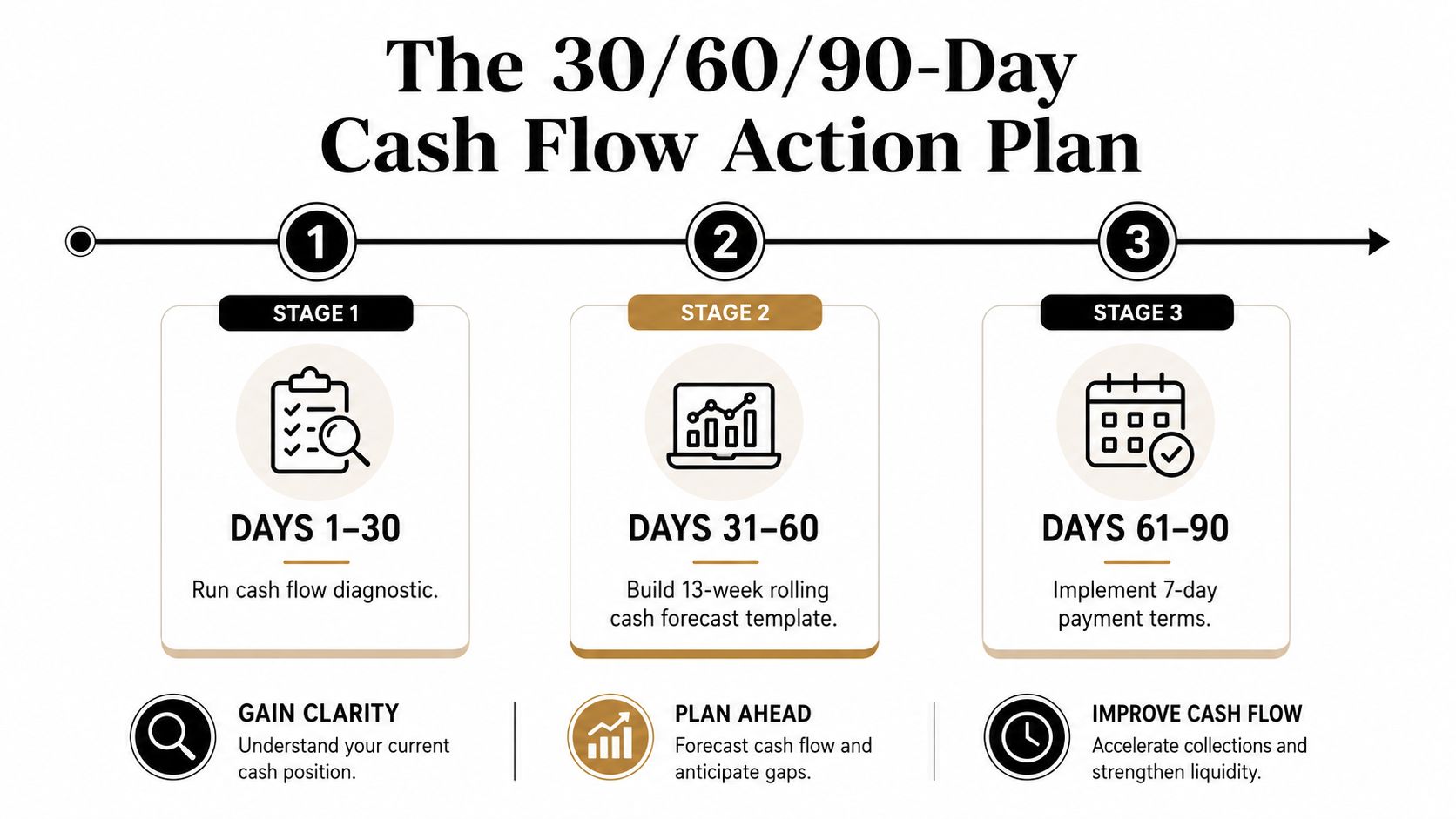
Days 31 to 60
Renegotiate terms with the three suppliers that create the largest cash outflows. Set credit limits for debtors above AU$5,000, introduce deposits or staged billing for appropriate work, and escalate the oldest or most material debts to a collection process. If you add card surcharging, follow applicable ATO and ACCC requirements and document how the charge is calculated.
Review the weekly forecast every Monday. The checkpoint is simple: expected receipts should become more realistic, overdue balances should have clear actions, and upcoming supplier payments should be approved against available cash.
Days 61 to 90
Review the bottom-quartile services or SKUs by margin. Formalise reorder points, document supplier lead times and stop buying from habit. Write a short weekly cash-meeting SOP covering forecast variance, payables approval, aged receivables and bank reconciliation.
By day 90, a typical SME should be able to identify the cash released from collections, purchasing changes and pricing decisions. Don't invent a target lift. Measure the actual movement from the baseline, and separate one-off recoveries from recurring improvements.
Watch the accompanying video after you've built your own forecast, so the concepts are tested against your numbers rather than consumed as passive advice.
Forecasting, KPIs and Automation That Hold the Gains
A forecast only works when someone reads it often enough to act. Use a thirteen-week rolling model with five lines that matter: opening balance, weekly customer receipts, weekly operating outflows, financing and tax payments, and closing balance. Every Monday, compare the forecast with the bank balance and explain the variance before approving discretionary spending.
Use a small KPI set
Weekly measures should expose immediate movement. Monthly measures should explain why margins and working capital changed.
Metric | Cadence | Target Benchmark | Off-Track Action |
|---|---|---|---|
Aged receivables | Weekly | Overdue balances have a named action | Escalate calls, pause credit or agree a payment plan |
Debtor days | Weekly | Aligned with agreed terms | Tighten terms and invoice earlier |
Stock cover | Weekly for stock-heavy firms | Aligned with demand and lead time | Freeze reorders and clear slow stock |
Cash conversion cycle | Weekly or monthly | Trending down where cash is constrained | Review receivables, stock and supplier timing together |
Bank balance versus forecast | Weekly | Variance explained promptly | Rebuild receipts and outflow assumptions |
Gross margin by SKU or service | Monthly | Within the approved margin plan | Reprice, rescope or discontinue weak work |
Supplier terms | Monthly | Consistent with customer collection | Renegotiate or adjust purchasing |
Debt covenant headroom | Monthly | Within lender requirements | Escalate financing review early |
Make Monday cash meetings short
Run a fifteen-minute meeting with one owner and one decision-maker.
Review last week's forecast variance.
Approve this week's payables against the closing cash position.
Select the three most important AR follow-ups.
Confirm the bank balance trend and any upcoming tax, payroll or debt events.
Xero and MYOB can provide the accounting base. Chaser or Apricity can help structure debtor follow-ups, while Google Sheets or Looker Studio can present a simple management dashboard. The tool matters less than the ownership rule. Every exception needs a person, a due date and a next action.
Automation should support policy, not replace it. Configure reminders at day 1, day 7 and day 14 after the due date where appropriate, trigger a stop-credit alert when a customer reaches 80% of their approved limit, and schedule weekly reconciliation tasks. The exact settings must reflect your contracts, customer relationships and accounting controls.
A properly designed three-way forecast connects profit, cash and the balance sheet, which is essential when a cash shortfall comes from stock purchases, tax or debt rather than sales alone.
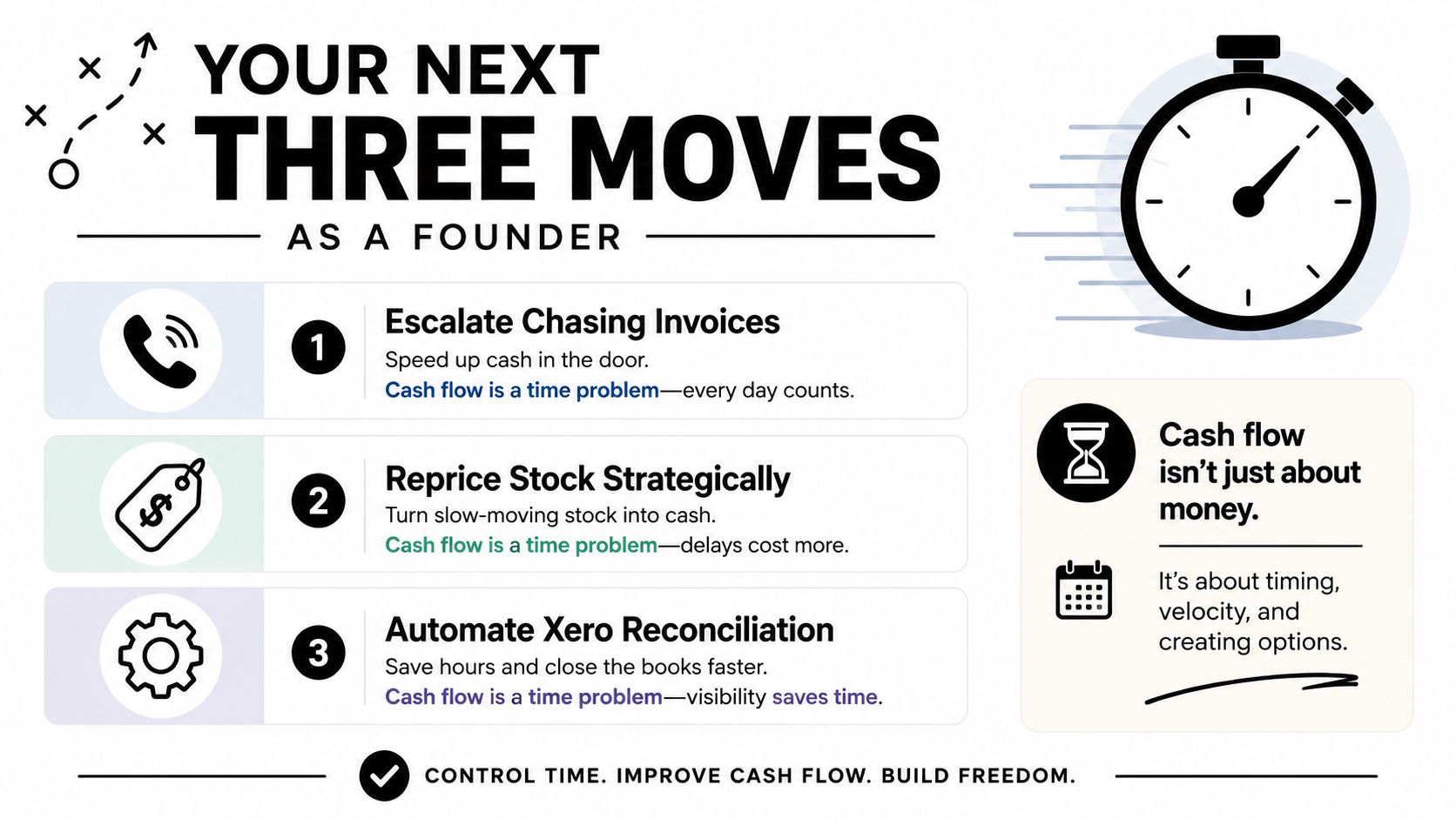
Your Next Three Moves as an Australian Founder
Cash flow is also a founder-time problem. Every hour spent checking whether an invoice was sent, chasing a vague promise to pay or reconciling unexplained transactions is an hour unavailable for sales, customer delivery or strategic decisions.
The 2025 Australian payment research found that businesses chasing payments lose an average of 1.5 hours each week, or about 78 hours a year, on collections. (Pursuing Payments 2025 report) That's why delegation and automation can produce more value than another round of low-impact cost cutting.
Know when DIY has ended
Bring in a virtual CFO when shortfalls keep recurring, you're negotiating an ATO payment plan, or a business lender's covenant pressure is affecting decisions. Indicative SME virtual CFO retainers can sit around AU$3,000 to AU$8,000 per month, but the correct fee depends on scope and complexity. Treat the engagement as a decision-support and implementation function, not a recurring report subscription.
Nexist is one option for Australian founders who need cash-flow forecasting, KPI design, working-capital reviews, management reporting and process automation in one finance operating layer. The practical test is whether the work changes collections, purchasing, pricing, forecasting or founder workload.
Manage debt according to its purpose
Good debt finances a productive asset or provides flexible working capital that the business can repay from reliable cash generation. Examples include equipment finance for an asset that supports delivery and a sensibly structured overdraft used for timing gaps.
Bad debt funds ongoing losses or personal spending. High-interest credit cards used to cover a broken operating model don't solve cash flow. They postpone the decision and add another outflow to the forecast.
If ATO debt is involved, speak with your accountant or adviser about available relief and hardship arrangements, including the ATO's Small Business Hardship program. Don't wait until enforcement pressure removes your options.
Complete these three actions within seven days
Pull a thirteen-week rolling forecast from Xero or MYOB, including the actual opening bank balance, expected receipts and committed outflows.
Book a thirty-minute AR review to identify overdue accounts, tighten suitable payment terms and assign every follow-up.
Calculate true owner compensation so personal drawings don't disguise business losses or create an unexplained cash deficit.
Start this week with the forecast and AR review, then bring in support if the numbers still don't reconcile. Nexist helps Australian SMEs find cash leaks across receivables, inventory, pricing and processes, then build forecasting, KPI and finance systems that turn cash-flow control into a weekly operating habit.
improve cash flow, cash flow management, Australian SMEs, virtual CFO, working capital

" width="24px"/><g d="M 0 24.129 L 0 0.129 L 24 0.129 L 24 24.129 Z M 0 24.129 L 0 0.129 L 24 0.129 L 24 24.129 Z M 24 3 C 24 1.344 22.656 0 21 0 L 3 0 C 1.344 0 0 1.344 0 3 L 0 21 C 0 22.656 1.344 24 3 24 L 21 24 C 22.656 24 24 22.656 24 21 Z M 6.883 8.375 L 2.863 8.375 L 2.863 20.467 L 6.883 20.467 Z M 4.899 2.545 C 3.524 2.545 2.625 3.449 2.625 4.634 C 2.625 5.795 3.496 6.724 4.846 6.724 L 4.872 6.724 C 6.273 6.724 7.146 5.795 7.146 4.634 C 7.12 3.449 6.274 2.545 4.899 2.545 Z M 16.747 8.09 C 14.614 8.09 13.659 9.263 13.124 10.086 L 13.124 8.374 L 9.105 8.374 C 9.159 9.508 9.105 20.466 9.105 20.466 L 13.124 20.466 L 13.124 13.713 C 13.124 13.352 13.15 12.99 13.257 12.732 C 13.547 12.01 14.209 11.262 15.319 11.262 C 16.773 11.262 17.355 12.372 17.355 13.996 L 17.355 20.466 L 21.374 20.466 L 21.374 13.532 C 21.374 9.818 19.391 8.09 16.747 8.09 Z" fill="transparent" height="24.12890599668026px" id="dSFdkJotL" width="24px"><path d="M 0 24 L 0 0 L 24 0 L 24 24 Z" fill="transparent" height="24px" id="wscNJE44G" transform="translate(0 0.129)" width="24px"/><g d="M 0 24.129 L 0 0.129 L 24 0.129 L 24 24.129 Z M 24 3 C 24 1.344 22.656 0 21 0 L 3 0 C 1.344 0 0 1.344 0 3 L 0 21 C 0 22.656 1.344 24 3 24 L 21 24 C 22.656 24 24 22.656 24 21 Z M 6.883 8.375 L 2.863 8.375 L 2.863 20.467 L 6.883 20.467 Z M 4.899 2.545 C 3.524 2.545 2.625 3.449 2.625 4.634 C 2.625 5.795 3.496 6.724 4.846 6.724 L 4.872 6.724 C 6.273 6.724 7.146 5.795 7.146 4.634 C 7.12 3.449 6.274 2.545 4.899 2.545 Z M 16.747 8.09 C 14.614 8.09 13.659 9.263 13.124 10.086 L 13.124 8.374 L 9.105 8.374 C 9.159 9.508 9.105 20.466 9.105 20.466 L 13.124 20.466 L 13.124 13.713 C 13.124 13.352 13.15 12.99 13.257 12.732 C 13.547 12.01 14.209 11.262 15.319 11.262 C 16.773 11.262 17.355 12.372 17.355 13.996 L 17.355 20.466 L 21.374 20.466 L 21.374 13.532 C 21.374 9.818 19.391 8.09 16.747 8.09 Z" fill="transparent" height="24.12890599668026px" id="sTpjGo1tb" width="24px"><path d="M 0 24 L 0 0 L 24 0 L 24 24 Z" fill="transparent" height="24px" id="s7ffpmKOD" transform="translate(0 0.129)" width="24px"/><g d="M 24 3 C 24 1.344 22.656 0 21 0 L 3 0 C 1.344 0 0 1.344 0 3 L 0 21 C 0 22.656 1.344 24 3 24 L 21 24 C 22.656 24 24 22.656 24 21 Z M 6.883 8.375 L 2.863 8.375 L 2.863 20.467 L 6.883 20.467 Z M 4.899 2.545 C 3.524 2.545 2.625 3.449 2.625 4.634 C 2.625 5.795 3.496 6.724 4.846 6.724 L 4.872 6.724 C 6.273 6.724 7.146 5.795 7.146 4.634 C 7.12 3.449 6.274 2.545 4.899 2.545 Z M 16.747 8.09 C 14.614 8.09 13.659 9.263 13.124 10.086 L 13.124 8.374 L 9.105 8.374 C 9.159 9.508 9.105 20.466 9.105 20.466 L 13.124 20.466 L 13.124 13.713 C 13.124 13.352 13.15 12.99 13.257 12.732 C 13.547 12.01 14.209 11.262 15.319 11.262 C 16.773 11.262 17.355 12.372 17.355 13.996 L 17.355 20.466 L 21.374 20.466 L 21.374 13.532 C 21.374 9.818 19.391 8.09 16.747 8.09 Z" fill="transparent" height="24.000006px" id="D0ecaHEcW" transform="translate(0 0)" width="24px"><path d="M 24 3 C 24 1.344 22.656 0 21 0 L 3 0 C 1.344 0 0 1.344 0 3 L 0 21 C 0 22.656 1.344 24 3 24 L 21 24 C 22.656 24 24 22.656 24 21 Z" fill="rgb(55, 184, 218)" height="24.000006px" id="IPLFE6zXx" width="24px"/><path d="M 4.02 0 L 0 0 L 0 12.092 L 4.02 12.092 Z" fill="rgb(255, 255, 255)" height="12.09201px" id="FWhtzAyuY" transform="translate(2.863 8.375)" width="4.02px"/><path d="M 2.274 0 C 0.899 0 0 0.904 0 2.089 C 0 3.25 0.871 4.179 2.221 4.179 L 2.247 4.179 C 3.648 4.179 4.521 3.25 4.521 2.089 C 4.495 0.904 3.649 0 2.274 0 Z" fill="rgb(255, 255, 255)" height="4.17876px" id="VmOsKv4kO" transform="translate(2.625 2.545)" width="4.52095px"/><path d="M 7.641 0 C 5.509 0 4.554 1.173 4.019 1.996 L 4.019 0.284 L 0 0.284 C 0.053 1.419 0 12.376 0 12.376 L 4.019 12.376 L 4.019 5.623 C 4.019 5.262 4.045 4.9 4.151 4.642 C 4.442 3.92 5.103 3.172 6.214 3.172 C 7.667 3.172 8.25 4.282 8.25 5.907 L 8.25 12.376 L 12.269 12.376 L 12.269 5.442 C 12.269 1.728 10.286 0 7.641 0 Z" fill="rgb(255, 255, 255)" height="12.37626px" id="n1XUbhaq0" transform="translate(9.105 8.09)" width="12.268830000000001px"/></g></g></g></g></svg>)