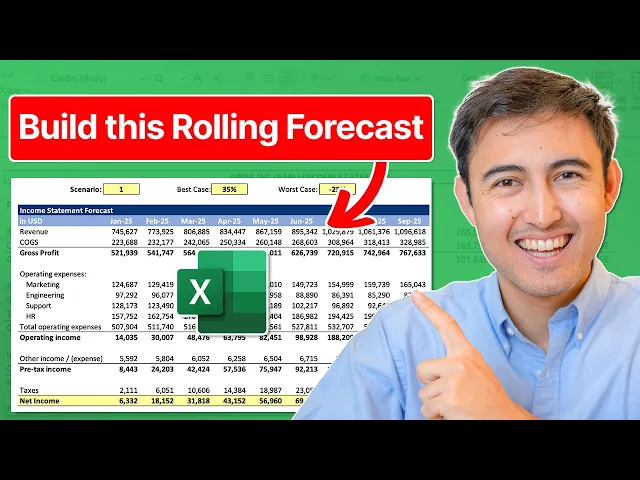
Three Way Forecast: A Guide to Master Your Cash Flow
Unlock growth with a three way forecast. Our guide explains how to link your P&L, balance sheet, and cash flow to manage cash and make smarter decisions.
Ansh Malhotra

Your P&L says you're making money. Sales are moving. Margins look acceptable. Yet payroll week arrives, the BAS deadline looms, suppliers want paying, and the bank balance is tighter than it should be.
That's a familiar pattern in Australian SMEs, especially in retail, ecommerce, wholesale, and manufacturing. The business isn't necessarily failing. More often, cash is getting stuck between the sale and the bank account. Inventory absorbs it. Debtors hold it. Poorly linked forecasting hides it.
A proper three way forecast is the tool that exposes that gap. It doesn't just tell you whether the business looks profitable. It shows whether your operating decisions, stock levels, payment timing, and financing choices will leave you with actual cash when you need it.
Table of Contents
The Common Founder Trap Profit on Paper No Cash in the Bank
A founder reviews month-end numbers and sees a decent profit. On paper, the business is moving in the right direction. Then the next conversation is with the bookkeeper about delaying a payment run or drawing on an overdraft.
That contradiction usually has a practical cause, not a mysterious one. The margin exists, but it's trapped somewhere else in the system. For inventory-heavy businesses, it often sits on shelves, in containers, or in stock that was bought too early, too deep, or too broadly.
Generic forecasting advice rarely deals with that properly. One of the more important gaps in common guidance is the failure to model stock as a cash trap in its own right. BDO notes that existing content often misses how inventory-heavy Australian SMEs trap profit in stock, and cites Australian Bureau of Statistics 2025 data showing inventory values rose 18% annually while cash conversion cycles lengthened by 22 days for SMEs in retail, manufacturing, and ecommerce sectors (BDO on preparing a three-way forecast).
What this looks like in real life
You sell more. To support that growth, you order more stock. Some lines move fast, some don't. The P&L records sales and gross profit. The bank account only feels the stock purchases, freight, duty, storage, and supplier timing.
That's why founders can feel like they're running harder for less breathing room.
Practical rule: If profit is improving but cash feels worse, don't start with cost-cutting. Start by checking whether inventory, receivables, or timing differences are swallowing the cash.
If you want a broader refresher on the mechanics of short-term liquidity, this guide for startup founders on cash flow is a useful companion. It's especially relevant if you're trying to separate a temporary timing issue from a structural cash problem.
Why this problem keeps repeating
Most founders are looking at separate reports. The P&L tells one story. The balance sheet tells another. The cash flow statement is either missing, ignored, or treated like an afterthought.
A three way forecast fixes that by linking the reports together so the business can see the consequence of stock decisions before the cash crunch arrives.
What Is a Three-Way Forecast
Think of a three way forecast as the financial equivalent of a full dashboard, not a single warning light. One dial tells you speed. Another tells you engine temperature. Another tells you fuel. If you only watch one, you can still end up stranded.
In finance, those three dials are the Profit and Loss statement, the Balance Sheet, and the Cash Flow statement.
A three way forecast combines projected versions of all three into one integrated model. Calxa describes it as an integrated financial model that combines the projected Profit and Loss, Balance Sheet, and Cash Flow statements, designed to help Australian businesses secure financing by showing informed decision-making and an integrated view of future cash position (Calxa on automating the 3-way forecast).
What each statement answers
Statement | Core question | What it shows |
|---|---|---|
Profit and Loss | Are we profitable? | Revenue, costs, and profit over a period |
Balance Sheet | What do we own and owe? | Assets, liabilities, and equity at a point in time |
Cash Flow | Where did the cash actually go? | Cash movements from operating, investing, and financing activities |
Each statement is useful on its own. None is enough on its own.
The P&L can say you're profitable while cash is under pressure. The balance sheet can show rising inventory and debtors, but not whether they'll create a crunch next quarter. The cash flow statement can show outflows, but not whether they're connected to profitable growth or poor working capital discipline.
Why founders need the integrated version
The value of the model isn't the formatting. It's the linkage.
When revenue moves, debtors move. When debtors move, operating cash changes. When stock builds, cash drops and the balance sheet shifts. When you buy equipment, the cash impact is different again. A proper model lets one decision flow through the whole business picture.
A cash flow forecast by itself can tell you what might happen to cash. A three way forecast tells you why.
That's also why lenders and serious investors prefer it. It shows that management understands not just sales ambition, but the mechanics behind funding, timing, and solvency.
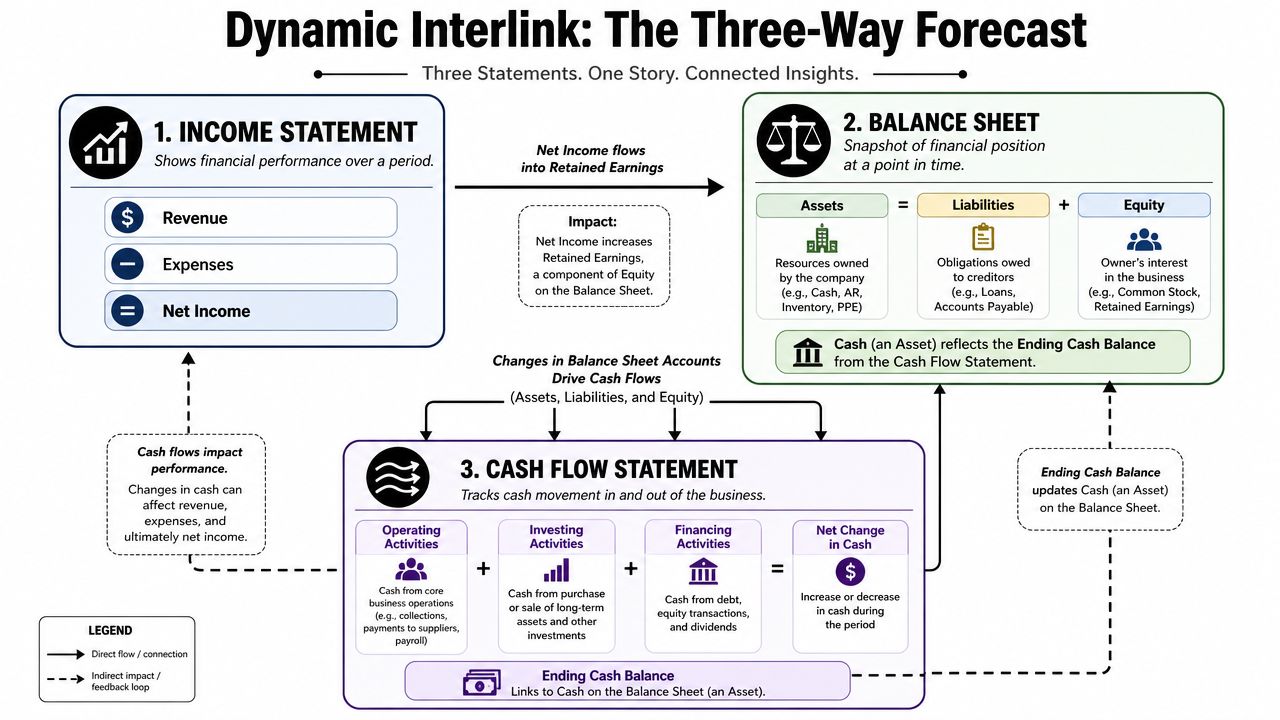
How the Three Statements Dynamically Interlink
The easiest way to understand a three way forecast is to follow one transaction through the model.
Say you make a sale on credit. The customer gets the goods today but pays later. The P&L records revenue and profit now. The bank account does not receive cash now. That timing gap is exactly where many forecasting mistakes begin.
Start with the P&L
The sale appears as revenue. The cost of that sale appears as cost of goods sold. The difference contributes to gross profit, then net profit after operating costs and other items.
At this stage, the founder often feels reassured. The sale is booked. Profit improves. The month looks stronger.
But that's only one-third of the picture.
Then the balance sheet changes
If the customer hasn't paid yet, accounts receivable goes up on the balance sheet. If stock was sold, inventory goes down. Net profit also feeds into retained earnings over time, which affects equity.
So the balance sheet captures the position created by the sale. You now have less stock, more receivables, and a changed equity balance.
Balance sheet movements explain why “good trading” doesn't always create immediate liquidity.
A founder who only watches the P&L sees success. A founder who also watches the balance sheet sees where cash is being delayed.
Finally the cash flow statement tells the truth about timing
The cash flow statement adjusts accounting profit for non-cash and timing items. If the sale hasn't been collected yet, it won't appear as cash received from operations in the same way as a cash sale would.
That means the model can show a profitable month with weak operating cash flow. It isn't a contradiction. It's an explanation.
Here's the simplified chain:
P&L records the sale and recognises profit.
Balance sheet records the unpaid invoice as receivables and reduces inventory.
Cash flow statement shows the delay between earning revenue and collecting cash.
Ending cash updates the balance sheet cash line for the closing period.
Where inventory-heavy businesses get caught
In inventory businesses, that chain gets more complex because stock is often purchased well before the related sale. Cash leaves early, inventory rises, and only later does the P&L recognise cost of sales when units are sold.
That creates a dangerous blind spot. Founders may think, “sales are growing, so cash should follow.” It often doesn't, at least not on the same timeline.
A good three way forecast makes these trade-offs visible:
Higher stock coverage may reduce stockouts, but it ties up more cash.
Longer supplier terms can support liquidity, but not every supplier will agree.
Faster customer collection improves cash, but may require tighter credit control.
Promotions to clear old stock may free up cash while compressing margin.
What a dynamic model does better than a static spreadsheet
A static forecast is usually a set of disconnected tabs. A dynamic model updates all three statements when one assumption changes.
Raise sales, and the model should also adjust receivables, stock requirements, GST effects where applicable, and cash timing. Add a loan, and it should affect both financing cash flows and the balance sheet liability. Delay debtor collections, and the cash forecast should tighten even if profit does not.
That interconnected logic is the difference between a budgeting exercise and an actual management tool.
Why Your Business Needs a Three-Way Forecast
A three way forecast matters because founders don't run businesses in accounting silos. They make decisions that hit sales, stock, staffing, tax, debt, and cash at the same time. The model gives you one place to see those consequences before they land.
For Australian growth-stage companies, this isn't fringe best practice. BDO notes that the three-way forecast is a standard for growth-stage businesses to optimise production and profit, and that it helps founders move from watchman to visionary by setting targets and turning numbers into action (BDO on three-way financial modelling for manufacturers).

It improves funding readiness
Banks and investors want more than optimism. They want to see how management thinks.
A solid model shows whether growth needs more working capital, whether debt service remains manageable, and whether the business can absorb shocks. It also helps explain why borrowing is needed. Is the business funding losses, or funding profitable growth tied up in stock and debtors? Those are very different conversations.
It shows the real cost of operational decisions
Hiring, moving warehouse, adding a product line, importing a larger order, or offering longer payment terms all have cash consequences. Without an integrated model, founders often approve these moves based on topline logic.
That's where pressure builds. The business can look healthy while the operating cycle imperceptibly tightens.
It exposes trapped cash in inventory
Inventory-heavy businesses get the biggest benefit. A proper model shows whether margin is sitting in stock instead of the bank.
That changes the conversation from “we need more sales” to sharper questions:
Which SKUs are tying up capital without enough turnover
Whether reorder points are too generous
If margin is being diluted by aged stock
How much purchasing can the business support before liquidity tightens
If inventory is your biggest use of cash, your forecast should treat stock as a strategic lever, not just a balance sheet line.
It gives your reviews teeth
A monthly management pack is useful. A quarterly strategic review is more useful when the forecast is built into it. If you already run formal review meetings, a disciplined quarterly business review process works far better when each discussion is anchored to a current integrated forecast rather than backward-looking reports alone.
The point isn't more reporting. It's better decisions from the reporting you already have.
Running Scenarios to Stress-Test Your Business
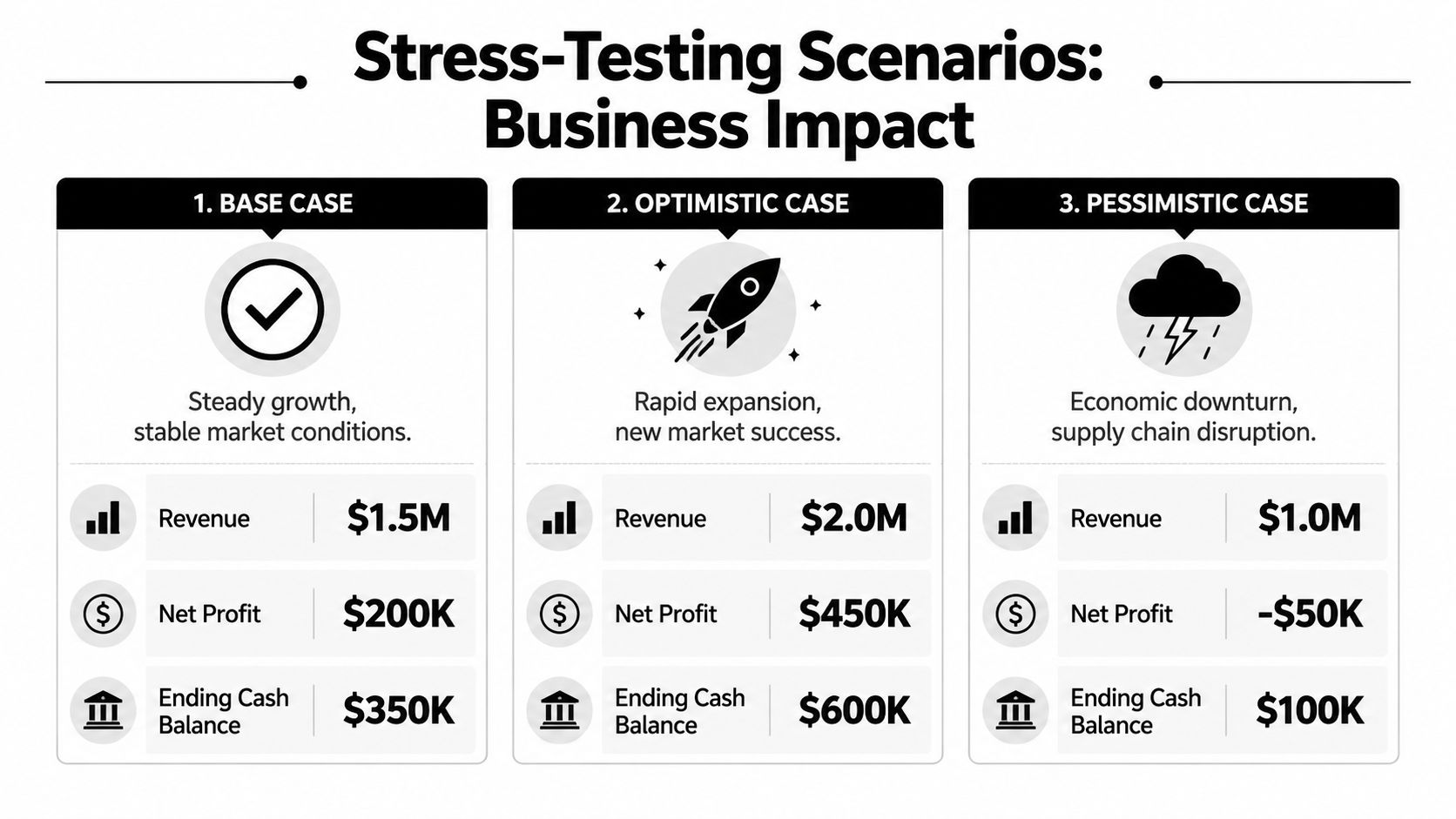
The strength of a three way forecast appears when you stop treating it as a single prediction and start using it as a testing ground.
William Buck notes that three-way forecasting in Australian manufacturing supports sector-specific scenario simulation, can improve audit accuracy and regulatory compliance by up to 30%, and allows businesses to model decisions like stock adjustments that reduce cash leaks by 15–20% in inventory-heavy SMEs (William Buck on cash flow and three-way forecasting in manufacturing).
Questions worth testing before reality answers them
A useful forecast should answer practical founder questions like these:
Customer concentration risk: What happens if your biggest account slows payments or leaves?
Team expansion: Can the business absorb two hires before the extra revenue arrives?
Supplier pressure: What if supplier costs rise and you can't pass the increase on immediately?
Inventory strategy: What happens to cash if you buy deeper to avoid stockouts?
Growth opportunity: If a new contract lands, can you fund fulfilment without straining working capital?
These are not abstract finance questions. They're operating decisions with cash consequences.
A founder example
Take a wholesaler carrying broad product lines. Sales are steady, but cash feels tight every time a large stock order lands. The founder is considering a bigger buy to secure supply and improve availability.
The base case might show acceptable profitability. A stress-tested scenario may reveal that the extra inventory pushes cash too low before those units convert into sales. Another scenario may show that trimming slower lines and buying deeper only in proven movers protects both margin and liquidity.
That kind of exercise changes behaviour fast. It turns purchasing from a habit into a decision.
Good scenario planning doesn't try to predict the future perfectly. It helps you see which assumptions can hurt you fastest.
Sensitivity matters more than false precision
Many founders ask for one “best” forecast number. That's the wrong question. A healthier approach is to understand which variables create the most pressure when they shift.
For a useful primer on that way of thinking, this Domus sensitivity analysis overview is worth reading. It's a helpful way to frame how changes in one assumption can alter the wider result.
Scenarios that usually matter most
Scenario type | What changes | Why it matters |
|---|---|---|
Base case | Expected trading conditions | Sets the operating plan |
Downside case | Slower sales, delayed receipts, margin pressure | Shows survival and response options |
Upside case | Stronger sales or new contracts | Tests whether growth is fundable |
A three way forecast lets you test each path before committing real cash, stock, or headcount.
A Practical Roadmap to Your First Forecast
Most businesses don't need a perfect model on day one. They need a model that is accurate enough to support decisions and disciplined enough to update regularly.
The first version should be useful, not elegant.
Start with the data you already have
Pull together recent financial statements and the operational drivers behind them. At minimum, gather:
Historical P&L reports for revenue, gross margin, payroll, and overhead patterns
Balance sheet data with receivables, payables, debt, GST-related balances where relevant, and inventory
Cash movement history from bank transactions or your accounting platform
Operational inputs such as units sold, average order values, staff roster plans, stock lead times, and debtor behaviour
For product businesses, don't stop at accounting reports. Reorder logic, landed cost assumptions, and stock ageing often explain more than the ledger does.
If your sales assumptions need work, it can help to explore sales prediction strategies to sharpen the demand side before you build the financial model around it.
Build assumptions that reflect operations
Many DIY models fail. Founders type in a revenue growth line, then leave the rest of the model too shallow to respond properly.
Use assumptions that connect to how the business runs:
Sales drivers: volume, product mix, pricing, seasonality, conversion patterns
Gross margin drivers: supplier cost changes, freight, discounts, write-down risk
Working capital drivers: debtor days, creditor days, stock turns, purchase timing
Operating cost drivers: payroll plans, rent, software, finance costs, tax obligations
For inventory-heavy businesses, stock assumptions should be explicit. Build them around lead times, minimum order quantities, likely stock cover, and slow-moving items. If inventory is your biggest cash user, it deserves its own logic.
Choose the right tool for your stage
A simple business with limited stock complexity can begin in Excel or Google Sheets. That's often enough if the owner understands the model and updates it consistently.
Specialised tools can speed things up and reduce formula risk. Products such as Calxa and Spotlight Reporting are commonly used when businesses want more structure, reporting discipline, and scenario capability.
If you want a starting point before building a full model, this cash flow forecast template is a sensible first step. It won't replace a fully linked three way forecast, but it helps clarify the timing patterns you need to model properly.
Know when DIY stops being efficient
DIY works when the business is simple, the founder is financially literate, and the stakes are moderate.
Bring in expert help when any of these are true:
Inventory is material: stock decisions are driving liquidity risk
Funding is involved: a bank, lender, or investor needs a credible integrated model
The business has multiple moving parts: entities, locations, product categories, or complex terms
The founder keeps rebuilding the model: time is going into spreadsheets instead of decisions
There's also a practical limit. If your model takes hours to update and still doesn't answer obvious questions, it isn't saving money. It's costing management attention.
A short walkthrough can help if you want to see how a forecast is built and interpreted in practice:
The best forecasting setup is the one your team will maintain. Consistency beats complexity every time.
Common Pitfalls and Key KPIs to Monitor
Most bad forecasts don't fail because the maths is hard. They fail because the assumptions are lazy, disconnected, or never updated.
The common traps are predictable. Founders overestimate sales timing, underestimate stock requirements, forget tax and finance commitments, or build a model that doesn't properly reconcile across the three statements.
Mistakes that cause the most damage
Optimistic collections: Revenue might land this month. Cash often won't.
Ignoring inventory behaviour: Stock purchases don't move in a straight line, especially with seasonal buys or imported goods.
Treating the forecast as static: A model built once and untouched quickly becomes decorative.
Missing the balance sheet logic: If the model doesn't balance, the output can't be trusted.
Keep the model close to operations. If sales, stock, or staffing changes in the real business, the forecast should change within days, not months.
KPIs worth watching from the model
A good three way forecast helps you monitor a compact set of management metrics:
Cash conversion cycle: This shows how long cash stays tied up between paying suppliers and collecting from customers. If you need a sharper grounding on the concept, this guide to the cash conversion cycle is worth keeping handy.
Gross profit margin: Useful for spotting pricing drift, discounting, or rising landed costs.
Debtor days: A warning light for collection discipline and customer payment behaviour.
Runway: Essential when cash is tight or growth requires upfront funding.
Don't turn this into a dashboard with twenty lines no one uses. A founder needs a short list of measures that trigger action.
If your business is profitable on paper but cash keeps disappearing into stock, debtors, or poor timing, Nexist helps Australian founders build forecasting systems that turn reports into decisions. The focus is practical: expose cash leaks, model the actual operating cycle, and put more cash back in the bank.
three way forecast, cash flow management, financial modeling, virtual cfo, business forecasting
" width="24px"/><g d="M 0 24.129 L 0 0.129 L 24 0.129 L 24 24.129 Z M 0 24.129 L 0 0.129 L 24 0.129 L 24 24.129 Z M 24 3 C 24 1.344 22.656 0 21 0 L 3 0 C 1.344 0 0 1.344 0 3 L 0 21 C 0 22.656 1.344 24 3 24 L 21 24 C 22.656 24 24 22.656 24 21 Z M 6.883 8.375 L 2.863 8.375 L 2.863 20.467 L 6.883 20.467 Z M 4.899 2.545 C 3.524 2.545 2.625 3.449 2.625 4.634 C 2.625 5.795 3.496 6.724 4.846 6.724 L 4.872 6.724 C 6.273 6.724 7.146 5.795 7.146 4.634 C 7.12 3.449 6.274 2.545 4.899 2.545 Z M 16.747 8.09 C 14.614 8.09 13.659 9.263 13.124 10.086 L 13.124 8.374 L 9.105 8.374 C 9.159 9.508 9.105 20.466 9.105 20.466 L 13.124 20.466 L 13.124 13.713 C 13.124 13.352 13.15 12.99 13.257 12.732 C 13.547 12.01 14.209 11.262 15.319 11.262 C 16.773 11.262 17.355 12.372 17.355 13.996 L 17.355 20.466 L 21.374 20.466 L 21.374 13.532 C 21.374 9.818 19.391 8.09 16.747 8.09 Z" fill="transparent" height="24.12890599668026px" id="dSFdkJotL" width="24px"><path d="M 0 24 L 0 0 L 24 0 L 24 24 Z" fill="transparent" height="24px" id="wscNJE44G" transform="translate(0 0.129)" width="24px"/><g d="M 0 24.129 L 0 0.129 L 24 0.129 L 24 24.129 Z M 24 3 C 24 1.344 22.656 0 21 0 L 3 0 C 1.344 0 0 1.344 0 3 L 0 21 C 0 22.656 1.344 24 3 24 L 21 24 C 22.656 24 24 22.656 24 21 Z M 6.883 8.375 L 2.863 8.375 L 2.863 20.467 L 6.883 20.467 Z M 4.899 2.545 C 3.524 2.545 2.625 3.449 2.625 4.634 C 2.625 5.795 3.496 6.724 4.846 6.724 L 4.872 6.724 C 6.273 6.724 7.146 5.795 7.146 4.634 C 7.12 3.449 6.274 2.545 4.899 2.545 Z M 16.747 8.09 C 14.614 8.09 13.659 9.263 13.124 10.086 L 13.124 8.374 L 9.105 8.374 C 9.159 9.508 9.105 20.466 9.105 20.466 L 13.124 20.466 L 13.124 13.713 C 13.124 13.352 13.15 12.99 13.257 12.732 C 13.547 12.01 14.209 11.262 15.319 11.262 C 16.773 11.262 17.355 12.372 17.355 13.996 L 17.355 20.466 L 21.374 20.466 L 21.374 13.532 C 21.374 9.818 19.391 8.09 16.747 8.09 Z" fill="transparent" height="24.12890599668026px" id="sTpjGo1tb" width="24px"><path d="M 0 24 L 0 0 L 24 0 L 24 24 Z" fill="transparent" height="24px" id="s7ffpmKOD" transform="translate(0 0.129)" width="24px"/><g d="M 24 3 C 24 1.344 22.656 0 21 0 L 3 0 C 1.344 0 0 1.344 0 3 L 0 21 C 0 22.656 1.344 24 3 24 L 21 24 C 22.656 24 24 22.656 24 21 Z M 6.883 8.375 L 2.863 8.375 L 2.863 20.467 L 6.883 20.467 Z M 4.899 2.545 C 3.524 2.545 2.625 3.449 2.625 4.634 C 2.625 5.795 3.496 6.724 4.846 6.724 L 4.872 6.724 C 6.273 6.724 7.146 5.795 7.146 4.634 C 7.12 3.449 6.274 2.545 4.899 2.545 Z M 16.747 8.09 C 14.614 8.09 13.659 9.263 13.124 10.086 L 13.124 8.374 L 9.105 8.374 C 9.159 9.508 9.105 20.466 9.105 20.466 L 13.124 20.466 L 13.124 13.713 C 13.124 13.352 13.15 12.99 13.257 12.732 C 13.547 12.01 14.209 11.262 15.319 11.262 C 16.773 11.262 17.355 12.372 17.355 13.996 L 17.355 20.466 L 21.374 20.466 L 21.374 13.532 C 21.374 9.818 19.391 8.09 16.747 8.09 Z" fill="transparent" height="24.000006px" id="D0ecaHEcW" transform="translate(0 0)" width="24px"><path d="M 24 3 C 24 1.344 22.656 0 21 0 L 3 0 C 1.344 0 0 1.344 0 3 L 0 21 C 0 22.656 1.344 24 3 24 L 21 24 C 22.656 24 24 22.656 24 21 Z" fill="rgb(55, 184, 218)" height="24.000006px" id="IPLFE6zXx" width="24px"/><path d="M 4.02 0 L 0 0 L 0 12.092 L 4.02 12.092 Z" fill="rgb(255, 255, 255)" height="12.09201px" id="FWhtzAyuY" transform="translate(2.863 8.375)" width="4.02px"/><path d="M 2.274 0 C 0.899 0 0 0.904 0 2.089 C 0 3.25 0.871 4.179 2.221 4.179 L 2.247 4.179 C 3.648 4.179 4.521 3.25 4.521 2.089 C 4.495 0.904 3.649 0 2.274 0 Z" fill="rgb(255, 255, 255)" height="4.17876px" id="VmOsKv4kO" transform="translate(2.625 2.545)" width="4.52095px"/><path d="M 7.641 0 C 5.509 0 4.554 1.173 4.019 1.996 L 4.019 0.284 L 0 0.284 C 0.053 1.419 0 12.376 0 12.376 L 4.019 12.376 L 4.019 5.623 C 4.019 5.262 4.045 4.9 4.151 4.642 C 4.442 3.92 5.103 3.172 6.214 3.172 C 7.667 3.172 8.25 4.282 8.25 5.907 L 8.25 12.376 L 12.269 12.376 L 12.269 5.442 C 12.269 1.728 10.286 0 7.641 0 Z" fill="rgb(255, 255, 255)" height="12.37626px" id="n1XUbhaq0" transform="translate(9.105 8.09)" width="12.268830000000001px"/></g></g></g></g></svg>)