Accounting Services for Small Business: The Complete 2026
Discover how accounting services for small business drive cash flow, compliance and growth. Compare pricing, providers and KPIs
Ansh Malhotra

You're staring at a pile of receipts late at night, trying to reconcile the bank account before tomorrow's BAS deadline. Payroll is waiting, one customer still hasn't paid a large invoice, and the cash balance looks healthy until the next supplier run and tax payment leave the account.
That isn't an accounting problem in the narrow sense. It's an operating problem. If your records only tell you what happened after the fact, you're managing the business through the windscreen with the lights off.
Australian founders have plenty of businesses to support. The Australian Small Business and Family Enterprise Ombudsman reports that 97.3% of Australian businesses were small businesses in June 2025, representing 2,656,469 firms employing fewer than 20 people. Accounting services for small business therefore sit at the centre of the Australian professional-services market, not at its edges.
The right engagement should do more than process BAS, payroll and tax returns. It should improve cash-flow timing, gross margin, reporting discipline and decision speed. This guide gives you a practical way to decide what to buy first, how to assess providers, and which measures should improve during the first 90 days.
Table of Contents
Why Accounting Services Matter More Than Ever for Australian SMEs
A founder can post strong sales figures and still miss payroll. Customers pay late, stock is purchased before it is needed, wages fall due on schedule, and tax obligations arrive whether invoices have cleared or not. Bookkeeping records those events. Effective accounting support helps the owner act before the cash squeeze becomes a crisis.
Australia's small-business base has grown steadily. ASBFEO recorded 2,520,419 small businesses in June 2023, 2,589,595 in June 2024, and 2,656,469 in June 2025 in its small-business data series. More owners therefore need systems that manage bookkeeping, BAS, payroll, cash-flow reporting and financial control without making the founder the default finance manager.
Compliance is only the floor
BAS and payroll reporting keep the business compliant. They do not show whether a popular service is underpriced, whether receivables are financing customers, or whether inventory is consuming cash that should support growth.
The Reserve Bank of Australia says at least three-quarters of companies entering insolvency are small businesses, with insolvencies high in sectors including hospitality and construction. Its analysis also says insolvencies are concentrated among businesses with fewer than 20 employees, and that around 0.5% of all businesses entered insolvency during 2024. The RBA's analysis of small-business economic and financial conditions shows why liquidity and operating resilience belong in the accounting brief. A business can appear profitable and still fail when cash arrives too late.
Practical rule: If your accountant only contacts you near a deadline, you are buying compliance processing, not financial control.
Buy the information you need to act
Your accounting engagement should produce answers you can use this week:
What cash will be available next month?
Which customers need collection attention?
Which products, jobs or locations produce acceptable margin?
What tax and payroll commitments are approaching?
Which decision can the owner make using reliable numbers?
Buy bookkeeping first when the records are unreliable. Add reporting and cash-flow forecasting once the basic data is current. Add margin analysis when pricing, job selection or product mix is affecting profit. That sequence puts money into the work with the clearest operating payoff.
DIY bookkeeping suits a simple operation with few transactions and no employees. It fails when the owner must choose between serving customers and maintaining the books, or when transactions are recorded without interpretation. A ledger cannot tell you which customer to chase, which job to decline, or where margin is leaking.
The goal is not to hand over responsibility for the business. It is to establish a finance rhythm that exposes cash and margin problems early enough to correct them.
What Small Business Accounting Services Cover
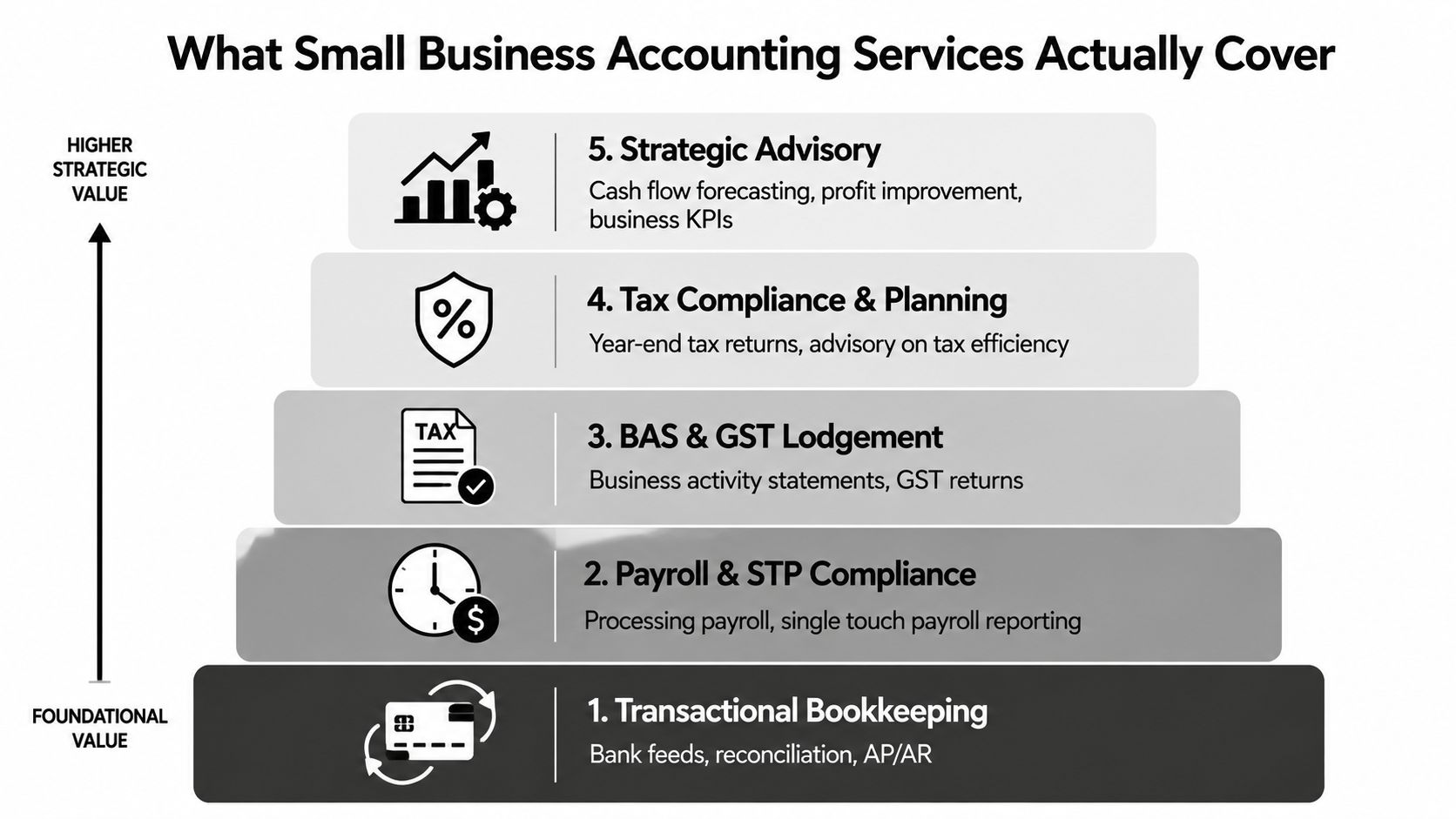
Accounting services for small business should scale with the decisions your business must make. Start with accurate transaction processing, then add compliance, reporting and decision support as complexity grows. Buying strategic advice before the records work is wasteful. Staying with basic bookkeeping while cash and margins become harder to control leaves profit exposed.
Level one is transactional bookkeeping
Bookkeeping covers bank-feed management, transaction coding, reconciliation, accounts payable and accounts receivable. The result should be current records that match bank activity, with unpaid invoices and upcoming bills clearly identified.
This level suits a straightforward sole trader or small company with limited transaction volume. It fails when the owner cannot trust the profit figure, supplier balances are stale, or the bank feed contains uncategorised and duplicated entries. At that point, the problem is not data entry alone. It is the lack of reliable information for cash decisions.
Set clear ownership from the start. Your provider should state who approves bills, who follows up customers and who reviews reconciliations. Technically complete bookkeeping still leaves cash stuck if no one owns collections.
Level two adds payroll and STP
Payroll involves more than transferring wages. The process must handle accurate employee data, pay categories, leave treatment, superannuation and Single Touch Payroll reporting. Once employees are involved, errors can damage trust and create correction work.
Some firms include payroll processing in a monthly package. Others charge per employee or pay run. Confirm what happens with new starter setup, termination calculations, corrections and year-end finalisation before signing. These details determine whether the advertised fee reflects the work your team needs.
Level three covers BAS and GST
BAS preparation involves reviewing GST coding, sales, purchases, PAYG withholding and other relevant activity. The reporting cycle depends on the business's circumstances, while PAYG instalments also affect cash planning.
Treat BAS as a control point, not form filling. GST classification errors can distort pricing, cash forecasts and management reports. The ATO's small business benchmarks give accountants a way to compare expense patterns with industry expectations, then investigate the operational reasons for unusual results.
Level four is tax compliance and planning
Year-end tax work includes preparing returns and finalising accounts. Good planning happens during the year, before decisions are locked in. Your adviser should examine the tax consequences of major purchases, asset decisions, changes in entity structure and distributions.
Ask whether tax planning is included, scheduled separately or billed as advisory work. A low monthly fee can become expensive when every useful conversation sits outside the engagement.
Level five is strategic advisory
Strategic advisory turns financial data into operating decisions. Services can include 13-week cash-flow forecasting, margin analysis by product or job, inventory review, scenario modelling, KPI reporting and virtual CFO support.
A virtual CFO makes sense when the business has multiple revenue streams, material working-capital pressure, management reporting needs or external funding conversations. Revenue alone should not decide the purchase. Complexity and the cost of a wrong decision matter more.
For a broader view of the shift from compliance work to decision support, review accounting business advisory services. Before engaging a firm, request a written scope showing what is bundled, what a qualified accountant reviews, what needs owner approval and what creates an extra fee. Buy the service that fixes your current constraint first, then expand the engagement as the business earns that complexity.
The Impact on Cash Flow and Business Survival
A business can show healthy sales and still miss payroll because cash arrives late, margins have slipped, or tax obligations were never scheduled. Accounting earns its keep by changing those decisions early, not by producing another set of historical forms.
The RBA's insolvency analysis shows why small businesses need tighter liquidity control. At least three-quarters of companies entering insolvency are small businesses, while approximately 0.5% of all businesses entered insolvency during 2024, according to the Reserve Bank of Australia. A modest shortfall can therefore become an operational crisis when the owner has no forward view of receipts, wages, suppliers and tax.
Three mechanisms protect cash and profit
Receivables control begins with accurate invoices, clear payment terms, scheduled reminders and an assigned escalation process. Basic bookkeeping can show which customers owe money. Your adviser should help make collection ownership part of the weekly operating rhythm, so overdue accounts receive action before they restrict purchasing or payroll.
Margin control needs more than a total profit figure. Reporting by product, project or service line can expose underquoted work, rework, unproductive labour, stock shrinkage and supplier cost increases. The ATO benchmark framework gives accountants a reference point for investigating expenses outside expected industry patterns, rather than accepting “costs are high” as an explanation. For businesses with turnover above $600,000, the relevant expense range is typically 75% to 86% of turnover, based on benchmark data discussed by the RBA. Use that comparison to prompt investigation, not to replace business-specific analysis.
Tax timing places GST, PAYG, superannuation and income-tax commitments beside customer receipts and supplier payments in the cash forecast. The aim is straightforward: schedule predictable obligations before they compete with wages, stock purchases or other operating costs.
Metric | DIY or basic bookkeeping | Professional accounting services | Impact |
|---|---|---|---|
Receivables | Outstanding invoices are reported periodically | Collection actions are assigned and reviewed | Faster visibility of cash trapped in debtors |
Margin | Profit is reviewed at total-business level | Costs are mapped to jobs, products or services | Earlier detection of pricing and leakage issues |
Tax timing | Obligations are handled near deadlines | Tax commitments sit inside the cash forecast | Fewer avoidable liquidity surprises |
Forecasting | Bank balance guides decisions | Short-horizon inflows and outflows are modelled | Better control over supplier and payroll timing |
Reporting | Historical accounts answer what happened | Management reports support what to do next | Faster, more disciplined decisions |
The accounting fee should be judged against the cash and margin decisions it enables, not the number of forms submitted. Buy receivables reporting and a short-horizon forecast first if cash is tight. Add margin analysis when pricing or delivery costs are unclear.
For practical guidance, review small-business cash-flow problems. Start with visibility, then assign action for collections, costs and payment timing.
Pricing Models and What You Should Expect to Pay
A café owner may compare a low bookkeeping quote with a higher advisory fee while supplier bills, payroll and equipment purchases compete for the same cash. The right question is not, “What is the cheapest monthly fee?” It is, “Which service prevents cash delays and margin leakage?”
Australian accounting firms typically charge by the hour, through a fixed monthly retainer or with a value-based package. Choose the model after defining the decisions and reporting your business needs.
Hourly billing
Hourly pricing suits contained work, including historical clean-up, a one-off structure review or an ATO matter. It gives flexibility, but a messy ledger, late records or repeated questions can increase the invoice without improving business performance.
Use hourly work for projects with a clear scope, starting point and finish line. Avoid making it the default for recurring bookkeeping, payroll and reporting when predictable cash planning matters.
Fixed monthly retainers
A retainer suits recurring services. The agreement should state transaction volumes, reconciliation frequency, payroll scope, BAS preparation, management reports, meeting cadence and response expectations.
Vague scope creates the largest risk. “Ongoing support” can mean basic processing at one firm and active financial management at another. Get exclusions in writing, including catch-up work, software subscriptions, payroll corrections, extra entities and year-end adjustments. Ask which reports arrive each month and who reviews them with you.
Value-based packages
A value-based package combines compliance with decision support, such as a cash forecast, margin review and monthly management meeting. It costs more than basic processing because the work is intended to change purchasing, pricing, collection and hiring decisions.
Published pricing varies by provider and complexity. Treat market ranges as discussion points, not promises. Transaction volume, payroll structure, inventory, entity count and reporting requirements will shape the final quote.
Tier | Monthly cost | Typical inclusions | Best for |
|---|---|---|---|
Basic bookkeeping | AUD $300 to $600 | Bank feeds, reconciliations, basic AP and AR | Simple operations with limited complexity |
Compliance plus BAS | AUD $800 to $1,500 | Bookkeeping, payroll processes, BAS and routine tax support | Businesses with employees and recurring compliance |
Virtual CFO engagement | AUD $2,500 to $6,000 or more | Forecasting, KPIs, management reporting and advisory | Growth-stage or complex businesses needing decision support |
Buy services in order of financial risk. If cash is tight, start with receivables visibility and a short-horizon forecast. Add margin analysis when job, product or delivery costs are unclear. Businesses approaching material scale should compare advisory fees with delayed decisions, missed collections and unexamined leakage.
For guidance on the role and scope of a virtual chief financial officer, assess which decisions the engagement will improve. If your business buys equipment or manages large operational purchases, Simply Hospitality payment options offers a practical prompt for considering payment timing without treating every purchase as an immediate cash expense.
How to Evaluate and Choose the Right Accounting Provider
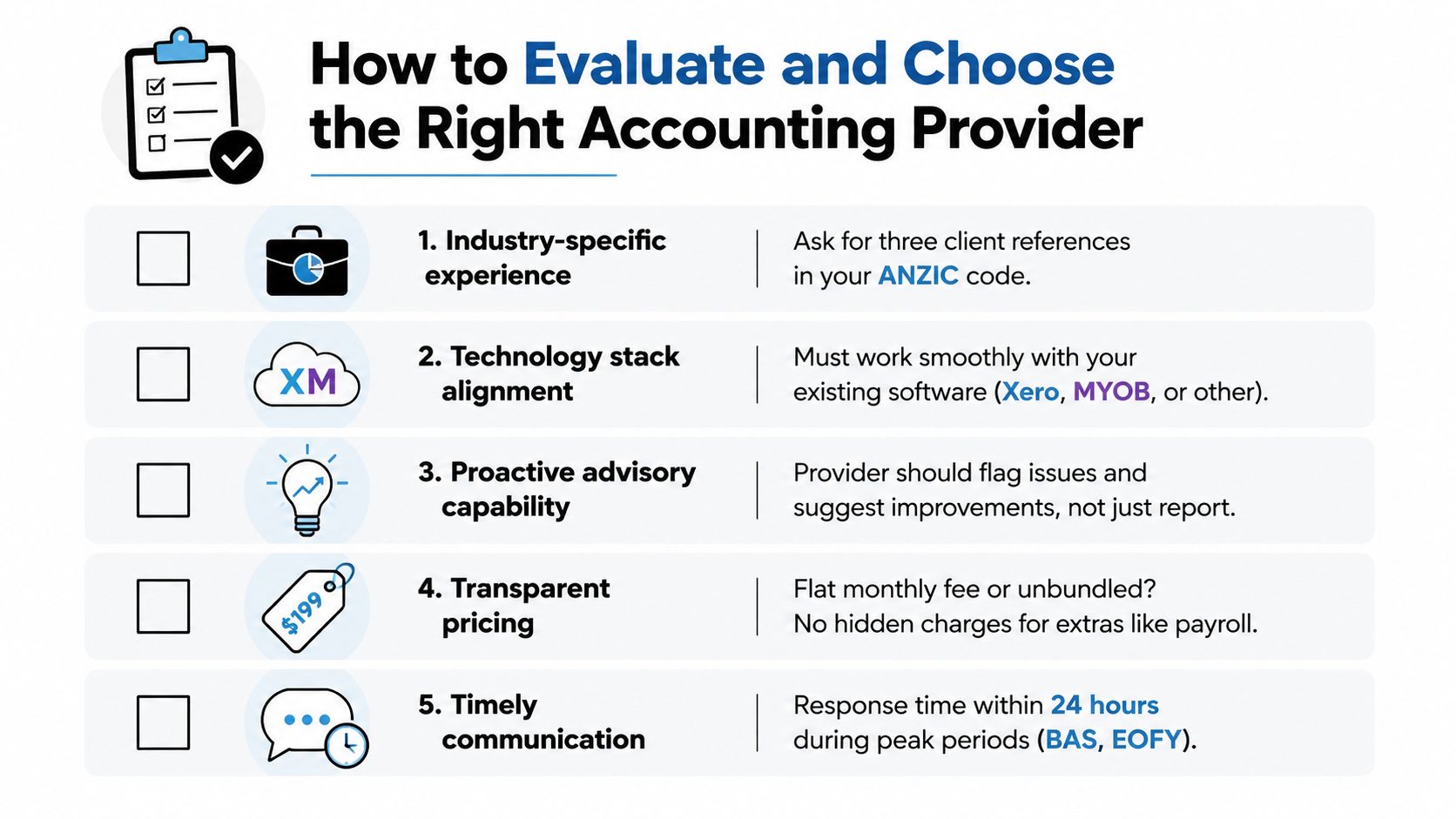
Choose an accountant who understands how your business makes and loses money. Accurate data entry is only the baseline. Your provider should question pricing, debtor behaviour, stock levels and margin leakage, then connect those findings to cash decisions.
Five essential checks
Industry experience: Ask about relevant experience in your ANZSIC code and request three suitable client references where confidentiality allows.
Technology alignment: Confirm the firm works confidently with Xero, MYOB or QuickBooks, plus your connected payroll, invoicing and inventory tools.
Advisory capability: Ask for an example of a problem they identified and helped fix, rather than a list of compliance services.
Fee transparency: Require a written scope, exclusions, software costs and pricing for additional work.
Communication discipline: Agree on response times, reporting dates and meeting frequency before the engagement begins.
Check relevant Australian credentials. Depending on the work, that may include CPA, CA ANZ or IPA membership. Confirm that the person responsible for tax work is an ATO-registered tax agent.
Questions that reveal the depth of service
Take these questions into the discovery call:
Who performs the day-to-day work, and who reviews it?
How do you handle an ATO review or audit?
What does your monthly management report include?
How do you build and update a 13-week cash forecast?
How do you identify margin leakage by job, product or location?
Which payroll and STP tasks are included?
What happens when records arrive late?
Which software licences are included or passed through?
How do you flag potential R&D tax incentive eligibility?
What must the owner approve or provide each month?
Ask how the provider turns reporting into action. For businesses managing equipment or large operational purchases, Simply Hospitality payment options can prompt a useful discussion about payment timing and cash commitments.
Red flags include a quote issued without reviewing recent BAS lodgements, undisclosed offshore outsourcing, and an engagement letter with no clear scope boundary. Your provider should challenge weak assumptions respectfully. If every answer is “we'll process that for you”, you are buying administration rather than accountability.
Implementation Checklist and KPIs for the First 90 Days
A new accounting provider won't improve the business by taking over the inbox. The first 90 days should create clean data, reliable reporting and an agreed decision rhythm.
Days 1 to 30 establish the base
Start with data migration, chart-of-accounts cleanup, bank-feed reconciliation and opening-balance verification. The owner must provide system access, historical records, bank statements, loan details and approval rules. The provider owns the technical review and documents unresolved gaps.
Don't rush this stage. Opening balances that carry old errors into a new system will undermine every later report.
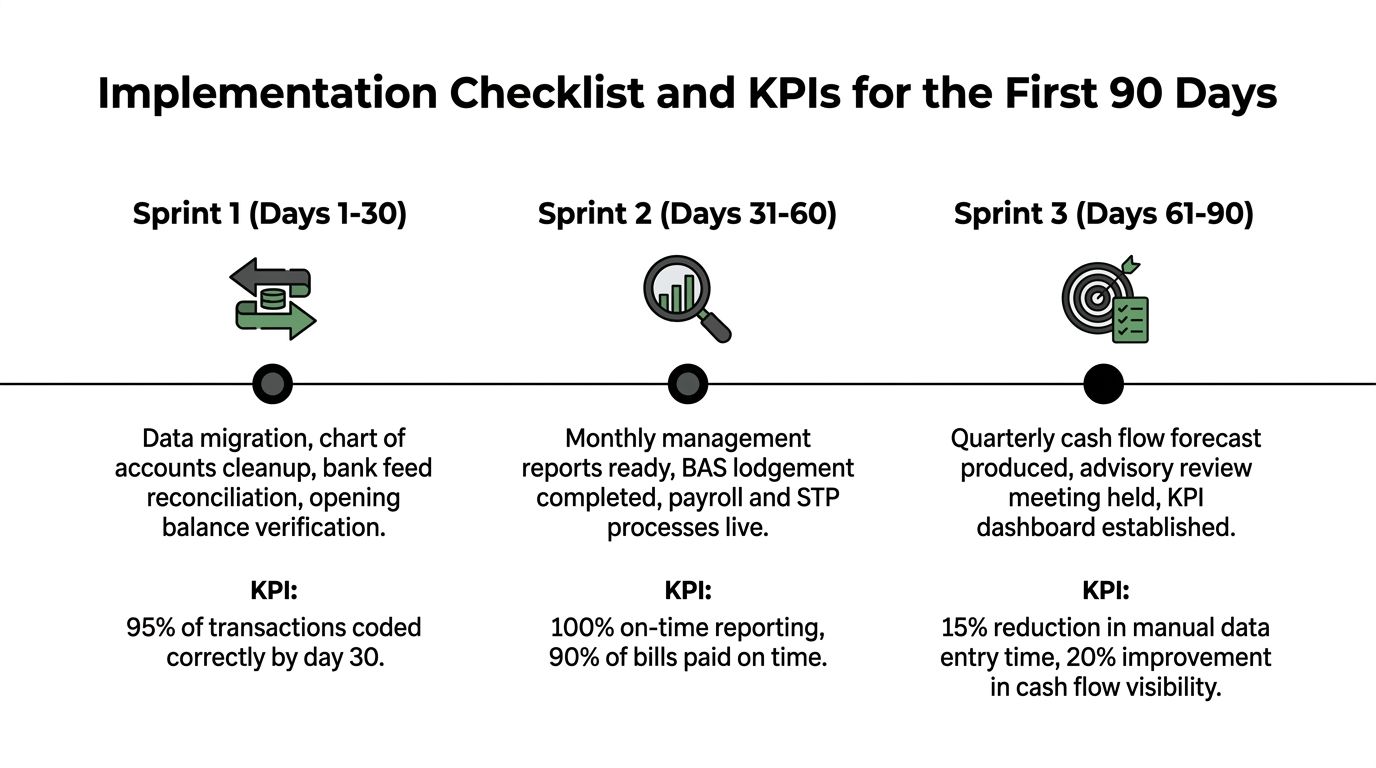
Days 31 to 60 make compliance dependable
Run a payroll audit, review GST codes, establish the reporting calendar and complete the first clean BAS process. Build a baseline cash-flow forecast using known receivables, supplier commitments, wages and tax obligations.
The business owner approves payroll, invoices and payment priorities. The provider prepares reconciliations, reporting and exception lists, then records what needs a decision.
Days 61 to 90 turn reports into action
Set a monthly management-reporting cadence, establish the KPI dashboard and hold the first advisory strategy session. The meeting should cover cash, margin, debtors, upcoming obligations and decisions, not just whether the accounts are reconciled.
Track these measures from the beginning:
Days sales outstanding: Monitor how long customer invoices remain unpaid.
Gross margin: Review performance by product, service or job where the system supports it.
Cash runway: Express available cash against expected near-term commitments.
BAS accuracy: Track corrections, rework and avoidable classification issues.
Payroll errors: Record corrections, missed items and employee queries.
Monthly close time: Measure how quickly reliable reports become available.
Forecast variance: Compare expected and actual cash movements, then explain the gap.
The supplied implementation targets in the roadmap visual should be treated as operating goals, not universal industry benchmarks. ATO benchmark data is better used to investigate unusual expense patterns than to set a single target for every business.
Activity | Owner | Accounting provider | Shared outcome |
|---|---|---|---|
System access and source records | Responsible | Consulted | Complete data set |
Chart of accounts and reconciliations | Consulted | Responsible | Reliable ledger |
Invoice approval and collections | Responsible | Supports | Better receivables control |
Payroll inputs and approvals | Responsible | Responsible for processing and reporting | Accurate payroll |
BAS preparation | Consulted and approves | Responsible for preparation | Timely, supportable lodgement |
Cash forecast decisions | Accountable | Prepares and explains | Planned payment timing |
KPI review | Accountable | Facilitates and interprets | Decisions linked to numbers |
Next Steps to Regain Control of Your Finances
The right starting point depends on the business you're running. A solo trader should prioritise automated bookkeeping, reconciliations and BAS support. A growing employer needs payroll control and cash-flow forecasting. An established SME with complex operations or board and funding requirements should consider virtual CFO support and management reporting.
The Australian small-business base is large and still expanding, while the RBA's insolvency analysis shows why liquidity controls matter. That makes accounting a management system, not a grudge purchase.
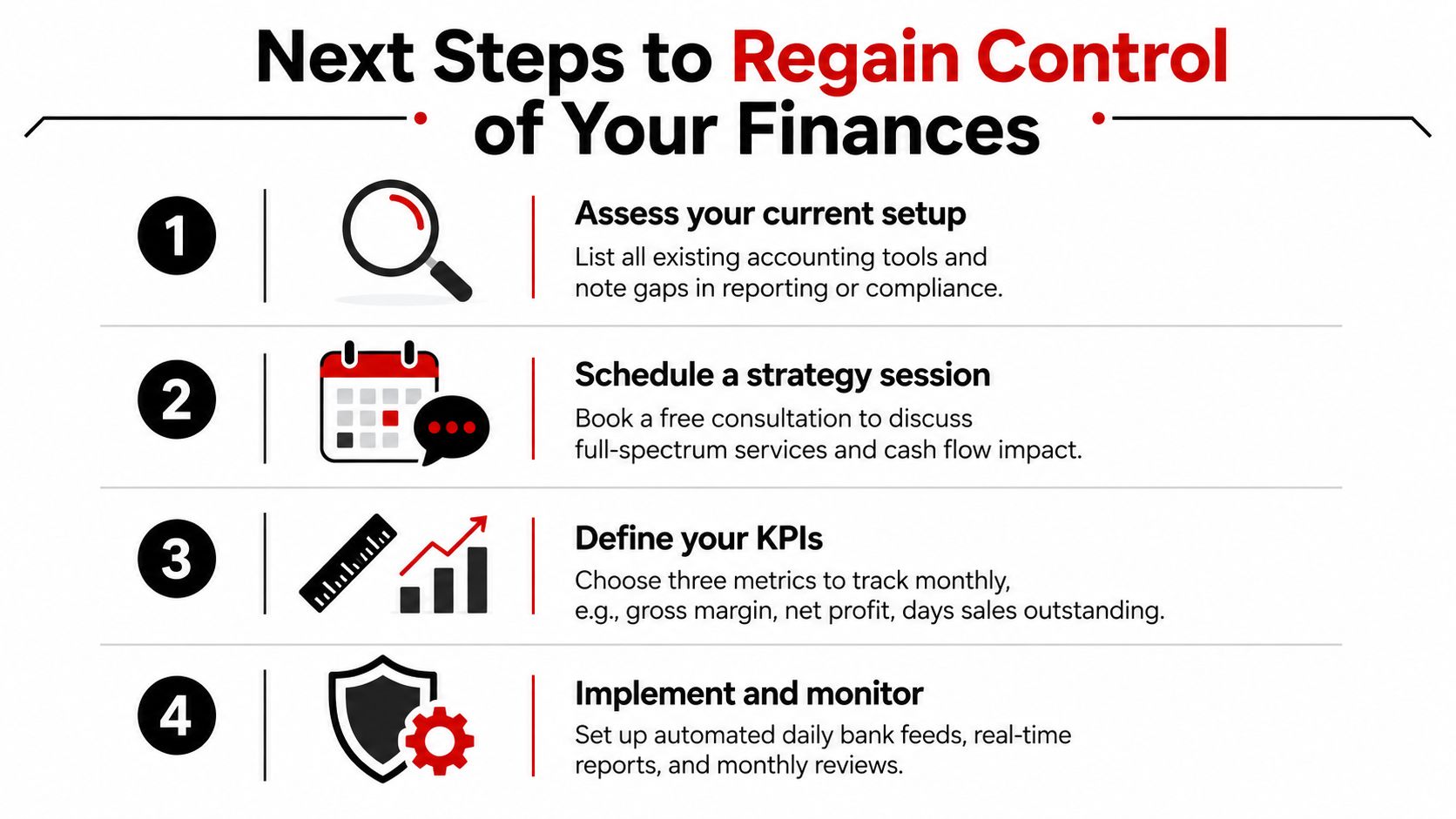
Take three actions this week:
Audit current value: List what you pay for, what arrives each month and which decisions the information supports.
Find the largest cash leak: Check late receivables, weak pricing, excess stock, payroll leakage or supplier timing.
Book two discovery calls: Use the provider questions above and compare scope, communication and advisory depth.
The cheapest provider can become expensive when the books hide margin leakage or cash commitments. Choose the engagement that gives you reliable numbers early enough to act.
Nexist helps Australian founders with bookkeeping, BAS, payroll, cash-flow forecasting, KPI reporting and virtual CFO support, with the focus on turning financial information into practical operating decisions. Visit Nexist to discuss where your current accounting setup is losing time, cash or margin, and decide what support should come first.
accounting services, small business accounting, virtual CFO, bookkeeping Australia, cash flow management

" width="24px"/><g d="M 0 24.129 L 0 0.129 L 24 0.129 L 24 24.129 Z M 0 24.129 L 0 0.129 L 24 0.129 L 24 24.129 Z M 24 3 C 24 1.344 22.656 0 21 0 L 3 0 C 1.344 0 0 1.344 0 3 L 0 21 C 0 22.656 1.344 24 3 24 L 21 24 C 22.656 24 24 22.656 24 21 Z M 6.883 8.375 L 2.863 8.375 L 2.863 20.467 L 6.883 20.467 Z M 4.899 2.545 C 3.524 2.545 2.625 3.449 2.625 4.634 C 2.625 5.795 3.496 6.724 4.846 6.724 L 4.872 6.724 C 6.273 6.724 7.146 5.795 7.146 4.634 C 7.12 3.449 6.274 2.545 4.899 2.545 Z M 16.747 8.09 C 14.614 8.09 13.659 9.263 13.124 10.086 L 13.124 8.374 L 9.105 8.374 C 9.159 9.508 9.105 20.466 9.105 20.466 L 13.124 20.466 L 13.124 13.713 C 13.124 13.352 13.15 12.99 13.257 12.732 C 13.547 12.01 14.209 11.262 15.319 11.262 C 16.773 11.262 17.355 12.372 17.355 13.996 L 17.355 20.466 L 21.374 20.466 L 21.374 13.532 C 21.374 9.818 19.391 8.09 16.747 8.09 Z" fill="transparent" height="24.12890599668026px" id="dSFdkJotL" width="24px"><path d="M 0 24 L 0 0 L 24 0 L 24 24 Z" fill="transparent" height="24px" id="wscNJE44G" transform="translate(0 0.129)" width="24px"/><g d="M 0 24.129 L 0 0.129 L 24 0.129 L 24 24.129 Z M 24 3 C 24 1.344 22.656 0 21 0 L 3 0 C 1.344 0 0 1.344 0 3 L 0 21 C 0 22.656 1.344 24 3 24 L 21 24 C 22.656 24 24 22.656 24 21 Z M 6.883 8.375 L 2.863 8.375 L 2.863 20.467 L 6.883 20.467 Z M 4.899 2.545 C 3.524 2.545 2.625 3.449 2.625 4.634 C 2.625 5.795 3.496 6.724 4.846 6.724 L 4.872 6.724 C 6.273 6.724 7.146 5.795 7.146 4.634 C 7.12 3.449 6.274 2.545 4.899 2.545 Z M 16.747 8.09 C 14.614 8.09 13.659 9.263 13.124 10.086 L 13.124 8.374 L 9.105 8.374 C 9.159 9.508 9.105 20.466 9.105 20.466 L 13.124 20.466 L 13.124 13.713 C 13.124 13.352 13.15 12.99 13.257 12.732 C 13.547 12.01 14.209 11.262 15.319 11.262 C 16.773 11.262 17.355 12.372 17.355 13.996 L 17.355 20.466 L 21.374 20.466 L 21.374 13.532 C 21.374 9.818 19.391 8.09 16.747 8.09 Z" fill="transparent" height="24.12890599668026px" id="sTpjGo1tb" width="24px"><path d="M 0 24 L 0 0 L 24 0 L 24 24 Z" fill="transparent" height="24px" id="s7ffpmKOD" transform="translate(0 0.129)" width="24px"/><g d="M 24 3 C 24 1.344 22.656 0 21 0 L 3 0 C 1.344 0 0 1.344 0 3 L 0 21 C 0 22.656 1.344 24 3 24 L 21 24 C 22.656 24 24 22.656 24 21 Z M 6.883 8.375 L 2.863 8.375 L 2.863 20.467 L 6.883 20.467 Z M 4.899 2.545 C 3.524 2.545 2.625 3.449 2.625 4.634 C 2.625 5.795 3.496 6.724 4.846 6.724 L 4.872 6.724 C 6.273 6.724 7.146 5.795 7.146 4.634 C 7.12 3.449 6.274 2.545 4.899 2.545 Z M 16.747 8.09 C 14.614 8.09 13.659 9.263 13.124 10.086 L 13.124 8.374 L 9.105 8.374 C 9.159 9.508 9.105 20.466 9.105 20.466 L 13.124 20.466 L 13.124 13.713 C 13.124 13.352 13.15 12.99 13.257 12.732 C 13.547 12.01 14.209 11.262 15.319 11.262 C 16.773 11.262 17.355 12.372 17.355 13.996 L 17.355 20.466 L 21.374 20.466 L 21.374 13.532 C 21.374 9.818 19.391 8.09 16.747 8.09 Z" fill="transparent" height="24.000006px" id="D0ecaHEcW" transform="translate(0 0)" width="24px"><path d="M 24 3 C 24 1.344 22.656 0 21 0 L 3 0 C 1.344 0 0 1.344 0 3 L 0 21 C 0 22.656 1.344 24 3 24 L 21 24 C 22.656 24 24 22.656 24 21 Z" fill="rgb(55, 184, 218)" height="24.000006px" id="IPLFE6zXx" width="24px"/><path d="M 4.02 0 L 0 0 L 0 12.092 L 4.02 12.092 Z" fill="rgb(255, 255, 255)" height="12.09201px" id="FWhtzAyuY" transform="translate(2.863 8.375)" width="4.02px"/><path d="M 2.274 0 C 0.899 0 0 0.904 0 2.089 C 0 3.25 0.871 4.179 2.221 4.179 L 2.247 4.179 C 3.648 4.179 4.521 3.25 4.521 2.089 C 4.495 0.904 3.649 0 2.274 0 Z" fill="rgb(255, 255, 255)" height="4.17876px" id="VmOsKv4kO" transform="translate(2.625 2.545)" width="4.52095px"/><path d="M 7.641 0 C 5.509 0 4.554 1.173 4.019 1.996 L 4.019 0.284 L 0 0.284 C 0.053 1.419 0 12.376 0 12.376 L 4.019 12.376 L 4.019 5.623 C 4.019 5.262 4.045 4.9 4.151 4.642 C 4.442 3.92 5.103 3.172 6.214 3.172 C 7.667 3.172 8.25 4.282 8.25 5.907 L 8.25 12.376 L 12.269 12.376 L 12.269 5.442 C 12.269 1.728 10.286 0 7.641 0 Z" fill="rgb(255, 255, 255)" height="12.37626px" id="n1XUbhaq0" transform="translate(9.105 8.09)" width="12.268830000000001px"/></g></g></g></g></svg>)