
Cash Flow Management: A Practical Playbook for Owners
A practical cash flow management playbook for Australian founders. Diagnose leaks, forecast, fix receivables, and decide when to bring in a virtual CFO.
Ansh Malhotra

You've made a profit, but payroll is due Friday, BAS is approaching, and the bank balance doesn't support either. Your P&L looks healthy because sales have been recorded, yet customers haven't paid, stock has already been purchased, GST is sitting in the operating account, and recurring expenses have expanded. This is the point where cash flow management stops being a bookkeeping exercise and becomes an operating discipline.
Australian owners have plenty of company. Nearly 80% of Australian small and medium businesses reported that cash flow was impacted in the previous 12 months, with declining revenue, low cash reserves and seasonal fluctuations among the most common causes, according to UNSW's summary of Australian small-business cash flow pressures. The solution isn't another attractive spreadsheet that nobody updates. Forecasting should diagnose the problem, then pricing, stock, collections, supplier terms, processes and accountability should fix it.
Table of Contents
Why Profitable Businesses Still Run Out of Cash
Profit and cash answer different questions. Profit asks whether revenue exceeds expenses under accounting rules. Cash asks whether money has arrived in the bank before wages, rent, tax, suppliers and loan repayments fall due.
A sale can appear in revenue when you issue an invoice, but the customer may pay weeks later. GST collected from customers may belong to the ATO, not the business. Inventory can absorb cash long before the product is sold, while depreciation reduces accounting profit without creating a cash outflow in the current period.
The three structural gaps
Receivable lag is the first leak. You deliver the work, carry the cost of labour and materials, and wait for payment. A growing sales ledger can therefore create more pressure, not less, if collections don't keep pace.
Inventory lock-up is the second. Ecommerce, retail, wholesale and manufacturing owners often read stock purchases as growth investment. Some stock is necessary, but excess units turn cash into shelves, pallets and aged products that may later require discounting.
Fixed-cost creep is the third. New software, additional staff, larger premises, marketing retainers and outsourced services often arrive disguised as growth spend. If the revenue lift doesn't arrive quickly enough, the business carries a higher monthly cash requirement before it has earned the right to do so.
Practical rule: A profitable business can still fail if its collection cycle, stock cycle and payment schedule are badly timed.
Australian evidence makes this a recurring operating issue rather than a rare emergency. Xero-related Australian SME reporting found that 92% of small businesses experienced at least one month of negative cash flow in 2021, while the average small business spent 4.2 months of the year with more money leaving than entering. The data is summarised in Australian SME cash flow reporting from ScaleSuite.
The fix is layered. First, diagnose where cash is trapped. Then build a forecast that shows the timing and severity of the gap. Finally, attack the four operating levers that move the bank balance: receivables, payables, inventory and pricing. The diagnostic comes next, because forecasting without clean questions just produces organised confusion.
Run a 7-Day Cash Diagnostic Before You Forecast Anything
Don't begin with a blank forecast template. Spend one week finding the transactions and decisions that changed your bank balance.
Days one and two
Pull the last 90 days of bank statements and tag every outflow. Use practical categories such as COGS, payroll, tax, loan repayments, owner drawings, rent, software, marketing and discretionary spend. Don't accept vague labels such as “business expense”. The owner needs to know whether the largest drains came from stock, labour, tax, debt or optional spending.
On the second day, reconcile the P&L to cash. Mark non-cash items such as depreciation and accrued revenue, then identify timing items including unpaid invoices, stock received but not invoiced, prepaid expenses and bills recorded after payment. This exercise explains why the P&L and bank balance disagree.
Days three to five
Review the balance sheet with a short list of uncomfortable questions:
Receivables: Which customers are older than 60 days, and who approved their terms?
Payables: Which supplier bills fall due inside 14 days, and which can be scheduled without breaching an agreement?
Inventory: Has stock grown faster than sales, and which SKUs have stopped moving?
Owner funding: Has the owner been using personal savings, credit cards or unpaid labour to keep operations moving?
The Australian survey cited by UNSW found that 85% of businesses used at least one cash-flow strategy, including expense cuts, cash reserves and new revenue streams. It also found that 27% dipped into personal savings or didn't pay themselves a salary, a clear warning that business cash pressure quickly becomes household pressure. See the UNSW Australian small-business cash flow findings for the full context.
Days six and seven
Calculate DSO, DPO and the cash conversion cycle, even if the first result is approximate. The direction matters. Rising DSO means customers are taking longer to pay. Falling DPO may mean suppliers are demanding cash sooner. A longer cash conversion cycle means more working capital is trapped between purchase and collection.
Finish by ranking the top five cash drains by dollar value, then assign an owner and a first action to each. Your output should be a short action list, not a polished report.
Day | Action | Data Source | Output |
|---|---|---|---|
One | Pull and categorise bank outflows | Bank statements | Cash-spend categories |
Two | Reconcile profit to cash | P&L, balance sheet, bank | Timing and non-cash adjustments |
Three | Review receivables | Aged debtor report | Collection priorities |
Four | Review payables | Aged creditor report | Near-term payment obligations |
Five | Review stock movement | Inventory report, sales data | Slow and excess stock list |
Six | Calculate DSO, DPO and cash conversion cycle | Accounting and sales records | Working-capital trend |
Seven | Rank the five largest drains | All diagnostic outputs | First 30-day action plan |
Build a Rolling 13-Week Forecast That Actually Drives Decisions
A rolling 13-week forecast is useful because it forces timing into the conversation. Build it with weekly columns, not monthly averages. Monthly figures hide the Friday payroll problem that appears clearly in a weekly view.
Start each week with the opening bank balance. Add expected inflows, split by customer where concentration creates risk. If one customer represents more than 20% of expected receipts, show that customer separately rather than blending the amount into a single sales line. Then list outflows by payroll, COGS, tax, loan repayments, owner drawings, rent and committed purchases.

Use operational drivers, not hopeful guesses
Expected receipts should reflect actual debtor behaviour. Apply collection rates by week, customer and invoice age. A customer who routinely pays late shouldn't sit in the forecast on the contractual due date.
Outflows need the same treatment. Map supplier terms, payroll dates, BAS and tax obligations, loan schedules, stock reorder timing and seasonal patterns. For an inventory-heavy business, a planned purchase order belongs in the forecast before the supplier invoice arrives. For a hospitality venue, roster commitments and event deposits need to sit beside expected takings.
A practical forecast includes three scenarios:
Best case: Strong collections, planned sales and no major disruption.
Expected case: The most defensible view based on current orders and payment behaviour.
Worst case: Slower receipts, weaker sales and every unavoidable cost still paid on time.
The worst case should dictate discretionary spending. If the business only survives under the best case, it doesn't have a spending plan. It has a gamble.
For a structured starting point, use this cash flow forecast template guidance and adapt the layout to your bank accounts, customers and payment cycles.
Make the forecast roll every Monday
Every Monday, remove the week that has just finished and add a fresh week 13. Replace estimates with actual receipts and payments. Compare forecast against actual, then investigate every material variance within seven days.
Add a red, amber or green flag to each week's closing balance. Green means the business can fund committed obligations. Amber means the owner must delay or approve spending deliberately. Red means the business needs a cash meeting, not another optimistic sales target.
A forecast that isn't updated from actual bank movements is not cash flow management. It's a document.
Plug the Four Cash Leaks Eating Your Bank Balance
Forecasting shows the shape of the problem. These four levers change it.
Receivables
Start with the invoice-to-cash process. Issue invoices immediately after delivery, define payment terms by customer risk, request deposits for work that consumes materials, and automate reminders before and after the due date.
Don't give every customer the same credit terms. A reliable repeat customer may earn flexibility. A new customer, a customer with weak payment history or a project with high upfront costs should face tighter terms, staged billing or a deposit.
Australian businesses continue to feel the effect of slow collection. Recent reporting found that 63% spend time chasing payments, 41% wait more than 14 days past due on average, and 34% used credit cards or loans because late payments affected cash flow, according to CommBank's small-business cash flow management material.
Thirty-day action: Set a credit policy, review every overdue debtor, add a reminder cadence, and require approval before extending terms to a high-risk customer. The trade-off is real. Aggressive deposits or daily chasing can damage a valuable relationship, so match the collection approach to customer value and risk.
Payables
Pay suppliers according to the forecast, not according to whoever sends the loudest email. Maintain a scheduled payment run, protect agreed terms and communicate early when a timing problem appears.
Negotiate terms that match your collection cycle. Use an early-payment discount only when the cash benefit exceeds the cost of the discount and the business has enough liquidity to take it. Paying early to feel organised can be expensive.
Thirty-day action: Create a creditor calendar, separate critical suppliers from discretionary vendors, and agree payment dates before invoices become overdue. Teams that need a more controlled process can use a practical roadmap for AP teams to organise approvals, payment scheduling and invoice visibility.
Inventory
Stock is cash with a barcode. Measure weeks of cover by SKU category, link reorder points to genuine sales velocity, and define a dead-stock threshold before the shelf becomes crowded.
Don't treat every product equally. Core products can justify tighter availability targets. Seasonal, fragile or trend-sensitive stock needs an age-based markdown trigger. Discounting too late creates a larger cash problem, but fire-sale pricing too early destroys margin.
Thirty-day action: Rank stock by movement, freeze reorders for slow lines, set an aged-stock review and release cash from items that no longer deserve working capital.
Pricing
Pricing is often the fastest lever, but owners fear customer reaction before modelling the contribution margin. Test a 4% to 7% margin lift across suitable products or service lines and model the effect on contribution, volume and cash conversion using the Australian cash-flow survey context from UNSW only as background for the broader pressure environment, not as evidence of a pricing result.
The volume-risk trap matters. A higher price that causes a sharp sales decline may reduce cash, while a targeted increase on low-sensitivity products, rush work or underpriced customer segments can improve it.
Thirty-day action: Identify underpriced offers, calculate contribution by product or job, test targeted changes, and remove work that consumes cash without adequate margin.
Lever | Typical Cash Impact | Effort | Key Trade-off |
|---|---|---|---|
Receivables | Faster conversion of earned revenue | Medium | Customer friction if terms become too rigid |
Payables | Better timing between receipts and payments | Medium | Supplier trust if communication fails |
Inventory | Cash released from excess stock | High | Lost sales or margin damage if reductions are poorly planned |
Pricing | More contribution from each sale | Medium | Volume loss if customers resist changes |
Reclaim 20+ Hours a Week With SOPs and Smart Automation
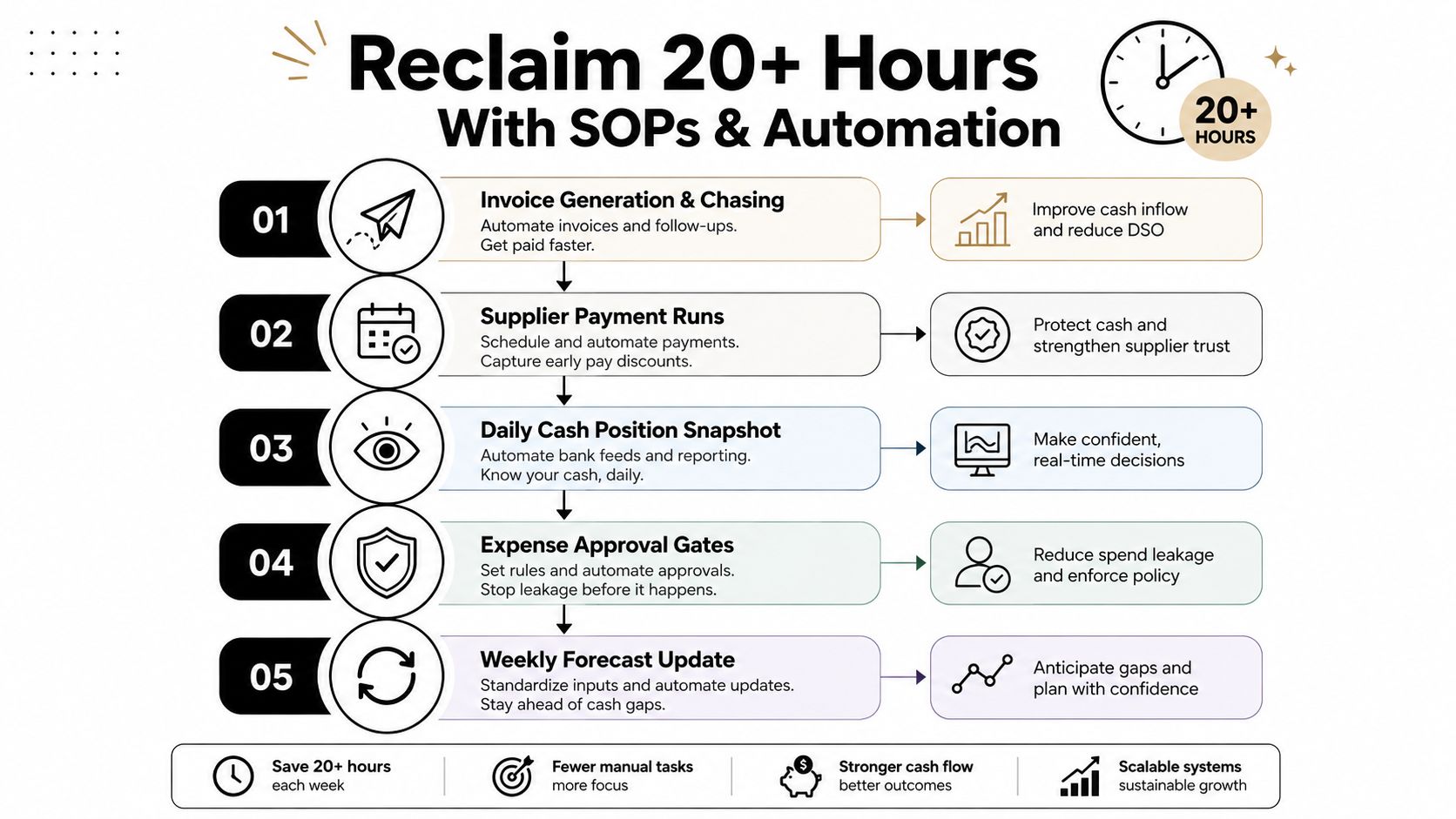
The owner shouldn't be the only person who knows which invoices to chase, which suppliers to pay or which bank transactions need review. Document the recurring rituals first, then automate the repeatable parts.
Write each SOP on one page. Include the trigger, owner, inputs, exact steps, exception rules and completion check. Assign a named team member, not “the finance team”.
Five rituals worth documenting
Invoice generation and chasing: The accounts administrator issues invoices, checks required purchase-order details, and follows the reminder sequence. The SOP should state when an invoice is sent, when a phone call replaces an email, and when the owner approves escalation.
Supplier payment runs: The finance owner or bookkeeper prepares the run, checks duplicate invoices and confirms approval limits. The SOP must distinguish critical suppliers from payments that can wait for the next forecasted inflow.
Bank reconciliation: A bookkeeper reviews bank-feed matches, investigates unknown transactions and clears exceptions. The process should include a daily cash-position snapshot for businesses with thin buffers.
Weekly forecast update: The finance lead replaces estimates with actuals, records variances and refreshes the scenario view. The owner reviews decisions, rather than spending the morning assembling data.
Debtor follow-up: A designated staff member works the aged receivables list, records contact outcomes and escalates disputed invoices. The SOP should separate a genuine dispute from simple avoidance.
Add automation after the process works
Use accounting-platform bank rules for recurring coding, automated invoice reminders at 7, 14 and 30 days, scheduled payment runs, and AI-assisted bank-feed categorisation. AI can also draft debtor email sequences in the owner's tone, but a person should approve sensitive messages and disputed-account responses.
For venues and event-heavy operators, reducing manual coordination across bookings, invoices and supplier details can support the wider objective of reducing admin time for hotel events. The principle applies beyond hospitality. Remove repeated data entry wherever the source information is stable.
Use this standard operating procedures guide to keep the documents short enough for staff to follow and specific enough to audit.
Automation without SOPs creates silent errors at scale. SOPs without automation create owner burnout. You need both if the aim is to reclaim 20+ hours a week and have the owner read the dashboard instead of producing it.
The KPIs and Weekly Cash Dashboard That Keep You Honest
A dashboard should answer three questions quickly. How much cash is available, what will happen before the next major obligations, and which person needs to act today?
Review these five measures every Monday:
Cash runway: Track available cash against committed operating outflows. Set a business-specific warning band, with 13 or more weeks as a strong planning threshold. If runway enters the warning zone, freeze discretionary spend and review financing options.
Days sales outstanding: Compare receivables with credit sales and track the trend. A 30-day target for most B2B businesses is a useful starting point, but customer contracts and industry cycles matter. If DSO rises, review the debtor list that day.
Days payable outstanding: Monitor how long the business takes to pay suppliers against agreed terms. A falling DPO can signal tighter supplier expectations or poor payment scheduling.
Inventory weeks of cover: Calculate cover separately by category. If slow stock carries more weeks than the category can justify, stop replenishment and activate an age-based sell-through plan.
Cash conversion cycle: Use the combined view of stock, receivables and payables to identify whether working capital is improving or deteriorating.
Build the Monday view
Put the opening bank balance at the top. Under it, show forecast versus actual variance for the prior week, then place the KPI tiles in one row. Finish with the top three debtor actions and top three creditor actions, each with a named owner and due date.
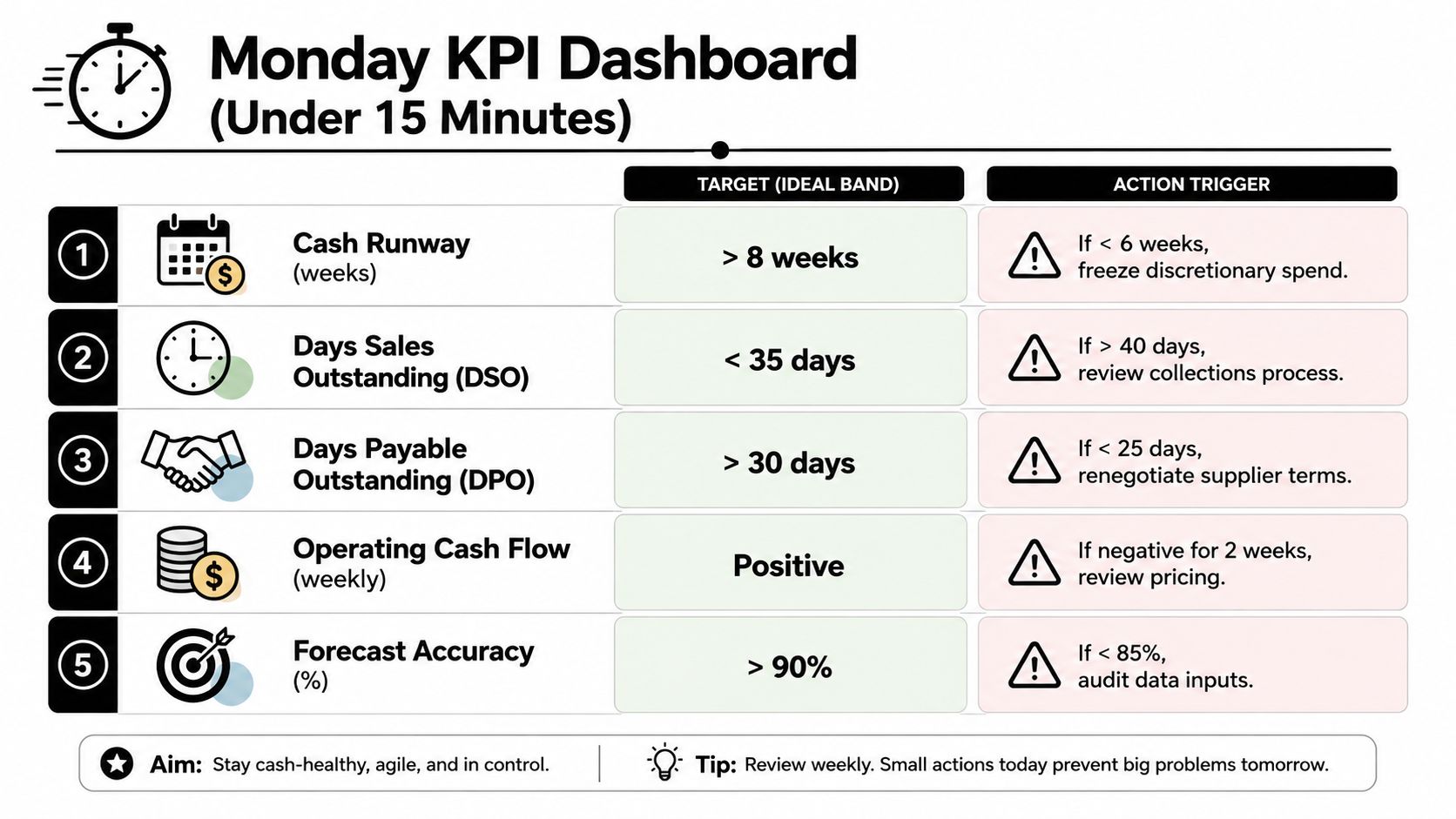
Use a simple breach protocol. An amber KPI triggers a same-day owner review and a documented action. A red KPI triggers a cash meeting with the leadership team, where spending, collections, supplier timing and sales assumptions are decided together.
The dashboard only works if someone reads it. Put a 15-minute Monday ritual in the calendar and nominate a backup reader for holidays, illness and busy trading periods.
When to Stop DIY-ing and Bring in a Virtual CFO
DIY cash flow management has a ceiling. You've reached it when the owner is making decisions from incomplete data while also trying to sell, hire, deliver and solve every operational problem.
Use this challenge list:
You rely on an overdraft repeatedly instead of using it for a defined short-term purpose.
Your forecast regularly misses actual cash movements by more than 15%.
Revenue is growing faster than approvals, stock controls, debtor follow-up and reporting.
Suppliers are shortening terms, requesting payment before dispatch or placing accounts on hold.
The owner personally chases every invoice because nobody else owns collections.
A bookkeeper usually keeps records accurate and current. An accountant generally handles compliance, tax and reporting. A virtual CFO takes responsibility for decision support, including rebuilding the 13-week forecast, redesigning AR and AP, modelling scenarios, preparing banker or investor reporting, and turning KPIs into operating actions.
Task | DIY Owner | Bookkeeper | Virtual CFO |
|---|---|---|---|
Transaction coding and reconciliation | Oversees or completes | Completes | Designs controls and reviews exceptions |
Invoicing and debtor follow-up | Often personally involved | Processes or supports | Redesigns terms, escalation and reporting |
BAS, tax and compliance | Approves information | Prepares records | Coordinates financial implications |
Rolling cash forecast | Builds or updates | Supplies data | Owns model, scenarios and decisions |
Pricing, stock and working capital | Makes informal calls | Reports historical data | Models trade-offs and execution priorities |
Banker, investor and board reporting | Usually reactive | Produces basic reports | Builds decision-ready reporting |
A virtual assistant can handle defined administrative tasks, such as inbox sorting and invoice follow-up, through virtual assistant services. That support is useful, but it isn't a substitute for financial ownership, scenario modelling or control design.
Choose the right upgrade
Stay DIY if your records are reliable, cash is stable, the owner can review the dashboard weekly and the business has a clear process owner for each ritual. Upgrade tooling first if the data is sound but manual entry consumes the owner's time.
Bring in fractional CFO support when the business needs an integrated forecast, working-capital intervention and management accountability. A practical onboarding sequence is straightforward:
First 30 days: Clean the data, complete the cash diagnostic, rebuild the forecast and identify the largest leaks.
Days 31 to 60: Redesign collections, supplier scheduling, stock decisions, pricing tests and approval controls.
Days 61 to 90: Embed the dashboard, scenario rhythm, SOP ownership and leadership reporting.
For a clearer view of the role, review this guide to a virtual chief financial officer. Nexist offers forecasting, cash-flow management, performance reporting, KPI design, working-capital reviews and operational systems that connect financial information with weekly decisions.
If cash is tight, start with the seven-day diagnostic, then build the rolling forecast and rank your five largest leaks by value. Nexist can help Australian founders turn those findings into a working cash system across forecasting, collections, inventory, pricing and SOP automation. Visit Nexist to arrange a practical Business Scorecard and identify the next actions that can put more cash back in the bank.
cash flow management, small business cash flow, cash flow forecast, virtual CFO Australia, cash flow KPIs

" width="24px"/><g d="M 0 24.129 L 0 0.129 L 24 0.129 L 24 24.129 Z M 0 24.129 L 0 0.129 L 24 0.129 L 24 24.129 Z M 24 3 C 24 1.344 22.656 0 21 0 L 3 0 C 1.344 0 0 1.344 0 3 L 0 21 C 0 22.656 1.344 24 3 24 L 21 24 C 22.656 24 24 22.656 24 21 Z M 6.883 8.375 L 2.863 8.375 L 2.863 20.467 L 6.883 20.467 Z M 4.899 2.545 C 3.524 2.545 2.625 3.449 2.625 4.634 C 2.625 5.795 3.496 6.724 4.846 6.724 L 4.872 6.724 C 6.273 6.724 7.146 5.795 7.146 4.634 C 7.12 3.449 6.274 2.545 4.899 2.545 Z M 16.747 8.09 C 14.614 8.09 13.659 9.263 13.124 10.086 L 13.124 8.374 L 9.105 8.374 C 9.159 9.508 9.105 20.466 9.105 20.466 L 13.124 20.466 L 13.124 13.713 C 13.124 13.352 13.15 12.99 13.257 12.732 C 13.547 12.01 14.209 11.262 15.319 11.262 C 16.773 11.262 17.355 12.372 17.355 13.996 L 17.355 20.466 L 21.374 20.466 L 21.374 13.532 C 21.374 9.818 19.391 8.09 16.747 8.09 Z" fill="transparent" height="24.12890599668026px" id="dSFdkJotL" width="24px"><path d="M 0 24 L 0 0 L 24 0 L 24 24 Z" fill="transparent" height="24px" id="wscNJE44G" transform="translate(0 0.129)" width="24px"/><g d="M 0 24.129 L 0 0.129 L 24 0.129 L 24 24.129 Z M 24 3 C 24 1.344 22.656 0 21 0 L 3 0 C 1.344 0 0 1.344 0 3 L 0 21 C 0 22.656 1.344 24 3 24 L 21 24 C 22.656 24 24 22.656 24 21 Z M 6.883 8.375 L 2.863 8.375 L 2.863 20.467 L 6.883 20.467 Z M 4.899 2.545 C 3.524 2.545 2.625 3.449 2.625 4.634 C 2.625 5.795 3.496 6.724 4.846 6.724 L 4.872 6.724 C 6.273 6.724 7.146 5.795 7.146 4.634 C 7.12 3.449 6.274 2.545 4.899 2.545 Z M 16.747 8.09 C 14.614 8.09 13.659 9.263 13.124 10.086 L 13.124 8.374 L 9.105 8.374 C 9.159 9.508 9.105 20.466 9.105 20.466 L 13.124 20.466 L 13.124 13.713 C 13.124 13.352 13.15 12.99 13.257 12.732 C 13.547 12.01 14.209 11.262 15.319 11.262 C 16.773 11.262 17.355 12.372 17.355 13.996 L 17.355 20.466 L 21.374 20.466 L 21.374 13.532 C 21.374 9.818 19.391 8.09 16.747 8.09 Z" fill="transparent" height="24.12890599668026px" id="sTpjGo1tb" width="24px"><path d="M 0 24 L 0 0 L 24 0 L 24 24 Z" fill="transparent" height="24px" id="s7ffpmKOD" transform="translate(0 0.129)" width="24px"/><g d="M 24 3 C 24 1.344 22.656 0 21 0 L 3 0 C 1.344 0 0 1.344 0 3 L 0 21 C 0 22.656 1.344 24 3 24 L 21 24 C 22.656 24 24 22.656 24 21 Z M 6.883 8.375 L 2.863 8.375 L 2.863 20.467 L 6.883 20.467 Z M 4.899 2.545 C 3.524 2.545 2.625 3.449 2.625 4.634 C 2.625 5.795 3.496 6.724 4.846 6.724 L 4.872 6.724 C 6.273 6.724 7.146 5.795 7.146 4.634 C 7.12 3.449 6.274 2.545 4.899 2.545 Z M 16.747 8.09 C 14.614 8.09 13.659 9.263 13.124 10.086 L 13.124 8.374 L 9.105 8.374 C 9.159 9.508 9.105 20.466 9.105 20.466 L 13.124 20.466 L 13.124 13.713 C 13.124 13.352 13.15 12.99 13.257 12.732 C 13.547 12.01 14.209 11.262 15.319 11.262 C 16.773 11.262 17.355 12.372 17.355 13.996 L 17.355 20.466 L 21.374 20.466 L 21.374 13.532 C 21.374 9.818 19.391 8.09 16.747 8.09 Z" fill="transparent" height="24.000006px" id="D0ecaHEcW" transform="translate(0 0)" width="24px"><path d="M 24 3 C 24 1.344 22.656 0 21 0 L 3 0 C 1.344 0 0 1.344 0 3 L 0 21 C 0 22.656 1.344 24 3 24 L 21 24 C 22.656 24 24 22.656 24 21 Z" fill="rgb(55, 184, 218)" height="24.000006px" id="IPLFE6zXx" width="24px"/><path d="M 4.02 0 L 0 0 L 0 12.092 L 4.02 12.092 Z" fill="rgb(255, 255, 255)" height="12.09201px" id="FWhtzAyuY" transform="translate(2.863 8.375)" width="4.02px"/><path d="M 2.274 0 C 0.899 0 0 0.904 0 2.089 C 0 3.25 0.871 4.179 2.221 4.179 L 2.247 4.179 C 3.648 4.179 4.521 3.25 4.521 2.089 C 4.495 0.904 3.649 0 2.274 0 Z" fill="rgb(255, 255, 255)" height="4.17876px" id="VmOsKv4kO" transform="translate(2.625 2.545)" width="4.52095px"/><path d="M 7.641 0 C 5.509 0 4.554 1.173 4.019 1.996 L 4.019 0.284 L 0 0.284 C 0.053 1.419 0 12.376 0 12.376 L 4.019 12.376 L 4.019 5.623 C 4.019 5.262 4.045 4.9 4.151 4.642 C 4.442 3.92 5.103 3.172 6.214 3.172 C 7.667 3.172 8.25 4.282 8.25 5.907 L 8.25 12.376 L 12.269 12.376 L 12.269 5.442 C 12.269 1.728 10.286 0 7.641 0 Z" fill="rgb(255, 255, 255)" height="12.37626px" id="n1XUbhaq0" transform="translate(9.105 8.09)" width="12.268830000000001px"/></g></g></g></g></svg>)