Virtual CFO Services for Australian SMEs: A Practical Guide
A practical guide to virtual CFO services for Australian SMEs, covering cash flow, pricing, use cases, red flags, and what a strong engagement looks like.
Ansh Malhotra

You've got a profitable business on paper and a cash problem in real life. Customers take 60 days to pay, stock sits in a Melbourne warehouse, and payroll arrives before the money does. The profit and loss statement says everything is fine, but your bank balance says you're one delayed payment away from a difficult conversation.
That gap is where virtual CFO services earn their keep. They're not another monthly report or a polished presentation. They're hands-on financial leadership that connects bookkeeping, operations and commercial decisions, then fixes the processes causing cash to disappear.
Table of Contents
What Virtual CFO Services Actually Mean for Australian SMEs
A virtual CFO sits between a bookkeeper and a full-time CFO. The bookkeeper records transactions and keeps the accounts organised. A CFO-level adviser uses that information to decide what the business should do next, including whether to hire, raise funding, change prices, reduce stock or slow spending.
For an Australian SME, that work starts with the operational truth behind the accounts. A March 2026 Tyro survey found that 59% of small business owners had experienced cash-flow stress in the previous six months, while 80% had faced late payments. The same dataset found 10% had no cash buffer and 20% had less than one month of reserves. Those figures are reported in Australian business statistics compiled by Savvy, and they explain why cash forecasting and debtor control matter more than attractive reporting.
A practical engagement usually includes:
Cash-flow forecasting: A rolling view of receipts, payments, tax obligations, payroll and funding requirements.
Margin analysis: Product, customer, channel or job-level analysis that exposes unprofitable work.
Scenario modelling: Testing the cash effect of hiring, discounting, stock purchases, marketing or expansion.
Funding readiness: Clean forecasts, management accounts and supporting information for lender discussions.
Performance reporting: A short monthly scorecard that shows what changed, why it changed and what management must do.
Implementation: Better invoicing, approval workflows, reconciliations, collection routines and system connections.
That last item separates a useful virtual CFO from outsourced bookkeeping dressed up with a strategy call. If the adviser never looks at your inventory system, bank feeds, payment terms or payroll process, they're unlikely to find the cause of your cash shortage.
Practical rule: If the engagement doesn't change how money moves through the business, it isn't CFO work. It's reporting theatre.
A virtual CFO service isn't a PowerPoint deck, a once-off strategy workshop or glorified bookkeeping. It should give you a repeatable operating rhythm, with owners and managers making decisions from current data rather than waiting for year-end accounts. Founders seeking broader commercial guidance can also review this resource on business advisory for WA owners, particularly when financial decisions connect with growth, structure and operations.
The role is best understood alongside what a chief financial officer does. The difference is delivery and capacity, not whether the work is strategic. You're buying access to senior financial judgement without carrying a full-time executive structure before the business needs one.
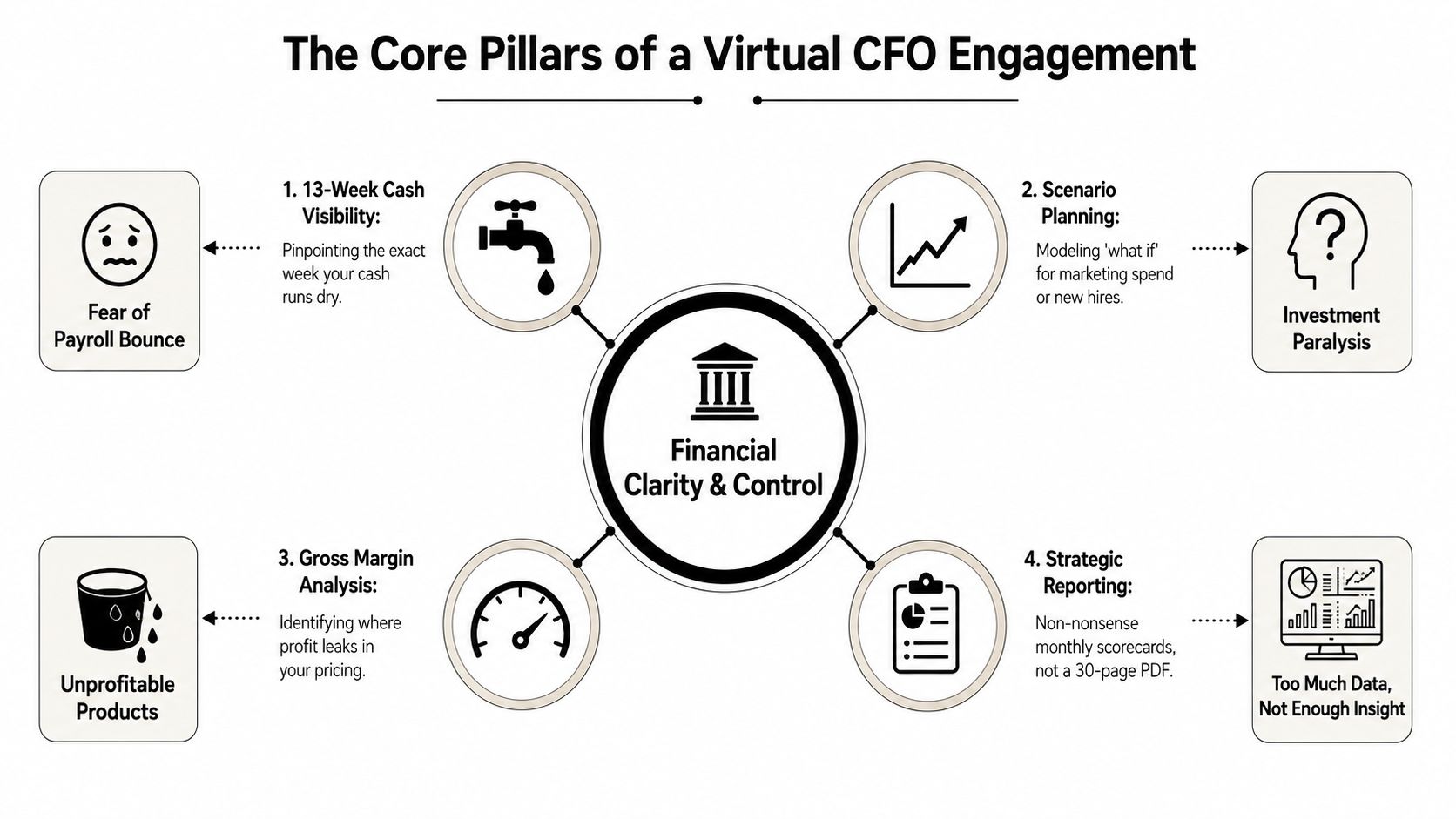
The Core Pillars of a Virtual CFO Engagement
A sound engagement has several connected workstreams. The exact mix depends on whether cash is trapped in unpaid invoices, stock, labour, pricing or poor systems, but the service should always lead to decisions and actions.
Cash visibility comes first
A 13-week cash forecast turns a vague concern into a weekly management tool. It maps expected customer receipts against payroll, suppliers, tax, loan repayments, stock purchases and other commitments. The trigger is simple: you're profitable but regularly surprised by the bank balance, or you can't say which week needs intervention.
The deliverable should be a living forecast, not a spreadsheet prepared once and forgotten. Your adviser should update assumptions, compare forecast with actual results and tell you which payments to accelerate, defer or renegotiate.
Margin analysis stops quiet profit leakage
Revenue can grow while profit weakens. Discounting, freight, payment fees, returns, overtime and supplier increases often sit outside the headline product margin. A virtual CFO should analyse gross margin by product, customer, channel, job or location, then connect the findings to pricing and purchasing decisions.
The trigger is any situation where sales are rising but cash and profit aren't keeping pace. The output should identify what to stop, reprice, bundle or renegotiate.
Budgeting and reporting end the month-end scramble
A budget versus actuals process gives management a consistent explanation for performance. It should show the difference between plan and result, identify the operational reason and assign an action. A useful dashboard might include revenue, gross margin, debtor days, stock movement, labour cost, operating expenses and cash position, but only if those measures drive decisions.
The trigger is a meeting where everyone argues about whose spreadsheet is correct. Your adviser should create one agreed reporting pack and a review cadence that managers can use.
Funding and lender readiness make capital conversations easier
A lender, whether a bank or a specialist provider such as NAB or Stripe Capital, needs more than optimism. A virtual CFO prepares current management accounts, a cash forecast, debt schedule, assumptions, key performance indicators and an organised data room. The trigger is a planned facility, equipment purchase, working-capital requirement or refinancing conversation.
This work also exposes whether the proposed borrowing solves a timing issue or merely delays a structural margin problem. A clean funding pack helps you have that conversation with facts.
Systems and process design find the leaks
Your finance system is only as useful as the workflow around it. A virtual CFO may need to connect Xero or MYOB with DEAR, Cin7, Shopify, a point-of-sale system, payroll and payment platforms. The work includes chart-of-accounts design, reconciliation rules, invoice approval, stock coding, purchase orders and management reporting.
The trigger is manual rekeying, inconsistent numbers between systems or a finance team that spends its week fixing errors. This is often the least glamorous work and the fastest route to better visibility.
Tax coordination keeps compliance from becoming a crisis
The virtual CFO doesn't replace your registered tax adviser. Instead, they coordinate with the external accountant around BAS, STP, year-end accounts, tax provisions and supporting records. That coordination matters because tax timing can distort the cash forecast and create sudden funding pressure.
For a useful comparison of responsibilities, review CFO job responsibilities. The point isn't to add another layer. It's to make sure the operational finance function and compliance function work from the same information.
Benefits and ROI You Can Actually Measure
Don't approve virtual CFO services because the provider promises “better insights”. Build the business case from measurable changes in time, margin, cash and decision quality.
Start with founder time. If you spend hours chasing reports, correcting invoices or reconciling conflicting figures, calculate what that time could do elsewhere. The value isn't just the hours removed. It's the sales conversations, production improvements or supplier negotiations you can handle when finance stops consuming every spare evening.
Next, examine margin. A pricing review may reveal that a customer, channel or product absorbs more delivery cost than its revenue suggests. Supplier terms, freight charges, payment fees, discounts and returns all deserve attention. Don't accept a provider's promised uplift in advance. Ask for the baseline, the proposed action and the method used to measure the result.
Cash release comes from several small disciplines working together:
Debtor control: Clear terms, accurate invoices, early follow-up and escalation for overdue accounts.
Inventory discipline: Purchasing based on demand and contribution, not on habit or supplier pressure.
Payment planning: Timing supplier payments against expected receipts without damaging key relationships.
Forecast accuracy: Updating assumptions when sales, stock or customer behaviour changes.
A three-way forecast links profit and loss, balance sheet and cash movement. Use this guide to three-way forecasting when testing whether a proposed investment produces cash or only accounting profit.
A simple decision test
Suppose a business pays a monthly retainer. The fee is the cost of buying senior attention, but the return must come from identified outcomes. Those might include fewer hours spent on finance administration, improved pricing discipline, released working capital, reduced avoidable costs or a better funding outcome.
You can model the decision without making unsupported promises. List the current monthly finance burden, the gross margin opportunities already visible, overdue receivables, slow-moving stock and decisions currently being delayed. Assign only values you can substantiate from your own records.
Outcome Area | Baseline | After 6 Months | Estimated Annual Impact |
|---|---|---|---|
Founder finance administration | Time spent chasing data and correcting errors | Defined reporting rhythm and clearer ownership | Value of time redirected into revenue or operations |
Gross margin | Margin varies by product, customer or job | Pricing and cost drivers reviewed | Additional gross profit from approved changes |
Working capital | Cash tied up in overdue invoices or excess stock | Collection and purchasing actions tracked | Cash made available for operations |
Forecasting | Decisions based on bank balance and instinct | Rolling cash and scenario planning | Fewer emergency funding decisions |
Funding readiness | Information gathered reactively | Current accounts, forecast and debt schedule maintained | Better-prepared lender discussions |
The table is a measurement framework, not a promised result. If a provider can't agree on the baseline and reporting method, you can't judge payback. Choose the engagement only when the likely operational gains are visible and the work required to create them is explicit.
Pricing Models and How to Read a Quote
Pricing is where many founders get distracted by the monthly number. The more important question is what the provider will do, who will do it and how often you'll receive usable decisions.
There are three common structures.
Pricing Model | Typical Monthly Range AUD | What's Usually Included | Common Cuts at Lower Price Points |
|---|---|---|---|
Monthly retainer | Varies by scope, complexity and seniority | Recurring reporting, forecast updates, review meetings and agreed implementation work | Less senior attention, limited system work, fewer forecast updates |
Hourly advisory | Charged for time used | Specific questions, reviews, modelling or lender support | No consistent operating rhythm, limited follow-through |
Project-based work | Fixed fee for defined work | Forecast build, pricing review, process redesign or funding pack | Ongoing accountability and maintenance after delivery |
Because the scope varies widely, a provider should explain the fee in terms of deliverables rather than claim that one price fits every SME. A cheap retainer often removes the work that creates value, including bank-feed review, inventory analysis, debtor follow-up and process implementation. You're left with a report that describes last month after the decisions have already been made.
Stress-test every proposal
Ask four direct questions before signing:
How much work is included? Get the expected hours, meeting cadence, response times and monthly deliverables in writing.
Who does the work? The person selling senior CFO access may not be the person reviewing your data.
Is cash-flow work included? A dashboard without a rolling forecast, debtor review and payment planning isn't cash management.
What sits outside the fee? Confirm whether bookkeeping, payroll, BAS coordination, system work and lender support are bundled or charged separately.
Also ask how the fee changes if revenue grows. A percentage of revenue can make the price rise without adding work. Scope-based pricing is easier to assess because you can tie the fee to responsibilities, complexity and capacity.
A genuine fractional CFO may work with an outsourced bookkeeper or internal finance manager. That's fine, provided the roles are clear. The warning sign is a service that labels routine bookkeeping as strategic leadership and adds a strategy call to make the package sound senior.
Industry Use Cases Across Ecommerce, Hospitality, Trades and Freight
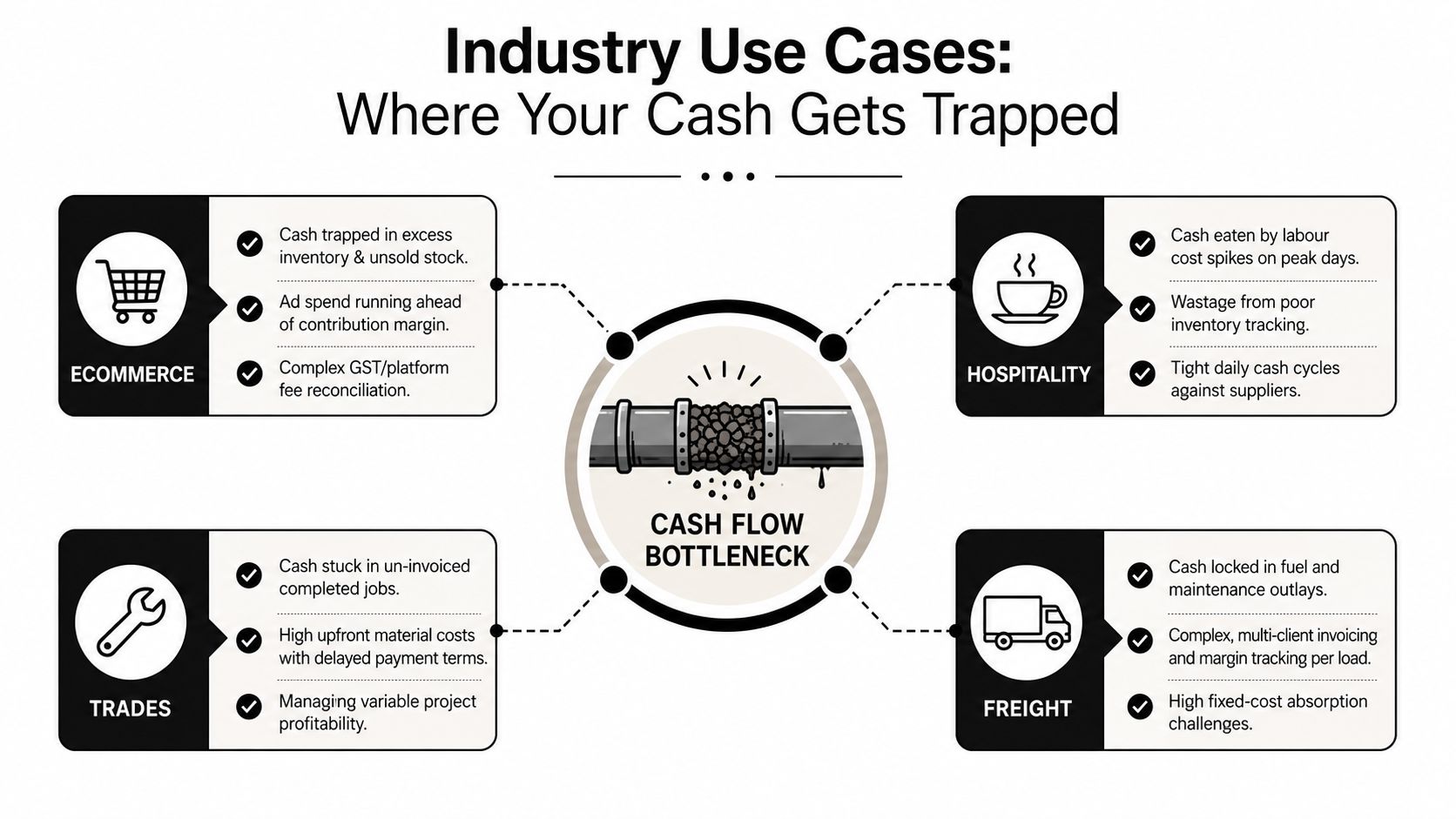
Cash problems look different across industries. The service model should change with the bottleneck, not force every business into the same dashboard.
Ecommerce
An online retailer can show sales growth while cash sits in unsold stock. The first review should map inventory by age, product contribution, reorder logic, returns, fulfilment cost, advertising spend and platform fees. Shopify revenue may not reconcile neatly with settlement reports, GST treatment and payment deductions, so the adviser must trace the money from order to bank account.
The first 60 days should focus on a stock purchasing rule, contribution-margin reporting and a clean settlement reconciliation. The working-capital opportunity depends on the stock profile and customer payment behaviour. A disciplined engagement should identify the specific products, channels and processes holding cash, rather than promise a generic release.
Hospitality
A venue collects takings daily but carries wages, suppliers, rent, wastage and maintenance obligations. A profitable week can still become a poor month if labour scheduling, purchasing or portion control slips. The virtual CFO should compare sales by service period with labour cost, food cost, wastage and supplier payment timing.
Early work includes a weekly cash snapshot, purchasing controls and a review of menu or service-line contribution. The adviser should distinguish a busy venue from a profitable venue. A sales target without a labour and gross-margin target encourages managers to chase volume that doesn't cover the full cost of service.
Trades
Trade businesses often invoice after work is complete, while materials and subcontractors are paid earlier. Cash gets trapped in unbilled completed jobs, retention money, variations and work in progress. A virtual CFO should connect the job-management system to the accounts, then compare quoted margin with actual labour, materials, subcontractor and rework costs.
The first 60 days should establish job-costing discipline, invoicing triggers and a work-in-progress review. The useful result isn't a prettier profit report. It's knowing which jobs need a variation, which customers require tighter terms and which project types should be avoided.
Freight
Freight operators carry fuel, maintenance, insurance, registration and vehicle costs before collecting from customers. Margin can differ sharply by client, route, load and vehicle, while one large debtor can create a serious concentration problem.
The initial review should separate vehicle cost centres, track margin per load or route, examine fuel recovery and identify invoice delays. A sound adviser will also test fixed-cost absorption, so the owner knows how much utilisation the fleet needs before accepting lower-margin work.
In every industry, the provider should show the bottleneck, the action taken and the cash or margin measure affected. If the recommendation doesn't connect to a bank account, gross margin or operating decision, it's probably too abstract.
Red Flags and a Vetting Checklist Before You Sign
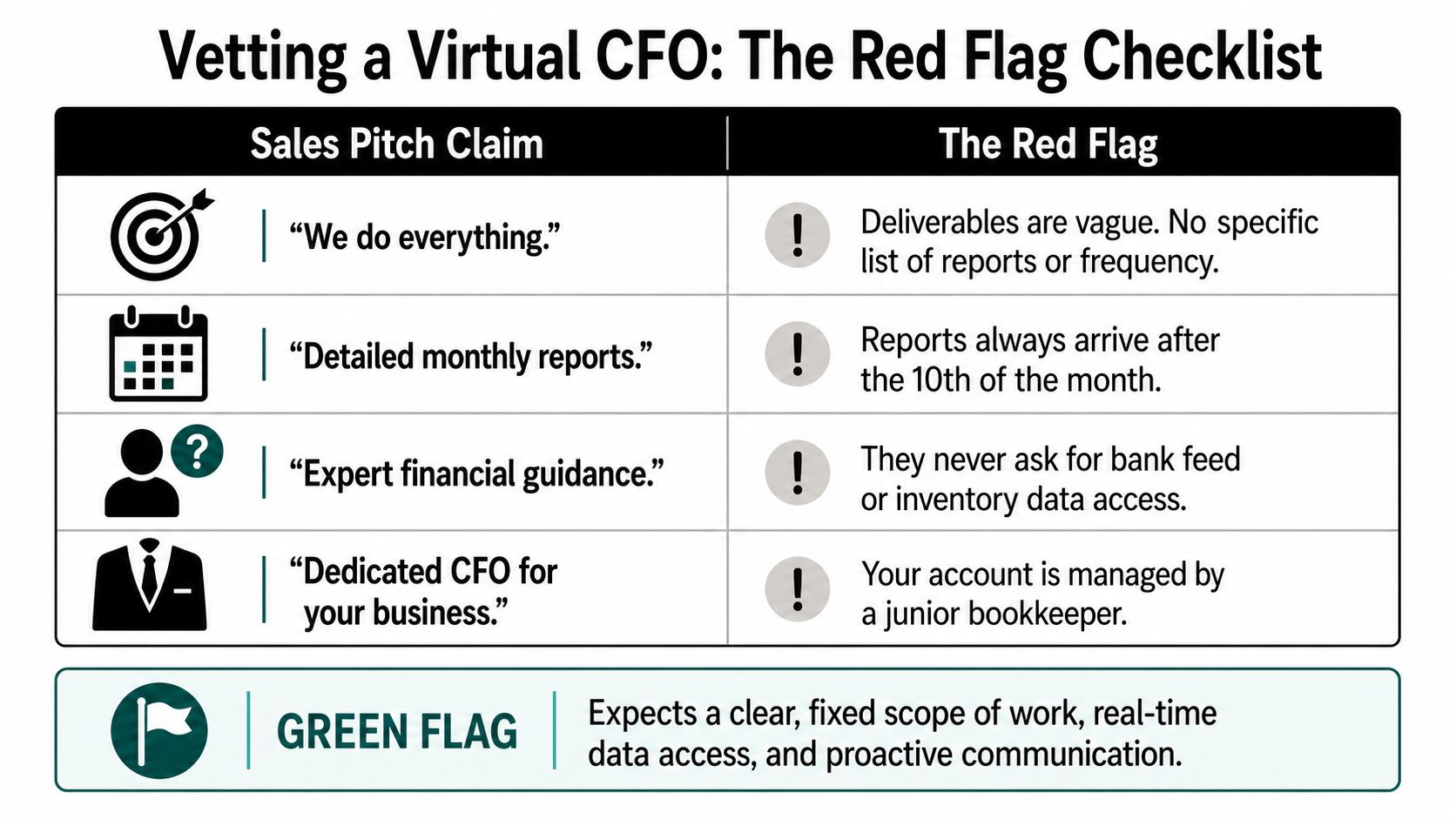
The most dangerous virtual CFO pitch is broad and impressive. “We do everything” sounds convenient until you ask what arrives each week, who prepares it and what happens when the forecast is wrong.
Be suspicious of monthly reports delivered after the month has closed and the decisions are already irreversible. Be equally cautious if the adviser never requests bank-feed access, inventory data, payroll information, payment-platform reports or customer ageing. A finance leader who only reviews the general ledger can miss the operational cause of the problem.
Use the sales process as evidence
Ask for a sample pack with sensitive information removed. It should show the level of detail, the decision commentary and the timing. A 30-page PDF isn't automatically better than a short scorecard. In most SMEs, a concise pack with clear actions beats a long report nobody reads.
Run this checklist:
Credentials: Confirm the lead adviser's CPA or CA credentials and relevant commercial experience.
Named responsibility: Get the actual senior adviser's name, not just the firm's logo.
Specific deliverables: Write down the forecast frequency, reporting pack, meetings, system work and implementation responsibilities.
Cash-first approach: Ask how they'll investigate receivables, inventory, payment timing and bank movements.
Relevant references: Speak with businesses similar in revenue complexity and operating model.
Data access: Confirm the systems they need and how they'll protect access and information.
AI approach: Ask where AI tools are used, who reviews outputs and how confidential data is handled.
Exit terms: Check notice periods, handover documents, system ownership and access after termination.
A senior title doesn't fix a junior process. Ask who will open the bank reconciliation, inspect the stock report and chase the missing information.
Pricing that scales automatically with revenue also deserves scrutiny. Revenue growth may increase transaction volume, but it doesn't necessarily increase CFO workload in the same proportion. Pay for defined scope, complexity and accountability.
The strongest green flag is a provider that asks difficult questions before proposing a package. They should challenge your data quality, identify missing information and explain what they can't conclude yet. That's a better sign than instant certainty.
A Realistic 30-60-90 Day Implementation Roadmap
The first 90 days should build control in stages. Don't expect a complete transformation from the first report. Expect a clearer diagnosis, a few practical interventions and a financial rhythm the team can maintain.
Days 1 to 30 focus on access and diagnosis
The adviser needs access to the accounting platform, bank feeds, payroll, inventory, payment platforms, sales systems and debt schedule. They should review the chart of accounts, reconciliations, customer ageing, supplier ageing, stock reporting and management assumptions.
The first cash-flow forecast will expose data gaps. That's useful. If the forecast can't be trusted, the adviser should identify why, whether receipts are overstated, stock purchases are missing, payroll is misclassified or tax payments aren't timed correctly.
The founder's job is to provide access quickly, explain commercial realities and identify decisions already under consideration. The adviser's job is to separate symptoms from causes and document the baseline.
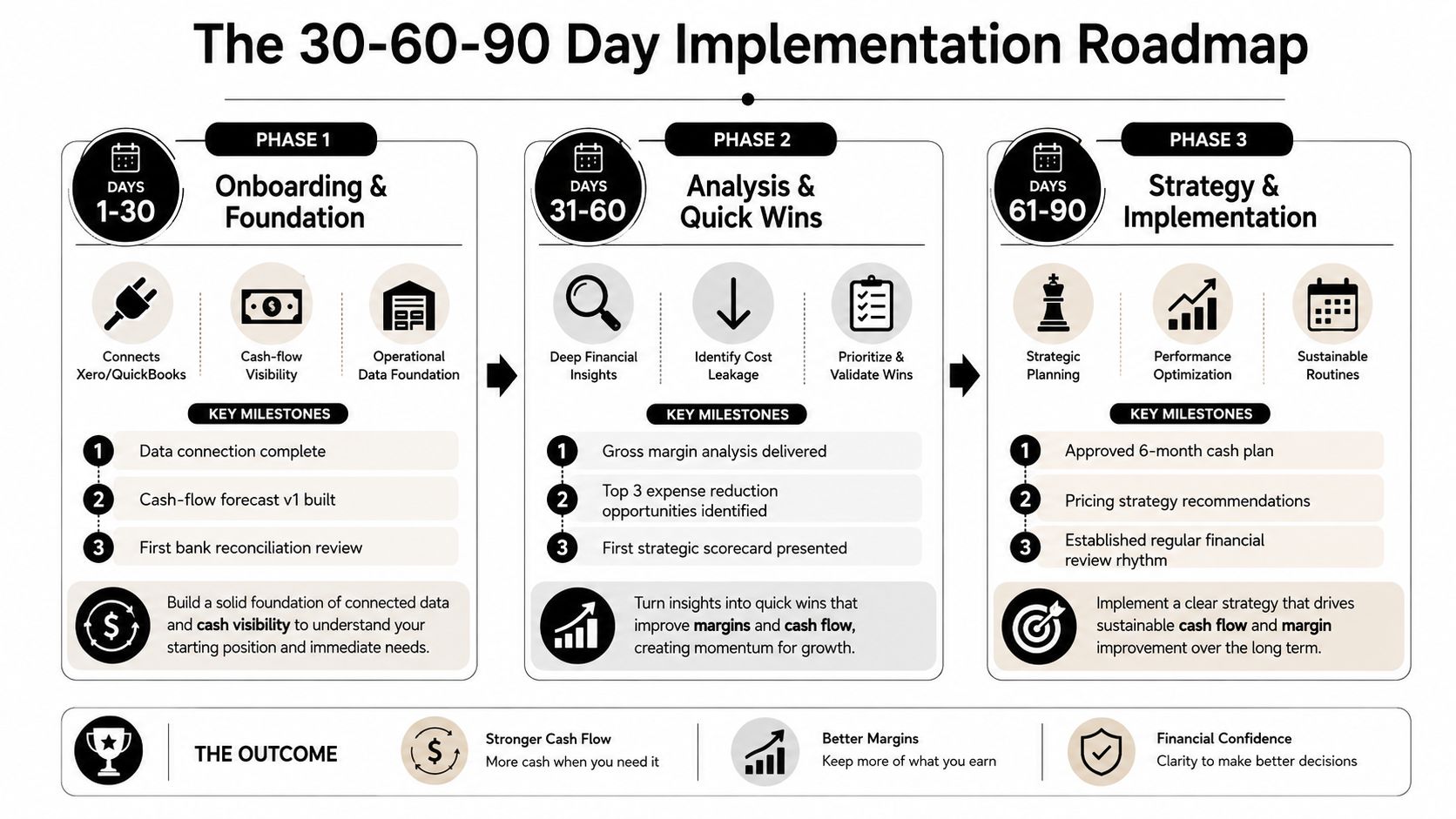
Days 31 to 60 are for quick wins
Once the data is usable, the work should move to actions that improve control. That may include tightening debtor terms, fixing invoice timing, setting approval limits, changing supplier payment cycles, correcting GST treatment or establishing a weekly cash snapshot.
The adviser should present a short list of priorities, not a catalogue of every possible improvement. Each priority needs an owner, a due date and a measure. For example, the team might track overdue invoices, stock purchases against plan, or the difference between expected and actual cash receipts.
This stage is also where the founder sees whether the provider implements or merely recommends. Advice without ownership becomes another item on the founder's task list.
Days 61 to 90 establish the operating rhythm
The engagement should now produce a rolling 13-week cash forecast, margin analysis by product or service line, a pricing review and a monthly reporting pack. Scenario planning can test proposed hires, stock commitments, marketing changes, debt repayments or capital purchases before the business commits cash.
Agree the cadence. A weekly cash review may suit a business under pressure, while a monthly strategic review can handle broader performance. Managers should know which numbers they own and what action follows if performance moves outside plan.
Transformation usually becomes visible after the initial clean-up, not in the first month. The early period is about access, definitions and corrections. The following period shows whether the team keeps using the forecast, acts on debtor information and changes purchasing or pricing behaviour.
Watch the onboarding video below for another view of the implementation process.
A suitable virtual CFO should leave you with more than a report. You should have an agreed cash routine, a clearer margin view, accountable finance processes and a forecast that informs decisions before the bank balance forces them.
Nexist helps Australian founders implement cash-flow forecasting, margin reporting, finance processes and operational automation, rather than stopping at monthly accounts. Visit Nexist to discuss the financial bottlenecks in your business and request a practical starting assessment.
virtual cfo services, virtual cfo australia, sme cash flow, fractional cfo, nexist

" width="24px"/><g d="M 0 24.129 L 0 0.129 L 24 0.129 L 24 24.129 Z M 0 24.129 L 0 0.129 L 24 0.129 L 24 24.129 Z M 24 3 C 24 1.344 22.656 0 21 0 L 3 0 C 1.344 0 0 1.344 0 3 L 0 21 C 0 22.656 1.344 24 3 24 L 21 24 C 22.656 24 24 22.656 24 21 Z M 6.883 8.375 L 2.863 8.375 L 2.863 20.467 L 6.883 20.467 Z M 4.899 2.545 C 3.524 2.545 2.625 3.449 2.625 4.634 C 2.625 5.795 3.496 6.724 4.846 6.724 L 4.872 6.724 C 6.273 6.724 7.146 5.795 7.146 4.634 C 7.12 3.449 6.274 2.545 4.899 2.545 Z M 16.747 8.09 C 14.614 8.09 13.659 9.263 13.124 10.086 L 13.124 8.374 L 9.105 8.374 C 9.159 9.508 9.105 20.466 9.105 20.466 L 13.124 20.466 L 13.124 13.713 C 13.124 13.352 13.15 12.99 13.257 12.732 C 13.547 12.01 14.209 11.262 15.319 11.262 C 16.773 11.262 17.355 12.372 17.355 13.996 L 17.355 20.466 L 21.374 20.466 L 21.374 13.532 C 21.374 9.818 19.391 8.09 16.747 8.09 Z" fill="transparent" height="24.12890599668026px" id="dSFdkJotL" width="24px"><path d="M 0 24 L 0 0 L 24 0 L 24 24 Z" fill="transparent" height="24px" id="wscNJE44G" transform="translate(0 0.129)" width="24px"/><g d="M 0 24.129 L 0 0.129 L 24 0.129 L 24 24.129 Z M 24 3 C 24 1.344 22.656 0 21 0 L 3 0 C 1.344 0 0 1.344 0 3 L 0 21 C 0 22.656 1.344 24 3 24 L 21 24 C 22.656 24 24 22.656 24 21 Z M 6.883 8.375 L 2.863 8.375 L 2.863 20.467 L 6.883 20.467 Z M 4.899 2.545 C 3.524 2.545 2.625 3.449 2.625 4.634 C 2.625 5.795 3.496 6.724 4.846 6.724 L 4.872 6.724 C 6.273 6.724 7.146 5.795 7.146 4.634 C 7.12 3.449 6.274 2.545 4.899 2.545 Z M 16.747 8.09 C 14.614 8.09 13.659 9.263 13.124 10.086 L 13.124 8.374 L 9.105 8.374 C 9.159 9.508 9.105 20.466 9.105 20.466 L 13.124 20.466 L 13.124 13.713 C 13.124 13.352 13.15 12.99 13.257 12.732 C 13.547 12.01 14.209 11.262 15.319 11.262 C 16.773 11.262 17.355 12.372 17.355 13.996 L 17.355 20.466 L 21.374 20.466 L 21.374 13.532 C 21.374 9.818 19.391 8.09 16.747 8.09 Z" fill="transparent" height="24.12890599668026px" id="sTpjGo1tb" width="24px"><path d="M 0 24 L 0 0 L 24 0 L 24 24 Z" fill="transparent" height="24px" id="s7ffpmKOD" transform="translate(0 0.129)" width="24px"/><g d="M 24 3 C 24 1.344 22.656 0 21 0 L 3 0 C 1.344 0 0 1.344 0 3 L 0 21 C 0 22.656 1.344 24 3 24 L 21 24 C 22.656 24 24 22.656 24 21 Z M 6.883 8.375 L 2.863 8.375 L 2.863 20.467 L 6.883 20.467 Z M 4.899 2.545 C 3.524 2.545 2.625 3.449 2.625 4.634 C 2.625 5.795 3.496 6.724 4.846 6.724 L 4.872 6.724 C 6.273 6.724 7.146 5.795 7.146 4.634 C 7.12 3.449 6.274 2.545 4.899 2.545 Z M 16.747 8.09 C 14.614 8.09 13.659 9.263 13.124 10.086 L 13.124 8.374 L 9.105 8.374 C 9.159 9.508 9.105 20.466 9.105 20.466 L 13.124 20.466 L 13.124 13.713 C 13.124 13.352 13.15 12.99 13.257 12.732 C 13.547 12.01 14.209 11.262 15.319 11.262 C 16.773 11.262 17.355 12.372 17.355 13.996 L 17.355 20.466 L 21.374 20.466 L 21.374 13.532 C 21.374 9.818 19.391 8.09 16.747 8.09 Z" fill="transparent" height="24.000006px" id="D0ecaHEcW" transform="translate(0 0)" width="24px"><path d="M 24 3 C 24 1.344 22.656 0 21 0 L 3 0 C 1.344 0 0 1.344 0 3 L 0 21 C 0 22.656 1.344 24 3 24 L 21 24 C 22.656 24 24 22.656 24 21 Z" fill="rgb(55, 184, 218)" height="24.000006px" id="IPLFE6zXx" width="24px"/><path d="M 4.02 0 L 0 0 L 0 12.092 L 4.02 12.092 Z" fill="rgb(255, 255, 255)" height="12.09201px" id="FWhtzAyuY" transform="translate(2.863 8.375)" width="4.02px"/><path d="M 2.274 0 C 0.899 0 0 0.904 0 2.089 C 0 3.25 0.871 4.179 2.221 4.179 L 2.247 4.179 C 3.648 4.179 4.521 3.25 4.521 2.089 C 4.495 0.904 3.649 0 2.274 0 Z" fill="rgb(255, 255, 255)" height="4.17876px" id="VmOsKv4kO" transform="translate(2.625 2.545)" width="4.52095px"/><path d="M 7.641 0 C 5.509 0 4.554 1.173 4.019 1.996 L 4.019 0.284 L 0 0.284 C 0.053 1.419 0 12.376 0 12.376 L 4.019 12.376 L 4.019 5.623 C 4.019 5.262 4.045 4.9 4.151 4.642 C 4.442 3.92 5.103 3.172 6.214 3.172 C 7.667 3.172 8.25 4.282 8.25 5.907 L 8.25 12.376 L 12.269 12.376 L 12.269 5.442 C 12.269 1.728 10.286 0 7.641 0 Z" fill="rgb(255, 255, 255)" height="12.37626px" id="n1XUbhaq0" transform="translate(9.105 8.09)" width="12.268830000000001px"/></g></g></g></g></svg>)