
Activity Based Pricing: A Guide for Australian SMEs
Unlock true profitability with activity based pricing. Our guide helps Australian SMEs identify hidden costs and set prices that boost margins and cash flow.
Ansh Malhotra

Revenue is up. Orders are moving. The calendar is full. Yet the cash in the bank still feels thin, and your gross margin report doesn't explain why.
That usually means one thing. The business is pricing off averages while much of the work occurs in exceptions, rework, support, admin, travel, handling, returns, and small decisions your team makes every day. A product can be a bestseller and still be a lousy contributor to profit. A client can look “good” on revenue and subtly consume your team's time.
Activity Based Pricing gives you a cleaner lens. Instead of asking, “What does this sell for?” it asks, “What does this consume?” For Australian SMEs in retail, trade, and services, that shift matters because pricing mistakes don't stay on paper. They show up as stock that doesn't convert to cash, jobs that feel busy but underpay, and founders who work harder without seeing the reward.
Table of Contents
Is Your Most Popular Product a Secret Profit Drain
A founder I speak with regularly will say some version of this: “We're selling heaps, so why does month end still feel tight?” The answer often sits inside the most popular line item.
Take a retailer moving a fast-selling accessory. On paper, it looks brilliant. Strong order volume, healthy top-line sales, and steady repeat demand. But underneath that product sit extra pick-and-pack touches, more customer questions, more return handling, and more small-quantity orders that create admin drag. Traditional pricing spreads those overheads broadly, so the product looks healthier than it is.
The same thing happens in trades and services. A job type that wins often might involve more call-outs, more quoting revisions, more site travel, or more hand-holding than the “slower” work. Revenue tells you what sold. It doesn't tell you what the business had to consume to deliver it.
For Australian SMEs in inventory-heavy sectors, adopting activity-based pricing has been empirically linked to a 15 to 25% improvement in margin visibility, while traditional methods often misallocate 20 to 40% of indirect costs to the wrong products, according to Workday's overview of activity-based costing.
That matters because hidden costs are usually hidden in service effort, not materials.
If you haven't mapped that effort yet, a useful starting point is to understand cost of serving. It helps frame why two customers buying the same thing can produce very different profit outcomes.
A good pricing system doesn't just tell you what to charge. It tells you what to stop subsidising.
If your reporting still treats all sales in a category as roughly equal, you're probably carrying one of these problems:
A bestseller with expensive support needs that erodes margin after the sale.
A “simple” customer account that creates repeat admin, split deliveries, or returns.
A job type with hidden setup effort that your quote never captures.
A product mix issue where high-volume items absorb too little overhead and lower-volume items absorb too much.
That's why a proper profitability analysis approach matters. It moves the conversation from revenue pride to cash reality.
What Is Activity Based Pricing Really
Activity Based Pricing is a pricing method built on a simple idea. Products, jobs, and customers should carry the costs of the activities they utilise.
That sounds technical, but it's easier to grasp in a cafe than in a spreadsheet.
The cafe test
A black coffee is quick. Grind, pour, serve. A specialty latte with milk substitutions, syrup, extra shots, foam art, and a remake because the customer changed the order is a different job entirely. If the cafe prices both drinks by spreading overhead evenly, the simple order subsidises the complex one.
That's the core problem Activity Based Pricing fixes. It links price to the work required, not just the final item sold.
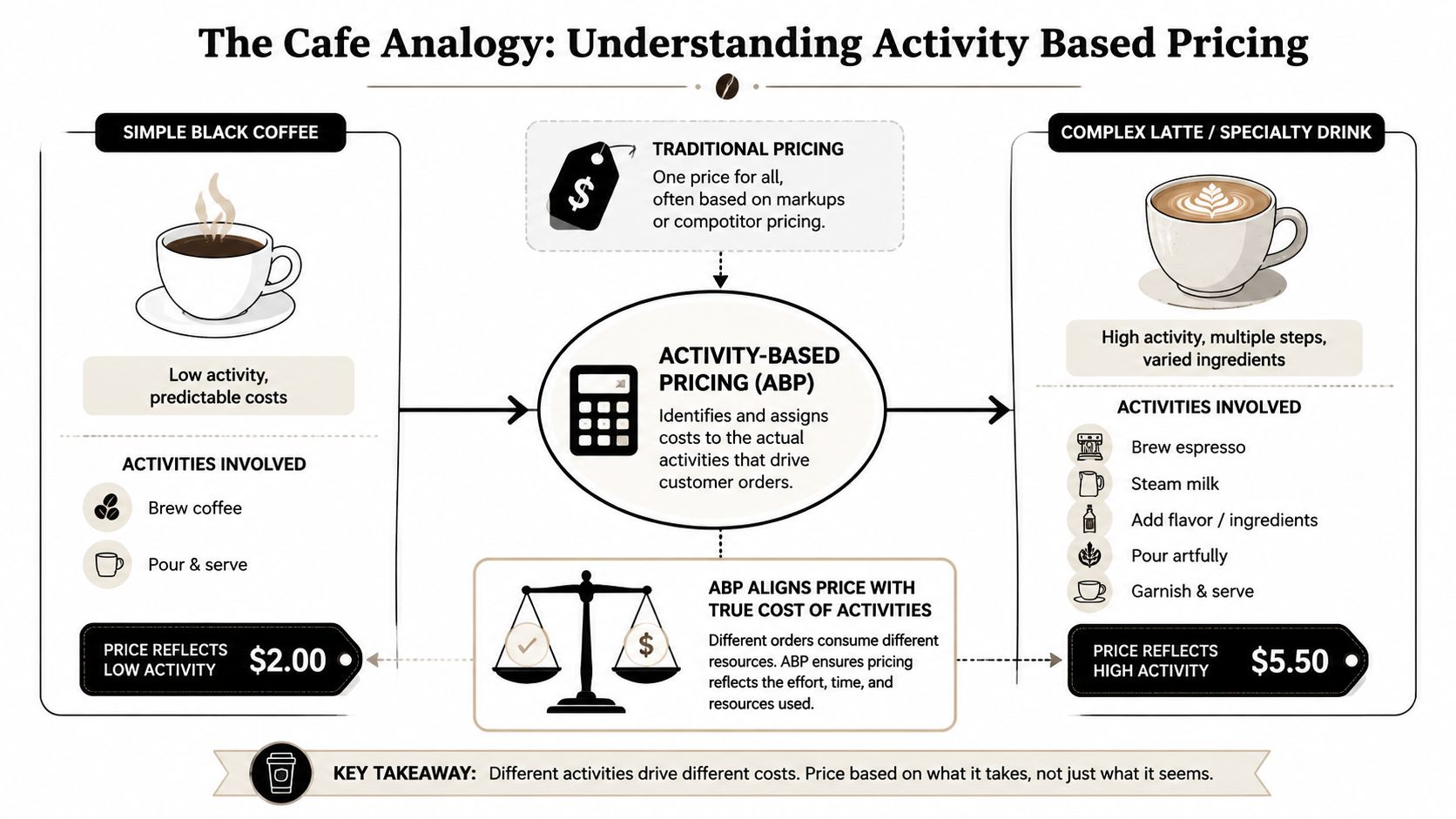
In practice, that means you stop treating overhead as one big blob. Instead, you ask what activities consume staff time, systems, space, and management attention.
Australia already has a major precedent for this logic. The Independent Health and Aged Care Pricing Authority explains that the 2011 National Health Reform Agreement mandated Activity Based Funding for public hospitals, linking payment to the number and mix of patients treated. Different sector, same principle. Funding follows activity and resource consumption.
The two building blocks that matter
Two terms matter more than the rest.
Cost pools are buckets of cost tied to an activity. Think customer service, purchasing, machine setup, dispatch, quoting, onboarding, returns processing, or site travel administration.
Cost drivers are the measures that connect those costs to what caused them. That could be support calls, minutes spent, number of deliveries, quotes prepared, or setups performed.
The simplest way to understand this is:
Term | Plain-English meaning | Example |
|---|---|---|
Cost pool | A grouped business cost | Returns handling |
Cost driver | The thing that triggers or measures usage | Number of returns or time spent handling them |
Cost object | What you're pricing or analysing | A product, a client, a job |
Practical rule: If you can't explain why a cost belongs to a product, customer, or job, you probably don't have the right driver yet.
The goal isn't perfect mathematical purity. The goal is a stronger cause-and-effect link between effort and price.
That's why Activity Based Pricing is so useful for SMEs with messy operations. A wholesaler may discover a customer ordering small, urgent drops is less profitable than another customer buying similar volume in clean weekly batches. A trade business may find diagnostic work should be priced differently from straightforward installation. A service firm may realise revisions and stakeholder management are primary cost drivers, not just hours delivered.
When founders get this right, pricing stops being a guess with a margin added on top. It becomes a decision tool.
ABP vs Traditional Pricing Models
Most SMEs don't choose a pricing model formally. They inherit one. A markup gets added to product cost. An hourly rate gets carried forward from a few years ago. A competitor's number becomes the benchmark. It works until complexity creeps in.
Activity Based Pricing is not the only option, but it solves a different problem from the common alternatives.
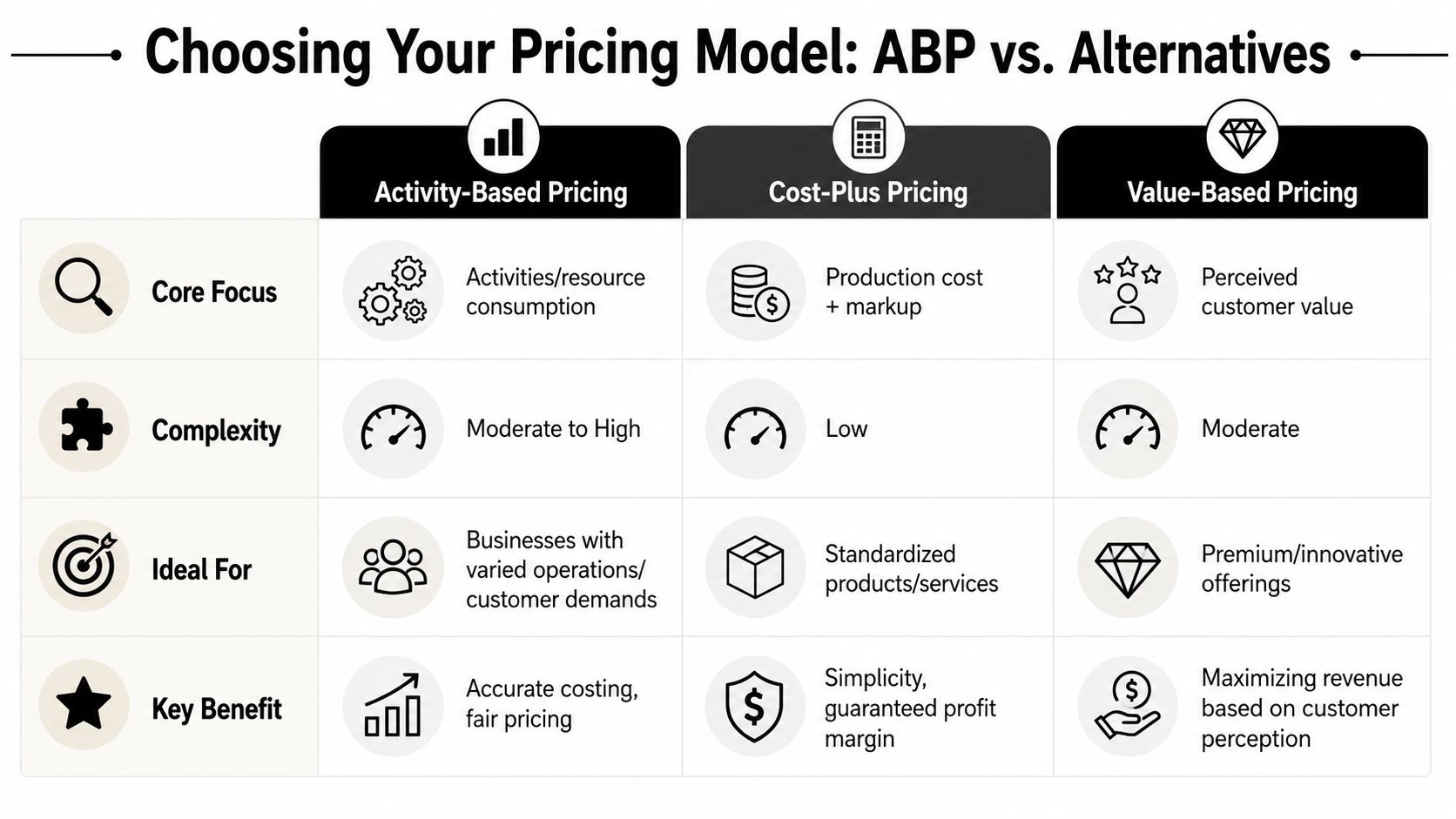
Pricing Model Comparison
Attribute | Cost-Plus Pricing | Value-Based Pricing | Activity Based Pricing |
|---|---|---|---|
Core focus | Cost plus markup | Customer's perceived value | Activities and resource consumption |
Best fit | Standardised work | Premium or differentiated offers | Mixed operations with uneven effort |
Strength | Simple and fast | Can lift realised price | Improves cost accuracy |
Weakness | Can hide loss-making work | Hard to anchor without cost clarity | Needs better operational data |
Typical founder risk | Underpricing complexity | Overestimating what buyers will pay | Overbuilding the model |
Cost-plus pricing is common because it's easy. For a simple business with low variation, that can be enough. If one product line behaves much like another, or if every job follows nearly the same pattern, the bluntness may not hurt you much.
Value-based pricing sits at the other end. It asks what the outcome is worth to the buyer. That's powerful when you're selling expertise, speed, convenience, or a clear commercial result. But if you don't know your internal cost-to-serve, value-based pricing can become hand-wavy. You might win premium work while still undercharging for the delivery burden.
A practical benchmark helps here. This example of published service rates is useful not because you should copy someone else's numbers, but because it shows how service packaging and price presentation can differ from pure hourly charging.
When each model works
Activity Based Pricing is often the better base layer when any of these are true:
Your products vary in complexity even if they look similar to customers.
Your clients behave differently in support load, ordering habits, or delivery demands.
Your staff spend time on invisible work like admin, troubleshooting, rework, and coordination.
Your margin feels inconsistent across jobs, stock lines, or accounts.
Research on Australian firms shows that those adopting activity-based costing techniques outperform matched non-ABC firms by approximately 27 percent over the three years following implementation, according to Australian and New Zealand Academy of Management research.
That doesn't mean every founder should throw out cost-plus or ignore value-based pricing. The better move is usually this:
Use Activity Based Pricing to understand your real cost base.
Use value-based pricing where the market will support premium positioning.
Keep cost-plus for simple lines where complexity is low and speed matters.
If you're working through broader pricing strategy decisions, this guide on value-based pricing strategy is a useful complement. It helps answer the market side of the equation after your internal economics are clear.
Your Step-by-Step Guide to Implementing ABP
Most founders stall here because they assume they need a finance team, a giant ERP rollout, and six months of workshops. You don't. You need a usable model that captures the major cost drivers first.
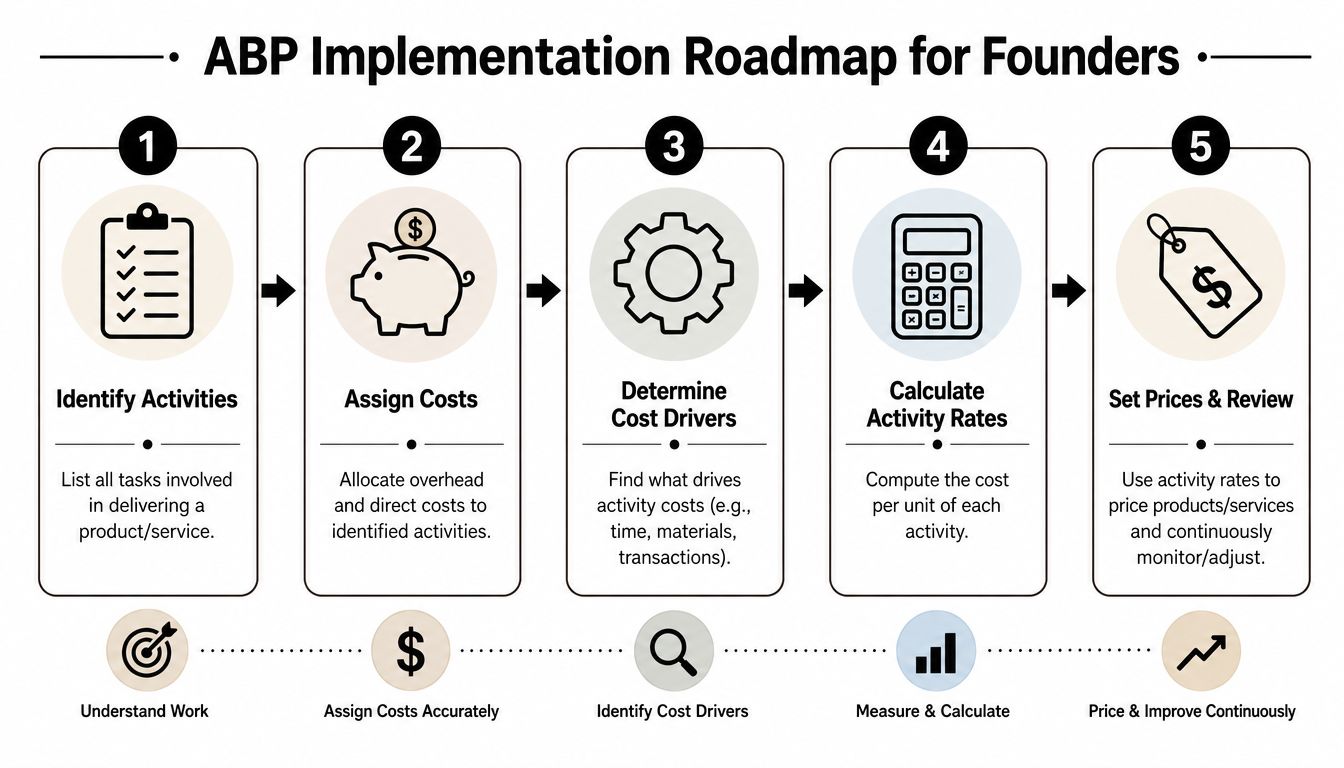
Step 1 and Step 2
Step 1 is to identify your key activities.
Don't start with the chart of accounts. Start with the work. Follow one product, one job, or one customer order from start to finish. In retail, that might include purchasing, receipting, put-away, picking, packing, dispatch, returns, and support. In a trade business, it might be quoting, travel, diagnostics, procurement, onsite labour, and invoicing. In a service firm, think scoping, delivery, revisions, meetings, reporting, and account management.
Keep the first draft tight. You're looking for the activities that consume meaningful time or create friction.
Step 2 is to group costs into activity pools.
Overheads are assigned to those activities. Wages, software, warehouse overhead, fuel, admin time, merchant fees, team leaders, phone systems, and rent can all sit in pools if they relate clearly to the activity.
A simple way to structure this is:
Operational pools for direct delivery work such as picking, packing, onsite labour, or campaign execution.
Support pools for customer service, scheduling, quoting, and account management.
Control pools for quality checking, rework, returns handling, and issue resolution.
Start where the money is. The top five expensive activities usually tell you more than tracking twenty minor ones.
Step 3 and Step 4
Step 3 is to select meaningful cost drivers.
Many models fall short in this regard. Founders often choose what's easy to count rather than what truly causes the cost. Revenue is a poor driver for most support or admin costs. It's convenient, but it's usually lazy.
Better examples look like this:
Activity | Weak driver | Better driver |
|---|---|---|
Customer service | Revenue by customer | Support minutes or support cases |
Warehouse dispatch | Sales dollars | Orders shipped or handling time |
Quoting | Job revenue | Number of quotes or quote time |
Site work | Invoice total | Travel time plus onsite time |
For service-based SMEs, using duration drivers such as time spent on an activity has been shown to reduce cost attribution errors by up to 30% compared to simpler volume drivers, according to this implementation discussion in The CPA Journal.
That's why time often matters more than count. Ten customer calls aren't the same if one takes two minutes and another burns half an hour and drags in a senior staff member.
Step 4 is to calculate activity cost rates.
Once your cost pools and drivers are set, calculate a rate for each activity. In plain terms:
Pool cost divided by driver quantity gives you the activity rate.
That rate then gets applied to the product, customer, or job based on actual usage.
Examples:
Dispatch cost pool divided by number of dispatches.
Quoting cost pool divided by quoting hours.
Customer support pool divided by support minutes.
Software proves beneficial, especially if your operational data sits across Xero, inventory tools, job systems, ecommerce platforms, and spreadsheets. If your data is fragmented, tools discussed in this article on project accounting software can help bring time, job, and cost records together.
Step 5 and the simpler Time-Driven option
Step 5 is to apply the costs and use them in pricing decisions.
Now test the model against reality. Look at a handful of products, jobs, and customers. Which ones consume more activity than their current price assumes? Which ones look easier than expected? Which account managers are carrying the heaviest service load? Which delivery methods undermine margin?
Then make commercial decisions. Not all of them require a price rise.
You might:
Repackage an offer so support or revisions are capped.
Add a handling fee for low-value, high-touch orders.
Set minimum order rules to reduce small-batch pain.
Change customer terms around urgency, delivery frequency, or scope creep.
Drop a product line that ties up too much effort for too little return.
For many SMEs, the best starting point is Time-Driven ABC rather than a full traditional model. It's simpler because it relies on two parameters: cost per time unit and unit time of consumption, as explained in this Time-Driven ABC overview.
That makes it practical for service, trade, hospitality, freight, and ecommerce businesses that don't have pristine data. Instead of building a giant activity library, you estimate how long common tasks take and multiply by the cost of the capacity performing them.
It's not perfect. It is useful. And useful wins.
Activity Based Pricing in Action
Theory gets real when you apply it to the jobs and orders sitting in front of you this week.

Retail and eCommerce
An online retailer sees one gadget fly out the door. It's the bestseller, so the team protects it aggressively on price. Gross sales look strong, and the owner assumes it's a hero line.
Then they map the activities. That product has more customer questions before purchase, more “where is my order?” follow-up, more exchange requests, and awkward packaging that slows dispatch. Suddenly the margin looks very different.
The fix isn't always to increase the ticket price. Sometimes the smarter move is to bundle it, reduce variant complexity, tighten return settings, or move support content upstream so fewer buyers need manual help.
Trade businesses
An electrician often prices based on labour, materials, and a rough allowance for overhead. That works reasonably well for standard installs. It breaks down on diagnostic work, jobs in hard-to-reach locations, and projects that require sourcing unusual parts or multiple client approvals.
When the business maps activities, several hidden costs appear:
Travel and parking admin around metro work.
Problem diagnosis time before any billable install begins.
Procurement effort for parts that aren't held in standard stock.
Follow-up communication with property managers, tenants, or builders.
A better pricing model may separate call-out, diagnosis, procurement, and install rather than burying everything in one blended rate. Customers often accept that structure more easily because it reflects the work more accurately.
If your quote assumes every job behaves like a clean, repeatable job, the messy jobs will eat your margin.
Service firms
A digital agency runs retainers for several clients. One large client seems demanding because the work is high profile. A smaller client looks easy because the fee is lower and the deliverables seem modest.
Then the agency maps activity. The large client gives fast approvals, attends one monthly meeting, sticks to scope, and rarely requests rework. The smaller client sends scattered messages, asks for frequent revisions, expands scope informally, and pulls senior staff into approval loops.
Revenue alone would point the team in the wrong direction. Activity Based Pricing shows where account management load, revision cycles, and stakeholder complexity sit. That can lead to revised retainer tiers, change-request rules, or meeting limits.
Across all three examples, the pattern is the same. The problem isn't just underpricing. It's using one pricing logic for work that behaves in very different ways.
Common Pitfalls and How to Avoid Them
Most failed Activity Based Pricing projects don't fail because the concept is wrong. They fail because the business makes the model too complicated, too abstract, or too disconnected from operations.
Three mistakes that break the model
First mistake: tracking everything.
Founders try to map every task, every click, and every exception. The team gets buried in admin before the model produces a useful answer.
Do this instead. Start with the activities most likely to move profit. Pick the few areas where your team spends the most time, where overhead is highest, or where customer behaviour varies sharply.
Second mistake: choosing bad drivers.
If you allocate service burden by revenue, you'll distort the result. The high-maintenance customer with a smaller invoice may look harmless, while the low-friction account with larger spend gets overcharged on paper.
Use drivers that reflect actual consumption. Time, number of touches, deliveries, setups, revisions, and support interactions usually beat broad financial averages.
Third mistake: building it in finance alone.
Operations staff usually know why one job blows out and another runs clean. If they're not part of the model, your assumptions will be wrong.
Ask direct questions such as:
What makes this order harder than the standard one?
Which customers generate the most interruptions?
Where do jobs get stuck or repeated?
What takes longer than management thinks it does?
The best driver often comes from the person doing the work, not the person staring at the P&L.
If you keep the first version practical, your model becomes a decision tool. If you try to make it academically perfect, it becomes shelfware.
From Hidden Costs to Strategic Clarity
Activity Based Pricing gives founders a more honest map of the business. It shows which products deserve a push, which jobs need a different pricing structure, which clients are worth protecting, and where the team is spending effort without enough return.
That shift matters because better pricing is only part of the gain. The bigger win is clarity. Once you can see what drives cost, you can redesign offers, simplify service, tighten customer terms, improve stock decisions, and stop rewarding work that looks busy but leaves little behind.
For Australian SMEs, that's the difference between reacting to month-end numbers and managing the business with intent. You stop guessing which line is profitable. You stop assuming your biggest account is your best account. You start making decisions that put more real cash in the bank.
If you want help turning pricing confusion into clean commercial decisions, Nexist works with Australian founders to uncover hidden cost drivers, tighten margins, improve cash flow, and build the finance systems that support growth without burnout.
activity based pricing, pricing strategy, cost management, virtual cfo australia, sme profitability

" width="24px"/><g d="M 0 24.129 L 0 0.129 L 24 0.129 L 24 24.129 Z M 0 24.129 L 0 0.129 L 24 0.129 L 24 24.129 Z M 24 3 C 24 1.344 22.656 0 21 0 L 3 0 C 1.344 0 0 1.344 0 3 L 0 21 C 0 22.656 1.344 24 3 24 L 21 24 C 22.656 24 24 22.656 24 21 Z M 6.883 8.375 L 2.863 8.375 L 2.863 20.467 L 6.883 20.467 Z M 4.899 2.545 C 3.524 2.545 2.625 3.449 2.625 4.634 C 2.625 5.795 3.496 6.724 4.846 6.724 L 4.872 6.724 C 6.273 6.724 7.146 5.795 7.146 4.634 C 7.12 3.449 6.274 2.545 4.899 2.545 Z M 16.747 8.09 C 14.614 8.09 13.659 9.263 13.124 10.086 L 13.124 8.374 L 9.105 8.374 C 9.159 9.508 9.105 20.466 9.105 20.466 L 13.124 20.466 L 13.124 13.713 C 13.124 13.352 13.15 12.99 13.257 12.732 C 13.547 12.01 14.209 11.262 15.319 11.262 C 16.773 11.262 17.355 12.372 17.355 13.996 L 17.355 20.466 L 21.374 20.466 L 21.374 13.532 C 21.374 9.818 19.391 8.09 16.747 8.09 Z" fill="transparent" height="24.12890599668026px" id="dSFdkJotL" width="24px"><path d="M 0 24 L 0 0 L 24 0 L 24 24 Z" fill="transparent" height="24px" id="wscNJE44G" transform="translate(0 0.129)" width="24px"/><g d="M 0 24.129 L 0 0.129 L 24 0.129 L 24 24.129 Z M 24 3 C 24 1.344 22.656 0 21 0 L 3 0 C 1.344 0 0 1.344 0 3 L 0 21 C 0 22.656 1.344 24 3 24 L 21 24 C 22.656 24 24 22.656 24 21 Z M 6.883 8.375 L 2.863 8.375 L 2.863 20.467 L 6.883 20.467 Z M 4.899 2.545 C 3.524 2.545 2.625 3.449 2.625 4.634 C 2.625 5.795 3.496 6.724 4.846 6.724 L 4.872 6.724 C 6.273 6.724 7.146 5.795 7.146 4.634 C 7.12 3.449 6.274 2.545 4.899 2.545 Z M 16.747 8.09 C 14.614 8.09 13.659 9.263 13.124 10.086 L 13.124 8.374 L 9.105 8.374 C 9.159 9.508 9.105 20.466 9.105 20.466 L 13.124 20.466 L 13.124 13.713 C 13.124 13.352 13.15 12.99 13.257 12.732 C 13.547 12.01 14.209 11.262 15.319 11.262 C 16.773 11.262 17.355 12.372 17.355 13.996 L 17.355 20.466 L 21.374 20.466 L 21.374 13.532 C 21.374 9.818 19.391 8.09 16.747 8.09 Z" fill="transparent" height="24.12890599668026px" id="sTpjGo1tb" width="24px"><path d="M 0 24 L 0 0 L 24 0 L 24 24 Z" fill="transparent" height="24px" id="s7ffpmKOD" transform="translate(0 0.129)" width="24px"/><g d="M 24 3 C 24 1.344 22.656 0 21 0 L 3 0 C 1.344 0 0 1.344 0 3 L 0 21 C 0 22.656 1.344 24 3 24 L 21 24 C 22.656 24 24 22.656 24 21 Z M 6.883 8.375 L 2.863 8.375 L 2.863 20.467 L 6.883 20.467 Z M 4.899 2.545 C 3.524 2.545 2.625 3.449 2.625 4.634 C 2.625 5.795 3.496 6.724 4.846 6.724 L 4.872 6.724 C 6.273 6.724 7.146 5.795 7.146 4.634 C 7.12 3.449 6.274 2.545 4.899 2.545 Z M 16.747 8.09 C 14.614 8.09 13.659 9.263 13.124 10.086 L 13.124 8.374 L 9.105 8.374 C 9.159 9.508 9.105 20.466 9.105 20.466 L 13.124 20.466 L 13.124 13.713 C 13.124 13.352 13.15 12.99 13.257 12.732 C 13.547 12.01 14.209 11.262 15.319 11.262 C 16.773 11.262 17.355 12.372 17.355 13.996 L 17.355 20.466 L 21.374 20.466 L 21.374 13.532 C 21.374 9.818 19.391 8.09 16.747 8.09 Z" fill="transparent" height="24.000006px" id="D0ecaHEcW" transform="translate(0 0)" width="24px"><path d="M 24 3 C 24 1.344 22.656 0 21 0 L 3 0 C 1.344 0 0 1.344 0 3 L 0 21 C 0 22.656 1.344 24 3 24 L 21 24 C 22.656 24 24 22.656 24 21 Z" fill="rgb(55, 184, 218)" height="24.000006px" id="IPLFE6zXx" width="24px"/><path d="M 4.02 0 L 0 0 L 0 12.092 L 4.02 12.092 Z" fill="rgb(255, 255, 255)" height="12.09201px" id="FWhtzAyuY" transform="translate(2.863 8.375)" width="4.02px"/><path d="M 2.274 0 C 0.899 0 0 0.904 0 2.089 C 0 3.25 0.871 4.179 2.221 4.179 L 2.247 4.179 C 3.648 4.179 4.521 3.25 4.521 2.089 C 4.495 0.904 3.649 0 2.274 0 Z" fill="rgb(255, 255, 255)" height="4.17876px" id="VmOsKv4kO" transform="translate(2.625 2.545)" width="4.52095px"/><path d="M 7.641 0 C 5.509 0 4.554 1.173 4.019 1.996 L 4.019 0.284 L 0 0.284 C 0.053 1.419 0 12.376 0 12.376 L 4.019 12.376 L 4.019 5.623 C 4.019 5.262 4.045 4.9 4.151 4.642 C 4.442 3.92 5.103 3.172 6.214 3.172 C 7.667 3.172 8.25 4.282 8.25 5.907 L 8.25 12.376 L 12.269 12.376 L 12.269 5.442 C 12.269 1.728 10.286 0 7.641 0 Z" fill="rgb(255, 255, 255)" height="12.37626px" id="n1XUbhaq0" transform="translate(9.105 8.09)" width="12.268830000000001px"/></g></g></g></g></svg>)