Value Based Pricing Strategy: A Guide for AU Founders
Implement a value based pricing strategy to boost margins and cash flow. Our guide for Australian founders covers frameworks, KPIs, and industry examples.
Ansh Malhotra

You're probably in one of two pricing traps right now.
You raise prices because costs went up, then spend the next month defending the increase. Or you keep prices where they are because you're worried a change will slow sales, while margins thin out underneath you. Both are common. Both create cash flow stress. And both usually come from the same problem. The price was never built on a clear view of what the customer is buying.
That shows up everywhere in Australian SMEs. A wholesaler marks up landed cost and hopes the market accepts it. A services firm bills by the hour even when clients care about turnaround time, reduced risk, or cleaner reporting. A founder looks at what competitors charge and picks a number in the middle. It feels safe. It usually isn't.
A value based pricing strategy changes the starting point. You stop asking, “What does this cost us?” and start asking, “What is this worth to this customer segment, in this market, under these conditions?” That shift matters more when inflation, wages, stock costs, and customer budgets are all moving at once.
Table of Contents
Stop Guessing Your Price and Start Owning Your Value
A founder I've seen many times in practice doesn't have a pricing system. They have a pricing mood.
If stock costs rise this month, they add a bit. If a prospect pushes back, they discount. If a competitor looks cheaper, they hesitate. If the pipeline softens, they run a promotion. None of those decisions are irrational in isolation. Together, they create a business that can't explain its own margin.
That's where pricing starts to damage more than profit. It affects cash flow timing, stock purchasing decisions, sales confidence, and forecasting accuracy. Your team doesn't know when to hold price. Customers don't know why one quote looks different from the last. You end up negotiating from anxiety instead of evidence.
Practical rule: If your sales team can explain features but can't clearly explain commercial outcomes, your pricing model is probably doing too little work.
The answer isn't to “charge more”. Plenty of businesses try that and then wonder why conversions slip or churn rises. The answer is to build price around delivered value, then prove that value in language the customer already uses.
For an inventory-heavy business, that might be fewer stockouts, easier replenishment, less admin friction, or more reliable supply. For a service business, it might be faster completion, fewer revisions, better decision support, or reduced operational risk. Once price is linked to outcomes, it becomes easier to defend, easier to segment, and easier to review when conditions change.
What Is Value-Based Pricing And What It Is Not
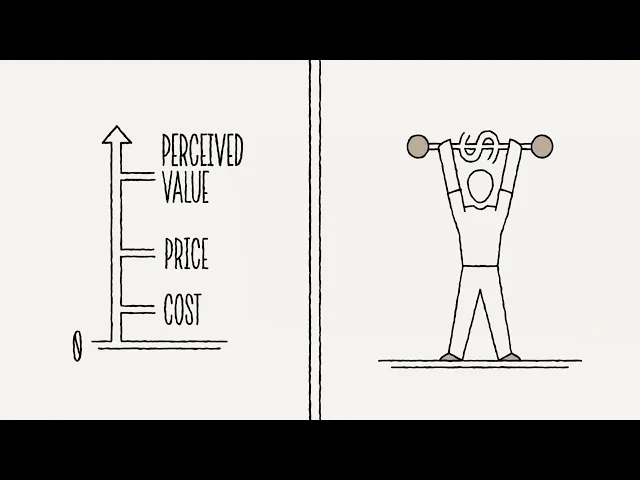
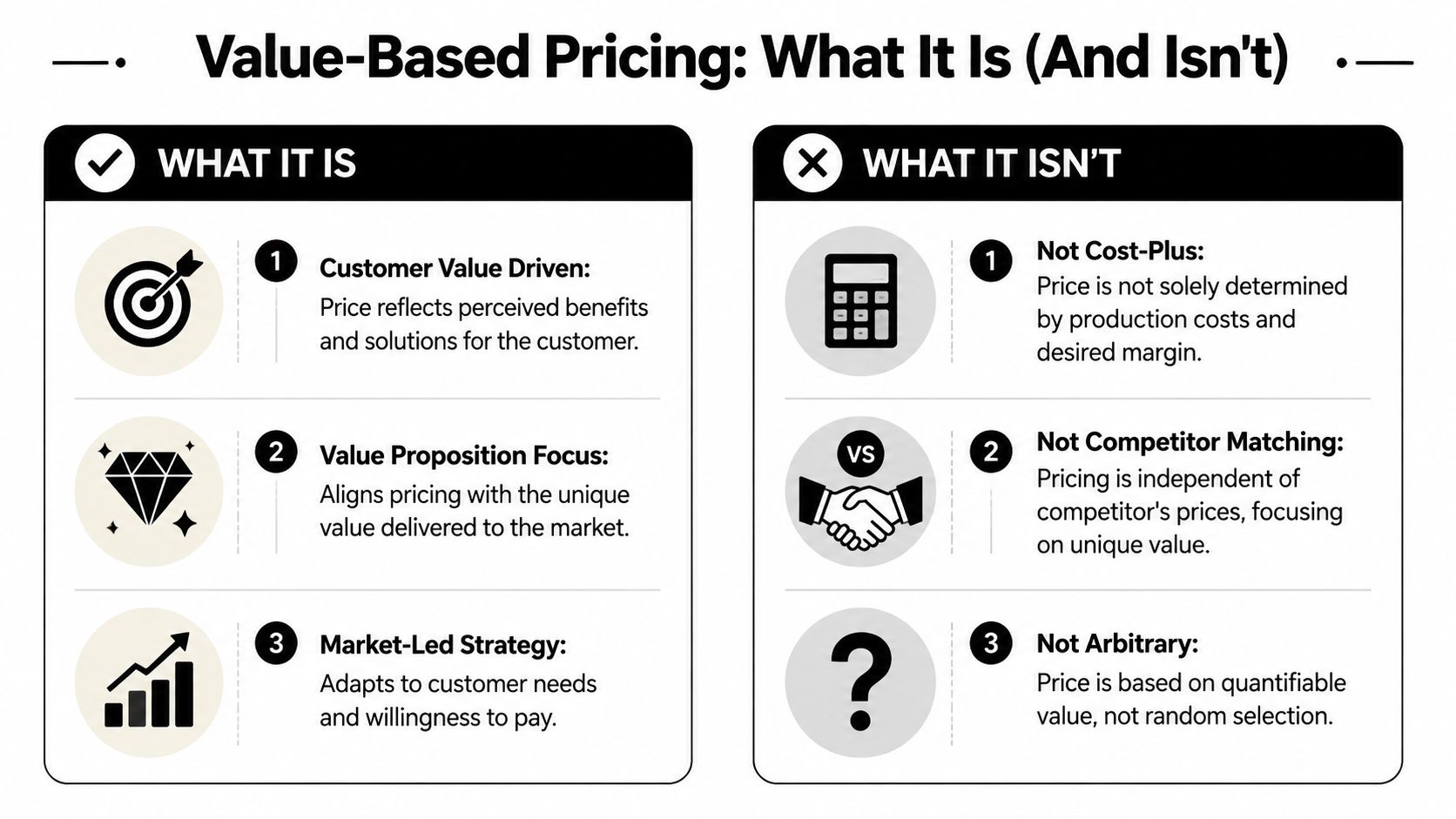
Value-based pricing means setting price according to the value a customer believes they'll receive, or the value you can clearly demonstrate, rather than basing price only on internal cost or competitor benchmarks.
The simplest way to think about it
Customers rarely buy the thing itself. They buy what the thing helps them achieve.
They don't buy bookkeeping hours. They buy cleaner numbers, less rework, and faster visibility. They don't buy warehouse software because software is exciting. They buy fewer errors, better stock visibility, and less wasted time chasing answers. The old line about selling the hole, not the drill, still holds because it forces the right commercial question. What changes for the customer after they buy?
That's why measurable improvement matters. The Australian Productivity Commission found that businesses adopting digital technologies achieved a median annual productivity gain of 13%, with some firms reporting gains of up to 25%, as cited in BillingPlatform's discussion of value-based pricing. That kind of quantified outcome is exactly what supports a premium price when the offer clearly contributes to it.
To sharpen that thinking, it helps to map customer pains, gains, and jobs before you touch pricing. Business Model Analyst's strategic insights are useful for that because they force you to connect the offer to the problem solved, not just the feature delivered.
The three pricing mindsets side by side
Model | Main question | What works | What breaks |
|---|---|---|---|
Cost-plus | What did it cost us, and what margin do we want? | Fast to calculate. Useful as a floor. | Ignores what buyers would actually pay for better outcomes. |
Competitor-based | What's everyone else charging? | Helps with market context. | Turns pricing into copycat behaviour and weakens differentiation. |
Value-based | What is this worth to this segment? | Stronger margin logic and better fit with differentiated offers. | Requires research, discipline, and clearer sales conversations. |
A painkiller is priced differently from a vitamin because urgency, impact, and willingness to pay are different. The same logic applies in B2B and SME markets. A service that removes a painful bottleneck will usually have more pricing power than a service that's merely nice to have.
Price should follow value perception first, cost second, and competitors third.
That doesn't mean you ignore costs or the market. It means you stop letting them lead the conversation.
Why Australian SMEs Should Adopt This Pricing Strategy
Australian SMEs don't need another pricing theory. They need a pricing model that holds up when supplier costs move, wages rise, and customers scrutinise every spend.
Why cost-plus breaks under pressure
Static markups look tidy in a spreadsheet. They're much less useful when your costs and your customers' buying behaviour shift at the same time.
Australia's CPI rose 7.8% in the year to December 2022, the fastest annual rise since 1990, according to the ABS data cited by Baremetrics. In that environment, firms that anchor prices to perceived value are in a better position to protect margins than firms relying on cost-plus markups that lag rising inputs.
That's the practical reason to adopt a value based pricing strategy now. It gives you a better mechanism for margin protection without turning every increase into a defensive apology. If your offer saves time, lowers friction, improves decision quality, or reduces volatility for the customer, those outcomes can support price movement more credibly than “our overheads went up”.
For service businesses, that often means moving away from hourly billing where the client only sees effort. For inventory-heavy firms, it means not treating every SKU or customer account as if they value the same thing.
A segmented value model can also improve customer fit. One buyer may care about speed and certainty. Another may care about flexibility. Another may care about less admin. Charging all three buyers the same way leaves money on the table in one segment and creates resistance in another.
The trade-offs are real
This approach isn't simpler at the start. It asks for more from finance, sales, and leadership.
You need better customer interviews. Better segmentation. Better packaging. Better sales scripts. You also need to accept that one “standard rate” might be comfortable internally but wrong commercially.
The trade-offs usually look like this:
More work upfront: You'll spend more time learning what buyers value and how they compare options.
More complexity in rollout: Different segments may need different packages, anchors, or terms.
More discipline in sales: Teams must explain outcomes, not just inclusions.
More frequent review: In a changing market, pricing can't be set once and forgotten.
Those are real costs. They're still cheaper than underpricing a strong offer for years or overpricing a weak one and bleeding demand.
A Framework for Implementing Value-Based Pricing
A workable pricing model doesn't begin with a calculator. It begins with evidence. Build that evidence in stages, and pricing becomes far less risky.
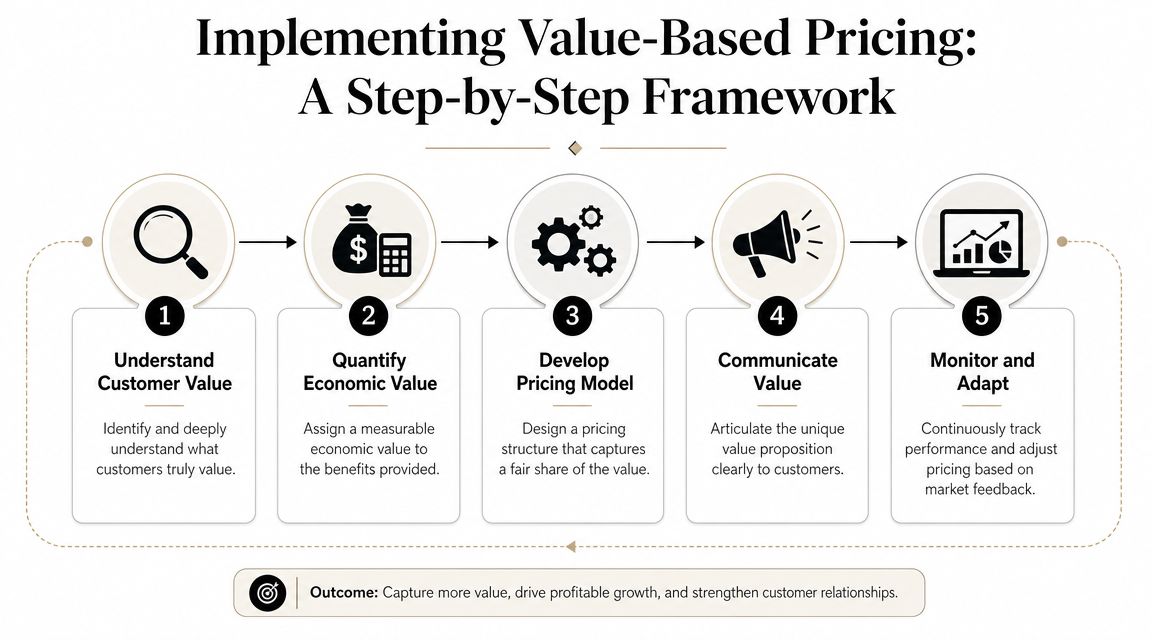
Start with customer value discovery
Talk to recent wins, long-term clients, and customers who almost bought but didn't. Ask what problem they were trying to solve, what alternatives they considered, what risk worried them most, and what changed after they bought.
Don't ask, “Would you pay more?” That question produces weak answers. Ask what made the purchase feel justified. Ask which outcome mattered most. Ask what would have made the offer feel overpriced.
NetSuite notes that companies can use customer interviews, value mapping, and conjoint analysis to estimate value drivers and convert pain points such as cash-flow visibility, inventory pressure, or admin time savings into price points tied to measurable outcomes, as explained in NetSuite's guide to value-based pricing.
Useful interview prompts include:
Decision trigger: What pushed you to look for a solution in the first place?
Commercial priority: Which outcome mattered most when you compared options?
Risk lens: What were you trying to avoid?
Proof point: What made you trust that this would work?
Segment by need not just industry
A strong value-based program requires segmentation. Intuit recommends defining the market by specific needs and testing prices by segment, which matters because value perception differs sharply between groups such as inventory-heavy firms and service businesses, as outlined in Intuit's value-based pricing guidance.
That means your segments shouldn't just be “retail”, “hospitality”, or “professional services”. Those labels are too broad to price from. Better segments are built around buying logic.
For example:
Segment type | What they value most | Pricing risk if ignored |
|---|---|---|
Inventory-heavy operators | Stock visibility, fewer delays, lower admin load | You undercharge complex accounts that gain more operational value |
Service-led firms | Turnaround, clarity, less internal coordination | You default to hourly pricing and hide the outcome |
Risk-sensitive buyers | Reliability, compliance, fewer mistakes | You fail to monetise confidence and accountability |
If your team needs sharper customer definition before pricing work starts, a practical way to tighten segment logic is to drive growth with ICP thinking. A clear ideal customer profile helps stop broad pricing assumptions from contaminating the whole model.
Research willingness to pay properly
Willingness to pay should be researched, not guessed.
For SMEs, that doesn't mean a giant pricing project. It means using lightweight methods with enough structure to produce decisions you can defend. Start with customer interviews, then test packages, anchors, and price points in proposals, landing pages, or controlled sales conversations.
What works in practice:
Package comparison testing
Offer two or three versions with different outcome framing, not just different feature counts.Proposal analysis
Review where deals stall. Price objection is often a value communication problem in disguise.Simple conjoint-style trade-off work
Ask buyers to choose between combinations of service levels, speed, support, and price. That reveals what they value, not what they say sounds nice.
Buyers rarely object to price in a vacuum. They object when the value case is unclear, unproven, or mismatched to their specific problem.
Choose a pricing model that matches the value
The charging mechanism matters. If it doesn't match how the customer experiences value, the model will feel wrong even if the price level is reasonable.
A few common fits:
Tiered pricing: Good when segments want distinct levels of support, speed, reporting, or scope.
Fixed-fee packages: Useful for services where the client cares about the outcome more than the hours.
Usage-based elements: Works when value rises with volume or activity.
Hybrid models: Often best when there's a base level of service plus variable complexity.
A strategic finance lens helps here because pricing shouldn't sit separate from planning, capacity, and cash flow. Teams doing this well usually connect pricing decisions with broader strategic and financial planning, rather than treating pricing as a one-off sales exercise.
A useful test is simple. If volume grows, complexity rises, or risk increases, does the pricing model capture that? If not, the structure is probably leaking margin.
A short walkthrough can help if you're refining the mechanics of the model:
Roll out in a controlled way
Don't reprice everything at once. Pilot first.
Choose one offer, one segment, or one new-customer channel. Test the new pricing with a clear sales narrative and a small set of commercial guardrails. Watch conversion quality, discounting behaviour, gross margin, and customer questions.
A low-risk rollout usually follows this order:
Pilot one offer: Pick a product or service where value is already easiest to explain.
Train sales first: Give the team language for outcomes, trade-offs, and objections.
Set approval rules: Limit ad hoc discounting so the test isn't contaminated.
Review weekly: Capture what customers reacted to, where they hesitated, and which segment responded best.
That's how you de-risk a value based pricing strategy. You don't launch with hope. You launch with controlled evidence.
KPIs to Measure Your Pricing Strategy's Success
If pricing changes but your reporting doesn't, you won't know whether the model is working or just creating noise.

The metrics that matter most
The first group of KPIs tells you whether price is improving the economics of the business. The second tells you whether customers agree that the price matches the value.
Start with these:
Gross margin by segment: This shows whether the new pricing is capturing more value where complexity is higher.
Average revenue per customer or account: Useful for seeing whether package design and anchoring are lifting realised price.
Discount rate: If discounting stays high, the value story probably isn't landing.
Win rate by segment: You need to know where pricing is strong and where it's too aggressive.
Churn or retention by segment: Price can improve short-term revenue and still damage long-term value if the fit is wrong.
Feature or service adoption: Low uptake in “premium” inclusions often means the package doesn't match what buyers care about.
Customer feedback by segment: Track sentiment around fairness, clarity, and realised value.
Pricing must stay dynamic. With ongoing inflation and wage pressure in Australia, value perceptions can shift quickly, and SMEs need to revalidate willingness to pay by segment as market conditions change, as discussed in CCBill's commentary on value-based pricing.
Operator check: If margin improves but retention weakens in one segment, don't celebrate too early. You may have priced above perceived value.
For service firms, it also helps to evaluate the commercial return of specific offers and campaigns. A measurement discipline similar to this framework for professional services webinar ROI is useful because it forces you to connect activity, buyer response, and commercial outcome instead of relying on vague impressions.
Build a simple pricing dashboard
Your dashboard doesn't need to be complicated. It needs to make pricing decisions visible.
A practical monthly dashboard might include:
Dashboard section | What to review | What it tells you |
|---|---|---|
Price realisation | List price versus sold price | Whether discounting is eroding the model |
Segment economics | Margin, revenue, churn by segment | Which customer groups are actually profitable |
Sales friction | Common objections and lost-deal reasons | Whether the issue is price or poor value communication |
Adoption signals | Use of core features, service inclusions, support load | Whether customers experience the value they paid for |
This is the kind of topic worth bringing into a regular quarterly business review, because pricing should be reviewed alongside margin, demand, operations, and capacity, not in isolation.
If a segment shows weaker conversion, heavier discounting, and lower retention, you usually have one of three issues. The segment isn't a fit. The packaging is wrong. Or the sales team is leading with features instead of outcomes.
Value-Based Pricing in Action Industry Examples
A price rise lands. Sales slow, gross margin still looks weak, and the owner assumes the market pushed back on price. In practice, the problem is often simpler. The business charged more without changing the offer, the proof, or the customer segment. Value-based pricing works when it is built into how the offer is packaged and sold.
For Australian SMEs dealing with higher freight, wages, and stock holding costs, that distinction matters. Inventory-heavy businesses need pricing that protects cash tied up in stock. Service businesses need pricing that reflects responsiveness, expertise, and risk reduction rather than hours alone.
Ecommerce and wholesale
Ecommerce and wholesale businesses usually start with landed cost plus markup. That gives a floor. It does not tell you which products or customer groups can carry more margin.
The better approach is to identify where the buyer gets commercial value beyond the item itself. That might be fewer stockouts, easier reordering, better shelf presentation, lower spoilage, or less admin for the purchasing team. Once those drivers are clear, the pricing model can separate a standard buy from a premium buy through pack size, fulfilment speed, account service, or supply certainty.
This matters most in inventory-heavy businesses. If one SKU turns faster, creates fewer support issues, and is purchased by customers who reorder predictably, it can justify a stronger price position than a slower-moving item with the same markup target. I have seen SMEs improve margin by reserving their best service levels for accounts that value reliability and buy consistently, instead of giving that away to every customer.
Hospitality and experience-led venues
Hospitality operators often default to food cost, labour cost, and a target margin per booking. That logic misses what customers are paying to avoid.
A guest booking a birthday dinner, private event, or client function is buying confidence. They want the night to run on time, the space to feel right, and the coordination to be easy. Premium pricing holds when the offer includes practical value such as faster booking confirmation, a dedicated contact, reserved areas, or clearer event execution.
Random extras rarely improve realised price. Reduced planning stress often does.
That is why two packages with similar direct costs can support very different margins. The premium option is not more profitable because it includes one more drink or menu item. It is more profitable because it lowers perceived risk for the customer.
Freight and logistics
Freight businesses get into trouble when every quote is built around rate per pallet or rate per job. That trains the customer to compare only on transport cost.
Many customers are pricing the consequence of failure, not just the delivery itself. A late shipment can stop production, create overtime, miss a retail window, or trigger complaints downstream. In those cases, guaranteed delivery windows, better tracking, account responsiveness, and exception handling have clear economic value.
The commercial significance of segmentation is evident. A customer replenishing standard stock may buy on price. A customer shipping time-sensitive inputs may buy on reliability and communication. Those accounts should not sit on the same pricing logic.
If you advise clients in this space, good accounting and business advisory support helps connect pricing changes to working capital, customer profitability, and service cost before you roll anything out.
Professional services
Professional services firms usually have the clearest path to value-based pricing, but they also drift back to hourly billing fastest. That is usually a confidence issue, not a technical one.
Clients buy different outcomes. One wants compliance done properly with minimal effort on their side. Another wants access to advice that improves decisions. Another is willing to pay for speed, senior attention, and less rework. A single rate card blurs those differences and leaves margin on the table.
A stronger model packages the work around scope, response time, seniority, complexity, and business impact. Fixed fees suit defined outcomes. Hybrid pricing suits work with a stable core and variable complexity. Retainers suit ongoing access and decision support.
The trade-off is operational discipline. If scope is vague, value pricing can become underpriced delivery. Firms that do this well define what is included, what triggers variation, and which client segments find particular value in faster access or deeper input. That protects margin without forcing every pricing conversation back to hours.
Your Action Checklist to Get Started
Most pricing problems don't need a full rebuild on day one. They need a disciplined first pass.
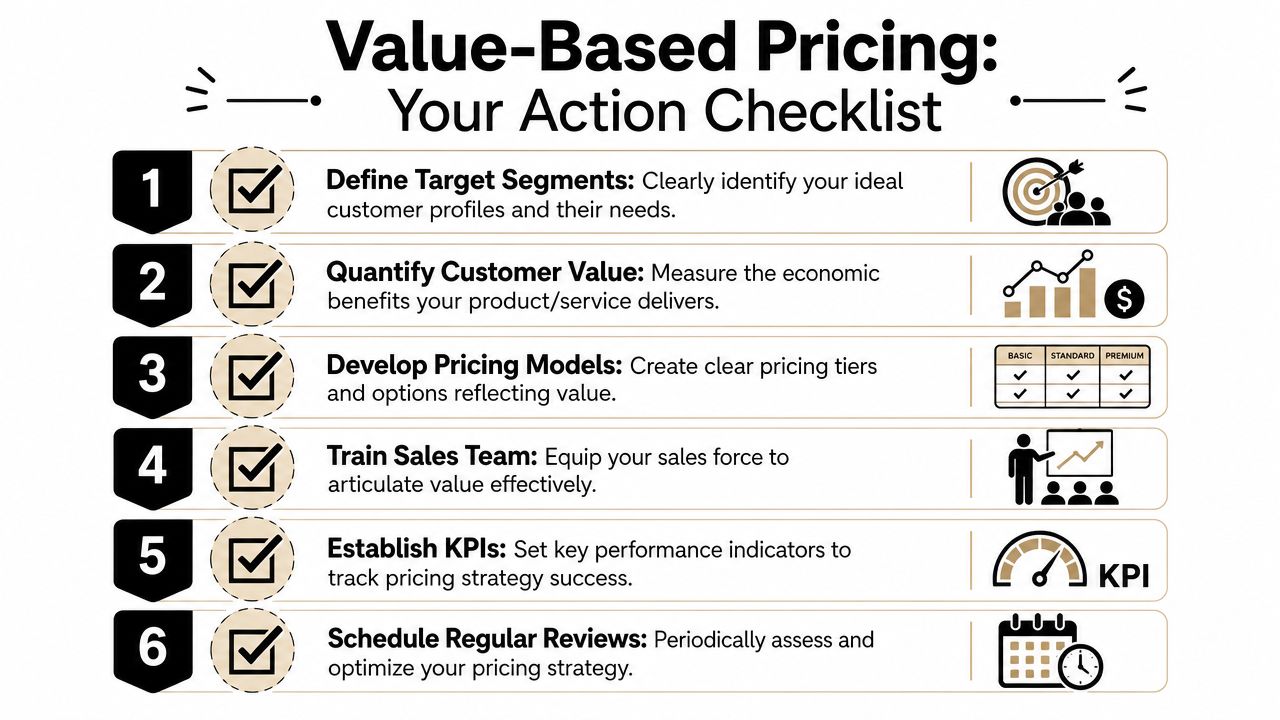
Use this checklist to start:
Pick one offer first: Choose the product or service where value is easiest to explain and margin matters most.
Interview recent customers: Speak to buyers who said yes, buyers who hesitated, and buyers who left. Look for repeated outcome language.
Create rough value segments: Split customers by what they care about most, not just by size or industry.
Rewrite the offer: Package around outcomes, service levels, turnaround, or certainty. Don't just rename inclusions.
Test price with guardrails: Pilot with new customers or a narrow segment before changing everything.
Track realised results: Watch margin, discounting, conversion quality, churn, and feedback by segment.
Review regularly: Pricing drift is common when nobody owns the process.
Common mistakes are predictable:
Leading with effort: Customers don't want to fund your internal complexity.
Using one price for everyone: Mixed segments create mixed results.
Discounting too early: This usually hides weak value communication.
Setting and forgetting: Markets change, and so does willingness to pay.
Trying to serve every buyer equally: Strong pricing usually comes from clearer positioning, not broader positioning.
For founders who need stronger finance discipline around pricing, margin, and operational follow-through, this broader view of accounting and business advisory is often where the pricing work becomes sustainable instead of reactive.
If you want help turning pricing into a practical cash flow and margin lever, Nexist helps Australian founders build the financial clarity, reporting discipline, and commercial systems needed to price with confidence.
value based pricing strategy, pricing models, sme finance australia, virtual cfo, profit margins

" width="24px"/><g d="M 0 24.129 L 0 0.129 L 24 0.129 L 24 24.129 Z M 0 24.129 L 0 0.129 L 24 0.129 L 24 24.129 Z M 24 3 C 24 1.344 22.656 0 21 0 L 3 0 C 1.344 0 0 1.344 0 3 L 0 21 C 0 22.656 1.344 24 3 24 L 21 24 C 22.656 24 24 22.656 24 21 Z M 6.883 8.375 L 2.863 8.375 L 2.863 20.467 L 6.883 20.467 Z M 4.899 2.545 C 3.524 2.545 2.625 3.449 2.625 4.634 C 2.625 5.795 3.496 6.724 4.846 6.724 L 4.872 6.724 C 6.273 6.724 7.146 5.795 7.146 4.634 C 7.12 3.449 6.274 2.545 4.899 2.545 Z M 16.747 8.09 C 14.614 8.09 13.659 9.263 13.124 10.086 L 13.124 8.374 L 9.105 8.374 C 9.159 9.508 9.105 20.466 9.105 20.466 L 13.124 20.466 L 13.124 13.713 C 13.124 13.352 13.15 12.99 13.257 12.732 C 13.547 12.01 14.209 11.262 15.319 11.262 C 16.773 11.262 17.355 12.372 17.355 13.996 L 17.355 20.466 L 21.374 20.466 L 21.374 13.532 C 21.374 9.818 19.391 8.09 16.747 8.09 Z" fill="transparent" height="24.12890599668026px" id="dSFdkJotL" width="24px"><path d="M 0 24 L 0 0 L 24 0 L 24 24 Z" fill="transparent" height="24px" id="wscNJE44G" transform="translate(0 0.129)" width="24px"/><g d="M 0 24.129 L 0 0.129 L 24 0.129 L 24 24.129 Z M 24 3 C 24 1.344 22.656 0 21 0 L 3 0 C 1.344 0 0 1.344 0 3 L 0 21 C 0 22.656 1.344 24 3 24 L 21 24 C 22.656 24 24 22.656 24 21 Z M 6.883 8.375 L 2.863 8.375 L 2.863 20.467 L 6.883 20.467 Z M 4.899 2.545 C 3.524 2.545 2.625 3.449 2.625 4.634 C 2.625 5.795 3.496 6.724 4.846 6.724 L 4.872 6.724 C 6.273 6.724 7.146 5.795 7.146 4.634 C 7.12 3.449 6.274 2.545 4.899 2.545 Z M 16.747 8.09 C 14.614 8.09 13.659 9.263 13.124 10.086 L 13.124 8.374 L 9.105 8.374 C 9.159 9.508 9.105 20.466 9.105 20.466 L 13.124 20.466 L 13.124 13.713 C 13.124 13.352 13.15 12.99 13.257 12.732 C 13.547 12.01 14.209 11.262 15.319 11.262 C 16.773 11.262 17.355 12.372 17.355 13.996 L 17.355 20.466 L 21.374 20.466 L 21.374 13.532 C 21.374 9.818 19.391 8.09 16.747 8.09 Z" fill="transparent" height="24.12890599668026px" id="sTpjGo1tb" width="24px"><path d="M 0 24 L 0 0 L 24 0 L 24 24 Z" fill="transparent" height="24px" id="s7ffpmKOD" transform="translate(0 0.129)" width="24px"/><g d="M 24 3 C 24 1.344 22.656 0 21 0 L 3 0 C 1.344 0 0 1.344 0 3 L 0 21 C 0 22.656 1.344 24 3 24 L 21 24 C 22.656 24 24 22.656 24 21 Z M 6.883 8.375 L 2.863 8.375 L 2.863 20.467 L 6.883 20.467 Z M 4.899 2.545 C 3.524 2.545 2.625 3.449 2.625 4.634 C 2.625 5.795 3.496 6.724 4.846 6.724 L 4.872 6.724 C 6.273 6.724 7.146 5.795 7.146 4.634 C 7.12 3.449 6.274 2.545 4.899 2.545 Z M 16.747 8.09 C 14.614 8.09 13.659 9.263 13.124 10.086 L 13.124 8.374 L 9.105 8.374 C 9.159 9.508 9.105 20.466 9.105 20.466 L 13.124 20.466 L 13.124 13.713 C 13.124 13.352 13.15 12.99 13.257 12.732 C 13.547 12.01 14.209 11.262 15.319 11.262 C 16.773 11.262 17.355 12.372 17.355 13.996 L 17.355 20.466 L 21.374 20.466 L 21.374 13.532 C 21.374 9.818 19.391 8.09 16.747 8.09 Z" fill="transparent" height="24.000006px" id="D0ecaHEcW" transform="translate(0 0)" width="24px"><path d="M 24 3 C 24 1.344 22.656 0 21 0 L 3 0 C 1.344 0 0 1.344 0 3 L 0 21 C 0 22.656 1.344 24 3 24 L 21 24 C 22.656 24 24 22.656 24 21 Z" fill="rgb(55, 184, 218)" height="24.000006px" id="IPLFE6zXx" width="24px"/><path d="M 4.02 0 L 0 0 L 0 12.092 L 4.02 12.092 Z" fill="rgb(255, 255, 255)" height="12.09201px" id="FWhtzAyuY" transform="translate(2.863 8.375)" width="4.02px"/><path d="M 2.274 0 C 0.899 0 0 0.904 0 2.089 C 0 3.25 0.871 4.179 2.221 4.179 L 2.247 4.179 C 3.648 4.179 4.521 3.25 4.521 2.089 C 4.495 0.904 3.649 0 2.274 0 Z" fill="rgb(255, 255, 255)" height="4.17876px" id="VmOsKv4kO" transform="translate(2.625 2.545)" width="4.52095px"/><path d="M 7.641 0 C 5.509 0 4.554 1.173 4.019 1.996 L 4.019 0.284 L 0 0.284 C 0.053 1.419 0 12.376 0 12.376 L 4.019 12.376 L 4.019 5.623 C 4.019 5.262 4.045 4.9 4.151 4.642 C 4.442 3.92 5.103 3.172 6.214 3.172 C 7.667 3.172 8.25 4.282 8.25 5.907 L 8.25 12.376 L 12.269 12.376 L 12.269 5.442 C 12.269 1.728 10.286 0 7.641 0 Z" fill="rgb(255, 255, 255)" height="12.37626px" id="n1XUbhaq0" transform="translate(9.105 8.09)" width="12.268830000000001px"/></g></g></g></g></svg>)