Accounts Payable Process Explained for Australian SMEs
Learn the accounts payable process end to end for Australian SMEs, from invoice capture to payment, with controls, KPIs and automation tips that protect
Ansh Malhotra
Your sales look fine. Your gross margin looks fine. Yet every few weeks you're shifting money between accounts, stretching the overdraft, or delaying your own drawings because cash keeps disappearing faster than it should.
I see this constantly in Australian SMEs. The issue usually isn't revenue. It's a messy accounts payable process. Supplier invoices sit in three inboxes, someone keys the same bill twice, a manager approves by text, and the BAS doesn't quite reconcile because GST was coded differently across similar purchases. On paper, the business is profitable. In the bank, it feels chaotic.
Most owners still treat AP like admin. That's a mistake. AP decides when cash leaves the business, who can authorise it, how clean your records are, and whether finance can trust the liabilities sitting in Xero, MYOB, QuickBooks or an ERP. If you want cleaner cashflow, AP is one of the first places to fix.
Table of Contents
Why AP Quietly Drains Cash in Australian SMEs
A common version looks like this. An ecommerce founder in Melbourne is selling well, stock is moving, and the P&L says the business is healthy. But the owner keeps getting caught short because freight invoices were paid early, one inventory bill was paid twice, and another supplier was paid without anyone checking it against the purchase order.
That isn't rare. It's what happens when AP lives in email, scattered PDFs and memory.
AP is where cash leaves before anyone notices
Small teams usually don't break because they lack effort. They break because one person is trying to do too much. The bookkeeper enters invoices, chases approvals, fields supplier calls, prepares payment runs and answers BAS questions. When that person is juggling AP inside cloud software plus email attachments and supplier portals, blind spots appear fast.
The damage shows up in familiar ways:
Invoices get paid without matching documents. No PO, no receipt, no challenge.
Approval is vague. Someone says “all good” in Teams or WhatsApp, but nobody can prove who approved what.
GST coding drifts. Similar costs land in different accounts or carry inconsistent tax treatment.
Liabilities stop reflecting reality. The balance sheet says one thing. Supplier statements say another.
The bigger point is that AP isn't just back-office processing. The Australian Bureau of Statistics tracks “other accounts receivable and payable” as a formal balance-sheet category in the national accounts framework, drawing on data from ABS financial surveys, APRA reporting, government finance statistics, Commonwealth ledger information and ATO returns through the sources outlined in the ABS methodology on other accounts receivable and payable. That should tell you something. AP isn't clerical clutter. It sits inside the broader financial reporting system that serious institutions rely on.
Practical rule: If you can't explain exactly how an invoice entered the ledger, who approved it, and when it was paid, your AP process is leaking cash.
What founders should fix first
Don't start with software. Start with control.
For most SMEs, the first reset is simple:
Force one entry point for supplier invoices.
Require a document trail before approval.
Separate data entry from payment release.
Review the creditor ageing every week, not just at month-end.
If your AP process is messy, cashflow won't stay stable for long. It doesn't matter how good your sales are if money is leaving the business with weak controls.
The End-to-End Accounts Payable Process
A usable accounts payable process isn't complicated. It is disciplined. Every invoice should move through the same sequence, with clear ownership at each step.

Step 1 through Step 3
The first stage is invoice capture. Suppliers send bills by email, portal, PDF or e-invoice. One person, usually AP or the bookkeeper, should own intake. If invoices arrive in multiple inboxes, you've already lost control. Centralise them.
Next comes the three-way match. AP checks the invoice against the purchase order and the goods received note, or service confirmation if it's a non-stock item. Procurement or operations usually confirms receipt. AP should not guess whether the goods turned up.
Then comes coding. AP or the finance officer assigns the general ledger account, department, class or tracking category. Reporting quality is won or lost. If inventory, freight, marketing and repairs are all miscoded, your P&L becomes noise.
Step 4 through Step 7
After coding, you need GST verification. The invoice must be valid, the GST treatment must be correct, and the tax code in the accounting system must match what's claimable. This isn't just tax admin. It affects BAS accuracy and your recoverable cash position.
Then the invoice moves to approval routing. Department managers approve the commercial spend. The owner, general manager or CFO approves based on delegation limits. Low-risk recurring invoices can use simplified rules. Higher-risk or exception invoices should never.
Once approved, finance handles payment scheduling. Cash discipline matters. Paying on receipt is lazy. Paying late because no one approved the invoice is worse. The right move is to schedule according to terms, cash position and obligations.
The last stage is payment and reconciliation. Treasury, finance manager or an authorised director releases payment. After payment, AP reconciles the transaction back to the supplier ledger and bank feed. If you skip this step, duplicate payments and uncleared supplier balances hang around for months.
Good AP teams don't “process bills”. They control the path from invoice arrival to cash leaving the bank.
Who should own each step
Here's the clean split I recommend in an SME:
Invoice capture. AP clerk, bookkeeper or shared inbox owner.
Receipt confirmation. Operations, store manager, warehouse lead or project manager.
Coding and GST. AP officer with finance oversight.
Approval. Budget owner first, final authoriser second.
Payment release. Someone different from the person who entered the invoice.
Reconciliation. Finance or bookkeeper after the bank transaction clears.
If you're tightening controls, the walkthrough on AP fraud controls from Procright is a useful companion to this workflow, especially around separation of duties and approval discipline.
Payment Timing, GST and the Real Cost of Late Settlements
Most owners think payment is the last AP step. It isn't. Payment timing is a working-capital decision.
A rushed payment run can hurt cash. A delayed one can damage suppliers, BAS accuracy and month-end reporting. Both problems usually come from the same issue. Nobody designed the timing rules properly.
Clearance lag is real cashflow friction
Australian finance teams need to account for bank and allocation lag, not just the date they click “pay”. The ATO states that payments made through BPAY or online services can take up to 4 business days to be received and appear on an ATO account, and cheque or post-office payments can also take up to 4 business days after receipt to appear, as outlined in the ATO payment processing timing guidance.
That matters more than people think. If you're paying BAS, PAYG or other tax obligations at the edge of available cash, a payment initiated today may not yet show when you reconcile tomorrow. For SMEs with thin buffers, that creates avoidable confusion in both cash forecasting and liability reporting.
GST only helps when the records are clean
A lot of founders talk about “getting the GST back” as if it happens automatically. It doesn't. GST credits depend on valid records and correct BAS treatment. If AP captures the wrong invoice, duplicates a bill, or applies the wrong tax code, finance has to unwind it later.
The ATO requires businesses to keep records that support GST amounts claimed and reported in the BAS, and those records must be retained for at least 5 years under the ATO GST record-keeping requirements. That makes AP a compliance workflow, not just a payment queue.
For a practical plain-English overview of tax payment obligations and timing, the FaxZen complete tax guide is a handy reference for owners who want the bigger picture.
Impact of AP Timing Decisions on Australian SMEs
Payment Behaviour | Impact on Cashflow | GST and BAS Effect | Supplier Relationship |
|---|---|---|---|
Paying invoices as soon as they arrive | Cash leaves early and reduces flexibility | GST may be claimed correctly, but only if invoice coding is clean | Suppliers are happy, but you may give away useful trading terms |
Paying after poor internal delays | Cash may sit longer, but unpredictably | Coding and substantiation errors are more likely when teams rush close to BAS | Suppliers lose trust and start chasing |
Paying with no verification | Cash leaks through duplicates or wrong amounts | BAS can be misstated if GST treatment is wrong | Disputes increase when overpayments or reversals happen |
Scheduling payments to agreed terms | Cash stays in the business for the right period | BAS is cleaner because AP follows a set review rhythm | Suppliers see consistency and fewer excuses |
If your payment terms are vague or all over the place, tighten them at the source. This guide to invoice payment terms is worth reviewing alongside your AP rules.
Where AP Approvals Actually Break Down
Late supplier payments usually get blamed on “finance being slow”. In most SMEs, that's the wrong diagnosis. The invoice didn't stall because AP couldn't click a button. It stalled because the approval design was weak.
Australian AP commentary has started to catch up to this. Recent coverage highlighted that invoice routing and escalation matter more than the payment date itself, and noted rising B2B payment stress in Australia, with more than half of B2B invoices overdue in 2025 and bad debts averaging just over 10% of B2B invoices, as discussed in this analysis of why traditional accounts payable is dead. That's exactly what I see on the ground. Businesses often have the cash. They just don't have a clean path to approval.

Four failure points that cause most AP gridlock
The first is missing delegation. A director goes on leave, invoices wait, suppliers chase, and everyone acts surprised. If only one person can approve key spend, your process isn't controlled. It's fragile.
The second is bad threshold design. I still see businesses send a low-value recurring invoice and a major capex bill through the same workflow. That clogs the queue and trains approvers to rubber-stamp.
The third is self-approval. The same person raises the order, confirms receipt, enters the bill and approves it. That isn't efficiency. That's an invitation to error and fraud.
The fourth is approval by email or message. A screenshot saying “approved” is not a system. It's barely a memory.
What a functional approval structure looks like
You need a written delegation-of-authority matrix. Not a rough understanding. A document.
Use rules such as:
Low-risk recurring invoices follow a more efficient approval path if supplier, amount pattern and coding are already known.
Operational spend goes to the budget owner first, then finance if it breaches threshold or falls outside normal pattern.
Exception invoices with no PO, unusual GST treatment or pricing variance get escalated automatically.
Payment release sits with a separate authorised person.
Weak approvals are usually disguised as flexibility. In practice, they create payment delays, duplicate spend and bad audit trails.
A strong AP workflow also logs who approved, when they approved, and what changed before payment. If the system can't show that clearly, it's not fit for purpose.
KPIs and Internal Controls That Keep AP Audit-Ready
Most SMEs don't need a giant AP dashboard. They need a short list of metrics that expose risk early.
If you review five things every month, you can usually spot trouble before it hits cashflow, BAS or supplier relationships. The trick is pairing each KPI with the control that produces it.
The controls matter more than the metric
The ATO recommends digital record-keeping systems to reduce manual errors and correctly classify transactions in accounts payable and accounts receivable systems, and it specifically calls out avoidable issues such as duplicate invoices, incorrect GST treatment and manual data entry errors in its BAS and GST tips for business. That should shape your AP scorecard.
Track the metric. But fix the process behind it.
AP KPIs and matching controls
KPI | What it measures | Matching control | Cash or compliance outcome |
|---|---|---|---|
Invoice cycle time | How long invoices take from receipt to ready-for-payment | Centralised intake and approval deadlines | Fewer last-minute payment runs |
Exception rate | How many invoices fall out of normal workflow | PO discipline, receipt confirmation, exception log | Less rework and fewer disputed bills |
First-pass match rate | How often invoices match cleanly on first review | Three-way match rules and supplier onboarding standards | Faster processing and better spend control |
Duplicate spend captured | Whether the process catches repeated invoices before payment | Duplicate invoice detection and supplier statement review | Prevents direct cash leakage |
Days payable outstanding versus terms | Whether payments align with agreed supplier terms | Payment calendar and creditor ageing review | Better working-capital control |
Invoices over 30 days past due | Where supplier obligations are becoming stale | Escalation rules and weekly approval review | Reduces supplier strain and firefighting |
The monthly review I'd insist on
Run one AP control review each month with these elements:
Creditor ageing review to identify old or disputed balances.
Supplier statement reconciliation for major suppliers.
GST code review for unusual or manually entered transactions.
Document retention check to confirm invoices and approvals are attached and complete.
Segregation of duties check so one person isn't controlling too much of the chain.
If your team is redesigning these responsibilities, this guide on segregation of duties is worth keeping beside your workflow map.
For businesses building or integrating AP systems, the detail in e invoice compliance for developers is useful because it forces you to think beyond data capture and into validation and audit structure.
Automating AP and Preparing for E-Invoicing in Australia
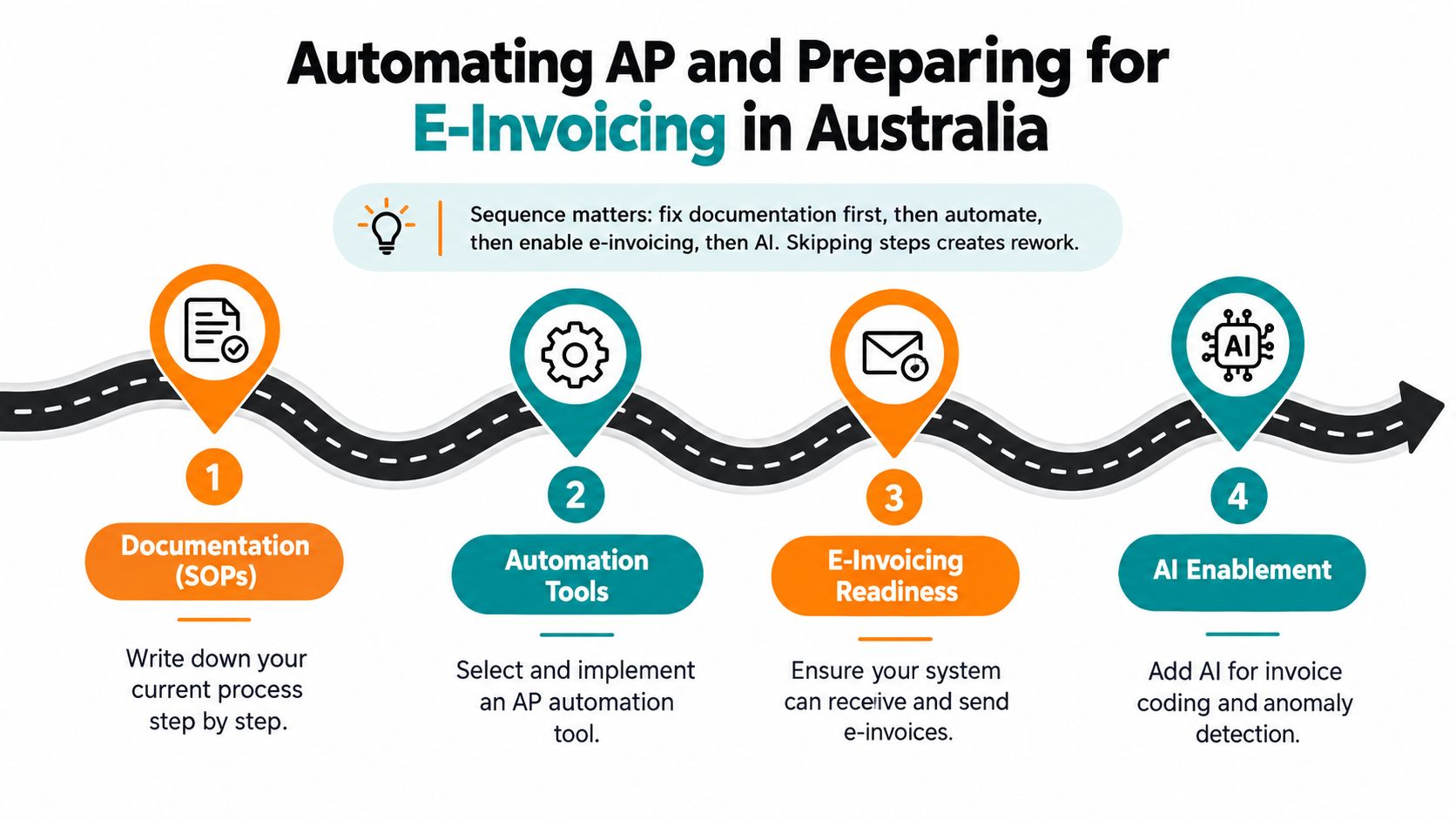
Most AP automation projects fail for a simple reason. The business automates the mess instead of fixing it first.
If your invoice coding is inconsistent, approver rules are vague and supplier records are untidy, adding OCR or AI won't solve much. It will just help bad process move faster.
Fix the operating rules before the software
Start with documentation.
Write down the AP policy. Set the delegation matrix. Clean up the chart of accounts and tracking categories. Define which invoices need PO matching and which don't. Decide who can create suppliers, who can amend bank details and who can release payments.
Only after that should you look at tools.
The sequence I'd use is:
Capture and digitise invoices through one intake point.
Automate matching against purchase orders and receipts.
Standardise approval rules inside the system.
Enable payment scheduling based on terms and cash plan.
Layer in e-invoicing and AI once the data is clean.
Australia is moving, but many businesses still aren't ready
There's a clear readiness gap in Australia. In a 2025 survey, 29% of large Australian companies had started planning for the transition to real-time payments, while AP and invoice processing ranked among the top finance use cases for AI at 56% and automation at 57%, according to the Robert Half finance AI and automation survey. My view is blunt. If large companies are still planning, SMEs shouldn't wait for perfect certainty. They should get operationally ready now.
That means your AP setup should be capable of receiving e-invoices, supporting stronger validation, and adapting to faster payment rails without weakening controls.
Here's a useful overview before you shortlist platforms or redesign your workflow:
A practical rollout path for SMEs
Don't buy an “AI AP solution” first. Get the basics right.
Use a staged rollout:
Weeks one to four. Document the current workflow, approval rules and coding map.
Weeks five to eight. Deploy invoice capture and matching.
Weeks nine to twelve. Turn on e-invoicing readiness, then add AI for coding suggestions, duplicate detection and anomaly flags.
One local option in this space is Nexist, which supports AP process improvement, invoice automation, approval controls and Peppol eInvoice workflows as part of broader finance operations. If you're comparing systems or service models, this breakdown of accounts payable automation in Australia will help you frame the decision properly.
AI works well in AP when the invoice data is clean, supplier records are controlled, and approval logic is already defined. Without that, it guesses inside a broken process.
Your 30-Day AP Reset Checklist for Australian SMEs
You don't need a six-month transformation to get AP under control. Most SMEs can make serious progress in a month if someone owns it and the rules are written down.
The key is to stop chasing old invoices randomly and start rebuilding the process in sequence.

Week 1 and Week 2
In week 1, run a full invoice triage. Pull every unpaid supplier invoice into one list. Match each one to the ledger. Flag duplicates, unclear GST treatment, missing approvals and any bill that has no clear owner. If an invoice can't be explained, don't pay it yet.
In week 2, standardise the workflow. Create a one-page SOP covering intake, coding, approval, payment scheduling and reconciliation. Then define who approves what, who steps in when someone is away, and where the final record must live.
Week 3 and Week 4
In week 3, lock in controls. Review the supplier master. Remove duplicate suppliers, confirm bank details, separate invoice entry from payment release, and start an exception log. Every unusual invoice should leave a trail.
In week 4, turn the process into a routine. Set payment run dates. Align AP review with BAS and cash planning. Reconcile supplier statements for key vendors. If your volume justifies it, assess e-invoicing or automation now that the process is cleaner.
The weekly rhythm that stops AP sliding backwards
After the reset, keep one short AP review every week. Fifteen minutes is enough if the process is organised.
Use the time to check:
Which invoices are waiting for approval
Which supplier balances don't match statements
Which payments are due soon
Which exceptions need escalation
Which GST or coding issues need correction before month-end
That small rhythm matters. Most AP problems don't start as disasters. They start as unattended invoices, weak handoffs and nobody owning the queue.
If your accounts payable process feels reactive, Nexist helps Australian SMEs rebuild it properly. We map the workflow, tighten approvals, clean up coding, improve payment timing and put the controls in place so cash stops leaking through avoidable errors. If you want a finance team that fixes the process instead of just reporting the mess, visit Nexist.
accounts payable process, AP workflow, invoice automation, cash flow, Australian SMEs

" width="24px"/><g d="M 0 24.129 L 0 0.129 L 24 0.129 L 24 24.129 Z M 0 24.129 L 0 0.129 L 24 0.129 L 24 24.129 Z M 24 3 C 24 1.344 22.656 0 21 0 L 3 0 C 1.344 0 0 1.344 0 3 L 0 21 C 0 22.656 1.344 24 3 24 L 21 24 C 22.656 24 24 22.656 24 21 Z M 6.883 8.375 L 2.863 8.375 L 2.863 20.467 L 6.883 20.467 Z M 4.899 2.545 C 3.524 2.545 2.625 3.449 2.625 4.634 C 2.625 5.795 3.496 6.724 4.846 6.724 L 4.872 6.724 C 6.273 6.724 7.146 5.795 7.146 4.634 C 7.12 3.449 6.274 2.545 4.899 2.545 Z M 16.747 8.09 C 14.614 8.09 13.659 9.263 13.124 10.086 L 13.124 8.374 L 9.105 8.374 C 9.159 9.508 9.105 20.466 9.105 20.466 L 13.124 20.466 L 13.124 13.713 C 13.124 13.352 13.15 12.99 13.257 12.732 C 13.547 12.01 14.209 11.262 15.319 11.262 C 16.773 11.262 17.355 12.372 17.355 13.996 L 17.355 20.466 L 21.374 20.466 L 21.374 13.532 C 21.374 9.818 19.391 8.09 16.747 8.09 Z" fill="transparent" height="24.12890599668026px" id="dSFdkJotL" width="24px"><path d="M 0 24 L 0 0 L 24 0 L 24 24 Z" fill="transparent" height="24px" id="wscNJE44G" transform="translate(0 0.129)" width="24px"/><g d="M 0 24.129 L 0 0.129 L 24 0.129 L 24 24.129 Z M 24 3 C 24 1.344 22.656 0 21 0 L 3 0 C 1.344 0 0 1.344 0 3 L 0 21 C 0 22.656 1.344 24 3 24 L 21 24 C 22.656 24 24 22.656 24 21 Z M 6.883 8.375 L 2.863 8.375 L 2.863 20.467 L 6.883 20.467 Z M 4.899 2.545 C 3.524 2.545 2.625 3.449 2.625 4.634 C 2.625 5.795 3.496 6.724 4.846 6.724 L 4.872 6.724 C 6.273 6.724 7.146 5.795 7.146 4.634 C 7.12 3.449 6.274 2.545 4.899 2.545 Z M 16.747 8.09 C 14.614 8.09 13.659 9.263 13.124 10.086 L 13.124 8.374 L 9.105 8.374 C 9.159 9.508 9.105 20.466 9.105 20.466 L 13.124 20.466 L 13.124 13.713 C 13.124 13.352 13.15 12.99 13.257 12.732 C 13.547 12.01 14.209 11.262 15.319 11.262 C 16.773 11.262 17.355 12.372 17.355 13.996 L 17.355 20.466 L 21.374 20.466 L 21.374 13.532 C 21.374 9.818 19.391 8.09 16.747 8.09 Z" fill="transparent" height="24.12890599668026px" id="sTpjGo1tb" width="24px"><path d="M 0 24 L 0 0 L 24 0 L 24 24 Z" fill="transparent" height="24px" id="s7ffpmKOD" transform="translate(0 0.129)" width="24px"/><g d="M 24 3 C 24 1.344 22.656 0 21 0 L 3 0 C 1.344 0 0 1.344 0 3 L 0 21 C 0 22.656 1.344 24 3 24 L 21 24 C 22.656 24 24 22.656 24 21 Z M 6.883 8.375 L 2.863 8.375 L 2.863 20.467 L 6.883 20.467 Z M 4.899 2.545 C 3.524 2.545 2.625 3.449 2.625 4.634 C 2.625 5.795 3.496 6.724 4.846 6.724 L 4.872 6.724 C 6.273 6.724 7.146 5.795 7.146 4.634 C 7.12 3.449 6.274 2.545 4.899 2.545 Z M 16.747 8.09 C 14.614 8.09 13.659 9.263 13.124 10.086 L 13.124 8.374 L 9.105 8.374 C 9.159 9.508 9.105 20.466 9.105 20.466 L 13.124 20.466 L 13.124 13.713 C 13.124 13.352 13.15 12.99 13.257 12.732 C 13.547 12.01 14.209 11.262 15.319 11.262 C 16.773 11.262 17.355 12.372 17.355 13.996 L 17.355 20.466 L 21.374 20.466 L 21.374 13.532 C 21.374 9.818 19.391 8.09 16.747 8.09 Z" fill="transparent" height="24.000006px" id="D0ecaHEcW" transform="translate(0 0)" width="24px"><path d="M 24 3 C 24 1.344 22.656 0 21 0 L 3 0 C 1.344 0 0 1.344 0 3 L 0 21 C 0 22.656 1.344 24 3 24 L 21 24 C 22.656 24 24 22.656 24 21 Z" fill="rgb(55, 184, 218)" height="24.000006px" id="IPLFE6zXx" width="24px"/><path d="M 4.02 0 L 0 0 L 0 12.092 L 4.02 12.092 Z" fill="rgb(255, 255, 255)" height="12.09201px" id="FWhtzAyuY" transform="translate(2.863 8.375)" width="4.02px"/><path d="M 2.274 0 C 0.899 0 0 0.904 0 2.089 C 0 3.25 0.871 4.179 2.221 4.179 L 2.247 4.179 C 3.648 4.179 4.521 3.25 4.521 2.089 C 4.495 0.904 3.649 0 2.274 0 Z" fill="rgb(255, 255, 255)" height="4.17876px" id="VmOsKv4kO" transform="translate(2.625 2.545)" width="4.52095px"/><path d="M 7.641 0 C 5.509 0 4.554 1.173 4.019 1.996 L 4.019 0.284 L 0 0.284 C 0.053 1.419 0 12.376 0 12.376 L 4.019 12.376 L 4.019 5.623 C 4.019 5.262 4.045 4.9 4.151 4.642 C 4.442 3.92 5.103 3.172 6.214 3.172 C 7.667 3.172 8.25 4.282 8.25 5.907 L 8.25 12.376 L 12.269 12.376 L 12.269 5.442 C 12.269 1.728 10.286 0 7.641 0 Z" fill="rgb(255, 255, 255)" height="12.37626px" id="n1XUbhaq0" transform="translate(9.105 8.09)" width="12.268830000000001px"/></g></g></g></g></svg>)