
Segregation of Duties: A Practical Guide for SMEs
Learn how segregation of duties protects Australian SMEs from fraud, cash leaks, and costly errors—with actionable steps and examples.
Ansh Malhotra
You probably know the feeling already. A supplier query lands in your inbox, payroll needs to go out, a stock count is overdue, and the same person is still the one creating vendors, approving payments, and reconciling the bank. On a good week, nothing blows up. On a bad week, you find duplicated invoices, odd journal entries, or a payment trail that no one can cleanly explain.
That's where segregation of duties stops being an audit phrase and starts being a cash-protection tool. In an Australian SME, it's the difference between a founder who can trust the numbers and a founder who is stuck personally checking every transaction after hours. The controls matter because one person shouldn't be able to start a transaction, approve it, record it, and hide the mess afterwards, especially in businesses handling payments, payroll, inventory, and supplier approvals. Australian fraud-control guidance treats that separation as a baseline control for integrity, not a nice-to-have bookkeeping preference, and that mindset is the right one for lean teams too. Commonwealth fraud-control guidance on segregation of duties
Table of Contents
The Hidden Cash Leak Most Australian Founders Miss
A founder I'd call to mind had a bookkeeper who “just handled AP”. That meant she created the supplier, entered the invoice, matched the payment, and cleared the bank rec. Nobody was trying to commit fraud, but the structure was bad enough that duplicate invoices sat undetected, supplier details changed without a second review, and the business leaked cash for months before the pattern became obvious.
That's the problem with weak controls. You don't need a dramatic theft to hurt margin, you just need one person to control too much of the payment path for too long. Australian public-sector guidance is blunt on this point, duties should be split so one identity can't own the whole transaction chain, and that same logic fits SMEs that feel too small to worry about formal control design. The smaller the team, the easier it is for a sloppy workflow to become the normal workflow.
Practical rule: if one person can create the risk, approve the risk, and hide the risk, you've already left the door open.
The cleanest way to think about it is cash protection. Segregation of duties isn't about being compliance theatre or impressing an auditor. It's about stopping leakage in the places where money leaves the business fastest, vendor payments, payroll, journals, privileged access, and supplier master data. That's why control frameworks keep coming back to the same design logic, separate authorization, custody, recording, and reconciliation, then force an independent review at the risky points.
If you're running a founder-led business, treat SoD like pricing and debtor control. You don't wait until the account is empty to fix margins, and you don't wait until payroll fraud or a bogus supplier account lands in your lap to tighten process. business risk management for SMEs
What Segregation of Duties Actually Means
At its simplest, segregation of duties means no one person should control the whole transaction. The working model I use with founders is four stages, request, approve, execute, reconcile. If the same person sits on all four, the process is too exposed, even if that person is trusted and well liked.
The four-stage test
Think of a bar tab signed only by the person pouring the drinks. It's fast, but it's also how you end up with no real control over what was consumed or charged. Business processes behave the same way. A person who requests a payment shouldn't also be the one approving it, sending it, and later reconciling it to the bank.
Here's the plain-English test I use. If a workflow lets one user both authorise and record a transaction, or control both the custody of an asset and the reconciliation of the books, the control is weak. That's why classical internal-control thinking keeps these responsibilities apart.
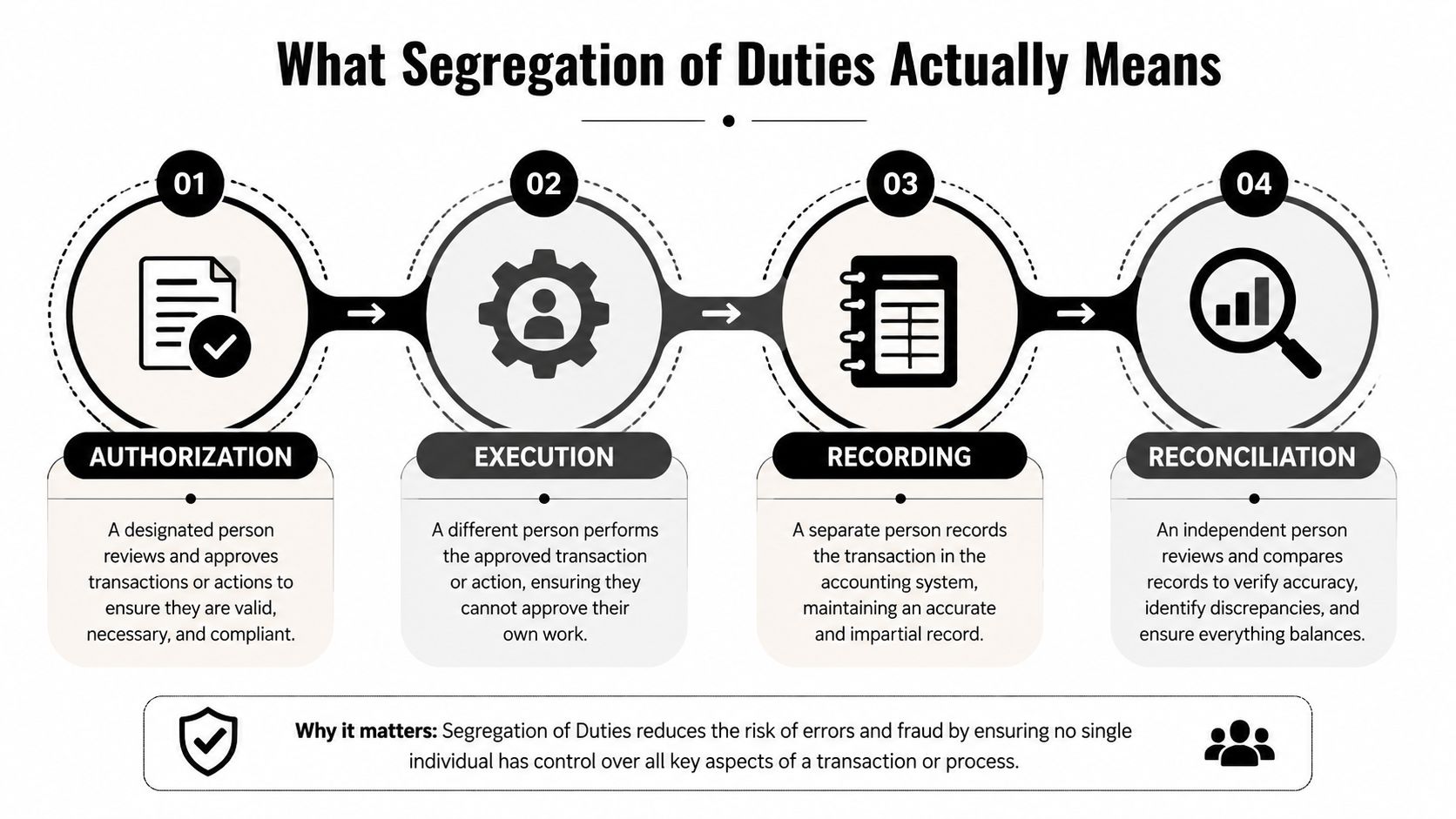
Stage | What happens | Risk if one person owns it |
|---|---|---|
Request | Someone initiates the transaction | Fake or unnecessary transactions can start unnoticed |
Approve | Someone authorises it | Self-approval becomes possible |
Execute | Someone carries it out | Payment, posting, or release can happen without challenge |
Reconcile | Someone checks it against evidence | Errors and fraud can be hidden after the fact |
The control logic behind the model
The reason this works is simple, humans make mistakes, and humans can also misuse access. When the same person creates the vendor, processes the invoice, and reconciles the payment, there's no natural checkpoint. When those steps are split, the workflow creates friction at exactly the place where fraud or error would otherwise move through.
This is also why compliance frameworks keep tying SoD to evidence. If you've ever looked at Sarbanes-Oxley compliance requirements, the pattern is familiar, controls must be designed so the business can prove the same person isn't controlling incompatible parts of the process. Australian SMEs don't need a listed-company bureaucracy, but they do need the same discipline in a lighter form.
The one-line test is easy. If one person can initiate, approve, execute, and hide the same transaction, the process needs redesign.
The Four SoD Models and Which One Fits Your Team
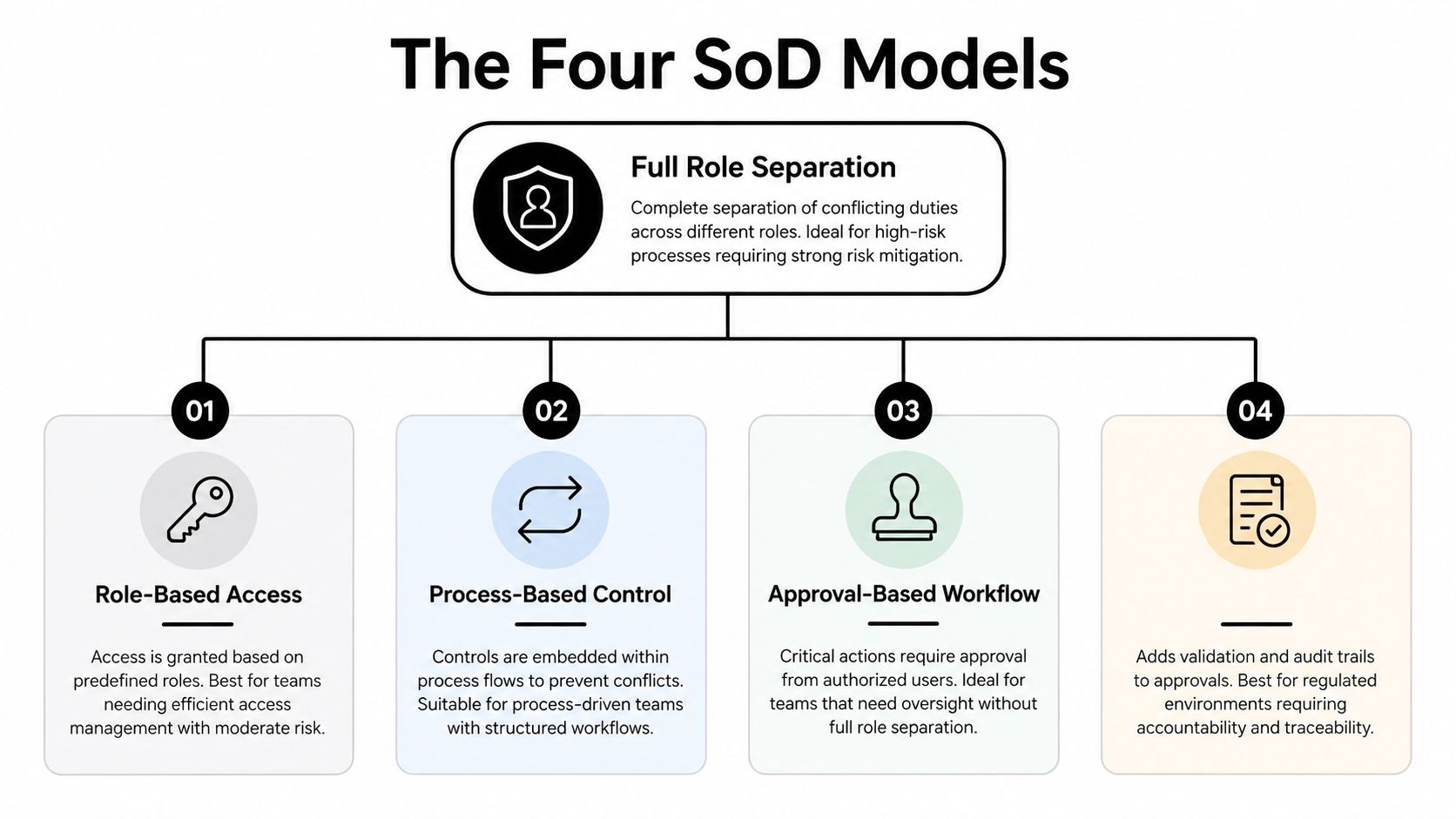
Most businesses don't move from chaos to perfection in one leap. They move through four practical models, and the right one depends on team size, system maturity, and how much of the workflow lives in software versus in people's heads. For an Australian SME, the point isn't theoretical purity, it's getting the highest-risk paths under control without breaking the business.
Full separation for bigger teams
This is the classic model. One person handles the request, another approves, a third executes, and someone else reconciles. It fits larger teams where there's enough depth to split AP, payroll, inventory, and finance functions cleanly. It's strongest, but it's also the hardest to staff in a small business.
Role-based access control for ERP-driven teams
RBAC matters. Access rights in the ERP, payroll, or HR system are tied to job roles, not personal favour or convenience. A finance officer may post bills, but not create new vendors. An operations manager may approve stock receipts, but not alter supplier banking details. This model is common once a business has enough system structure to enforce boundaries consistently.
Rule-based SoD enforced in the workflow
This model uses software rules to block bad combinations. A payment request can't be approved by the same user. A journal entry above a threshold requires a second reviewer. A production deployment needs a separate release approver. The system makes self-approval impossible or at least visible, which matters because policy alone won't stop a tired bookkeeper from clicking through a task.
Risk-based SoD with compensating controls
This is the reality for many small Australian businesses. The ABS reports that 99.8% of Australian businesses are SMEs, so full role separation often isn't staffed into the building at all. In that case, you use compensating controls, mandatory reviewer approval, immutable logs, periodic access recertification, and detailed supervisory review when one person has to do more than one thing.
Bottom line: if you're a three-person team, don't copy a 300-person control model. Use the lightest model that still blocks self-approval and forces review at the risk points.
A simple fit test works well:
3-person team: risk-based SoD with strong reviewer checks and system-enforced approval blocks.
30-person operation: role-based access with clear matrix rules and routine access reviews.
Multi-system business with payroll, inventory, and finance teams: rule-based workflows plus RBAC, with exception handling only for unavoidable cases.
A lot of Australian control guidance assumes the ideal model is fully separable. That's useful, but not always usable. The key is to pick the model you can realistically sustain this quarter, then harden it over time. Segregation of duties and internal control practices
Real-World Scenarios Where SoD Would Have Caught the Problem
The strongest control argument is rarely a theory. It's a pattern you recognise in your own business before the damage gets bigger.
Supplier master data changed once, then the payments drifted
A common AP failure starts with a simple change, a supplier updates their banking details, and the same person who maintains the vendor record also runs payments. If that account change isn't independently checked, a legitimate supplier can turn into a fraudulent destination. The fix is boring and effective, one person updates the supplier record, another approves the change, and a separate person or system exception review handles the payment run.
Payroll stayed “clean” while one employee never existed
Payroll ghost employee schemes rely on a gap between employee setup, payroll processing, and review. If the same person can create the employee file, process the pay, and reconcile the payroll clearing account, the fake name can keep earning a wage. When HR, payroll, and finance each touch the workflow separately, the ghost gets caught much earlier because the records don't line up.
Inventory shrinkage disappeared into the count process
Inventory losses often hide inside the count itself. If the same warehouse staff member can receive stock, count stock, and reconcile variances, shrinkage can be disguised as a mistake or a timing issue. Separation works better when custody sits with operations, counting sits with someone else, and the variance review lands with finance or a manager who doesn't handle the stock every day.

The point across all three scenarios is the same. When a single person can both create and conceal the problem, the fraud or error path stays open longer than it should. A properly split workflow doesn't guarantee perfection, but it creates the first hard stop, and that is usually enough to catch the issue before it becomes embedded.
A useful control habit is to ask one blunt question at each step. Who can change the data, who can release the value, and who can see the exception before the bank does? If the answer is the same name three times in a row, you've found the weak spot.
A short video walkthrough can help your team visualise where these gaps usually sit in finance and operations workflows.
A Prioritised Implementation Roadmap for Australian SMEs
Start where the losses are most likely to happen. For most Australian SMEs, that means vendor payments, payroll, journal entries, privileged access grants, vendor master-data changes, and production deployments. Those are the spots where one user can both trigger and conceal a bad transaction path, which is exactly what you want to break first.
Week one, map the highest-risk workflows
Don't build a giant policy document first. Map the actual process steps for each high-loss area, then list who currently requests, approves, executes, and reconciles. The goal is to find where one person is doing too much, or where the system lets one user override the controls without anyone noticing.
Next, build the SoD matrix
An SoD matrix is just a practical conflict map. Put roles down one side, tasks across the top, then flag where the same person can perform incompatible actions. For a small business, that matrix should cover AP, payroll, inventory receipts, bank reconciliations, journal posting, and access changes. If the matrix is clear, your bookkeeper, CFO, and IT partner can all work from the same control picture.
Then layer in compensating controls
When staffing is too lean for full role separation, don't shrug and move on. Use mandatory reviewer approval, immutable logs, periodic access recertification, and monthly supervisory review. That layered approach is supported in practical control guidance when small teams can't separate every task cleanly. Cornell's internal-controls guidance notes that when segregation isn't possible or practical, alternative controls are needed, and UCLA similarly points to detailed supervisory review as a compensating measure for smaller departments. Cornell segregation of duties guidance
A strong rollout sequence looks like this:
Vendor payments first. Duplicate or redirected payments hurt fast.
Payroll second. It's repetitive, sensitive, and easy to abuse if setup and processing are combined.
Journal entries third. That's where people can hide issues after the fact.
Privileged access last, but not late. Access grants should be reviewed before they become normal.
Keep the process boring. If a control feels dramatic, it's probably too hard for a lean team to sustain.
The smartest move is to make controls visible in systems rather than buried in a handbook. Policy matters, but system design decides whether the policy works on a busy Tuesday.
Embedding SoD into Your ERP, IAM and Workflow Stack
Paper policy doesn't stop self-approval. Systems do. If your ERP, payroll platform, and access layer still let the same person create, approve, and release a transaction, then your control design is still mostly wishful thinking.
Turn the matrix into system rules
Start with RBAC in the tools you already use. In Xero, MYOB, NetSuite, SAP Business One, payroll software, and your HR platform, the job is to make permissions reflect actual duties, not personal convenience. The rule should be simple, if a user can initiate a transaction, they shouldn't also be able to approve the same class of transaction unless a compensating control is in place.
Workflow automation helps because it blocks self-approval at the point of action. A payment request can route to a different approver. A journal entry can require review before posting. A supplier master-data change can trigger an exception queue and a second set of eyes. That's the difference between a control that lives in a PDF and one that interrupts a risky workflow.
If you need a broader operations lens, the logic in accounts payable automation for Australian businesses lines up neatly with SoD. Automation is useful only when it removes manual dependence without removing review, otherwise you've just made bad process faster.
Use access reviews to catch privilege creep
One of the quietest failures in SMEs is access drift. A person changes roles, takes on a temporary project, or gets added to a system “just for now”, then the extra access never comes off. That's where periodic recertification matters. It forces the business to ask who still needs what, and it catches the combination of permissions that became toxic over time.
Privileged access deserves special attention. If someone can alter users, change approvals, or override workflow rules, that's not ordinary access. For a practical overview of that issue, Ollo's guidance on privileged identity management is a useful reference point for the kinds of control questions you should be asking your IT partner or advisor.
Know when you need deeper governance tools
For a smaller business, native ERP controls may be enough if they're configured properly and reviewed regularly. Once you're running multiple entities, multiple systems, or a more complex finance and operations stack, third-party governance, risk, and compliance tooling can help surface SoD conflicts more consistently. The point isn't to buy more software. The point is to make self-approval technically impossible and access drift visible before it becomes a problem.
Checklists and Templates You Can Use This Week
Start with a simple SoD risk matrix. Cover AP, payroll, inventory, reconciliations, journal entries, and privileged access. Mark each role against the tasks it can request, approve, execute, and reconcile, then flag every conflict where one person can control more than one critical stage. That document should be short enough to use, not so elaborate that it sits in a folder unopened.
For a lean team, build a compensating-control checklist next. It should ask three blunt questions, is there mandatory reviewer approval, are the logs immutable, and is access recertified on a schedule the business can maintain. If the answer to any of those is no, you don't have a control, you have an intention.
A simple 30-60-90 day rollout plan works well for founders or an operations lead. Use the first 30 days to map the highest-risk processes, the next 30 to configure approvals and access rules, and the final 30 to run the first review cycle and remove leftover access that no longer matches the job. If you want a compliance reference point while you build it, the logic in this compliance checklist resource gives you a useful structure to adapt for SoD and related controls.
The best template is the one your team uses. Start with the high-loss workflows, keep the matrix visible, and make the review cadence mandatory.
Turning SoD Into a Profit-Protection Discipline
SoD stops being “compliance overhead” the moment you treat it as profit protection. Map AP and payroll first, turn the approvals into system-enforced workflows, and schedule monthly access recertification so privilege creep doesn't rebuild the risk. If you need a broader anti-fraud lens for staff behaviour and control design, Logical Commander's employee fraud prevention guide is a useful companion read.
The win is simple. You get fewer cash leaks, cleaner margins, and a founder who isn't the permanent watchman over every transaction.
Nexist helps Australian founders put controls around the places money slips away, including AP, payroll, inventory, approvals, and reporting. If you want a practical SoD diagnostic and a finance engine that scales without burnout, visit Nexist and book a conversation around your control gaps, cash leaks, and next-quarter priorities.
segregation of duties, internal controls, fraud prevention, SME finance, virtual CFO

" width="24px"/><g d="M 0 24.129 L 0 0.129 L 24 0.129 L 24 24.129 Z M 0 24.129 L 0 0.129 L 24 0.129 L 24 24.129 Z M 24 3 C 24 1.344 22.656 0 21 0 L 3 0 C 1.344 0 0 1.344 0 3 L 0 21 C 0 22.656 1.344 24 3 24 L 21 24 C 22.656 24 24 22.656 24 21 Z M 6.883 8.375 L 2.863 8.375 L 2.863 20.467 L 6.883 20.467 Z M 4.899 2.545 C 3.524 2.545 2.625 3.449 2.625 4.634 C 2.625 5.795 3.496 6.724 4.846 6.724 L 4.872 6.724 C 6.273 6.724 7.146 5.795 7.146 4.634 C 7.12 3.449 6.274 2.545 4.899 2.545 Z M 16.747 8.09 C 14.614 8.09 13.659 9.263 13.124 10.086 L 13.124 8.374 L 9.105 8.374 C 9.159 9.508 9.105 20.466 9.105 20.466 L 13.124 20.466 L 13.124 13.713 C 13.124 13.352 13.15 12.99 13.257 12.732 C 13.547 12.01 14.209 11.262 15.319 11.262 C 16.773 11.262 17.355 12.372 17.355 13.996 L 17.355 20.466 L 21.374 20.466 L 21.374 13.532 C 21.374 9.818 19.391 8.09 16.747 8.09 Z" fill="transparent" height="24.12890599668026px" id="dSFdkJotL" width="24px"><path d="M 0 24 L 0 0 L 24 0 L 24 24 Z" fill="transparent" height="24px" id="wscNJE44G" transform="translate(0 0.129)" width="24px"/><g d="M 0 24.129 L 0 0.129 L 24 0.129 L 24 24.129 Z M 24 3 C 24 1.344 22.656 0 21 0 L 3 0 C 1.344 0 0 1.344 0 3 L 0 21 C 0 22.656 1.344 24 3 24 L 21 24 C 22.656 24 24 22.656 24 21 Z M 6.883 8.375 L 2.863 8.375 L 2.863 20.467 L 6.883 20.467 Z M 4.899 2.545 C 3.524 2.545 2.625 3.449 2.625 4.634 C 2.625 5.795 3.496 6.724 4.846 6.724 L 4.872 6.724 C 6.273 6.724 7.146 5.795 7.146 4.634 C 7.12 3.449 6.274 2.545 4.899 2.545 Z M 16.747 8.09 C 14.614 8.09 13.659 9.263 13.124 10.086 L 13.124 8.374 L 9.105 8.374 C 9.159 9.508 9.105 20.466 9.105 20.466 L 13.124 20.466 L 13.124 13.713 C 13.124 13.352 13.15 12.99 13.257 12.732 C 13.547 12.01 14.209 11.262 15.319 11.262 C 16.773 11.262 17.355 12.372 17.355 13.996 L 17.355 20.466 L 21.374 20.466 L 21.374 13.532 C 21.374 9.818 19.391 8.09 16.747 8.09 Z" fill="transparent" height="24.12890599668026px" id="sTpjGo1tb" width="24px"><path d="M 0 24 L 0 0 L 24 0 L 24 24 Z" fill="transparent" height="24px" id="s7ffpmKOD" transform="translate(0 0.129)" width="24px"/><g d="M 24 3 C 24 1.344 22.656 0 21 0 L 3 0 C 1.344 0 0 1.344 0 3 L 0 21 C 0 22.656 1.344 24 3 24 L 21 24 C 22.656 24 24 22.656 24 21 Z M 6.883 8.375 L 2.863 8.375 L 2.863 20.467 L 6.883 20.467 Z M 4.899 2.545 C 3.524 2.545 2.625 3.449 2.625 4.634 C 2.625 5.795 3.496 6.724 4.846 6.724 L 4.872 6.724 C 6.273 6.724 7.146 5.795 7.146 4.634 C 7.12 3.449 6.274 2.545 4.899 2.545 Z M 16.747 8.09 C 14.614 8.09 13.659 9.263 13.124 10.086 L 13.124 8.374 L 9.105 8.374 C 9.159 9.508 9.105 20.466 9.105 20.466 L 13.124 20.466 L 13.124 13.713 C 13.124 13.352 13.15 12.99 13.257 12.732 C 13.547 12.01 14.209 11.262 15.319 11.262 C 16.773 11.262 17.355 12.372 17.355 13.996 L 17.355 20.466 L 21.374 20.466 L 21.374 13.532 C 21.374 9.818 19.391 8.09 16.747 8.09 Z" fill="transparent" height="24.000006px" id="D0ecaHEcW" transform="translate(0 0)" width="24px"><path d="M 24 3 C 24 1.344 22.656 0 21 0 L 3 0 C 1.344 0 0 1.344 0 3 L 0 21 C 0 22.656 1.344 24 3 24 L 21 24 C 22.656 24 24 22.656 24 21 Z" fill="rgb(55, 184, 218)" height="24.000006px" id="IPLFE6zXx" width="24px"/><path d="M 4.02 0 L 0 0 L 0 12.092 L 4.02 12.092 Z" fill="rgb(255, 255, 255)" height="12.09201px" id="FWhtzAyuY" transform="translate(2.863 8.375)" width="4.02px"/><path d="M 2.274 0 C 0.899 0 0 0.904 0 2.089 C 0 3.25 0.871 4.179 2.221 4.179 L 2.247 4.179 C 3.648 4.179 4.521 3.25 4.521 2.089 C 4.495 0.904 3.649 0 2.274 0 Z" fill="rgb(255, 255, 255)" height="4.17876px" id="VmOsKv4kO" transform="translate(2.625 2.545)" width="4.52095px"/><path d="M 7.641 0 C 5.509 0 4.554 1.173 4.019 1.996 L 4.019 0.284 L 0 0.284 C 0.053 1.419 0 12.376 0 12.376 L 4.019 12.376 L 4.019 5.623 C 4.019 5.262 4.045 4.9 4.151 4.642 C 4.442 3.92 5.103 3.172 6.214 3.172 C 7.667 3.172 8.25 4.282 8.25 5.907 L 8.25 12.376 L 12.269 12.376 L 12.269 5.442 C 12.269 1.728 10.286 0 7.641 0 Z" fill="rgb(255, 255, 255)" height="12.37626px" id="n1XUbhaq0" transform="translate(9.105 8.09)" width="12.268830000000001px"/></g></g></g></g></svg>)