What Is Cash Flow Forecasting: A Practical Guide for SMEs
What is cash flow forecasting? Learn the definition, methods and 13-week rolling forecast model Australian SMEs use to avoid shortfalls and plan
Ansh Malhotra

Your P&L says you're profitable. Your bank account says otherwise. Friday payroll is coming, rent is due, BAS is around the corner, and one customer still hasn't paid.
That's the moment most founders finally ask what cash flow forecasting is. Usually too late.
My blunt view: if you run an SME and you're still managing cash off the profit and loss, yesterday's bank balance, and gut feel, you're not really steering the business. You're reacting to it. Cash flow forecasting is the tool that fixes that, but only if you build it from real operating inputs, not vague top-line assumptions.
Table of Contents
What Cash Flow Forecasting Actually Means
A cash flow forecast is simple in theory and unforgiving in practice. It projects whether your business will have enough cash to meet its obligations over a defined period.
Australian government guidance defines a cash flow forecast as an estimate of future sales and costs used to check whether a business will have enough income to cover its obligations, and the core formula is straightforward: closing balance = opening balance + inflows - outflows. That's the foundation whether you use a spreadsheet or software, as outlined by business.gov.au's cash flow guidance.
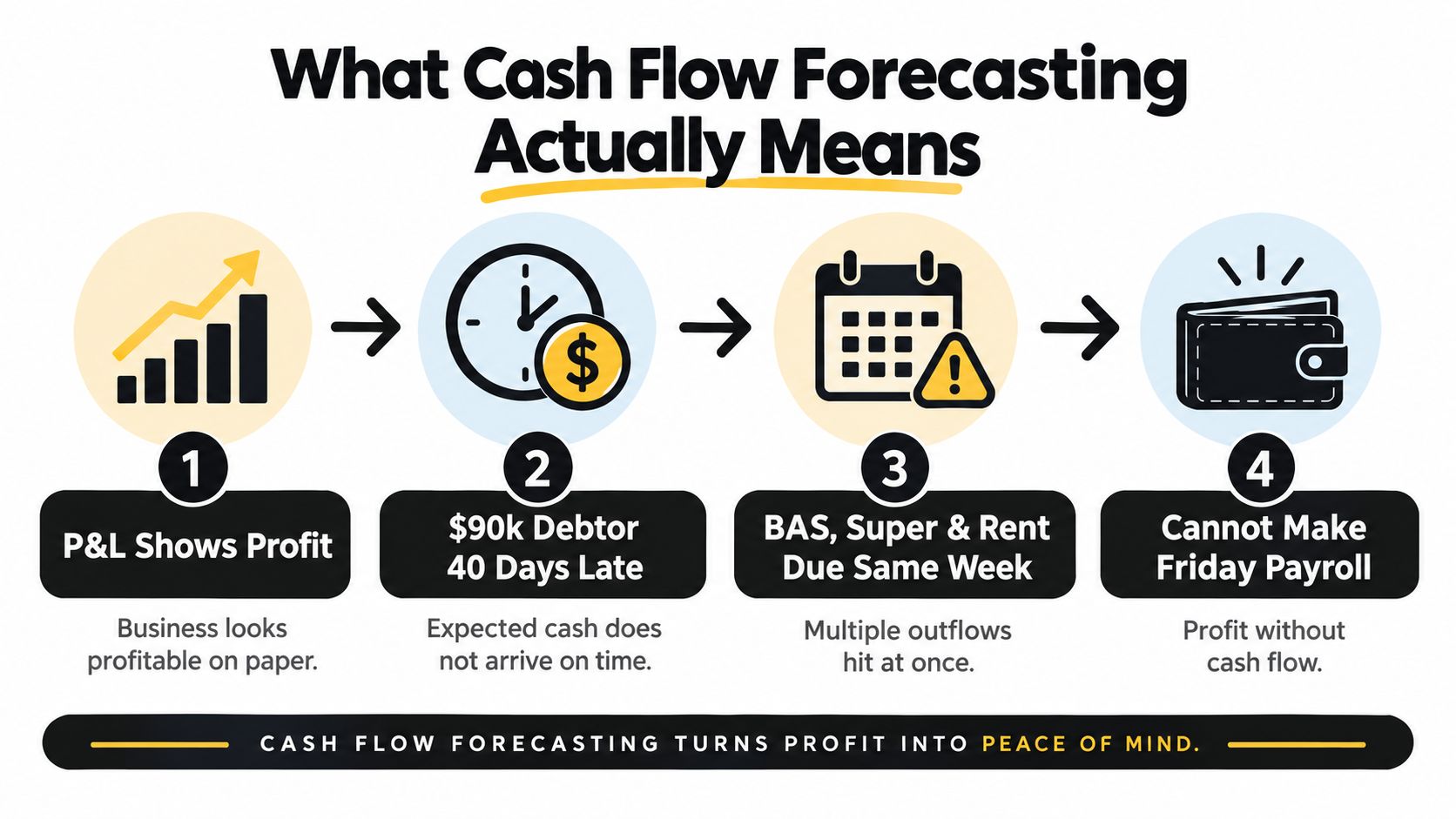
The key word is cash. Not revenue. Not profit. Not “work won”. Cash.
Profit is not the same thing as cash
A founder can have a healthy P&L and still miss payroll. Why? Because profit is based on accrual accounting. Cash depends on timing.
If a customer pays late, stock sits too long, or BAS and wages hit in the same week, the bank balance gets crushed even when the accounts say the business is doing fine. That's why a cash flow forecast is a forward-looking control tool, while a statement like a cash flow statement records what already happened.
Practical rule: A forecast answers one question your P&L never can. Will the money be in the bank when the payment falls due?
The three horizons that matter
SMEs usually need three time lenses:
Daily view: Useful when cash is tight, payments are being triaged, or you're in a genuine squeeze.
Weekly view: The operating view. Payroll, supplier runs, tax dates, and collections get managed.
Monthly view: Fine for longer planning, but too blunt for near-term cash control if the business has staff, stock, or uneven receipts.
Business Victoria notes that many businesses use monthly forecasting and recommends estimating inflows and outflows, then comparing forecast to actuals after the period ends through its cash flow forecasting guidance. That's sensible. But for founders running real weekly commitments, monthly alone usually isn't enough.
Cash flow forecasting isn't budgeting. It isn't bookkeeping. It isn't year-end accounting. It's the live view of whether the cheque clears. Without it, you're flying on accruals and hope.
Direct vs Indirect Forecasting Methods
There are two ways to build a forecast. One is useful for operators. The other is useful for presentations.
Use direct if you actually need to manage cash
The direct method lists expected receipts and expected payments by period. Customer collections, supplier payments, payroll, loan repayments, rent, BAS, PAYG. It tracks what is expected to hit the bank and when.
The indirect method starts with profit, then adjusts for non-cash items and working capital movements. It has its place, but not for deciding whether you can pay wages next Thursday.
Here's the side-by-side view:
Dimension | Direct Method | Indirect Method |
|---|---|---|
Starting point | Expected cash receipts and payments | Profit adjusted for non-cash and balance sheet movements |
Best use | Weekly liquidity management | Longer-range planning and reporting |
Level of detail | High. Payment timing matters | Lower. More assumption-driven |
Good for payroll and supplier decisions | Yes | No |
Good for board packs and investor summaries | Sometimes | Yes |
Data source | AR, AP, payroll, tax dates, bank timing | Management accounts and balance sheet assumptions |
Founder verdict | Use this first | Ignore this until your monthly close is disciplined |
My decision rule
If you're forecasting the next few weeks and trying to manage supplier runs, wages, and statutory payments, use direct. No debate.
If you're building a longer planning model for strategy, a lender conversation, or an investor update, indirect can be acceptable. But most founders jump to indirect too early because it feels cleaner. It isn't. It just hides timing.
A forecast that starts with profit is often too far removed from the bank account to help a founder make an operating decision.
Why most SMEs should keep it simple
Mature finance teams often run both methods. That's fine. They have the discipline and people for it.
Most SMEs don't need that complexity yet. They need one working model that shows collections, payroll, supplier due dates, tax obligations, and the closing cash balance by week. Start there. Get that right first.
Why the 13-Week Rolling Forecast Is the AU Standard
If you only build one forecasting tool, make it a rolling 13-week cash flow forecast.
Australian SME guidance consistently points founders toward weekly monitoring and a rolling 13-week structure, often paired with longer monthly planning. Scalesuite's Australian SME guidance recommends a rolling 13-week weekly forecast with monthly extensions, built from bank statements, invoices, payroll schedules, BAS timing, and loan repayments in its cash flow forecasting guide for Australian SMEs.

That setup has become standard for a reason. It fits how Australian SMEs operate.
Why 13 weeks works
A 13-week forecast gives you a full quarter in weekly detail. That matters because businesses don't fail monthly. They get caught on timing.
Weekly granularity maps to real life:
Payroll cycles hit weekly or fortnightly
Supplier payments often bunch into specific weeks
Rent and loan repayments usually land on fixed dates
BAS, PAYG, and super create lumpier compliance outflows
Monthly forecasts smooth over those dips. That's exactly the problem.
Why rolling matters more than the template
A static forecast dies quickly. A rolling forecast stays useful because you update it every week.
The mechanic is simple:
Close the week with actual cash movement.
Compare forecast versus actual.
Drop the completed week.
Add a new week at the end.
That means the horizon never shrinks. You're always looking ahead, not just catching up.
This visual gives a good sense of the rhythm founders need to adopt.
Why daily is too noisy and monthly is too late
Daily forecasting has a place during distress, but for most SMEs it creates noise. Founders end up staring at account movements instead of managing the drivers.
Monthly is the opposite problem. It's too delayed to be useful when cash gets tight. The sweet spot is weekly. One disciplined review each week, same day, same model, same owner.
If the forecast only gets opened when cash is already tight, it isn't a forecast. It's a post-mortem.
Inputs That Make an SME Forecast Accurate
Most forecasts don't fail because the maths is wrong. They fail because the inputs are lazy.
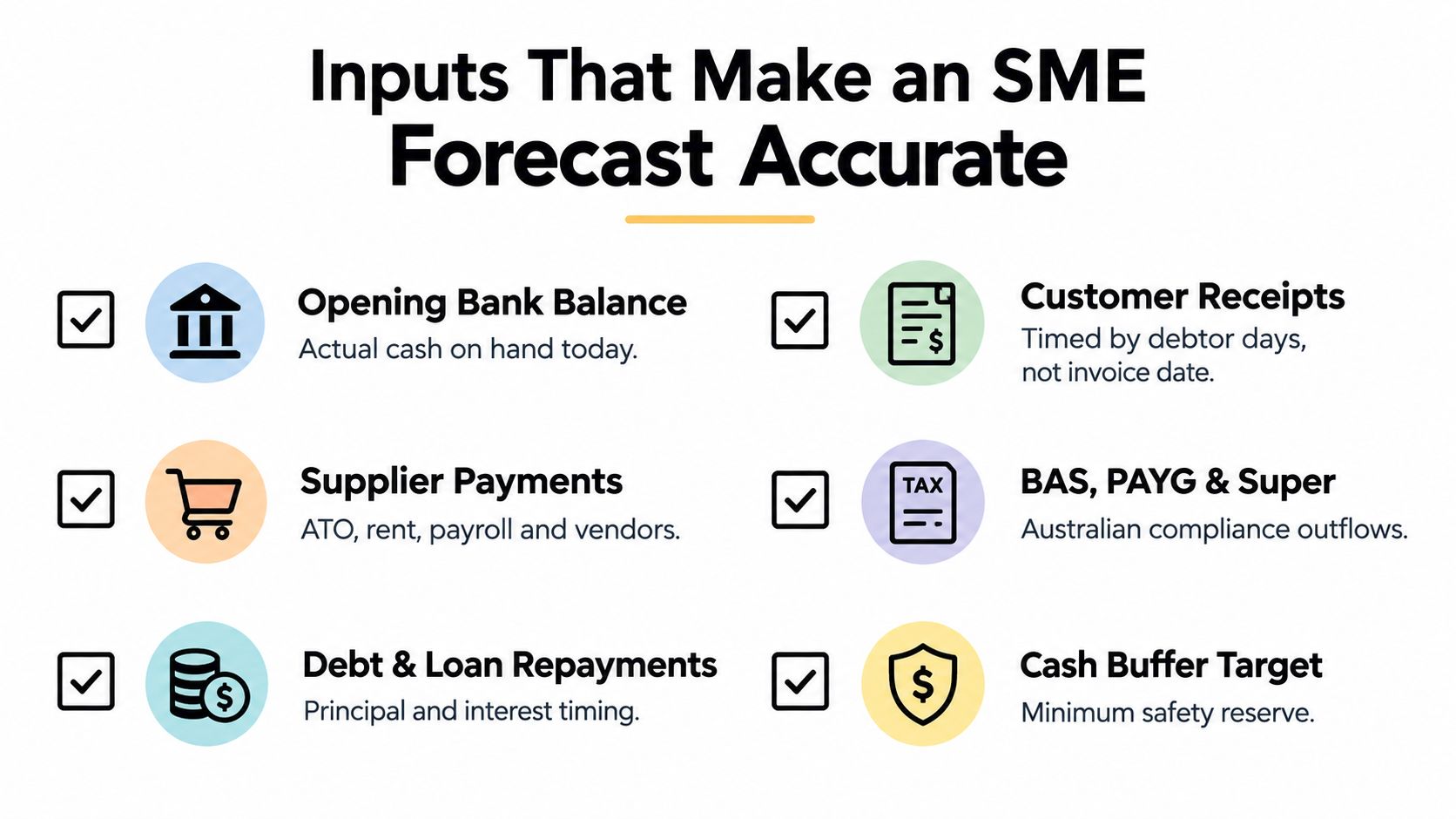
Founders plug in “sales”, “expenses”, and “tax” as broad monthly guesses, then wonder why the bank balance never matches the model. A usable forecast needs operating data, not accounting wallpaper.
Australian tax guidance for managing business cash flow stresses the importance of including statutory obligations such as GST and PAYG instalments, and separating fixed costs from variable costs in the projection through the ATO's business cash flow record-keeping guidance.
Start with live financial inputs
If you're still exporting CSVs and manually pasting figures, accuracy will drift.
Use live feeds from your accounting stack. For most SMEs that means:
Bank feeds: Xero, MYOB, or QuickBooks connected properly
Accounts receivable: Aged by customer, with expected receipt timing based on behaviour, not invoice date
Accounts payable: Supplier bills grouped by due week, not by the month they were entered
Payroll calendar: Weekly or fortnightly gross wages, tax, and super timing
Debt schedules: Loans, leases, hire purchase, and regular direct debits
For a broader planning layer on top of cash timing, a separate revenue forecasting process helps, but it shouldn't be confused with short-term liquidity forecasting.
The inputs inventory businesses always miss
Inventory-heavy businesses usually have the worst forecasts because profit gets trapped in stock.
You need more than sales and supplier invoices. You need:
Open purchase orders with expected payment timing
Supplier delivery dates because stock delays change sell-through and cash conversion
Stock on hand valued at landed cost, not wishful margin
Freight and duty timing where relevant
Minimum reorder points so the model reflects operational reality
Australian commentary on SME working capital highlights that many businesses still treat forecasting as a spreadsheet exercise rather than a working-capital model, even though effective forecasting needs bank feeds, AR/AP, payroll, tax calendars, and inventory or PO data. It also notes that cash flow is the No. 1 concern for Australian businesses at 38% in this discussion of AI, liquidity, and working capital strategy.
Service businesses have different blind spots
Service firms don't have stock, but they do have timing traps:
WIP not yet billed
Deferred revenue
Contractor invoices not received yet
Large annual software renewals
Project delivery slipping beyond the expected billing point
One owner needs to own each data source. Sales owns debtor timing. Ops owns purchase orders. Payroll owns wage dates. Finance owns the cash model. If everyone assumes someone else updated it, the forecast goes stale in a week.
Turning the Forecast Into a Decision System
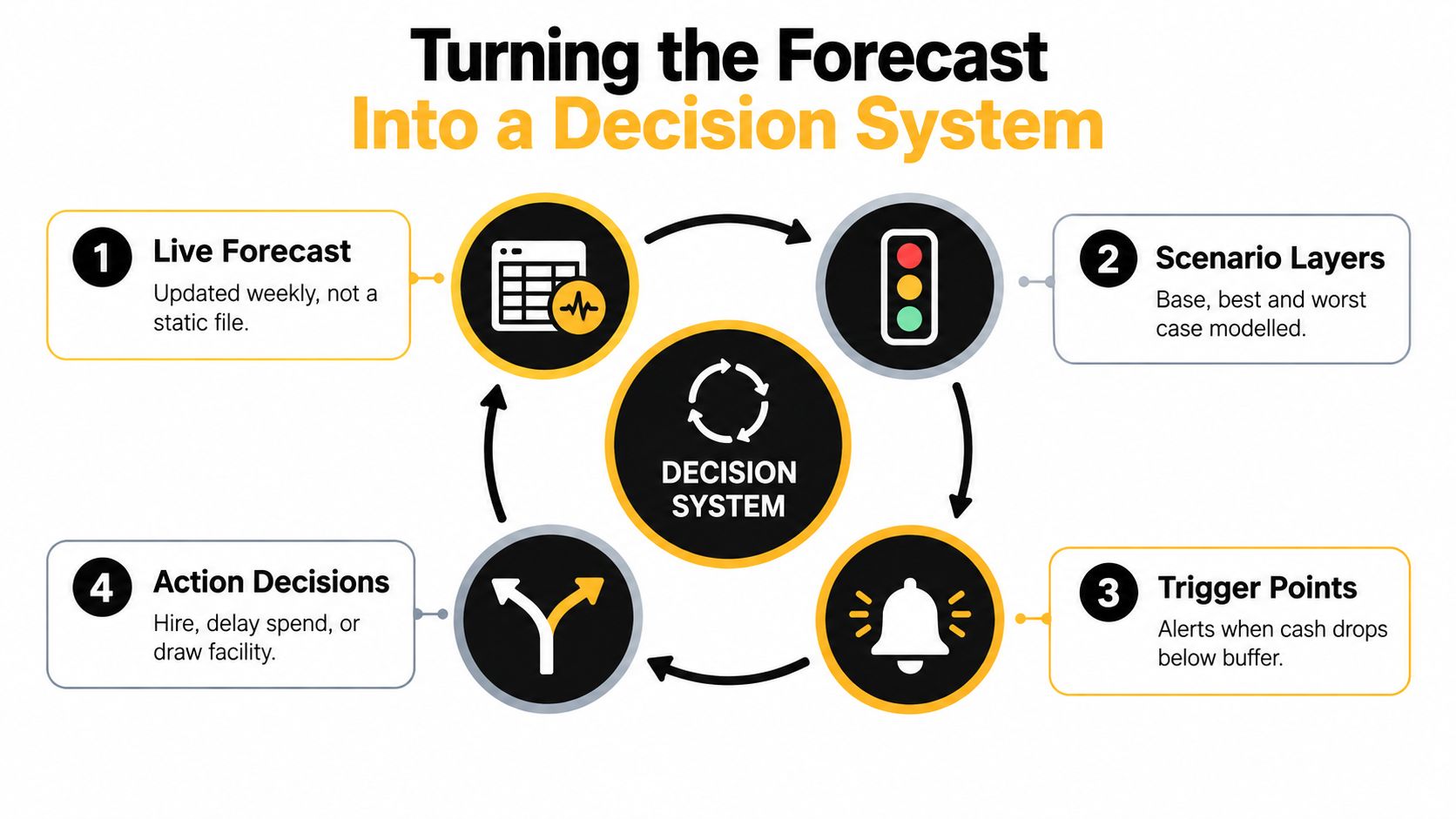
A forecast no one uses is admin. A forecast tied to decisions is power.
The baseline model is only the first layer. Value starts when you use it to decide what happens next.
Build scenarios, not just one version of the truth
A single forecast assumes life behaves. It won't.
Run at least three scenario views:
Base case: what's most likely given current receipts and payments
Best case: collections land on time, spend stays controlled
Worst case: a key customer delays payment, stock lands late, or a cost spikes into an earlier week
For founder use, the worst-case view matters most. Not because you should run scared, but because it gives you reaction time.
Set trigger points before the problem lands
Most founders wait too long because they haven't defined the action thresholds.
Use explicit rules such as:
Trigger | Action |
|---|---|
Cash drops below the next payroll run | Pull forward debtor calls and freeze discretionary spend |
Cash drops below tax obligations in the forecast horizon | Rework payment timing and test facility usage early |
A major customer payment slips | Delay non-critical purchase orders or negotiate supplier timing |
Lender review approaching | Export a clean one-page cash summary with assumptions and scenarios |
Founder discipline: Don't debate actions during a cash squeeze. Decide the triggers while you're calm, then follow them when the model flashes red.
Make the weekly review brutally short
This meeting should not become finance theatre.
A good weekly review can be done in half an hour:
What changed from forecast to actual?
Why did it change?
What must be updated for the next 13 weeks?
What actions follow now?
That's how a forecast becomes an early-warning system instead of a reporting artefact.
Common Mistakes and the Optimism Trap
The most common forecasting error isn't technical. It's emotional.
Australian SME commentary notes a strange split: cash flow remains the top concern for many businesses, yet some owners still expect conditions to improve. One cited example is that nearly half of small businesses expected cash flow to increase in 2025, even while cash flow remained the top concern, as discussed in commentary drawing on Australian survey coverage and pressure signals in the RBA Financial Stability Review reference.
That gap is the optimism trap. Founders believe the next few months will sort themselves out, so they model hope instead of timing.
The mistakes that create false confidence
These are the repeat offenders:
Using quote dates instead of payment dates: A signed proposal is not cash.
Ignoring quarterly lumps: BAS, PAYG, and super don't care that sales were soft.
Underestimating stock dwell time: Inventory doesn't become bank balance just because it's in the warehouse.
Forgetting auto-debits: Loan repayments and subscriptions still count even when nobody manually approves them.
Forecasting monthly when the business moves weekly: By the time the issue shows up, the pressure is already in the account.
Weekly beats monthly for most real businesses
If receipts are stable and the business is tiny, monthly may be enough. For everyone else, weekly is the default.
That matters even more if you have:
staff,
lumpy collections,
stock on order,
tax obligations with sharp due dates,
or any debt facility that needs managing properly.
The value of a forecast isn't that it predicts perfectly. The value is that it shows you the miss early enough to do something useful.
A forecast that surfaces a shortfall well ahead of time gives you options. A forecast that identifies it right before payday gives you stress.
Spreadsheets vs Software vs Virtual CFO
There are three common ways SMEs handle forecasting. None is perfect. Each has a ceiling.
Spreadsheet is fine, until it isn't
A spreadsheet is cheap, flexible, and easy to start with. For a simple business with one entity, stable receipts, and a disciplined founder, that can work.
It falls apart when you add bank feeds, tax timing, multiple scenarios, stock purchases, or more than one decision-maker. One broken formula or one stale tab can hide a real problem.
Software fixes admin, not judgement
Dedicated tools can do the heavy lifting. They pull in accounting data, automate updates, and make scenario views easier to maintain. Tools commonly used by SMEs include Fathom, Calxa, Spotlight, and Pulse.
The software question usually starts one level earlier, with your core finance stack. If you're still deciding between platforms, this QuickBooks vs FreshBooks comparison is useful because the quality of your forecast depends heavily on the quality of your underlying bookkeeping and invoice workflow.
Software improves visibility. It does not decide whether you should defer a PO, push collections harder, or speak to the bank this week.
Virtual CFO is the decision layer
A virtual CFO doesn't just maintain the model. They own the cadence, challenge assumptions, and tie the numbers to action. Many growing businesses need this kind of help.
If you're comparing delivery options, this overview of virtual CFO services is a useful reference point for what that role should cover.
Nexist is one example of that model. It combines the forecasting process with ongoing finance leadership, including rolling cash visibility, scenario modelling, and weekly decision support.
Dimension | Spreadsheet | Software (e.g. Fathom, Pulse) | Virtual CFO (Nexist) |
|---|---|---|---|
Setup cost | Low | Medium | Higher |
Flexibility | High | Medium | High |
Automation | Low | High | High |
Scenario handling | Manual | Easier | Easier, with interpretation |
Risk of user error | High | Lower | Lower |
Suitable for inventory complexity | Limited | Better | Best when paired with active oversight |
Founder time required | High | Medium | Lower |
Best fit | Small, simple, disciplined business | Growing business needing better visibility | Founder wanting judgement, rhythm, and accountability |
My verdict is simple. Start with a spreadsheet if the business is small and straightforward. Move to software when the model starts taking too long to maintain. Bring in senior finance support when the consequences of being wrong are too expensive.
Practical Next Steps for Founders
If you want to get control of cash, don't wait for month-end. Start this week.
By Friday, pull the raw data
Download the recent bank transactions and categorise every inflow and outflow. Don't overcomplicate it. You're trying to see timing patterns, not win an accounting prize.
Create a first-pass list of:
customer receipts,
wages,
rent,
suppliers,
tax,
debt repayments,
software and subscriptions,
any irregular items that keep appearing.
By Monday, build the first 13 weeks
Put the opening bank balance at the top. Then map each expected receipt and each expected payment into the actual week it should land.
Not the invoice month. Not the budget month. The week it hits the account.
Use separate lines for:
payroll,
BAS and PAYG,
super,
rent,
loan repayments,
supplier due dates,
stock purchases or open POs,
contractor payments,
owner drawings if they happen.
By mid-week, pressure-test the forecast
Run three views: base, best, and worst.
Write down what action gets triggered if cash gets squeezed:
chase overdue debtors sooner,
defer a non-essential order,
pause a hire,
use an existing facility,
renegotiate timing before the pressure week arrives.
That written trigger matters. It removes hesitation later.
By next Friday, make it a weekly operating rhythm
Book a recurring half-hour slot. Same day each week.
Review:
actual versus forecast,
what moved,
what must change in the next horizon,
what decisions now follow.
If updating the model takes too long, don't assume the forecast is the problem. Usually the issue is poor inputs, messy systems, or nobody owning the data. Fix that first.
A founder doesn't need a perfect model. You need a current one, fed by real operating inputs, reviewed weekly, and tied to action. That's enough to stop cash from surprising you.
If your forecast still lives in a spreadsheet no one trusts, that's fixable. Nexist helps Australian founders build a working 13-week cash model tied to payroll, BAS, debtors, suppliers, and stock, then uses it to drive weekly decisions instead of month-end surprises. If you want that kind of cash control without doing it all yourself, visit Nexist.
cash flow forecasting, cash flow forecast, SME finance, rolling forecast, virtual CFO

" width="24px"/><g d="M 0 24.129 L 0 0.129 L 24 0.129 L 24 24.129 Z M 0 24.129 L 0 0.129 L 24 0.129 L 24 24.129 Z M 24 3 C 24 1.344 22.656 0 21 0 L 3 0 C 1.344 0 0 1.344 0 3 L 0 21 C 0 22.656 1.344 24 3 24 L 21 24 C 22.656 24 24 22.656 24 21 Z M 6.883 8.375 L 2.863 8.375 L 2.863 20.467 L 6.883 20.467 Z M 4.899 2.545 C 3.524 2.545 2.625 3.449 2.625 4.634 C 2.625 5.795 3.496 6.724 4.846 6.724 L 4.872 6.724 C 6.273 6.724 7.146 5.795 7.146 4.634 C 7.12 3.449 6.274 2.545 4.899 2.545 Z M 16.747 8.09 C 14.614 8.09 13.659 9.263 13.124 10.086 L 13.124 8.374 L 9.105 8.374 C 9.159 9.508 9.105 20.466 9.105 20.466 L 13.124 20.466 L 13.124 13.713 C 13.124 13.352 13.15 12.99 13.257 12.732 C 13.547 12.01 14.209 11.262 15.319 11.262 C 16.773 11.262 17.355 12.372 17.355 13.996 L 17.355 20.466 L 21.374 20.466 L 21.374 13.532 C 21.374 9.818 19.391 8.09 16.747 8.09 Z" fill="transparent" height="24.12890599668026px" id="dSFdkJotL" width="24px"><path d="M 0 24 L 0 0 L 24 0 L 24 24 Z" fill="transparent" height="24px" id="wscNJE44G" transform="translate(0 0.129)" width="24px"/><g d="M 0 24.129 L 0 0.129 L 24 0.129 L 24 24.129 Z M 24 3 C 24 1.344 22.656 0 21 0 L 3 0 C 1.344 0 0 1.344 0 3 L 0 21 C 0 22.656 1.344 24 3 24 L 21 24 C 22.656 24 24 22.656 24 21 Z M 6.883 8.375 L 2.863 8.375 L 2.863 20.467 L 6.883 20.467 Z M 4.899 2.545 C 3.524 2.545 2.625 3.449 2.625 4.634 C 2.625 5.795 3.496 6.724 4.846 6.724 L 4.872 6.724 C 6.273 6.724 7.146 5.795 7.146 4.634 C 7.12 3.449 6.274 2.545 4.899 2.545 Z M 16.747 8.09 C 14.614 8.09 13.659 9.263 13.124 10.086 L 13.124 8.374 L 9.105 8.374 C 9.159 9.508 9.105 20.466 9.105 20.466 L 13.124 20.466 L 13.124 13.713 C 13.124 13.352 13.15 12.99 13.257 12.732 C 13.547 12.01 14.209 11.262 15.319 11.262 C 16.773 11.262 17.355 12.372 17.355 13.996 L 17.355 20.466 L 21.374 20.466 L 21.374 13.532 C 21.374 9.818 19.391 8.09 16.747 8.09 Z" fill="transparent" height="24.12890599668026px" id="sTpjGo1tb" width="24px"><path d="M 0 24 L 0 0 L 24 0 L 24 24 Z" fill="transparent" height="24px" id="s7ffpmKOD" transform="translate(0 0.129)" width="24px"/><g d="M 24 3 C 24 1.344 22.656 0 21 0 L 3 0 C 1.344 0 0 1.344 0 3 L 0 21 C 0 22.656 1.344 24 3 24 L 21 24 C 22.656 24 24 22.656 24 21 Z M 6.883 8.375 L 2.863 8.375 L 2.863 20.467 L 6.883 20.467 Z M 4.899 2.545 C 3.524 2.545 2.625 3.449 2.625 4.634 C 2.625 5.795 3.496 6.724 4.846 6.724 L 4.872 6.724 C 6.273 6.724 7.146 5.795 7.146 4.634 C 7.12 3.449 6.274 2.545 4.899 2.545 Z M 16.747 8.09 C 14.614 8.09 13.659 9.263 13.124 10.086 L 13.124 8.374 L 9.105 8.374 C 9.159 9.508 9.105 20.466 9.105 20.466 L 13.124 20.466 L 13.124 13.713 C 13.124 13.352 13.15 12.99 13.257 12.732 C 13.547 12.01 14.209 11.262 15.319 11.262 C 16.773 11.262 17.355 12.372 17.355 13.996 L 17.355 20.466 L 21.374 20.466 L 21.374 13.532 C 21.374 9.818 19.391 8.09 16.747 8.09 Z" fill="transparent" height="24.000006px" id="D0ecaHEcW" transform="translate(0 0)" width="24px"><path d="M 24 3 C 24 1.344 22.656 0 21 0 L 3 0 C 1.344 0 0 1.344 0 3 L 0 21 C 0 22.656 1.344 24 3 24 L 21 24 C 22.656 24 24 22.656 24 21 Z" fill="rgb(55, 184, 218)" height="24.000006px" id="IPLFE6zXx" width="24px"/><path d="M 4.02 0 L 0 0 L 0 12.092 L 4.02 12.092 Z" fill="rgb(255, 255, 255)" height="12.09201px" id="FWhtzAyuY" transform="translate(2.863 8.375)" width="4.02px"/><path d="M 2.274 0 C 0.899 0 0 0.904 0 2.089 C 0 3.25 0.871 4.179 2.221 4.179 L 2.247 4.179 C 3.648 4.179 4.521 3.25 4.521 2.089 C 4.495 0.904 3.649 0 2.274 0 Z" fill="rgb(255, 255, 255)" height="4.17876px" id="VmOsKv4kO" transform="translate(2.625 2.545)" width="4.52095px"/><path d="M 7.641 0 C 5.509 0 4.554 1.173 4.019 1.996 L 4.019 0.284 L 0 0.284 C 0.053 1.419 0 12.376 0 12.376 L 4.019 12.376 L 4.019 5.623 C 4.019 5.262 4.045 4.9 4.151 4.642 C 4.442 3.92 5.103 3.172 6.214 3.172 C 7.667 3.172 8.25 4.282 8.25 5.907 L 8.25 12.376 L 12.269 12.376 L 12.269 5.442 C 12.269 1.728 10.286 0 7.641 0 Z" fill="rgb(255, 255, 255)" height="12.37626px" id="n1XUbhaq0" transform="translate(9.105 8.09)" width="12.268830000000001px"/></g></g></g></g></svg>)