
What Is Fractional CFO: Your 2026 Australian SME Guide
Discover what is fractional cfo & how they boost cash flow, drive growth, and offer C-suite expertise to Australian SMEs in 2026. Get expert insights now!
Ansh Malhotra

A fractional CFO is an experienced, part-time financial executive who gives your business C-suite financial leadership without the cost of a full-time hire. In Australia, that model typically delivers equivalent strategic financial leadership at 20% to 30% of the total cost of a full-time CFO, with Sydney SMEs commonly paying $4,000 to $7,000 per month for a standard engagement.
If you're running an Australian SME, there's a good chance you're doing more finance work than you ever intended. You approve supplier payments between sales calls, check the bank balance before payroll, and try to work out whether revenue growth is turning into profit. The books might be up to date, but the decisions still feel fuzzy.
That's where the answer to “what is Fractional CFO” becomes useful in practical terms, not just as a job title. A fractional CFO isn't there to enter bills or lodge BAS. They step in to help you understand what the numbers mean, what happens next if you hire, borrow, buy stock, or expand, and where cash is getting trapped.
For many founders, the surprise isn't the monthly retainer. It's the first 90 days. Most guides talk about forecasting, dashboards, and board reporting. Fewer acknowledge the setup work needed before any of that is reliable. If your chart of accounts is messy, GST codes are inconsistent, or the balance sheet hasn't been properly cleaned up, even the best forecast will be built on shaky ground.
That hidden layer matters because a fractional CFO only adds value when the data underneath the advice is clean enough to trust. In practice, the model works best when you treat it as both strategy and finance infrastructure.
Table of Contents
Introduction Are You the Chief Everything Officer
You started the business to build something valuable. Then finance crept into every corner of your week.
One founder is chasing late invoices on Monday, negotiating supplier terms on Tuesday, and trying to explain margin swings to a business partner on Friday. Another has a good accountant and a capable bookkeeper, but still can't answer basic management questions quickly. Can we afford another hire? Are these sales profitable? Why is cash tight when revenue looks healthy?
That's the daily reality behind most searches for “what is fractional cfo”. It usually starts when the owner realises the issue isn't bookkeeping. It's the absence of someone turning financial data into decisions.
A fractional CFO fills that gap. They work part-time, but they think at full executive level. They help you see around corners, not just close out last month. For an SME, that can mean tighter cashflow forecasting, clearer management accounts, sharper pricing decisions, and more confidence before you commit to stock, debt, or growth.
Most founders don't need another spreadsheet. They need someone who can tell them what action the spreadsheet supports.
The pressure is worse when the owner has become the unofficial finance department. You know enough to be dangerous, not enough to be calm. You're checking Xero, watching the bank account, and hoping the timing works out. That's not financial leadership. That's financial firefighting.
A good fractional CFO takes those decisions out of guesswork and puts them into a rhythm.
Common signs you're carrying too much of the finance load yourself:
Cash feels unpredictable: Revenue is coming in, but the bank balance keeps surprising you.
Reporting is historical only: You get compliance reports, but not a clear view of what happens next.
Growth is harder than expected: More sales are creating more complexity, not more control.
You're the bottleneck: Too many important decisions wait for you because no one owns the financial picture end to end.
The Fractional CFO Explained More Than Just Numbers
A fractional CFO is best understood as a financial personal trainer for your business. A trainer doesn't just count your reps. They assess your condition, set the plan, correct form, and keep you focused on the outcome. A fractional CFO does the same with your finances.

They build the future from the numbers
A bookkeeper records transactions. An accountant keeps compliance on track. A fractional CFO takes those inputs and asks harder questions.
What happens to cash if debtor days stretch out? Can the business carry more inventory without creating stress? Is a new sales hire likely to improve profit, or just overhead? Should you fund growth through debt, internal cash, or slower expansion?
That's why the role matters. It isn't just finance administration with a more senior title. It's decision support at founder level.
In Australia, the economics are a large part of the appeal. The model can deliver equivalent strategic financial leadership at 20% to 30% of the total cost of a full-time hire, and Sydney-based SMEs typically pay $4,000 to $7,000 per month for a standard engagement that includes weekly cashflow forecasting, monthly management accounts, variance analysis, and strategic input, according to ScaleSuite's guide to fractional CFO cost in Sydney.
What they do that your accountant usually does not
Most founders need all three layers of finance support at different times. Problems start when they expect one role to do another role's job.
A fractional CFO usually handles work such as:
Scenario planning: If sales slow, stock builds up, or wages increase, they model the impact before it hits.
Management decision support: They help founders weigh trade-offs, not just review reports after the fact.
Cash discipline: They build routines around forecasting, payment timing, and working capital.
Commercial analysis: They look at customer, product, location, or channel profitability in a way compliance reporting often doesn't.
Practical rule: If your main finance question is “Did we code this correctly?”, you probably need bookkeeping or accounting support. If your question is “What should we do next?”, you probably need CFO-level thinking.
Why part-time often makes more sense
A lot of SMEs don't need a full-time CFO sitting in the office all week. They need senior judgement at key moments, a regular operating cadence, and someone to bring discipline to decisions that would otherwise be made on instinct.
That's why the fractional model fits founder-led businesses well. You gain an advantage without carrying the full executive overhead. You also get a role that's naturally focused on the highest-value finance work, not on filling a full-time diary.
Core Services What a Fractional CFO Actually Delivers
The easiest way to understand the role is to ignore the title and look at the outputs. What does a founder receive every month?
Strategic forecasting and budgeting
A lot of businesses find immediate relief. Instead of relying on an annual budget that becomes irrelevant by March, a fractional CFO builds live planning tools around what the business is doing now.
That usually means a rolling forecast, a practical budget, and regular variance analysis. If your sales are seasonal, if labour moves around, or if stock ordering creates lumpiness, the forecast should reflect that.
The point isn't to predict the future perfectly. It's to stop being surprised by obvious financial consequences.
Cash flow management and optimisation
Most founders say they care about profit. Most lose sleep over cash.
A fractional CFO focuses on the movement of money through the business. That includes receivables, payables, inventory timing, tax obligations, payroll pressure points, and upcoming capital needs. They create a weekly or fortnightly cash rhythm so decisions happen before pressure turns into urgency.
For businesses with long payment cycles, this can overlap with process work too. If your invoicing is slow, approvals are messy, or debtor follow-up is inconsistent, finance leadership has to connect with operations. For B2B businesses trying to tighten that part of the engine, this guide on optimizing revenue cycles for B2B is useful background because it shows how cash delays often start upstream, not in the finance team.
A strong quarterly rhythm also matters. If your management meetings drift into reactive commentary, a proper quarterly business review process helps turn reporting into decisions.
Later in the month, many teams also need context, not just numbers. This video gives a plain-English explanation of how the strategic side of the role tends to work in practice.
KPI reporting and performance visibility
Not every KPI is useful. Founders often get dashboards with too much data and not enough judgement.
A fractional CFO should identify the small set of measures that drive decisions. Gross margin by channel. Labour efficiency. Stock turn. Aged receivables. Cash runway. Forecast versus actual. The exact list depends on the business model.
What matters is that the KPI pack answers operational questions quickly:
What changed this month
Why it changed
Whether it matters
What we're doing next
Debt capital and decision support
Businesses don't just need help with current numbers. They need support when decisions carry consequences for months or years.
That includes preparing for bank conversations, assessing debt capacity, reviewing repayment pressure, and testing whether planned growth is financeable. It also includes board pack preparation, investor material, and support around major decisions such as acquisitions or expansion.
The value here is often less visible than bookkeeping. But it's substantial. You avoid expensive mistakes made with incomplete information.
Inventory and supply chain optimisation
Many retail, ecommerce, wholesale, and manufacturing businesses find hidden cash this way.
Inventory can make the P&L look healthy while starving the bank account. Too much slow-moving stock ties up cash. Poor purchasing cadence creates peaks in funding needs. Margin can also disappear through discounting, freight leakage, write-downs, and poor reorder logic.
A fractional CFO can help by connecting finance to stock decisions:
Reorder discipline: Buy based on demand patterns and cash capacity, not habit.
Margin visibility: Separate high-revenue products from high-contribution products.
Supplier timing: Improve the match between payment terms and sell-through.
Exception reporting: Flag stock lines that trap cash or underperform.
When this work is done properly, finance stops being a rear-view mirror and becomes part of day-to-day operating control.
Fractional CFO vs Full-Time CFO vs Bookkeeper
A lot of hiring mistakes happen because founders know they have a finance problem, but they choose the wrong level of solution.
If the issue is unreconciled accounts, missing invoices, or BAS workflow, a strategist won't fix the fundamentals. If the issue is poor decisions, no cash visibility, and no forward planning, a bookkeeper won't solve it either.
Role Comparison Bookkeeper vs Fractional CFO vs Full-Time CFO
Aspect | Bookkeeper / Accountant | Fractional CFO | Full-Time CFO |
|---|---|---|---|
Primary focus | Transactions, compliance, historical reporting | Strategy, forecasting, cash, decisions | Enterprise-wide financial leadership |
Typical time commitment | Ongoing operational support | Part-time, regular cadence | Full-time, embedded executive |
Best for | Clean books, tax, payroll, BAS, reconciliations | Growth-stage SMEs needing senior guidance without full-time overhead | Larger or more complex businesses needing constant executive finance leadership |
Main question answered | What happened | What happens next and what should we do | How do we finance and lead the whole business at scale |
Deliverables | Accurate records, lodgements, reporting | Forecasts, KPI packs, scenario models, board support, cash planning | Full finance leadership, team management, strategic capital decisions |
For founders who want a deeper explanation of the broader CFO role itself, this overview of what a CFO does is a useful companion.
Where founders usually get this wrong
The most common confusion is between “good finance hygiene” and “financial leadership”. They overlap, but they're not the same.
A bookkeeper or accountant usually manages the mechanics well. They keep the ledger clean, process transactions, handle tax and compliance, and make sure reports can be produced accurately. That work is essential. But it doesn't automatically tell you whether your pricing is working, whether your stock position is too heavy, or whether your next growth step is affordable.
A full-time CFO is often too much for an SME that doesn't need daily executive finance coverage. A fractional CFO sits in the middle. They bring strategic capability without making the cost base heavier than it needs to be.
If your finance pain is operational, hire for control. If your finance pain is strategic, hire for judgement.
The right structure for many Australian growth-stage businesses is straightforward in practice. Keep transaction processing and compliance handled by the bookkeeper and accountant. Add CFO capacity when the business needs interpretation, direction, and financial discipline across the leadership team.
The Real ROI How Fractional CFOs Boost Your Bottom Line
The return from a fractional CFO doesn't come from having nicer reports. It comes from making better decisions earlier.

ROI comes from decisions not reports
In Australia, cash flow improvement services delivered by fractional CFOs typically generate 15% to 25% working capital efficiency gains, and CPA Australia's In The Black notes a case study involving a $12M revenue custom kitchenware manufacturer that achieved measurable ROI through a $7,500 per month fractional CFO investment, as reported in CPA Australia's coverage of the growth of fractional finance roles.
That's the commercial case in one line. Better cash discipline creates options.
For an inventory-heavy business, ROI might show up as less cash tied up in slow-moving stock. For a trade or services firm, it might show up in cleaner job costing, faster invoicing, or less margin leakage across teams and projects. For a founder-led company preparing to borrow or raise funds, the return might be stronger lender confidence because the numbers are finally coherent and current.
If you run an online store, there are practical operational levers outside finance that also affect liquidity. This list on how to improve ecommerce cash flow is worth reviewing because it complements the finance side with actions on stock, fulfilment, and payment timing.
Where the gains usually show up first
Most businesses don't see the benefit in one dramatic event. They see it in a series of better moves.
Receivables tighten up: Invoices go out earlier, collections become deliberate, and cash arrives with less chasing.
Stock gets more disciplined: Purchasing aligns more closely with demand and working capital limits.
Margins become visible: Unprofitable customers, jobs, or product lines are easier to spot.
Management time frees up: The owner stops spending hours trying to decode the numbers and can focus on sales, staff, and growth.
A proper profitability analysis approach often sits at the centre of this work because many businesses don't have a revenue problem. They have a margin visibility problem.
Better finance leadership rarely feels dramatic day to day. It feels calmer. The bank balance becomes less mysterious, and decisions stop being delayed by uncertainty.
Pricing Models and When Your SME Should Hire One
Price matters, but fit matters more. A cheap retainer won't help if the business isn't ready for strategic finance, and an expensive engagement won't deliver if the scope is vague.
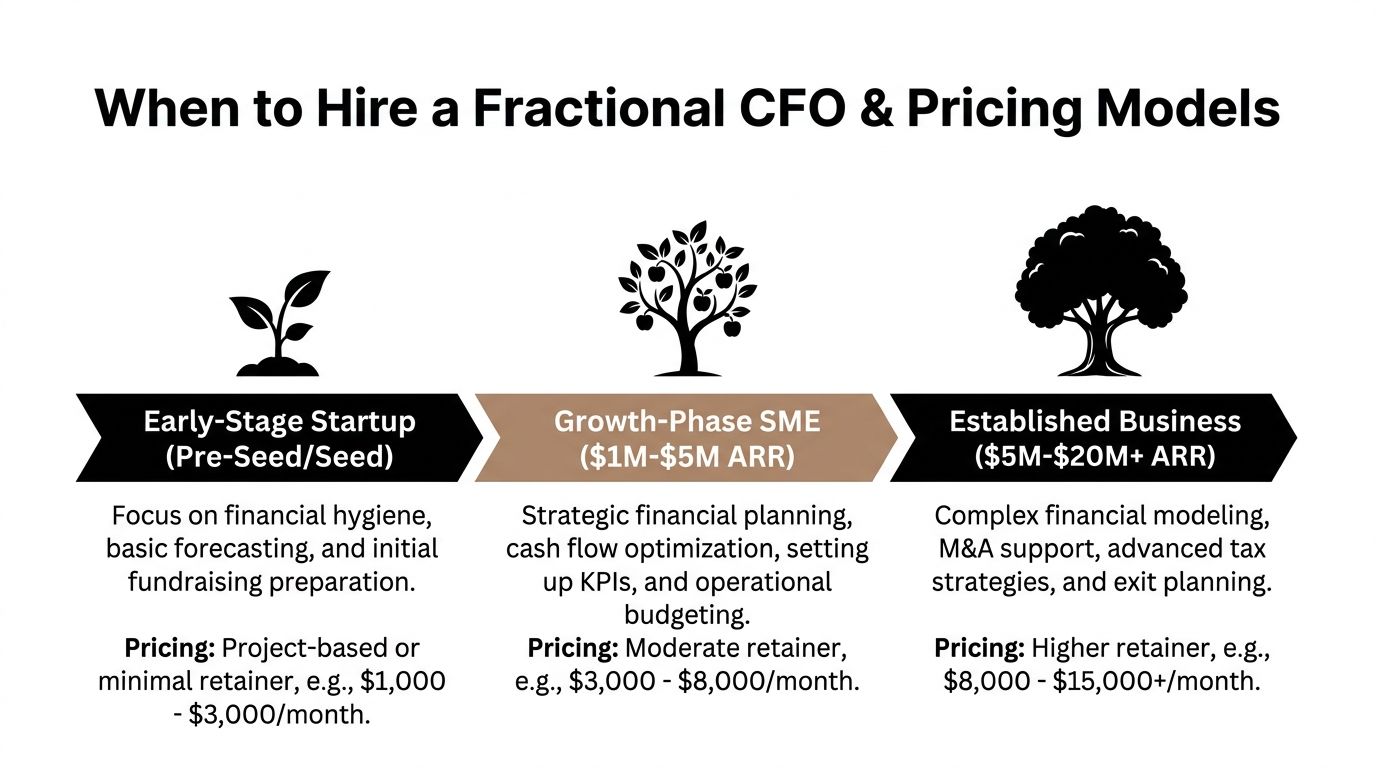
What Australian retainers usually look like
For Australian SMEs, the most common model is a monthly retainer. According to this Australian guide to fractional CFO services and pricing tiers, startups and SMEs under $5M revenue typically pay $3,000 to $6,000 per month for 10 to 20 hours, growing SMEs at $5M to $25M pay $6,000 to $10,000 per month for 20 to 30 hours, and established SMEs at $25M to $100M pay $8,000 to $15,000 per month for 30 to 40 hours.
That tiering is useful because it sets expectations. You're not buying a title. You're buying a level of access, judgement, and output.
Some businesses also need project work around funding, board preparation, model rebuilds, or finance system clean-up. In those cases, the monthly retainer may be only one part of the total first-phase cost.
If your business imports goods or operates across trade logistics, one practical area a CFO should understand is how customs and recovery opportunities affect landed margin. For importers and exporters, this overview of duty drawback Australia is a useful example of the kind of operational finance issue that can sit outside normal bookkeeping.
Signs it is time to hire
You usually don't need a fractional CFO because revenue hit a magic number. You need one because complexity overtook your current setup.
Good trigger points include:
You're making material decisions without reliable forecasts: Hiring, borrowing, expansion, and stock buys all feel harder than they should.
Your business has outgrown spreadsheet management: The numbers exist, but no one is turning them into an operating plan.
Cash is tight despite decent sales: That often signals working capital issues, pricing issues, or both.
You're talking to lenders or investors: External stakeholders expect financial clarity, not patched-together reports.
The owner is still the finance backstop: If every major money decision waits for you, the business is under-supported.
The right time is usually earlier than founders think. Waiting until there's pressure often means you're buying rescue work instead of structured growth support.
How to Choose the Right Fractional CFO Partner in Australia
The monthly fee is only part of the buying decision. The harder question is whether the provider can create a reliable foundation fast enough to make the engagement worthwhile.
Many guides stay too shallow, describing strategic outputs but ignoring the onboarding reality.
According to CFO On Call's write-up on fractional CFO onboarding gaps, a major blind spot in the market is the “unbilled discovery” phase, where 15 to 20 hours may be needed for chart-of-accounts setup, GST tax-code configuration, and balance-sheet cleanup before the first forecast is built. The same source notes that firms with audited charts of accounts achieve 15% to 25% faster working capital efficiency gains.
What to ask before you sign
A capable provider should be comfortable answering direct operational questions, not just strategic ones.
Ask things like:
How do you handle onboarding: Do they review the chart of accounts, GST coding, and balance sheet quality before producing forecasts?
What do you need access to in the first month: Xero, inventory systems, payroll data, bank feeds, loan schedules, debtor ageing, supplier terms?
How do you measure success: Cash visibility, reporting cadence, margin clarity, working capital, forecast accuracy?
What experience do you have with businesses like mine: Especially if you carry inventory, manage projects, or have uneven cash cycles.
Who does the work: The senior adviser, a team member, or a mix of both?
What works and what does not
What works is disciplined onboarding, clear scope, reliable reporting cadence, and a CFO who can move between strategy and operational detail.
What doesn't work is a polished dashboard built on dirty data. It also doesn't work when founders expect a fractional CFO to act as bookkeeper, accountant, strategist, debt adviser, and systems admin without a clear priority order.
A low monthly retainer is expensive if the underlying numbers are unreliable.
The best buyer mindset is simple. Don't ask only, “How much per month?” Ask, “What has to be true in the first 90 days for this to produce real value?”
If you want help turning messy financial data into clear decisions, Nexist works with Australian founders to improve cash flow, sharpen margins, and build the finance systems that support growth without burnout. If your business needs more than bookkeeping but less than a full-time CFO, that's the gap Nexist is built to fill.
what is fractional cfo, virtual cfo australia, sme financial strategy, cash flow management, inventory optimisation

" width="24px"/><g d="M 0 24.129 L 0 0.129 L 24 0.129 L 24 24.129 Z M 0 24.129 L 0 0.129 L 24 0.129 L 24 24.129 Z M 24 3 C 24 1.344 22.656 0 21 0 L 3 0 C 1.344 0 0 1.344 0 3 L 0 21 C 0 22.656 1.344 24 3 24 L 21 24 C 22.656 24 24 22.656 24 21 Z M 6.883 8.375 L 2.863 8.375 L 2.863 20.467 L 6.883 20.467 Z M 4.899 2.545 C 3.524 2.545 2.625 3.449 2.625 4.634 C 2.625 5.795 3.496 6.724 4.846 6.724 L 4.872 6.724 C 6.273 6.724 7.146 5.795 7.146 4.634 C 7.12 3.449 6.274 2.545 4.899 2.545 Z M 16.747 8.09 C 14.614 8.09 13.659 9.263 13.124 10.086 L 13.124 8.374 L 9.105 8.374 C 9.159 9.508 9.105 20.466 9.105 20.466 L 13.124 20.466 L 13.124 13.713 C 13.124 13.352 13.15 12.99 13.257 12.732 C 13.547 12.01 14.209 11.262 15.319 11.262 C 16.773 11.262 17.355 12.372 17.355 13.996 L 17.355 20.466 L 21.374 20.466 L 21.374 13.532 C 21.374 9.818 19.391 8.09 16.747 8.09 Z" fill="transparent" height="24.12890599668026px" id="dSFdkJotL" width="24px"><path d="M 0 24 L 0 0 L 24 0 L 24 24 Z" fill="transparent" height="24px" id="wscNJE44G" transform="translate(0 0.129)" width="24px"/><g d="M 0 24.129 L 0 0.129 L 24 0.129 L 24 24.129 Z M 24 3 C 24 1.344 22.656 0 21 0 L 3 0 C 1.344 0 0 1.344 0 3 L 0 21 C 0 22.656 1.344 24 3 24 L 21 24 C 22.656 24 24 22.656 24 21 Z M 6.883 8.375 L 2.863 8.375 L 2.863 20.467 L 6.883 20.467 Z M 4.899 2.545 C 3.524 2.545 2.625 3.449 2.625 4.634 C 2.625 5.795 3.496 6.724 4.846 6.724 L 4.872 6.724 C 6.273 6.724 7.146 5.795 7.146 4.634 C 7.12 3.449 6.274 2.545 4.899 2.545 Z M 16.747 8.09 C 14.614 8.09 13.659 9.263 13.124 10.086 L 13.124 8.374 L 9.105 8.374 C 9.159 9.508 9.105 20.466 9.105 20.466 L 13.124 20.466 L 13.124 13.713 C 13.124 13.352 13.15 12.99 13.257 12.732 C 13.547 12.01 14.209 11.262 15.319 11.262 C 16.773 11.262 17.355 12.372 17.355 13.996 L 17.355 20.466 L 21.374 20.466 L 21.374 13.532 C 21.374 9.818 19.391 8.09 16.747 8.09 Z" fill="transparent" height="24.12890599668026px" id="sTpjGo1tb" width="24px"><path d="M 0 24 L 0 0 L 24 0 L 24 24 Z" fill="transparent" height="24px" id="s7ffpmKOD" transform="translate(0 0.129)" width="24px"/><g d="M 24 3 C 24 1.344 22.656 0 21 0 L 3 0 C 1.344 0 0 1.344 0 3 L 0 21 C 0 22.656 1.344 24 3 24 L 21 24 C 22.656 24 24 22.656 24 21 Z M 6.883 8.375 L 2.863 8.375 L 2.863 20.467 L 6.883 20.467 Z M 4.899 2.545 C 3.524 2.545 2.625 3.449 2.625 4.634 C 2.625 5.795 3.496 6.724 4.846 6.724 L 4.872 6.724 C 6.273 6.724 7.146 5.795 7.146 4.634 C 7.12 3.449 6.274 2.545 4.899 2.545 Z M 16.747 8.09 C 14.614 8.09 13.659 9.263 13.124 10.086 L 13.124 8.374 L 9.105 8.374 C 9.159 9.508 9.105 20.466 9.105 20.466 L 13.124 20.466 L 13.124 13.713 C 13.124 13.352 13.15 12.99 13.257 12.732 C 13.547 12.01 14.209 11.262 15.319 11.262 C 16.773 11.262 17.355 12.372 17.355 13.996 L 17.355 20.466 L 21.374 20.466 L 21.374 13.532 C 21.374 9.818 19.391 8.09 16.747 8.09 Z" fill="transparent" height="24.000006px" id="D0ecaHEcW" transform="translate(0 0)" width="24px"><path d="M 24 3 C 24 1.344 22.656 0 21 0 L 3 0 C 1.344 0 0 1.344 0 3 L 0 21 C 0 22.656 1.344 24 3 24 L 21 24 C 22.656 24 24 22.656 24 21 Z" fill="rgb(55, 184, 218)" height="24.000006px" id="IPLFE6zXx" width="24px"/><path d="M 4.02 0 L 0 0 L 0 12.092 L 4.02 12.092 Z" fill="rgb(255, 255, 255)" height="12.09201px" id="FWhtzAyuY" transform="translate(2.863 8.375)" width="4.02px"/><path d="M 2.274 0 C 0.899 0 0 0.904 0 2.089 C 0 3.25 0.871 4.179 2.221 4.179 L 2.247 4.179 C 3.648 4.179 4.521 3.25 4.521 2.089 C 4.495 0.904 3.649 0 2.274 0 Z" fill="rgb(255, 255, 255)" height="4.17876px" id="VmOsKv4kO" transform="translate(2.625 2.545)" width="4.52095px"/><path d="M 7.641 0 C 5.509 0 4.554 1.173 4.019 1.996 L 4.019 0.284 L 0 0.284 C 0.053 1.419 0 12.376 0 12.376 L 4.019 12.376 L 4.019 5.623 C 4.019 5.262 4.045 4.9 4.151 4.642 C 4.442 3.92 5.103 3.172 6.214 3.172 C 7.667 3.172 8.25 4.282 8.25 5.907 L 8.25 12.376 L 12.269 12.376 L 12.269 5.442 C 12.269 1.728 10.286 0 7.641 0 Z" fill="rgb(255, 255, 255)" height="12.37626px" id="n1XUbhaq0" transform="translate(9.105 8.09)" width="12.268830000000001px"/></g></g></g></g></svg>)