
What Is Cost of Goods Sold and How Does It Actually Work
Learn what is cost of goods sold, how to calculate it, and why it matters for Australian SMEs. Clear formula, examples, and practical margin tips.
Ansh Malhotra

Cost of goods sold (COGS) is the direct cost of the inventory you sell during an accounting period. In Australia, the standard formula is Opening Stock + Purchases − Closing Stock = COGS.
That sounds straightforward until sales are rising, supplier invoices are arriving at different times, and your bank balance still refuses to move in the same direction. You may be selling more products while carrying expensive unsold stock, missing freight-in costs, or using a closing stock figure that makes profit look healthier than it is.
COGS is the number that translates stock movement into a useful business answer: how much did the products sold cost, and what gross profit remained after those costs? For Australian founders, the answer also connects to trading-stock rules, stocktakes, GST and BAS reporting, and the cash leaks that sit between purchasing and selling.
Table of Contents
The Plain-English Meaning of Cost of Goods Sold
A founder can watch revenue climb and still feel uncertain about every sale. The products are moving, but the cash balance stays flat. The natural question is whether each sale is contributing enough after the cost of getting that product ready for the customer.
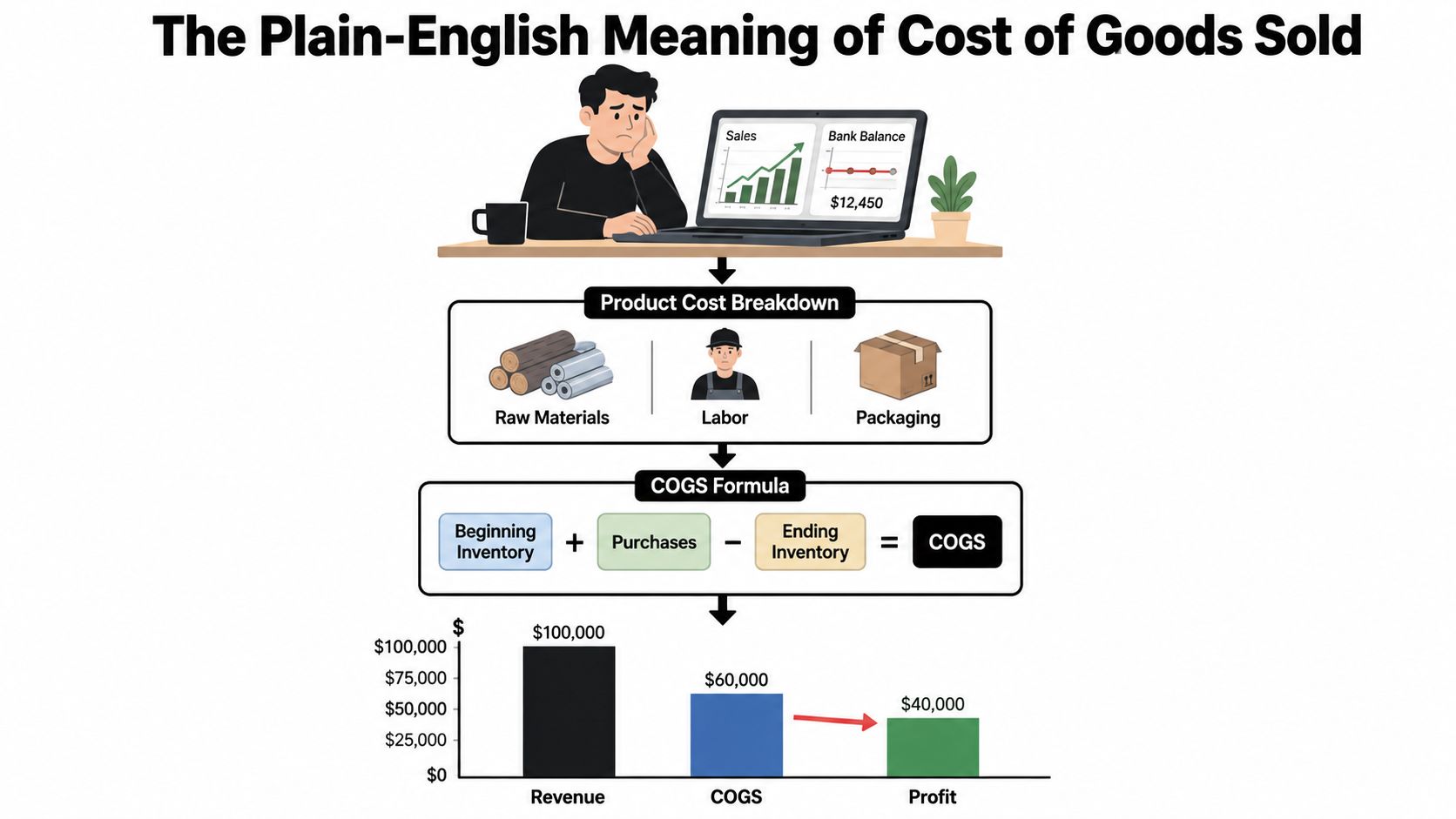
Cost of goods sold, usually shortened to COGS, is the direct cost of the goods sold during a particular period. It appears on the income statement after revenue and before gross profit. The Australian Taxation Office approach for trading stock uses this formula:
Opening Stock + Purchases − Closing Stock = COGS
The three inputs are easier to understand than they first appear:
Opening stock is the value of inventory you had at the beginning of the period. For an Australian financial year, that opening point is generally 1 July.
Purchases are the inventory and other direct acquisition costs added during the period.
Closing stock is the value of inventory still on hand at the end. For the Australian financial year, that figure is verified at 30 June, usually through a physical stocktake.
The formula starts with everything available for sale, then removes what remains unsold. What's left is the cost assigned to the products that left inventory.
Why the formula matters
Revenue tells you what customers paid. COGS tells you what the sold goods consumed. Subtract COGS from revenue and you get gross profit, the amount available to cover overheads and leave a return for the owner.
That distinction matters because COGS isn't the same as every expense in the business. Product purchases, direct materials, production labour and freight-in can belong in the stock cost. Rent, marketing, office administration and general software usually sit outside COGS as operating expenses.
The ATO describes COGS as an inventory-based calculation for businesses that buy or manufacture goods for sale, and this framework helps separate direct inventory costs from indirect overheads. The Australian COGS formula and stocktake framework shows why the calculation is central to annual tax and margin reporting for Australian SMEs.
Practical rule: If you can't explain what one sale cost you, you can't confidently judge its price, margin or cash contribution.
A profit and loss statement can show the result, but the quality of the result depends on the stock records behind it. Understanding how a profit and loss statement works helps place COGS in the wider income statement. The formula is simple. The difficult work is getting the inputs complete, correctly valued and recorded in the right period.
What's Included and What's Not in the COGS Formula
The most useful test is direct connection. Ask whether a cost is required to acquire or produce the goods being sold. If it is, it may belong in COGS or inventory. If it supports the business generally, it usually belongs below gross profit as an operating expense.
For an Australian retailer, wholesale purchase costs are the starting point. Freight-in, customs duty and other direct acquisition costs can increase the cost of inventory before it reaches the business. For a manufacturer, direct materials and production-floor labour are also tied to the goods being made. Packaging that travels with the product can be part of the direct product cost, while general office packaging usually isn't.
The practical boundary
Consider two wage bills. A worker assembling products on the factory floor is directly involved in creating inventory, so that labour can affect the cost of goods. A marketing employee may generate demand for the same products, but that salary supports selling activity rather than creating the inventory. It should generally remain an operating expense.
The same distinction applies to premises. A production facility may involve costs that support manufacturing, while office rent, insurance, administration and general utilities support the business as a whole. Correct classification keeps gross margin meaningful rather than using COGS as a dumping ground for every expense.
Cost Item | Include in COGS? | Reason |
|---|---|---|
Inventory purchase price | Yes | Directly acquires goods for resale |
Freight-in | Yes | Brings inventory to the business and increases its cost base |
Customs duty | Yes | Direct acquisition cost for imported stock |
Direct materials | Yes | Used to produce the goods |
Manufacturing labour | Yes | Directly contributes to production |
Product packaging | Usually | Travels with or forms part of the product sold |
Marketing | No | Creates demand but doesn't create inventory |
Admin wages | No | Supports general business operations |
Office rent | No | Covers administration rather than the product itself |
Software subscriptions | Usually no | General operating tools don't become part of inventory |
Customer delivery freight | Usually no | Relates to fulfilment after the sale rather than acquisition |
The exact treatment can depend on the business model and accounting policy. Australian inventory rules include purchase costs, conversion costs and other costs needed to bring stock to its present location and condition. Inventory valuation methods for Australian businesses is useful when the issue is not only classification, but also how the cost should flow into remaining stock and sold goods.
Technology can help maintain the boundary. For example, teams reviewing AI in supply chain operations may find useful context for automating purchasing, supplier data and inventory workflows. Automation doesn't replace accounting judgement, but it can make missing freight, inconsistent product costs and unusual purchase entries easier to identify.
Practical COGS Examples for Product and Service Businesses
A product business and a service business can both have direct costs, but they don't always use COGS in the same way. The formula is most intuitive when a business buys, holds and sells physical inventory.
Take a small Australian coffee roaster for a quarter. It begins with $18,000 of stock, buys $42,000 of additional stock, and counts $11,500 remaining at quarter-end.
Line Item | Amount (AUD) |
|---|---|
Opening stock | $18,000 |
Purchases | $42,000 |
Less closing stock | ($11,500) |
COGS | $48,500 |
The calculation is:
$18,000 + $42,000 − $11,500 = $48,500
If the roaster generated $75,000 in revenue, gross profit would be $26,500, and gross margin would be 35.3%. The gross margin calculation is:
($75,000 − $48,500) ÷ $75,000 = 35.3%
Those figures are a worked example rather than a business benchmark. The important lesson is the role of closing stock. If the roaster had counted less stock than it held, COGS would be overstated and gross profit would look weaker. If it valued too much stock as remaining, COGS would fall and profit would look stronger.
A service business follows a different path
Now consider a freelance graphic designer. The designer may pay for Adobe Creative Cloud, cloud storage, accounting software and a laptop. Those costs support the practice, but they don't normally become COGS because the designer used them while completing a client project.
A service business may have minimal or no trading-stock COGS. That doesn't mean the work is costless. Direct subcontractor fees for a deliverable, printing materials passed through to a client, or a specialist directly engaged to complete a contracted output may be treated as direct service-delivery costs.
The terminology may also change. A service firm might use cost of sales or cost of revenue instead of COGS. The management question stays the same: what direct cost was required to deliver the revenue, and what remains to cover operating expenses?
The absence of inventory doesn't remove the need to understand direct delivery costs. It changes where you look for them.
A print-on-demand operator sits between these models. It may not hold much physical stock, but supplier charges, product production and fulfilment can still affect the economics of each sale. Guidance on starting a print on demand business can provide operational context, while bookkeeping for ecommerce businesses helps connect orders, purchases, stock and accounting records.
How COGS Affects Gross Margin and Cash Flow
The direct relationship is short:
Gross Profit = Revenue − COGS
Gross Margin = Gross Profit ÷ Revenue
When purchase prices rise, gross margin falls unless selling prices, product mix or operating efficiency compensate. Australian price data illustrates why founders need to monitor this closely. The Australian Bureau of Statistics Consumer Price Index reported annual CPI inflation of 3.5% in the 12 months to July 2026, with food and non-alcoholic beverages up 3.2% and housing up 5.0% over that period.
For a food retailer or hospitality operator, a 3.2% annual rise in food prices can move directly into purchase costs. If menu prices stay fixed, the gross margin absorbs the pressure. The cash effect can be just as important as the accounting effect, because the business must fund more expensive stock before collecting revenue from customers.
Three blind spots founders encounter
A late stocktake can leave the owner without a reliable view of what is still tying up cash. Unsold inventory may sit in the warehouse or storeroom, while the income statement makes the period look acceptable because closing stock has not been properly counted and valued.
Freight-in is another quiet leak. If inbound transport is posted to a general freight account rather than included in inventory cost, product-level margin can look better than it really is. The business still paid the invoice, but its pricing decisions are based on an incomplete unit cost.
A supplier price rise can also disappear inside the accounts without prompting a menu or catalogue review. The founder sees sales continuing, but each transaction contributes less gross profit. An income statement example, such as OrderOut's restaurant income statement example, can help restaurant operators see how revenue, COGS, gross profit and operating expenses sit together.
Scenario | COGS Change | Gross Margin Before | Gross Margin After | Cash Tied Up |
|---|---|---|---|---|
Incomplete stocktake | Closing stock is misstated | Appears unreliable | Appears unreliable | Unsold stock remains unseen |
Freight-in omitted | Direct product cost is understated | Overstated | Lower once corrected | Cash has already left the bank |
Supplier prices rise | Purchase cost increases | Based on old inputs | Falls if prices stay fixed | More cash needed to replenish stock |
The practical rule is simple: better COGS visibility often releases cash more reliably than chasing additional sales, because it shows where money is already trapped or leaking.
Australian Rules That Change How You Calculate COGS
Australian founders need more than a generic formula. Trading-stock treatment, valuation choices and BAS reporting can all change how the numbers should be recorded.
The starting point remains:
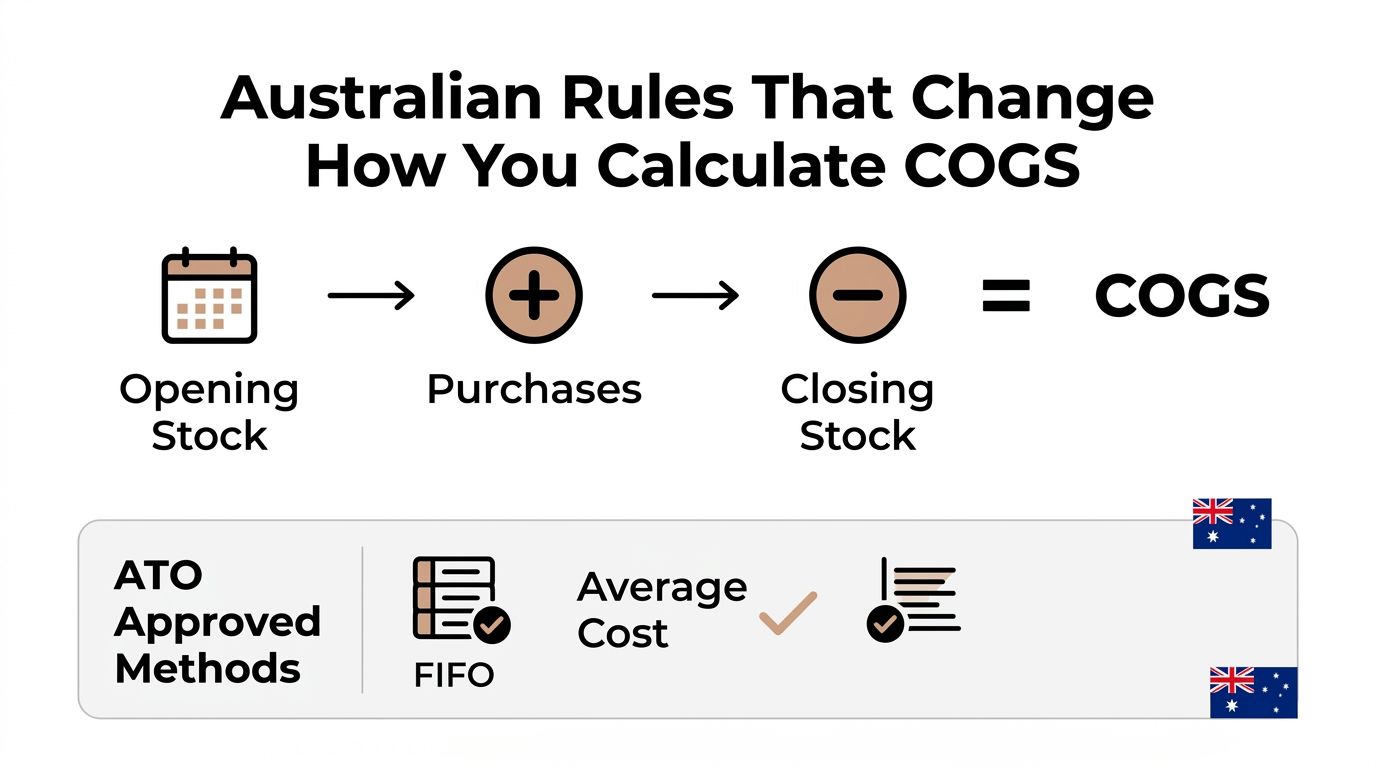
Opening Stock + Purchases − Closing Stock = COGS
For an Australian financial year, opening stock is measured at 1 July and closing stock is checked at 30 June. The ATO business income instructions explain that the calculation relies on the stock and sales information provided, so inventory still on hand is removed from the cost assigned to sales.
Valuation affects the result
Australian accounting rules require inventory to be measured at the lower of cost and net realisable value. Cost includes purchase costs, conversion costs and other costs needed to bring stock to its present location and condition. Net realisable value is the amount the business expects to recover from selling the stock, after relevant selling costs.
FIFO and weighted average are permitted cost formulas in Australia, while LIFO isn't. The method matters when input prices move because it changes which costs are assigned to sold goods and which remain in inventory. A change in method can therefore affect reported COGS and gross margin, so founders shouldn't switch approaches casually.
Private use and GST questions
If a director or owner takes trading stock home for private use, the transaction cannot disappear from the records. The ATO treatment is that stock taken for private use is treated as sold and included in assessable income. That adjustment protects the link between stock movement and business income.
GST and COGS also need separate treatment. COGS is generally analysed using GST-exclusive amounts where the business can claim input tax credits, while sales and purchases are reported through the relevant BAS labels and accounting records. The ATO's Simpler BAS GST bookkeeping guide separates sales disclosure from the trading-stock calculation, which is why BAS reporting shouldn't be treated as a substitute for inventory accounting.
The Australian trading-stock guidance also highlights that private-use stock, purchases and stocktakes can change the result. The safest process is to reconcile physical stock to the 30 June cut-off, record direct acquisition costs such as freight-in consistently, and document any valuation or private-use adjustment.
Common Mistakes That Quietly Distort Your COGS
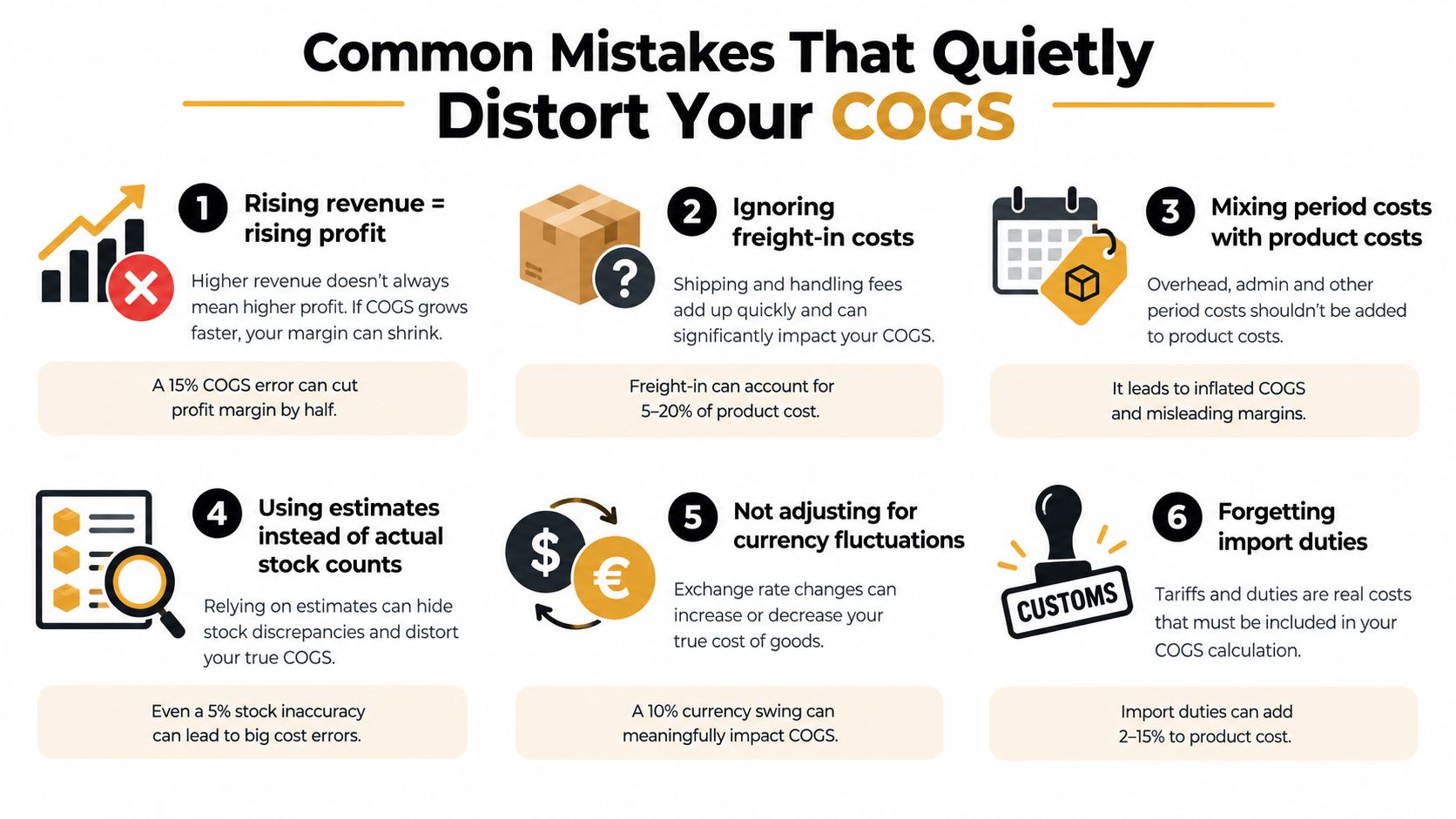
Revenue growth doesn't guarantee profit. A business can sell more while paying substantially more for the goods behind those sales, especially when prices, freight and product mix move at different speeds. The owner needs to examine gross profit, not sales alone.
The following mistakes are common because they often leave the bank account and sales dashboard looking normal:
Treating every expense as COGS: Rent, marketing, admin wages and general software usually belong in operating expenses. Putting them in COGS distorts the gross margin and makes product economics harder to compare.
Ignoring freight-in: Inbound freight is part of getting stock to its present location. Leaving it out understates the cost of acquiring the product.
Using estimates instead of counted stock: A rough closing-stock figure can change reported COGS, taxable profit and the value of inventory on the balance sheet.
Leaving obsolete stock at full cost: Stock that won't recover its recorded cost may require a lower-of-cost-and-net-realisable-value review.
Recording purchases in the wrong period: Supplier invoices and physical stock movements need to align with the relevant reporting cut-off.
Ignoring private-use withdrawals: Stock taken from the business for personal use still needs to be reflected in income and inventory records.
Why the stocktake deserves attention
A stocktake isn't just administrative paperwork. It determines how much of the available stock cost belongs to goods already sold and how much remains as an asset. Overvalued closing stock suppresses COGS and inflates reported profit, while undervalued stock has the opposite effect.
That can create a dangerous decision loop. The founder sees an attractive gross margin, orders more stock, and later discovers that damaged, slow-moving or missing goods were never reflected properly. The cash was committed long before the accounting issue became visible.
A stocktake is a financial control over cash, profit and tax, not merely a count of boxes.
The video below provides another visual explanation of common COGS mistakes.
Steps to Take This Quarter and How a Virtual CFO Can Help
You don't need to wait for the annual tax process to improve COGS. Start with the records that influence the formula, then build a repeatable review around them.
Reconcile stock records: Match opening stock to the prior closing balance, then compare purchases with supplier invoices, goods received records and inventory reports.
Separate freight and duties: Identify inbound freight and import duties that belong in the cost of acquiring stock. Keep customer delivery charges separate where they relate to fulfilment after sale.
Review cost allocation: Check that direct materials, production labour and product-specific packaging are captured consistently, while general overhead remains outside COGS.
Audit physical counts: Count stock at a regular operating cadence, investigate variances and document damaged, missing or obsolete lines.
Review valuation: Apply the chosen FIFO or weighted-average method consistently, then test stock at the lower of cost and net realisable value.
Check BAS and private use: Reconcile GST treatment, stock movements and any goods removed for personal use before finalising reporting.
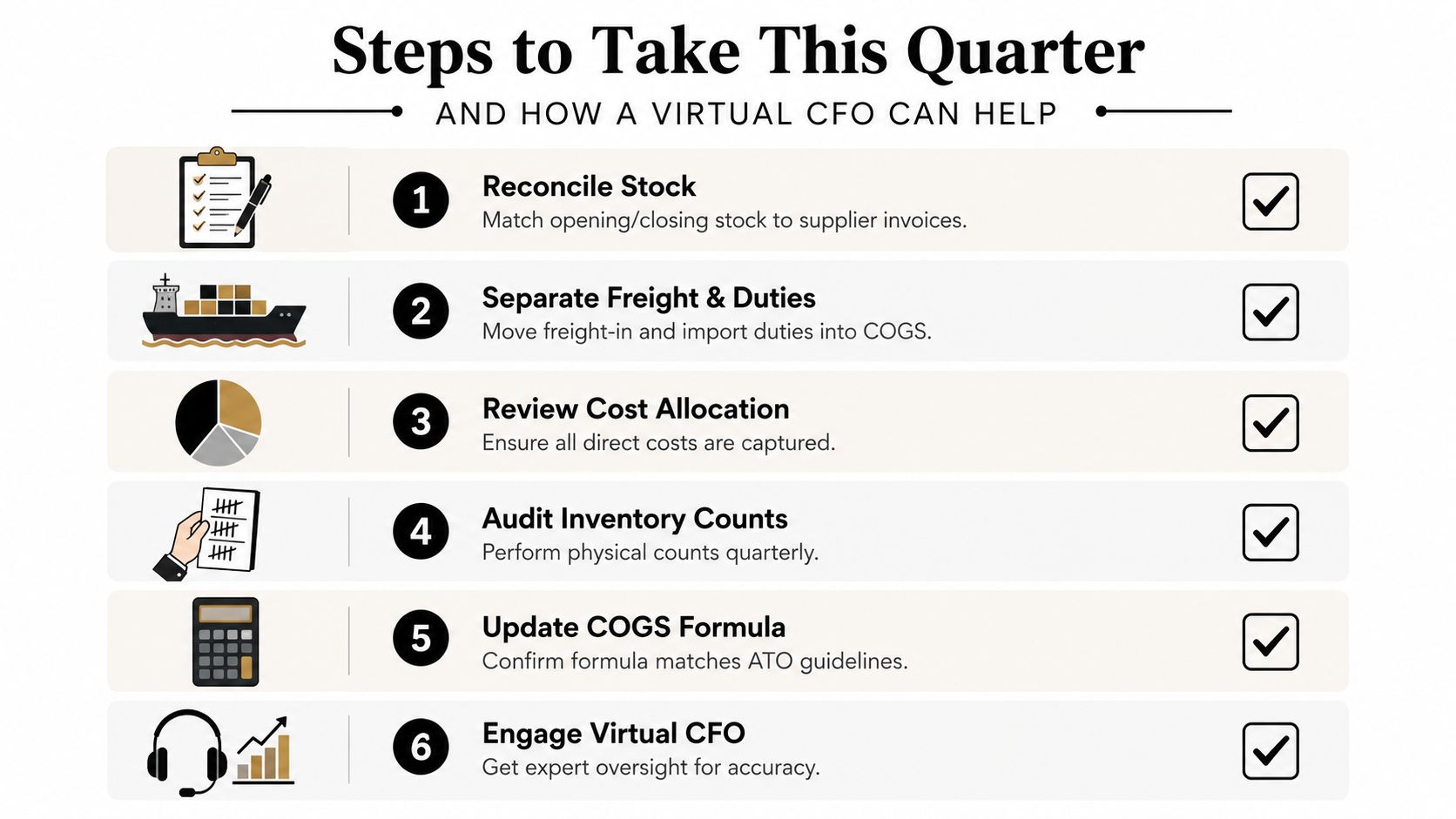
A virtual CFO turns these checks into a management rhythm rather than a once-a-year scramble. That can include monthly margin reporting, stocktake variance reviews, supplier-cost tracking, forward cash-flow forecasts and alerts when product margins drift away from pricing assumptions.
Nexist can support Australian founders with bookkeeping, BAS and tax coordination, inventory and supply-chain optimisation, forecasting, KPI reporting and cash-flow management. Its role is to connect COGS movements with the decisions that affect working capital, including what to buy, what to reprice and which stock is trapping cash.
The aim isn't to make the formula more complicated. It's to make the information timely enough for you to act before a margin problem becomes a cash problem.
Review your latest stock records, supplier invoices and freight-in entries before the next management meeting, then compare the resulting gross margin with your pricing assumptions. If you want a finance partner to turn that review into a recurring cash-leak detection process, visit Nexist and request a practical discussion about your COGS, inventory and cash-flow priorities.
cogs, cost of goods sold, small business accounting, gross profit margins, australian tax

" width="24px"/><g d="M 0 24.129 L 0 0.129 L 24 0.129 L 24 24.129 Z M 0 24.129 L 0 0.129 L 24 0.129 L 24 24.129 Z M 24 3 C 24 1.344 22.656 0 21 0 L 3 0 C 1.344 0 0 1.344 0 3 L 0 21 C 0 22.656 1.344 24 3 24 L 21 24 C 22.656 24 24 22.656 24 21 Z M 6.883 8.375 L 2.863 8.375 L 2.863 20.467 L 6.883 20.467 Z M 4.899 2.545 C 3.524 2.545 2.625 3.449 2.625 4.634 C 2.625 5.795 3.496 6.724 4.846 6.724 L 4.872 6.724 C 6.273 6.724 7.146 5.795 7.146 4.634 C 7.12 3.449 6.274 2.545 4.899 2.545 Z M 16.747 8.09 C 14.614 8.09 13.659 9.263 13.124 10.086 L 13.124 8.374 L 9.105 8.374 C 9.159 9.508 9.105 20.466 9.105 20.466 L 13.124 20.466 L 13.124 13.713 C 13.124 13.352 13.15 12.99 13.257 12.732 C 13.547 12.01 14.209 11.262 15.319 11.262 C 16.773 11.262 17.355 12.372 17.355 13.996 L 17.355 20.466 L 21.374 20.466 L 21.374 13.532 C 21.374 9.818 19.391 8.09 16.747 8.09 Z" fill="transparent" height="24.12890599668026px" id="dSFdkJotL" width="24px"><path d="M 0 24 L 0 0 L 24 0 L 24 24 Z" fill="transparent" height="24px" id="wscNJE44G" transform="translate(0 0.129)" width="24px"/><g d="M 0 24.129 L 0 0.129 L 24 0.129 L 24 24.129 Z M 24 3 C 24 1.344 22.656 0 21 0 L 3 0 C 1.344 0 0 1.344 0 3 L 0 21 C 0 22.656 1.344 24 3 24 L 21 24 C 22.656 24 24 22.656 24 21 Z M 6.883 8.375 L 2.863 8.375 L 2.863 20.467 L 6.883 20.467 Z M 4.899 2.545 C 3.524 2.545 2.625 3.449 2.625 4.634 C 2.625 5.795 3.496 6.724 4.846 6.724 L 4.872 6.724 C 6.273 6.724 7.146 5.795 7.146 4.634 C 7.12 3.449 6.274 2.545 4.899 2.545 Z M 16.747 8.09 C 14.614 8.09 13.659 9.263 13.124 10.086 L 13.124 8.374 L 9.105 8.374 C 9.159 9.508 9.105 20.466 9.105 20.466 L 13.124 20.466 L 13.124 13.713 C 13.124 13.352 13.15 12.99 13.257 12.732 C 13.547 12.01 14.209 11.262 15.319 11.262 C 16.773 11.262 17.355 12.372 17.355 13.996 L 17.355 20.466 L 21.374 20.466 L 21.374 13.532 C 21.374 9.818 19.391 8.09 16.747 8.09 Z" fill="transparent" height="24.12890599668026px" id="sTpjGo1tb" width="24px"><path d="M 0 24 L 0 0 L 24 0 L 24 24 Z" fill="transparent" height="24px" id="s7ffpmKOD" transform="translate(0 0.129)" width="24px"/><g d="M 24 3 C 24 1.344 22.656 0 21 0 L 3 0 C 1.344 0 0 1.344 0 3 L 0 21 C 0 22.656 1.344 24 3 24 L 21 24 C 22.656 24 24 22.656 24 21 Z M 6.883 8.375 L 2.863 8.375 L 2.863 20.467 L 6.883 20.467 Z M 4.899 2.545 C 3.524 2.545 2.625 3.449 2.625 4.634 C 2.625 5.795 3.496 6.724 4.846 6.724 L 4.872 6.724 C 6.273 6.724 7.146 5.795 7.146 4.634 C 7.12 3.449 6.274 2.545 4.899 2.545 Z M 16.747 8.09 C 14.614 8.09 13.659 9.263 13.124 10.086 L 13.124 8.374 L 9.105 8.374 C 9.159 9.508 9.105 20.466 9.105 20.466 L 13.124 20.466 L 13.124 13.713 C 13.124 13.352 13.15 12.99 13.257 12.732 C 13.547 12.01 14.209 11.262 15.319 11.262 C 16.773 11.262 17.355 12.372 17.355 13.996 L 17.355 20.466 L 21.374 20.466 L 21.374 13.532 C 21.374 9.818 19.391 8.09 16.747 8.09 Z" fill="transparent" height="24.000006px" id="D0ecaHEcW" transform="translate(0 0)" width="24px"><path d="M 24 3 C 24 1.344 22.656 0 21 0 L 3 0 C 1.344 0 0 1.344 0 3 L 0 21 C 0 22.656 1.344 24 3 24 L 21 24 C 22.656 24 24 22.656 24 21 Z" fill="rgb(55, 184, 218)" height="24.000006px" id="IPLFE6zXx" width="24px"/><path d="M 4.02 0 L 0 0 L 0 12.092 L 4.02 12.092 Z" fill="rgb(255, 255, 255)" height="12.09201px" id="FWhtzAyuY" transform="translate(2.863 8.375)" width="4.02px"/><path d="M 2.274 0 C 0.899 0 0 0.904 0 2.089 C 0 3.25 0.871 4.179 2.221 4.179 L 2.247 4.179 C 3.648 4.179 4.521 3.25 4.521 2.089 C 4.495 0.904 3.649 0 2.274 0 Z" fill="rgb(255, 255, 255)" height="4.17876px" id="VmOsKv4kO" transform="translate(2.625 2.545)" width="4.52095px"/><path d="M 7.641 0 C 5.509 0 4.554 1.173 4.019 1.996 L 4.019 0.284 L 0 0.284 C 0.053 1.419 0 12.376 0 12.376 L 4.019 12.376 L 4.019 5.623 C 4.019 5.262 4.045 4.9 4.151 4.642 C 4.442 3.92 5.103 3.172 6.214 3.172 C 7.667 3.172 8.25 4.282 8.25 5.907 L 8.25 12.376 L 12.269 12.376 L 12.269 5.442 C 12.269 1.728 10.286 0 7.641 0 Z" fill="rgb(255, 255, 255)" height="12.37626px" id="n1XUbhaq0" transform="translate(9.105 8.09)" width="12.268830000000001px"/></g></g></g></g></svg>)