What Is Capital Raising: Your 2026 Business Guide
Learn what is capital raising for your Australian business. Unpack debt vs equity, the step-by-step process, valuation, & how to get investor-ready.
Ansh Malhotra

You're looking at a business that should be growing faster than it is. Sales are there. Customers want the product. The problem is cash. A large inventory order has to be paid before the revenue lands, or a growing services team needs wages covered weeks before client invoices are collected.
That is usually when the question shifts from theory to decision. What is capital raising, and do you need it?
Capital raising means bringing outside money into the business so it can fund growth that internal cash flow cannot comfortably support. That funding might cover stock purchases, equipment, a new hire, a product launch, a second location, or working capital to bridge the gap between paying suppliers and getting paid by customers.
For Australian founders, the issue is not just how to get money. It is choosing the right type of money.
I see founders get this wrong in both directions. Some give up equity too early for a short-term cash problem that a well-structured debt facility could have solved. Others take on debt that looked affordable on paper but did not match the timing of their cash conversion cycle, BAS obligations, or seasonal swings. Inventory-heavy businesses are especially exposed here. If cash is tied up in stock for months, the funding structure matters as much as the amount raised.
Capital raising can help a business move at the pace demand requires. It can also add repayment pressure, investor expectations, reporting obligations, and dilution. The smart move is to match the capital to the job. If you are funding a temporary working capital gap, debt may be the cleaner answer. If you are backing a long product build, entering a new market, or scaling before profitability, equity may make more sense.
That is the practical lens founders should use from the start. Capital is not just fuel. It is a commercial choice that affects control, risk, and what your business needs to deliver next.
Table of Contents
Your Growth Is Stuck Is Capital the Answer
You've got orders coming in, customers are responding, and the business should be growing. Then cash gets pinned down in stock, customers take 45 or 60 days to pay, a key machine needs replacing, or the team is already stretched. Growth has not failed. It has outgrown the current funding setup.

That is the point where founders start asking what capital raising means in practice.
Capital raising is bringing external money into the business for a defined purpose. In Australia, that usually means debt from a lender or equity from an investor. The source matters less than the use. Good capital gives the business room to execute a sound plan. Bad capital keeps an operational problem alive for longer and usually makes it more expensive.
The first question is simple. Is the business constrained by funding, or is it constrained by economics?
If gross margins are thin, stock turns are poor, pricing is off, or collections are sloppy, extra capital will not fix the root issue. It gives the problem more oxygen. I see this often with inventory-heavy businesses. A founder assumes they need equity because the bank account is tight, when the underlying issue is that too much cash is sitting in slow-moving SKUs or customer terms are doing the financing job badly.
On the other hand, some businesses are plainly underfunded. A wholesaler may have confirmed demand but cannot buy enough inventory ahead of peak season. A manufacturer may need a new piece of equipment to lift throughput and shorten lead times. A services firm may need working capital to cover payroll while larger clients pay on extended terms. In those cases, capital is a tool with a clear job.
That distinction matters more in Australia than many generic guides admit. Local founders are raising money inside a market shaped by bank credit settings, private investors, ASIC rules, director duties, personal guarantees, and tax consequences. The private capital pool is active, as noted earlier, but access to money does not mean every form of capital is a good fit for your business.
For founders selling physical products, the practical answer is often less glamorous than a pitch deck. If the problem is timing between paying suppliers and getting paid by customers, debt can be the cleaner answer because it matches the operating cycle without giving up ownership. Equity is usually better reserved for situations where the model still needs proving, cash flows are not yet reliable, or the business is taking a bigger strategic bet.
That is also why capital raising in an inventory business has more in common with cash-flow design than startup storytelling. Founders who want a broader comparison can look at how other asset-backed structures work in navigating real estate syndication financing. The mechanics differ, but the principle is the same. Match the funding tool to the asset, the risk, and the repayment profile.
A practical rule applies here. Raise capital for a specific outcome you can measure. More purchase orders fulfilled. Faster production. Better stock availability. Shorter cash conversion pressure. If the use of funds cannot be explained clearly in one or two sentences, the business probably is not ready to raise yet.
Debt vs Equity Renting Money or Selling the House
If you want the shortest useful explanation, here it is.
Debt is renting money. You use someone else's capital for a period of time and pay for that privilege through interest, fees, and repayment terms.
Equity is selling part of the house. You receive money without scheduled repayments, but you permanently give up a slice of ownership and some future upside.
Debt keeps ownership intact
For many Australian SMEs, debt is the cleaner tool. That's especially true when the business has inventory, receivables, equipment, or stable trading history that a lender can assess.
The overlooked point is that debt can be smarter than equity for inventory-heavy businesses because it lets founders keep full ownership while funding growth. That's noted in this Australian perspective on capital raising and debt finance. If you sell products and cash is trapped in stock, giving away equity to solve a working capital problem can be a very expensive fix.
A retailer, wholesaler, or manufacturer often doesn't need a shareholder to solve a timing issue. They need funding matched to the operating cycle.
Equity buys runway and risk tolerance
Equity makes more sense when repayments would choke the business. Early-stage ventures, product-heavy startups, and companies entering a new market often choose equity because they need time to prove the model before cash generation catches up.
That doesn't mean equity is “free”. It's expensive in a different way. Founders give up ownership, future dividends, and sometimes decision-making flexibility. You also inherit investor expectations, reporting requirements, and pressure around milestones.
Here's the side-by-side view.
Attribute | Debt Financing | Equity Financing |
|---|---|---|
Ownership | Founder usually keeps ownership | Founder gives up part of ownership |
Repayment | Regular repayment obligations usually apply | No scheduled repayment like a loan |
Cost | Interest, fees, security, covenants | Dilution, governance, future upside shared |
Control | Lender usually doesn't run the business if terms are met | Investors may want rights, reporting, and influence |
Best fit | Inventory, receivables, equipment, predictable cash flow | Early-stage growth, product build, market expansion, longer runway |
Main risk | Cash flow stress if repayments don't match trading cycle | Permanent loss of ownership and possible misalignment |
What usually works better
Founders often jump to equity because it sounds flexible. In reality, a business with strong gross margins, saleable stock, and repeat customers may be better served by debt.
If you're weighing that trade-off, this breakdown of debt to equity ratio is useful because it frames debt financing in operating terms rather than theory.
If the funding need is temporary and tied to working capital, debt often fits better. If the funding need is uncertain and tied to proving the business model, equity often fits better.
What doesn't work is choosing based on emotion. “I don't want debt” or “I don't want investors” isn't analysis. Match the funding structure to the job.
A Founder's Guide to Capital Types and Sources
Most founders don't need every capital option. They need the right one for their stage, their business model, and the job the money needs to do.
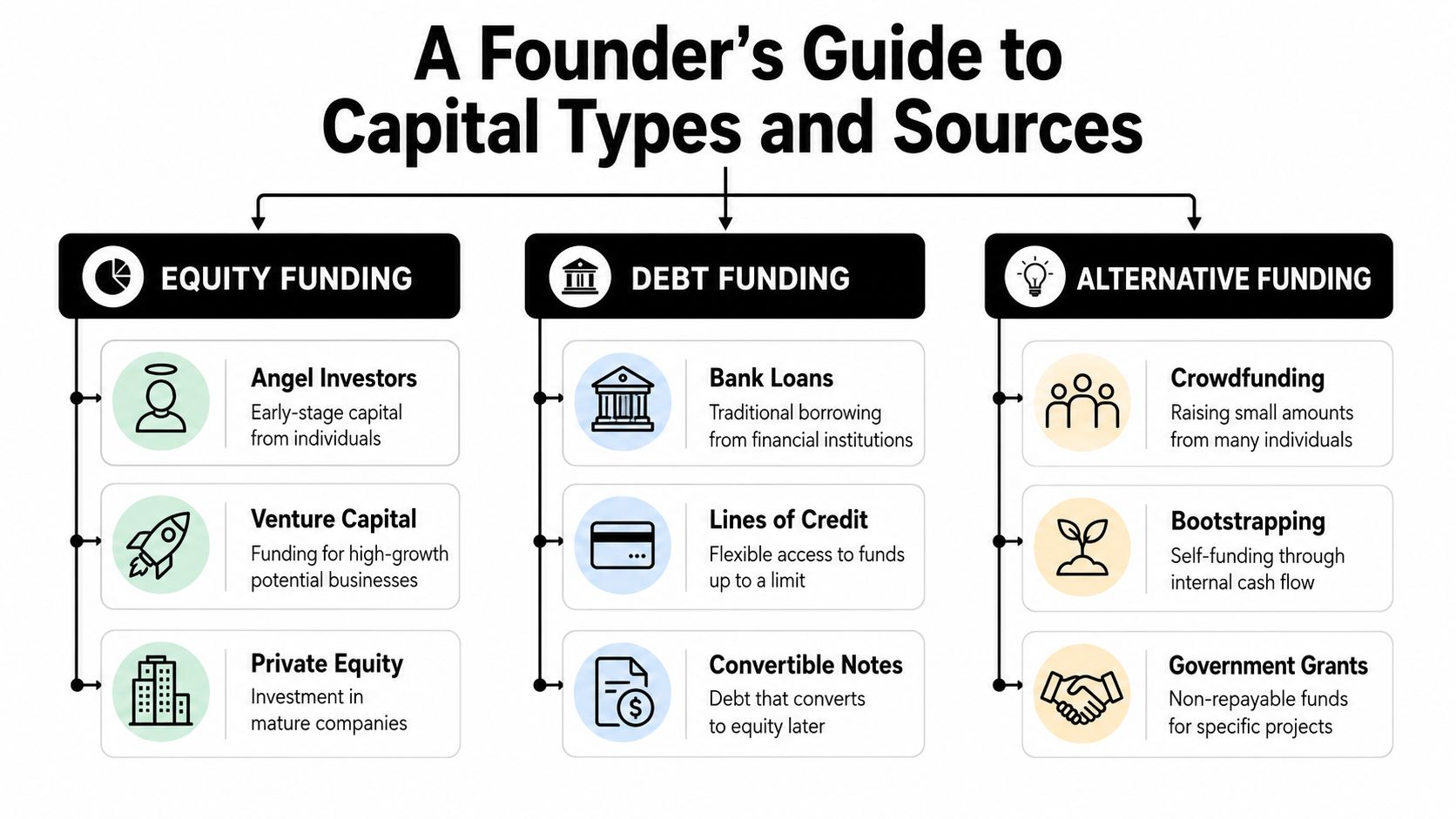
The cleanest way to think about it is by where the business sits today.
Idea stage and pre-seed
At this point, the business usually has more belief than proof. Revenue may be limited or non-existent. Founders often rely on:
Bootstrapping through personal funds or early customer cash
Friends and family where trust matters as much as the business case
Grants where the project fits a specific programme
Crowdfunding if the offer is easy to explain to a broad audience
This stage rewards restraint. If you can validate demand cheaply, do that first. Raising too early often leads to weak negotiating power because the business has little evidence yet.
Early traction and angel funding
At this stage, external capital starts becoming more realistic. The business has some proof. Customers exist. The product or service is in market. Founders can point to early revenue, retention, or operational traction.
The Ashurst Australian equity capital market report for FY25 notes that seed-stage capital raising in Australia typically ranges from $100K to $500K for idea development, while expansion-stage rounds range from $2m to $10m for venture capital-backed growth.
At this level, common sources include:
Angel investors who back founders early and may offer networks as well as capital
Micro VCs or seed funds where the business has enough traction to fit a clearer thesis
Early customer-funded growth if margins and payment terms allow it
For some founders, it also helps to study adjacent funding structures outside the startup world. This piece on navigating real estate syndication financing is useful because it shows how capital stacks, investor expectations, and deal structure work in a different but still relevant context.
Scaling stage and structured funding
Once the business has stronger systems, clearer reporting, and a repeatable sales engine, the menu expands. That's when founders start looking at:
Venture capital for high-growth companies with a large upside story
Private equity for more mature businesses with operational strength and scale potential
Strategic investors who bring distribution, capability, or market access
Bank loans and business facilities for companies with serviceable cash flow
Invoice finance or trade finance where receivables or supplier cycles create pressure
A founder's best funding source is usually the one that matches the business model, not the one that sounds most exciting.
What works is choosing a source that understands your economics. A manufacturer with long production cycles and stock on hand doesn't need the same capital as a software startup. A wholesale business with receivables pressure doesn't need the same investor as a biotech venture. Good founders stop treating funding as generic.
The Typical Capital Raising Process Step by Step
Raising capital is a project. It touches finance, legal, operations, tax, commercial strategy, and founder psychology. If you treat it like a quick pitch exercise, the process usually drags, and investors notice the gaps.
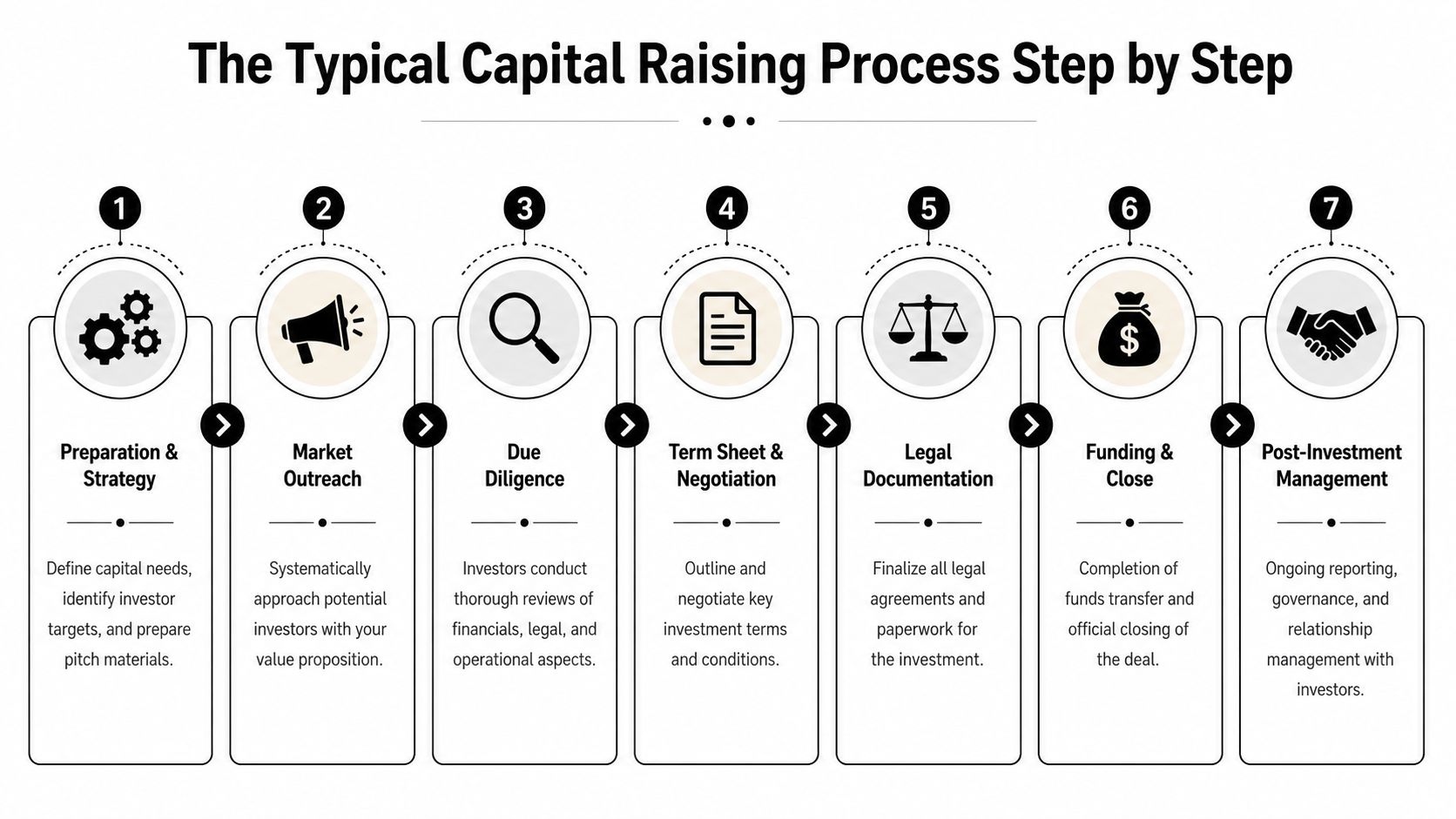
Preparation and strategy
Before speaking to investors or lenders, get clear on three things.
How much capital is needed
Not the biggest amount you can justify. The amount required to reach a specific business outcome.What milestone that capital funds
The IBISWorld Australian equity capital raising outlook notes that for growth-stage startups, rounds should be milestone-driven, and that investors expect 25%+ returns, investor readiness, and clear KPIs.What story the numbers support
Your model, assumptions, cash flow forecast, margin profile, and operational plan all need to line up.
Build a proper data room. Use organised folders, current financials, legal documents, customer concentration analysis, tax records, cap table details, and a model you can defend under questioning.
Outreach and pitching
The next step is matching the raise to the right audience. Many founders waste months pitching people who were never a fit.
A practical shortlist should answer:
Mandate fit. Do they fund this stage, sector, and cheque size?
Geography fit. Are they active in Australia?
Structure fit. Do they invest in debt, equity, or both?
Relationship fit. Will they be useful after the money lands?
Pitching isn't about hype. It's about showing that the problem is real, the economics are sensible, the use of funds is disciplined, and the team can execute.
For founders who want a broader context on how funding stages evolve, this guide to startup funding for founders gives a helpful stage-by-stage companion view.
Due diligence to close
Once interest turns serious, the process gets slower and more detailed. That's normal.
Expect scrutiny over:
Financial quality such as revenue recognition, margin consistency, working capital needs, and forecasting logic
Legal hygiene including contracts, share registers, IP ownership, employment matters, and compliance
Operational reality covering fulfilment, systems, customer retention, supplier dependencies, and key-person risk
Investors don't walk away only because of bad numbers. They walk away because the founder can't explain the numbers.
Then come term sheets, negotiations, legal documents, and finally settlement. This is the stage where weak preparation becomes expensive. A messy data room, contradictory figures, or unclear assumptions can force repricing, delays, or a complete reset.
After the funds arrive, the job doesn't end. Reporting cadence, board updates, covenants, and capital allocation discipline become part of normal operations.
Valuation Dilution and the True Costs of Capital
Founders often focus on one question first. What valuation can I get?
That's understandable, but it's incomplete. A better question is this. What ownership outcome am I creating now, and how will it affect future rounds, control, and returns to me later?
Valuation is a negotiation grounded in evidence
Valuation is the agreed value of the company at the time of the raise. In practice, investors usually look at comparable businesses, transaction history, growth quality, risk, margin profile, and how believable the forecast is.
For early-stage deals, valuation is rarely a pure spreadsheet exercise. It's a judgment call based on traction and risk. That's why two businesses with similar revenue can get very different outcomes.
If you need a practical lens on how transaction logic gets tested, this overview of transaction advisory services is a useful reference point.
Dilution is the part founders feel later
Think of the company as a pizza. Before the raise, you own a certain number of slices. When new shares are issued, the pizza gets bigger, but your percentage can shrink unless you're buying into the new round yourself.
The benchmark many founders ask about is early angel funding. According to this guide on Australian angel investors and capital raising, angel investors typically invest between A$25,000 and A$500,000 per deal, often representing 5–15% equity.
That range is useful, but it isn't a rule. The right amount depends on risk, sector, traction, future capital needs, and what milestones this round enables.
The costs that don't appear in the headline number
Even when the valuation looks decent, capital still has hidden costs.
Time cost because founders spend weeks or months in meetings, modelling, and diligence
Legal cost through documents, negotiations, and compliance work
Complexity cost once governance, reporting, and investor communication become more formal
Strategic cost if the wrong investor or funding structure pushes the business in the wrong direction
The cheapest capital on paper can become the most expensive capital in practice.
What works is modelling dilution before you start. Include option pools, future rounds, and founder ownership after each scenario. Too many founders negotiate one round at a time and only realise later how much of the business they've given away.
Timing and Signals When Should You Raise Capital
The best time to raise isn't when cash is nearly gone. It's when the business can tell a credible story about what the next capital injection will achieve.
Signals that suggest you're ready
A raise usually has better odds when several things are already true:
Demand is proven and customers are buying without heroic effort
The sales process is becoming repeatable rather than relying on founder improvisation
Margins make sense and growth doesn't destroy cash every time revenue increases
Operations can absorb more volume with the right funding behind them
The use of funds is specific rather than vague
If those pieces aren't in place, external capital can expose weakness rather than fix it.
Sometimes the right answer is don't raise yet
Plenty of businesses don't need capital first. They need better receivables control, sharper stock planning, cleaner pricing, lower waste, or tighter operating discipline.
That's especially true in Australian SMEs where cash gets trapped in ordinary places. Slow debtors, excess inventory, underquoted jobs, and poor visibility over margins. Founders often call this a funding problem when it's really a finance operations problem.
For a broader founder-oriented checklist on preparing the business before chasing money, this roadmap for data-driven founders is a worthwhile read.
A simple test helps. If you injected capital tomorrow, would it produce a clear return, or would it disappear into existing inefficiencies? If it's the second one, wait. Fix the machine first.
Navigating Your Raise with a Virtual CFO Partner
A raise gets serious the moment an investor asks for the last 12 months of monthly trading, a current cash flow forecast, and a clear explanation for margin swings. Plenty of founders have the story. Fewer have numbers that reconcile cleanly under scrutiny.
A virtual CFO helps get the business ready for that scrutiny. The job is to turn raw trading activity into reporting that a lender, investor, or due diligence team can test properly. That usually means building forecast models, tightening working capital assumptions, explaining KPI movements, pressure-testing scenarios, and preparing reporting packs that hold together from the P&L through to cash.
In Australian raises, that matters more than many founders expect. Debt providers want confidence that repayments fit actual cash generation, not optimistic top-line growth. Equity investors want a believable plan for how capital converts into value, and they will push hard on assumptions around sales cycles, gross margin, stock turns, and hiring. Inventory-heavy businesses feel this most. I often see founders assume equity is the safer option, when a structured debt facility is the cleaner answer because it funds stock without giving away ownership.
Compliance also sits in the background of every raise. Once information is shared with investors or lenders, loose numbers and inconsistent statements create real risk. The issue is not just presentation. It is whether management can support the claims being made, explain variances, and show control over the business.
A good CFO partner also helps founders avoid expensive category errors. For example, using long-term equity to patch a short-term working capital gap usually costs too much. Trying to force debt onto a business with volatile cash flow can create pressure at exactly the wrong time. The right answer depends on what the money is funding, how fast it turns back into cash, and what flexibility the business needs if trading softens.
For founders weighing that support, a virtual chief financial officer can give you finance leadership without hiring a full-time executive before the business needs one.
A short explainer can also help make the role more concrete:
The best raise leaves the business with more than cash. It leaves you with better reporting, clearer funding logic, and terms that match how the company operates.
If you're weighing debt, equity, or whether you should raise at all, Nexist helps Australian founders get clear on cash flow, funding readiness, forecasts, and the numbers investors or lenders will test. The right capital decision starts with knowing how your business really performs.
what is capital raising, business funding Australia, debt vs equity financing, startup funding, virtual cfo

" width="24px"/><g d="M 0 24.129 L 0 0.129 L 24 0.129 L 24 24.129 Z M 0 24.129 L 0 0.129 L 24 0.129 L 24 24.129 Z M 24 3 C 24 1.344 22.656 0 21 0 L 3 0 C 1.344 0 0 1.344 0 3 L 0 21 C 0 22.656 1.344 24 3 24 L 21 24 C 22.656 24 24 22.656 24 21 Z M 6.883 8.375 L 2.863 8.375 L 2.863 20.467 L 6.883 20.467 Z M 4.899 2.545 C 3.524 2.545 2.625 3.449 2.625 4.634 C 2.625 5.795 3.496 6.724 4.846 6.724 L 4.872 6.724 C 6.273 6.724 7.146 5.795 7.146 4.634 C 7.12 3.449 6.274 2.545 4.899 2.545 Z M 16.747 8.09 C 14.614 8.09 13.659 9.263 13.124 10.086 L 13.124 8.374 L 9.105 8.374 C 9.159 9.508 9.105 20.466 9.105 20.466 L 13.124 20.466 L 13.124 13.713 C 13.124 13.352 13.15 12.99 13.257 12.732 C 13.547 12.01 14.209 11.262 15.319 11.262 C 16.773 11.262 17.355 12.372 17.355 13.996 L 17.355 20.466 L 21.374 20.466 L 21.374 13.532 C 21.374 9.818 19.391 8.09 16.747 8.09 Z" fill="transparent" height="24.12890599668026px" id="dSFdkJotL" width="24px"><path d="M 0 24 L 0 0 L 24 0 L 24 24 Z" fill="transparent" height="24px" id="wscNJE44G" transform="translate(0 0.129)" width="24px"/><g d="M 0 24.129 L 0 0.129 L 24 0.129 L 24 24.129 Z M 24 3 C 24 1.344 22.656 0 21 0 L 3 0 C 1.344 0 0 1.344 0 3 L 0 21 C 0 22.656 1.344 24 3 24 L 21 24 C 22.656 24 24 22.656 24 21 Z M 6.883 8.375 L 2.863 8.375 L 2.863 20.467 L 6.883 20.467 Z M 4.899 2.545 C 3.524 2.545 2.625 3.449 2.625 4.634 C 2.625 5.795 3.496 6.724 4.846 6.724 L 4.872 6.724 C 6.273 6.724 7.146 5.795 7.146 4.634 C 7.12 3.449 6.274 2.545 4.899 2.545 Z M 16.747 8.09 C 14.614 8.09 13.659 9.263 13.124 10.086 L 13.124 8.374 L 9.105 8.374 C 9.159 9.508 9.105 20.466 9.105 20.466 L 13.124 20.466 L 13.124 13.713 C 13.124 13.352 13.15 12.99 13.257 12.732 C 13.547 12.01 14.209 11.262 15.319 11.262 C 16.773 11.262 17.355 12.372 17.355 13.996 L 17.355 20.466 L 21.374 20.466 L 21.374 13.532 C 21.374 9.818 19.391 8.09 16.747 8.09 Z" fill="transparent" height="24.12890599668026px" id="sTpjGo1tb" width="24px"><path d="M 0 24 L 0 0 L 24 0 L 24 24 Z" fill="transparent" height="24px" id="s7ffpmKOD" transform="translate(0 0.129)" width="24px"/><g d="M 24 3 C 24 1.344 22.656 0 21 0 L 3 0 C 1.344 0 0 1.344 0 3 L 0 21 C 0 22.656 1.344 24 3 24 L 21 24 C 22.656 24 24 22.656 24 21 Z M 6.883 8.375 L 2.863 8.375 L 2.863 20.467 L 6.883 20.467 Z M 4.899 2.545 C 3.524 2.545 2.625 3.449 2.625 4.634 C 2.625 5.795 3.496 6.724 4.846 6.724 L 4.872 6.724 C 6.273 6.724 7.146 5.795 7.146 4.634 C 7.12 3.449 6.274 2.545 4.899 2.545 Z M 16.747 8.09 C 14.614 8.09 13.659 9.263 13.124 10.086 L 13.124 8.374 L 9.105 8.374 C 9.159 9.508 9.105 20.466 9.105 20.466 L 13.124 20.466 L 13.124 13.713 C 13.124 13.352 13.15 12.99 13.257 12.732 C 13.547 12.01 14.209 11.262 15.319 11.262 C 16.773 11.262 17.355 12.372 17.355 13.996 L 17.355 20.466 L 21.374 20.466 L 21.374 13.532 C 21.374 9.818 19.391 8.09 16.747 8.09 Z" fill="transparent" height="24.000006px" id="D0ecaHEcW" transform="translate(0 0)" width="24px"><path d="M 24 3 C 24 1.344 22.656 0 21 0 L 3 0 C 1.344 0 0 1.344 0 3 L 0 21 C 0 22.656 1.344 24 3 24 L 21 24 C 22.656 24 24 22.656 24 21 Z" fill="rgb(55, 184, 218)" height="24.000006px" id="IPLFE6zXx" width="24px"/><path d="M 4.02 0 L 0 0 L 0 12.092 L 4.02 12.092 Z" fill="rgb(255, 255, 255)" height="12.09201px" id="FWhtzAyuY" transform="translate(2.863 8.375)" width="4.02px"/><path d="M 2.274 0 C 0.899 0 0 0.904 0 2.089 C 0 3.25 0.871 4.179 2.221 4.179 L 2.247 4.179 C 3.648 4.179 4.521 3.25 4.521 2.089 C 4.495 0.904 3.649 0 2.274 0 Z" fill="rgb(255, 255, 255)" height="4.17876px" id="VmOsKv4kO" transform="translate(2.625 2.545)" width="4.52095px"/><path d="M 7.641 0 C 5.509 0 4.554 1.173 4.019 1.996 L 4.019 0.284 L 0 0.284 C 0.053 1.419 0 12.376 0 12.376 L 4.019 12.376 L 4.019 5.623 C 4.019 5.262 4.045 4.9 4.151 4.642 C 4.442 3.92 5.103 3.172 6.214 3.172 C 7.667 3.172 8.25 4.282 8.25 5.907 L 8.25 12.376 L 12.269 12.376 L 12.269 5.442 C 12.269 1.728 10.286 0 7.641 0 Z" fill="rgb(255, 255, 255)" height="12.37626px" id="n1XUbhaq0" transform="translate(9.105 8.09)" width="12.268830000000001px"/></g></g></g></g></svg>)