
Business Process Improvement Consulting for Australian SMEs
A guide to business process improvement consulting for Australian SMEs. Learn how to increase cashflow, margins, and time with a finance-first approach.
Ansh Malhotra

You can feel when operations are running the business instead of you. Cash is tighter than sales suggest it should be. The team stays busy, yet jobs still fall behind. Inventory sits too long, quotes take too long, invoices go out too late, and every week gets swallowed by preventable follow-up.
That's usually not a people problem. It's a process problem with financial consequences.
For Australian SMEs, business process improvement consulting matters most when it stops being framed as “efficiency work” and starts being treated as a way to release cash, protect margin, and give the owner time back. In a crowded advisory market, that distinction matters. Australia's management consulting industry includes 95,557 businesses and generated $40.8 billion in revenue during 2025-26, according to IBISWorld's management consulting industry data. Plenty of advisers can map a workflow. Fewer can show you why that workflow is hurting your bank balance.
Table of Contents
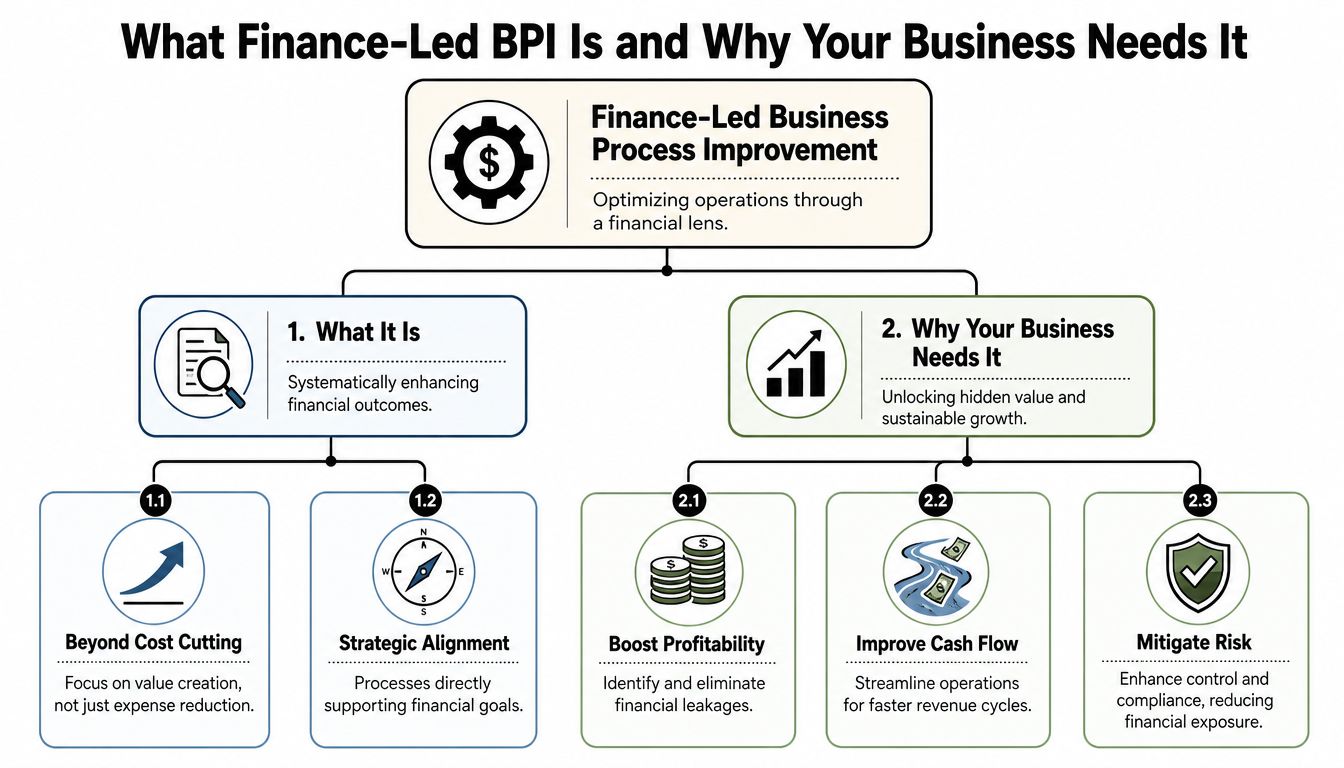
What Finance-Led BPI Is and Why Your Business Needs It
A lot of SMEs treat broken processes like a slow leak in the roof. They notice the stain, put a bucket under it, and keep moving. Finance-led business process improvement works more like tracing the plumbing inside the walls. You're not just cleaning up the visible mess. You're finding where money, margin, and management attention are escaping.
The real problem isn't inefficiency
Most owners don't wake up wanting “better processes”. They want stock levels that don't choke cash flow. They want debtors collected faster. They want fewer errors in pricing, payroll, reporting, and delivery. They want their week back.
That's why finance-led business process improvement consulting starts with one question. Where is the process creating a financial leak? Sometimes that leak is obvious, such as rework, write-offs, freight mistakes, or overdue invoices. Sometimes it's hidden in handover delays, approval bottlenecks, or poor visibility over stock and job profitability.
Practical rule: If a process can't be linked to cash in the bank, margin on the P&L, or hours returned to the owner, it's not a priority yet.
This approach is especially relevant because half of Australian industry leaders have identified process improvement as a strategic priority in 2026, and more than 500 firms were assessed in process management rankings, with 56 qualifying as top players, according to Business Analysis Solutions. The demand is real. The harder part is separating process theatre from work that changes financial outcomes.
For owners trying to get a better grip on preventing revenue leakage, the useful shift is this: stop treating operational friction as a soft issue. It usually shows up later as lower collections, higher working capital pressure, missed capacity, or margin erosion.
What finance-led BPI changes
A standard operational review might tell you a workflow is clunky. A finance-led review asks what that clunkiness costs every month and what changes first. That changes the order of decisions.
For example, a finance-led BPI project will often look at:
Inventory movement: Is cash trapped in slow stock because purchasing, sales, and fulfilment aren't operating from the same rules?
Quote-to-cash flow: Are delays in approvals or invoicing stretching the gap between work completed and cash received?
Admin load: Are senior people doing low-value coordination because nobody built a reliable handoff process?
Error points: Are manual entries creating avoidable corrections, credits, or reporting issues?
A virtual CFO usually sits close to these trade-offs because the numbers expose them early. If you want a practical view of that role, this overview of a virtual chief financial officer is a useful starting point.
The point of finance-led BPI isn't to create prettier process maps. It's to build a business that holds more cash, converts work into profit more consistently, and stops depending on the owner as the control system.
Common BPI Methodologies for Australian SMEs
Most methodologies sound abstract until you apply them to an actual business. In SMEs, the value isn't in memorising labels. It's in knowing which method solves which problem.

Four methods that show up in real SME work
Lean is about removing waste. In practice, that might mean cutting unnecessary touches in a warehouse, reducing double handling in dispatch, or removing approvals that slow down purchasing without improving control. Lean works well when the business is busy but output doesn't match effort.
Six Sigma is about reducing variation and defects. In a manufacturing or service setting, that usually means tightening the steps that cause inconsistent results. If jobs are profitable on paper but get eaten up by rework, missed specifications, or repeated mistakes, this method helps.
Process mapping is the most underrated tool for SMEs. A simple map from lead to quote, quote to job, job to invoice, and invoice to cash will often show where the business really breaks. Service businesses benefit from this quickly because handovers tend to live in email threads, verbal instructions, and individual memory.
AI-enabled automation can remove repetitive admin, but only after the workflow itself makes sense. Good examples include routing approvals, standardising invoice creation, or reducing rekeying between systems. Poor examples include layering automation over inconsistent data, unclear ownership, or broken approval logic.
Here's a simple way to think about the fit:
Method | Best used for | Common SME example |
|---|---|---|
Lean | Waste and delay | Warehouse picking, purchasing approvals |
Six Sigma | Error reduction | Manufacturing consistency, job quality checks |
Process mapping | Visibility and handoffs | Quote-to-cash in a trade or service firm |
AI automation | Repetitive admin | Data entry, follow-ups, routine workflow triggers |
Where automation goes wrong
Often, many projects stall. Owners buy software hoping the tool will force discipline into the process. It rarely works that way.
Recent data from the Australian Tech Council shows 62% of AU SMEs attempted AI automation in 2025, but only 28% achieved measurable ROI. The same verified dataset notes that a Deloitte AU survey found 45% of failed AI implementations came from automating broken processes rather than improving them first.
Automating confusion just helps the business make mistakes faster.
The better sequence is map, simplify, assign ownership, then automate. That's also where staff resistance usually drops. People push back less when the new process removes friction they already hate.
For owners comparing options, this guide to automating business processes is useful because it frames automation as workflow design, not just software setup. In practice, that's the difference between a system your team adopts and one they work around.
The BPI Consulting Engagement Roadmap
A solid engagement should feel structured, not mysterious. If you can't see the phases, deliverables, and decision points, the project will drift.

A practical roadmap usually runs through five phases.
Phase one and two
Discovery and assessment comes first. The consultant investigates how work unfolds, as opposed to how people assume it does. A professional business process audit is the critical first step in BPI, involving a systematic review of operations to identify delays, redundant tasks, and unnecessary costs. Organisations that implement automation tools following such audits can increase efficiency by up to 30%, according to Bentleys' guidance on business process improvement.
The deliverables here should be concrete:
Current-state process maps: How work flows today across sales, delivery, finance, and admin.
Bottleneck diagnosis: Where delays, rework, and handoff failures occur.
Financial impact summary: Which problems affect cash flow, margin, or capacity most directly.
Baseline measures: The handful of metrics that will show whether the project worked.
Strategy and planning comes next. This phase turns diagnosis into a prioritised action plan. Good consultants don't dump every issue into one giant implementation backlog. They separate urgent fixes from structural fixes.
That roadmap should usually include:
Quick wins that improve control or remove obvious friction.
System changes that need process redesign first.
Ownership decisions so every task has a responsible role.
A sequence that avoids disrupting the team during peak trading periods.
For businesses reviewing broader digitised workflow solutions, the main thing to notice is whether the solution is tied to operating discipline, not just digitisation for its own sake.
Phase three and four
Hands-on implementation is where a lot of advisory projects fall apart. Recommendations aren't enough. Someone has to translate them into SOPs, system rules, approvals, templates, training, and reporting rhythms.
A useful implementation phase often includes:
Rewritten SOPs: Short, usable instructions for recurring tasks.
System configuration notes: What changes in Xero, inventory platforms, job management tools, CRM, or approval workflows.
Training sessions: Team-specific guidance, not generic “change management”.
Pilot rollouts: Testing in one workflow before wider release.
One example of a provider in this space is Nexist, which offers a business health check that maps broken workflows, ranks issues by impact and effort, and guides cleanup before automation. That's the kind of scope that makes BPI practical rather than theoretical.
A strong engagement also builds in monitoring early. Dashboards matter because most process failures reemerge unnoticed. Teams drift back to old habits unless someone measures adoption and outcome.
A useful walkthrough can help owners visualise what this kind of project looks like in practice:
Phase five
Review and sustainment is where the consultant checks whether the gains are sticking. This phase should answer three questions. Are the new steps being followed? Are the financial outcomes showing up? What needs adjusting now that the process is live?
The handover isn't complete when the workflow is built. It's complete when the team can run it without dragging the owner back into every decision.
If you're evaluating whether a project sits inside a wider growth agenda, this overview of business growth consulting services gives useful context. Process improvement should support scale, not sit beside it as a separate exercise.
Decoding BPI Pricing and Proving Your ROI
Price matters, but it's the wrong first question. The better question is what the process problem is costing right now.
That's especially important because 78% of Australian SMEs report that process inefficiencies are costing them over $50,000 annually in lost revenue. The bigger issue is that many owners still can't trace those inefficiencies back to specific causes such as overstock, delayed receivables, avoidable admin load, or margin leakage. When you can't see the connection, every consulting proposal looks like overhead.
How pricing is usually structured
Most business process improvement consulting work lands in one of three pricing models.
Fixed project fees suit clearly defined problems. If the scope is a warehouse workflow redesign, a quote-to-cash rebuild, or an audit plus implementation plan, fixed fees make budgeting easier. The risk is poor scoping. If neither side has defined the boundaries properly, tension shows up quickly.
Monthly retainers work better when the business needs staged implementation, ongoing optimisation, or cross-functional support. This model fits companies that need process work tied into finance, systems, reporting, and leadership rhythm over time. The downside is that vague retainers can drift unless deliverables and priorities stay visible.
Hourly rates can make sense for narrow specialist tasks, workshops, or troubleshooting. They're flexible, but they shift budget risk to the client. For SMEs, that often feels uncomfortable unless the work is very contained.
A simple comparison helps:
Pricing model | Best fit | Watch-out |
|---|---|---|
Fixed fee | Defined project scope | Scope creep |
Retainer | Ongoing implementation | Weak accountability if milestones are fuzzy |
Hourly | Specialist support | Uncertain total cost |
How to build the ROI case
The strongest ROI cases use only three buckets. Cash released. Margin improved. Time reclaimed.
Start with cash. If better purchasing rules, cleaner stock visibility, or faster invoicing reduce the gap between work and payment, that shows up in working capital. If a process change shortens the delay between delivery and invoice, that's not abstract efficiency. It's money arriving sooner.
Then look at margin. If the business reduces rework, write-offs, underquoting, avoidable freight, or manual corrections, gross profit should improve. Margin gains are often easier to sustain than revenue gains because they come from tighter execution, not constant new selling.
Time is the third bucket, and owners often undervalue it. Reclaimed hours matter when they remove founder bottlenecks, reduce overtime, or free experienced staff to do work that generates value. The right way to measure this isn't to admire the saved hours. It's to decide what those hours will now be used for.
Key takeaway: Don't approve a BPI project because it sounds efficient. Approve it because you can point to the exact line where the business will keep more cash, protect more profit, or remove owner dependence.
If a consultant can't help you model that logic in plain language, they probably don't understand the commercial side of the problem well enough.
Real-World BPI Case Studies for Australian SMEs
The pattern is usually the same. The business thinks it has a workload problem. After a proper review, it is found to have a workflow problem tied to cash and control.
Case one ecommerce with cash trapped in stock
An Australian ecommerce business had strong sales but constant cash pressure. The owner kept reordering based on instinct, customer service staff were chasing stock answers manually, and dispatch priority shifted daily depending on who shouted loudest.
The first fix wasn't software. It was process clarity. The business mapped purchasing, receipting, stock allocation, and dispatch in one flow, then set simple replenishment rules, ownership points, and exception handling. Slow stock was flagged earlier. Purchase decisions moved from habit to actual movement. Dispatch stopped being reordered on the warehouse floor.
The financial effect came from three places. Less cash sat idle in the wrong SKUs. Fewer split shipments and fulfilment errors chipped away at margin. The owner stopped spending mornings chasing stock visibility and could focus on supplier terms and sales planning instead.
What didn't work before that change was important. The business had already tried adding another app to “solve inventory”. It didn't solve anything because no one had agreed on reorder logic, stock ownership, or what counted as urgent.
Case two trade services with admin drag
A trade services company had plenty of demand, but profit conversion was messy. Quotes went out in different formats depending on who prepared them. Job details were incomplete at handover. Invoices were delayed because the office had to reconstruct what happened on site.
The improvement work started by mapping the path from enquiry to quote, quote to job, and job to invoice. Then the business standardised estimate templates, approval points, and job-close information. Admin tasks that had been scattered across inboxes were pulled into one repeatable workflow.
The commercial gain came from cleaner pricing discipline, faster billing, and less time spent fixing preventable mistakes. The office no longer had to chase technicians for missing details at the end of the week. The owner no longer had to approve routine exceptions because the rules were already built into the process.
The lesson from service businesses is consistent. Admin drag rarely looks dramatic in isolation. It shows up as delayed invoicing, inconsistent margins, frustrated staff, and owners doing quality control on work they should've delegated months earlier.
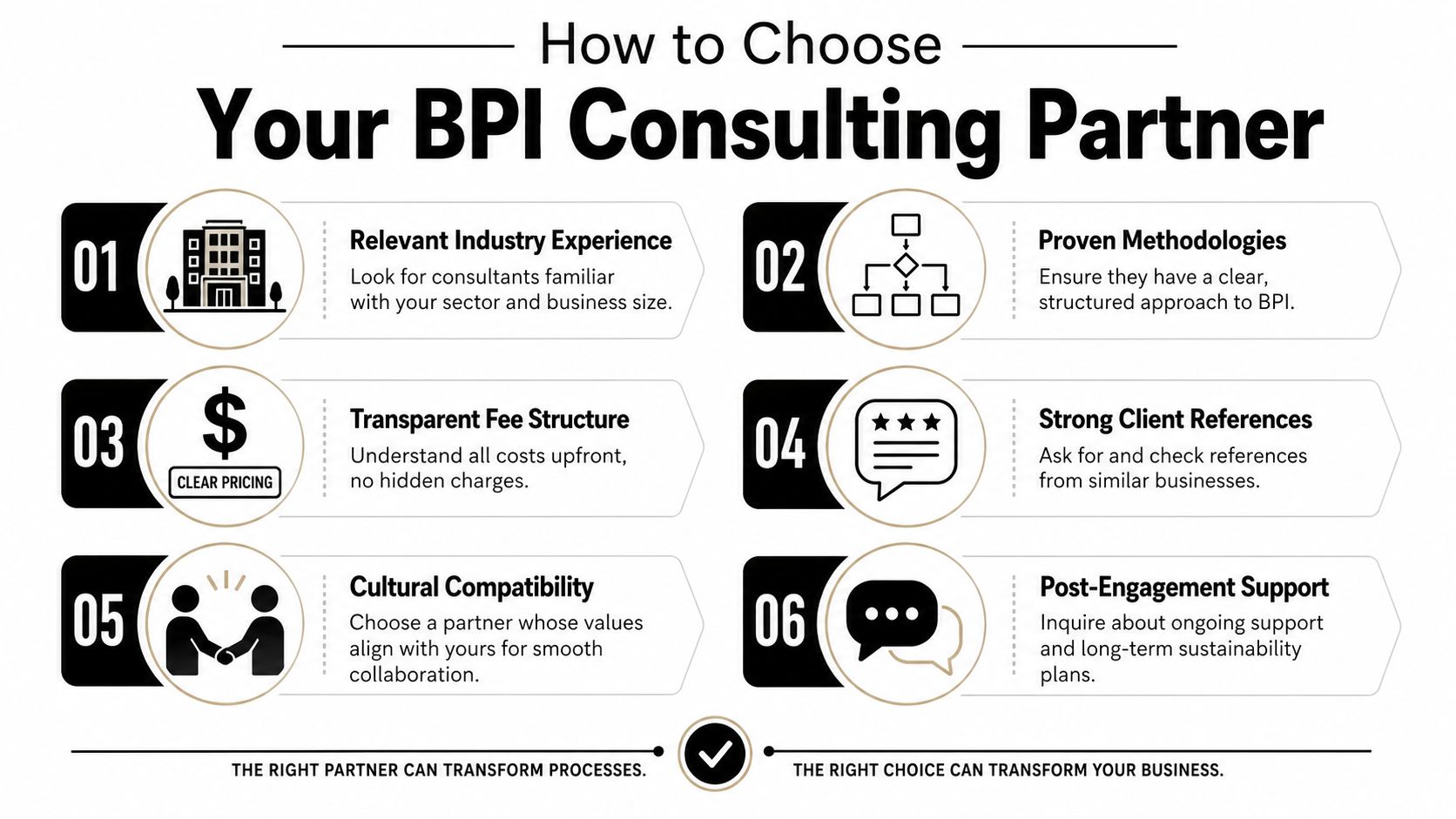
How to Choose Your BPI Consulting Partner
A lot of owners start this search after a bad month. Cash is tighter than it should be, the team is busy, and nobody can explain why profit still feels thin. At that point, a polished proposal is easy to mistake for capability.
The harder question is whether the consultant can connect process changes to financial results you will realize. IBISWorld lists process management and operational improvement work inside Australia's large management consulting field, which is crowded and fragmented enough that branding alone is a weak buying signal. That is exactly why the selection criteria need to be commercial, not cosmetic.
Questions worth asking before you sign
The first meeting should tell you how the consultant thinks. Good operators get specific quickly.
What financial outcomes do you target first? A useful answer includes cash conversion, gross margin leakage, rework cost, debtor timing, stock exposure, or owner time tied up in approvals.
How do you diagnose root causes? Ask how they gather evidence from staff, systems, and reporting, and how they separate symptoms from the process failure causing them.
What happens before automation? Process cleanup should come before software changes. If the conversation jumps straight to tools, you are likely hearing an implementation pitch.
What will my team need to do differently? Real improvement changes decision rights, approval thresholds, handovers, routines, and reporting discipline.
What do your deliverables look like? Ask to see anonymised examples of process maps, SOPs, KPI scorecards, meeting rhythms, and implementation plans.
A useful side reference is this guide on choosing CRO agencies. It covers a different service, but the buying test is similar. Method matters. Evidence matters. Commercial judgment matters most.
What a strong partner does differently
A strong BPI partner will not try to fix everything at once. That sounds thorough, but it usually burns time, creates change fatigue, and delays the gains that actually matter.
The better approach is financial triage. Start with the process failures that are holding cash, eroding margin, or pulling senior people back into work they should have delegated. In practice, that might mean tightening quote approval before redesigning the whole CRM, or fixing job-close information before adding another field app.
That judgment is what owners should pay for.
Look for these signs:
What to look for | Why it matters |
|---|---|
Finance-first thinking | Links each process change to cash flow, margin, and management capacity |
Industry fit | Reduces diagnosis time and avoids theory that does not survive day-to-day operations |
Hands-on implementation | Gets changes adopted in the team, not left in a slide deck |
System literacy | Aligns software with workflow and reporting requirements |
Clear accountability | Leaves process ownership with named people after the consultant exits |
Strong partners also push back when needed. They will tell you when a reporting problem is really a data-entry problem, when an invoicing delay starts in job handover, or when the owner is still the approval bottleneck. That can be uncomfortable. It is also where the value sits.
The right choice is usually the firm that can explain three things in plain language. Where cash is getting trapped. Where margin is leaking through poor execution. What the team will change in the next 30 to 90 days to stop it.
If you want a finance-first view of where your operations are leaking cash, margin, or management time, Nexist helps Australian SMEs map the breakdowns, prioritise fixes, and implement systems that turn workflow changes into stronger cash flow and cleaner execution.
business process improvement consulting, virtual cfo australia, sme operational efficiency, cashflow management, process automation

" width="24px"/><g d="M 0 24.129 L 0 0.129 L 24 0.129 L 24 24.129 Z M 0 24.129 L 0 0.129 L 24 0.129 L 24 24.129 Z M 24 3 C 24 1.344 22.656 0 21 0 L 3 0 C 1.344 0 0 1.344 0 3 L 0 21 C 0 22.656 1.344 24 3 24 L 21 24 C 22.656 24 24 22.656 24 21 Z M 6.883 8.375 L 2.863 8.375 L 2.863 20.467 L 6.883 20.467 Z M 4.899 2.545 C 3.524 2.545 2.625 3.449 2.625 4.634 C 2.625 5.795 3.496 6.724 4.846 6.724 L 4.872 6.724 C 6.273 6.724 7.146 5.795 7.146 4.634 C 7.12 3.449 6.274 2.545 4.899 2.545 Z M 16.747 8.09 C 14.614 8.09 13.659 9.263 13.124 10.086 L 13.124 8.374 L 9.105 8.374 C 9.159 9.508 9.105 20.466 9.105 20.466 L 13.124 20.466 L 13.124 13.713 C 13.124 13.352 13.15 12.99 13.257 12.732 C 13.547 12.01 14.209 11.262 15.319 11.262 C 16.773 11.262 17.355 12.372 17.355 13.996 L 17.355 20.466 L 21.374 20.466 L 21.374 13.532 C 21.374 9.818 19.391 8.09 16.747 8.09 Z" fill="transparent" height="24.12890599668026px" id="dSFdkJotL" width="24px"><path d="M 0 24 L 0 0 L 24 0 L 24 24 Z" fill="transparent" height="24px" id="wscNJE44G" transform="translate(0 0.129)" width="24px"/><g d="M 0 24.129 L 0 0.129 L 24 0.129 L 24 24.129 Z M 24 3 C 24 1.344 22.656 0 21 0 L 3 0 C 1.344 0 0 1.344 0 3 L 0 21 C 0 22.656 1.344 24 3 24 L 21 24 C 22.656 24 24 22.656 24 21 Z M 6.883 8.375 L 2.863 8.375 L 2.863 20.467 L 6.883 20.467 Z M 4.899 2.545 C 3.524 2.545 2.625 3.449 2.625 4.634 C 2.625 5.795 3.496 6.724 4.846 6.724 L 4.872 6.724 C 6.273 6.724 7.146 5.795 7.146 4.634 C 7.12 3.449 6.274 2.545 4.899 2.545 Z M 16.747 8.09 C 14.614 8.09 13.659 9.263 13.124 10.086 L 13.124 8.374 L 9.105 8.374 C 9.159 9.508 9.105 20.466 9.105 20.466 L 13.124 20.466 L 13.124 13.713 C 13.124 13.352 13.15 12.99 13.257 12.732 C 13.547 12.01 14.209 11.262 15.319 11.262 C 16.773 11.262 17.355 12.372 17.355 13.996 L 17.355 20.466 L 21.374 20.466 L 21.374 13.532 C 21.374 9.818 19.391 8.09 16.747 8.09 Z" fill="transparent" height="24.12890599668026px" id="sTpjGo1tb" width="24px"><path d="M 0 24 L 0 0 L 24 0 L 24 24 Z" fill="transparent" height="24px" id="s7ffpmKOD" transform="translate(0 0.129)" width="24px"/><g d="M 24 3 C 24 1.344 22.656 0 21 0 L 3 0 C 1.344 0 0 1.344 0 3 L 0 21 C 0 22.656 1.344 24 3 24 L 21 24 C 22.656 24 24 22.656 24 21 Z M 6.883 8.375 L 2.863 8.375 L 2.863 20.467 L 6.883 20.467 Z M 4.899 2.545 C 3.524 2.545 2.625 3.449 2.625 4.634 C 2.625 5.795 3.496 6.724 4.846 6.724 L 4.872 6.724 C 6.273 6.724 7.146 5.795 7.146 4.634 C 7.12 3.449 6.274 2.545 4.899 2.545 Z M 16.747 8.09 C 14.614 8.09 13.659 9.263 13.124 10.086 L 13.124 8.374 L 9.105 8.374 C 9.159 9.508 9.105 20.466 9.105 20.466 L 13.124 20.466 L 13.124 13.713 C 13.124 13.352 13.15 12.99 13.257 12.732 C 13.547 12.01 14.209 11.262 15.319 11.262 C 16.773 11.262 17.355 12.372 17.355 13.996 L 17.355 20.466 L 21.374 20.466 L 21.374 13.532 C 21.374 9.818 19.391 8.09 16.747 8.09 Z" fill="transparent" height="24.000006px" id="D0ecaHEcW" transform="translate(0 0)" width="24px"><path d="M 24 3 C 24 1.344 22.656 0 21 0 L 3 0 C 1.344 0 0 1.344 0 3 L 0 21 C 0 22.656 1.344 24 3 24 L 21 24 C 22.656 24 24 22.656 24 21 Z" fill="rgb(55, 184, 218)" height="24.000006px" id="IPLFE6zXx" width="24px"/><path d="M 4.02 0 L 0 0 L 0 12.092 L 4.02 12.092 Z" fill="rgb(255, 255, 255)" height="12.09201px" id="FWhtzAyuY" transform="translate(2.863 8.375)" width="4.02px"/><path d="M 2.274 0 C 0.899 0 0 0.904 0 2.089 C 0 3.25 0.871 4.179 2.221 4.179 L 2.247 4.179 C 3.648 4.179 4.521 3.25 4.521 2.089 C 4.495 0.904 3.649 0 2.274 0 Z" fill="rgb(255, 255, 255)" height="4.17876px" id="VmOsKv4kO" transform="translate(2.625 2.545)" width="4.52095px"/><path d="M 7.641 0 C 5.509 0 4.554 1.173 4.019 1.996 L 4.019 0.284 L 0 0.284 C 0.053 1.419 0 12.376 0 12.376 L 4.019 12.376 L 4.019 5.623 C 4.019 5.262 4.045 4.9 4.151 4.642 C 4.442 3.92 5.103 3.172 6.214 3.172 C 7.667 3.172 8.25 4.282 8.25 5.907 L 8.25 12.376 L 12.269 12.376 L 12.269 5.442 C 12.269 1.728 10.286 0 7.641 0 Z" fill="rgb(255, 255, 255)" height="12.37626px" id="n1XUbhaq0" transform="translate(9.105 8.09)" width="12.268830000000001px"/></g></g></g></g></svg>)