What Is Business Advisory: Your Guide to Growth in 2026
What is business advisory - Understand what business advisory is: services, SME benefits, & how it differs from accounting for growth in 2026
Ansh Malhotra

You're probably feeling one of two frustrations right now.
The first is the classic one. Sales look decent, your profit and loss says the business is making money, but the bank account tells a very different story. The second is more personal. You built the business to create freedom, yet you're still approving invoices at night, chasing stock, answering team questions, and making urgent decisions with incomplete numbers.
That's where most founders start asking a version of the same question. What is business advisory, really, and how is it different from the accounting support I already have?
For Australian SMEs, it's not a niche service. It's a practical response to a common problem. Australia has 2.5 million actively trading small businesses, representing 97.2% of all businesses nationally, and for these organisations, advisory services help move the focus from simple compliance to strategic clarity and sustainable growth, as outlined by Daintree Consulting's summary of the ASBFEO 2024 small business landscape.
Table of Contents
Are You a Business Owner or a Business Watchman
A watchman doesn't lead the business. A watchman guards it.
That shows up in familiar ways. You check the bank balance before making ordinary decisions. You know which supplier is late, which staff issue is brewing, which customer still hasn't paid, and which product line is overstocked. You're across everything, but you can't get above anything.
For inventory-heavy businesses, this trap gets worse. Money disappears into stock purchases, freight, discounting, returns, and slow-moving lines. On paper, the business may still look healthy. In practice, the owner becomes the person standing in the middle of a messy system trying to stop leaks by force of will.
What the watchman pattern looks like
You react more than you plan: Decisions happen because a supplier called, a payment bounced, or stock is running low.
You know the issues but not the numbers behind them: You can feel margin pressure, but you can't see which products, channels, or customers are causing it.
You carry too much operational weight: Every problem rises back to the owner because there's no reliable system for finance, reporting, or accountability.
You don't need more visibility alone. You need a way to turn visibility into decisions.
Business advisory earns its keep not as a vague strategy service, and not as a polished report that sits unread. Proper advisory gives an owner an external perspective, sharper financial structure, and a practical roadmap. It helps translate raw business activity into choices about cash, stock, hiring, pricing, debt, timing, and capacity.
The difference is subtle but important. A stressed founder often thinks the problem is workload. Sometimes it is. More often, the problem is that the business has outgrown reactive management.
What changes when advisory is working
A good advisor helps shift the owner from guarding the business to steering it. That usually means clearer forecasts, simpler KPIs, firmer operating rhythms, and fewer decisions made in panic. It also means someone is looking around corners with you, not just documenting what happened last quarter.
For founders who feel trapped in the day-to-day, that's the ultimate answer to what is business advisory. It's a strategic working relationship that helps you stop operating as the business watchman and start acting like its leader.
Beyond the Books From Accountant to Strategic Advisor
Most founders understand what an accountant does. Fewer understand where advisory begins.
The simplest way to think about it is this. The accountant is the scorekeeper. The advisor is the coach. One tells you the result of the game that's already been played. The other helps you decide how to win the next one.
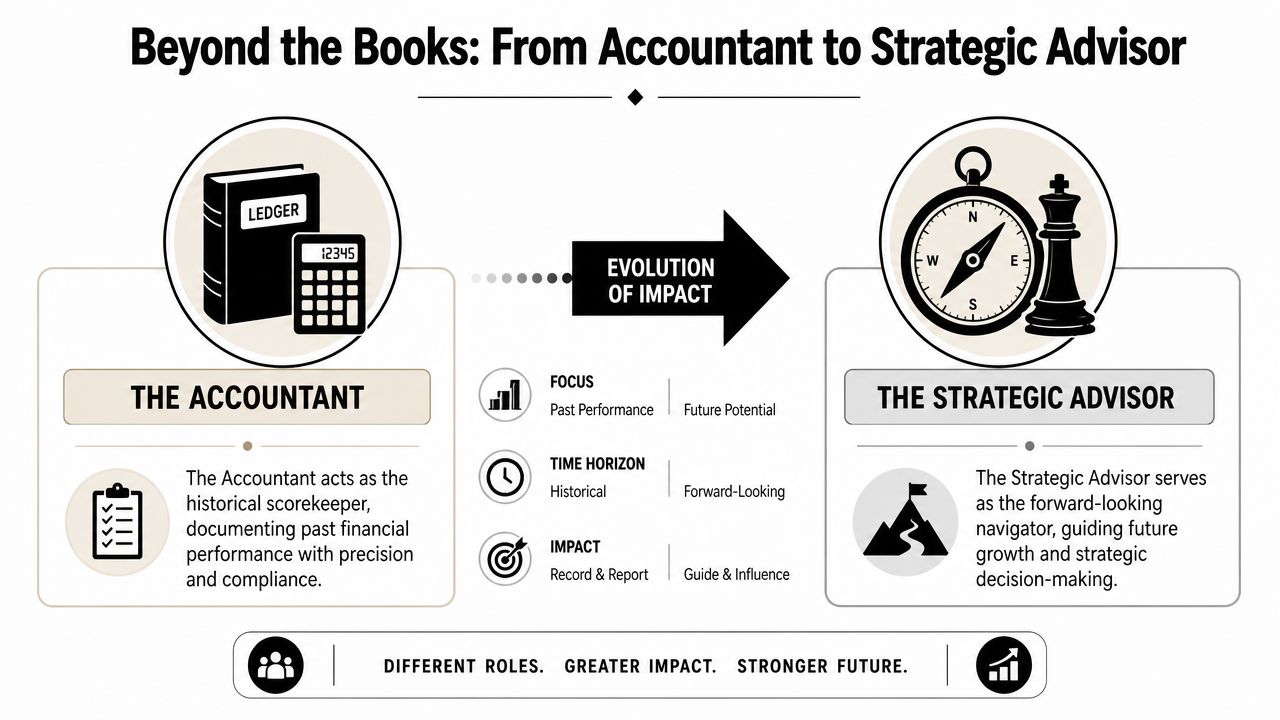
Historical reporting versus forward movement
Traditional accounting work matters. Tax, BAS, statutory reporting, bookkeeping integrity, and year-end accounts are essential. Without them, the foundation is weak.
But compliance work is mostly historical. It records, reconciles, submits, and explains what has already happened.
Business advisory is different. It asks questions like:
What's happening to gross margin by product or channel?
How much cash is trapped in stock that isn't turning?
What does the next quarter look like if receivables slip or supplier costs rise?
Should you hire, raise prices, cut a line, or change reorder points?
That's why advisory is more operational than many people realise. It turns financial data into decisions.
Why this matters for Australian SMEs
The value of this broader guidance is recognised well beyond private firms. The Western Australian Government offers free and confidential support on business planning, financial management, structures, tax, disputes, licensing, and leasing through its small business advisory services program. That tells you something important. Serious business support isn't limited to tax and compliance.
Practical rule: If your finance function only tells you what happened, you're still driving by the rear-view mirror.
Founders also run into a measurement problem. They optimise for the wrong scorecard. In ecommerce, for example, plenty of owners focus on ad platform efficiency while ignoring the question that matters most: did the business keep more money? If you want a clear explanation of that gap, this breakdown of Shopify ad efficiency vs profit is worth reading.
A capable advisor helps connect those dots. Marketing spend, fulfilment costs, returns, inventory holding, and discounting all affect whether “growth” turns into cash.
What advisory looks like in practice
The best advisory relationships aren't theoretical. They usually involve regular check-ins, live forecasting, management reporting, issue prioritisation, and follow-through. Good advisors don't just hand over a dashboard. They help owners interpret it, decide what matters now, and implement the fix.
If you want a more detailed take on where the line sits between these services, this guide on accounting and business advisory is a useful reference.
Business advisory starts where bookkeeping and compliance stop. It's the shift from recording the business to improving it.
What Services Do Business Advisors Actually Provide
Once you move past the definition, most founders want the practical answer. What does an advisor do week to week or month to month?
The answer depends on the business stage, but the core work is usually tied to better decisions, stronger cash control, and less owner dependency. For stock-heavy businesses, that often means the advisor sits at the intersection of finance and operations.
Cash flow and forecasting
Cash flow is usually the first area to fix because it affects every other decision.
A business advisor builds forecasting around reality, not wishful thinking. That includes expected receipts, payment timing, payroll, tax obligations, supplier terms, debt commitments, and planned stock purchases. For a wholesaler or retailer, the forecast also needs to reflect seasonality, reorder cycles, and the lag between buying inventory and collecting cash from customers.
This work matters because many businesses don't fail from lack of sales. They fail from timing.
A useful forecast should help answer questions like these:
Can we place the next purchase order without choking cash?
Which month is tight enough to require action now?
What happens if a major debtor pays late?
Should we clear old inventory before buying deeper into the next range?
KPIs that drive decisions
Not all KPIs are helpful. Some create noise.
The right business advisor narrows reporting down to the handful of indicators that change behaviour. In an inventory-based business, that often means tracking margin quality, stock movement, receivables ageing, purchasing discipline, and channel performance. In a service or trade business, labour efficiency, work in progress, debtor days, and job profitability may matter more.
What works is a small reporting pack reviewed consistently. What doesn't work is a crowded dashboard full of numbers nobody acts on.
For teams that already hold regular planning meetings, a structured quarterly business review process often gives those KPIs somewhere useful to live.
A KPI only matters if someone can act on it this week.
Inventory and supply chain optimisation
Advisory becomes especially valuable for ecommerce, retail, wholesale, and manufacturing operators.
Inventory isn't just a balance sheet item. It's cash sitting on shelves, in containers, in warehouses, or in products that looked promising six months ago. An advisor helps separate healthy stock from dead stock, identify purchasing habits that create cash pressure, and tighten the link between demand, margin, and reorder decisions.
Typical work here includes:
SKU rationalisation: Cutting lines that absorb cash and attention without contributing enough margin.
Reorder discipline: Setting purchasing decisions against demand patterns and cash capacity, not supplier pressure.
Supplier review: Looking at terms, lead times, minimum order quantities, and freight assumptions.
Sell-through analysis: Identifying which products deserve capital and which should be cleared fast.
This is often the fastest way to improve cash position without chasing new revenue.
SOPs and team handoffs
Many businesses don't have a finance problem alone. They have a handoff problem.
Stock arrives but isn't reconciled cleanly. Invoices are raised late. Credits sit unresolved. Returns process badly. Payroll data comes in inconsistently. The owner becomes the glue between departments because nobody has documented the workflow properly.
Advisory often includes building simple SOPs that remove repeat friction. Good SOPs don't add bureaucracy. They stop the same questions and errors from returning every week.
Technology roadmaps and AI enablement
The best advisory today is tech-enabled, not spreadsheet-bound.
That might mean cleaning up your Xero file, connecting reporting apps, introducing approvals, improving inventory software use, automating debtor follow-up, or using AI tools to handle repetitive internal admin. The point isn't to add software for the sake of it. The point is to remove manual work and improve decision speed.
The Australian Government's ASBAS Digital Solutions Round 3 program allocates $25.136 million over five years from 2025 to 2030, with one-to-one advisory sessions priced at $110 including GST. Round 2 supported approximately 12,000 businesses. That scale shows how strongly targeted digital advisory is linked with better digital capability for small businesses.
When founders ask what is business advisory in modern terms, this is the practical answer. It's commercial guidance plus implementation. Numbers, systems, stock, process, and technology working together.
Advisory vs Accounting vs Consulting vs vCFO
These labels get mixed together all the time, and that confusion leads founders to hire the wrong type of help.
Some need compliance support. Some need a specialist for a fixed problem. Some need ongoing financial leadership. Those are not the same engagement.

A quick comparison
Role | Primary focus | Time horizon | Typical output | Relationship style |
|---|---|---|---|---|
Accounting | Historical records, tax, compliance, reconciliations | Periodic and backward-looking | Financial statements, BAS, tax returns, bookkeeping accuracy | Transactional and compliance-focused |
Business advisory | Future decisions, performance improvement, planning | Ongoing and forward-looking | Forecasts, KPIs, action plans, operational priorities | Strategic partnership |
Consulting | Solving a defined business problem | Project-based | Recommendations, project deliverables, specialist advice | Expert brought in for a specific issue |
vCFO | Financial leadership across strategy and operations | Ongoing, strategic and hands-on | Board-style reporting, cash strategy, margin analysis, decision support, implementation oversight | Embedded executive-level support |
The point isn't that one is better than another. It's that each does a different job.
Accounting keeps the records reliable and compliant. Consulting tends to go deep on a narrow issue like pricing, systems selection, supply chain redesign, or market entry. Business advisory sits closer to the owner and helps with recurring decisions across finance and operations.
For a deeper explanation of the vCFO role specifically, this overview of a virtual Chief Financial Officer is useful.
Where a vCFO fits
A virtual CFO is usually the most involved option for a growing SME that's too complex for basic accounting support but not ready for a full-time finance executive.
That role often includes:
Decision support: Helping the owner evaluate hiring, purchasing, debt, pricing, and expansion choices.
Financial rhythm: Running reporting cadences, board packs, monthly reviews, and forecast updates.
Operational follow-through: Working with bookkeepers, payroll, operations staff, and software stacks to make sure the plan happens.
This short video gives a helpful overview of how these support models differ in practice.
A plain way to think about it is this. If an accountant closes the books, and a consultant solves a project, a vCFO helps run the financial engine of the business over time.
That's why founders asking what is business advisory often end up really asking a second question. Do I just need advice, or do I need someone to stay involved until the advice becomes operating reality?
Seven Signs Your Business Needs an Advisor Now
Businesses usually don't seek advisory because they've read a definition. They seek it because something feels off, heavy, or harder than it should be.
The signs below are common across ecommerce, wholesale, manufacturing, trade, and service businesses. If several sound familiar, you likely don't need more hustle. You need a better decision framework.
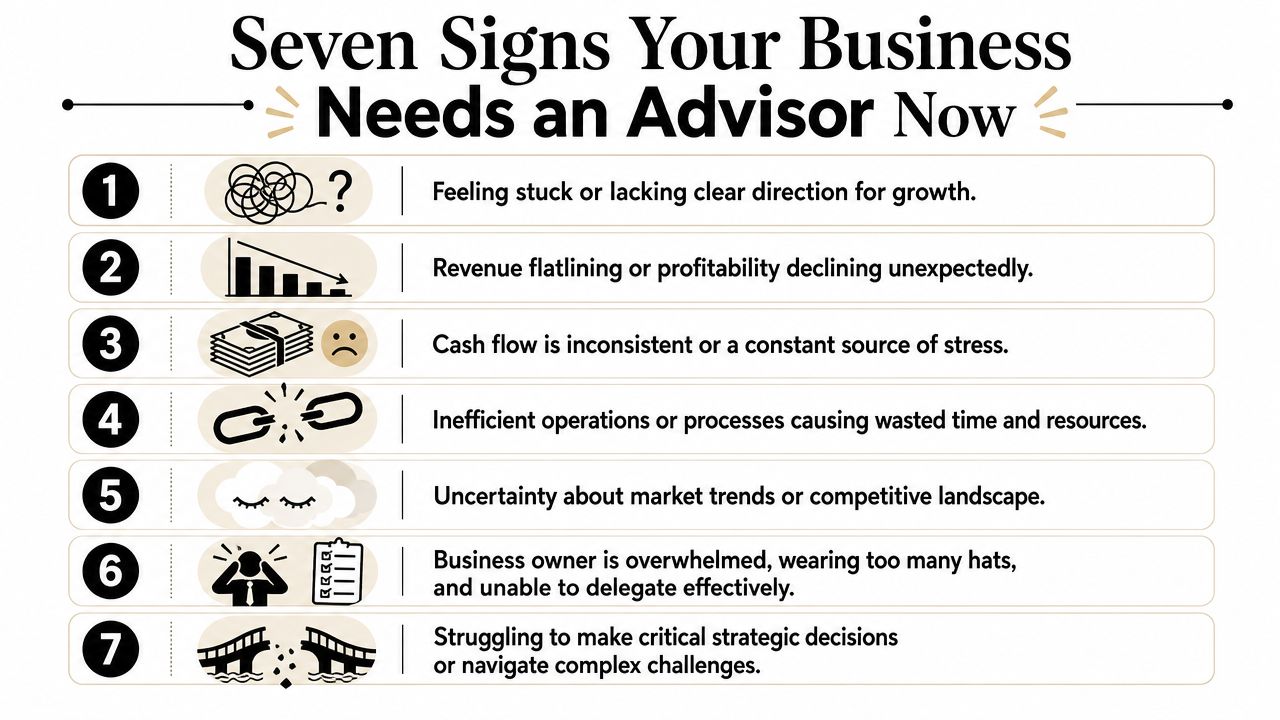
The diagnostic checklist
You're profitable on paper but cash is always tight
This is one of the clearest warning signs. Usually the issue sits in timing, stock, debtors, repayment pressure, or weak margin discipline, not headline sales.Inventory keeps swallowing money
You place purchase orders, receive stock, and still feel under pressure. Slow-moving items, overbuying, poor forecasting, and supplier constraints can lock up working capital.You don't trust the numbers enough to move fast
Reports arrive late, or they're technically correct but commercially useless. If you can't answer basic questions about margin, cash runway, or line-by-line performance, decision-making slows down.
Most owners wait too long because the business is still functioning. Functioning isn't the same as being in control.
You're spending too much time on admin and exception handling
Every week gets filled with approvals, payroll checks, supplier calls, chasing payments, and fixing process misses. That usually signals weak systems rather than a personal productivity issue.Growth is creating stress instead of clarity
More orders and more activity should improve the business. If growth brings confusion, stockouts, margin erosion, and team friction, the operating model hasn't caught up.Big decisions keep getting deferred
Hiring, borrowing, expanding, changing suppliers, raising prices, or exiting a line all require confidence. Owners often delay these choices when they don't have a tested financial view of the trade-offs.You feel stuck in the centre of everything
The business depends on you to interpret problems, join departments together, and make every material call. That's not sustainable leadership. It's owner bottlenecking.
A lot of founders normalise these problems because they've lived with them for so long. They think this is just what business ownership feels like.
It isn't. These are signs the business has become too complex to run on instinct and memory alone.
How to Choose the Right Business Advisor for You
Choosing an advisor isn't about finding the smartest person in the room. It's about finding someone whose way of working matches the reality of your business.
That matters even more if you carry stock, manage supplier complexity, or operate across multiple systems. In those businesses, vague strategy won't help. You need someone who can connect margin, timing, inventory, workflow, and reporting.
Questions worth asking
Start with direct questions. Good advisors should be comfortable answering them plainly.
What kinds of businesses do you work with most often?
Industry familiarity matters. A service business and a stock-based business don't behave the same way.How do you approach cash flow in an inventory-heavy business?
Listen for specifics like purchasing discipline, stock turns, debtor timing, and supplier terms.What does your reporting actually look like each month or quarter?
You want practical reporting, not decorative dashboards.Do you help implement changes, or do you only recommend them?
Some advisors are thinkers. Some are operators. Neither is wrong, but you need to know which one you're hiring.How do you use technology?
Ask about Xero, reporting apps, inventory systems, workflow tools, approvals, and communication methods.How will we communicate between meetings?
If everything has to wait for a formal review, momentum dies.
Why virtual matters in Australia
Location used to be a major constraint. It doesn't need to be now.
According to the IFA report on the regional advice gap, 68% of SME owners in regional areas struggle to access quality financial advice, and the gap is tied to adviser capability rather than just the absence of services. That's why virtual models matter so much. They make it easier to get consistent support through tools like online scorecards, video calls, and direct messaging without needing a local office.
A modern advisor should be easy to reach, commercially literate, and comfortable working remotely without becoming distant.
The right fit often comes down to one simple test. After speaking with them, do you feel you'll get clearer decisions and faster follow-through, or just another layer of commentary?
Your Next Steps to Financial Clarity and Growth
If this article has done its job, you should have a clearer answer to what is business advisory.
It isn't extra accounting. It isn't generic business coaching. It's a practical partnership that helps an owner make better financial and operational decisions before problems harden into stress, cash pressure, or stalled growth.
For many founders, the first useful move isn't a major restructure. It's diagnosis. You need to see where the pressure is really coming from. In stock-heavy businesses, that often means looking at margin leakage, purchasing patterns, aged receivables, workflow friction, and whether the reporting cadence is strong enough to support action.

A practical path forward
A sensible progression usually looks like this:
Get a sharp view of the current business
Look at cash flow pressure points, stock quality, debtors, creditor timing, and reporting blind spots. Don't start with software. Start with the commercial truth.Build a regular operating rhythm
That means forecasts, KPI reviews, decision deadlines, and simple communication channels that stop issues drifting.Strengthen the finance engine over time
Once the basics are stable, you can improve automation, refine purchasing, tighten process, and create room for strategic growth.
Bottom line: Good advisory should leave you with more cash clarity, fewer repeated issues, and more time spent leading instead of reacting.
As part of that work, it often helps to improve how product, sales, and stock data connect to commercial decisions. If that's a current issue in your business, this guide on strategies to maximize revenue offers a useful perspective on using better data and product intelligence to support growth.
The biggest shift is mental as much as financial. You stop asking, “Why does this always feel tight?” and start asking, “Which lever do we pull first?” That's a much better place to run a business from.
If you want that kind of clarity, Nexist helps Australian founders regain control of cash flow, margins, and time through growth accounting and virtual CFO support. The work starts with a practical diagnosis, often through a 30-minute Business Scorecard, then extends into forecasting, KPI reporting, inventory and supply chain optimisation, SOPs, AI-enabled systems, and ongoing access to strategists through WhatsApp. If your business feels profitable but heavy, Nexist can help turn the numbers into action and move you from watchman to leader.
what is business advisory, business advisory services, virtual cfo australia, sme growth, cashflow management

" width="24px"/><g d="M 0 24.129 L 0 0.129 L 24 0.129 L 24 24.129 Z M 0 24.129 L 0 0.129 L 24 0.129 L 24 24.129 Z M 24 3 C 24 1.344 22.656 0 21 0 L 3 0 C 1.344 0 0 1.344 0 3 L 0 21 C 0 22.656 1.344 24 3 24 L 21 24 C 22.656 24 24 22.656 24 21 Z M 6.883 8.375 L 2.863 8.375 L 2.863 20.467 L 6.883 20.467 Z M 4.899 2.545 C 3.524 2.545 2.625 3.449 2.625 4.634 C 2.625 5.795 3.496 6.724 4.846 6.724 L 4.872 6.724 C 6.273 6.724 7.146 5.795 7.146 4.634 C 7.12 3.449 6.274 2.545 4.899 2.545 Z M 16.747 8.09 C 14.614 8.09 13.659 9.263 13.124 10.086 L 13.124 8.374 L 9.105 8.374 C 9.159 9.508 9.105 20.466 9.105 20.466 L 13.124 20.466 L 13.124 13.713 C 13.124 13.352 13.15 12.99 13.257 12.732 C 13.547 12.01 14.209 11.262 15.319 11.262 C 16.773 11.262 17.355 12.372 17.355 13.996 L 17.355 20.466 L 21.374 20.466 L 21.374 13.532 C 21.374 9.818 19.391 8.09 16.747 8.09 Z" fill="transparent" height="24.12890599668026px" id="dSFdkJotL" width="24px"><path d="M 0 24 L 0 0 L 24 0 L 24 24 Z" fill="transparent" height="24px" id="wscNJE44G" transform="translate(0 0.129)" width="24px"/><g d="M 0 24.129 L 0 0.129 L 24 0.129 L 24 24.129 Z M 24 3 C 24 1.344 22.656 0 21 0 L 3 0 C 1.344 0 0 1.344 0 3 L 0 21 C 0 22.656 1.344 24 3 24 L 21 24 C 22.656 24 24 22.656 24 21 Z M 6.883 8.375 L 2.863 8.375 L 2.863 20.467 L 6.883 20.467 Z M 4.899 2.545 C 3.524 2.545 2.625 3.449 2.625 4.634 C 2.625 5.795 3.496 6.724 4.846 6.724 L 4.872 6.724 C 6.273 6.724 7.146 5.795 7.146 4.634 C 7.12 3.449 6.274 2.545 4.899 2.545 Z M 16.747 8.09 C 14.614 8.09 13.659 9.263 13.124 10.086 L 13.124 8.374 L 9.105 8.374 C 9.159 9.508 9.105 20.466 9.105 20.466 L 13.124 20.466 L 13.124 13.713 C 13.124 13.352 13.15 12.99 13.257 12.732 C 13.547 12.01 14.209 11.262 15.319 11.262 C 16.773 11.262 17.355 12.372 17.355 13.996 L 17.355 20.466 L 21.374 20.466 L 21.374 13.532 C 21.374 9.818 19.391 8.09 16.747 8.09 Z" fill="transparent" height="24.12890599668026px" id="sTpjGo1tb" width="24px"><path d="M 0 24 L 0 0 L 24 0 L 24 24 Z" fill="transparent" height="24px" id="s7ffpmKOD" transform="translate(0 0.129)" width="24px"/><g d="M 24 3 C 24 1.344 22.656 0 21 0 L 3 0 C 1.344 0 0 1.344 0 3 L 0 21 C 0 22.656 1.344 24 3 24 L 21 24 C 22.656 24 24 22.656 24 21 Z M 6.883 8.375 L 2.863 8.375 L 2.863 20.467 L 6.883 20.467 Z M 4.899 2.545 C 3.524 2.545 2.625 3.449 2.625 4.634 C 2.625 5.795 3.496 6.724 4.846 6.724 L 4.872 6.724 C 6.273 6.724 7.146 5.795 7.146 4.634 C 7.12 3.449 6.274 2.545 4.899 2.545 Z M 16.747 8.09 C 14.614 8.09 13.659 9.263 13.124 10.086 L 13.124 8.374 L 9.105 8.374 C 9.159 9.508 9.105 20.466 9.105 20.466 L 13.124 20.466 L 13.124 13.713 C 13.124 13.352 13.15 12.99 13.257 12.732 C 13.547 12.01 14.209 11.262 15.319 11.262 C 16.773 11.262 17.355 12.372 17.355 13.996 L 17.355 20.466 L 21.374 20.466 L 21.374 13.532 C 21.374 9.818 19.391 8.09 16.747 8.09 Z" fill="transparent" height="24.000006px" id="D0ecaHEcW" transform="translate(0 0)" width="24px"><path d="M 24 3 C 24 1.344 22.656 0 21 0 L 3 0 C 1.344 0 0 1.344 0 3 L 0 21 C 0 22.656 1.344 24 3 24 L 21 24 C 22.656 24 24 22.656 24 21 Z" fill="rgb(55, 184, 218)" height="24.000006px" id="IPLFE6zXx" width="24px"/><path d="M 4.02 0 L 0 0 L 0 12.092 L 4.02 12.092 Z" fill="rgb(255, 255, 255)" height="12.09201px" id="FWhtzAyuY" transform="translate(2.863 8.375)" width="4.02px"/><path d="M 2.274 0 C 0.899 0 0 0.904 0 2.089 C 0 3.25 0.871 4.179 2.221 4.179 L 2.247 4.179 C 3.648 4.179 4.521 3.25 4.521 2.089 C 4.495 0.904 3.649 0 2.274 0 Z" fill="rgb(255, 255, 255)" height="4.17876px" id="VmOsKv4kO" transform="translate(2.625 2.545)" width="4.52095px"/><path d="M 7.641 0 C 5.509 0 4.554 1.173 4.019 1.996 L 4.019 0.284 L 0 0.284 C 0.053 1.419 0 12.376 0 12.376 L 4.019 12.376 L 4.019 5.623 C 4.019 5.262 4.045 4.9 4.151 4.642 C 4.442 3.92 5.103 3.172 6.214 3.172 C 7.667 3.172 8.25 4.282 8.25 5.907 L 8.25 12.376 L 12.269 12.376 L 12.269 5.442 C 12.269 1.728 10.286 0 7.641 0 Z" fill="rgb(255, 255, 255)" height="12.37626px" id="n1XUbhaq0" transform="translate(9.105 8.09)" width="12.268830000000001px"/></g></g></g></g></svg>)