
Business Process Improvement: Unlock Cash Flow & Save Time
Unlock cash flow & save time with our guide to business process improvement. Identify bottlenecks, automate tasks, & measure what matters.
Ansh Malhotra

You're probably feeling the same drag most SME owners feel when the business is busy but the bank balance doesn't reflect it. Sales are happening, the team is flat out, stock is moving in some lines and sitting in others, and yet you're still chasing overdue invoices at night, approving purchases on your phone, and answering the same operational questions every week.
That's usually the point where people say they need to “be more efficient”. What they need is business process improvement tied directly to financial outcomes. Not cleaner diagrams. Not corporate jargon. Not a giant software rollout that creates more admin than it removes.
If a process change doesn't improve cash flow, protect margin, reduce errors, or free up founder time, it's probably not the right change to do first. That's the finance-first lens. It keeps you out of busywork and focused on the parts of the business that are leaking money every day.
Table of Contents
Why Business Process Improvement Is an SME Survival Tool
Monday starts with three fires. A customer is waiting on a quote that should have gone out Friday. A supplier invoice is higher than expected, but no one picked it up before payment. Two completed jobs still have not been invoiced, so cash that should be in your account is sitting in someone else's.
That is what weak process control looks like in an SME. It rarely arrives as one dramatic failure. It shows up as margin loss, delayed cash, staff workarounds, and an owner who has become the safety net for the whole business.
For a business your size, that is a survival issue, not an admin issue.
McKinsey notes that companies often carry significant performance losses through inefficient processes, duplicated effort, and poor coordination across teams in its work on operating model and process redesign. The financial effect is familiar to any owner. More hours go into the same output. Errors rise. Cash conversion slows. Profit gets squeezed from both sides. McKinsey's operations insights make the broader point, but the impact lands hardest in SMEs because there is less room to absorb waste.
We see this every week. A process problem in a large business creates noise. The same problem in an SME can disrupt payroll timing, force short-term borrowing, or wipe out profit on an otherwise busy month.
What survival looks like in practice
For an ecommerce business, survival often means buying stock with better discipline so cash is not trapped in slow-moving lines.
For a trade business, it usually means tightening the path from completed work to invoice issued to cash collected. If that handoff is loose, revenue can look healthy while the bank balance says otherwise. A stronger accounts receivable management process shortens that gap and gives you more control over working capital.
For a service business, survival often comes down to cleaner scope control, faster approvals, and tighter billing so delivered work turns into collected revenue.
One rule is simple. If you have to personally chase a task every week to make sure it happens, the process is costing you money.
Business process improvement works best when you treat it as a cash protection system. We are not trying to create perfect workflows for their own sake. We are trying to improve the parts of the business that change cash flow, margin, and capacity.
A stronger process can:
Release cash by reducing debtor delays, excess inventory, and duplicate spend
Protect margin by cutting rework, pricing errors, write-offs, and rushed purchasing
Create capacity by removing repetitive admin from skilled staff
Reduce founder dependence so the business can keep moving without you checking every handoff
What usually goes wrong
SME owners often lose time in three places.
They document everything before fixing anything. The team maps workflows for weeks, but the bank balance does not improve.
They buy software too early. The old mess gets digitised, which makes it faster to repeat the same mistakes. Good business process automation strategies only work after the process itself is clear.
They focus on tidy but low-value changes. New templates and dashboards look productive, while the underlying cash leaks stay untouched.
The better approach is harder and more useful. Start with the process that has the biggest financial consequence. Fix the handoffs. Set a clear owner. Measure the result in cash, margin, or time recovered.
That is how process improvement stops being a nice operational goal and becomes a practical tool for staying profitable.
How to Find Your Biggest Process Bottlenecks
Most businesses don't have one big operational problem. They have a cluster of smaller bottlenecks that slow cash conversion and create constant rework. You won't find them by asking, “Where are we inefficient?” That's too broad. You find them by following where money stalls, where time gets wasted, and where people keep inventing workarounds.
Start with a simple lens. Look for bottlenecks in finance, operations, and resource use.

Start where cash gets stuck
Finance teams are usually close to the pain. In Australia, 35% of finance professionals identify poor systems and processes as their primary workflow challenge, while 33% of accounting professionals prioritise automating purchasing and procurement processes as a top initiative, according to IBISWorld's Australian Business Process Outsourcing Services industry data.
That tells you something important. The financial core of the business is often where process friction is easiest to spot and most valuable to fix.
Here are the first questions we'd ask.
Accounts receivable
How long does it take from issuing an invoice to receiving payment?
Where do invoices stall: draft, approval, sending, dispute, or follow-up?
Who owns collection once the invoice is sent?
Accounts payable and purchasing
Who approves spend and how often do invoices arrive with no purchase context?
Are supplier price changes visible before you reorder?
Do purchases happen to a plan, or because someone realised too late that stock or materials were missing?
Inventory
Which items aren't moving and still tie up working capital?
Which fast-moving lines keep going out of stock?
Do reorder decisions rely on data, or on memory and gut feel?
A lot of owners discover that the actual bottleneck isn't one task. It's the handoff between tasks.
When a business says, “We're busy but cash is tight,” the first place to inspect is usually the gap between work completed and cash collected.
Use examples from your own operating model
An ecommerce brand might find its bottleneck in purchasing. Best-sellers reorder late because nobody owns the reorder point. Slow-moving stock keeps arriving because supplier minimums drive the decision instead of margin and velocity.
A trade business often finds leakage in admin flow. The work is done, but job data comes back incomplete, invoices go out late, and collections start too far down the track. If that sounds familiar, tightening your accounts receivable management approach is often one of the fastest ways to improve cash visibility.
A service business usually sees bottlenecks in quoting, scope control, or internal approvals. Teams do extra work that never gets billed because the process for variation approval is vague or ignored.
For owners who want a practical external reference on automation opportunities, this guide to business process automation strategies is useful because it pushes the conversation beyond generic “save time” advice and into specific workflow candidates.
Make a short bottleneck list
Don't try to diagnose the whole business in one sitting. Build a shortlist of problems that are clearly costing money or blocking throughput.
A useful way to do that is a simple table.
Area | Red flag | Financial consequence |
|---|---|---|
Receivables | Invoices go out late or follow-up is inconsistent | Cash arrives later than it should |
Purchasing | Orders are raised reactively | Rush spend, stockouts, margin pressure |
Inventory | Old stock keeps sitting on shelves | Cash trapped in non-performing stock |
Service delivery | Rework or double handling is common | Labour cost rises without added value |
Approvals | Work waits for one person | Delays, bottlenecks, founder dependence |
Once you've got three to five clear bottlenecks, stop diagnosing and move to ranking. That's where most businesses regain traction.
A short explainer can help your team spot the same patterns visually before you start changing anything.
Prioritising Improvements for Maximum Financial Impact
A common SME pattern looks like this. Cash is tight, the team is stretched, and you have a list of obvious process problems. Late invoicing, slow approvals, stock issues, rework, patchy follow-up. Owners often respond by launching fixes across all of them. The result is predictable. Attention gets split, people get frustrated, and very little changes in the numbers.
The better approach is to rank process fixes by financial return.
That means asking one question first. Which change will improve cash flow, margin, or capacity fastest, with the least disruption to the business?
Use impact versus effort
A simple prioritisation grid works well because it forces trade-offs into the open and stops low-value work from crowding out higher-return changes.
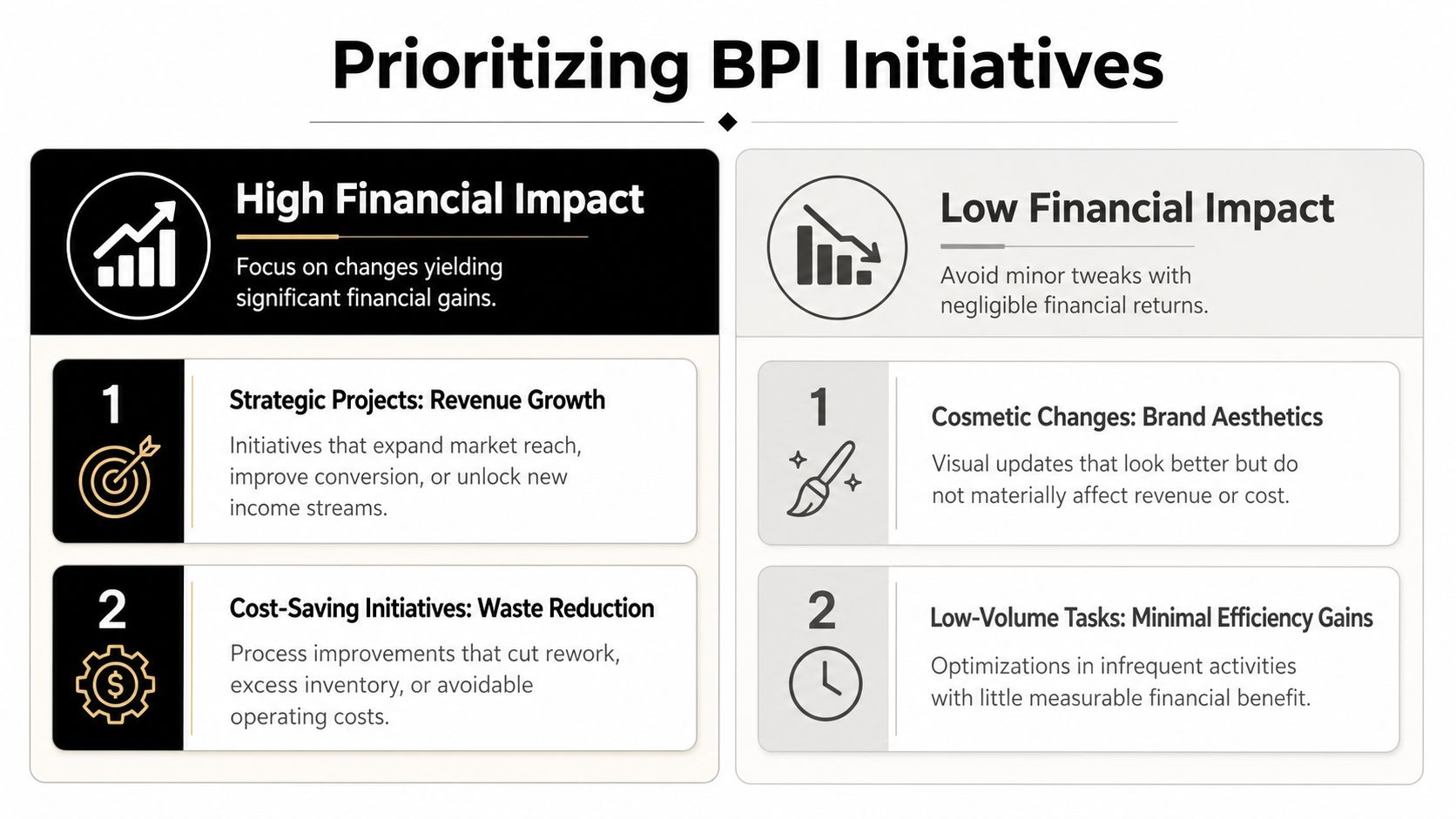
Put each bottleneck into one of four groups.
Quick wins
High financial impact, low effort. Examples include sending invoices on the day work is completed, assigning one owner to debtor follow-up, or tightening routine purchase approvals.Major projects
High financial impact, higher effort. These often include inventory planning changes, system integration, or fixing how job data moves from operations into finance.Fill-ins
Low financial impact, low effort. These jobs are easy to complete, but they rarely shift cash or profit in a meaningful way.Time sinks
Low financial impact, high effort. Leave these alone until a real commercial reason appears.
The trap is obvious once you lay it out. Teams often choose fill-ins because they feel achievable. Owners should choose quick wins first because they release cash and create room to handle bigger fixes.
Score each process by money, speed, and risk
We usually tell clients to rate each candidate improvement against three factors.
Financial upside. Will it bring cash in faster, protect margin, or reduce avoidable labour cost?
Time to benefit. Will you see the result in weeks, or only after a long implementation period?
Execution risk. Does it depend on one person, a system change, or a behaviour shift across the whole team?
A process that scores well on all three should move to the top of the list. A process with vague upside, a long payback period, and heavy change effort should wait.
This is why improving internal templates rarely deserves priority over tightening the cash conversion cycle. One may make work look tidier. The other changes how quickly completed work turns into usable cash.
Ask tougher questions than the team expects
The right first project usually survives a hard finance test.
Will this change shorten the time between doing the work and getting paid?
Will it stop margin leaking through rework, rush orders, write-offs, or missed billables?
Will it free up skilled staff from admin that should never have sat with them in the first place?
Will it reduce founder dependence or remove a single-point approval bottleneck?
If the answer is unclear, the priority is unclear.
In practice, the strongest first moves are often boring. Same-day invoicing. Reorder rules on your top stock lines. Clear approval limits. A single workflow for capturing billable time before it gets missed. These are not exciting projects, but they often produce a faster financial result than larger transformation ideas.
For businesses considering automation, use it where the commercial case is clear. This overview of AI solutions for e-commerce and healthcare is a useful reminder that automation only pays off when it removes a defined cost, delay, or error.
Pick one visible win
Choose one improvement that the team can feel and that finance can measure inside a quarter.
Good first wins include:
getting invoices out the same day work is finished
reducing approval steps for routine supplier purchases
setting reorder points for your highest-value stock items
standardising how billable work is recorded before payroll or month-end
Visible wins matter because they build confidence. When your team sees one process change reduce pressure on cash or cut wasted effort, they are far more likely to support the next change.
Designing and Implementing High-Value Changes
Monday starts with three avoidable problems. A completed job still has not been invoiced. A supplier bill lands that nobody expected. Stock runs short on a line that should have been reordered last week. None of those failures look dramatic in isolation, but each one pushes on cash flow, margin, or both. That is why implementation matters. The right process change should make the business easier to run and financially tighter within weeks, not months.

Build simple SOPs first
Start with the few routines that directly affect cash collection, purchasing control, stock levels, customer delivery, and sign-off authority. In SMEs, a short set of working SOPs beats a polished manual nobody opens.
A useful SOP answers five questions:
who owns the task
what triggers it
what steps happen in order
what good looks like
what gets escalated, and to whom
If a routine process takes pages to explain, there is usually a design problem underneath it. Either too many handoffs exist, or the rule is still unclear.
We see one mistake repeatedly. Owners document the process they wish they had, not the one the team is following. Write down the current process first, including workarounds, approval delays, and duplicate entries. Then remove steps that do not add control or customer value, assign one owner, and set a standard your team can follow on a normal Tuesday, not just in a workshop.
Good SOP candidates include:
Invoice issue process after job completion or delivery
Purchasing workflow including approvals and supplier checks
Stock reorder procedure for fast-moving or margin-critical items
Variation approval flow in service and project businesses
End-of-week cash review covering debtors, payables, and stock pressure
Automate the repetitive work
Automation pays when the rule is clear and the volume is high enough to matter. If the process is inconsistent, software just helps you make the same mistake faster.
For most SMEs, the first target is not advanced AI. It is repetitive admin that delays billing, creates rework, or ties up capable staff in low-value tasks. That can include invoice reminders, purchase approvals, status notifications, form capture, or task creation after a quote is accepted.
Examples that usually make financial sense early:
Invoice reminders triggered on due date and overdue intervals
Data entry capture from forms, emails, or standardised documents
Purchase approval routing based on supplier, amount, or category
Customer update notifications when a status changes
Task creation after a quote is accepted or stock hits a reorder threshold
For businesses exploring sector-specific automation use cases, this overview of AI solutions for e-commerce and healthcare is a useful reference point because it shows how automation can be applied to real operational flows rather than abstract AI talk.
If you want a broader operating view before choosing tools, this guide on automating business processes is a practical companion.
Automate routine work first. Leave exceptions and judgment calls with people until the underlying rule is stable.
Fix the financial handoffs
The highest-value improvements usually sit where operations and finance meet. That is where a missed step turns into slower cash collection, extra spend, or margin leakage.
A few design choices have an outsized effect:
Process area | Better design choice | Likely result |
|---|---|---|
Job completion to invoicing | Trigger invoice preparation from completed job data | Faster billing and fewer missed charges |
Purchasing | Require purchase context before supplier spend is approved | Better cost visibility and fewer surprise invoices |
Inventory | Set reorder logic by movement and margin, not guesswork | Less trapped cash and fewer stockouts |
Accounts payable | Batch routine payment reviews with clear due-date visibility | Better cash planning and fewer rushed decisions |
For stock-heavy businesses, discipline usually creates the first gain. Reorder points should reflect movement, lead time, and margin contribution. Aged stock needs regular review because old inventory ties up cash long after the buying decision is forgotten.
For service and trade businesses, speed matters more. Capture work completed on the day, approve variations while the detail is still clear, and invoice as close to delivery as possible. A one-day delay repeated across dozens of jobs becomes a working capital problem.
Use structure, not enthusiasm
Improvement work drifts when nobody follows a method. A simple framework keeps the team focused on commercial results instead of activity.
DMAIC is a practical structure for this. Define the problem clearly. Measure the current baseline. Analyse the cause of the delay, error, or cost. Improve the process. Control it so the old habit does not return. The framework comes from Six Sigma practice and is outlined by the American Society for Quality's overview of DMAIC.
The last step is where many changes fail. A process can look fixed for two weeks because everyone is paying attention. Then pressure returns, shortcuts creep back in, and the financial benefit disappears. Set an owner, review date, and a small set of checks from the start so the gain stays real.
Measuring Success with Finance-First KPIs
A process has not improved because the team likes the new workflow or because a system went live on time. It has improved when cash comes in faster, margin holds up better, or operating cost drops without creating new risk.
That is the standard we use with SME owners. If a change cannot be tied to stronger cash flow, better profitability, or tighter control, it is still an operational idea, not a business result.
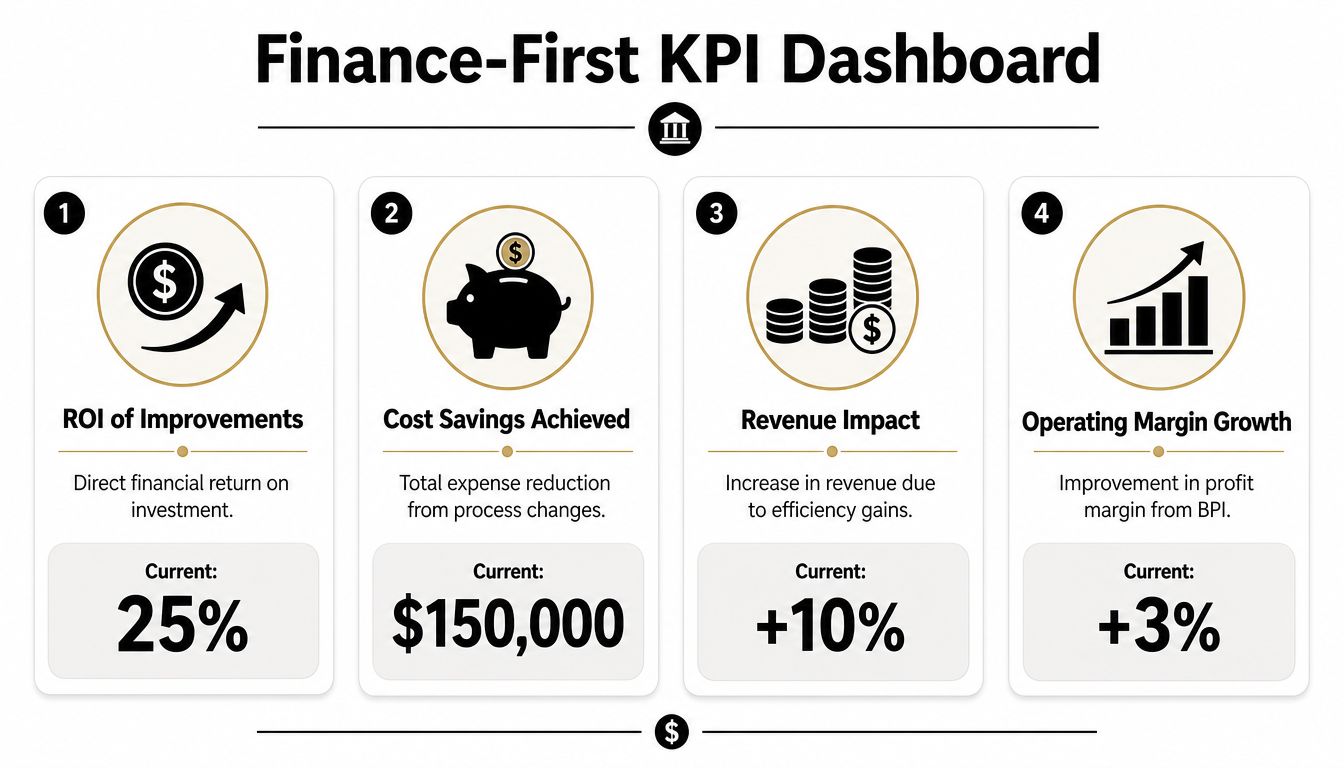
Measure financial outcomes, not completed tasks
Activity metrics have a place, but they sit underneath the numbers that affect the bank balance.
“Invoices sent” shows output. It does not show whether you collected cash sooner. Debtor days does. “Orders processed” shows throughput. It does not show whether margin improved or whether rework fell. A good KPI closes that gap between effort and financial effect.
A few examples make the difference clearer:
Invoices sent becomes Days Sales Outstanding, because speed of collection matters more than document volume.
Inventory accuracy becomes Gross Margin Return on Inventory, because stock should produce profit, not just sit there correctly counted.
Tasks automated becomes labour cost saved, capacity created, or error reduction, because software only pays off if it changes the economics.
Purchase order volume becomes purchasing cost as a percentage of revenue or margin, because buying more efficiently matters more than buying more often.
If a KPI does not help you decide where cash is tied up or where profit is leaking, it should not lead the discussion.
Keep the dashboard small enough to use
SMEs do not need a long KPI pack that nobody reads after the first month. A short dashboard reviewed consistently beats a thick report ignored under pressure.
In practice, five to seven finance-first KPIs are usually enough. They should reflect how your business turns work into cash and profit.
KPI | What it tells you | Basic calculation |
|---|---|---|
Days Sales Outstanding | How long customers take to pay | Accounts receivable divided by average daily credit sales |
Gross margin | Whether pricing and delivery are producing enough profit | Revenue minus direct costs, expressed as a percentage of revenue |
Gross Margin Return on Inventory | Whether stock is generating enough gross profit | Gross margin divided by average inventory cost |
Operating margin | Whether the business keeps enough after operating costs | Operating profit divided by revenue |
Cash conversion cycle | How quickly cash moves through stock, debtors, and payables | Debtor days plus inventory days minus payable days |
Consistency matters more than perfect reporting in month one. Use the same definitions each month, assign an owner to each metric, and review the trend against the process change you made. Otherwise, the team ends up debating the numbers instead of acting on them.
That discipline also supports the control step discussed earlier in DMAIC. If you cannot see whether cycle time, cost, or cash performance stayed improved, the process can slide back without anyone calling it out.
Review the economics monthly
A monthly review should be short and commercial. We want to know whether the process change paid for itself and whether the gain held under normal operating pressure.
Use questions like these:
Did cash arrive faster?
Did margin improve or at least stay protected?
Did rework, write-offs, credits, or admin hours fall?
Did the change reduce reliance on one owner or one key staff member?
Did the process stay in place, or did old habits return?
One trade-off matters here. Not every useful metric belongs on the main dashboard. Customer acquisition cost, utilisation, and conversion rate can all matter. But if your immediate problem is slow collections, stock tying up cash, or margin erosion, those should take priority. We focus first on the numbers that change business health now.
From Watchman to Visionary Your Next Steps
The payoff from business process improvement isn't a tidier workflow. It's that the business stops depending on your constant supervision to function properly.
Owners often become the watchman because nobody trusts the system. The team asks before acting. Problems bounce upward. Every missed invoice, late purchase, or stock issue finds its way back to the founder. That's exhausting, and it limits growth because the person who should be thinking ahead is stuck policing the basics.
Build a review rhythm
Good processes don't stay good by accident. They stay good because someone reviews them on a cadence.
That review rhythm doesn't need to be elaborate. It does need to be regular.
Weekly: Check urgent operational metrics such as overdue invoices, stock exceptions, or approval backlogs.
Monthly: Review finance-first KPIs and decide whether the change is improving cash and margin.
Quarterly: Re-rank bottlenecks. The next constraint usually appears once the current one is removed.
A lot of businesses lose gains because they treat improvement like a one-off project. It works better as a management habit.
Get the team involved early
The people doing the work usually know where the friction sits. They know where information goes missing, where approvals slow down, and where customers get impacted first. If they help shape the fix, adoption is easier and the process is more realistic.
That doesn't mean every process change should be debated endlessly. It means the people closest to the workflow should help identify failure points and test the new version before it becomes the standard.
A process sticks when ownership is clear, the steps are simple, and the team understands why the change matters financially.
The shift from watchman to visionary happens when you can rely on numbers, routines, and ownership instead of memory and heroics. You stop chasing every issue by hand. You start seeing where cash is tightening before it becomes a problem. You spend more time on pricing, planning, growth, and leadership.
That's the point of all this. Better process isn't just cleaner operations. It's a business that gives the owner room to think again.
If you want a clearer view of where your cash is getting stuck and which process fixes will matter most, Nexist offers a 30-minute Business Scorecard built for Australian founders. It's a practical starting point to identify cash leaks, prioritise improvements, and build the finance-first systems that give you more control over margin, cash flow, and time.
business process improvement, sme growth, cash flow management, process automation, virtual cfo

" width="24px"/><g d="M 0 24.129 L 0 0.129 L 24 0.129 L 24 24.129 Z M 0 24.129 L 0 0.129 L 24 0.129 L 24 24.129 Z M 24 3 C 24 1.344 22.656 0 21 0 L 3 0 C 1.344 0 0 1.344 0 3 L 0 21 C 0 22.656 1.344 24 3 24 L 21 24 C 22.656 24 24 22.656 24 21 Z M 6.883 8.375 L 2.863 8.375 L 2.863 20.467 L 6.883 20.467 Z M 4.899 2.545 C 3.524 2.545 2.625 3.449 2.625 4.634 C 2.625 5.795 3.496 6.724 4.846 6.724 L 4.872 6.724 C 6.273 6.724 7.146 5.795 7.146 4.634 C 7.12 3.449 6.274 2.545 4.899 2.545 Z M 16.747 8.09 C 14.614 8.09 13.659 9.263 13.124 10.086 L 13.124 8.374 L 9.105 8.374 C 9.159 9.508 9.105 20.466 9.105 20.466 L 13.124 20.466 L 13.124 13.713 C 13.124 13.352 13.15 12.99 13.257 12.732 C 13.547 12.01 14.209 11.262 15.319 11.262 C 16.773 11.262 17.355 12.372 17.355 13.996 L 17.355 20.466 L 21.374 20.466 L 21.374 13.532 C 21.374 9.818 19.391 8.09 16.747 8.09 Z" fill="transparent" height="24.12890599668026px" id="dSFdkJotL" width="24px"><path d="M 0 24 L 0 0 L 24 0 L 24 24 Z" fill="transparent" height="24px" id="wscNJE44G" transform="translate(0 0.129)" width="24px"/><g d="M 0 24.129 L 0 0.129 L 24 0.129 L 24 24.129 Z M 24 3 C 24 1.344 22.656 0 21 0 L 3 0 C 1.344 0 0 1.344 0 3 L 0 21 C 0 22.656 1.344 24 3 24 L 21 24 C 22.656 24 24 22.656 24 21 Z M 6.883 8.375 L 2.863 8.375 L 2.863 20.467 L 6.883 20.467 Z M 4.899 2.545 C 3.524 2.545 2.625 3.449 2.625 4.634 C 2.625 5.795 3.496 6.724 4.846 6.724 L 4.872 6.724 C 6.273 6.724 7.146 5.795 7.146 4.634 C 7.12 3.449 6.274 2.545 4.899 2.545 Z M 16.747 8.09 C 14.614 8.09 13.659 9.263 13.124 10.086 L 13.124 8.374 L 9.105 8.374 C 9.159 9.508 9.105 20.466 9.105 20.466 L 13.124 20.466 L 13.124 13.713 C 13.124 13.352 13.15 12.99 13.257 12.732 C 13.547 12.01 14.209 11.262 15.319 11.262 C 16.773 11.262 17.355 12.372 17.355 13.996 L 17.355 20.466 L 21.374 20.466 L 21.374 13.532 C 21.374 9.818 19.391 8.09 16.747 8.09 Z" fill="transparent" height="24.12890599668026px" id="sTpjGo1tb" width="24px"><path d="M 0 24 L 0 0 L 24 0 L 24 24 Z" fill="transparent" height="24px" id="s7ffpmKOD" transform="translate(0 0.129)" width="24px"/><g d="M 24 3 C 24 1.344 22.656 0 21 0 L 3 0 C 1.344 0 0 1.344 0 3 L 0 21 C 0 22.656 1.344 24 3 24 L 21 24 C 22.656 24 24 22.656 24 21 Z M 6.883 8.375 L 2.863 8.375 L 2.863 20.467 L 6.883 20.467 Z M 4.899 2.545 C 3.524 2.545 2.625 3.449 2.625 4.634 C 2.625 5.795 3.496 6.724 4.846 6.724 L 4.872 6.724 C 6.273 6.724 7.146 5.795 7.146 4.634 C 7.12 3.449 6.274 2.545 4.899 2.545 Z M 16.747 8.09 C 14.614 8.09 13.659 9.263 13.124 10.086 L 13.124 8.374 L 9.105 8.374 C 9.159 9.508 9.105 20.466 9.105 20.466 L 13.124 20.466 L 13.124 13.713 C 13.124 13.352 13.15 12.99 13.257 12.732 C 13.547 12.01 14.209 11.262 15.319 11.262 C 16.773 11.262 17.355 12.372 17.355 13.996 L 17.355 20.466 L 21.374 20.466 L 21.374 13.532 C 21.374 9.818 19.391 8.09 16.747 8.09 Z" fill="transparent" height="24.000006px" id="D0ecaHEcW" transform="translate(0 0)" width="24px"><path d="M 24 3 C 24 1.344 22.656 0 21 0 L 3 0 C 1.344 0 0 1.344 0 3 L 0 21 C 0 22.656 1.344 24 3 24 L 21 24 C 22.656 24 24 22.656 24 21 Z" fill="rgb(55, 184, 218)" height="24.000006px" id="IPLFE6zXx" width="24px"/><path d="M 4.02 0 L 0 0 L 0 12.092 L 4.02 12.092 Z" fill="rgb(255, 255, 255)" height="12.09201px" id="FWhtzAyuY" transform="translate(2.863 8.375)" width="4.02px"/><path d="M 2.274 0 C 0.899 0 0 0.904 0 2.089 C 0 3.25 0.871 4.179 2.221 4.179 L 2.247 4.179 C 3.648 4.179 4.521 3.25 4.521 2.089 C 4.495 0.904 3.649 0 2.274 0 Z" fill="rgb(255, 255, 255)" height="4.17876px" id="VmOsKv4kO" transform="translate(2.625 2.545)" width="4.52095px"/><path d="M 7.641 0 C 5.509 0 4.554 1.173 4.019 1.996 L 4.019 0.284 L 0 0.284 C 0.053 1.419 0 12.376 0 12.376 L 4.019 12.376 L 4.019 5.623 C 4.019 5.262 4.045 4.9 4.151 4.642 C 4.442 3.92 5.103 3.172 6.214 3.172 C 7.667 3.172 8.25 4.282 8.25 5.907 L 8.25 12.376 L 12.269 12.376 L 12.269 5.442 C 12.269 1.728 10.286 0 7.641 0 Z" fill="rgb(255, 255, 255)" height="12.37626px" id="n1XUbhaq0" transform="translate(9.105 8.09)" width="12.268830000000001px"/></g></g></g></g></svg>)