What Is Accounts Payable? a Guide for Australian SMEs
Confused about what is accounts payable? Our guide for Australian SMEs explains the AP process, its impact on cash flow, and how to optimise it for profit.
Ansh Malhotra

You open your banking app, see cash is tighter than expected, then glance at the invoice inbox and realise half the problem is sitting there waiting for approval. Supplier bills are due. Stock has already arrived. A few invoices are probably duplicated in someone's email. One vendor is chasing payment. Another will hold the next order if you don't settle soon.
That's the daily reality for a lot of Australian founders. Accounts payable looks administrative from the outside, but it has a direct effect on cash in the bank, supplier trust, and how much headspace you have left for pricing, sales, and operations.
In practical terms, accounts payable is the money your business owes suppliers for goods or services already received but not yet paid. It matters more than many founders think. For Australian SMEs, accounts payable typically makes up 15% to 25% of total liabilities, which means that for every $1 million in liabilities, $150,000 to $250,000 can sit in unpaid supplier bills that need to be managed within typical 30- to 90-day terms, according to ScaleSuite's overview of accounts payable management.
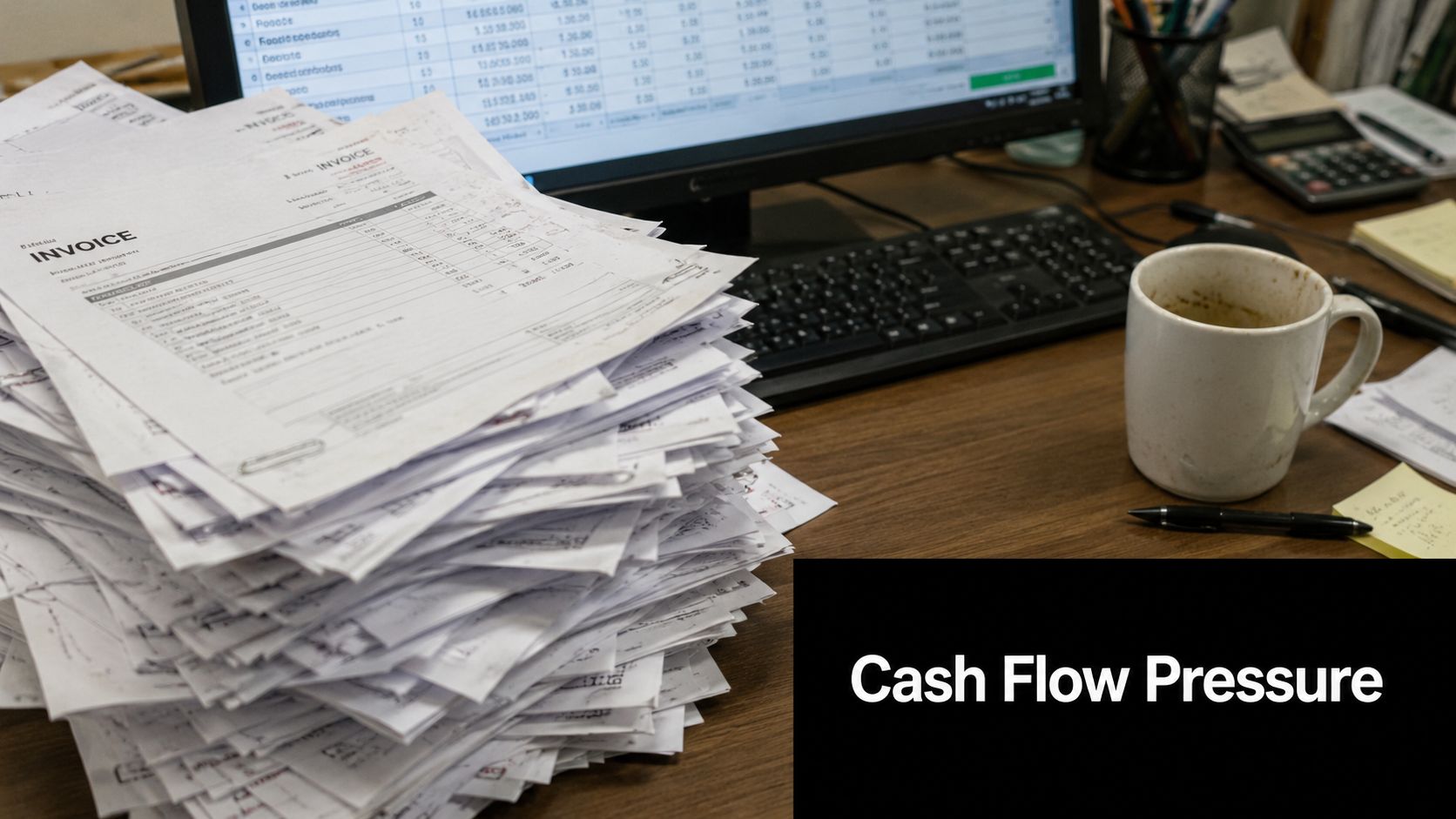
If you're asking what is accounts payable, the useful answer isn't a textbook definition. It's this: AP is the control point between buying something and losing cash. Run it badly, and you get cash leaks, strained suppliers, and hours of founder cleanup. Run it well, and you gain breathing room.
Table of Contents
Introduction The Unpaid Bill Pile and Your Cash Flow
Founders usually notice AP when the pressure builds. The inbox is full of PDFs. A supplier statement doesn't match your records. Someone in the team asks whether a bill has been approved, and nobody's sure. Cash feels tight, but you also know delaying the wrong payment could create a bigger problem next week.
That's why AP shouldn't sit in the mental bucket marked admin. It's one of the main places where your working capital gets decided in real time. Every invoice forces a choice about timing, control, and trade-offs.
Why founders feel AP pressure so quickly
If your business buys stock, materials, freight, contractors, software, or services on terms, AP is already shaping your cash flow. You may be profitable on paper and still feel squeezed because supplier payments come due before cash has cleared elsewhere in the business.
A simple way to think about it is this:
Business event | What it means operationally | What it means for cash |
|---|---|---|
Stock or service arrives | You can trade or use it | Cash hasn't left yet |
Supplier invoice lands | Obligation becomes clearer | Payment clock starts |
Bill gets approved late | Team loses visibility | You make rushed decisions |
Payment goes out | Liability clears | Bank balance drops |
Practical rule: AP is not about paying everything as fast as possible. It's about paying the right amount, to the right supplier, at the right time, with clear records.
Why this matters beyond bookkeeping
Poor AP creates two kinds of damage. The obvious damage is late fees, duplicate payments, and supplier friction. The less obvious damage is time. Founders end up acting as the final approval layer, dispute resolver, and part-time accounts clerk.
Good AP gives you control over timing. It also gives you confidence. You know what's due, what can wait, what needs review, and what should never have entered the system in the first place.
That shift matters because cash pressure rarely comes from one giant mistake. It usually comes from a pile of small, avoidable errors in how bills are received, checked, approved, and paid.
Defining Accounts Payable in Plain English
If you want the plain-English version of what is accounts payable, it's this: money your business owes to suppliers. You've already received the goods or services. You just haven't paid for them yet.
That sounds simple, but the confusion starts because founders often lump AP into “bookkeeping” and move on. In reality, AP sits at the point where operations, finance, and compliance meet.
Think of AP like your household bills, scaled up
Think about your personal life. You receive an electricity bill, a phone bill, and a mortgage or rent payment. You don't pay them blindly. You check the amount, make sure it's legitimate, and decide when it should leave your account.
Business AP works the same way, only with more moving parts. Instead of one streaming subscription, you might have freight providers, packaging suppliers, ad platforms, software tools, wholesalers, and contractors. Some bills recur. Some are one-off. Some should match a purchase order. Some need manager approval first.
If you want a simple glossary-style explanation, BookkeepDIY explains accounts payable in a straightforward way that's useful for founders who want the basics without finance jargon.
The basic terms founders should know
A few terms matter because they affect how AP works day to day:
Invoice means the supplier's bill. It tells you what you're being charged for and when payment is due.
Vendor or supplier means the business you owe. Different software platforms use different labels, but they mean the same thing in practice.
Purchase order means the document created before buying. It records what was ordered, from whom, and often at what price.
Credit terms mean how long you have to pay. In everyday language, this is your payment window.
Accounts receivable is the opposite side of the coin. AP is money you owe. AR is money customers owe you.
The cleanest way to remember it is this. Payable points out. Receivable points in.
Founders often underestimate how much confusion comes from mixing AP and AR decisions together. If your team is chasing overdue customer payments while also paying supplier invoices with no clear priority, cash gets pinched from both sides.
A disciplined finance function treats AP as a controlled queue, not a pile. Once you see it that way, the rest of the workflow gets much easier to organise.
The Core Accounts Payable Workflow Step by Step
A solid AP process follows a simple logic. Something is requested, ordered, received, billed, checked, approved, paid, and recorded. When any of those stages are missing, errors creep in.
In Australia, AP also has a compliance layer. Indeed's explanation of accounts payable in Australia notes that AP sits on the balance sheet as a current liability, and the local procure-to-pay flow includes a mandatory step of validating the 10% GST on supplier invoices. When an invoice is received, the AP balance increases as a credit entry and reduces net working capital until payment is made.
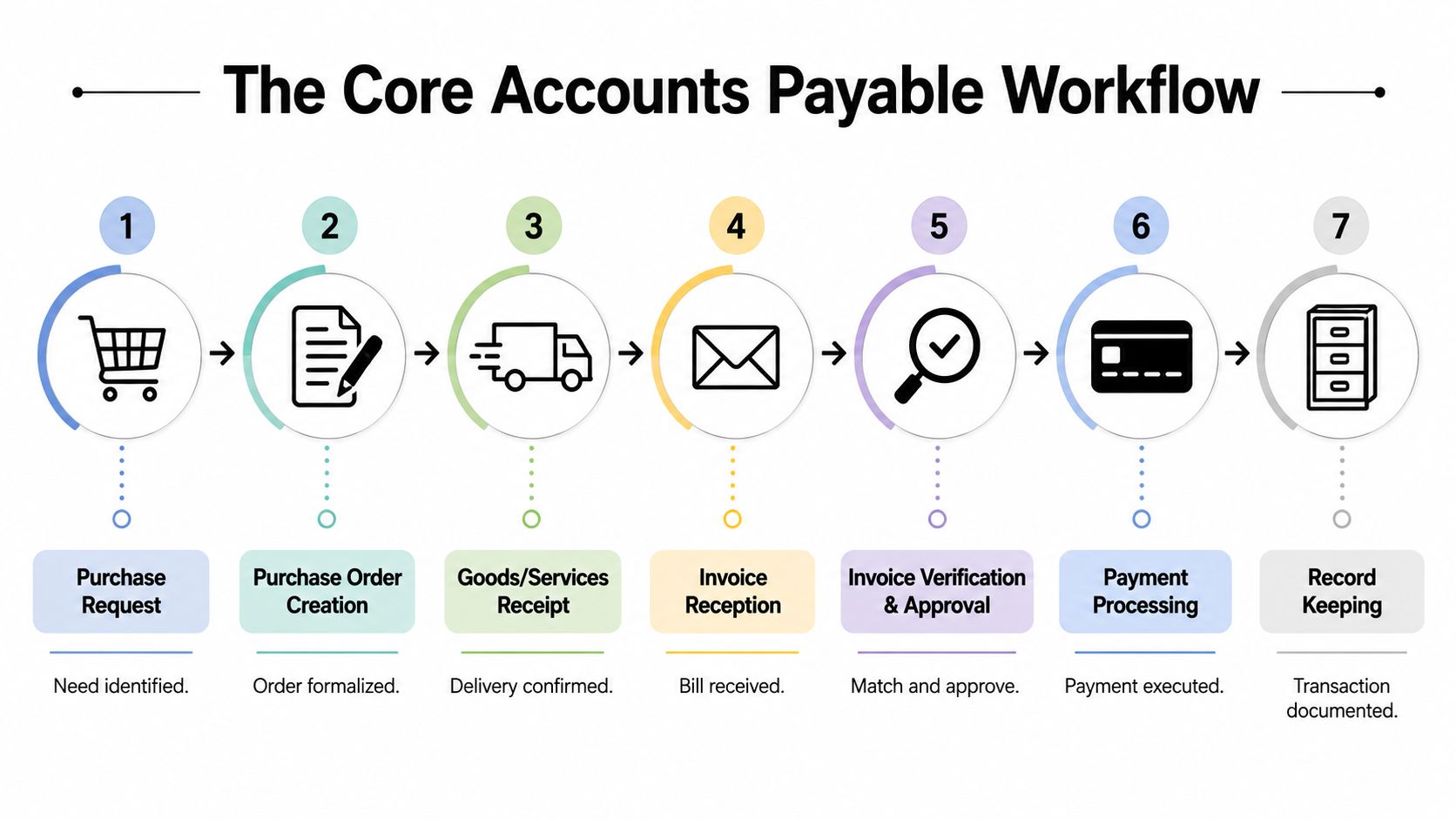
From purchase request to invoice receipt
Most healthy AP workflows start before the invoice appears.
Purchase request
Someone in the business identifies a need. It could be stock, raw materials, software, or a contractor.Purchase order creation
The order gets formalised. This matters because it sets expectations around supplier, quantity, and price.Goods or services receipt
The team confirms that what was ordered was delivered. Many small businesses cut corners, then struggle later when an invoice doesn't match reality.Invoice reception
The bill arrives by email, supplier portal, or accounting inbox. At this point, the invoice becomes something that needs checking, not just paying.
Verification, approval, payment and record keeping
The second half of AP is where control either exists or falls apart.
Verification and coding
The invoice should be checked against what was ordered and what was received. It also needs to be coded to the right account in your chart of accounts. If GST applies, that treatment needs proper validation.Approval routing
The right person approves the spend. In small businesses, that might be the owner for too many invoices. In a healthier setup, routine bills follow clear approval rules and only exceptions rise to founder level.Payment processing
Once approved, payment is scheduled through the bank and pushed through the accounting system. This is the point where the liability gets cleared.Record keeping and reconciliation
The transaction has to land correctly in Xero, MYOB, NetSuite, or your ERP. The supplier ledger should agree with what was paid, and any differences should be resolved quickly.
A founder doesn't need to perform each step personally. But a founder does need to know whether each step exists. If you can't answer where invoices land, who approves them, how coding is reviewed, or how duplicates are prevented, your AP process isn't a process. It's a habit.
Why AP Is a Secret Weapon for Cash Flow and Margins
A lot of businesses treat AP as a back-office task because the work looks repetitive. The effect isn't repetitive at all. AP shapes how long cash stays in your business, how reliable your supplier relationships are, and how much management time gets pulled into low-value work.
AP shapes your working capital every week
Every unpaid supplier bill is a timing decision. Pay too early across the board and you starve the business of useful cash. Pay too late without a plan and you train suppliers not to trust you. The skill is in controlling timing without losing credibility.
That's why the common advice to “always pay on time” is incomplete. Good AP means knowing which payments must go immediately, which should follow normal terms, and which need to be negotiated because cash is tight. The discipline sits in visibility and communication.
Here's where founders often improve results quickly:
Group payments intentionally so cash leaves in planned windows rather than in random bursts.
Escalate critical suppliers such as key stock, freight, or manufacturing partners before they become a problem.
Use payment timing as a lever within agreed terms, instead of reacting to whichever invoice gets shouted about most loudly.
Businesses don't get into trouble because one invoice exists. They get into trouble because nobody can see the full queue and rank what matters.
If you're tightening this side of the business, it's worth pairing AP discipline with stronger debtor control as well. Nexist's guide to accounts receivable management is useful because payables and receivables work as a system, not as separate admin tasks.
Inventory businesses feel bad AP twice
For inventory-heavy businesses, weak AP is especially painful because the cash is already tied up elsewhere. Monite's discussion of AP and AR pressure for SMBs points to a double bind. Manual AP takes over 4 hours weekly, and 38% of Australian accountants identify manual invoice processing as a bottleneck. That's time not spent on inventory optimisation, pricing decisions, or clearing slow-moving stock.
That trade-off matters in retail, ecommerce, wholesale, and manufacturing. If your margin is trapped in stock, every hour spent chasing invoice approvals is an hour not spent fixing the thing holding back cash conversion.
Founders often ask where hidden cash sits. A big part of the answer is operational attention. AP may not look strategic, but it determines whether your team spends its week on supplier admin or on the decisions that free cash from stock.
Common AP Problems That Bleed Your Business Dry
Bad AP rarely announces itself with one dramatic failure. It usually shows up as friction. A payment gets missed. A statement doesn't reconcile. The owner gets copied into a supplier complaint. Someone pays an invoice twice because the first payment wasn't logged clearly.
Those issues seem small until they become a pattern.

Where the leaks usually start
In SMEs, the same AP mistakes appear again and again:
Late approvals create rushed payments. The bill may have arrived on time, but it sat in an inbox waiting for someone senior to notice it.
Duplicate invoices slip through when there's no single source of truth. One copy lives in email, another in the accounting system.
Weak supplier controls make fraud and simple errors easier. If nobody checks bank details or invoice history carefully, the business carries the risk.
Poor visibility means the founder can't tell what's due, what's disputed, and what has already been paid.
Manual keying turns AP into repetitive labour instead of controlled finance work.
A common sign of trouble is when suppliers know more about your payable status than your team does.
What manual AP really costs
The labour cost is not theoretical. Hays salary data and AP market insights show that the average cost to manually process a single invoice is $15, while 68% of teams still manually key invoice data. The same source notes Australian AP salaries ranging from $51,000 for junior roles to over $105,000 for managers.
That doesn't mean people in AP are the problem. It means manual process design is expensive. If skilled staff spend their time retyping invoice fields, chasing approvers, and checking whether something was already paid, the business is buying labour where it should be building control.
A useful diagnostic is to ask five blunt questions:
Question | If the answer is unclear |
|---|---|
Where do all supplier invoices arrive? | You likely have scattered intake points |
Who approves what? | Delays and blame-shifting are likely |
How are duplicates caught? | Overpayment risk is higher |
How do you verify supplier details? | Fraud exposure rises |
Can you see what's due this week? | Cash planning is weaker |
Warning sign: If the owner is the fallback approver for everything, AP isn't supporting growth. It's bottlenecking it.
AP Best Practices and Automation for 2026
The fix for poor AP isn't just “buy software”. Software on top of a messy process makes the mess move faster. The strongest AP setups start with clean controls, then use automation to enforce them consistently.
The controls that still matter
Before adding new tools, get the basics right:
Use a three-way check where practical. Compare the purchase order, the receipt of goods or services, and the supplier invoice before payment.
Set approval rules. Low-risk recurring expenses can follow a lighter path. Unusual or higher-value spend should escalate automatically.
Keep a clean supplier master file. Supplier names, ABNs, payment details, and contacts should live in one maintained record.
Separate duties where possible. The person receiving an invoice shouldn't always be the same person approving and paying it.
Review aged payables regularly. Not to panic over them, but to understand what's normal, what's disputed, and what needs supplier communication.
These controls don't slow the business down. They stop stupid losses.
What automation actually does
ProSpend's guide to AP management software in Australia describes AP automation software as a centralised system that captures, approves, matches, and posts supplier invoices while applying consistent GST rules. It uses four core workflows: Capture, Approval, Matching, and Posting, and can export coded payables directly into systems like Xero or MYOB without manual data entry.
In practice, that means:
Capture brings invoices in through a dedicated inbox or portal rather than scattered staff emails.
Approval routes invoices to the right person based on rules.
Matching compares invoices against the underlying purchasing records.
Posting pushes the coded result into your accounting system with less rework.
For a practical overview of how modern platforms approach this, Snyp's insights on automating payments are worth reading alongside your own software shortlist.
If you're evaluating how this fits an Australian finance stack, Nexist's article on accounts payable automation in Australia is also useful because it frames automation as part of a wider operating system, not just an invoice scanner.
What tends to work:
Dedicated AP inboxes
Rule-based approvals
Xero or MYOB integration
Consistent GST treatment
Clear exception handling for mismatches
What usually doesn't work:
Forwarding invoices from random inboxes
Approvals buried in email chains
Founder sign-off on routine spend
Pay runs based on memory
Treating automation as a substitute for policy
How a Virtual CFO Turns AP into a Profit Centre
Automation handles workflow. It doesn't decide strategy. That's the gap many founders feel when the software is in place but cash still feels unstable.
Business Avengers' cash flow management discussion captures the tension well. It highlights the Strategic Delay paradox. With 80% of Australian SMEs facing cash flow crises and 54% already paying late, the core issue isn't whether bills are paid on time. It's whether payment timing is being managed deliberately, within contractual bounds, and with supplier trust in mind.

A strong finance lead looks at AP in context. Which suppliers are critical? Which terms can be renegotiated? Which payments should be held until a receivable clears? Which recurring expenses should be challenged altogether?
That's the difference between processing bills and managing cash. A virtual CFO uses AP data to improve forecasting, protect supplier relationships, and stop founders making reactive payment decisions under pressure. If you want a clearer picture of that role, Nexist's overview of a virtual chief financial officer explains how strategic finance support sits above day-to-day bookkeeping.
If your invoices, stock, margins, and cash flow all feel connected but hard to untangle, Nexist helps Australian founders turn that mess into a finance system that supports growth. The team combines bookkeeping, AP and AR process improvement, cash flow forecasting, inventory optimisation, and virtual CFO leadership so you can make better payment decisions, protect supplier relationships, and get more cash back into the business.
what is accounts payable, accounts payable process, ap automation, cash flow management, sme finance australia

" width="24px"/><g d="M 0 24.129 L 0 0.129 L 24 0.129 L 24 24.129 Z M 0 24.129 L 0 0.129 L 24 0.129 L 24 24.129 Z M 24 3 C 24 1.344 22.656 0 21 0 L 3 0 C 1.344 0 0 1.344 0 3 L 0 21 C 0 22.656 1.344 24 3 24 L 21 24 C 22.656 24 24 22.656 24 21 Z M 6.883 8.375 L 2.863 8.375 L 2.863 20.467 L 6.883 20.467 Z M 4.899 2.545 C 3.524 2.545 2.625 3.449 2.625 4.634 C 2.625 5.795 3.496 6.724 4.846 6.724 L 4.872 6.724 C 6.273 6.724 7.146 5.795 7.146 4.634 C 7.12 3.449 6.274 2.545 4.899 2.545 Z M 16.747 8.09 C 14.614 8.09 13.659 9.263 13.124 10.086 L 13.124 8.374 L 9.105 8.374 C 9.159 9.508 9.105 20.466 9.105 20.466 L 13.124 20.466 L 13.124 13.713 C 13.124 13.352 13.15 12.99 13.257 12.732 C 13.547 12.01 14.209 11.262 15.319 11.262 C 16.773 11.262 17.355 12.372 17.355 13.996 L 17.355 20.466 L 21.374 20.466 L 21.374 13.532 C 21.374 9.818 19.391 8.09 16.747 8.09 Z" fill="transparent" height="24.12890599668026px" id="dSFdkJotL" width="24px"><path d="M 0 24 L 0 0 L 24 0 L 24 24 Z" fill="transparent" height="24px" id="wscNJE44G" transform="translate(0 0.129)" width="24px"/><g d="M 0 24.129 L 0 0.129 L 24 0.129 L 24 24.129 Z M 24 3 C 24 1.344 22.656 0 21 0 L 3 0 C 1.344 0 0 1.344 0 3 L 0 21 C 0 22.656 1.344 24 3 24 L 21 24 C 22.656 24 24 22.656 24 21 Z M 6.883 8.375 L 2.863 8.375 L 2.863 20.467 L 6.883 20.467 Z M 4.899 2.545 C 3.524 2.545 2.625 3.449 2.625 4.634 C 2.625 5.795 3.496 6.724 4.846 6.724 L 4.872 6.724 C 6.273 6.724 7.146 5.795 7.146 4.634 C 7.12 3.449 6.274 2.545 4.899 2.545 Z M 16.747 8.09 C 14.614 8.09 13.659 9.263 13.124 10.086 L 13.124 8.374 L 9.105 8.374 C 9.159 9.508 9.105 20.466 9.105 20.466 L 13.124 20.466 L 13.124 13.713 C 13.124 13.352 13.15 12.99 13.257 12.732 C 13.547 12.01 14.209 11.262 15.319 11.262 C 16.773 11.262 17.355 12.372 17.355 13.996 L 17.355 20.466 L 21.374 20.466 L 21.374 13.532 C 21.374 9.818 19.391 8.09 16.747 8.09 Z" fill="transparent" height="24.12890599668026px" id="sTpjGo1tb" width="24px"><path d="M 0 24 L 0 0 L 24 0 L 24 24 Z" fill="transparent" height="24px" id="s7ffpmKOD" transform="translate(0 0.129)" width="24px"/><g d="M 24 3 C 24 1.344 22.656 0 21 0 L 3 0 C 1.344 0 0 1.344 0 3 L 0 21 C 0 22.656 1.344 24 3 24 L 21 24 C 22.656 24 24 22.656 24 21 Z M 6.883 8.375 L 2.863 8.375 L 2.863 20.467 L 6.883 20.467 Z M 4.899 2.545 C 3.524 2.545 2.625 3.449 2.625 4.634 C 2.625 5.795 3.496 6.724 4.846 6.724 L 4.872 6.724 C 6.273 6.724 7.146 5.795 7.146 4.634 C 7.12 3.449 6.274 2.545 4.899 2.545 Z M 16.747 8.09 C 14.614 8.09 13.659 9.263 13.124 10.086 L 13.124 8.374 L 9.105 8.374 C 9.159 9.508 9.105 20.466 9.105 20.466 L 13.124 20.466 L 13.124 13.713 C 13.124 13.352 13.15 12.99 13.257 12.732 C 13.547 12.01 14.209 11.262 15.319 11.262 C 16.773 11.262 17.355 12.372 17.355 13.996 L 17.355 20.466 L 21.374 20.466 L 21.374 13.532 C 21.374 9.818 19.391 8.09 16.747 8.09 Z" fill="transparent" height="24.000006px" id="D0ecaHEcW" transform="translate(0 0)" width="24px"><path d="M 24 3 C 24 1.344 22.656 0 21 0 L 3 0 C 1.344 0 0 1.344 0 3 L 0 21 C 0 22.656 1.344 24 3 24 L 21 24 C 22.656 24 24 22.656 24 21 Z" fill="rgb(55, 184, 218)" height="24.000006px" id="IPLFE6zXx" width="24px"/><path d="M 4.02 0 L 0 0 L 0 12.092 L 4.02 12.092 Z" fill="rgb(255, 255, 255)" height="12.09201px" id="FWhtzAyuY" transform="translate(2.863 8.375)" width="4.02px"/><path d="M 2.274 0 C 0.899 0 0 0.904 0 2.089 C 0 3.25 0.871 4.179 2.221 4.179 L 2.247 4.179 C 3.648 4.179 4.521 3.25 4.521 2.089 C 4.495 0.904 3.649 0 2.274 0 Z" fill="rgb(255, 255, 255)" height="4.17876px" id="VmOsKv4kO" transform="translate(2.625 2.545)" width="4.52095px"/><path d="M 7.641 0 C 5.509 0 4.554 1.173 4.019 1.996 L 4.019 0.284 L 0 0.284 C 0.053 1.419 0 12.376 0 12.376 L 4.019 12.376 L 4.019 5.623 C 4.019 5.262 4.045 4.9 4.151 4.642 C 4.442 3.92 5.103 3.172 6.214 3.172 C 7.667 3.172 8.25 4.282 8.25 5.907 L 8.25 12.376 L 12.269 12.376 L 12.269 5.442 C 12.269 1.728 10.286 0 7.641 0 Z" fill="rgb(255, 255, 255)" height="12.37626px" id="n1XUbhaq0" transform="translate(9.105 8.09)" width="12.268830000000001px"/></g></g></g></g></svg>)