Australia's Business Growth Consulting Services Guide
Unlock your SME's potential. Our guide to business growth consulting services for Australian founders covers virtual CFOs, cashflow, pricing & consultant
Ansh Malhotra

You're probably feeling the squeeze from both sides. Sales might be holding up, maybe even growing, but cash still feels tight. Your team asks more questions than they solve. Stock keeps eating working capital, projects drag, and you're still the person approving invoices, fixing operational messes, and making every meaningful decision.
That's the point where most founders start looking at business growth consulting services. Not because they want another strategy deck. Because they want cash in the bank, cleaner margins, and a business that doesn't need them in every room.
That demand isn't fringe. In Australia, the management consulting market grew 8.2% to AUD $5.4 billion in 2018, its fastest growth in seven years and nearly three times the national economic growth rate at the time, according to Consultancy Asia's coverage of Source Global Research data. Businesses don't spend at that scale for vague advice. They spend because complexity gets expensive when nobody owns the fix.
Table of Contents
Is Your Business Stuck in a Growth Rut
A founder I speak to often sounds like this: revenue is moving, the business looks busy from the outside, but profit hasn't followed. Payroll lands, suppliers need paying, tax deadlines keep coming, and the owner is still the fallback system for everything from pricing decisions to stock shortages.
That's not a growth phase. That's a capacity trap.
The trap usually has a familiar pattern. You add customers, then service complexity rises. You hire people, then communication gets messy. You buy more stock, then cash disappears into shelves or containers. You work longer hours, but the business still feels fragile because the engine underneath it isn't built for scale.
Growth that increases stress but not surplus isn't growth. It's just a larger mess.
Business growth consulting services can be useful, but only if they're tied to commercial outcomes. A good adviser doesn't hand you abstract recommendations and vanish. They identify what's blocking growth right now, then help fix it in the numbers and in the workflow.
For some businesses, the constraint is poor pricing discipline. For others, it's receivables, inventory, weak reporting, unclear staff accountability, or the owner still acting as dispatch, approver, and problem-solver of last resort.
You don't need more ideas. You need fewer bottlenecks.
Signs you're stuck in a rut usually include:
Cash feels unpredictable: You can't confidently say what the next few months look like.
Margin is unclear: Sales are happening, but you don't know which jobs, products, or channels make money.
The owner is the system: Things stall when you step out.
Operational drag keeps rising: Simple tasks take too long because nobody has documented the right way to do them.
If that sounds familiar, the issue probably isn't effort. It's that the business has outgrown its current financial and operational structure.
What Are Business Growth Consulting Services Really
Most firms describe business growth consulting services as strategy support. That's too soft and too broad to be useful.
A better definition is this. It's external expertise that helps you find the primary constraint to growth, fix it, and measure whether the fix improved the business. That means finance, operations, systems, and leadership all need to connect. If they don't, you get a nice plan that dies in execution.
Strategy without cash is fantasy
Most consulting approaches often miss this critical point. In Australia, 68% of SMEs report that poor cash flow management is the top barrier to scaling, as noted in Whiteboard Consulting's discussion of growth barriers for Australian SMEs. That lines up with what founders see every day. The growth plan often exists. The funding capacity doesn't.
A consultant who talks only about market entry, lead generation, branding, or expansion is giving you half a job. If cash is trapped in stock, margins are thin, or receivables are slow, that strategy won't survive contact with reality.
That's why I prefer a finance-first model. If you want a broader view of how transformation work connects strategy, systems, and execution, Wistec's business consultancy insights are a useful reference point. The underlying principle is sound. Growth only sticks when the operating model can support it.
What a useful consultant actually does
Think of the right consultant as part performance coach, part operator, and part commercial mechanic.
They should be doing things like:
Diagnosing the constraint: Is the core issue demand, delivery capacity, gross margin, overhead creep, stock turns, or founder dependence?
Connecting money to operations: If stock purchasing, staffing, or fulfilment decisions hurt cash flow, they need to show up in the plan.
Building execution rhythm: Weekly reporting, decision rules, accountability, and clear ownership.
Measuring commercial movement: Not vanity metrics. Real business outcomes.
A serious engagement usually has practical outputs. Forecasts. KPI dashboards. Pricing reviews. Receivables discipline. Inventory planning. SOPs. Automation opportunities. Clear meeting cadence. Decision rights.
Practical rule: If the consultant can't explain how their work improves cash, profit, or owner capacity, they're probably selling theatre.
That's what business growth consulting services should be. Not inspiration. Not generic strategy. A structured way to remove friction from growth.
Key Services That Drive Real Growth
Founders often buy “growth” when what they really need is control. The right support usually sits inside a few core services. Each one removes a specific drag on cash, time, or margin.
Virtual CFO support
This is the commercial layer most SMEs miss. A Virtual CFO brings financial leadership without the cost and complexity of a full-time executive. The useful work here isn't bookkeeping dressed up in a nicer title. It's decisions.
A strong Virtual CFO should help you set profit targets, build rolling forecasts, pressure-test hiring plans, review pricing, and translate the P&L into actions. If you're making growth decisions without that layer, you're often guessing with nicer spreadsheets.
For founders who want a practical example of how this thinking translates into planning and execution, this guide to business growth strategy for Australian SMEs is worth reading.
Cash flow and working capital control
Most businesses don't fail because they run out of ideas. They run out of cash or clarity.
Good consulting work here focuses on where money gets stuck. That can mean invoicing delays, weak debtor follow-up, poor payment terms, unnecessary subscriptions, messy job costing, or buying stock before the timing makes sense.
The outcome you want is simple:
Cleaner forecasting: You know what's coming.
Fewer surprises: Bills, tax, payroll, and debt don't ambush you.
Better timing: Purchases match actual demand and available cash.
One practical filter I use is this. If a recommendation requires cash the business doesn't currently have, it's incomplete.
Inventory and supply chain discipline
This matters most for ecommerce, retail, wholesale, and manufacturing. Growth can hide bad inventory decisions for a while. Then cash tightens and the shelves tell the truth.
Too much stock traps working capital. Too little stock creates missed sales, rushed purchasing, and unhappy customers. The essential task is finding a tighter planning rhythm between sales, demand patterns, purchasing, lead times, and cash availability.
If you sell physical products, outside market demand research can still help. For example, Etsy product market research can give founders a practical view of what customers are buying in certain categories. But market demand is only half the issue. You still need to buy, price, and replenish in a way the business can fund.
Systems, SOPs and automation
A business that depends on the founder for repeat decisions isn't scalable. It's just busy.
Standard operating procedures, workflow tools, and automation are essential. Not because “systems” sound impressive, but because they remove avoidable interruptions. Repetitive approval loops, manual reporting, inconsistent onboarding, and ad hoc customer handling all consume senior attention.
The goal isn't to automate everything. The goal is to protect high-value human time and make routine work consistent.
Examples of useful fixes include:
Documented SOPs: So work gets done the same way each time.
Workflow automation: For approvals, reminders, follow-up, and handovers.
Role clarity: So staff stop escalating issues they should own.
Reporting cadence: So decisions happen before problems become expensive.
Bookkeeping, tax and reporting that support decisions
Founders often separate compliance from growth. That's a mistake.
If bookkeeping is late, coding is inconsistent, and the reporting pack is unreliable, every strategic decision gets weaker. BAS, payroll, accounts payable, accounts receivable, and management reporting all feed the same machine. If the base data is messy, the advice built on top of it will be messy too.
This is also where one integrated provider can make sense. For example, Nexist combines growth accounting and Virtual CFO support with cash flow management, forecasting, operational improvements, and reporting. That kind of setup can be useful for founders who don't want finance and operations handled in separate silos.
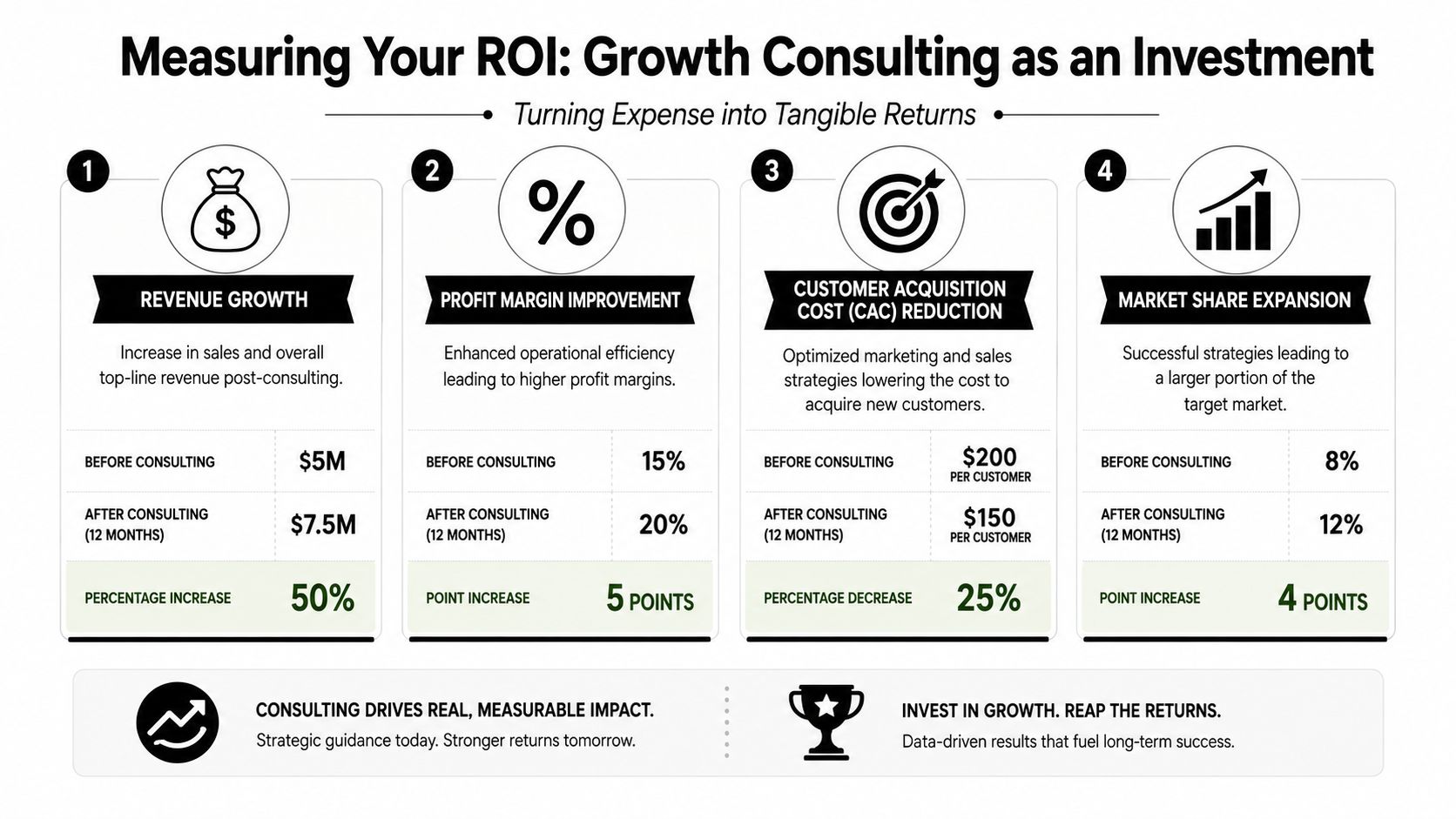
Measuring the ROI of Growth Consulting
If you can't measure the return, don't call it growth consulting. Call it coaching, mentoring, or advisory. That's fine. Just don't confuse it with commercial execution.
The return on business growth consulting services should show up in three places. Cash, profit, and founder capacity. Everything else is supporting evidence.
Start with the money metrics
Useful consulting work should improve the economics of the business, not just the appearance of activity.
One metric worth understanding is Days Sales Outstanding, or DSO. According to Mordor Intelligence's overview of the Australia management consulting services market, DSO is calculated as (Accounts Receivable / Total Revenue) * 365 days. It's a lagging KPI, but it matters because it tells you how quickly revenue turns into actual cash.
That same source also highlights Client Profitability and Resource Utilisation as useful performance measures. Those terms aren't just for large firms. SMEs can use the same thinking.
A practical ROI scorecard often includes:
Measure | What it tells you | Why it matters |
|---|---|---|
DSO | How fast invoices convert to cash | Slower collections create cash stress |
Client profitability | Which customers or jobs actually make money | Revenue can rise while margin falls |
Resource utilisation | How much paid effort goes into billable or productive work | Low utilisation usually hides process waste |
If your consultant reports on impressions, engagement, or “visibility” but can't tie that to commercial KPIs, you're not measuring ROI. You're measuring activity.
A strong review cadence helps too. If you're not already doing them, a disciplined quarterly business review process can expose where targets slipped, what changed in the numbers, and which decisions need correcting now.
Time matters too
Founders often ignore time because it doesn't sit neatly on the P&L. That's a mistake.
If better systems remove recurring approvals, reduce team confusion, and stop you from chasing numbers manually, that is a return. The value shows up in faster decisions, better staff ownership, and fewer expensive interruptions.
The key is to treat time reclaimed as a business asset, not a personal luxury. When owners step out of low-value operational noise, they can focus on pricing, key hires, supplier negotiations, sales leadership, and customer relationships. Those are the activities that usually move the needle.
Choosing the Right Growth Consultant in Australia
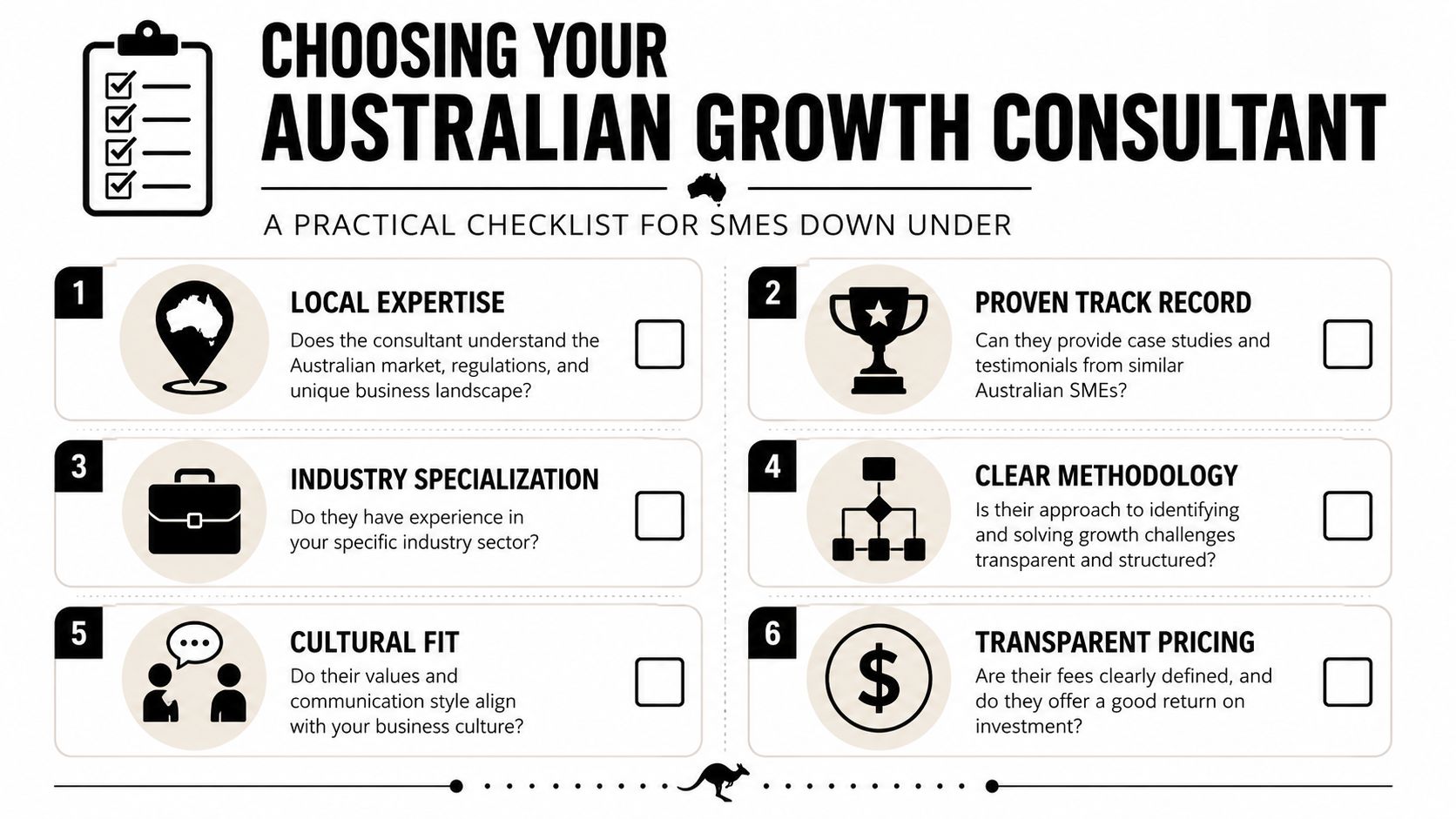
The market is crowded. That doesn't mean your options are good. It means your filtering has to be sharper.
A consultant should be able to diagnose, implement, and measure. If they only advise, you'll still be left doing the hard part yourself. For many founders, that's exactly why past consulting engagements disappointed.
Questions worth asking before you sign
Don't ask whether they can help you grow. Everyone says yes. Ask questions that force substance.
Use questions like these:
What commercial KPIs will you own with us? You want profit, cash, payback, client economics, or channel performance. Not broad promises.
How do you diagnose the main constraint? If they jump straight to a solution, they're guessing.
Who implements the changes? Some firms sell strategy and leave execution to your already-stretched team.
What systems do you use to track progress? Dashboards, forecasting tools, operating rhythms, and workflow visibility matter.
How do you work with finance and operations together? If those are separate conversations, results usually drift.
You should also look at how they think about advisory work more broadly. This overview of accounting and business advisory support for growing firms is a useful benchmark for what integrated, commercially focused support should look like.
Red flags you should take seriously
A few warning signs show up again and again.
Red flag: The consultant talks confidently about growth levers but never asks for your margin structure, cash position, receivables ageing, or stock profile.
Other common problems include:
Vanity metric obsession: They care more about traffic, reach, or engagement than profit and cash conversion.
No implementation layer: They deliver recommendations but have no operating rhythm to make them happen.
Generic playbooks: Their advice sounds identical whether the client is a manufacturer, ecommerce brand, trade business, or agency.
No view on technology: If they can't talk about the tools, workflows, and reporting stack required, they're not thinking operationally.
No accountability window: You need a timeline for outcomes, not an endless “strategic partnership” with fuzzy deliverables.
For inventory-heavy businesses, industry experience matters even more. A consultant who doesn't understand purchasing cycles, lead times, landed costs, and stock discipline can do real damage while sounding impressive.
Understanding Pricing Timelines and Engagement Models
Pricing shouldn't be mysterious. If it is, expect scope creep or weak accountability.
In Australia, Involve Digital's guide to business growth consulting expectations notes that ongoing performance engagements typically range from AUD 3,000 to AUD 15,000 per month, while project-based diagnostic engagements typically range from AUD 5,000 to AUD 20,000 as a one-off fee. The same source says a successful engagement should produce a measurable improvement in at least one commercial KPI by month six.
That month-six benchmark is sensible. Not because every problem gets solved by then, but because something material should have moved if the work is focused and the client is engaged.
What consulting usually costs
Here's a simple way to think about common pricing models.
Model | Best For | Typical Cost (AUD) |
|---|---|---|
Project-based diagnostic | Founders who need a clear diagnosis, roadmap, and priorities before committing to ongoing support | AUD 5,000 to AUD 20,000 |
Monthly performance engagement | Businesses that need implementation, accountability, KPI tracking, and ongoing strategic support | AUD 3,000 to AUD 15,000 per month |
Different firms may also use hourly or value-based pricing, but if you're an SME owner, these two models are usually the most practical to compare.
How the engagement usually runs
A proper engagement often works best in phases rather than one long blur of advice.
A typical sequence looks like this:
Diagnostic phase
The consultant reviews financials, workflows, reporting quality, pricing, and key bottlenecks. This should end with a clear priority list.Roadmap and KPI setting
You agree on the commercial targets and the operating changes required. Keep the KPI list tight.Implementation
Most value is created as forecasting, reporting, debtor controls, stock planning, SOPs, pricing changes, and leadership rhythm get put in place.Review and refine
The consultant measures what changed, what stalled, and what needs to be adjusted.
You don't need a huge engagement to start. But you do need one with clear ownership, a timeline, and evidence that the work is affecting real business outcomes.
Your Next Steps A Practical Checklist
Most founders wait too long. They tolerate messy reporting, weak cash discipline, and operational friction until the pressure becomes impossible to ignore. That's expensive.
The broader market is only getting more competitive. The Australian consulting services market is projected to grow from USD 9.10 billion in 2024 to approximately USD 18.76 billion by 2034 at a 7.5% CAGR, according to this market projection for Australia's consulting services sector. You don't need to chase trends for the sake of it, but you do need to stop running growth on instinct alone.

Use this checklist now:
Review your last three months of numbers: Look for margin drift, slow collections, irregular overhead, and stock build-up.
List your top three operational bottlenecks: Focus on the issues that repeatedly waste senior time or delay delivery.
Identify where cash is trapped: Inventory, receivables, poor pricing, overstaffing, or low-value subscriptions.
Write down the decisions only you can make: Then note the tasks you should no longer be doing.
Choose two or three commercial KPIs: Keep them tied to cash generation, margin, or payback.
Decide whether you need diagnosis, implementation, or both: That determines the right engagement model.
Small improvements in the right constraint can change the whole business. Broad effort spread across the wrong issues usually does nothing.
If you do nothing else, start there. Clarity comes before scale.
If you want a finance-first view of where growth is getting blocked, Nexist helps Australian founders diagnose cash leaks, tighten margins, improve reporting, and build the operating systems needed to scale without adding more chaos.
business growth consulting, virtual cfo australia, sme consulting, cashflow management, business advisory services

" width="24px"/><g d="M 0 24.129 L 0 0.129 L 24 0.129 L 24 24.129 Z M 0 24.129 L 0 0.129 L 24 0.129 L 24 24.129 Z M 24 3 C 24 1.344 22.656 0 21 0 L 3 0 C 1.344 0 0 1.344 0 3 L 0 21 C 0 22.656 1.344 24 3 24 L 21 24 C 22.656 24 24 22.656 24 21 Z M 6.883 8.375 L 2.863 8.375 L 2.863 20.467 L 6.883 20.467 Z M 4.899 2.545 C 3.524 2.545 2.625 3.449 2.625 4.634 C 2.625 5.795 3.496 6.724 4.846 6.724 L 4.872 6.724 C 6.273 6.724 7.146 5.795 7.146 4.634 C 7.12 3.449 6.274 2.545 4.899 2.545 Z M 16.747 8.09 C 14.614 8.09 13.659 9.263 13.124 10.086 L 13.124 8.374 L 9.105 8.374 C 9.159 9.508 9.105 20.466 9.105 20.466 L 13.124 20.466 L 13.124 13.713 C 13.124 13.352 13.15 12.99 13.257 12.732 C 13.547 12.01 14.209 11.262 15.319 11.262 C 16.773 11.262 17.355 12.372 17.355 13.996 L 17.355 20.466 L 21.374 20.466 L 21.374 13.532 C 21.374 9.818 19.391 8.09 16.747 8.09 Z" fill="transparent" height="24.12890599668026px" id="dSFdkJotL" width="24px"><path d="M 0 24 L 0 0 L 24 0 L 24 24 Z" fill="transparent" height="24px" id="wscNJE44G" transform="translate(0 0.129)" width="24px"/><g d="M 0 24.129 L 0 0.129 L 24 0.129 L 24 24.129 Z M 24 3 C 24 1.344 22.656 0 21 0 L 3 0 C 1.344 0 0 1.344 0 3 L 0 21 C 0 22.656 1.344 24 3 24 L 21 24 C 22.656 24 24 22.656 24 21 Z M 6.883 8.375 L 2.863 8.375 L 2.863 20.467 L 6.883 20.467 Z M 4.899 2.545 C 3.524 2.545 2.625 3.449 2.625 4.634 C 2.625 5.795 3.496 6.724 4.846 6.724 L 4.872 6.724 C 6.273 6.724 7.146 5.795 7.146 4.634 C 7.12 3.449 6.274 2.545 4.899 2.545 Z M 16.747 8.09 C 14.614 8.09 13.659 9.263 13.124 10.086 L 13.124 8.374 L 9.105 8.374 C 9.159 9.508 9.105 20.466 9.105 20.466 L 13.124 20.466 L 13.124 13.713 C 13.124 13.352 13.15 12.99 13.257 12.732 C 13.547 12.01 14.209 11.262 15.319 11.262 C 16.773 11.262 17.355 12.372 17.355 13.996 L 17.355 20.466 L 21.374 20.466 L 21.374 13.532 C 21.374 9.818 19.391 8.09 16.747 8.09 Z" fill="transparent" height="24.12890599668026px" id="sTpjGo1tb" width="24px"><path d="M 0 24 L 0 0 L 24 0 L 24 24 Z" fill="transparent" height="24px" id="s7ffpmKOD" transform="translate(0 0.129)" width="24px"/><g d="M 24 3 C 24 1.344 22.656 0 21 0 L 3 0 C 1.344 0 0 1.344 0 3 L 0 21 C 0 22.656 1.344 24 3 24 L 21 24 C 22.656 24 24 22.656 24 21 Z M 6.883 8.375 L 2.863 8.375 L 2.863 20.467 L 6.883 20.467 Z M 4.899 2.545 C 3.524 2.545 2.625 3.449 2.625 4.634 C 2.625 5.795 3.496 6.724 4.846 6.724 L 4.872 6.724 C 6.273 6.724 7.146 5.795 7.146 4.634 C 7.12 3.449 6.274 2.545 4.899 2.545 Z M 16.747 8.09 C 14.614 8.09 13.659 9.263 13.124 10.086 L 13.124 8.374 L 9.105 8.374 C 9.159 9.508 9.105 20.466 9.105 20.466 L 13.124 20.466 L 13.124 13.713 C 13.124 13.352 13.15 12.99 13.257 12.732 C 13.547 12.01 14.209 11.262 15.319 11.262 C 16.773 11.262 17.355 12.372 17.355 13.996 L 17.355 20.466 L 21.374 20.466 L 21.374 13.532 C 21.374 9.818 19.391 8.09 16.747 8.09 Z" fill="transparent" height="24.000006px" id="D0ecaHEcW" transform="translate(0 0)" width="24px"><path d="M 24 3 C 24 1.344 22.656 0 21 0 L 3 0 C 1.344 0 0 1.344 0 3 L 0 21 C 0 22.656 1.344 24 3 24 L 21 24 C 22.656 24 24 22.656 24 21 Z" fill="rgb(55, 184, 218)" height="24.000006px" id="IPLFE6zXx" width="24px"/><path d="M 4.02 0 L 0 0 L 0 12.092 L 4.02 12.092 Z" fill="rgb(255, 255, 255)" height="12.09201px" id="FWhtzAyuY" transform="translate(2.863 8.375)" width="4.02px"/><path d="M 2.274 0 C 0.899 0 0 0.904 0 2.089 C 0 3.25 0.871 4.179 2.221 4.179 L 2.247 4.179 C 3.648 4.179 4.521 3.25 4.521 2.089 C 4.495 0.904 3.649 0 2.274 0 Z" fill="rgb(255, 255, 255)" height="4.17876px" id="VmOsKv4kO" transform="translate(2.625 2.545)" width="4.52095px"/><path d="M 7.641 0 C 5.509 0 4.554 1.173 4.019 1.996 L 4.019 0.284 L 0 0.284 C 0.053 1.419 0 12.376 0 12.376 L 4.019 12.376 L 4.019 5.623 C 4.019 5.262 4.045 4.9 4.151 4.642 C 4.442 3.92 5.103 3.172 6.214 3.172 C 7.667 3.172 8.25 4.282 8.25 5.907 L 8.25 12.376 L 12.269 12.376 L 12.269 5.442 C 12.269 1.728 10.286 0 7.641 0 Z" fill="rgb(255, 255, 255)" height="12.37626px" id="n1XUbhaq0" transform="translate(9.105 8.09)" width="12.268830000000001px"/></g></g></g></g></svg>)