
Technology Roadmap Guide for Australian SMEs
Learn how to build a technology roadmap that aligns AI, automation and finance KPIs with real Australian SME operations, cashflow and growth goals.
Ansh Malhotra

The founder usually notices the problem in the bank account before noticing it in the technology stack. A new platform promised cleaner reporting, an automation app promised fewer manual tasks, and an AI tool promised faster content or customer responses. The subscriptions looked manageable in isolation. Together, they created more logins, more integrations, more training and less certainty about what the business was earning.
A technology roadmap fixes that by putting sequencing before software. It connects technology decisions to cashflow, gross margin, inventory, customer service and the team's capacity to absorb change. For an Australian SME, the roadmap shouldn't be a glossy list of platforms. It should be a finance-first operating instrument that shows what gets implemented, when it gets implemented, who owns it and what business result justifies the spend.
Table of Contents
Why Most Australian SMEs Buy Tech Before They Build a Roadmap
A Melbourne direct-to-consumer brand can accumulate Xero, a CRM, Shopify apps, a project management platform and an AI writing assistant in a short period. Each purchase makes sense during the sales conversation. The CRM promises better follow-up, the app removes a small fulfilment annoyance and the AI tool saves time on product descriptions.
The trouble starts when nobody asks what happens across the whole system. Orders may still be copied between platforms. Inventory may not reconcile cleanly. Customer data may be duplicated. The founder may spend evenings checking reports that should have been automatic, while the business pays for overlapping functionality.
That's how technology spend outruns control. Approval happens in a Slack message, the implementation follows the vendor's sales cycle and no document shows what each tool owes the business in revenue, margin, cash or capacity.
The finance test: If you can't state the business outcome, owner and review date for a tool, you haven't approved an investment. You've approved a subscription.
A technology roadmap creates the missing bridge between ambition and cash reality. It forces each initiative to answer practical questions:
Cashflow: Will this reduce cash tied up in stock, receivables or manual administration?
Margin: Will it protect gross margin by reducing errors, waste, rework or platform duplication?
Capacity: Can the current team implement and use it without disrupting sales or delivery?
Accountability: Who will prove that the initiative delivered its intended result?
Skipping that discipline has a real economic cost, even when the individual licence fees appear small. The business can pay twice for similar tools, write off migration work when systems change and lose founder hours to stitching disconnected platforms together. Those hours could have gone into selling, pricing, supplier negotiations or hiring.
Australian technology planning has moved towards structured, milestone-led investment. The Australian Technology Investment Roadmap was designed to set clear priorities over the short, medium and long term, supported by annual Low Emissions Technology Statements that tracked progress against economic stretch goals, as outlined by the International Energy Agency's overview of the Australian roadmap. SMEs should apply the same discipline at their own scale. The roadmap isn't about buying more technology. It's about making fewer, better-timed bets.
What a Technology Roadmap Actually Is
A technology roadmap is a time-phased plan showing which business capabilities, platforms and tools the company will build, buy, retire or defer. Each item carries a business purpose, an owner, a cost band, a delivery point and an outcome linked to the P&L or operating KPIs.
Think of a building blueprint. The blueprint doesn't list every possible tap, light fitting and appliance available from suppliers. It shows how the parts fit together, what must happen first and what the finished building needs to do. A software shopping list is closer to walking through a showroom and collecting brochures.
Founders often confuse three different artefacts:
Artefact | What it answers | What it leaves out | Typical failure in SMEs |
|---|---|---|---|
Technology roadmap | Which capabilities will be delivered, in what order, by whom and for what business result? | Detailed technical implementation tasks | It becomes a presentation that isn't reviewed against management accounts |
IT plan | How existing systems will be maintained, supported, secured and upgraded | Whether the current stack supports future growth or margin goals | The team keeps old systems running while strategic gaps remain |
Software shopping list | Which products the business might purchase | Sequencing, adoption, ownership, payback and exit options | Vendors dictate priorities through demos and discount deadlines |
An IT plan can be useful. A software list can be a useful starting point. Neither is a roadmap unless it explains the relationship between investment and execution.
The minimum information each line needs
Every roadmap item should include:
The problem: What process, risk or constraint needs attention?
The capability: What must the business be able to do afterwards?
The decision: Build, buy, integrate, retire or defer?
The owner: One person accountable for delivery and adoption.
The economics: Cost band, expected benefit and payback logic.
The timing: A realistic implementation window based on cash and capacity.
The proof: The KPI that will confirm whether the initiative worked.
A real roadmap can say “defer”. That's a strength, not a weakness. If the business can't support a new platform without exhausting cash or overloading staff, postponement is a responsible investment decision. A wishlist, by contrast, treats every attractive feature as urgent.
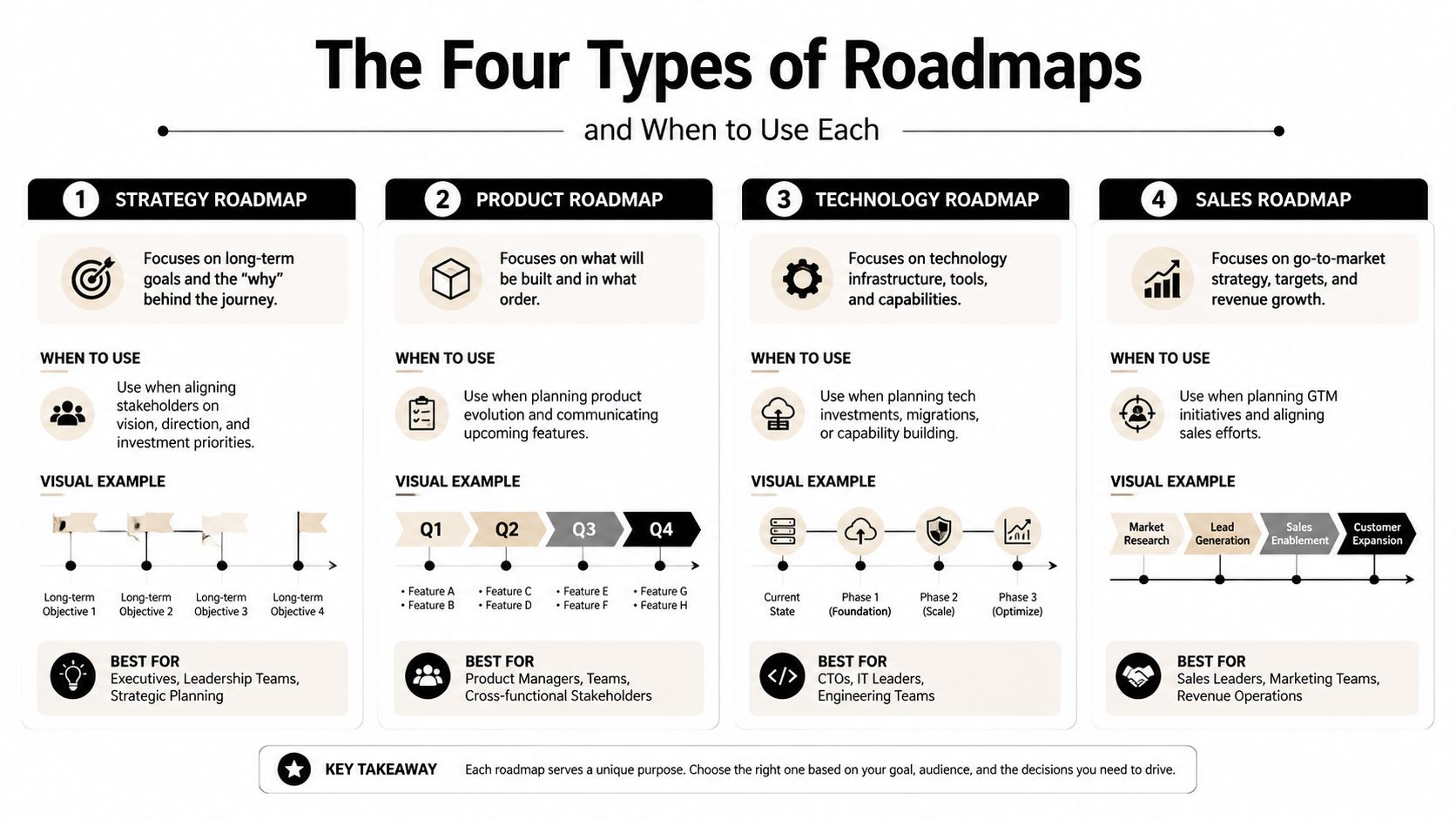
The Four Types of Roadmaps and When to Use Each
Not every SME needs one giant roadmap. The right format depends on the decision you're trying to make. A founder preparing for a funding conversation needs a different view from an operations manager trying to reconcile warehouse data.
Strategic roadmap
The strategic roadmap sits at owner, board or investor level. It connects technology investment to the company's longer-term revenue, margin and risk objectives. Use it when the business is making material capital allocation decisions, entering a new market or preparing to scale beyond the founder's direct control.
Tie it to measures such as contribution margin, operating cash conversion and capacity to support growth. The warning sign is a strategic roadmap that exists mainly to justify a platform someone already wants to buy. Strategy should determine the purchase, not the reverse.
Capability roadmap
The capability roadmap starts with what the business must be able to do. Examples include producing a quote quickly, reconciling stock across warehouses, responding to service requests without repeated data entry or closing the month with reliable information.
This is usually the most useful format for Australian service, retail, wholesale and trade SMEs. Tie it to the constraint currently limiting cash or capacity, such as debtor days, stock accuracy, fulfilment time, rework or billable utilisation. If the roadmap contains product names but can't describe the required capability, it's probably a shopping list.
Platform roadmap
The platform roadmap describes the underlying architecture. It covers systems such as Xero, an ERP, CRM, inventory software, reporting tools, data stores, integration services and identity or security controls.
Use it when duplication, technical debt, vendor concentration or fragile integrations are creating operational risk. Tie it to total technology cost, support effort, data quality and resilience. The mistake is to treat the platform view as the business strategy. A clean architecture that doesn't improve a meaningful business constraint is expensive housekeeping.
Product roadmap
A product roadmap belongs to software-led businesses or SMEs running an internal digital product. It sequences features by customer value, user adoption, revenue impact and delivery risk, rather than by engineering preference.
Tie it to product revenue, retention, activation or support demand. The wrong signal is a feature backlog full of technical requests with no customer or commercial rationale. Product decisions still need a platform and capability context, but the product roadmap's job is to decide what users receive and when.
The Five Components a SME Roadmap Cannot Skip
A credible roadmap starts with evidence, not enthusiasm. It should be detailed enough to support a cash decision but simple enough for the leadership team to review without a technical interpreter.
Start with a current-state audit
Build a register of every subscription, integration, spreadsheet, manual handoff and outsourced system. Add the accountable user, business function, renewal date, cost band, data held and known limitation.
Track software-as-a-service spend against revenue, but don't stop at licence fees. Include implementation, support, duplicate entry, training and the time spent correcting errors. Skip this audit and the business can pay for overlapping systems while assuming the stack is efficient.
Describe the target state as capabilities
Write the future state in operational language. “A new ERP” is not a target state. “Purchasing, inventory and sales use the same stock position” is.
Connect each capability to revenue, gross margin, working capital or risk. An inventory-led business might prioritise better stock visibility because excess stock traps cash and stockouts create missed sales. A service business might prioritise a quote-to-invoice workflow because delayed billing weakens cash conversion.
Rank the gaps by cash payback
List the distance between current and target state. Then rank the gaps by benefit, effort, disruption and confidence.
A practical benefit case should name the relevant KPI:
Receivables automation: debtor days, overdue invoices or collection effort.
Inventory improvement: stock accuracy, stockturn, write-offs or stock-on-hand.
Platform consolidation: recurring software cost, duplicate administration or support hours.
Workflow automation: cycle time, error rate or hours released.
Reporting improvements: close quality, decision speed or forecast reliability.
Assign one accountable person
A committee can advise, but one named person must own each workstream. That person coordinates decisions, manages adoption and reports the result.
If ownership is vague, the roadmap becomes a slide deck. The finance approver should challenge the business case, while the operational owner confirms whether the process works in practice.
Define the financial proof
Every initiative needs a before-and-after measure, a review date and a decision rule. State whether the business will continue, adjust, pause or retire the initiative.
A roadmap is not successful because a system went live. It's successful when the business can show what changed in cash, margin, risk or capacity.
Roadmap Component | Finance or Operations Metric | Typical SME Failure When Missing |
|---|---|---|
Current-state audit | SaaS spend as a share of revenue, duplicate tools and manual hours | The business buys another platform without seeing overlap |
Target-state capability stack | Gross margin, debtor days, stock accuracy or cycle time | The team selects features without defining the business result |
Sequenced gap list | Payback period, implementation effort and cash requirement | High-cost projects consume capacity before quick wins are proven |
Named ownership | Adoption rate, delivery status and unresolved decisions | Nobody is accountable once the vendor leaves |
Finance-linked benefit case | KPI movement against the approved baseline | The board measures activity instead of commercial impact |
For a practical explanation of how roadmap work can sit alongside finance and operating improvement, a finance team such as Nexist can help connect systems decisions to cashflow, reporting and process ownership.
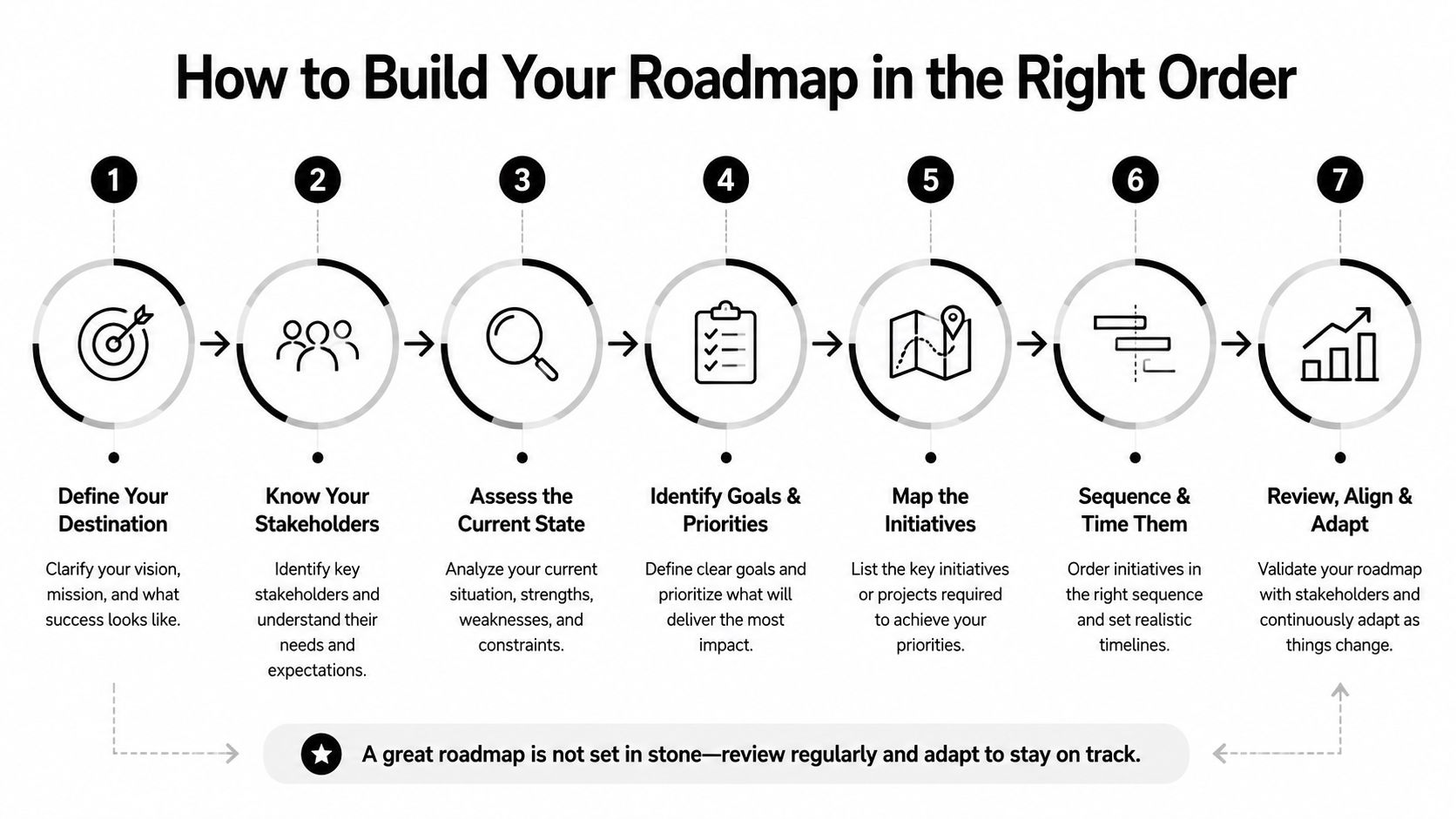
How to Build Your Roadmap in the Right Order
Don't run a technology roadmap as a motivational workshop. Build it as an operating process with a clear sequence and tangible outputs.
1. Inventory the current state
Spend two weeks gathering the full system picture. Record subscriptions, integrations, spreadsheets, manual re-keying, approval steps and recurring reporting work. Price each item and tag it to a business function, such as sales, purchasing, fulfilment, payroll or finance.
The output should be a working tool register, not a polished slide. Include renewal dates and exit constraints so upcoming commitments don't surprise the cash forecast.
2. Describe the target state
Write a one-page target state using outcomes rather than vendor names. Examples include fewer handoffs per order, quicker debtor follow-up, cleaner stock availability or a faster month-end close.
This forces the team to solve the business problem before choosing the product. It also makes it easier to compare competing platforms on usefulness rather than demo quality.
3. Convert gaps into economic choices
Turn each gap into a cost and benefit question. What does the current process consume in labour, delay, rework, stock or missed collection? What will implementation require in cash, management attention and training?
The output is a payback-ranked gap list. If the team can't estimate an initiative confidently, mark it for discovery rather than pretending the estimate is precise.
4. Sequence against capacity
Build a 12-month view, but don't let the vendor's sales cycle set the order. Constrain the sequence by cashflow, hiring capacity, operational seasonality, customer commitments and the team's appetite for change.
The common mistake is stacking multiple implementations because they appear strategically important. That can create a temporary productivity dip at exactly the point the business needs stable delivery.
5. Govern it through management accounts
Review the roadmap with the monthly management accounts and refresh priorities quarterly. Compare actual cost, adoption and KPI movement against the approved case.
The Australian Government's digital projects report shows how roadmap-style planning can connect complex projects with investment and delivery tracking. Its portfolio covers 110 strategically significant digital projects and represents $12.9 billion in total investment, a scale that illustrates the value of linking plans to implementation evidence. An SME doesn't need that bureaucracy. It does need the same basic habit of connecting planned investment with delivery and results.
For a broader view of roadmap structure and sequencing, Blowfish Technology's roadmap resource is useful background. For process candidates, identify repetitive work before selecting automation, then use the business process automation guide to pressure-test where automation belongs.
The roadmap should change the founder's question from “Which tool has the most features?” to “Which constraint should we remove first, and how will the accounts prove it?”
Aligning the Roadmap with Finance Operations and AI
The order of technology work changes depending on which lens you use. Finance protects liquidity, operations removes process friction and AI depends on reliable data and connected workflows. A sensible roadmap uses all three, but it chooses a lead lens based on the immediate constraint.
Finance-led sequencing
The finance lens puts payback and cash protection ahead of technical ambition. It favours initiatives that improve collections, reduce avoidable spend, release trapped working capital or prevent margin leakage.
If monthly cash runway is below four months, run the roadmap finance-led. That may mean improving invoicing and debtor follow-up before investing in a detailed forecasting model. The trade-off is clear. The business may delay attractive automation, but it avoids funding a transformation that increases pressure on cash.
For finance teams reviewing systems, small business finance software guidance can help frame the decision around reporting, controls and day-to-day usability rather than features alone.
Operations-led sequencing
The operations lens starts with the bottleneck that costs the business margin or customer trust. If fulfilment costs are climbing, begin with order flow, inventory accuracy, warehouse handoffs or exception management. If service delivery is overloaded, map scheduling, quoting, job notes and invoicing before purchasing a new CRM.
This lens can produce a different answer from finance-led sequencing. A warehouse fix may require upfront effort but protect service levels and stock availability. The decision should still include cash impact, but the first initiative is chosen because operations is the current constraint.
AI-enabled sequencing
AI should come after the data and integration foundations it relies on. Clean master data, consistent process definitions, usable history, access controls and stable workflows matter more than adding another copilot.
Recent adoption data shows why execution now matters more than awareness. 43% of SMEs reported some AI adoption across December 2025 to February 2026, rebounding to 44% in February 2026, according to the Australian Chamber of Commerce and Industry's AI adoption update. The National AI Plan also identifies specific SME support as necessary and notes a $17 million AI Adopt Program for implementation assistance, as described in the same government-linked material.
The practical rule is simple:
Sequencing Lens | Trigger Condition | First Initiative | Primary KPI | Failure Mode If Misapplied |
|---|---|---|---|---|
Finance-led | Monthly cash runway below four months | Cash collection, spend control or working-capital improvement | Cash conversion and liquidity | Deferring operational fixes that protect customer delivery |
Operations-led | Fulfilment cost, errors or bottlenecks are rising | Workflow, inventory or service-flow improvement | Cycle time, error rate or gross margin | Automating a broken process |
AI-enabled | Data foundations are stable, owned and budgeted | Data quality, integration and controlled automation | Forecast quality, hours released or decision speed | Buying an AI tool before the business can trust its inputs |
Australian government digital strategy work reinforces this sequencing logic. The Data and Digital Government Strategy links roadmaps with service standards, workforce capability and data maturity tools. The lesson for SMEs is direct: software adoption without governance, skills and process ownership leaves the expensive part unfinished.
Common Roadmaps That Fail and How to Avoid Them
Roadmap failure usually starts before implementation. The team approves a commitment without checking the exit path, capability requirements or proof of value.
Vendor lock-in
A CRM, ERP or warehouse platform can become difficult to leave when data formats, integrations and workflows are tightly tied to one supplier. Australian technology-sector discussion has also flagged vendor lock-in and the productivity impact of staff onboarding and training during system changes, as outlined in the Australian sovereign technology capacity discussion.
Before signing, require open export formats, documented APIs, ownership of business data and a written estimate of exit costs. The circuit breaker is simple: pause the contract until the business can explain how it would migrate.
Capability gaps
A roadmap that assumes a data engineer, automation specialist or confident system administrator will appear is not a plan. It's an unbudgeted hiring assumption.
Backfill the capability before go-live. That might mean training an internal process owner, engaging fractional support or reducing the first release until the team can operate it. Don't launch a system that only the vendor understands.
Big-bang rollouts
Large implementations create too many dependencies at once. If one module, integration or data migration fails, the whole programme can stall.
Slice the work into releases that produce a usable outcome. Set kill criteria before starting, such as unacceptable disruption, missing data quality or benefits that no longer justify the effort. A smaller release gives the founder permission to stop without defending sunk cost.
KPI-free roadmaps
Tickets closed, modules configured and training sessions completed are delivery measures. They don't prove commercial value.
Tie every initiative to cashflow, gross margin, stockturn, error rate or hours saved. For additional perspective on practical AI use cases and implementation decisions, spend time reading the Expressify AI blog, then test each idea against your own data and operating constraints.
Milestones and Governance That Keep the Roadmap Alive
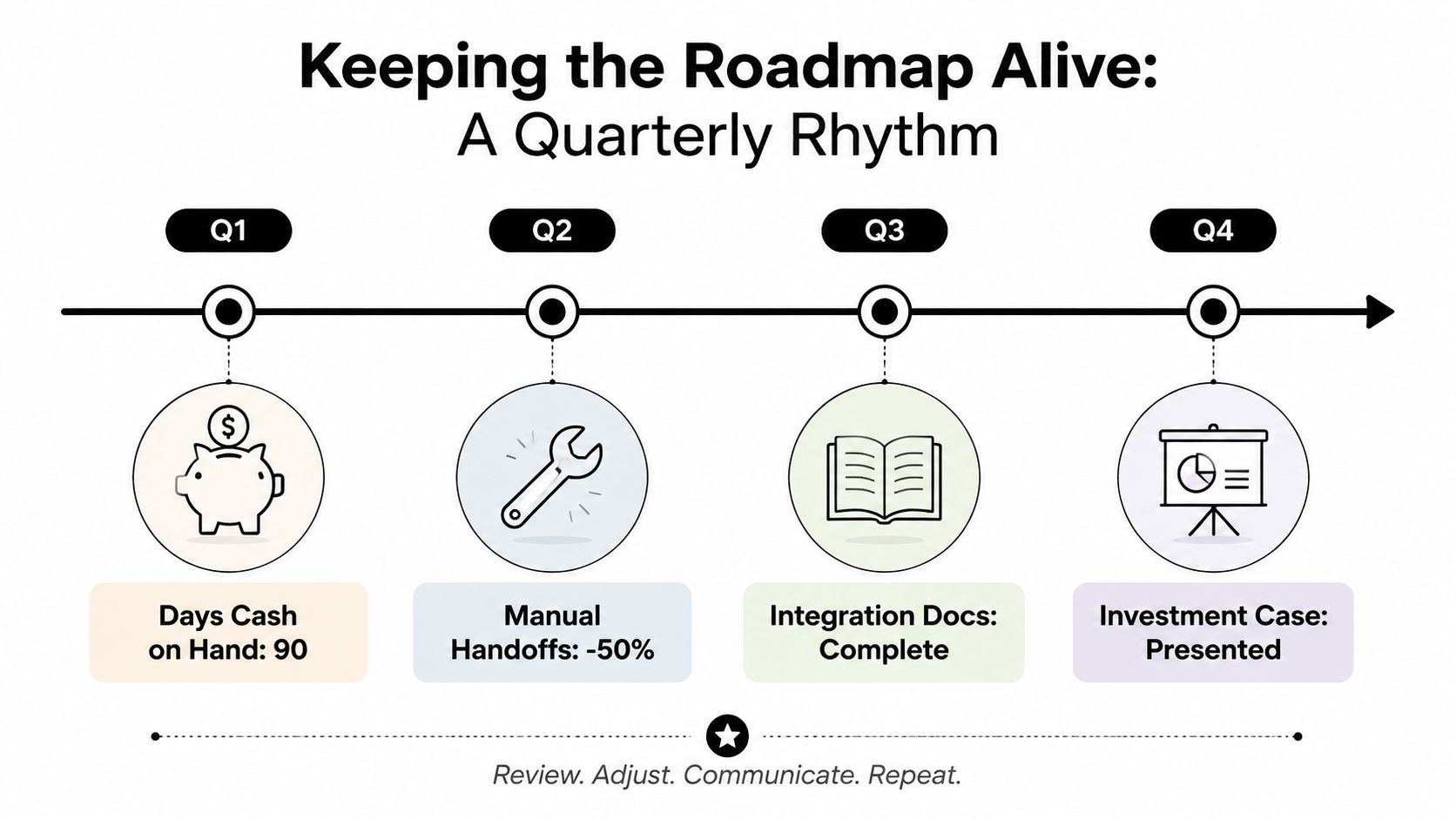
A roadmap survives when management reviews outcomes, not when someone updates a slide. Use milestones written in finance and operations language: days cash on hand restored to 90, gross margin lift of 1.5 percentage points, pick error rate below 0.5%, monthly close reduced from eight days to three, or AI forecast accuracy within plus or minus 8%. These are the assigned milestone measures, not universal benchmarks, so set them only where they reflect the business case and baseline.
The government's Data and Digital Government Strategy describes roadmaps as mechanisms for coordinating initiatives towards a 2030 vision, while noting that the published roadmap includes both new and existing initiatives and isn't exhaustive, as explained in the strategy documentation. SMEs should take the operating principle without copying the administrative scale. Keep the roadmap visible, selective and tied to decisions.
Use a 12-week operating cycle
Map each cycle to BAS preparation, management accounts and board or owner review dates. Hold a monthly working session lasting 45 minutes, then run a quarterly steering review with decision-makers.
The monthly session should cover:
Progress: What was delivered and adopted?
Economics: What has been spent and what benefit has appeared?
Risks: Which dependency, data issue or skills gap threatens the next release?
Decisions: What should continue, change, pause or stop?
Assign three roles. The roadmap owner manages delivery and adoption. The finance approver tests the investment case and cash impact. The technical translator turns business requirements into platform, integration and data decisions.
Create trigger conditions
Don't wait for the next scheduled review when the operating environment changes. Reprioritise after a cashflow shock, repeated stockout pattern, material vendor outage, acquisition, leadership change or stalled initiative that changes the cost and complexity picture.
Use reporting automation to reduce manual preparation and make these conversations more reliable. A practical starting point is automated business reporting, provided the underlying definitions and data ownership are clear.
Your one-page governance template should list the cadence, attendees, inputs, outputs and escalation thresholds. It should also show the current owner, approved budget, KPI baseline, next decision and stop condition for every active initiative. That's enough structure to withstand staff changes, vendor churn and a founder's changing priorities.
A technology roadmap is valuable because it makes trade-offs explicit. It tells the business what not to buy yet, which capability must come first and how the accounts will confirm whether the decision worked. Build the register, define the target state, rank the gaps by cash impact and put the first review date in the calendar.
If your technology spend has grown faster than your cash clarity, Nexist can help connect your systems, KPIs, cashflow and implementation priorities into a practical roadmap. Visit Nexist to start with a finance-first view of the tools and process changes your Australian SME should make next.
technology roadmap, SME strategy, AI adoption, cashflow planning, virtual CFO

" width="24px"/><g d="M 0 24.129 L 0 0.129 L 24 0.129 L 24 24.129 Z M 0 24.129 L 0 0.129 L 24 0.129 L 24 24.129 Z M 24 3 C 24 1.344 22.656 0 21 0 L 3 0 C 1.344 0 0 1.344 0 3 L 0 21 C 0 22.656 1.344 24 3 24 L 21 24 C 22.656 24 24 22.656 24 21 Z M 6.883 8.375 L 2.863 8.375 L 2.863 20.467 L 6.883 20.467 Z M 4.899 2.545 C 3.524 2.545 2.625 3.449 2.625 4.634 C 2.625 5.795 3.496 6.724 4.846 6.724 L 4.872 6.724 C 6.273 6.724 7.146 5.795 7.146 4.634 C 7.12 3.449 6.274 2.545 4.899 2.545 Z M 16.747 8.09 C 14.614 8.09 13.659 9.263 13.124 10.086 L 13.124 8.374 L 9.105 8.374 C 9.159 9.508 9.105 20.466 9.105 20.466 L 13.124 20.466 L 13.124 13.713 C 13.124 13.352 13.15 12.99 13.257 12.732 C 13.547 12.01 14.209 11.262 15.319 11.262 C 16.773 11.262 17.355 12.372 17.355 13.996 L 17.355 20.466 L 21.374 20.466 L 21.374 13.532 C 21.374 9.818 19.391 8.09 16.747 8.09 Z" fill="transparent" height="24.12890599668026px" id="dSFdkJotL" width="24px"><path d="M 0 24 L 0 0 L 24 0 L 24 24 Z" fill="transparent" height="24px" id="wscNJE44G" transform="translate(0 0.129)" width="24px"/><g d="M 0 24.129 L 0 0.129 L 24 0.129 L 24 24.129 Z M 24 3 C 24 1.344 22.656 0 21 0 L 3 0 C 1.344 0 0 1.344 0 3 L 0 21 C 0 22.656 1.344 24 3 24 L 21 24 C 22.656 24 24 22.656 24 21 Z M 6.883 8.375 L 2.863 8.375 L 2.863 20.467 L 6.883 20.467 Z M 4.899 2.545 C 3.524 2.545 2.625 3.449 2.625 4.634 C 2.625 5.795 3.496 6.724 4.846 6.724 L 4.872 6.724 C 6.273 6.724 7.146 5.795 7.146 4.634 C 7.12 3.449 6.274 2.545 4.899 2.545 Z M 16.747 8.09 C 14.614 8.09 13.659 9.263 13.124 10.086 L 13.124 8.374 L 9.105 8.374 C 9.159 9.508 9.105 20.466 9.105 20.466 L 13.124 20.466 L 13.124 13.713 C 13.124 13.352 13.15 12.99 13.257 12.732 C 13.547 12.01 14.209 11.262 15.319 11.262 C 16.773 11.262 17.355 12.372 17.355 13.996 L 17.355 20.466 L 21.374 20.466 L 21.374 13.532 C 21.374 9.818 19.391 8.09 16.747 8.09 Z" fill="transparent" height="24.12890599668026px" id="sTpjGo1tb" width="24px"><path d="M 0 24 L 0 0 L 24 0 L 24 24 Z" fill="transparent" height="24px" id="s7ffpmKOD" transform="translate(0 0.129)" width="24px"/><g d="M 24 3 C 24 1.344 22.656 0 21 0 L 3 0 C 1.344 0 0 1.344 0 3 L 0 21 C 0 22.656 1.344 24 3 24 L 21 24 C 22.656 24 24 22.656 24 21 Z M 6.883 8.375 L 2.863 8.375 L 2.863 20.467 L 6.883 20.467 Z M 4.899 2.545 C 3.524 2.545 2.625 3.449 2.625 4.634 C 2.625 5.795 3.496 6.724 4.846 6.724 L 4.872 6.724 C 6.273 6.724 7.146 5.795 7.146 4.634 C 7.12 3.449 6.274 2.545 4.899 2.545 Z M 16.747 8.09 C 14.614 8.09 13.659 9.263 13.124 10.086 L 13.124 8.374 L 9.105 8.374 C 9.159 9.508 9.105 20.466 9.105 20.466 L 13.124 20.466 L 13.124 13.713 C 13.124 13.352 13.15 12.99 13.257 12.732 C 13.547 12.01 14.209 11.262 15.319 11.262 C 16.773 11.262 17.355 12.372 17.355 13.996 L 17.355 20.466 L 21.374 20.466 L 21.374 13.532 C 21.374 9.818 19.391 8.09 16.747 8.09 Z" fill="transparent" height="24.000006px" id="D0ecaHEcW" transform="translate(0 0)" width="24px"><path d="M 24 3 C 24 1.344 22.656 0 21 0 L 3 0 C 1.344 0 0 1.344 0 3 L 0 21 C 0 22.656 1.344 24 3 24 L 21 24 C 22.656 24 24 22.656 24 21 Z" fill="rgb(55, 184, 218)" height="24.000006px" id="IPLFE6zXx" width="24px"/><path d="M 4.02 0 L 0 0 L 0 12.092 L 4.02 12.092 Z" fill="rgb(255, 255, 255)" height="12.09201px" id="FWhtzAyuY" transform="translate(2.863 8.375)" width="4.02px"/><path d="M 2.274 0 C 0.899 0 0 0.904 0 2.089 C 0 3.25 0.871 4.179 2.221 4.179 L 2.247 4.179 C 3.648 4.179 4.521 3.25 4.521 2.089 C 4.495 0.904 3.649 0 2.274 0 Z" fill="rgb(255, 255, 255)" height="4.17876px" id="VmOsKv4kO" transform="translate(2.625 2.545)" width="4.52095px"/><path d="M 7.641 0 C 5.509 0 4.554 1.173 4.019 1.996 L 4.019 0.284 L 0 0.284 C 0.053 1.419 0 12.376 0 12.376 L 4.019 12.376 L 4.019 5.623 C 4.019 5.262 4.045 4.9 4.151 4.642 C 4.442 3.92 5.103 3.172 6.214 3.172 C 7.667 3.172 8.25 4.282 8.25 5.907 L 8.25 12.376 L 12.269 12.376 L 12.269 5.442 C 12.269 1.728 10.286 0 7.641 0 Z" fill="rgb(255, 255, 255)" height="12.37626px" id="n1XUbhaq0" transform="translate(9.105 8.09)" width="12.268830000000001px"/></g></g></g></g></svg>)