
Supply Chain Resilience: SME Guide to Risk in 2026
Boost your supply chain resilience to protect cash flow & margins. A guide for Australian SMEs on managing risks & improving ops in 2026.
Ansh Malhotra

A late container, a missing component, a supplier who stops answering, a warehouse that suddenly runs lean. For an Australian SME, that's rarely just an operations problem. It hits sales first, then margin, then cash.
Most founders feel the damage in the same order. You scramble to cover the stock gap, pay more for freight, placate customers, delay other payments, then spend the week firefighting instead of running the business. By the time the numbers show up in your P&L, the pressure has already spread into receivables, payroll timing, pricing decisions and owner fatigue.
That's why supply chain resilience matters. Not as a boardroom buzzword, but as a cash discipline. If you sell, hold, move or assemble stock, resilience is really about one question: how do you stay deliverable without burying your working capital in inventory?
Table of Contents
When Your Supply Chain Breaks Your Business
A founder orders stock on time, gets the forecast roughly right, and expects a normal month. Then a key shipment slips. Production stalls, customer orders stack up, the sales team starts making apology calls, and finance suddenly needs to explain why cash is tighter even though demand still exists.
That sequence is common because supply chain failure travels fast through the business. You don't just lose product availability. You get margin compression from rush freight, revenue delays from stockouts, and wasted management time from reactive decision-making. In Australia, the cost has been material. The ABS reported that supply chain disruptions in 2024 cost Australian firms an average of 8% of annual revenue, while 25% of freight operators encountered over 20 disruptive events, including material shortages and port delays (ABS data referenced here).
What founders usually notice first
The first pain point is rarely a spreadsheet metric. It's operational friction.
Sales disruption: Customers can't buy what isn't available, or they lose confidence in lead times.
Cash timing pressure: Money goes out for replacement stock or expedited freight before normal inflows arrive.
Margin erosion: The job still needs to be fulfilled, just at a worse gross profit outcome.
Owner overload: The founder becomes the escalation point for purchasing, customer service and supplier chasing.
A lot of SMEs treat that as a one-off headache. It isn't. Repeated disruption creates a business that always looks busy but never feels liquid.
Practical rule: If a stock problem forces you to change pricing, payment timing or fulfilment method, it's already a finance problem, not just a logistics problem.
Operational teams often jump straight to transport fixes, warehouse changes or vendor calls. Those matter. A grounded overview like this guide for middle-mile operations is useful because execution breakdowns often happen between supplier dispatch and final delivery, where visibility is weak and handoffs are messy.
The real damage sits below the surface
Founders often understate the hidden cost. Lost time matters. So does the opportunity cost of management attention. If the business keeps absorbing shocks manually, the owner becomes a watchman of stock movements instead of the person setting direction.
That's where supply chain resilience changes the conversation. The goal isn't to prevent every disruption. The goal is to build a business that can absorb the hit, recover without panic, and protect cash while competitors are still reacting.
What Supply Chain Resilience Really Means for Your SME
For an SME, supply chain resilience isn't about building a giant fortress. It's closer to a suspension system in a ute. The road stays rough, but the vehicle keeps moving because it can absorb the shock.
The reason this matters now is simple. 76% of Australian shippers experienced supply chain disruptions in 2024, with major events occurring approximately every 3.7 years, according to the 2025 OECD Resilient Supply Chains Review. That makes resilience a standard operating requirement, not a special project.
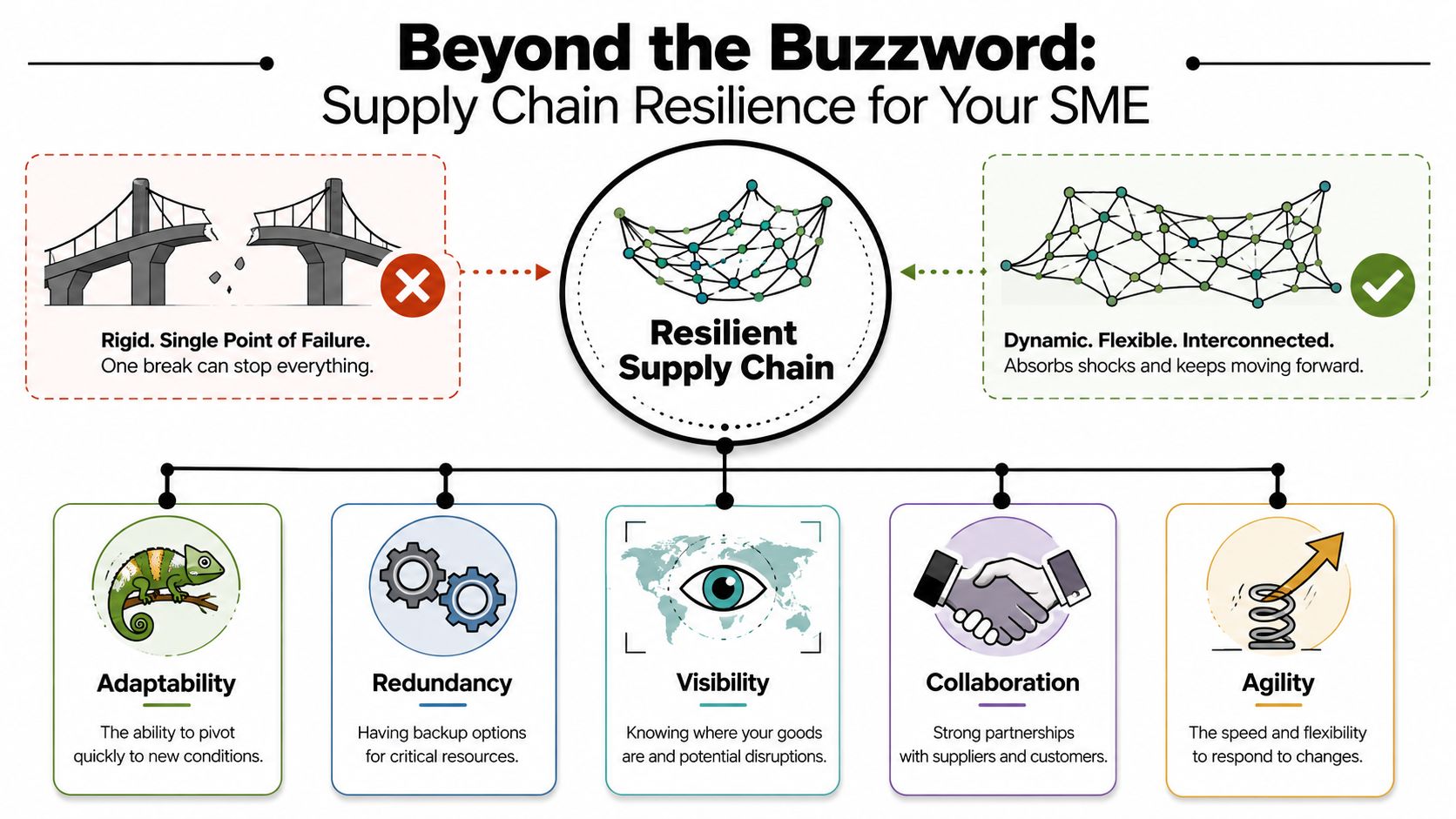
Resilience is a suspension system, not a wall
A rigid supply chain looks efficient until one point fails. One supplier, one freight route, one key warehouse process, one person who “knows how it all works”. Then the whole thing shakes.
A resilient one has options. It bends without snapping. That doesn't mean endless redundancy or corporate-level tech spend. It means being organised enough to see issues early, switch faster, and protect cash when conditions change.
Strong supply chain resilience doesn't remove volatility. It shortens the time your business spends trapped by it.
The four pillars that matter in an SME
Large enterprises can throw teams and capital at the problem. SMEs need a cleaner model.
Visibility
You need to know what's on order, what's late, what's overstocked and what's about to run out. In practice, that often starts with cleaner ERP, inventory and purchasing data, not with a flashy platform.
If your buyer, warehouse and finance team are all working from different versions of reality, you're making decisions too late.
Diversification
Don't confuse loyalty with concentration risk. A strong supplier relationship is valuable, but dependence is dangerous. Resilience improves when you have credible alternatives for critical inputs, freight options and fulfilment pathways.
That doesn't mean replacing your best supplier. It means avoiding a setup where one disruption stops revenue.
Agility
Agility is decision speed. Can you reallocate stock? Can you change purchasing cadence? Can you shift customer promises before service failure spreads?
SMEs often outperform larger businesses here because they don't need layers of approval. But speed only helps if someone has already defined the trigger points and response rules.
Collaboration
The best supply chains aren't adversarial. Suppliers, freight partners, warehouse staff, sales and finance need shared priorities. If procurement is rewarded for unit cost alone while finance is trying to free up working capital, the business pulls in two directions.
A resilient SME aligns decisions around service continuity and cash preservation. That's what turns disruption from a threat into an advantage. Competitors freeze. You keep moving.
Common Risks and Key Resilience Metrics to Track
Most supply chain problems don't arrive as dramatic disasters. They show up as longer lead times, inconsistent supplier performance, demand surprises, delayed purchase orders and stock that sits in the wrong place for too long.
That's why measurement matters. If you only look at fulfilment after something breaks, you'll miss the financial warning signs.

Where SMEs usually get exposed
Australian SMEs tend to carry a specific mix of risk.
Risk area | What it looks like in practice | Cash flow effect |
|---|---|---|
Supplier concentration | One vendor supplies the item you can't easily replace | Revenue stalls if supply fails |
Freight disruption | Port delays, booking gaps, domestic transport bottlenecks | Extra freight cost and late invoicing |
Inventory imbalance | Too much of the slow mover, not enough of the fast mover | Cash tied up in the wrong stock |
Process fragility | Reordering lives in one spreadsheet or one person's head | Slow response and ordering errors |
Demand volatility | Promotions, seasonality or uneven sales patterns | Stockouts or excess purchasing |
One useful mindset comes from reliability work. Maintenance teams track failure patterns because random breakdowns often aren't random at all. The same logic applies in supply chain operations. If you want a sharper framework for recurring failure analysis, this piece on transforming CMMS data into MTBF insights shows how structured data can expose weak points before they become outages.
The numbers worth tracking every month
The first metric is Time to Recover, or TTR. ABARES indicates that inventory-intensive Australian SMEs face a median TTR of 14 to 21 days following regional disruptions, and that implementing automated safety stock buffers can reduce operational impact by 40% (ABARES data referenced here).
TTR matters because it tells you how long the business stays financially impaired after a disruption. If recovery takes weeks, receivables slow, labour gets misallocated and urgent purchasing decisions pile up.
Next is Days of Inventory on Hand, or DIOH. This shows how many days your current stock position represents. Too low, and a delay hurts immediately. Too high, and your working capital gets trapped in shelves, bins and containers instead of staying available for wages, tax, debt and growth.
Then there's Supplier Diversification Index, or SDI. This is less about a textbook formula and more about seeing whether your critical inputs come from multiple viable sources. If one region, one relationship or one warehouse supports too much of your operation, you've found a structural weakness.
A fourth measure is lead time variability. Average lead time alone can hide the problem. If a supplier usually delivers in a reasonable window but occasionally blows out badly, the average will look fine while your planning gets wrecked.
For stock-heavy businesses, this financial lens matters just as much as the operational one. Tightening these metrics supports a healthier working capital rhythm, which is closely connected to the cash conversion cycle.
Watch this monthly: TTR, DIOH, lead time variability, fill rate on core SKUs, and concentration risk by supplier. If those five numbers are drifting, cash usually follows.
Good supply chain resilience starts with visibility, but it improves when those metrics become management triggers. Not just reports. Triggers.
Your Resilience Playbook Tactical Strategies That Work
The best resilience plans are boring in the right way. They rely on rules, supplier options, clean data and repeatable responses. They don't rely on a heroic founder making fast calls under pressure.
Build inventory policy, not inventory anxiety
Many SMEs respond to disruption by buying more of everything. That's not strategy. It's stress purchasing.
Start with a simple stock classification. Core revenue-driving SKUs need one policy. Seasonal or slow-moving items need another. Components with long replacement times need more protection than items you can source locally with short notice.
Use practical rules such as:
Protect A-items: Keep tighter visibility and clearer reorder points on the stock that drives most revenue or production continuity.
Set safety stock selectively: Buffer critical items, not the entire catalogue.
Review dead and ageing stock: Slow inventory destroys flexibility because it occupies both cash and storage.
Tie reordering to actual lead-time behaviour: If supplier timing has become less reliable, your reorder logic needs to reflect that.
For ecommerce operators, the mechanics of buffer setting matter at the channel level too. This guide to preventing Shopify overselling is useful because overselling often starts with poor buffer logic and disconnected inventory systems.
Reduce single-point supplier risk
Single-source dependency feels efficient until it isn't. Australian SMEs sourcing 80% or more of critical components from a single domestic supplier face a 50% higher risk of total operational stoppage during regional events compared with those with an SDI of 3.0+, according to AIPC benchmarking.
That doesn't mean every product needs three suppliers tomorrow. It means you should identify the items that can stop trading if one relationship fails.
A practical supplier resilience review usually asks:
Which inputs are business-critical?
Which of those come from one supplier, one region or one freight path?
Which alternatives are pre-qualified, even if they're not primary today?
Which supplier terms need tightening around lead times, substitutions or notice periods?
If you hold stock across multiple channels, the operating side needs to line up with purchasing discipline. That's where stronger ecommerce inventory management becomes less about admin and more about preserving service levels without excess stock.
Turn disruption response into a repeatable process
When a disruption hits, time gets wasted on avoidable questions. Who contacts customers? Who approves substitute purchasing? Who updates forecast assumptions? Who decides whether to split shipments or pause promotions?
Write those answers down.
Don't build resilience around memory. Build it around SOPs that a team can run under pressure.
A usable disruption SOP should include:
Trigger events: Late supplier confirmations, freight delays, stock falling below threshold, customer backlog spikes.
Decision owner: One person accountable for the call, even if others advise.
Financial rules: When rush freight is approved, when price increases are passed through, when purchasing is paused.
Communication flow: Supplier, customer, warehouse and finance updates in a fixed order.
Post-event review: What failed, what was manual, what needs automation.
Scenario planning helps here. Ask hard questions before you need the answers. What if the main supplier disappears for two weeks? What if a key SKU goes unavailable during peak demand? What if inbound stock lands late and cash is already tight?
Founders don't need a thick risk manual. They need a short playbook the team can use.
The Cash-In-Stock Paradox Funding Resilience in an SME
Most supply chain advice breaks at the exact point an SME needs it most. It says: diversify suppliers, hold more safety stock, buy earlier, build buffers. Operationally, that sounds sensible. Financially, it can be reckless.
That's the cash-in-stock paradox. The same inventory that protects service can also suffocate working capital.

Why the usual advice breaks down
The core problem is simple. 60% of Australian SME liquidity is trapped in stock, and much of the public advice on resilience ignores that financial reality, leaving founders to choose between a broken supply chain and a broken balance sheet, as outlined in this Australian SME working capital discussion.
If cash is already tight, “just hold more inventory” usually creates three downstream problems:
Less flexibility: You can't respond to wage pressure, tax obligations or new opportunities because too much cash sits in product.
Higher carrying risk: Storage, shrinkage, obsolescence and discounting all become more likely.
False comfort: A bloated stock position can hide weak forecasting, poor pricing and slow receivables.
Founders frequently encounter a dilemma: they know they need more resilience, but they can't fund it without creating another problem.
How to fund resilience without hoarding cash
The answer usually isn't “find more cash” first. It's “access the cash already leaking elsewhere”.
Start with pricing. If margins are too thin, every stock decision becomes stressful because there's no room for delay, freight overruns or substitutions. Resilience needs gross profit headroom.
Then move to receivables. Faster collections change what you can afford to hold. A business that invoices promptly, follows up consistently and reduces payment lag has more room to carry strategic buffer stock without panicking.
Next is purchasing cadence. Larger buys aren't always better buys. Founders often chase unit cost savings while missing the financing cost of extra inventory. Smaller, smarter purchase cycles can preserve liquidity even if the sticker price looks slightly worse.
A few practical tests help:
Question | Healthy answer | Warning sign |
|---|---|---|
Are you buffering only critical items? | Yes, targeted by risk and margin | No, broad stockpiling |
Can finance see stock by SKU, age and velocity? | Yes, regularly | No, only total stock value |
Do payment terms support the buying pattern? | Mostly aligned | Cash leaves long before cash returns |
Can pricing absorb disruption cost? | Sometimes | Almost never |
CFO lens: Resilience should be funded through margin discipline, receivables speed and smarter purchasing rhythm before it's funded through larger cash reserves alone.
There are times when external facilities help. But debt should support a defined working-capital strategy, not cover a messy inventory habit. If the underlying stock logic is poor, more funding only buys a larger mistake.
Supply chain resilience becomes affordable when the business treats cash as a system, not a leftover number in the bank.
How a Virtual CFO Turns Your Plan into Profit
A resilience plan only works when someone connects stock decisions to cash, margin and operational behaviour. That's where a virtual CFO earns their keep. Not by producing a prettier report, but by turning supply chain resilience into a managed financial discipline.
This visual sums up the operating model well.
What execution looks like in practice
The job usually starts with a short list of hard questions.
Which products or inputs justify buffer stock?
Where is cash getting trapped right now?
Which supplier dependencies could stop trading?
What's the financial cost if lead times blow out again?
What process is still relying on one person or one spreadsheet?
From there, execution tends to follow a checklist:
Build scenario models around likely disruption events so purchasing and finance can act early rather than react late.
Set a practical dashboard for TTR, DIOH, supplier concentration and stock ageing.
Tighten forecast logic so sales, stock and cash assumptions come from the same numbers.
Fix cash leaks across pricing, receivables, excess stock and manual workflows.
Implement SOPs and automation so routine responses don't depend on founder memory.
Review capital allocation so resilience investment doesn't crowd out profitability.
A virtual CFO also helps management choose technology with a financial lens. Not every ERP add-on, forecasting tool or automation platform deserves a place in the stack. The right question isn't whether the tool is impressive. It's whether it improves visibility, speeds decisions and protects cash.
For founders weighing that kind of support, this overview of a virtual chief financial officer role is a useful starting point.
A short walkthrough can help make the connection between finance leadership and day-to-day resilience more concrete.
Supply chain resilience is operational on the surface, but financial underneath. The businesses that handle disruption best usually aren't the ones with the most stock. They're the ones with clearer numbers, faster decisions, better SOPs and enough cash discipline to fund resilience without strangling growth.
If you want help turning stock pressure, cash leaks and supply chain friction into a workable financial plan, Nexist helps Australian founders build the systems, forecasting and virtual CFO discipline to keep cash in the bank while the business keeps moving.
supply chain resilience, cash flow management, inventory management, SME business strategy, virtual CFO Australia

" width="24px"/><g d="M 0 24.129 L 0 0.129 L 24 0.129 L 24 24.129 Z M 0 24.129 L 0 0.129 L 24 0.129 L 24 24.129 Z M 24 3 C 24 1.344 22.656 0 21 0 L 3 0 C 1.344 0 0 1.344 0 3 L 0 21 C 0 22.656 1.344 24 3 24 L 21 24 C 22.656 24 24 22.656 24 21 Z M 6.883 8.375 L 2.863 8.375 L 2.863 20.467 L 6.883 20.467 Z M 4.899 2.545 C 3.524 2.545 2.625 3.449 2.625 4.634 C 2.625 5.795 3.496 6.724 4.846 6.724 L 4.872 6.724 C 6.273 6.724 7.146 5.795 7.146 4.634 C 7.12 3.449 6.274 2.545 4.899 2.545 Z M 16.747 8.09 C 14.614 8.09 13.659 9.263 13.124 10.086 L 13.124 8.374 L 9.105 8.374 C 9.159 9.508 9.105 20.466 9.105 20.466 L 13.124 20.466 L 13.124 13.713 C 13.124 13.352 13.15 12.99 13.257 12.732 C 13.547 12.01 14.209 11.262 15.319 11.262 C 16.773 11.262 17.355 12.372 17.355 13.996 L 17.355 20.466 L 21.374 20.466 L 21.374 13.532 C 21.374 9.818 19.391 8.09 16.747 8.09 Z" fill="transparent" height="24.12890599668026px" id="dSFdkJotL" width="24px"><path d="M 0 24 L 0 0 L 24 0 L 24 24 Z" fill="transparent" height="24px" id="wscNJE44G" transform="translate(0 0.129)" width="24px"/><g d="M 0 24.129 L 0 0.129 L 24 0.129 L 24 24.129 Z M 24 3 C 24 1.344 22.656 0 21 0 L 3 0 C 1.344 0 0 1.344 0 3 L 0 21 C 0 22.656 1.344 24 3 24 L 21 24 C 22.656 24 24 22.656 24 21 Z M 6.883 8.375 L 2.863 8.375 L 2.863 20.467 L 6.883 20.467 Z M 4.899 2.545 C 3.524 2.545 2.625 3.449 2.625 4.634 C 2.625 5.795 3.496 6.724 4.846 6.724 L 4.872 6.724 C 6.273 6.724 7.146 5.795 7.146 4.634 C 7.12 3.449 6.274 2.545 4.899 2.545 Z M 16.747 8.09 C 14.614 8.09 13.659 9.263 13.124 10.086 L 13.124 8.374 L 9.105 8.374 C 9.159 9.508 9.105 20.466 9.105 20.466 L 13.124 20.466 L 13.124 13.713 C 13.124 13.352 13.15 12.99 13.257 12.732 C 13.547 12.01 14.209 11.262 15.319 11.262 C 16.773 11.262 17.355 12.372 17.355 13.996 L 17.355 20.466 L 21.374 20.466 L 21.374 13.532 C 21.374 9.818 19.391 8.09 16.747 8.09 Z" fill="transparent" height="24.12890599668026px" id="sTpjGo1tb" width="24px"><path d="M 0 24 L 0 0 L 24 0 L 24 24 Z" fill="transparent" height="24px" id="s7ffpmKOD" transform="translate(0 0.129)" width="24px"/><g d="M 24 3 C 24 1.344 22.656 0 21 0 L 3 0 C 1.344 0 0 1.344 0 3 L 0 21 C 0 22.656 1.344 24 3 24 L 21 24 C 22.656 24 24 22.656 24 21 Z M 6.883 8.375 L 2.863 8.375 L 2.863 20.467 L 6.883 20.467 Z M 4.899 2.545 C 3.524 2.545 2.625 3.449 2.625 4.634 C 2.625 5.795 3.496 6.724 4.846 6.724 L 4.872 6.724 C 6.273 6.724 7.146 5.795 7.146 4.634 C 7.12 3.449 6.274 2.545 4.899 2.545 Z M 16.747 8.09 C 14.614 8.09 13.659 9.263 13.124 10.086 L 13.124 8.374 L 9.105 8.374 C 9.159 9.508 9.105 20.466 9.105 20.466 L 13.124 20.466 L 13.124 13.713 C 13.124 13.352 13.15 12.99 13.257 12.732 C 13.547 12.01 14.209 11.262 15.319 11.262 C 16.773 11.262 17.355 12.372 17.355 13.996 L 17.355 20.466 L 21.374 20.466 L 21.374 13.532 C 21.374 9.818 19.391 8.09 16.747 8.09 Z" fill="transparent" height="24.000006px" id="D0ecaHEcW" transform="translate(0 0)" width="24px"><path d="M 24 3 C 24 1.344 22.656 0 21 0 L 3 0 C 1.344 0 0 1.344 0 3 L 0 21 C 0 22.656 1.344 24 3 24 L 21 24 C 22.656 24 24 22.656 24 21 Z" fill="rgb(55, 184, 218)" height="24.000006px" id="IPLFE6zXx" width="24px"/><path d="M 4.02 0 L 0 0 L 0 12.092 L 4.02 12.092 Z" fill="rgb(255, 255, 255)" height="12.09201px" id="FWhtzAyuY" transform="translate(2.863 8.375)" width="4.02px"/><path d="M 2.274 0 C 0.899 0 0 0.904 0 2.089 C 0 3.25 0.871 4.179 2.221 4.179 L 2.247 4.179 C 3.648 4.179 4.521 3.25 4.521 2.089 C 4.495 0.904 3.649 0 2.274 0 Z" fill="rgb(255, 255, 255)" height="4.17876px" id="VmOsKv4kO" transform="translate(2.625 2.545)" width="4.52095px"/><path d="M 7.641 0 C 5.509 0 4.554 1.173 4.019 1.996 L 4.019 0.284 L 0 0.284 C 0.053 1.419 0 12.376 0 12.376 L 4.019 12.376 L 4.019 5.623 C 4.019 5.262 4.045 4.9 4.151 4.642 C 4.442 3.92 5.103 3.172 6.214 3.172 C 7.667 3.172 8.25 4.282 8.25 5.907 L 8.25 12.376 L 12.269 12.376 L 12.269 5.442 C 12.269 1.728 10.286 0 7.641 0 Z" fill="rgb(255, 255, 255)" height="12.37626px" id="n1XUbhaq0" transform="translate(9.105 8.09)" width="12.268830000000001px"/></g></g></g></g></svg>)