Staff Retention Strategies to Boost Your Bottom Line
Stop losing staff and cash. Learn finance-first staff retention strategies for AU SMEs to cut turnover costs, fix operational drag, and boost profit.
Ansh Malhotra

The most popular staff retention advice is also the least useful to a founder under pressure. Free lunches, birthday cakes, and a better-looking office don't fix the underlying reason good people leave. In many Australian SMEs, staff walk because the work itself is harder than it should be. Processes are messy, priorities change daily, roles are unclear, and the founder is too stretched to give people confidence about where the business is heading.
That makes turnover a finance problem first. Every resignation leaks cash through recruitment effort, rework, delayed jobs, missed sales, overtime, training time, and management distraction. If the person leaving holds customer knowledge, stock knowledge, payroll know-how, or receivables context, the leak gets worse. This is why staff retention strategies belong in the same conversation as gross margin, cash conversion, and operating efficiency.
Start with a simple internal formula:
List direct replacement costs such as ads, recruiter fees, payroll setup, uniforms, equipment, and manager interview time.
Add ramp-up costs such as training hours, shadowing time, reduced output, and errors during handover.
Add disruption costs such as delayed invoicing, slower warehouse throughput, missed follow-ups, customer complaints, and owner time pulled away from growth work.
Multiply the result by the number of regrettable exits each year.
A founder usually feels turnover as stress before they see it in a report. That's why it helps to connect exits to business risk. If one capable team member leaves and nobody else fully understands a key process, you've also created concentration risk. This is the same operational weakness behind key person risk in SMEs.
If you want a useful non-finance perspective to pair with this lens, Benely's employee retention guide is a solid reference. It complements the practical reality founders face: retention improves when daily work becomes clearer, fairer, and easier to succeed in.
Table of Contents
Introduction Why Your Best Staff Are Leaving and What It's Costing You
Founders often describe turnover as bad luck. It usually isn't. In most SMEs, resignation follows a pattern: a capable person spends months compensating for broken systems, unclear priorities, inconsistent decisions, or a workload that expands every time someone else leaves.
That pattern matters because the financial damage isn't limited to the empty seat. When a warehouse supervisor leaves, stock errors rise. When a senior administrator resigns, invoicing slows. When a bookkeeper exits, month-end reporting slips and cash visibility gets worse. The business then pays twice. First through replacement effort, then through weaker execution.
Practical rule: Treat every regrettable exit like a margin event. If turnover affects service levels, stock accuracy, collections, or team capacity, it belongs in your operating review.
A lot of generic staff retention strategies start with perks. Founders should start somewhere else:
Business symptom | What it often means | Financial effect |
|---|---|---|
Constant firefighting | Roles and workflows aren't clear | Higher labour waste and slower output |
Repeated overtime | Capacity planning is weak | Margin pressure and burnout |
New hires leave early | Onboarding is ad hoc | Recruiting spend gets recycled |
Managers give mixed messages | Decision rights are fuzzy | Rework, delays, and frustration |
Strong performers disengage | No visible progression | Capability drains out of the business |
The point isn't to ignore culture. It's to understand what creates culture in a smaller business. People experience culture through rosters, systems, handovers, pay decisions, manager behaviour, and whether the business keeps its promises.
If you tighten those areas, retention improves because work becomes more stable and fair. If you leave them loose, even loyal staff eventually conclude the role costs them too much energy.
How to Calculate the True Cost of Staff Turnover
Most founders understate turnover because they only count recruiting costs. That's the smallest part in many businesses. The larger cost sits in lost throughput, slower collections, training drag, and the owner time pulled into fixing preventable issues.
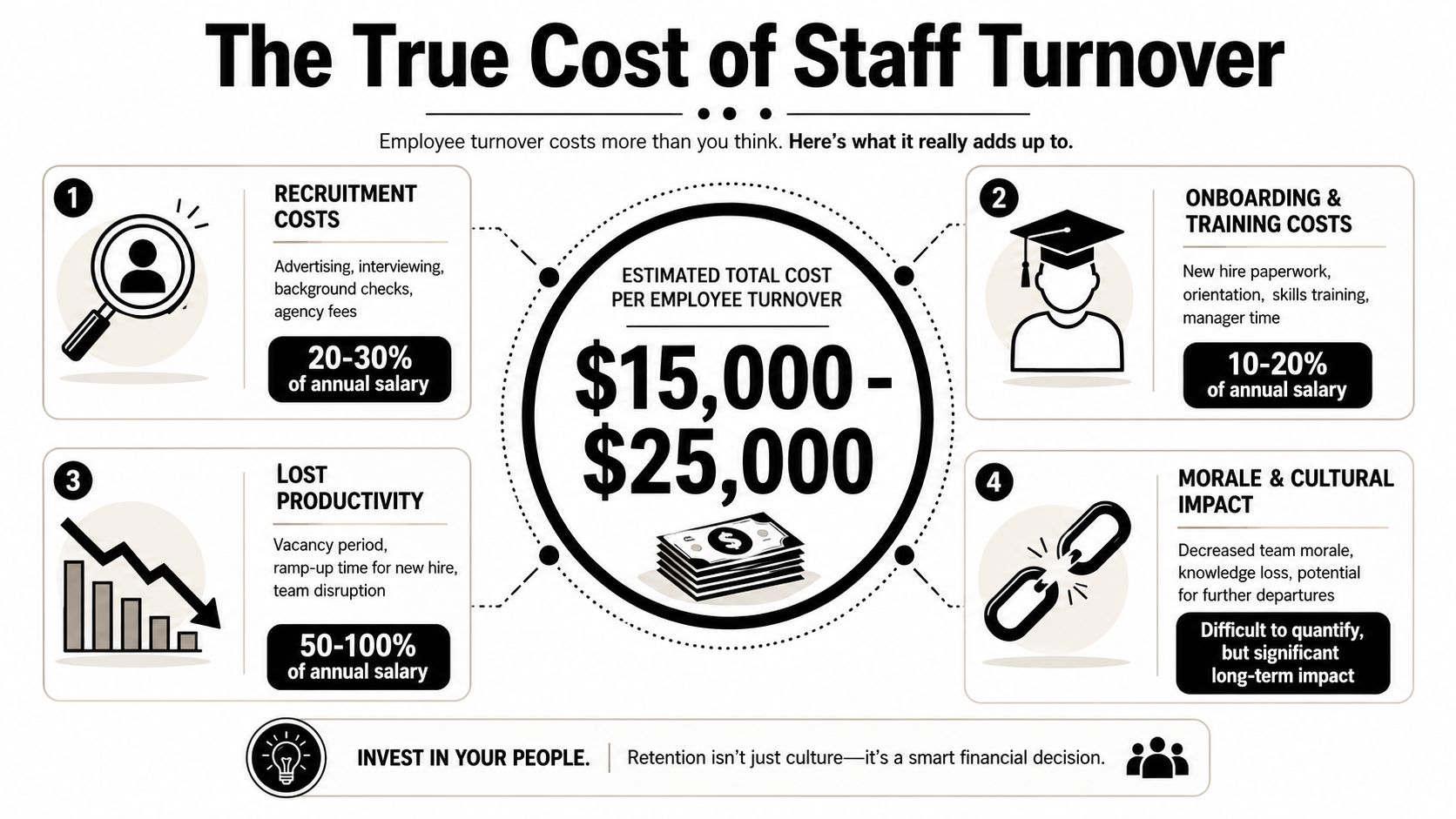
The four cost buckets founders usually miss
Break the cost into four buckets so you can see it clearly.
Separation cost includes leave payouts, exit admin, payroll changes, handover time, and management attention.
Recruitment cost includes job ads, recruiter fees if used, interview time, reference checks, induction prep, and setup.
Training and onboarding cost includes the trainer's time, the new person's lower early output, mistakes during learning, and extra supervision.
Lost productivity and opportunity cost includes slower turnaround, delayed invoices, missed orders, stock errors, customer dissatisfaction, and the drag on the rest of the team.
A useful mental model is this: the replacement doesn't step into a clean system. They inherit whatever confusion already existed. If the business relies on manual stocktakes, ad hoc rostering, spreadsheet-heavy reconciliations, and undocumented handovers, each exit multiplies the strain.
That is exactly why some firms struggle with turnover even when wages aren't the obvious problem. Australian labour data for manufacturing and wholesale SMEs points to high turnover despite above-average pay, with operational friction such as manual stocktakes and ad hoc rostering contributing to burnout and attrition.
For founders trying to justify changes internally, a simple cost-benefit worksheet helps. If you need a starting format, this resource for project approval is a practical way to structure the decision.
A practical worksheet you can use this week
Use one role as a test case. A warehouse manager or senior bookkeeper is usually a good candidate because the disruption is visible.
Cost area | What to include | Your estimate |
|---|---|---|
Separation | Leave payout, admin, exit interview, handover time | $ |
Recruitment | Ads, recruiter, interview time, setup | $ |
Training | Shadowing, manager support, lower productivity | $ |
Disruption | Delays, rework, overtime, customer issues, owner time | $ |
Total estimated turnover cost | Add all four lines | $ |
Keep this rough. Precision isn't the point. Visibility is.
Then compare that number against what you'd spend to remove one retention issue. A documented handover checklist, better rostering, clearer KPIs, or automated reporting often costs less than replacing one decent employee.
Good staff rarely leave because of one bad afternoon. They leave after repeated friction tells them the business won't get easier to work in.
This is also why profitability analysis should include workforce stability, not just pricing and expenses. If you're reviewing margin by team or function, profitability analysis for SMEs should include avoidable turnover as an operating leak.
A quick explainer on the hidden cost logic sits below.
Prioritised Retention Levers Your Accountant Will Love
Retention improves fastest when you focus on levers with direct financial impact. That usually means compensation clarity, workload control, and better operating systems. Perks can support morale, but they don't solve the reasons strong employees start scanning Seek.

Smart compensation that removes doubt
Pay doesn't need to be extravagant. It does need to feel fair, explainable, and linked to contribution.
Firms that run annual pay equity reviews and use structured pay banding tied to business drivers see voluntary turnover in finance and operations roles fall by roughly 20% compared with peers using ad hoc pay practices, according to the EEOC guidance on employee retention. The practical lesson is simple. Hidden pay logic creates suspicion. Clear pay logic reduces it.
A workable SME structure usually includes:
Role bands with a documented range for each position.
Progression criteria based on capability, reliability, and ownership of outcomes.
Variable pay rules tied to business drivers you already measure, such as collections discipline, stock accuracy, service turnaround, or reduction in write-downs.
If raises depend on who asked most recently, staff learn politics faster than performance. If raises follow a visible framework, managers can explain decisions without damaging trust.
Rostering and workload control that protects output
Founders often see rosters as an admin task. Staff experience them as a quality-of-life signal. Constant changes, late notice, and uneven shift loading tell people the business is disorganised or indifferent.
This matters most in hospitality, retail, trade, freight, and warehousing. In those environments, one poor roster sets off a chain reaction: absenteeism rises, reliable team members cover gaps, fatigue increases, errors increase, and resentment hardens.
Use a short operating checklist:
Publish schedules earlier. Staff can plan their lives, and managers spend less time renegotiating shifts.
Track recurring pressure points. If every Friday runs short, that's a planning failure, not a people problem.
Separate urgent from important work. Don't bury experienced staff in low-value admin during peak trading periods.
Review overtime by role. Persistent overtime often signals weak process design or under-resourced bottlenecks.
Systemised operations that make good staff want to stay
Many founders underestimate how much daily friction drives exits. Repeated manual reconciliations, vague handovers, duplicated data entry, and unclear KPIs make competent staff feel they're wasting effort.
The strongest retention gains often come from boring operational fixes:
Standard operating procedures for repeatable tasks such as purchase order processing, payroll cut-off, month-end close, and warehouse receiving.
Automation for repetitive reporting, invoice reminders, stock movement alerts, and approval flows.
Clean KPI ownership so each person knows what good looks like.
Operator's lens: If a person needs to ask the same process question every week, you don't have a people issue. You have a design issue.
Finance and operations intersect; every process you stabilise reduces rework, protects throughput, and lowers the emotional load on your team. That's also why virtual CFO support isn't just about reports. It's about building the operating discipline that keeps capable people productive. A useful overview sits in this piece on the virtual chief financial officer model.
Build Career Paths and Onboarding That Pay Dividends
A lot of founders think career pathing only matters in larger companies. In practice, smaller businesses need it more because ambiguity is higher. If people can't see how they grow, they start assuming the only path is out.

Why the first 90 days matter financially
Early exits are expensive because you've already paid the hiring and setup cost but haven't yet recovered value through performance. That's why onboarding isn't an HR ceremony. It's a capital protection process.
Experience-driven onboarding, with clear role expectations, peer connection, and early feedback, has been linked to an 82% improvement in new-hire retention and a 70% increase in productivity within the first year in the benchmark cited by NetSuite's retention resource. For Australian SMEs, that approach can reduce early exits by 20 to 40% in practice from the same reference.
The technical mistake many SMEs make is treating onboarding as paperwork plus software logins. A stronger approach has three parts:
First 90-day element | What it looks like in practice | Financial benefit |
|---|---|---|
Role clarity | Written outcomes, responsibilities, KPI definitions | Faster productive ramp-up |
Peer integration | Named go-to person, cross-functional introductions | Fewer avoidable errors |
Feedback rhythm | Planned check-ins and coaching | Problems corrected before they become exits |
A simple onboarding spine works well:
Day 1 to 7 focuses on role scope, key workflows, and who owns what.
Day 30 checks whether the employee understands priorities, pace, and quality standards.
Day 60 reviews capability gaps and where support is needed.
Day 90 links current performance to future growth.
How to create career movement in a smaller business
A flat structure doesn't prevent career growth. It just means progression should be built around skill depth, commercial ownership, and cross-functional range rather than title inflation.
For example, an accounts officer can progress by taking ownership of debtor follow-up, reporting accuracy, payroll reliability, or inventory support. A warehouse team leader can progress by owning receiving accuracy, pick-pack quality, supplier discrepancy resolution, or team scheduling. The key is to define the next level in terms of contribution, not vague potential.
Career ambiguity pushes people out long before pay becomes the decisive issue. Staff don't need twenty levels. They need evidence that effort leads somewhere.
A founder who can't describe what advancement looks like in their business shouldn't be surprised when staff define advancement as joining someone else's.
The most effective system is usually lightweight:
Write the current role clearly.
Define the next version of that role.
List the capabilities needed to get there.
Review progress in normal manager check-ins.
When growth is visible, retention improves because the business stops feeling like a holding pattern.
The Underrated Link Between Leadership and Retention
Leadership affects retention far more directly than many founders want to admit. Staff don't resign from an org chart. They resign from inconsistent decisions, silence, vague expectations, and repeated proof that nobody is steering properly.
When founder behaviour creates avoidable turnover
In owner-led businesses, the founder often becomes the operating system. If that founder changes priorities daily, hoards decisions, delays feedback, or disappears into urgent issues, the team feels the instability immediately.
That instability shows up as hesitation. People stop making calls because they're unsure what the boss will override. Managers stop coaching because they don't control outcomes. Strong performers get tired of carrying uncertainty for everyone else.
Australian workplaces that prioritise flexible work, mental health support, and clear career development see turnover reductions of roughly 20 to 25%, while only around 17 to 23% of Australian workers report being actively engaged, according to Benepass retention statistics. The implication for founders is practical. Flexibility and support only work when leadership makes them real through consistent decisions, not policy statements.
Leadership habits that stabilise teams
Good leadership in an SME isn't motivational theatre. It's operating discipline that reduces ambiguity.
Use habits people can feel:
Set a communication cadence. Weekly team updates and regular one-to-ones stop rumours filling the gap.
Clarify decision rights. Staff stay calmer when they know what they can decide without escalation.
Close the loop on concerns. If someone raises an issue about workload or process, respond with a decision or next step.
Run stay interviews. Ask capable people what's frustrating them before it becomes a resignation letter.
A simple stay interview works well with four questions:
Question | Why it matters |
|---|---|
What part of your work is harder than it should be? | Exposes operational friction |
What makes a good week here? | Shows what to preserve |
What would tempt you to leave? | Surfaces risk early |
What skill or responsibility do you want next? | Opens progression conversations |
One more leadership truth matters. Founders who are overloaded create overloaded teams. When the owner never has time to think, nobody gets clear priorities, clean handovers, or calm decision-making. Retention then weakens because staff feel trapped inside someone else's chaos.
A Step-by-Step Finance-First Retention Roadmap
Founders don't need a giant retention program to start. They need one disciplined sequence that turns turnover from a vague annoyance into a managed operating metric.

Step 1 Diagnose and baseline
Begin with your regrettable exits from the past year. Don't group everything together. Split by function, tenure, and likely cause. The question isn't just who left. It's where the business was most vulnerable when they did.
A useful baseline includes:
Roles lost and whether they were hard to replace
Tenure at exit so you can spot early attrition
Operational effect such as invoicing delays, stock issues, service gaps, or owner workload
Estimated turnover cost using the worksheet approach from earlier
If you have no formal career framework, note that immediately. A 2025 Australian SME hiring survey found that 67% of growth-stage SMEs had no formal career framework, while 89% of employees cited unclear advancement as a top reason they left. That makes career structure a commercial issue, not a nice extra.
Step 2 Fix one expensive friction point
Choose one issue that is both painful and solvable. Don't launch six initiatives at once.
Good first targets include:
A chaotic roster that causes repeated burnout and shift conflict.
A missing SOP for a role where handovers regularly fail.
An unclear pay process that creates distrust.
A weak onboarding flow where new hires start with confusion.
Pick the item that costs the most through rework, delay, or management firefighting. Solve that first.
Start with the friction staff complain about most often and finance feels most quickly.
Step 3 Track operational and financial return
Measure whether the change reduced drag. Don't rely on whether people say it feels better. That matters, but founders need harder signals as well.
Track items such as:
Change introduced | Operational metric | Financial readout |
|---|---|---|
Better roster process | Fewer last-minute changes | Lower overtime pressure |
Clear onboarding plan | Faster role readiness | Quicker productive contribution |
Documented SOP | Fewer repeat errors | Less rework and manager time |
Pay band clarity | Fewer disputes and surprises | Better retention in critical roles |
The exact metric depends on the issue. What matters is linking the intervention to cash, time, or margin.
Step 4 Build the next layer
Once one fix holds, add the next layer. That's how durable staff retention strategies are built in SMEs. Not through posters and slogans, but through compounding operational trust.
A practical sequence often looks like this:
First layer is removing daily friction.
Second layer is creating fairness through pay and workload clarity.
Third layer is giving people a visible path to grow.
Fourth layer is strengthening leadership rhythm so the gains stick.
Done properly, retention becomes an outcome of a better-run business. People stay because the work is organised, expectations are clear, growth is visible, and the company feels stable enough to build a future in.
If staff turnover is leaking cash out of your business, Nexist helps you find the operational and financial causes behind it. From cash flow visibility and margin analysis to SOPs, KPI design, automation, inventory process, and founder reporting cadence, the focus stays on what keeps good people productive and your business easier to run.
staff retention strategies, employee turnover, reduce staff turnover, improve profitability, business operations

" width="24px"/><g d="M 0 24.129 L 0 0.129 L 24 0.129 L 24 24.129 Z M 0 24.129 L 0 0.129 L 24 0.129 L 24 24.129 Z M 24 3 C 24 1.344 22.656 0 21 0 L 3 0 C 1.344 0 0 1.344 0 3 L 0 21 C 0 22.656 1.344 24 3 24 L 21 24 C 22.656 24 24 22.656 24 21 Z M 6.883 8.375 L 2.863 8.375 L 2.863 20.467 L 6.883 20.467 Z M 4.899 2.545 C 3.524 2.545 2.625 3.449 2.625 4.634 C 2.625 5.795 3.496 6.724 4.846 6.724 L 4.872 6.724 C 6.273 6.724 7.146 5.795 7.146 4.634 C 7.12 3.449 6.274 2.545 4.899 2.545 Z M 16.747 8.09 C 14.614 8.09 13.659 9.263 13.124 10.086 L 13.124 8.374 L 9.105 8.374 C 9.159 9.508 9.105 20.466 9.105 20.466 L 13.124 20.466 L 13.124 13.713 C 13.124 13.352 13.15 12.99 13.257 12.732 C 13.547 12.01 14.209 11.262 15.319 11.262 C 16.773 11.262 17.355 12.372 17.355 13.996 L 17.355 20.466 L 21.374 20.466 L 21.374 13.532 C 21.374 9.818 19.391 8.09 16.747 8.09 Z" fill="transparent" height="24.12890599668026px" id="dSFdkJotL" width="24px"><path d="M 0 24 L 0 0 L 24 0 L 24 24 Z" fill="transparent" height="24px" id="wscNJE44G" transform="translate(0 0.129)" width="24px"/><g d="M 0 24.129 L 0 0.129 L 24 0.129 L 24 24.129 Z M 24 3 C 24 1.344 22.656 0 21 0 L 3 0 C 1.344 0 0 1.344 0 3 L 0 21 C 0 22.656 1.344 24 3 24 L 21 24 C 22.656 24 24 22.656 24 21 Z M 6.883 8.375 L 2.863 8.375 L 2.863 20.467 L 6.883 20.467 Z M 4.899 2.545 C 3.524 2.545 2.625 3.449 2.625 4.634 C 2.625 5.795 3.496 6.724 4.846 6.724 L 4.872 6.724 C 6.273 6.724 7.146 5.795 7.146 4.634 C 7.12 3.449 6.274 2.545 4.899 2.545 Z M 16.747 8.09 C 14.614 8.09 13.659 9.263 13.124 10.086 L 13.124 8.374 L 9.105 8.374 C 9.159 9.508 9.105 20.466 9.105 20.466 L 13.124 20.466 L 13.124 13.713 C 13.124 13.352 13.15 12.99 13.257 12.732 C 13.547 12.01 14.209 11.262 15.319 11.262 C 16.773 11.262 17.355 12.372 17.355 13.996 L 17.355 20.466 L 21.374 20.466 L 21.374 13.532 C 21.374 9.818 19.391 8.09 16.747 8.09 Z" fill="transparent" height="24.12890599668026px" id="sTpjGo1tb" width="24px"><path d="M 0 24 L 0 0 L 24 0 L 24 24 Z" fill="transparent" height="24px" id="s7ffpmKOD" transform="translate(0 0.129)" width="24px"/><g d="M 24 3 C 24 1.344 22.656 0 21 0 L 3 0 C 1.344 0 0 1.344 0 3 L 0 21 C 0 22.656 1.344 24 3 24 L 21 24 C 22.656 24 24 22.656 24 21 Z M 6.883 8.375 L 2.863 8.375 L 2.863 20.467 L 6.883 20.467 Z M 4.899 2.545 C 3.524 2.545 2.625 3.449 2.625 4.634 C 2.625 5.795 3.496 6.724 4.846 6.724 L 4.872 6.724 C 6.273 6.724 7.146 5.795 7.146 4.634 C 7.12 3.449 6.274 2.545 4.899 2.545 Z M 16.747 8.09 C 14.614 8.09 13.659 9.263 13.124 10.086 L 13.124 8.374 L 9.105 8.374 C 9.159 9.508 9.105 20.466 9.105 20.466 L 13.124 20.466 L 13.124 13.713 C 13.124 13.352 13.15 12.99 13.257 12.732 C 13.547 12.01 14.209 11.262 15.319 11.262 C 16.773 11.262 17.355 12.372 17.355 13.996 L 17.355 20.466 L 21.374 20.466 L 21.374 13.532 C 21.374 9.818 19.391 8.09 16.747 8.09 Z" fill="transparent" height="24.000006px" id="D0ecaHEcW" transform="translate(0 0)" width="24px"><path d="M 24 3 C 24 1.344 22.656 0 21 0 L 3 0 C 1.344 0 0 1.344 0 3 L 0 21 C 0 22.656 1.344 24 3 24 L 21 24 C 22.656 24 24 22.656 24 21 Z" fill="rgb(55, 184, 218)" height="24.000006px" id="IPLFE6zXx" width="24px"/><path d="M 4.02 0 L 0 0 L 0 12.092 L 4.02 12.092 Z" fill="rgb(255, 255, 255)" height="12.09201px" id="FWhtzAyuY" transform="translate(2.863 8.375)" width="4.02px"/><path d="M 2.274 0 C 0.899 0 0 0.904 0 2.089 C 0 3.25 0.871 4.179 2.221 4.179 L 2.247 4.179 C 3.648 4.179 4.521 3.25 4.521 2.089 C 4.495 0.904 3.649 0 2.274 0 Z" fill="rgb(255, 255, 255)" height="4.17876px" id="VmOsKv4kO" transform="translate(2.625 2.545)" width="4.52095px"/><path d="M 7.641 0 C 5.509 0 4.554 1.173 4.019 1.996 L 4.019 0.284 L 0 0.284 C 0.053 1.419 0 12.376 0 12.376 L 4.019 12.376 L 4.019 5.623 C 4.019 5.262 4.045 4.9 4.151 4.642 C 4.442 3.92 5.103 3.172 6.214 3.172 C 7.667 3.172 8.25 4.282 8.25 5.907 L 8.25 12.376 L 12.269 12.376 L 12.269 5.442 C 12.269 1.728 10.286 0 7.641 0 Z" fill="rgb(255, 255, 255)" height="12.37626px" id="n1XUbhaq0" transform="translate(9.105 8.09)" width="12.268830000000001px"/></g></g></g></g></svg>)