Ecommerce Inventory Management for AU SMEs
Master ecommerce inventory management with our CFO-led guide for Australian SMEs. Reclaim cash flow, reduce costs, and fix profit leaks. Actionable advice.
Ansh Malhotra

Your sales are moving. Orders are going out. The warehouse looks busy. But the bank balance keeps tightening, BAS feels messier every quarter, and your team keeps discovering stock problems after the damage is done.
That's the situation for many Australian founders. You're not losing control because you don't care. You're losing it because “close enough” inventory management wrecks cash flow. Too much stock traps cash. Too little stock kills sales. Bad data makes both problems look smaller than they are until payroll, supplier payments, and returns all collide.
If you run an ecommerce brand, inventory isn't a back-office admin task. It's one of the biggest financial levers in the business. Get it right and you free up cash, protect margin, and stop firefighting. Get it wrong and you fund chaos with your own working capital.
Table of Contents
The Hidden Costs of 'Good Enough' Inventory Management
It's Monday morning. Your ad campaign starts at 9. By 10:30, your top SKU is oversold, the warehouse is questioning the pick list, and someone in finance is trying to work out why the stock value in Shopify doesn't match the balance sheet. By Friday, you've paid for replacement freight, refunded annoyed customers, and pushed a supplier payment because too much cash is sitting in the wrong products.
That is what “good enough” inventory management looks like in an Australian SME. It doesn't fail all at once. It drains cash in small, expensive ways that founders often write off as normal growing pains.
From a CFO's seat, inventory is not a back-of-house admin task. It is a working-capital asset that decides how quickly cash returns to the bank, how cleanly gross margin shows up in reporting, and how much time your team wastes fixing avoidable errors. If you already track revenue and bank balance, add a tighter set of business performance indicators for growing companies around stock. Otherwise, inventory keeps distorting the numbers you rely on.
What “good enough” usually looks like
For Australian ecommerce and wholesale brands, the pattern is predictable:
Stock records lag reality. The system shows units available that cannot be picked, sold, or shipped.
Buying decisions are reactive. Purchase orders go out when someone gets nervous, not when lead times, sell-through, and margin support the order.
True product margin stays hidden. Freight, shrinkage, write-offs, returns, and rush replenishment costs sit outside SKU-level reporting.
Inventory problems usually start in the handoff between finance, operations, and fulfilment. Each team is working hard. They are just not working from the same stock truth.
The real cost sits below the surface
Poor inventory control rarely appears as one obvious expense. It shows up across the P&L, the balance sheet, and your calendar.
Hidden cost | What it does to the business |
|---|---|
Cash tied up in the wrong SKUs | You fund slow stock while stronger lines wait for budget |
Margin leakage | Write-downs, discounts, rush freight, and split shipments chip away at gross profit |
Operational waste | Staff spend hours recounting, adjusting, chasing discrepancies, and handling preventable customer issues |
Forecasting errors | Bad stock data leads to bad purchasing, which creates the next round of mistakes |
Reporting distortion | Stock value, COGS, GST treatment, and BAS inputs become less reliable |
This matters more in Australia because replenishment mistakes are expensive. Supplier lead times are often longer, inbound freight is volatile, and many founders are balancing local sales with imported stock that has already tied up cash weeks before it lands.
A practical sign that your system is underperforming is simple. The team talks about stock every day, but nobody can answer basic questions quickly. Which SKUs are carrying too much cash? Which categories are turning well? Which lines are being kept alive by discounting? If those answers take hours to pull together, control is weaker than it should be.
You also need to watch sell-through closely. Strong strategies for improving inventory sell-through help you move stock faster, cut markdown risk, and stop working capital from sitting idle.
Good enough inventory management feels manageable right up until cash gets tight. Then every count error, late reorder, and margin blind spot lands at once.
The Three Numbers That Define Your Inventory Health
Most founders track revenue, ad spend, and bank balance. Fine. But if you run an inventory-heavy business, those numbers don't tell you whether stock is helping or choking the business.
You need three operating numbers that explain what inventory is doing to cash. Keep them visible in the same reporting pack as sales and gross margin. If they sit in a warehouse report nobody reads, they won't change behaviour.
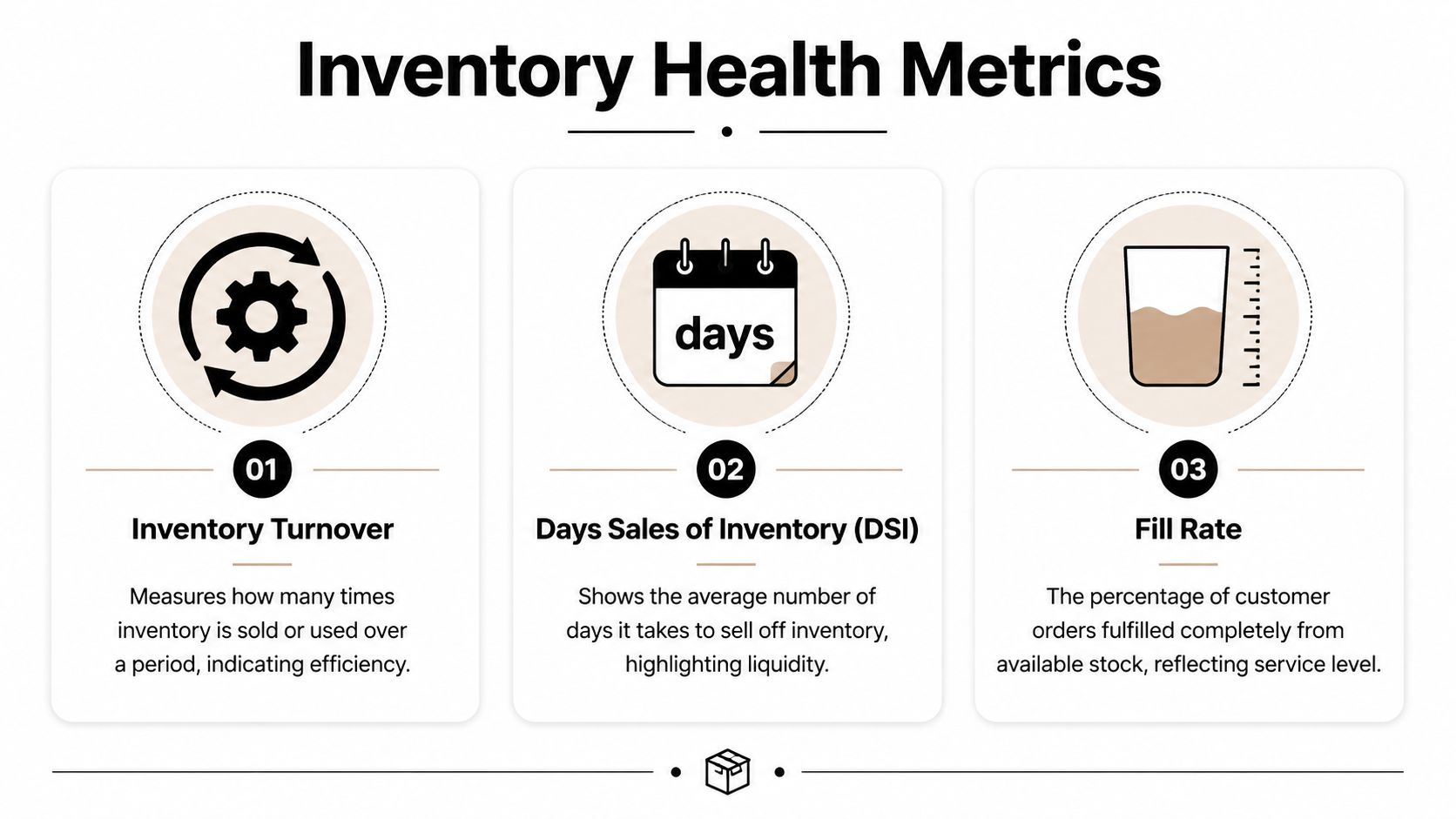
Inventory turnover tells you how fast cash comes back
Inventory turnover tells you how many times you sell through your stock over a period. Think of it as your stock's speed. Faster turnover usually means cash returns to the business sooner.
A practical formula is:
Inventory Turnover = Cost of Goods Sold / Average Inventory
If turnover is low, cash is sitting on shelves too long. If it's high, stock is moving efficiently, assuming you're not causing constant stockouts.
Use turnover to compare categories, not just the whole business. Apparel, beauty, spare parts, and wholesale lines all behave differently. A blended company-wide number can hide weak SKUs.
Days sales of inventory shows how long cash sits still
Days Sales of Inventory (DSI) converts stock into time. It answers one blunt question: how many days does it take to turn inventory into sales?
A practical formula is:
DSI = Average Inventory / Cost of Goods Sold × Number of Days
If turnover is speed, DSI is delay. Founders usually understand DSI faster because it links directly to working capital. The higher it is, the longer your cash is locked up.
Track it monthly. Then ask:
Which SKUs have a bloated DSI: These are the products draining cash.
Which suppliers create longer holding periods: Long lead times often force over-ordering.
Which ranges need action: Markdown, bundle, discontinue, or move to lower reorder settings.
If you need a sharper reporting framework around these kinds of metrics, business performance indicators for founders is a useful reference point.
Fill rate reveals whether your stock is actually serving customers
A lot of founders obsess over what's in the warehouse and ignore what customers experience. Fill rate fixes that. It measures the share of customer orders fulfilled completely from available stock.
A practical formula is:
Fill Rate = Orders fulfilled completely from stock / Total customer orders
Ecommerce inventory management makes the process commercial rather than just operational. A healthy warehouse with a poor fill rate isn't healthy. It's just full.
Practical rule: If your team celebrates “having plenty of stock” while customers still hit unavailable items, your buying is misaligned with demand.
For product teams trying to connect stock decisions to demand quality, these strategies for improving inventory sell-through are worth reviewing alongside turnover and fill rate. Sell-through sharpens the conversation around what moves, not what you hoped would move.
What to watch together
Don't review these in isolation. Use them as a group.
Metric | What it tells you | Bad sign |
|---|---|---|
Inventory turnover | How fast stock converts into sales | Slow-moving cash |
DSI | How long stock sits before selling | Cash tied up too long |
Fill rate | How often customer demand is met from stock | Revenue leaking through poor availability |
If turnover is weak and DSI is high, you've got too much stock. If turnover looks strong but fill rate is poor, you may be underbuying key lines and overbuying the wrong ones. That's why dashboard design matters. One metric alone can flatter a broken operation.
Where Profit Leaks Common Failure Points for AU Brands
It usually starts the same way. A founder sees cash tightening, the warehouse still looks full, and BAS time rolls around with more GST already paid on stock that has not turned into sales. The problem is not demand alone. It is inventory decisions that looked harmless month by month and then piled up on the balance sheet.

Overstocking drains cash first
Overstocking is usually framed as an operations issue. It is a cash issue first.
For Australian brands, that matters more because replenishment is often shaped by offshore suppliers, container timing, customs delays, and uneven local demand around EOFY, Black Friday, and Christmas. Founders respond by buying wide and buying early. That feels prudent. It usually leaves cash parked in the wrong SKUs, higher storage costs, and margin pressure when discounting starts.
The pattern is easy to spot:
Large purchase orders with no SKU ranking: cash gets spread across average lines instead of protecting the products that drive most revenue and gross profit.
One safety stock rule for everything: fast movers and weak sellers get treated the same, which is lazy buying.
Repeated reorders of poor performers: old decisions stay alive because nobody wants to write down a bad bet.
This is the part many teams miss. Excess inventory also distorts GST and BAS planning. You have already paid for the stock, and in many cases paid GST on related costs, but the sale and margin recovery arrive much later than expected. Bank balance down. Storage cost up. No commercial upside.
Stockouts waste more than revenue
A stockout does not just remove one sale. It wastes the marketing spend that created demand, pushes customers to competitors, and leaves your team scrambling to explain avoidable misses.
This hurts Australian SMEs harder because long inbound lead times leave little room to recover from a bad forecast. If your supplier timing slips and your reorder point was built off stale assumptions, the problem shows up weeks later in missed fulfilment during your most expensive campaign periods.
Treat every stockout on a core SKU as a finance problem, not a warehouse inconvenience. You already paid for ads, wages, platform fees, and agency support to generate that order. If the item is unavailable, that spend did not produce its expected return.
If a promoted SKU is out of stock, the campaign did not fail. The buying decision failed earlier.
Bad data creates false confidence
Bad inventory data is expensive because it looks believable right up until the moment it breaks fulfilment, reporting, or purchasing.
In ecommerce businesses, the mess usually sits between systems. Shopify says one thing. Xero says another. The warehouse has its own count. A spreadsheet sits on someone's desktop with manual fixes no one fully trusts. Then returns come back late, damages are not booked correctly, and stock adjustments happen outside any controlled process.
Common causes include:
Damages and shrinkage not recorded on time
Picking and receiving errors
Returns sitting in limbo
Manual stock overrides with no audit trail
Separate records across sales, finance, and warehouse systems
From a CFO view, bad data slows every decision that matters. Purchasing hesitates. Reporting loses credibility. Cash forecasting gets weaker because inventory value is wrong. Margin analysis gets muddied by write-offs and emergency freight that should have been visible earlier.
What these leaks look like in practice
Failure point | What you see in the business | What it does to the numbers |
|---|---|---|
Overstocking | Warehouse looks busy, slow lines keep piling up | Cash trapped in stock, more discounting, weaker gross margin |
Stockouts | Best sellers disappear during live campaigns | Lost sales, lower ad ROI, lower customer repeat rate |
Bad data | Staff checking counts by hand before every decision | Delayed purchasing, unreliable inventory valuation, poor cash forecasting |
Fix the leak you have, not the one your team finds easiest to discuss. Full shelves can hide weak stock quality. Strong sales can hide repeated stockouts. Clean-looking dashboards can hide broken inventory records.
Start with the failure point that is costing you cash today.
Your Toolkit for Inventory Optimisation
A founder usually reaches this point after the same ugly month. Sales look healthy. Cash feels tight. The warehouse says stock is low on winners and full of slow lines. Finance cannot tell you, with confidence, what inventory is worth right now. That is not an ops problem. It is a cash control problem.
Use a small set of tools well. That will put more money back into the business than another rushed PO or another end-of-month stocktake.
Start with ABC analysis
ABC analysis tells you where management attention should go first. For an Australian SME, that matters because working capital is limited, inbound freight is expensive, and dead stock steadily drags down margin quarter after quarter.
Bloomreach's article on ecommerce inventory management techniques explains the standard approach. Rank SKUs by revenue contribution, split them into A, B, and C groups, and review the top group more often because it drives most of the result.
Use it like this:
Export your full SKU list with units sold, revenue, and gross margin if available.
Rank SKUs by annual revenue, then sense-check with margin and sell-through.
Classify A-items as the products that deserve the fastest decisions and the tightest controls.
Set review frequency by class so your team is not treating a slow seller like a core line.
Direct purchasing cash to A-items first and challenge every repeat buy on C-items.
Revenue is only the start. A CFO view looks at gross margin, stock cover, and cash tied up per SKU. If a product sells well but chews through freight, returns, or discounting, it does not deserve blind priority. If you need a clearer finance-led view of where inventory is draining cash, a virtual CFO for Australian ecommerce businesses can help set those rules properly.
Build reorder points that reflect reality
Reorder points should come from actual demand and actual lead times. Guesswork is how founders end up paying for emergency air freight right before BAS is due.
A practical formula is:
Reorder Point = Average Daily Sales × Lead Time + Safety Stock
You can use the same logic to set a par level:
Par Level = Average Daily Sales × Lead Time + Safety Stock
The formula is simple. The discipline is harder.
Average daily sales should be adjusted for campaign periods, seasonality, and channel mix. Lead time should reflect what suppliers deliver, not what they promise on the PO. Safety stock belongs on SKUs where a stockout damages contribution margin, ad efficiency, or repeat purchase behaviour.
Use different settings for different item types. Your bestseller, your seasonal gift line, and your long-tail accessory should not share one reorder rule.
Here's a useful explainer before you automate the process:
Use demand forecasting with judgement
Forecasting should improve buying decisions, not create false confidence.
Historical sales are your base case. Then adjust for the things that matter in Australia:
EOFY, Boxing Day, Click Frenzy, and Black Friday spikes
Promotions, bundles, and product launches
Supplier delays, port congestion, or changes in inbound freight timing
Marketplace shifts across Shopify, Amazon, or wholesale
Cash limits, warehouse capacity, and GST timing around stock purchases
Founders often get caught at this stage. A spreadsheet can produce a neat forecast that ignores the actual trading plan and the actual bank balance. Buy to the forecast alone and you can still over-order.
Good forecasting gives you a better purchase decision. It does not remove the need for judgement.
Protect accuracy with cycle counting
Cycle counting keeps inventory records usable between full stocktakes. That matters because every purchasing decision, margin report, and balance sheet number depends on the stock file being close to reality.
Run cycle counts as an operating routine, not a once-a-year clean-up. Count high-value and high-velocity SKUs more often. Investigate variances quickly. Fix the process that caused the error, whether that sits in receiving, picking, returns, or manual adjustments.
A simple rhythm works:
SKU class | Count frequency | Why it matters |
|---|---|---|
A-items | Daily or very frequent checks | Protect the products that drive revenue and cash generation |
B-items | Weekly | Catch drift before it affects purchasing and reporting |
C-items | Monthly | Keep control without wasting labour on low-impact stock |
Track one number every week: inventory accuracy by SKU class. Then reconcile the stock movement back to finance so your inventory valuation, GST reporting, and BAS inputs are not built on bad records.
Cycle counting is repetitive. Do it anyway. It saves cash, cuts fire drills, and gives you numbers you can run the business on.
Choosing Your Tech Stack From Spreadsheets to Systems
It is 4:45 pm on a Thursday. Your warehouse says a best-seller is in stock, Shopify says two units left, Xero shows a different inventory value again, and your buyer is asking whether to place the next PO before the supplier cutoff. That is not a software problem first. It is a cash control problem.
A spreadsheet works for a small SKU count and a simple sales flow. Once you add multiple channels, returns, supplier lead times, and month-end reporting, it stops being a tool and starts becoming a risk. The cost shows up in rush freight, mis-timed purchase orders, margin errors, and founder time spent reconciling numbers that should already match.
Where spreadsheets break
The failure point is not that spreadsheets are basic. The failure point is that they do not hold one live stock record that operations and finance can trust at the same time.
They struggle with barcode-driven movements, version control, user permissions, and audit trails. They also make it far too easy to run side files for POs, returns, or landed costs. That is how your warehouse team, ecommerce team, and finance team end up working off three different answers.
If these questions come up every week, replace the spreadsheet:
What is available to sell right now
Was that customer return restocked, written off, or left in limbo
Which purchase order changed the unit cost on this SKU
Why does the stocktake not match the balance sheet
Build the stack that keeps stock and cash aligned
Do not buy a bloated system because a vendor promised scale. Buy the smallest stack that gives you accurate stock movement, clean financial postings, and usable reporting.
At minimum, your setup should cover these jobs:
Component | Job |
|---|---|
Ecommerce platform | Captures orders and channel demand |
Inventory management system | Maintains SKU records, stock availability, reordering, and cost data |
Warehouse management system | Controls receiving, barcode scans, picks, putaway, and dispatch |
Accounting platform | Records inventory value, COGS, GST treatment, and month-end truth |
Integration matters more than feature count. A sale, receipt, return, or adjustment should update stock records and financial records from the same event, not through a manual cleanup at month-end.
For an Australian founder, that means choosing systems that can cope with BAS timing, GST treatment, landed costs, and local freight reality. If your stock moves today but finance catches up next week, your margin reporting is late and your cash decisions are worse than they need to be.
Good systems also make funding decisions cleaner. If you are dealing with supplier terms or trade finance across regions, this piece on unlocking working capital for MENA suppliers is a useful example of how inventory visibility affects financing conversations.
If you need help selecting and wiring the stack so the numbers work for management reporting, not just warehouse operations, get support from a team that handles virtual CFO and growth accounting for Australian SMEs. The right setup saves hours every week and gives you a stock number you can use with confidence.
The CFO's Roadmap to Reclaiming Cash and Margin
Founders often treat inventory as an ops issue until the cash crunch forces a finance conversation. That's too late. Inventory should be governed like a balance sheet asset from the start.
The CFO view is simple. Every unit on the shelf represents cash that has already left the bank. The job is to make sure that cash comes back fast, accurately, and with margin intact.
Govern inventory like a financial asset
You need rules. Not broad intentions. Real rules.
Write SOPs for:
Receiving stock: What gets checked, scanned, and booked in on arrival
Putaway and storage: Where items go and how location accuracy is maintained
Picking and packing: How errors are prevented and recorded
Returns: How returned stock is assessed, restocked, quarantined, or written off
Adjustments: Who can change stock counts and why
Inventory failure usually starts with process drift. A warehouse team makes practical workarounds. Finance never hears about them. Then reporting stops matching reality.
A good SOP doesn't need to be long. It needs to be followed.
Fix GST and BAS at the stock level
This is the part many founders miss completely. Bad inventory management doesn't just create operational headaches. It can distort GST treatment, BAS reporting, and cash timing.
A key Australian SME risk is that inventory mismanagement triggers BAS errors and cash flow disruption. Manual tracking amplifies GST misreporting, while automated inventory system integration can reduce errors to under 2%, according to this analysis of common ecommerce inventory mistakes.
That matters in practice because:
Returns can be mishandled: GST treatment gets disconnected from the physical stock event.
Multi-location stock gets messy: One warehouse records movement differently from another.
Manual journals create phantom certainty: The BAS gets lodged, but the stock record is still wrong.
Unsynced systems delay cash: Refunds, credits, and inventory write-downs don't line up cleanly.
If you want cleaner BAS, fix the stock workflow behind it. Don't wait for the accountant to patch it at quarter end.
The ATO doesn't care whether your stock issue started in the warehouse. It only sees the reporting outcome.
This is also why working capital thinking matters beyond Australia. If you want a broader perspective on stock as a finance lever, this piece on unlocking working capital for MENA suppliers is useful because it frames inventory in the language founders should care about most: liquidity.
CFO's Inventory Optimisation Roadmap
Phase | Objective | Key Actions | Primary Metric |
|---|---|---|---|
Stabilise | Restore trust in the numbers | Clean SKU master data, stop manual side files, implement receiving and returns SOPs | Inventory accuracy |
Prioritise | Put cash behind the right products | Run ABC analysis, review slow movers, tighten purchasing on weak SKUs | Inventory turnover |
Automate | Reduce manual decisions and reporting lag | Integrate ecommerce, WMS, and accounting systems, automate barcode-based updates | Fill rate |
Govern | Keep gains from slipping | Monthly KPI review, owner-level approval for exceptions, BAS checks tied to stock movement | Cash conversion visibility |
For founders thinking beyond business operations into personal financial decision-making, private wealth advisory thinking for business owners is relevant because inventory discipline affects not just company cash, but how much real wealth ever leaves the business.
Your First Steps to Smarter Inventory Management
You don't need a six-month transformation project to start. You need a short list of actions that expose the truth fast.
Do these in the next seven days and you'll get more value than another month of guessing.

What to do in the next seven days
Pull your top SKUs by revenue
Don't start with the full catalogue. Start with the products that matter most. Identify your clear A-items and check whether current stock, supplier lead times, and reorder settings make sense.
Calculate turnover, DSI, and fill rate
Even rough first-pass numbers will tell you a lot. If one category is moving slowly while another keeps stocking out, you've already found a cash allocation problem.
Walk the warehouse yourself
Spend thirty minutes looking for practical friction. Check damaged stock, unlabeled locations, returns piles, and products the system says are available but staff can't find quickly.
Review one purchase order from start to finish
Trace it from order creation through receipt, stock update, sale, and accounting entry. You're looking for delay points, duplicate handling, and places where data gets rekeyed.
List every place inventory lives
Include Shopify, marketplaces, spreadsheets, accounting software, WMS tools, and staff-held files. If stock exists in multiple places, errors aren't accidental. They're built into the process.
Choose one rule to enforce immediately
Good options are simple. No manual stock adjustments without approval. No receipts booked without barcode confirmation. No returns restocked before inspection. Pick one and stick to it.
Start with control, not complexity. A tighter process beats a more expensive app that nobody uses properly.
The businesses that win at ecommerce inventory management don't have perfect demand, perfect suppliers, or perfect software. They have discipline. They know which SKUs deserve cash, which reports matter, and where bad process is draining margin.
If that isn't in place yet, fix that first.
If you want help turning stock chaos into clean reporting, tighter cash flow, and a practical action plan, Nexist helps Australian founders find the cash leaks, build the right controls, and install a finance-first operating rhythm that scales.
ecommerce inventory management, inventory management australia, sme cash flow, virtual cfo, stock optimisation

" width="24px"/><g d="M 0 24.129 L 0 0.129 L 24 0.129 L 24 24.129 Z M 0 24.129 L 0 0.129 L 24 0.129 L 24 24.129 Z M 24 3 C 24 1.344 22.656 0 21 0 L 3 0 C 1.344 0 0 1.344 0 3 L 0 21 C 0 22.656 1.344 24 3 24 L 21 24 C 22.656 24 24 22.656 24 21 Z M 6.883 8.375 L 2.863 8.375 L 2.863 20.467 L 6.883 20.467 Z M 4.899 2.545 C 3.524 2.545 2.625 3.449 2.625 4.634 C 2.625 5.795 3.496 6.724 4.846 6.724 L 4.872 6.724 C 6.273 6.724 7.146 5.795 7.146 4.634 C 7.12 3.449 6.274 2.545 4.899 2.545 Z M 16.747 8.09 C 14.614 8.09 13.659 9.263 13.124 10.086 L 13.124 8.374 L 9.105 8.374 C 9.159 9.508 9.105 20.466 9.105 20.466 L 13.124 20.466 L 13.124 13.713 C 13.124 13.352 13.15 12.99 13.257 12.732 C 13.547 12.01 14.209 11.262 15.319 11.262 C 16.773 11.262 17.355 12.372 17.355 13.996 L 17.355 20.466 L 21.374 20.466 L 21.374 13.532 C 21.374 9.818 19.391 8.09 16.747 8.09 Z" fill="transparent" height="24.12890599668026px" id="dSFdkJotL" width="24px"><path d="M 0 24 L 0 0 L 24 0 L 24 24 Z" fill="transparent" height="24px" id="wscNJE44G" transform="translate(0 0.129)" width="24px"/><g d="M 0 24.129 L 0 0.129 L 24 0.129 L 24 24.129 Z M 24 3 C 24 1.344 22.656 0 21 0 L 3 0 C 1.344 0 0 1.344 0 3 L 0 21 C 0 22.656 1.344 24 3 24 L 21 24 C 22.656 24 24 22.656 24 21 Z M 6.883 8.375 L 2.863 8.375 L 2.863 20.467 L 6.883 20.467 Z M 4.899 2.545 C 3.524 2.545 2.625 3.449 2.625 4.634 C 2.625 5.795 3.496 6.724 4.846 6.724 L 4.872 6.724 C 6.273 6.724 7.146 5.795 7.146 4.634 C 7.12 3.449 6.274 2.545 4.899 2.545 Z M 16.747 8.09 C 14.614 8.09 13.659 9.263 13.124 10.086 L 13.124 8.374 L 9.105 8.374 C 9.159 9.508 9.105 20.466 9.105 20.466 L 13.124 20.466 L 13.124 13.713 C 13.124 13.352 13.15 12.99 13.257 12.732 C 13.547 12.01 14.209 11.262 15.319 11.262 C 16.773 11.262 17.355 12.372 17.355 13.996 L 17.355 20.466 L 21.374 20.466 L 21.374 13.532 C 21.374 9.818 19.391 8.09 16.747 8.09 Z" fill="transparent" height="24.12890599668026px" id="sTpjGo1tb" width="24px"><path d="M 0 24 L 0 0 L 24 0 L 24 24 Z" fill="transparent" height="24px" id="s7ffpmKOD" transform="translate(0 0.129)" width="24px"/><g d="M 24 3 C 24 1.344 22.656 0 21 0 L 3 0 C 1.344 0 0 1.344 0 3 L 0 21 C 0 22.656 1.344 24 3 24 L 21 24 C 22.656 24 24 22.656 24 21 Z M 6.883 8.375 L 2.863 8.375 L 2.863 20.467 L 6.883 20.467 Z M 4.899 2.545 C 3.524 2.545 2.625 3.449 2.625 4.634 C 2.625 5.795 3.496 6.724 4.846 6.724 L 4.872 6.724 C 6.273 6.724 7.146 5.795 7.146 4.634 C 7.12 3.449 6.274 2.545 4.899 2.545 Z M 16.747 8.09 C 14.614 8.09 13.659 9.263 13.124 10.086 L 13.124 8.374 L 9.105 8.374 C 9.159 9.508 9.105 20.466 9.105 20.466 L 13.124 20.466 L 13.124 13.713 C 13.124 13.352 13.15 12.99 13.257 12.732 C 13.547 12.01 14.209 11.262 15.319 11.262 C 16.773 11.262 17.355 12.372 17.355 13.996 L 17.355 20.466 L 21.374 20.466 L 21.374 13.532 C 21.374 9.818 19.391 8.09 16.747 8.09 Z" fill="transparent" height="24.000006px" id="D0ecaHEcW" transform="translate(0 0)" width="24px"><path d="M 24 3 C 24 1.344 22.656 0 21 0 L 3 0 C 1.344 0 0 1.344 0 3 L 0 21 C 0 22.656 1.344 24 3 24 L 21 24 C 22.656 24 24 22.656 24 21 Z" fill="rgb(55, 184, 218)" height="24.000006px" id="IPLFE6zXx" width="24px"/><path d="M 4.02 0 L 0 0 L 0 12.092 L 4.02 12.092 Z" fill="rgb(255, 255, 255)" height="12.09201px" id="FWhtzAyuY" transform="translate(2.863 8.375)" width="4.02px"/><path d="M 2.274 0 C 0.899 0 0 0.904 0 2.089 C 0 3.25 0.871 4.179 2.221 4.179 L 2.247 4.179 C 3.648 4.179 4.521 3.25 4.521 2.089 C 4.495 0.904 3.649 0 2.274 0 Z" fill="rgb(255, 255, 255)" height="4.17876px" id="VmOsKv4kO" transform="translate(2.625 2.545)" width="4.52095px"/><path d="M 7.641 0 C 5.509 0 4.554 1.173 4.019 1.996 L 4.019 0.284 L 0 0.284 C 0.053 1.419 0 12.376 0 12.376 L 4.019 12.376 L 4.019 5.623 C 4.019 5.262 4.045 4.9 4.151 4.642 C 4.442 3.92 5.103 3.172 6.214 3.172 C 7.667 3.172 8.25 4.282 8.25 5.907 L 8.25 12.376 L 12.269 12.376 L 12.269 5.442 C 12.269 1.728 10.286 0 7.641 0 Z" fill="rgb(255, 255, 255)" height="12.37626px" id="n1XUbhaq0" transform="translate(9.105 8.09)" width="12.268830000000001px"/></g></g></g></g></svg>)