
Supplier Negotiation: A 2026 Playbook for SMEs
Master supplier negotiation with our 2026 playbook for Australian SMEs. Learn prep, tactics, contracts, KPIs & templates.
Ansh Malhotra

You've probably had this conversation recently. A supplier emails a price rise, shortens a payment window, or pushes your delivery slot out by another week. You know the margin pressure is real, but you also know you can't switch overnight without risking stockouts, customer delays, or a warehouse full of the wrong inventory.
That's where most Australian SMEs get stuck. They treat supplier negotiation as a one-off price conversation, when it's really a cash flow conversation, an inventory conversation, and often a survival conversation. For inventory-heavy businesses, the missed opportunity usually isn't only the unit cost. It's the timing of buys, the shape of order volumes, the mix across SKUs, the data you share, and whether you negotiate when the supplier actually has an incentive to move.
Generic advice tends to stop at “ask for a discount”. In practice, better outcomes usually come from showing a supplier something useful: what sells, when demand spikes, which lines are stable, which orders can be forecast, and what commitment you can make if they meet you on terms. Seasonal timing matters too. Quiet periods create room for a different conversation, especially when a supplier wants forward volume and cleaner production planning.
Table of Contents
Why Supplier Negotiation Matters for Australian SMEs
A wholesaler can look profitable on paper and still feel constantly squeezed. Stock arrives late, customers want immediate fulfilment, cash is tied up in slow-moving lines, and supplier terms don't match the sales cycle. The owner keeps buying to avoid shortages, but every extra pallet pushes more working capital into the warehouse.
That's why supplier negotiation matters far beyond the headline price. A better deal might mean a smaller minimum order quantity, a more realistic lead time, a rebate tied to actual throughput, or payment terms that line up with when customers pay you. Each one changes how much cash sits in stock and how much flexibility you keep when demand shifts.
For Australian SMEs, this matters most in businesses where inventory mistakes are expensive. Ecommerce brands feel it when they overbuy around peak periods. Importers feel it when a late container creates a chain reaction. Manufacturers feel it when one component holds up finished goods. In all three cases, a weak supplier agreement can trap profit in stock and turn routine purchasing into daily firefighting.
A stronger negotiation approach gives you room to manage those trade-offs properly. Instead of arguing only about cents per unit, you start reshaping the commercial structure around what drives margin and service.
Practical rule: If a supplier discussion doesn't touch payment timing, lead times, service levels, forecast visibility, or volume flexibility, you're probably negotiating too narrowly.
There's also a resilience angle. Businesses with clearer supplier terms usually recover faster when demand changes or supply gets messy, because they've already set expectations around communication, delivery windows, substitutions, and review points. If supplier risk is already showing up in your operations, it's worth tightening both the deal and the process around it, alongside broader work on supply chain resilience for Australian businesses.
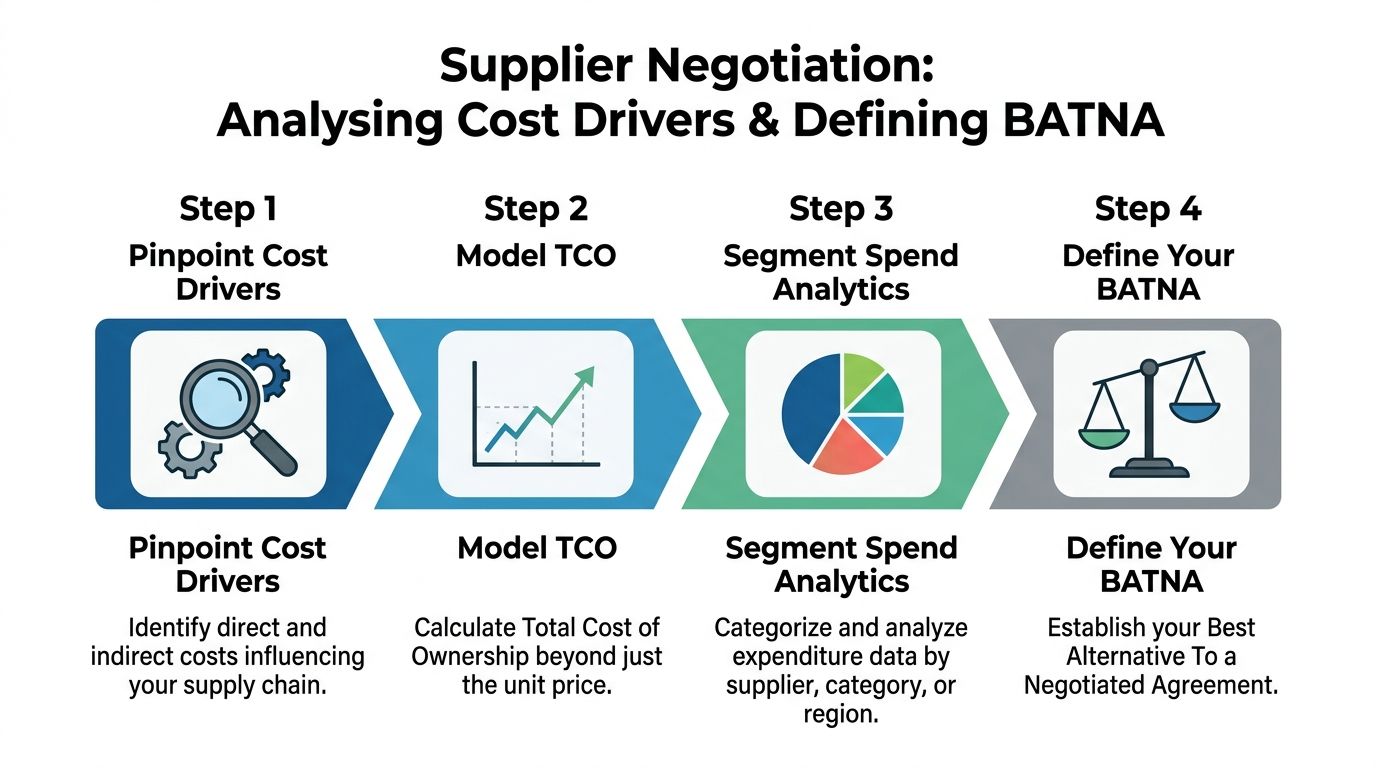
Analyse Cost Drivers and Define Your BATNA
Most poor supplier negotiation starts with the wrong number. Owners fixate on the unit price because it's visible, but the actual cost usually sits across freight, ordering frequency, holding cost, defects, stockouts, payment timing, and rework. You need the full picture before you ask for a better deal.
Australian procurement specialists describe a step-by-step supplier negotiation method that begins with Total Cost of Ownership, then moves into spend analytics, supplier cost understanding, BATNA, and data-backed sequencing. That approach is reported to achieve a 22-28% cost reduction success rate, and 75% of Australian SMEs achieve better terms when they share projected sales volumes and seasonal peaks with suppliers, according to Australian negotiation guidance from CMA Consulting.
Start with total cost, not the unit line
Pull twelve months of purchasing and sales data first. If you use Xero, Cin7, Unleashed, DEAR Systems, Shopify, NetSuite, or MYOB, export by SKU, supplier, order date, receipt date, and gross margin. Then sort your spend by product family, season, and stock velocity.
What you're looking for isn't just “who is expensive”. It's where cost behaves badly. A cheap supplier with unreliable lead times can force buffer stock. A low unit cost tied to a large MOQ can flood your warehouse with slow movers. A supplier who won't split shipments can create unnecessary inbound freight spikes and storage pressure.
Use a prep sheet that separates four categories:
Must-have outcomes like fill-rate reliability, quality thresholds, or workable payment terms.
Nice-to-have improvements such as marketing support, packaging changes, or exclusive variants.
Variables you can trade including order timing, volume commitments, forecast visibility, or product mix.
Non-negotiables such as compliance requirements or service standards tied to your customers.
A simple cost-driver review often reveals where negotiating advantage lies. For inventory-heavy SMEs, this advantage usually comes from concentration. If a handful of SKUs represent most of your spend or margin, negotiations should start there, not across the whole catalogue. For ecommerce operators, inventory management discipline in fast-moving channels usually makes the negotiation prep far sharper because you can show what turns and what only looks attractive in a supplier price list.
Build a BATNA you can actually use
A BATNA isn't a slogan. It's the practical alternative you can execute if the supplier won't move. That might be a second approved supplier, a temporary product substitution, a staggered order plan, or a decision to reduce range complexity and buy deeper on fewer lines.
Write it down in plain language:
Question | What to define |
|---|---|
If this supplier refuses terms, what will we buy instead? | Alternate supplier, alternate SKU, or reduced range |
What service impact can we tolerate? | Longer lead time, lower range breadth, or temporary substitution |
What cash impact can we tolerate? | Higher upfront outlay, lower MOQ flexibility, or more freight |
What is our walk-away point? | The exact term set that makes the deal uneconomic |
That last line matters. Too many owners say they'll walk, then keep conceding because there's no documented threshold.
The strongest BATNA is the one operations can actually execute next month, not the one that looks good in a spreadsheet.
Before the meeting, build a one-page negotiation brief. Include your top SKUs, seasonal peaks, current terms, target terms, concession order, and walk-away point. If you can't summarise your case in one page, you're probably not ready.
Map Key Negotiation Levers for Maximum Impact
Once the prep is done, stop treating supplier negotiation as a single lever. Price matters, but in most SME deals, the strongest outcome comes from combining several smaller changes that improve margin and cash at the same time.
Australian buyers now negotiate in a much more data-rich environment. In Australia, approximately 97% of buyers use AI tools or agentic AI to review contracts, select suppliers, compare proposals, and support price negotiations. The same reporting notes that this is above the global average of 89% for generative AI use in late-stage buying activities, while 43% of Australian organisations use internal GenAI tools during negotiation and 47% use AI agents to automate information gathering for project justification, according to ARN's coverage of Gartner's findings on AI in the tech buying cycle.

That changes the standard. Suppliers can validate market prices faster, compare your request against competitor norms, and test whether your proposal is commercially credible. If you turn up asking for “a better deal” without structure, you'll lose ground quickly.
The levers that change cash flow fastest
For most inventory-heavy SMEs, the highest-impact levers are these:
Minimum order quantities. Lower MOQs can reduce overstock risk, especially on seasonal or slower lines.
Payment terms. Extended terms can align cash outflows with sell-through, which matters more than a nominal discount in many retail and wholesale models.
Lead times. Shorter or more predictable lead times reduce the need for safety stock.
Volume brackets. A supplier may hold pricing if you commit volume across a quarter instead of one order.
Rebates and back-end credits. These work when purchasing is stable and finance tracks them properly.
Consignment or staged delivery. Useful where warehouse space is tight or demand is uneven.
Service levels. Fill-rate expectations, order accuracy, and communication standards often protect margin better than another small price concession.
Here's a practical way to rank them:
Lever | Best use case | Main trade-off |
|---|---|---|
MOQ reduction | Seasonal or broad SKU range | Supplier may seek higher unit pricing |
Longer payment terms | Fast sell-through, tight cash flow | Supplier may want stronger volume commitment |
Volume rebate | Stable recurring demand | Harder to capture if buying is fragmented |
Staged delivery | Tight storage or uneven sales | Requires cleaner forecasting |
Consignment stock | Strategic supplier relationship | More contract complexity |
Lead-time commitment | Service-sensitive categories | Supplier may resist during volatile periods |
If you need external support to structure formal procurement work, especially where supplier selection and negotiation intersect, resources around consultancy services for tender success can help frame the commercial process properly.
Why sales data and timing outperform blunt discount requests
A supplier will usually respond better to evidence than pressure. If you can show monthly sell-through by line, seasonal peaks, stock cover, and upcoming promotions, you give them a reason to change the deal. You're reducing their uncertainty.
That's particularly useful when asking for pricing tied to forecasted demand, split deliveries, or promotional support. Instead of saying, “Can you sharpen the price?”, you can say, “These three lines are stable, this range peaks before EOFY, and we can commit volume if the order pattern and terms work.”
Seasonal timing adds another edge. In quieter periods, suppliers may value committed future volume more than they value holding firm on every term. That doesn't guarantee a better outcome, but it often creates more room to negotiate structure instead of just price.
Apply Proven Negotiation Tactics and Scripts
Good preparation still falls over if the conversation itself is weak. The best negotiators don't sound theatrical. They sound organised, calm, and commercially clear.
Start with a firm opening position supported by data. Don't apologise for it. Don't rush to soften it. And don't fill silence because you're uncomfortable.

In the Australian market, prematurely splitting the difference reduces final savings by 15-20% compared with maintaining silence after a supplier's offer. Relying on verbal agreements leads to a 34% dispute rate in Australian supply contracts due to misunderstood pricing and delivery terms. The same guidance notes that 68% of Australian SMEs fail to nominate a single responsible communicator for supplier account management, and that formal review meetings every 6-12 months correlate with a 30% higher retention rate and improved contract compliance, according to Australian supplier negotiation guidance from NETT.
Tactics that work in live supplier conversations
Use anchoring early. Your first proposal should be ambitious but credible. If your number is disconnected from the buying pattern, service requirement, or supplier economics, it becomes noise. If it's grounded in range rationalisation, forecast visibility, or a larger annual commitment, it becomes a real opening.
A few tactics consistently work well:
Anchoring with structure
Open with a package, not a single ask. For example: revised pricing on core lines, staged deliveries, and longer terms against a quarterly volume plan.Framing around total value
Shift the conversation away from “cheaper” and toward “more workable”. Suppliers often resist price cuts less when they can protect production planning, order predictability, or account stability.The silence tactic
Ask for an improved offer, then stop talking. The silence often does more than another paragraph.Conditional offers
Use “if, then” language. If they hold price on a key line, then you may commit a cleaner forward schedule. If they improve terms, then you can consolidate more spend.Time-boxing
Keep negotiation rounds moving with specific deadlines, especially before seasonal buys.
Ask one direct question, then give the supplier room to answer. Many owners talk themselves into weaker terms because silence feels awkward.
This walkthrough is useful to watch before a live conversation:
Scripts for sales data and seasonal timing
When you want to introduce sales data without sounding desperate, use plain commercial language.
Script for a stable seller
“We've reviewed the past trading pattern on these core SKUs. Demand is consistent enough for us to give you better forward visibility. If we share that forecast and keep the volume with you, what movement can you make on pricing and delivery structure?”
Script for a seasonal category
“Our demand isn't flat across the year. We can show you where the peaks sit and where volume softens. If we place commitments in the quieter window and lock in volume earlier, I'd like to discuss sharper rates and more flexible delivery timing.”
Script for moving beyond price
“Unit price matters, but it isn't the only pressure point on our side. We'd like to explore payment terms, MOQ flexibility, and staged deliveries as part of the same conversation.”
Script when the first offer is weak
“I understand the offer. I need you to do better on the structure for this to work commercially.”
Then stop.
One more rule matters here. Nominate a single owner for the supplier relationship. If sales, operations, and finance all message the supplier separately, you'll create confusion, mixed commitments, and unnecessary friction.
Secure Terms with Effective Contract and PO Clauses
A negotiation isn't finished when both sides say yes on a call. It's finished when the terms are written clearly enough that operations, finance, and the supplier all behave the same way after the first order ships.
That's where many SMEs lose value. They negotiate a workable arrangement, then issue a vague purchase order or sign a contract that leaves the important commercial details implied rather than explicit.
Clauses worth locking in
Australian procurement specialists recommend reviewing major supplier contracts every 12 to 24 months, with a two-year review cycle often striking the right balance between stability and competitiveness. The same guidance notes a median end-to-end contract cycle of 42 days in 2025 globally from draft to signature, which shows how easily value gets delayed when approvals and redlines drag on, according to Industry Search's guidance on when to requote suppliers.
For SMEs, the most useful clauses are usually the least glamorous. They deal with timing, triggers, and accountability.
Use language like this as a starting point, then adapt it with legal advice where needed:
Price review trigger
“Pricing will remain fixed for the agreed term unless both parties approve a variation in writing under the review mechanism set out in this agreement.”Volume commitment and discount
“Where the buyer achieves the agreed purchase volume across the review period, the supplier will apply the corresponding discount tier or rebate in the next settlement cycle.”Lead-time commitment
“Standard lead time for core products is agreed at [insert operational target], measured from confirmed purchase order acceptance.”Staged delivery arrangement
“The buyer may place a consolidated order and call off deliveries in agreed instalments across the period, subject to forecast ranges communicated in advance.”Service level clause
“The supplier will notify the buyer promptly of any expected delay, substitution, allocation, or supply constraint affecting confirmed orders.”Payment milestone wording
“Payment terms commence from receipt of valid invoice and confirmed goods receipt, unless otherwise agreed in writing.”Written variation clause
“Any change to pricing, delivery timing, rebate treatment, or specification must be documented in writing and approved by both parties.”
That last clause matters because verbal “understandings” often unravel at the first dispute. Clear wording protects the relationship as much as it protects the buyer.
Reduce approval drag before it eats the deal
The commercial win can disappear during approvals if procurement, operations, and finance aren't aligned. Keep a simple workflow: commercial summary, clause mark-up, approver list, and final purchase order controls.
A procurement platform can help if your process is currently spread across email, spreadsheets, and disconnected approvals. For teams comparing systems, Zoho Procurement solutions are worth reviewing because they centralise supplier requests, approvals, and purchasing records in one workflow.
On the finance side, the handoff matters just as much. If AP doesn't have the final negotiated terms, invoices get paid incorrectly and savings leak back out. Stronger accounts payable automation for Australian businesses helps enforce agreed payment terms, flag exceptions, and reduce the messy back-and-forth that usually follows manual processing.
Put the negotiated terms where your team actually works. If they live only in a PDF no one checks, they won't survive contact with daily operations.
Track KPIs and Review Negotiation Outcomes
The signature isn't the finish line. It's the point where you find out whether the negotiation was real or just well-worded.
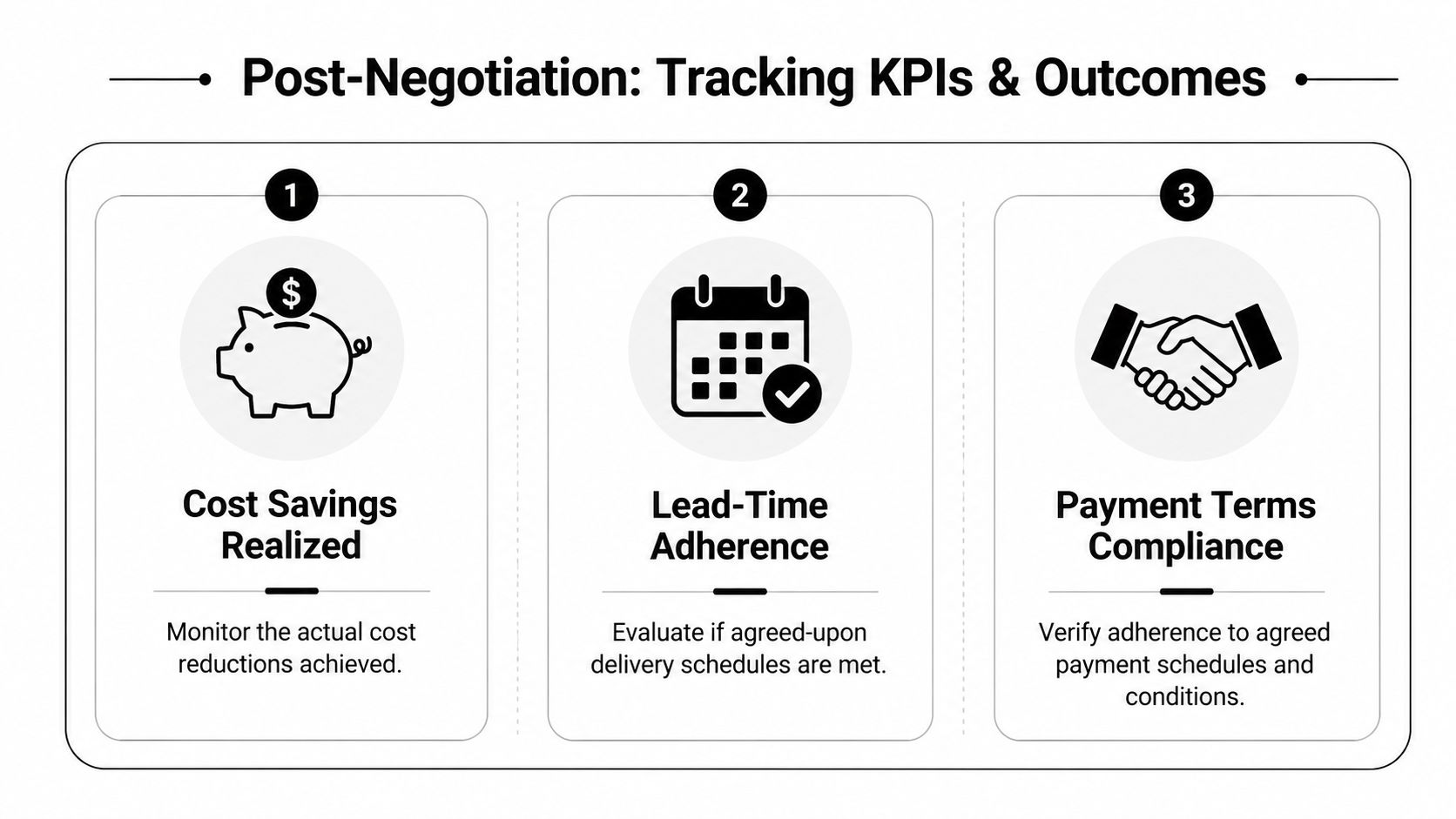
A useful post-negotiation scorecard stays close to operational outcomes. If you negotiated on cost, lead times, and payment terms, then those are the first things to track. Don't bury the result inside a broad monthly management pack where nobody can see whether the supplier is performing.
What to track after signature
Three KPI groups usually give the clearest picture:
Commercial outcomes
Actual landed cost, rebate capture, invoice accuracy, and whether the agreed pricing is showing up on live orders.Service outcomes
Lead-time adherence, order completeness, substitution frequency, and response time when issues arise.Cash flow outcomes
Payment term compliance, stock cover movement, and whether staged deliveries or MOQ changes reduced inventory pressure.
A simple dashboard can sit in Excel, Google Sheets, Power BI, or your ERP reporting layer. The format matters less than consistency. Track negotiated terms against actual performance by supplier and by key SKU group.
How to review without creating admin noise
Review meetings work best when they're structured and brief. Bring the scorecard, open issues, and one page of actions. If a supplier is meeting the deal, say so. If they're drifting, point to the metric and the clause that governs it.
For many SMEs, the bigger improvement is assigning ownership. One person should own supplier reviews, one person should validate invoice alignment, and one person should update purchasing parameters when terms change. Without that, negotiated gains get lost between operations and finance.
If your supplier base is getting harder to manage, practical guidance on streamlining vendor relationships can be useful for standardising communication, accountability, and review routines across multiple vendors.
A deal only improves margin when the business measures it after go-live. Otherwise, “savings” stay theoretical.
Use Templates and Real Examples for Successful Deals
The most useful supplier negotiation tools are usually simple. A BATNA worksheet, a lever-priority matrix, a call script, a contract clause library, and a KPI tracker will take most SMEs further than a dense procurement manual.
Three common Australian SME situations show how this works in practice.
An ecommerce retailer uses sales history to separate core lines from promotional lines. In the negotiation, the retailer asks for stronger pricing on the stable sellers, but more flexibility on delivery timing for the seasonal range. The breakthrough doesn't come from arguing harder. It comes from showing the supplier which volume is dependable and which volume is event-driven.
A manufacturer approaches a key input supplier with a cleaner quarterly forecast and asks for staged delivery against a broader commitment. The supplier gets better production visibility. The buyer avoids carrying unnecessary stock early.
A hospitality operator reviews spend concentration and finds that 60-70% of spend is concentrated in the top 20 line items for mid-sized cafes, based on hospitality-specific Australian guidance on negotiating better supplier prices. That same guidance highlights an underserved tactic in SME content: using sales data sharing to achieve better rates. Inventory-heavy businesses outside hospitality can apply the same logic by sharing sell-through patterns, peak periods, and likely order cadence where trust and commercial sensitivity allow.
The point isn't to copy someone else's script word for word. It's to bring your own numbers, your own timing, and your own walk-away point into the conversation.
If supplier negotiation keeps getting pushed down the list because cash flow, stock, and operations are already stretched, Nexist helps Australian founders turn those issues into a practical finance and operations plan. From inventory pressure and supplier terms to cash flow forecasting, KPI tracking, and process fixes, the focus is simple: get control back, close cash leaks, and make better commercial decisions with numbers you can use.
supplier negotiation, SME negotiation, procurement strategy, inventory management, contract optimisation

" width="24px"/><g d="M 0 24.129 L 0 0.129 L 24 0.129 L 24 24.129 Z M 0 24.129 L 0 0.129 L 24 0.129 L 24 24.129 Z M 24 3 C 24 1.344 22.656 0 21 0 L 3 0 C 1.344 0 0 1.344 0 3 L 0 21 C 0 22.656 1.344 24 3 24 L 21 24 C 22.656 24 24 22.656 24 21 Z M 6.883 8.375 L 2.863 8.375 L 2.863 20.467 L 6.883 20.467 Z M 4.899 2.545 C 3.524 2.545 2.625 3.449 2.625 4.634 C 2.625 5.795 3.496 6.724 4.846 6.724 L 4.872 6.724 C 6.273 6.724 7.146 5.795 7.146 4.634 C 7.12 3.449 6.274 2.545 4.899 2.545 Z M 16.747 8.09 C 14.614 8.09 13.659 9.263 13.124 10.086 L 13.124 8.374 L 9.105 8.374 C 9.159 9.508 9.105 20.466 9.105 20.466 L 13.124 20.466 L 13.124 13.713 C 13.124 13.352 13.15 12.99 13.257 12.732 C 13.547 12.01 14.209 11.262 15.319 11.262 C 16.773 11.262 17.355 12.372 17.355 13.996 L 17.355 20.466 L 21.374 20.466 L 21.374 13.532 C 21.374 9.818 19.391 8.09 16.747 8.09 Z" fill="transparent" height="24.12890599668026px" id="dSFdkJotL" width="24px"><path d="M 0 24 L 0 0 L 24 0 L 24 24 Z" fill="transparent" height="24px" id="wscNJE44G" transform="translate(0 0.129)" width="24px"/><g d="M 0 24.129 L 0 0.129 L 24 0.129 L 24 24.129 Z M 24 3 C 24 1.344 22.656 0 21 0 L 3 0 C 1.344 0 0 1.344 0 3 L 0 21 C 0 22.656 1.344 24 3 24 L 21 24 C 22.656 24 24 22.656 24 21 Z M 6.883 8.375 L 2.863 8.375 L 2.863 20.467 L 6.883 20.467 Z M 4.899 2.545 C 3.524 2.545 2.625 3.449 2.625 4.634 C 2.625 5.795 3.496 6.724 4.846 6.724 L 4.872 6.724 C 6.273 6.724 7.146 5.795 7.146 4.634 C 7.12 3.449 6.274 2.545 4.899 2.545 Z M 16.747 8.09 C 14.614 8.09 13.659 9.263 13.124 10.086 L 13.124 8.374 L 9.105 8.374 C 9.159 9.508 9.105 20.466 9.105 20.466 L 13.124 20.466 L 13.124 13.713 C 13.124 13.352 13.15 12.99 13.257 12.732 C 13.547 12.01 14.209 11.262 15.319 11.262 C 16.773 11.262 17.355 12.372 17.355 13.996 L 17.355 20.466 L 21.374 20.466 L 21.374 13.532 C 21.374 9.818 19.391 8.09 16.747 8.09 Z" fill="transparent" height="24.12890599668026px" id="sTpjGo1tb" width="24px"><path d="M 0 24 L 0 0 L 24 0 L 24 24 Z" fill="transparent" height="24px" id="s7ffpmKOD" transform="translate(0 0.129)" width="24px"/><g d="M 24 3 C 24 1.344 22.656 0 21 0 L 3 0 C 1.344 0 0 1.344 0 3 L 0 21 C 0 22.656 1.344 24 3 24 L 21 24 C 22.656 24 24 22.656 24 21 Z M 6.883 8.375 L 2.863 8.375 L 2.863 20.467 L 6.883 20.467 Z M 4.899 2.545 C 3.524 2.545 2.625 3.449 2.625 4.634 C 2.625 5.795 3.496 6.724 4.846 6.724 L 4.872 6.724 C 6.273 6.724 7.146 5.795 7.146 4.634 C 7.12 3.449 6.274 2.545 4.899 2.545 Z M 16.747 8.09 C 14.614 8.09 13.659 9.263 13.124 10.086 L 13.124 8.374 L 9.105 8.374 C 9.159 9.508 9.105 20.466 9.105 20.466 L 13.124 20.466 L 13.124 13.713 C 13.124 13.352 13.15 12.99 13.257 12.732 C 13.547 12.01 14.209 11.262 15.319 11.262 C 16.773 11.262 17.355 12.372 17.355 13.996 L 17.355 20.466 L 21.374 20.466 L 21.374 13.532 C 21.374 9.818 19.391 8.09 16.747 8.09 Z" fill="transparent" height="24.000006px" id="D0ecaHEcW" transform="translate(0 0)" width="24px"><path d="M 24 3 C 24 1.344 22.656 0 21 0 L 3 0 C 1.344 0 0 1.344 0 3 L 0 21 C 0 22.656 1.344 24 3 24 L 21 24 C 22.656 24 24 22.656 24 21 Z" fill="rgb(55, 184, 218)" height="24.000006px" id="IPLFE6zXx" width="24px"/><path d="M 4.02 0 L 0 0 L 0 12.092 L 4.02 12.092 Z" fill="rgb(255, 255, 255)" height="12.09201px" id="FWhtzAyuY" transform="translate(2.863 8.375)" width="4.02px"/><path d="M 2.274 0 C 0.899 0 0 0.904 0 2.089 C 0 3.25 0.871 4.179 2.221 4.179 L 2.247 4.179 C 3.648 4.179 4.521 3.25 4.521 2.089 C 4.495 0.904 3.649 0 2.274 0 Z" fill="rgb(255, 255, 255)" height="4.17876px" id="VmOsKv4kO" transform="translate(2.625 2.545)" width="4.52095px"/><path d="M 7.641 0 C 5.509 0 4.554 1.173 4.019 1.996 L 4.019 0.284 L 0 0.284 C 0.053 1.419 0 12.376 0 12.376 L 4.019 12.376 L 4.019 5.623 C 4.019 5.262 4.045 4.9 4.151 4.642 C 4.442 3.92 5.103 3.172 6.214 3.172 C 7.667 3.172 8.25 4.282 8.25 5.907 L 8.25 12.376 L 12.269 12.376 L 12.269 5.442 C 12.269 1.728 10.286 0 7.641 0 Z" fill="rgb(255, 255, 255)" height="12.37626px" id="n1XUbhaq0" transform="translate(9.105 8.09)" width="12.268830000000001px"/></g></g></g></g></svg>)