Aggregated Turnover ATO: Rules & Concessions 2026
Understand the aggregated turnover ato rules for 2026. Learn how to calculate it, what thresholds matter for ATO concessions, and avoid common mistakes.
Ansh Malhotra

You can be looking at a healthy set of books, a tidy company file, and a tax return that seems straightforward, then one overlooked trust or sibling company changes the whole picture. That's how many founders first meet aggregated turnover ATO rules, not as a definition, but as a surprise when a concession they expected suddenly depends on a wider group, not just one entity.
The practical problem is simple. Your business can feel small from the inside and still be treated as larger once the ATO adds up the turnover of connected entities and affiliates. If you're buying, selling, restructuring, or just growing through a family group, this number can decide whether you keep access to valuable tax settings or lose them at the cliff edge.
Table of Contents
Your Business Might Be Bigger Than You Think
A founder might stare at one trading company's sales and feel confident the business sits well inside the small business lane. Then the tax agent asks about the family trust that owns the shares, the related company that invoices the same customers, or the affiliate that helps with sales and operations. Suddenly the number that matters is no longer one entity's revenue, it's the combined picture of the whole economic group.
That is the trap. Aggregated turnover is built to look past legal wrappers and ask how large the business really is for tax purposes. The ATO says this measure is used for concessions, not just for curiosity, so a missing entity can distort the answer and trigger a bad planning decision.
A lot of owners only find the problem when they are already trying to claim a concession or finalise a transaction. By then, the structure may have been operating for years, and the earlier assumption that “my company is under the threshold” no longer holds. That's especially common where a trading company sits beside a family trust, holding company, or another operating arm that the owner didn't mentally count as part of the business.
Practical rule: if the group benefits from shared control, shared economics, or shared decision-making, assume the ATO may want the full group viewed together until the structure is checked properly.
For founders who also manage customer collections, sales cycles, and forecasting, turnover discipline already matters in day-to-day finance. A useful external lens is a guide for reducing DSO, because the habit of tracking receivables accurately is the same habit that helps you avoid turnover surprises. The difference is that, for tax, the stakes are not just cash flow, they're concession eligibility.
What Is Aggregated Turnover Exactly
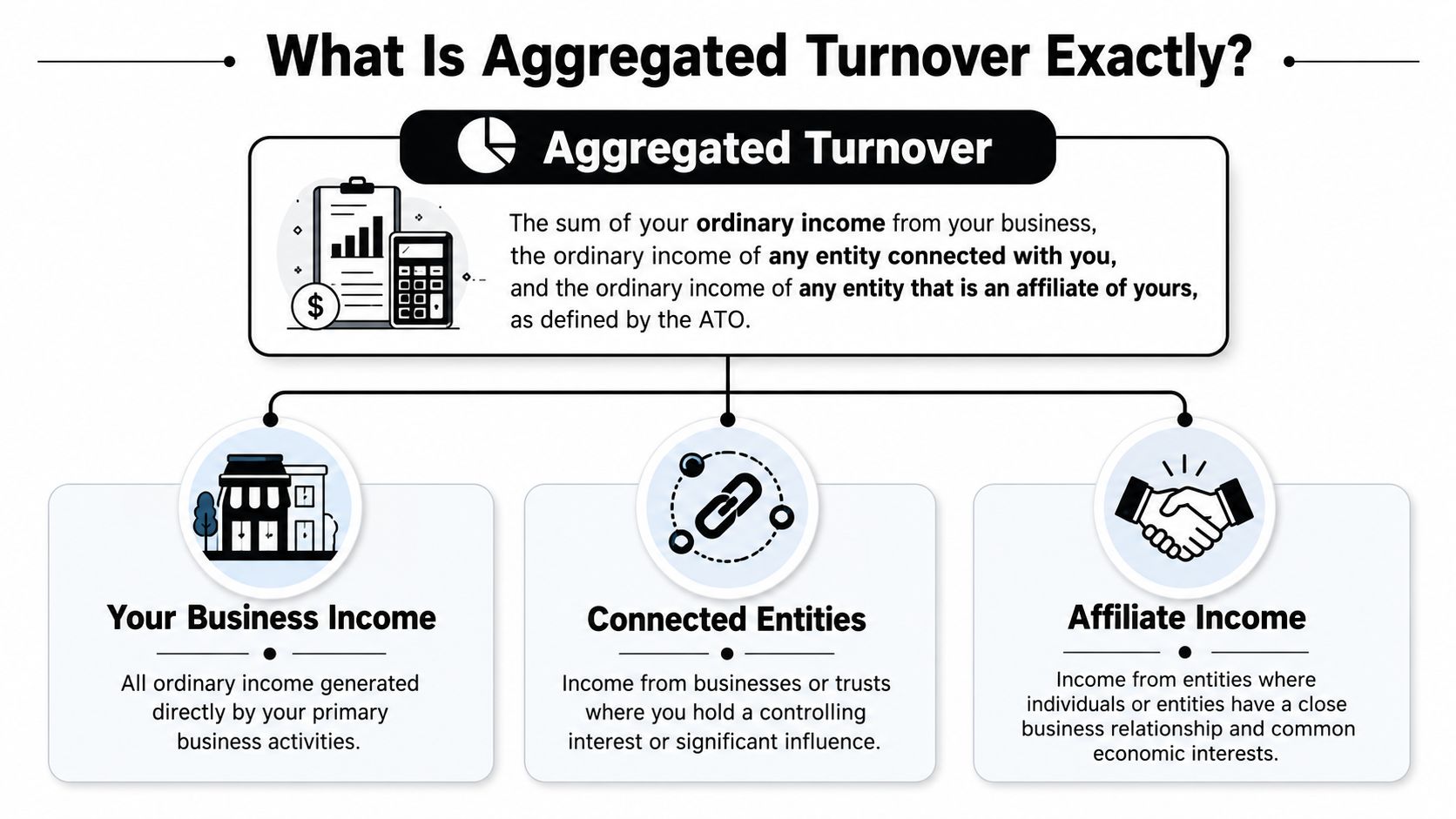
The ATO's three-part view
Under the ATO's definition, aggregated turnover is the sum of the taxpayer's annual turnover plus the annual turnover of any connected entity and any affiliate, with inter-entity dealings excluded from the calculation, and annual turnover means ordinary income earned in the ordinary course of business, not net profit (ATO definitions). That last point matters. The ATO is not asking how profitable you are, it's asking how much ordinary business income the relevant group earns.
A clean way to think about it is a financial family tree. Your trading company is one branch. Controlled subsidiaries, trusts, or other connected entities sit on nearby branches. Affiliates are the branches tied in by close business behaviour and shared economic purpose. The ATO looks at the family tree, not the label on each branch.
Plain-English version: the ATO wants the total size of the economic cluster you run or influence, not the turnover of one file in isolation.
That distinction cuts through a lot of confusion in founder conversations. A strong month of sales, or a clean profit line, doesn't settle the question by itself. The test is about business income across the relevant entities, and the structure of those relationships matters as much as the headline turnover.
Why this isn't a profit test
Profit can be low while turnover is high. A business with tight margins, heavy stock, or big subcontractor costs may still have substantial annual turnover. The ATO's definition focuses on ordinary income in the course of business, so the tax outcome follows revenue-based rules rather than earnings-based intuition.
That's why aggregated turnover catches owners off guard during restructuring or succession planning. A group can look modest in profit terms and still be too large for a concession that depends on turnover. If the legal and commercial group is larger than the standalone company, the tax view will usually follow the larger reality.
For founders, the takeaway is direct. If you only model one entity's P&L, you're probably missing the number that the ATO cares about. If you model the family tree, you're much closer to the truth.
Key Thresholds and Why They Are Important
Crossing a turnover threshold is not just a compliance change. It can shift several tax outcomes at once, which is why aggregated turnover is one of the first numbers I would want in front of me before year end. The same calculation can decide whether a business qualifies as a small business entity, whether it can access small business CGT concessions, how it is treated for R&D offsets, and how prepayment rules apply (ATO and CPA Australia).
The cliff effect in practice
The main trap is the cliff effect. A business does not just lose one benefit in isolation. Crossing a line can change several settings at once, so the planning response needs to be broader than a single tax form. If your entity group is drifting toward a threshold, you need enough lead time to change spending, asset timing, and group structure before lodgement pressure starts.
The ATO states that a business is a small business entity only if it is carrying on a business and has an aggregated turnover of less than $10 million (ATO small business entity guidance). That line matters because it separates businesses that can access a broad range of small business concessions from those that cannot.
A practical threshold map
Threshold | Key Concession / Obligation Triggered | What it Means for Your Business |
|---|---|---|
Less than $10 million | Small business entity status and related concessions | You may qualify for a broader set of small business tax settings, subject to the other rules |
$20 million | R&D tax incentive refundable vs non-refundable offset test | The turnover test can change the way the offset is applied |
$50 million | Prepayment rules | The treatment of certain prepayments changes as the business grows |
$1 billion or more | ATO reporting disclosure of actual turnover | Return reporting becomes more granular at the top end of the scale |
That threshold map is the practical reason founders should read a small business taxation overview before making structural changes. The ATO's reporting framework also uses turnover ranges, and where turnover is $1 billion or more, the actual figure must be disclosed rather than just a bracket. That tells you something important about the direction of travel. Aggregated turnover is not just a back-office calculation. It is built into compliance.
How to Calculate Your Aggregated Turnover
A founder can look at one company's sales and think the turnover test is comfortably under the line. That view is often too narrow. Aggregated turnover starts with the trading entity, then pulls in the connected entities and affiliates the ATO treats as part of the same economic group, so the number reflects outside revenue rather than internal billing loops. The ATO's working-out guide explains that you add the annual turnover of those relevant entities and leave out inter-entity dealings, which keeps the calculation focused on the revenue that genuinely sits in the group (ATO working-out guide).

Step 1 start with ordinary income
Begin with ordinary income earned in the ordinary course of business. Keep profit out of the calculation, because the ATO is testing revenue, not margin. Use the same records you would trust for management reporting, then strip the measure back to the turnover figure that matters for the test.
Step 2 add the relevant group entities
Next, identify every entity that is connected or affiliated for the relevant income year. The ATO's guidance says the calculation uses the test entity's income year, even where related entities have different year-ends or foreign residence status. That becomes important when the structure includes companies, trusts, or offshore entities that do not all report on the same timetable (ATO guidance).
A family trust or holding company can sit like the parent of a financial family tree. If it controls, or is tied to, other operating entities, their turnover can flow into the test even if the trading team only watches one dashboard.
Step 3 strip out internal dealings
Remove sales between entities in the group. If the trading company invoices the related distributor, that internal charge does not count twice just because it appears in two sets of books. The calculation is trying to measure the group's external economic scale, not the amount of money moving around inside the structure.
The timing matters as much as the relationship. If an entity becomes relevant part-way through the year, use the turnover for the period that falls within the ATO test, not a full-year assumption that ignores when control changed.
Before you sign off the number, check restructures, acquisitions, and internal invoicing for the year. Those are the points where errors usually creep in. Different accounting year-ends can also distort the result if you do not line up the entities correctly. Once the structure is mapped and the income is placed in the right period, the calculation becomes far more reliable.
The practical way to do it is to map the structure first, then layer in the income data. If the structure is messy, the turnover number will be messy too.
Worked Examples of Turnover Calculations
1. A standalone company
A consulting company earns ordinary business income in its own name and has no connected entities or affiliates. In that case, aggregated turnover is the company's annual turnover, because there is nothing else to add. That is the baseline case and the easiest one to test.
The practical lesson is that simple structures are simple only if they stay simple. The moment a shareholder starts running another entity alongside it, the analysis changes.
2. A company owned through a family trust
A trading company sits under a discretionary family trust, and the trust also runs a separate side business. Even if the owner mentally thinks in terms of “my company”, the ATO lens is broader if the entities are connected through control or affiliate relationships. The turnover test then needs to include the ordinary income of the relevant connected structure, not just the company on its own.
In real life, founders frequently misjudge eligibility. They look at one entity's sales dashboard and ignore the trust's operating activity, even though the economic group is moving as one. The result is a wrong comfort level about small business status.
3. A mid-year acquisition
A company buys a controlling stake in another company halfway through the year. For the earlier part of the year, the target's turnover is not part of the group test. Once the connection exists, the relevant turnover for the income year has to be considered in line with the ATO's rules on connected entities and timing.
That's the hardest scenario because the structure is changing under your feet. Internal sales between the entities also need to be stripped out so the group doesn't double count its own revenue. If the finance team doesn't track the acquisition date and internal billing lines carefully, the calculation will drift.
For founders, the rule of thumb is simple. A clean standalone company is easy. A family structure is a group problem. A mid-year acquisition is both a group problem and a timing problem, which is why transaction records and entity maps matter as much as the final number.
A Practical Checklist for Managing Your Turnover
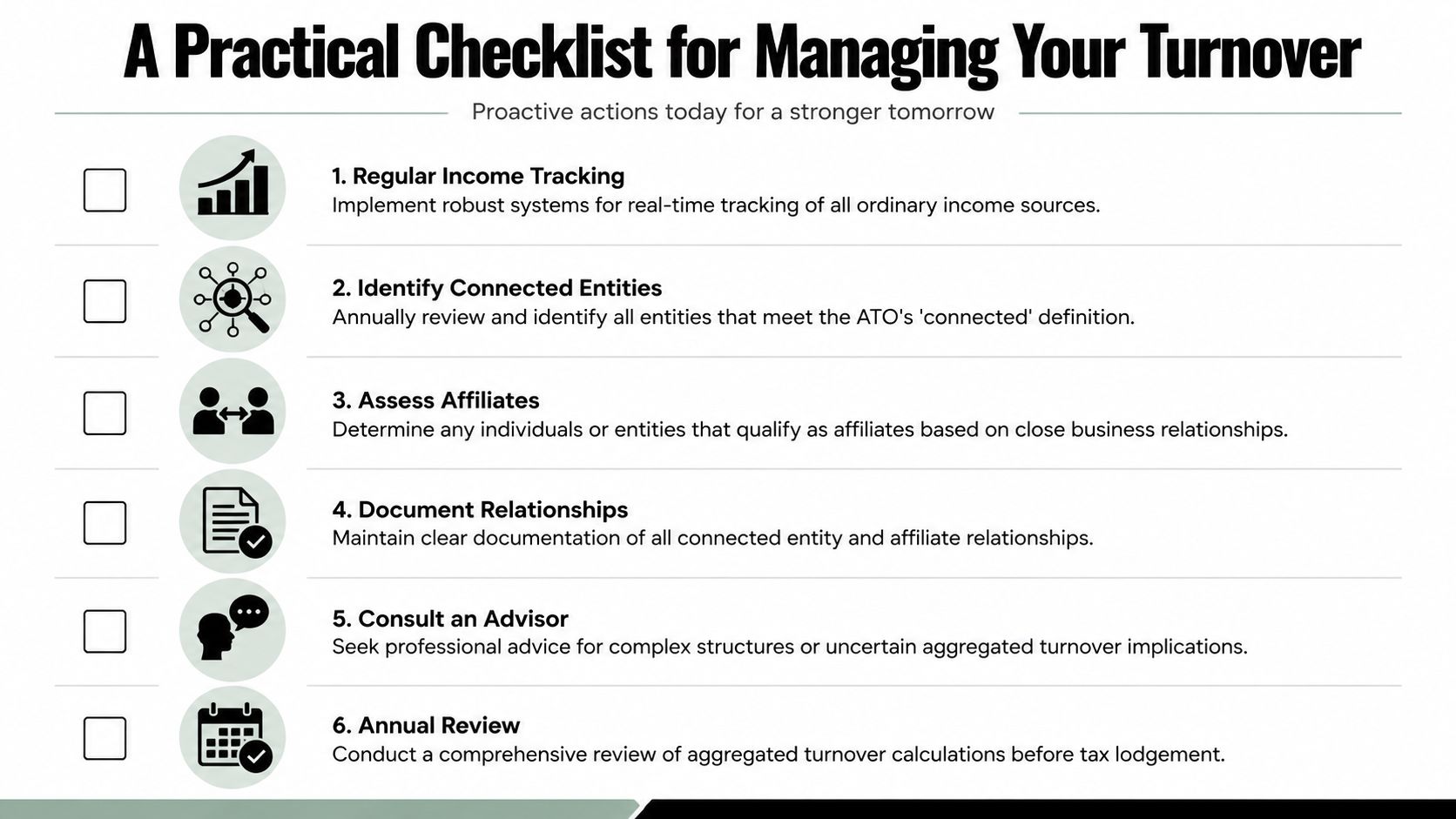
If you want fewer surprises at tax time, treat aggregated turnover as a rolling control metric, not an annual afterthought. The ATO's small business entity rules make that worth watching closely, because a group can cross a line without the operating company looking obviously large on its own.
The checklist
Map every entity: List every company, trust, and partnership in the group so you are not relying on memory or a single dashboard.
Review control regularly: Check whether ownership, voting power, or practical control has changed during the year, especially after a sale, buy-in, or restructure.
Test affiliate relationships: Look at who is acting together in the business, not just who sits on the share register. A financial family tree matters here.
Separate internal revenue: Keep inter-entity transactions easy to identify and remove from the turnover calculation, so internal billing does not inflate the result.
Track turnover monthly: A rolling view helps you spot a threshold breach before it becomes a lodgement problem or a lost concession.
Document changes immediately: Record acquisitions, disposals, and restructures as soon as they happen, while the facts are still clear.
That discipline pairs well with better finance process. A practical roadmap for invoice automation can help your team classify invoices cleanly, which makes it easier to distinguish external turnover from internal recharges. Good invoicing hygiene will not fix the tax rule by itself, but it does reduce avoidable mistakes when you are reviewing group turnover.
For a broader systems view, the tax and compliance guide is a useful reminder that turnover work sits inside a wider control environment, not in isolation.
Best practice: build the turnover review into your month-end routine. If you only look at it at year-end, you have already lost the chance to react.
From Calculation to Strategy With a Virtual CFO
Aggregated turnover is a group-wide revenue measure, not a single-company sales test, and that's why founders get into trouble when structures become more complex. The ATO rules on connected entities, affiliates, and internal dealings make the calculation a finance problem as much as a tax problem. If the structure changes, the number changes.
The strategic move is to forecast the number before it becomes a surprise. That means linking entity mapping, reporting, and tax planning into one view so you can see whether a concession is at risk, whether an acquisition changes your position, and whether a restructure should happen before the end of the income year. That's exactly where a virtual CFO adds value, because the work is not just about calculating history, it's about shaping the next decision.
If your group is getting more layered, the virtual chief financial officer guide is a practical next read. The point isn't to add complexity for its own sake. It's to get the turnover number right, then use it to protect cash flow, preserve concessions where possible, and avoid last-minute tax panic.
If you're unsure whether your structure is already affecting your turnover position, talk to Nexist about a turnover review and a practical tax planning reset before the next lodgement cycle.
aggregated turnover ato, small business concessions, ato turnover test, instant asset write off, virtual cfo australia

" width="24px"/><g d="M 0 24.129 L 0 0.129 L 24 0.129 L 24 24.129 Z M 0 24.129 L 0 0.129 L 24 0.129 L 24 24.129 Z M 24 3 C 24 1.344 22.656 0 21 0 L 3 0 C 1.344 0 0 1.344 0 3 L 0 21 C 0 22.656 1.344 24 3 24 L 21 24 C 22.656 24 24 22.656 24 21 Z M 6.883 8.375 L 2.863 8.375 L 2.863 20.467 L 6.883 20.467 Z M 4.899 2.545 C 3.524 2.545 2.625 3.449 2.625 4.634 C 2.625 5.795 3.496 6.724 4.846 6.724 L 4.872 6.724 C 6.273 6.724 7.146 5.795 7.146 4.634 C 7.12 3.449 6.274 2.545 4.899 2.545 Z M 16.747 8.09 C 14.614 8.09 13.659 9.263 13.124 10.086 L 13.124 8.374 L 9.105 8.374 C 9.159 9.508 9.105 20.466 9.105 20.466 L 13.124 20.466 L 13.124 13.713 C 13.124 13.352 13.15 12.99 13.257 12.732 C 13.547 12.01 14.209 11.262 15.319 11.262 C 16.773 11.262 17.355 12.372 17.355 13.996 L 17.355 20.466 L 21.374 20.466 L 21.374 13.532 C 21.374 9.818 19.391 8.09 16.747 8.09 Z" fill="transparent" height="24.12890599668026px" id="dSFdkJotL" width="24px"><path d="M 0 24 L 0 0 L 24 0 L 24 24 Z" fill="transparent" height="24px" id="wscNJE44G" transform="translate(0 0.129)" width="24px"/><g d="M 0 24.129 L 0 0.129 L 24 0.129 L 24 24.129 Z M 24 3 C 24 1.344 22.656 0 21 0 L 3 0 C 1.344 0 0 1.344 0 3 L 0 21 C 0 22.656 1.344 24 3 24 L 21 24 C 22.656 24 24 22.656 24 21 Z M 6.883 8.375 L 2.863 8.375 L 2.863 20.467 L 6.883 20.467 Z M 4.899 2.545 C 3.524 2.545 2.625 3.449 2.625 4.634 C 2.625 5.795 3.496 6.724 4.846 6.724 L 4.872 6.724 C 6.273 6.724 7.146 5.795 7.146 4.634 C 7.12 3.449 6.274 2.545 4.899 2.545 Z M 16.747 8.09 C 14.614 8.09 13.659 9.263 13.124 10.086 L 13.124 8.374 L 9.105 8.374 C 9.159 9.508 9.105 20.466 9.105 20.466 L 13.124 20.466 L 13.124 13.713 C 13.124 13.352 13.15 12.99 13.257 12.732 C 13.547 12.01 14.209 11.262 15.319 11.262 C 16.773 11.262 17.355 12.372 17.355 13.996 L 17.355 20.466 L 21.374 20.466 L 21.374 13.532 C 21.374 9.818 19.391 8.09 16.747 8.09 Z" fill="transparent" height="24.12890599668026px" id="sTpjGo1tb" width="24px"><path d="M 0 24 L 0 0 L 24 0 L 24 24 Z" fill="transparent" height="24px" id="s7ffpmKOD" transform="translate(0 0.129)" width="24px"/><g d="M 24 3 C 24 1.344 22.656 0 21 0 L 3 0 C 1.344 0 0 1.344 0 3 L 0 21 C 0 22.656 1.344 24 3 24 L 21 24 C 22.656 24 24 22.656 24 21 Z M 6.883 8.375 L 2.863 8.375 L 2.863 20.467 L 6.883 20.467 Z M 4.899 2.545 C 3.524 2.545 2.625 3.449 2.625 4.634 C 2.625 5.795 3.496 6.724 4.846 6.724 L 4.872 6.724 C 6.273 6.724 7.146 5.795 7.146 4.634 C 7.12 3.449 6.274 2.545 4.899 2.545 Z M 16.747 8.09 C 14.614 8.09 13.659 9.263 13.124 10.086 L 13.124 8.374 L 9.105 8.374 C 9.159 9.508 9.105 20.466 9.105 20.466 L 13.124 20.466 L 13.124 13.713 C 13.124 13.352 13.15 12.99 13.257 12.732 C 13.547 12.01 14.209 11.262 15.319 11.262 C 16.773 11.262 17.355 12.372 17.355 13.996 L 17.355 20.466 L 21.374 20.466 L 21.374 13.532 C 21.374 9.818 19.391 8.09 16.747 8.09 Z" fill="transparent" height="24.000006px" id="D0ecaHEcW" transform="translate(0 0)" width="24px"><path d="M 24 3 C 24 1.344 22.656 0 21 0 L 3 0 C 1.344 0 0 1.344 0 3 L 0 21 C 0 22.656 1.344 24 3 24 L 21 24 C 22.656 24 24 22.656 24 21 Z" fill="rgb(55, 184, 218)" height="24.000006px" id="IPLFE6zXx" width="24px"/><path d="M 4.02 0 L 0 0 L 0 12.092 L 4.02 12.092 Z" fill="rgb(255, 255, 255)" height="12.09201px" id="FWhtzAyuY" transform="translate(2.863 8.375)" width="4.02px"/><path d="M 2.274 0 C 0.899 0 0 0.904 0 2.089 C 0 3.25 0.871 4.179 2.221 4.179 L 2.247 4.179 C 3.648 4.179 4.521 3.25 4.521 2.089 C 4.495 0.904 3.649 0 2.274 0 Z" fill="rgb(255, 255, 255)" height="4.17876px" id="VmOsKv4kO" transform="translate(2.625 2.545)" width="4.52095px"/><path d="M 7.641 0 C 5.509 0 4.554 1.173 4.019 1.996 L 4.019 0.284 L 0 0.284 C 0.053 1.419 0 12.376 0 12.376 L 4.019 12.376 L 4.019 5.623 C 4.019 5.262 4.045 4.9 4.151 4.642 C 4.442 3.92 5.103 3.172 6.214 3.172 C 7.667 3.172 8.25 4.282 8.25 5.907 L 8.25 12.376 L 12.269 12.376 L 12.269 5.442 C 12.269 1.728 10.286 0 7.641 0 Z" fill="rgb(255, 255, 255)" height="12.37626px" id="n1XUbhaq0" transform="translate(9.105 8.09)" width="12.268830000000001px"/></g></g></g></g></svg>)