
How Do I Reduce My Taxable Income? an AU Founder's Guide
Asking how do I reduce my taxable income in Australia? This guide offers founders practical steps on super, deductions, and timing to legally lower your tax.
Ansh Malhotra

You're probably looking at a decent profit number, then looking at your bank balance, and wondering the same thing every founder asks near year end: how do I reduce my taxable income without doing anything dodgy or short-sighted?
Good question. The wrong answer is to panic-buy random expenses in June. The right answer is to move early, use the rules properly, and treat tax planning as a cash flow decision, not an accounting afterthought.
If you run an Australian SME, especially one with stock, debt, uneven profit, or founder income that's started pushing into higher marginal rates, there are a handful of moves that matter far more than the generic advice you usually hear. Some are simple timing plays. Some are structural. Some sit in plain sight on your balance sheet and get ignored for years.
Table of Contents
Beyond Compliance Why Tax Planning is a Growth Lever
A tax bill doesn't hurt because tax exists. It hurts because most founders leave the decision-making too late.
If you wait until the books are closed, you've lost most of your options. Tax planning only works when it sits upstream of the return. That means using the months before 30 June to decide what income to recognise, what expenses to bring forward, how to handle owner remuneration, and whether capital is better held in the business, moved into super, or redirected into productive assets.
That's why I don't treat tax as a compliance line item. I treat it as a growth lever. Cash you legally keep out of avoidable tax can fund inventory, payroll cover, debt reduction, marketing, systems, or a buffer that stops bad decisions under pressure. If you want a useful outside perspective, this round-up of practical guidance on lowering Australian taxes is worth reading alongside a proper planning session.
What founders usually get wrong
Most business owners focus only on the P&L. They ask whether they made money. They don't ask whether they structured the year well.
That's a mistake. A founder can show profit on paper and still have cash trapped in stock, debt, or unpaid receivables. In that situation, the tax bill lands on accounting profit while the cash isn't sitting where you need it. That's exactly why tax planning has to connect to operations.
Tax strategy works best when it changes behaviour before year end, not when it explains the damage after year end.
A stronger approach is to review tax in three buckets:
Timing moves: bring forward legitimate deductions and prepayments.
Structural moves: use superannuation, debt structure, and owner remuneration properly.
Operational moves: clean up stock, write off obsolete items, and stop cash being trapped in the wrong assets.
If you want that process embedded into forecasting instead of handled as a rushed June conversation, Nexist's work on tax planning strategies for Australian SMEs is the right model. The point isn't more paperwork. The point is better decisions while there's still time to make them.
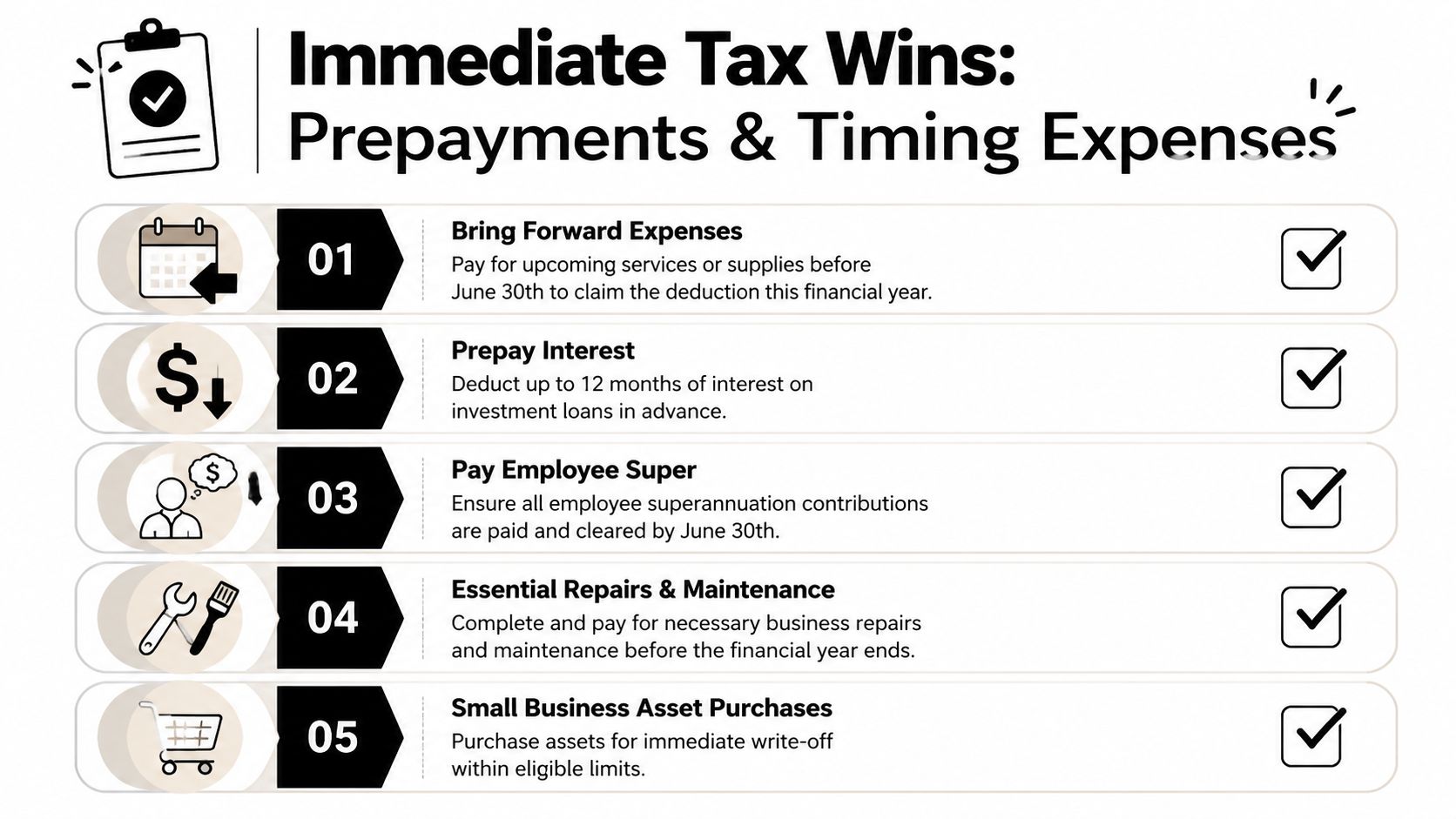
Immediate Wins Prepayments and Timing Your Expenses
You get to late June, profit is higher than expected, and the tax bill is starting to look ugly. The founders who respond well do not scramble for exotic schemes. They bring forward legitimate deductions they were going to pay anyway, protect cash, and make the year-end result less painful.
Bring forward what you were going to pay anyway
Prepayments work because timing matters. If a deductible cost belongs to the next 12 months and you pay it before 30 June, you may be able to claim it earlier under the ATO rules for eligible small businesses and specific prepayment situations, as explained in the ATO guidance on small business income tax deductions and prepayments.
That makes this a useful move when your year has run stronger than forecast and you want deductions in the current year, not after the tax bill has already hit.
Review these before year end:
Insurance premiums you know you will renew anyway
Software subscriptions and annual licences already locked into the business
Professional memberships and service retainers that support current operations
Loan interest on eligible income-producing investments where prepayment makes sense
Repairs or maintenance that are properly due now and correctly deductible
The mistake is obvious. Founders hear “prepay expenses” and start paying anything they can find. That is sloppy tax planning. Prepay committed costs. Do not create a cash squeeze in July just to get a deduction in June.
Cash flow still runs the business. Tax sits behind it.
There is also an operating discipline issue here. If your payables and receivables are messy, timing deductions will not save you from a weak cash position after year end. Tighten collections at the same time. Better invoice payment terms for Australian businesses reduce the risk of paying tax while customers are still sitting on your cash.
Use work from home claims properly
Work from home claims are not a headline strategy, but they are still worth taking seriously if you are entitled to them. Small deductions are only “small” until you ignore enough of them across the year.
The ATO's fixed rate method can apply if you meet the record-keeping rules, and the ATO sets out what expenses are covered, what is excluded, and what evidence you need in its guidance on working from home deductions. The key issue is records. If you cannot show hours worked from home and support the claim, the deduction is weak.
Keep it simple:
Item | What to do |
|---|---|
Prepaid expenses | Review deductible costs due within the next 12 months and pay early only if cash flow allows |
Work from home hours | Keep a clear log from diaries, calendars, or a dedicated timesheet record |
Evidence | Store invoices, receipts, loan statements, and proof of payment in one place |
Cash impact | Check that the deduction improves tax without creating a funding gap after 30 June |
One more point. Timing strategies are not only for your trading business. Founders with investments outside the company should coordinate those deductions too. If that applies to you, explore real estate portfolio deductions as part of the same year-end review.
The founders who do this well make decisions before 30 June, not after it. That is the difference between tax planning and tax regret.
Unlock Trapped Cash With Smarter Deductions
Most advice on reducing taxable income is too passive. It says “claim all your deductions” as if deductions just appear by magic.
That's not how it works in inventory-heavy businesses. If you run ecommerce, retail, wholesale, or manufacturing, one of the biggest missed tax levers is sitting on the shelf. Old stock, damaged stock, mis-bought stock, or stock that won't move can keep inflating your reported position while tying up real cash.

Stock is not neutral
Many guides overlook how inventory-heavy founders can legally accelerate tax deductions. By adjusting stock valuation methods or writing off bad inventory before 30 June, business owners can immediately reduce taxable income, and the ATO requires strong evidence of obsolescence, as noted in this guidance on reducing tax through stock valuation and inventory write-offs.
That's the nuance most generic tax articles miss. Stock isn't just a balance sheet number. It's an operational decision with tax consequences.
If obsolete inventory is still sitting at an unrealistic value, you've got two problems:
your profit is overstated
your cash is trapped in stock that won't convert properly
That's why a proper stock review before 30 June can be far more valuable than hunting for minor office deductions.
What good evidence looks like
The ATO focus on evidence matters. You can't just decide stock feels old and slash the value. You need a file that supports the treatment.
Use a practical review process:
Identify slow movers: Pull ageing reports and isolate items with no realistic path to full-price sale.
Separate damaged or obsolete lines: Don't mix dead stock with healthy inventory.
Document why value has changed: Supplier discontinuations, damage, expiry, failed product lines, or market changes all help support the decision.
Record the action taken: Markdowns, disposal, liquidation, or internal write-off approvals should be traceable.
Founders often ask, “How do I reduce my taxable income?” If you carry too much stock, the better question is, “Which part of my inventory no longer deserves to sit at full value?”
This matters beyond tax. A disciplined stock write-down cleans up purchasing decisions, improves margin reporting, and stops your team from reordering around bad data.
If you also hold investment property outside the business, it's worth separately reviewing real estate portfolio deductions so you don't miss legitimate non-stock deduction opportunities. Just keep the conversations separate. Property deductions and inventory decisions follow different logic, and combining them loosely is how founders confuse themselves.
Superannuation Your Most Powerful Tax Reduction Tool
For many founders, superannuation is the most effective tax move available. Not the most exciting. Not the most talked about. Just the most powerful.
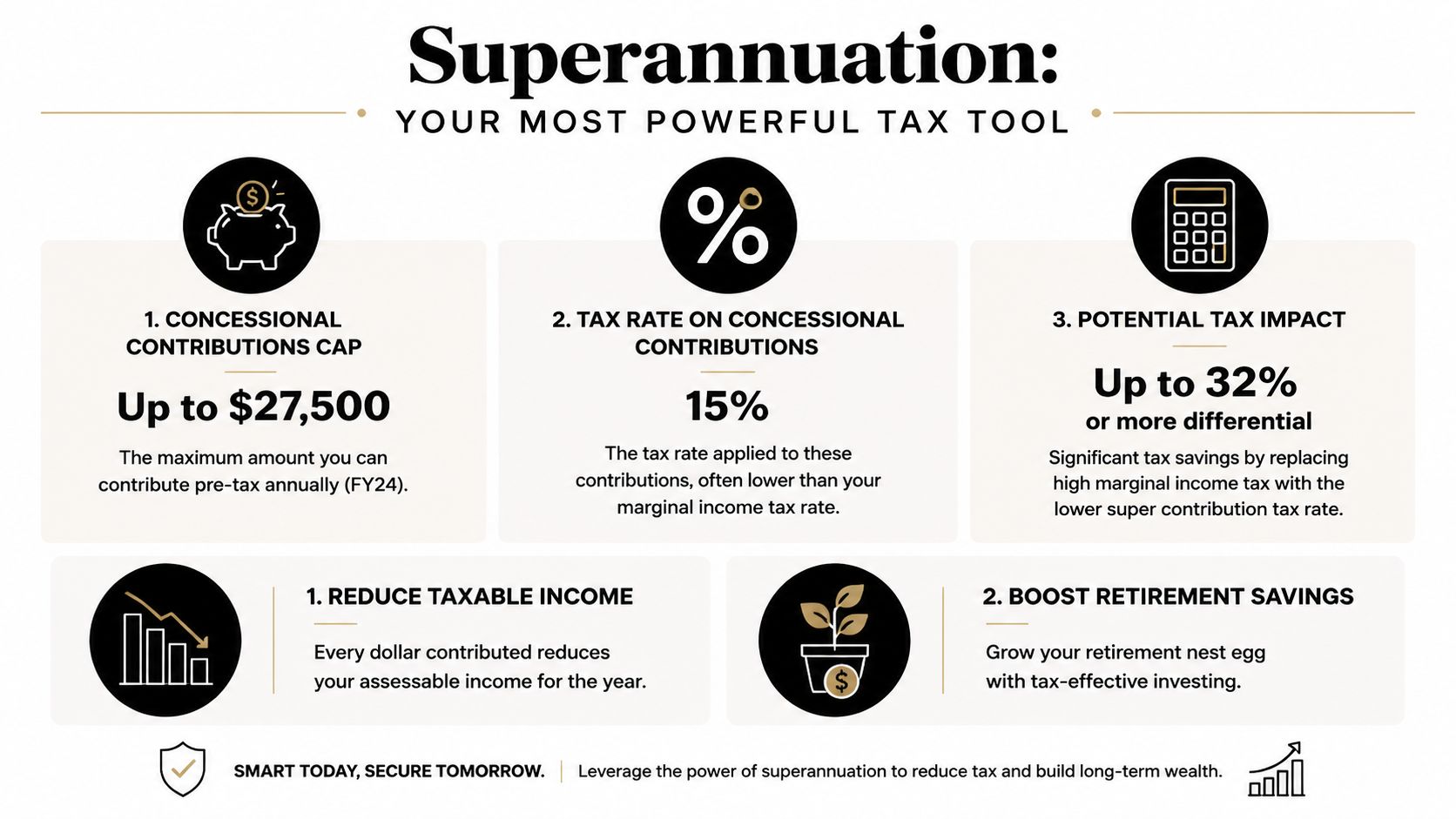
The reason is simple. Concessional super contributions reduce taxable income now, and they're taxed inside super at a lower rate than the marginal tax rates many growth-stage founders are already paying personally.
Why super beats most last minute tactics
For the 2024–25 financial year, concessional super contributions are capped at $30,000 and taxed at 15%, and a founder earning $200,000 in a 47% marginal tax bracket including Medicare levy who contributes $30,000 reduces taxable income by that amount and gets an immediate tax saving of approximately $9,600, according to this Australian super contribution tax example.
That's why I push founders to review super before scrambling for miscellaneous deductions. The tax differential is clear. You're moving income away from a much higher personal tax rate into the concessional super environment.
A simple approach is:
Option | Tax treatment |
|---|---|
Take income personally at a high marginal rate | Taxed at your personal rate, which may be much higher |
Contribute concessional amounts to super | Contribution taxed at 15% under the verified rules above |
A useful explainer sits below if you want a quick visual overview before talking numbers with your accountant.
The carry forward rule is where founders miss value
The strategy offers more interesting considerations: If your total super balance is under $500,000, you may be able to carry forward unused concessional caps from the previous five years and contribute up to $150,000 in a single year if you haven't used those earlier caps, based on the rules outlined in this guide to reducing taxable income with super.
That's useful in uneven-income businesses. Founders often have ordinary years followed by one stronger year with a bigger distribution, a sale event, or unusually high personal income. Carry-forward contributions can help smooth that spike.
The trap is eligibility. Don't assume you qualify because someone mentioned carry-forward contributions at a barbecue. Check your balance, prior cap usage, and timing properly.
Super works when it's planned. It fails when founders guess, overcontribute, or treat the cap like a rough suggestion.
If your income has climbed above the point where personal tax starts biting hard, this is usually one of the first areas worth reviewing.
Using Assets and Debt to Your Advantage
At this stage, tax planning becomes structural. You're no longer just shifting timing. You're deciding whether your assets and liabilities are arranged in a way that supports the outcome you want.
Used well, debt can create deductible interest against income-producing activity. Used badly, it creates false confidence, messy records, and trouble when the ATO asks what the borrowing was for.
Debt structure matters more than most founders think
Debt recycling can save $10,000–$20,000 in annual tax for founders with $1M+ in property assets, but it requires precise legal documentation, and the ATO rejects approximately 15% of negative gearing claims annually due to misaligned loan structures where the debt was not serve a clear income-producing purpose, according to this discussion of debt recycling and loan purpose risk.
The principle is straightforward. The deductibility of interest follows the purpose of the borrowing. If the debt funds income-producing activity, the interest treatment may work in your favour. If the debt funds private spending, the label on the loan won't save you.
That's why mixed-purpose loans are such a problem. Founders redraw from facilities casually, use offset accounts inconsistently, and then expect clean tax treatment later. It rarely ends well.
Use this filter before doing anything with debt:
Trace the funds: Where did the borrowed money go, exactly?
Separate private and investment use: Don't blend them in one messy facility if you want clean deductibility.
Document the structure early: Trying to rebuild the story after the fact is where risk explodes.
The ATO doesn't care what you intended in your head. It cares what the documents and fund flows show.
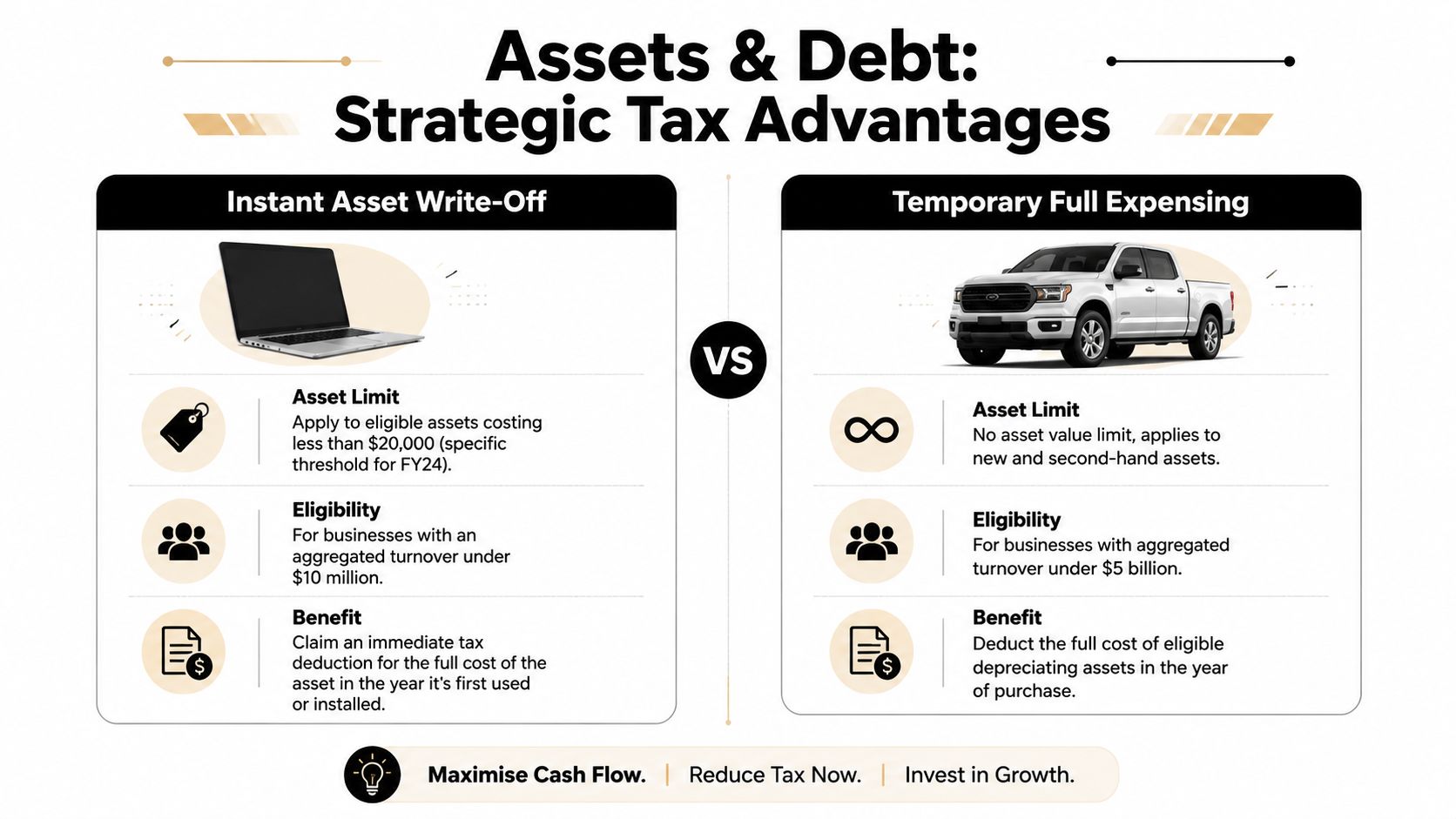
Asset decisions should follow business need
I'm wary of founders buying equipment purely because someone told them “you'll get a deduction.” A deduction on an unnecessary purchase is still a cash outflow you didn't need.
Buy assets when they improve throughput, reduce labour drag, replace failure-prone equipment, or remove bottlenecks. Then assess the tax treatment properly with your adviser. Tax should support the commercial decision, not drive it blindly.
This logic also matters when assets are sold, inherited, or restructured across family groups. If that's relevant, this guide to simplifying the inherited property sales process is useful for understanding the practical side before you loop in legal and tax advice.
The right sequence is simple. Start with commercial purpose. Then confirm tax treatment. Then document everything.
Your Tax Reduction Action Plan
If you've read this far, don't turn it into more theory. Turn it into a checklist and get the work done before the year disappears.
Immediate actions before year end
Start with the fast reviews.
Check prepayments: List deductible expenses you already expect to pay and assess whether bringing them forward before 30 June makes sense.
Review work-from-home records: If you operate partly from home, get your hours and evidence in order now, not during tax return season.
Run a stock ageing review: Flag obsolete, damaged, slow-moving, or dead stock and decide what needs to be written down or written off with support.
Confirm super capacity: If super is relevant to your personal position, check cap availability and don't guess.
Review debt purpose: Trace investment-related borrowings and fix any documentation gaps before they become bigger problems.
This is the point where founders usually see the pattern. The best tax savings don't come from magic loopholes. They come from tighter operations, better records, and decisions made while there's still room to act.
When DIY becomes expensive
There's a line between sensible founder involvement and false economy. You should absolutely understand the drivers of your taxable income. You should not improvise complex super, debt, stock valuation, or structural decisions from scattered internet notes.
DIY becomes expensive when:
The business has inventory complexity: old stock, multiple SKUs, changing valuation issues, or margin distortion.
Your personal income is lumpy: one unusually strong year can create planning opportunities, but only if you handle them correctly.
Debt has been used across personal and investment purposes: this needs clean tracing and documentation.
Cash feels tight despite profit: that usually means tax, stock, debt, and working capital need to be reviewed together.
A good virtual CFO doesn't just chase deductions. They connect tax planning to cash flow, forecasting, stock turns, debt pressure, owner pay, and decision-making rhythm. That's the difference between surviving June and building a business that keeps more of what it earns.
If you want a clearer view of where tax, cash flow, inventory and owner decisions are leaking money, Nexist helps Australian founders build that into a practical finance rhythm. The useful part isn't just lodging correctly. It's making the right moves early enough to change the outcome.
reduce taxable income, australian tax strategies, sme tax guide, founder tax tips, virtual cfo

" width="24px"/><g d="M 0 24.129 L 0 0.129 L 24 0.129 L 24 24.129 Z M 0 24.129 L 0 0.129 L 24 0.129 L 24 24.129 Z M 24 3 C 24 1.344 22.656 0 21 0 L 3 0 C 1.344 0 0 1.344 0 3 L 0 21 C 0 22.656 1.344 24 3 24 L 21 24 C 22.656 24 24 22.656 24 21 Z M 6.883 8.375 L 2.863 8.375 L 2.863 20.467 L 6.883 20.467 Z M 4.899 2.545 C 3.524 2.545 2.625 3.449 2.625 4.634 C 2.625 5.795 3.496 6.724 4.846 6.724 L 4.872 6.724 C 6.273 6.724 7.146 5.795 7.146 4.634 C 7.12 3.449 6.274 2.545 4.899 2.545 Z M 16.747 8.09 C 14.614 8.09 13.659 9.263 13.124 10.086 L 13.124 8.374 L 9.105 8.374 C 9.159 9.508 9.105 20.466 9.105 20.466 L 13.124 20.466 L 13.124 13.713 C 13.124 13.352 13.15 12.99 13.257 12.732 C 13.547 12.01 14.209 11.262 15.319 11.262 C 16.773 11.262 17.355 12.372 17.355 13.996 L 17.355 20.466 L 21.374 20.466 L 21.374 13.532 C 21.374 9.818 19.391 8.09 16.747 8.09 Z" fill="transparent" height="24.12890599668026px" id="dSFdkJotL" width="24px"><path d="M 0 24 L 0 0 L 24 0 L 24 24 Z" fill="transparent" height="24px" id="wscNJE44G" transform="translate(0 0.129)" width="24px"/><g d="M 0 24.129 L 0 0.129 L 24 0.129 L 24 24.129 Z M 24 3 C 24 1.344 22.656 0 21 0 L 3 0 C 1.344 0 0 1.344 0 3 L 0 21 C 0 22.656 1.344 24 3 24 L 21 24 C 22.656 24 24 22.656 24 21 Z M 6.883 8.375 L 2.863 8.375 L 2.863 20.467 L 6.883 20.467 Z M 4.899 2.545 C 3.524 2.545 2.625 3.449 2.625 4.634 C 2.625 5.795 3.496 6.724 4.846 6.724 L 4.872 6.724 C 6.273 6.724 7.146 5.795 7.146 4.634 C 7.12 3.449 6.274 2.545 4.899 2.545 Z M 16.747 8.09 C 14.614 8.09 13.659 9.263 13.124 10.086 L 13.124 8.374 L 9.105 8.374 C 9.159 9.508 9.105 20.466 9.105 20.466 L 13.124 20.466 L 13.124 13.713 C 13.124 13.352 13.15 12.99 13.257 12.732 C 13.547 12.01 14.209 11.262 15.319 11.262 C 16.773 11.262 17.355 12.372 17.355 13.996 L 17.355 20.466 L 21.374 20.466 L 21.374 13.532 C 21.374 9.818 19.391 8.09 16.747 8.09 Z" fill="transparent" height="24.12890599668026px" id="sTpjGo1tb" width="24px"><path d="M 0 24 L 0 0 L 24 0 L 24 24 Z" fill="transparent" height="24px" id="s7ffpmKOD" transform="translate(0 0.129)" width="24px"/><g d="M 24 3 C 24 1.344 22.656 0 21 0 L 3 0 C 1.344 0 0 1.344 0 3 L 0 21 C 0 22.656 1.344 24 3 24 L 21 24 C 22.656 24 24 22.656 24 21 Z M 6.883 8.375 L 2.863 8.375 L 2.863 20.467 L 6.883 20.467 Z M 4.899 2.545 C 3.524 2.545 2.625 3.449 2.625 4.634 C 2.625 5.795 3.496 6.724 4.846 6.724 L 4.872 6.724 C 6.273 6.724 7.146 5.795 7.146 4.634 C 7.12 3.449 6.274 2.545 4.899 2.545 Z M 16.747 8.09 C 14.614 8.09 13.659 9.263 13.124 10.086 L 13.124 8.374 L 9.105 8.374 C 9.159 9.508 9.105 20.466 9.105 20.466 L 13.124 20.466 L 13.124 13.713 C 13.124 13.352 13.15 12.99 13.257 12.732 C 13.547 12.01 14.209 11.262 15.319 11.262 C 16.773 11.262 17.355 12.372 17.355 13.996 L 17.355 20.466 L 21.374 20.466 L 21.374 13.532 C 21.374 9.818 19.391 8.09 16.747 8.09 Z" fill="transparent" height="24.000006px" id="D0ecaHEcW" transform="translate(0 0)" width="24px"><path d="M 24 3 C 24 1.344 22.656 0 21 0 L 3 0 C 1.344 0 0 1.344 0 3 L 0 21 C 0 22.656 1.344 24 3 24 L 21 24 C 22.656 24 24 22.656 24 21 Z" fill="rgb(55, 184, 218)" height="24.000006px" id="IPLFE6zXx" width="24px"/><path d="M 4.02 0 L 0 0 L 0 12.092 L 4.02 12.092 Z" fill="rgb(255, 255, 255)" height="12.09201px" id="FWhtzAyuY" transform="translate(2.863 8.375)" width="4.02px"/><path d="M 2.274 0 C 0.899 0 0 0.904 0 2.089 C 0 3.25 0.871 4.179 2.221 4.179 L 2.247 4.179 C 3.648 4.179 4.521 3.25 4.521 2.089 C 4.495 0.904 3.649 0 2.274 0 Z" fill="rgb(255, 255, 255)" height="4.17876px" id="VmOsKv4kO" transform="translate(2.625 2.545)" width="4.52095px"/><path d="M 7.641 0 C 5.509 0 4.554 1.173 4.019 1.996 L 4.019 0.284 L 0 0.284 C 0.053 1.419 0 12.376 0 12.376 L 4.019 12.376 L 4.019 5.623 C 4.019 5.262 4.045 4.9 4.151 4.642 C 4.442 3.92 5.103 3.172 6.214 3.172 C 7.667 3.172 8.25 4.282 8.25 5.907 L 8.25 12.376 L 12.269 12.376 L 12.269 5.442 C 12.269 1.728 10.286 0 7.641 0 Z" fill="rgb(255, 255, 255)" height="12.37626px" id="n1XUbhaq0" transform="translate(9.105 8.09)" width="12.268830000000001px"/></g></g></g></g></svg>)