
Superannuation Obligations: Guide for Australian SMEs 2026
Understand your superannuation obligations as an Australian SME. Our 2026 guide simplifies compliance, contributions, and reporting for small and medium
Ansh Malhotra

Most founders hear “superannuation obligations” and think paperwork. That's the wrong mental model. Super is a cash-out timing rule, a payroll systems test, and a misclassification risk that can hit your working capital long before anyone at the ATO sends a notice.
The core issue emerges when businesses treat super as a quarterly nuisance. From 1 July 2026, the payment rhythm changes under Payday Super, so contributions must be paid with wages rather than quarterly, and that turns super into a live treasury decision, not a back-office afterthought (ATO super guarantee rates and thresholds, Treasury Payday Super factsheet). If your business has been leaning on the quarterly gap as a quiet buffer, that buffer is being taken away.
A lot of advice still talks about compliance in isolation. Ignore that. For SMEs, super now sits right next to payroll, cash forecasting, contractor onboarding, and fund data collection. If those systems are sloppy, super will expose the weakness fast.
Table of Contents
Why Superannuation Obligations Are a Cash-Flow Problem in Disguise
Who Is Eligible and What the Current SG Rate Means for Your Payroll
How Payday Super Changes Your Cash-Flow Rhythm from July 2026
Payment Methods and Reporting Tools Compared for SME Payrolls
Contractors, Trusts, and Non-Standard Workers You Might Still Owe Super To
Your Superannuation Compliance Checklist for 2026 and Beyond
Why Superannuation Obligations Are a Cash-Flow Problem in Disguise
A lot of owners treat super as a payroll date reminder. That mindset causes trouble. Super is a cash commitment that comes out of the same operating account used for wages, suppliers, rent, tax, and debt service, so every delay in collections shows up twice, once in payroll and again in super funding.
The pressure is easy to miss until the numbers hit the bank account. If you pay $50,000 in wages fortnightly, you also need to hold the super that sits beside those wages, which can mean about $6,000 reserved for that cycle instead of $12,000 sitting aside for a quarter. That is not a bookkeeping detail, it is working capital that cannot be spent elsewhere.
The scale is not small. The ATO says about 902,000 employers are reporting super obligations through Single Touch Payroll, covering around 14.5 million workers (ATO super guarantee rates and thresholds). Super is standard operating pressure across Australian payroll, not a niche compliance task for a few large employers. For SMEs, the mistake is assuming the problem sits inside bookkeeping. It sits inside cash management, and it needs the same attention as debtor control and wage forecasting.
Practical rule: if payroll lands before your cash collection does, super becomes a funding problem, not just an accounting problem.
Weekly and fortnightly pay cycles make that problem worse because they pull cash out of the business more often than quarterly habits trained owners to expect. Every run creates a fresh super liability, which means the reserve has to be there before the wages go out, not after the BAS is filed or the bookkeeper gets around to it. A business that treats super as a later reconciliation item is already behind.
The pressure increases again under Payday Super. From 1 July 2026, employers must pay SG on the same day as wages, and contributions must still go to a complying super fund or RSA under the Superannuation Guarantee framework (business.gov.au superannuation guidance). That change forces a different operating rhythm. Finance teams need a reserve policy, a payroll calendar, and a live view of what is owed after each pay run, because the old quarterly float is going away.
The right response is direct. Build super into your cash forecast as a fixed line item, not a leftover. Tie payroll approval to available cash, not to the hope that receivables clear in time. If your process still depends on a bookkeeper chasing super later, the system is too loose for the way compliance now works.
Who Is Eligible and What the Current SG Rate Means for Your Payroll
The rule is simple. The payroll mistakes are not. Employers must pay SG for eligible workers aged 18 and over, whether they are full-time, part-time, or casual, and they must also pay for under-18s who work more than 30 hours a week. The contribution is worked out on ordinary time earnings, not on the total cash that left the business in that pay cycle.
That difference is where payroll setups go wrong. Overtime usually sits outside the super base, while ordinary wages usually sit inside it. If you apply one flat percentage to every dollar paid, you will overpay some workers and underpay others, and neither outcome leaves clean records.
A casual employee working 25 hours a week at $30 an hour earns $750 a week. At 12% SG on ordinary time earnings, the super liability is $90 a week, and under Payday Super it is paid with each pay cycle.
What the 12% SG rate means in practice
The legislated rate reached 12% of ordinary time earnings from 1 July 2025, up from 11.5% in the prior year. Use the current rate in your payroll system now, because any old setting will give you the wrong liability as soon as wages run.
The historical climb shows why super has to sit in your wage model, not on the side of it. The rate moved from 9.5% in 2014/15–2020/21 to 10% in 2021/22, 10.5% in 2022/23, 11% in 2023/24, 11.5% in 2024/25, and 12% from 2025/26 onward (Super Members Council report). That is a structural labour cost, and it keeps rising whether you budget for it or not.
Financial Year | SG Rate | Annual Super on $100k Salary |
|---|---|---|
2014/15 to 2020/21 | 9.5% | $9,500 |
2021/22 | 10% | $10,000 |
2022/23 | 10.5% | $10,500 |
2023/24 | 11% | $11,000 |
2024/25 | 11.5% | $11,500 |
2025/26 onward | 12% | $12,000 |
A clean payroll review should still answer three questions fast. Is the worker eligible, is the earnings base correct, and is the super rate current? If any one of those is unclear, fix the payroll setup before the next pay run and stop treating super as a back-office afterthought.
How Payday Super Changes Your Cash-Flow Rhythm from July 2026
Payday Super changes the timing of the cash hit. From 1 July 2026, superannuation guarantee contributions are due with salary and wages, so the old quarterly buffer disappears and payroll needs to be funded in real time. That shift is set out in the Treasury Payday Super factsheet.
That is where many SMEs will feel the pressure first. Quarterly super has often acted as short-term working capital, even when founders did not frame it that way. Wages go out now, super went out later. Payday Super closes that gap, which means the business has to carry the liability before each pay run instead of relying on end-of-quarter cash. Seasonal operators, businesses with uneven debtor collections, and firms that already run tight bank balances will need to plan for more cash sitting aside before payroll is approved.
A business with $100,000 in monthly wages and 12% super now pays $12,000 in super on the same day as wages. That is not a bookkeeping detail. It means you need a dedicated super account funded before each pay run, because the money cannot be left sitting in general operating cash and dealt with later. If you have been using quarter-end receipts to cover super, that habit now creates avoidable stress.
The timing window also gets tighter. Contributions must be received by the fund within 7 calendar days, and the fund allocation window is reduced to 3 business days. There is much less room for a bad pay file, a missing fund nomination, or a slow approval chain to be fixed later. Errors that once sat harmlessly inside a quarter now turn into cash-flow and compliance problems almost immediately.
A direct payroll process is the right response. Build a super reserve that moves with each pay cycle, not with the quarter. Then pressure-test the payroll calendar against how you pay people. Weekly payroll, fortnightly payroll, and mixed pay cycles do not create the same funding load, so one generic setting is poor practice.
The central question is blunt. Can the business fund super on the same day it pays wages without disrupting rent, tax, or supplier payments? If the answer is no, the payroll system is not just a compliance issue, it is a working-capital risk.
Payroll data and super data also have to stay aligned. If you are still cleaning up fund details after wages are approved, the process is already too loose. Review your employee records before the next cycle, and keep your Single Touch Payroll legislation guide close to the payroll policy so reporting, payment timing, and super entries stay in step.
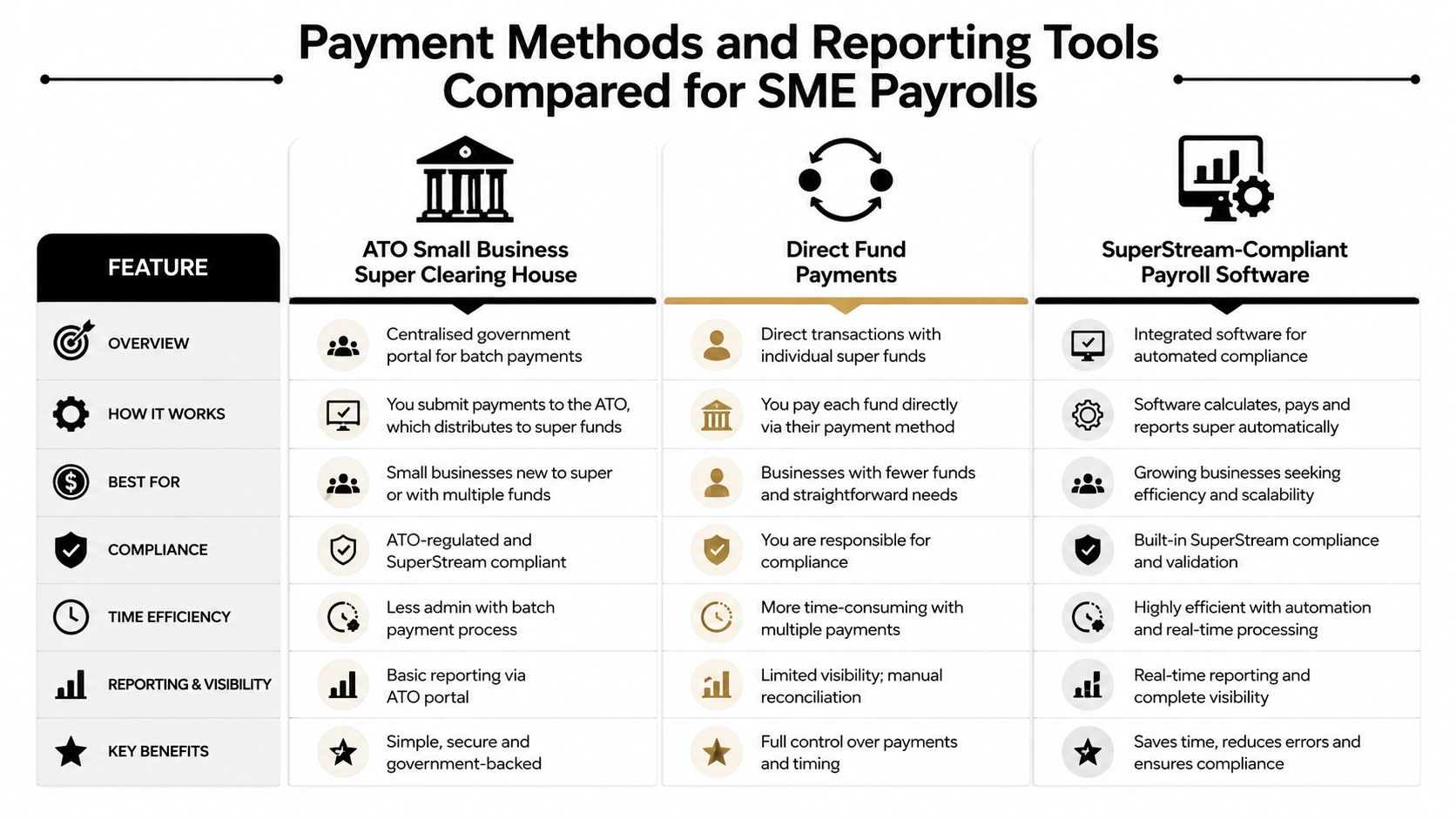
Payment Methods and Reporting Tools Compared for SME Payrolls
The payment method you choose should match your payroll complexity, not your comfort level. A tiny team with one payroll cycle can survive on simpler workflows. Once you have different worker types, different pay dates, and stricter timing, the payment infrastructure becomes part of compliance.
The ATO Small Business Super Clearing House has been the simplest path for many smaller employers, but the market is moving away from dependence on that model as Payday Super approaches. Direct payments to individual funds can work, but they demand tighter admin discipline and more careful reconciliation. SuperStream-compliant payroll software is the cleanest setup when you want payment and reporting to move together, because the system is designed to carry the data and the transaction in the same workflow.
Single Touch Payroll adds another layer. When payroll and super data are aligned, reporting is cleaner. When they aren't, the errors multiply. You need correct TFNs, fund ABNs, and USIs, and you need them captured before the pay run is approved. If you want a practical reminder of the broader payroll context, the internal STP guide at Single Touch Payroll legislation is worth keeping beside your payroll policy.
What good setup looks like
A sensible SME stack usually does three things well.
Captures employee fund data upfront: No nomination, no clean payment. Missing details slow everything down and increase rework.
Automates the super calculation: Manual percentages are fine until the first payroll exception lands, then they become a liability.
Reconciles payment and STP records together: If the payment file says one thing and payroll says another, someone has to fix it manually.
Different businesses need different controls. A professional services firm with straightforward staff rosters can often manage with a reliable payroll platform and a disciplined approval process. A labour-heavy or seasonal business should lean harder into automation, because manual handling gets fragile fast when the pay cycle shifts.
The right choice is the one that reduces exceptions. If a payment method creates more file handling than your team can manage cleanly, it's the wrong method for your business.
Common Compliance Mistakes and the Penalties That Follow
Most super problems start small. A payroll officer misses a fund detail. A founder labels a worker as a contractor because the invoice looks neat. A payment runs late because cash in the account was tighter than forecast. Then the business has a super issue, a payroll issue, and a trust issue all at once.
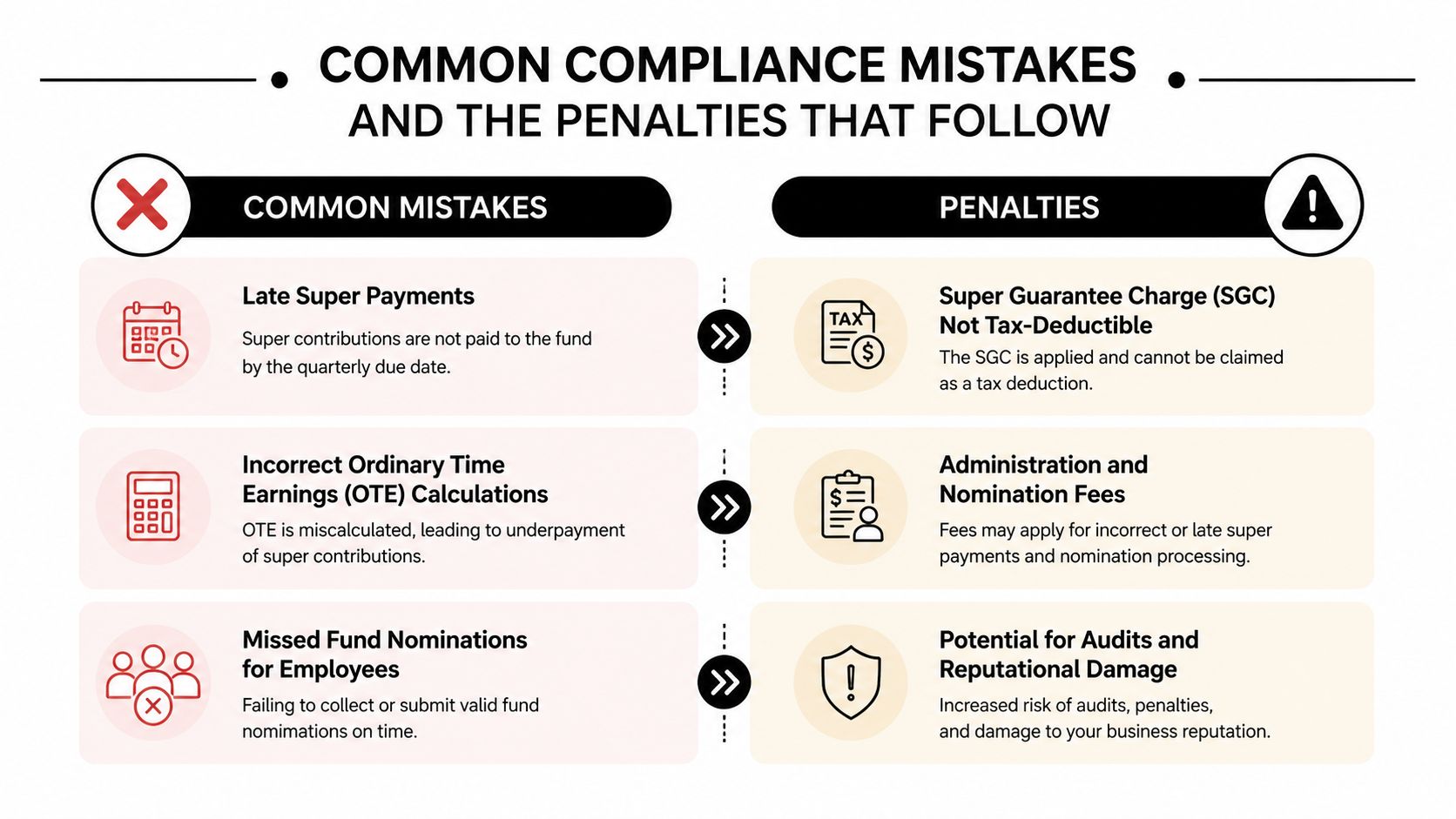
The ATO has a very practical way of finding trouble, it can match payroll data through STP with what should have been paid. That makes underpayment harder to hide than it used to be. And when super is late or missing, the exposure moves into Super Guarantee Charge territory, which is where interest and admin style penalties start to bite.
The mistakes that cause the most pain
Late super payments: Even one missed cycle can create a larger recovery problem later, especially once payment timing tightens.
Wrong ordinary time earnings treatment: If payroll includes the wrong components, super calculations are off before anyone notices.
Poor recordkeeping: If you can't show how you calculated the amount and when you paid it, you've made your own defence harder.
Misreading contractor status: A worker with an ABN isn't automatically outside super.
Ignoring nomination data: Missing fund details delay payment and increase the odds of a compliance miss.
If you're relying on “we usually fix it later”, you've already built a risk.
A useful internal check is whether payroll can reconstruct any pay run from source data alone. If the answer is no, your records are too weak. That matters because the ATO's compliance view is data-driven, not sympathy-driven. The business that can't prove its calculation is exposed even if the mistake was accidental.
For broader tax context, the compliance habits around payroll often spill into BAS, withholding, and year-end reporting too. The internal guide at tax and compliance is useful if you're tightening the whole finance stack, not just super.
There's a second risk that owners often ignore, reputation. Employees talk. Contractors talk. If people think the business is casual about super, trust drops quickly. That's not a PR issue, it's a retention issue and a hiring issue.
The cleanest response is to audit the payroll process before the ATO does it for you. Fix classification, fix timing, and keep proof.
Contractors, Trusts, and Non-Standard Workers You Might Still Owe Super To
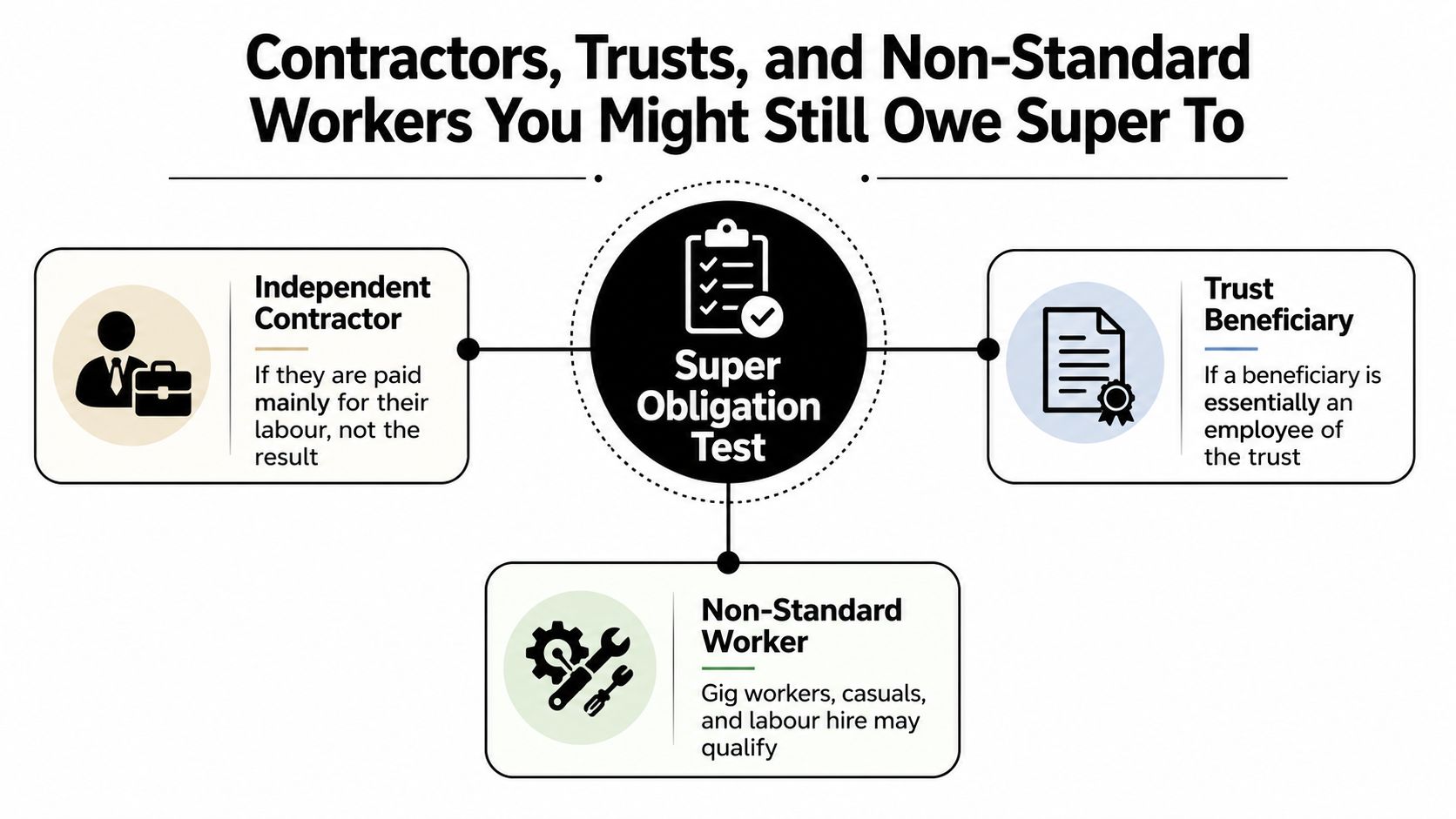
A contractor label does not erase super obligations. That's the trap. If someone is paid mainly for their labour, not for a genuine result-based service, the business may still have SG exposure under the super framework. The label on the invoice is not the whole test.
Founders often get caught out in real life. A sole trader who works like staff, a family trust arrangement that functions like employment, or a gig-adjacent worker who follows your instructions too closely can all raise super issues. The compliance question is not what the paperwork calls them, it's how the work operates.
A practical decision rule
Start with control, then move to substance. If the person is embedded in your roster, uses your systems, and is paid primarily for labour, treat that as a red flag. If they deliver a result as an independent business, the position is different, but the evidence has to support it.
The ATO's own guidance on superannuation basics is useful here because it ties the issue back to fund data, SuperStream processing, and the actual structure of the payment relationship (ATO super basics in other languages). The system is more data-driven than many owners realise. Once you're collecting TFNs, fund details, and payment data together, misclassification stops being an abstract HR question and becomes a payroll control problem.
I'd also avoid lazy assumptions around director-type or trust-type arrangements. If you want a cleaner view on worker classification in general, the internal guide at employee or contractor ATO is the right companion read.
Practical rule: if the arrangement only works because your business controls the person's labour, get the classification reviewed.
The point isn't to turn every contractor into an employee. It's to stop pretending the label alone decides the outcome. If the relationship is borderline, get advice before the next pay run, not after the ATO asks questions.
Your Superannuation Compliance Checklist for 2026 and Beyond
Treat this as an operations checklist, not a policy memo. If a payroll manager cannot turn each line into a clear action, the checklist is too vague to protect the business.
1. Confirm who actually qualifies
Review every worker category, including casuals, part-timers, directors, and under-18 staff who work more than 30 hours a week. If the role sits anywhere near the employee or contractor line, get the arrangement reviewed before the next pay run.
2. Verify the earnings base
Make sure your payroll system calculates ordinary time earnings correctly and only on the amounts that count. A system that treats every payment as superable will overstate the liability and distort cash planning.
3. Test Payday Super readiness now
From 1 July 2026, super needs to move with wages, not sit in the quarter-end queue. Run a test pay cycle in your payroll software with Payday Super enabled, then confirm the super transaction posts within 7 calendar days of the pay date, the fund details are accepted, and the reconciliation clears without manual intervention (Treasury Payday Super factsheet).
4. Build a cash buffer policy
Set aside super automatically from each pay run. If you wait and rely on discipline later, the operating account will get raided for rent, tax, and supplier payments before super is funded.
5. Clean up fund data
Collect TFNs, fund ABNs, and USIs before the first pay run, not after. Then check that the details in payroll match the actual fund records, because bad data slows payment and creates avoidable rejects.
6. Review payment method fit
If your workflow still depends on manual transfers, the process risk is too high. Decide whether SuperStream automation or a clearing house structure fits your payroll volume, approval chain, and month-end close process, then document who owns each step.
7. Reassess contractor classifications
If someone looks like a contractor but works like staff, review the arrangement now. Check the contract, the roster pattern, who controls the work, and whether the person is really running an independent business. Misclassification is cheaper to fix early than to unwind later.
8. Keep proof for every pay run
Store calculation support, payment confirmation, and fund details together for each cycle. Keep the approval trail as well, so if a payment is disputed you can show what was calculated, when it was sent, and who signed it off.
If you want a workflow lens on payroll automation and finance ops, the AI for finance professionals resource is a useful reference point for thinking about how systems can reduce manual handling without losing control. If you're reviewing this across the whole business, not just payroll, Nexist also works with founders on cash flow, payroll process design, and finance systems so super stops being an after-hours fire drill.
superannuation obligations, super guarantee, payday super, SME payroll compliance, ATO super rules

" width="24px"/><g d="M 0 24.129 L 0 0.129 L 24 0.129 L 24 24.129 Z M 0 24.129 L 0 0.129 L 24 0.129 L 24 24.129 Z M 24 3 C 24 1.344 22.656 0 21 0 L 3 0 C 1.344 0 0 1.344 0 3 L 0 21 C 0 22.656 1.344 24 3 24 L 21 24 C 22.656 24 24 22.656 24 21 Z M 6.883 8.375 L 2.863 8.375 L 2.863 20.467 L 6.883 20.467 Z M 4.899 2.545 C 3.524 2.545 2.625 3.449 2.625 4.634 C 2.625 5.795 3.496 6.724 4.846 6.724 L 4.872 6.724 C 6.273 6.724 7.146 5.795 7.146 4.634 C 7.12 3.449 6.274 2.545 4.899 2.545 Z M 16.747 8.09 C 14.614 8.09 13.659 9.263 13.124 10.086 L 13.124 8.374 L 9.105 8.374 C 9.159 9.508 9.105 20.466 9.105 20.466 L 13.124 20.466 L 13.124 13.713 C 13.124 13.352 13.15 12.99 13.257 12.732 C 13.547 12.01 14.209 11.262 15.319 11.262 C 16.773 11.262 17.355 12.372 17.355 13.996 L 17.355 20.466 L 21.374 20.466 L 21.374 13.532 C 21.374 9.818 19.391 8.09 16.747 8.09 Z" fill="transparent" height="24.12890599668026px" id="dSFdkJotL" width="24px"><path d="M 0 24 L 0 0 L 24 0 L 24 24 Z" fill="transparent" height="24px" id="wscNJE44G" transform="translate(0 0.129)" width="24px"/><g d="M 0 24.129 L 0 0.129 L 24 0.129 L 24 24.129 Z M 24 3 C 24 1.344 22.656 0 21 0 L 3 0 C 1.344 0 0 1.344 0 3 L 0 21 C 0 22.656 1.344 24 3 24 L 21 24 C 22.656 24 24 22.656 24 21 Z M 6.883 8.375 L 2.863 8.375 L 2.863 20.467 L 6.883 20.467 Z M 4.899 2.545 C 3.524 2.545 2.625 3.449 2.625 4.634 C 2.625 5.795 3.496 6.724 4.846 6.724 L 4.872 6.724 C 6.273 6.724 7.146 5.795 7.146 4.634 C 7.12 3.449 6.274 2.545 4.899 2.545 Z M 16.747 8.09 C 14.614 8.09 13.659 9.263 13.124 10.086 L 13.124 8.374 L 9.105 8.374 C 9.159 9.508 9.105 20.466 9.105 20.466 L 13.124 20.466 L 13.124 13.713 C 13.124 13.352 13.15 12.99 13.257 12.732 C 13.547 12.01 14.209 11.262 15.319 11.262 C 16.773 11.262 17.355 12.372 17.355 13.996 L 17.355 20.466 L 21.374 20.466 L 21.374 13.532 C 21.374 9.818 19.391 8.09 16.747 8.09 Z" fill="transparent" height="24.12890599668026px" id="sTpjGo1tb" width="24px"><path d="M 0 24 L 0 0 L 24 0 L 24 24 Z" fill="transparent" height="24px" id="s7ffpmKOD" transform="translate(0 0.129)" width="24px"/><g d="M 24 3 C 24 1.344 22.656 0 21 0 L 3 0 C 1.344 0 0 1.344 0 3 L 0 21 C 0 22.656 1.344 24 3 24 L 21 24 C 22.656 24 24 22.656 24 21 Z M 6.883 8.375 L 2.863 8.375 L 2.863 20.467 L 6.883 20.467 Z M 4.899 2.545 C 3.524 2.545 2.625 3.449 2.625 4.634 C 2.625 5.795 3.496 6.724 4.846 6.724 L 4.872 6.724 C 6.273 6.724 7.146 5.795 7.146 4.634 C 7.12 3.449 6.274 2.545 4.899 2.545 Z M 16.747 8.09 C 14.614 8.09 13.659 9.263 13.124 10.086 L 13.124 8.374 L 9.105 8.374 C 9.159 9.508 9.105 20.466 9.105 20.466 L 13.124 20.466 L 13.124 13.713 C 13.124 13.352 13.15 12.99 13.257 12.732 C 13.547 12.01 14.209 11.262 15.319 11.262 C 16.773 11.262 17.355 12.372 17.355 13.996 L 17.355 20.466 L 21.374 20.466 L 21.374 13.532 C 21.374 9.818 19.391 8.09 16.747 8.09 Z" fill="transparent" height="24.000006px" id="D0ecaHEcW" transform="translate(0 0)" width="24px"><path d="M 24 3 C 24 1.344 22.656 0 21 0 L 3 0 C 1.344 0 0 1.344 0 3 L 0 21 C 0 22.656 1.344 24 3 24 L 21 24 C 22.656 24 24 22.656 24 21 Z" fill="rgb(55, 184, 218)" height="24.000006px" id="IPLFE6zXx" width="24px"/><path d="M 4.02 0 L 0 0 L 0 12.092 L 4.02 12.092 Z" fill="rgb(255, 255, 255)" height="12.09201px" id="FWhtzAyuY" transform="translate(2.863 8.375)" width="4.02px"/><path d="M 2.274 0 C 0.899 0 0 0.904 0 2.089 C 0 3.25 0.871 4.179 2.221 4.179 L 2.247 4.179 C 3.648 4.179 4.521 3.25 4.521 2.089 C 4.495 0.904 3.649 0 2.274 0 Z" fill="rgb(255, 255, 255)" height="4.17876px" id="VmOsKv4kO" transform="translate(2.625 2.545)" width="4.52095px"/><path d="M 7.641 0 C 5.509 0 4.554 1.173 4.019 1.996 L 4.019 0.284 L 0 0.284 C 0.053 1.419 0 12.376 0 12.376 L 4.019 12.376 L 4.019 5.623 C 4.019 5.262 4.045 4.9 4.151 4.642 C 4.442 3.92 5.103 3.172 6.214 3.172 C 7.667 3.172 8.25 4.282 8.25 5.907 L 8.25 12.376 L 12.269 12.376 L 12.269 5.442 C 12.269 1.728 10.286 0 7.641 0 Z" fill="rgb(255, 255, 255)" height="12.37626px" id="n1XUbhaq0" transform="translate(9.105 8.09)" width="12.268830000000001px"/></g></g></g></g></svg>)