Leadership Skills Development for Australian SME Founders
Practical leadership skills development roadmap for Australian SME founders. Build decision-making, delegation and people leadership to scale your business.
Ansh Malhotra

You're probably carrying too much of the business in your head right now. The team waits for your call on the awkward customer issue, the bookkeeper pings you for approvals, the weekly numbers don't tell you whether margin is improving, and by Friday you've spent most of the week reacting instead of leading. That's not a motivation problem. It's a leadership skills development problem, and for Australian SME founders it's also an operations problem, a cash-flow problem, and a delegation problem.
If you want the business to grow without swallowing your calendar, stop treating leadership as a personal upgrade you'll get to later. It has to be built into how the business runs.
Table of Contents
Why Leadership Skills Development Is the Real SME Bottleneck
The Four Leadership Skills That Move the Needle for Founders
Why Leadership Skills Development Is the Real SME Bottleneck
Most founders blame cash flow, staff, or marketing when growth stalls. Those things matter, but they're often symptoms of a tighter constraint sitting at the centre of the business, the founder's own leadership capacity. If every decision still routes through you, your team can't move faster than your inbox.
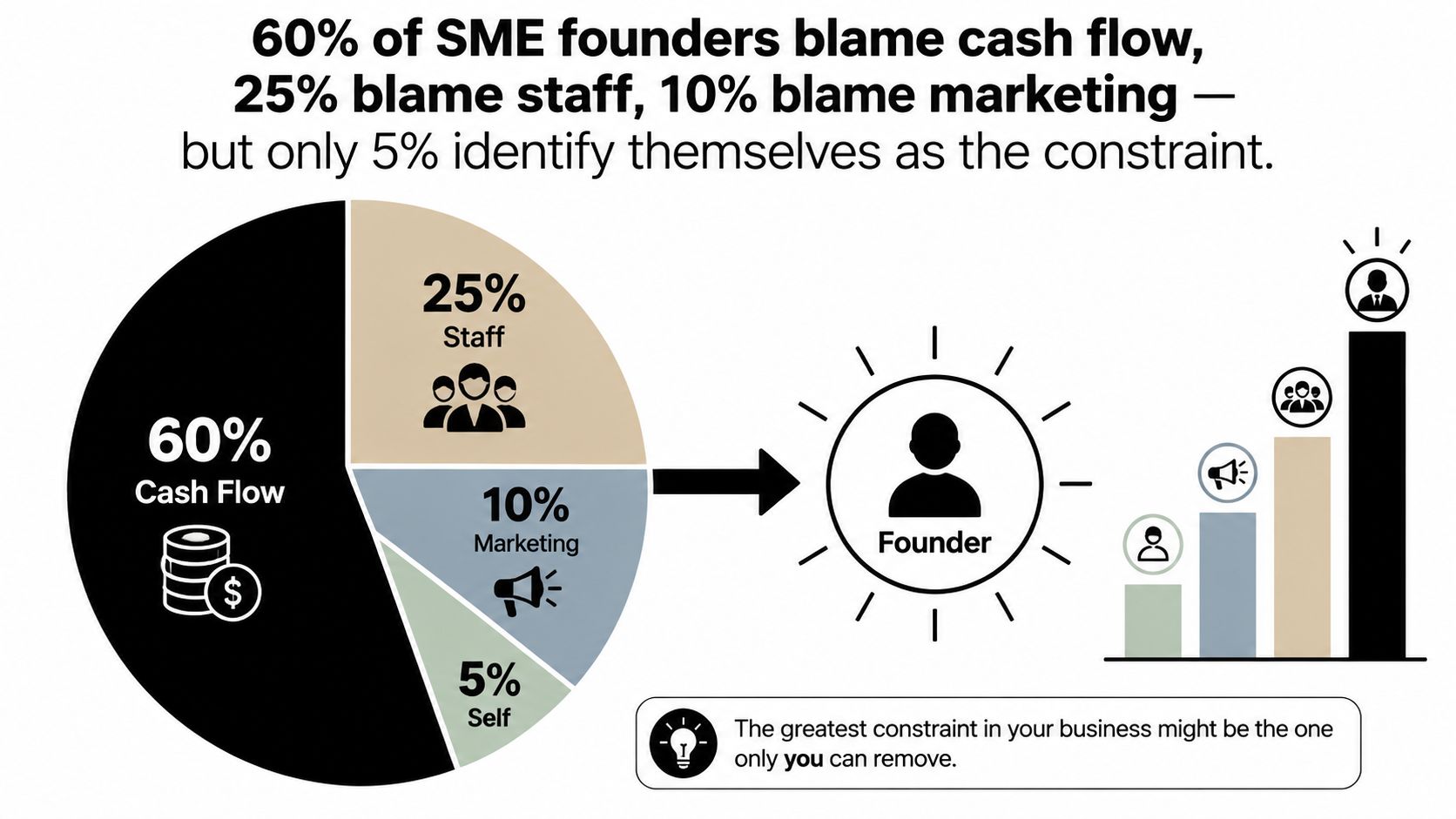
The founder week tells the truth
Look at the typical week. You're in back-to-back calls, clearing approvals, checking whether invoices went out, and making decisions without a clean view of margin by product or channel. The team learns to wait, because waiting is safer than guessing. That creates a slow business even when the market is moving.
This is why leadership skills development isn't a soft extra. It's the work that lets the business operate without your constant intervention. A leadership communication resource like the leadership communication guide is useful here because the core problem is rarely a lack of talking. It's unclear decisions, fuzzy handovers, and messages that don't produce action.
Practical rule: if your business only moves when you personally push it, your leadership system is underbuilt.
The bigger point is uncomfortable. You can hire better people, buy better tools, and spend more on marketing, but if your leadership habits stay unchanged, the business keeps hitting the same wall. Global benchmarks show how common this gap is, with only 44% of managers worldwide having received management training, and the Chartered Management Institute saying 82% of UK managers enter management without formal leadership or management training, which is why leadership capability gets treated as a core business function rather than a nice-to-have Kinkajou Consulting.
For owner-led SMEs, that's the lesson. The next stage of growth isn't achieved by another campaign or a louder sales push. It's achieved when the founder becomes easier to lead, easier to delegate from, and faster at making clean decisions. Leadership is the bottleneck until you make it the operating system.
Run an Honest Founder Self-Assessment Before Picking Skills
Don't buy a course until you know where you're broken. Founders are notorious for fixing the skill they enjoy, not the skill that's costing the business the most. A proper self-assessment strips away mood and ego.
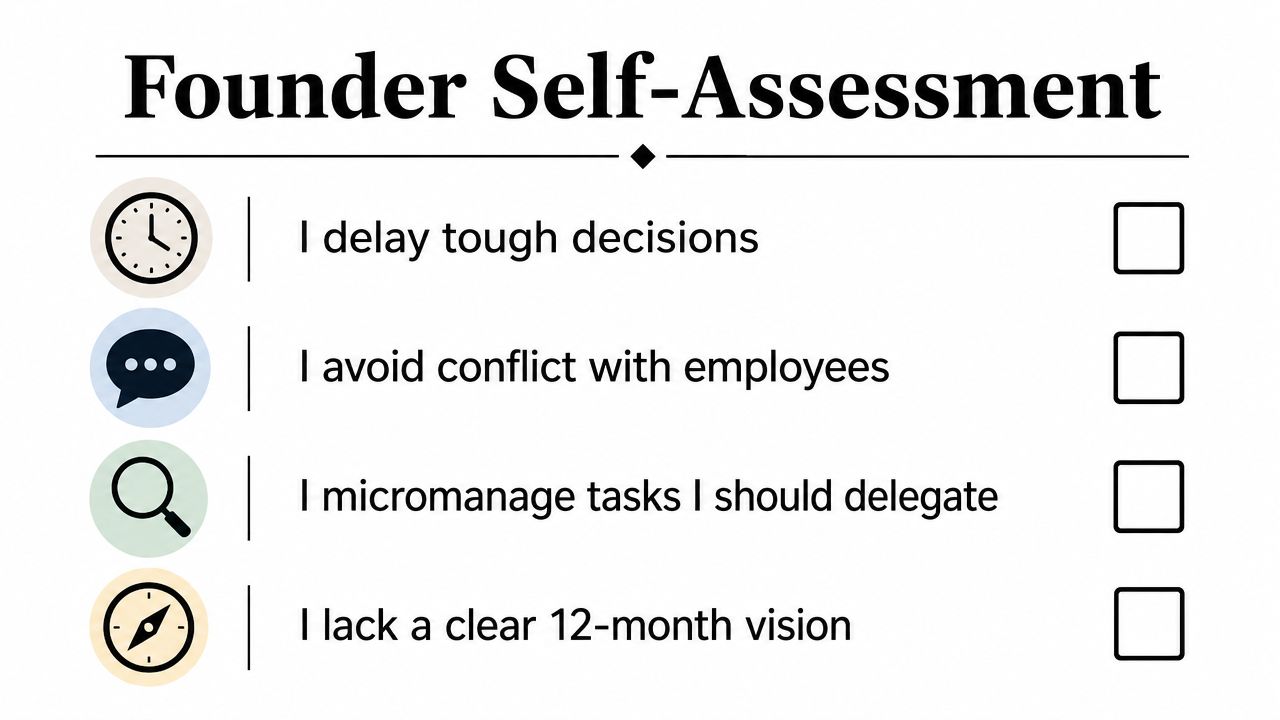
Score behaviour, not self-image
Give yourself a 1 to 5 score in four areas, using observable behaviour only.
Decision quality: Do decisions land quickly, or do they sit in your inbox for days?
Delegation habits: Does the work stay with you, or does it move out with clear ownership?
Financial command: Can you explain the weekly cash position, margin pressure, and key trade-offs without scrambling?
People leadership: Do team issues get resolved directly, or do you avoid hard conversations until they become bigger?
A 5 means the behaviour happens consistently without reminders. A 3 means it happens sometimes, but only when pressure is low. A 1 means the business is clearly paying for the gap. The point is to score what you do, not what you intend.
MyCulture.ai has a useful leadership guide that can help you sanity-check the people side of the scorecard, especially if you keep defaulting to general management advice instead of your actual day-to-day behaviour. Use the MyCulture.ai guide to leadership as a reference point, but score yourself against your own calendar, not your self-perception.
A simple example shows where the real leak is
Take a hypothetical ecommerce founder. They rate themselves a 4 on decision-making because they're decisive under pressure. Then they look at their inbox and realise supplier choices, customer escalations, stock approvals, and ad spend changes all sit untouched until the end of the week. That's not decisiveness. That's delay with confidence.
Now score the bottom two areas and ignore the rest for 90 days. If you try to improve all four at once, you'll end up doing none of them well. The written assessment should force a choice, because focus is what turns leadership development into change.
Write down the two lowest scores and make those the only leadership targets for the next quarter.
The Four Leadership Skills That Move the Needle for Founders
There are plenty of leadership skills you could chase. Most of them are useful in some context. Only four consistently move the numbers in an owner-led SME.
Compare them by business leverage
Decision-making comes first because slow decisions block everyone else. If the founder hesitates, the team can't price, hire, order stock, or respond to a customer issue with confidence. That delay spreads across the business like a tax.
Delegation is the multiplier. Every task you keep for yourself steals founder hours that should be spent on pricing, cash, and strategic control. When delegation works, you buy back time without adding headcount.
Financial literacy is the compass. It lets you see the difference between busy and profitable. Without it, founders tend to overreact to revenue and underreact to margin, receivables, and working capital.
People management is the retention layer. Bad hiring calls, vague feedback, and unaddressed tension destroy margin, even when sales look fine. Strong people management doesn't mean being liked. It means the team knows what good looks like and what happens when it doesn't show up.
The business case for leadership development is no longer abstract. A leadership statistics review reports that companies offering leadership training see a 25% boost in business performance and a 20% increase in overall performance on average, while organisations with strong leadership are 2.3 times more likely to outperform competitors financially eLearning Industry. The same source says poor leadership can cost businesses up to $550 billion annually in lost productivity. That scale matters because founder time is expensive and team drift is even more expensive.
What to prioritise first
For most founders, start with decision-making and delegation. Those two skills release time fastest. Once you've created headroom, build financial literacy in parallel so your decisions are grounded in cash reality. People management gets much easier once you're not constantly firefighting.
A useful contrast looks like this. A strong weekly cash review changes what you approve. A delegation brief changes who owns the work. A one-on-one template changes how problems surface. Those are operational habits, not personality traits.
The business does not need you to become a different person. It needs you to become a cleaner operator.
A 90-Day Practice Cadence That Actually Builds the Skills
Workshops don't build leadership. Repeated decisions in a live business do. If you want lasting change, put the practice into the week, not into a wish list.
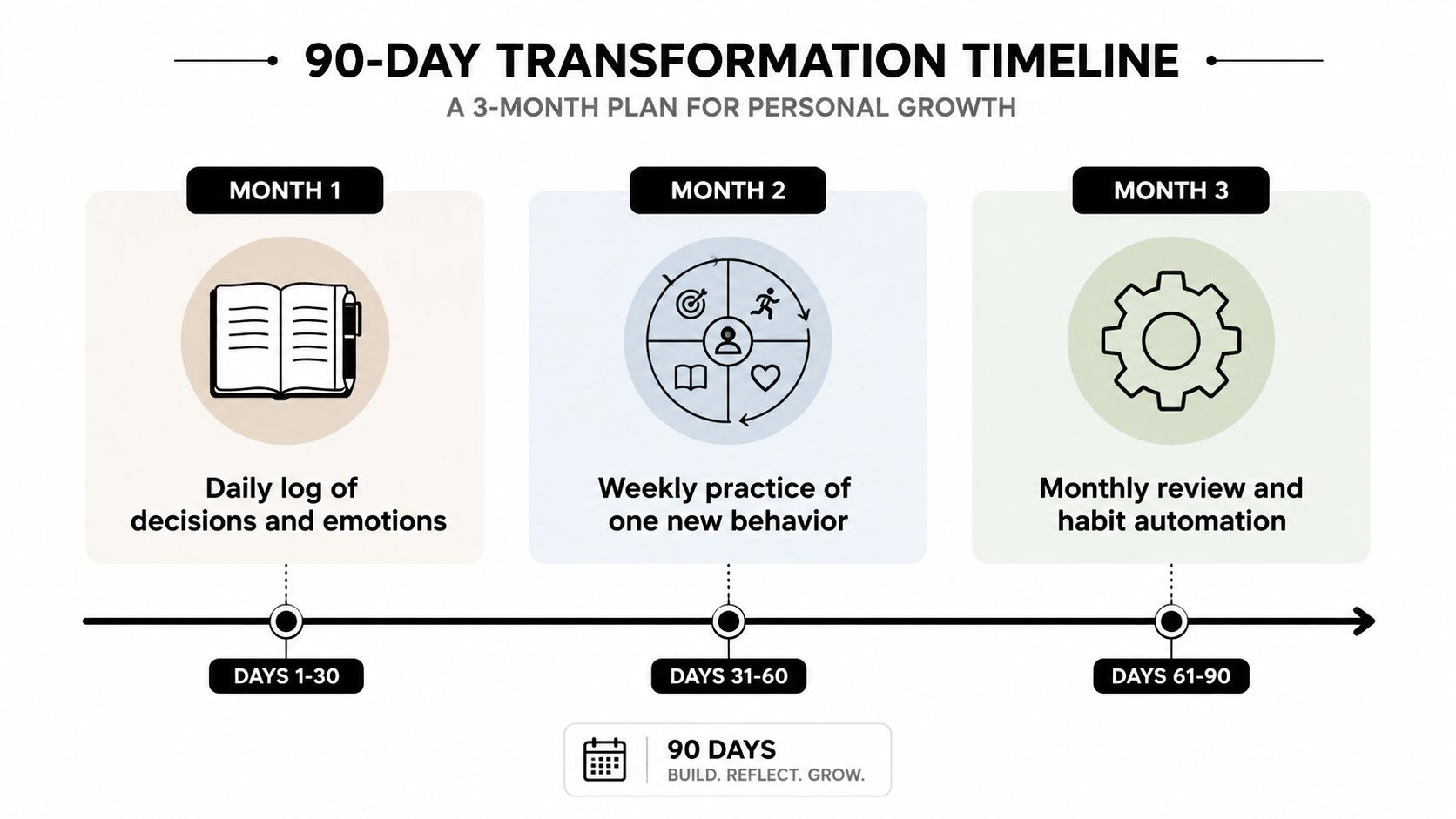
Make the week do the teaching
Start with a Sunday 30-minute planning block. Pick the three decisions that matter most, name the owner for each, and mark anything that must be resolved before Friday. That stops the week from becoming a pile of interruptions.
Use Monday decision triage to clear the fastest decisions first. If an issue can be answered in five minutes, answer it. If it needs more information, assign a deadline and a name. Don't let ambiguous items sit in limbo.
Mid-week, run one-on-ones with the people who carry real responsibility. Keep them focused on blockers, trade-offs, and the next decision. Friday becomes your cash and KPI review, where you check what happened, what slipped, and what needs escalation.
Synopsix has a practical leadership development piece that aligns well with this type of operating rhythm, especially if you need a tighter way to think about routine behaviour and decision patterns. The Synopsix guide on leadership development best practices is relevant if you're building habits that need to stick inside a real week.
Use monthly reinforcement, not occasional inspiration
Once a month, hold a structured feedback conversation with a coach, peer, or advisor. Use start, stop, continue. Keep it blunt. What should you start doing, what should stop because it creates drag, and what should continue because it's working?
Then write one page on the month's decisions. Note where you delayed, where you delegated badly, and where your judgment improved. That reflection matters because pattern recognition is what turns leadership practice into a system.
The research supports this structure. A meta-analysis of 335 independent samples found leadership training improved reactions, learning, transfer, and results, with stronger effects when programs used needs analysis, feedback, multiple delivery methods, and face-to-face practice PubMed. That's a direct argument for real-world repetition instead of passive learning.
If it isn't scheduled, it won't happen. Protected time isn't a nice-to-have, it's the delivery mechanism.
By day 90, the goal isn't perfection. It's evidence that decisions are moving faster, delegation is cleaner, and the founder's week is no longer the bottleneck.
Delegation Templates and SOPs That Stop Work Bouncing Back
The fastest way to grow as a founder is to stop being the person who redos everything. If work keeps bouncing back to you, delegation hasn't happened. You've only outsourced the first draft.
Use a delegation brief every time
A good delegation brief removes guesswork. Keep it simple:
Outcome required: what success looks like.
Definition of done: what must be true before you accept the work.
Constraints: budget, brand rules, timing, compliance, or supplier limits.
Decision rights: what the person can decide without asking you.
Check-in cadence: when you'll review progress and what triggers escalation.
That brief can be written in five minutes, but it saves hours of rework. It also stops the common founder habit of saying “just handle it” and then getting annoyed when the result doesn't match an unstated standard.
For recurring processes, build a basic RACI. It doesn't need to be fancy. It just needs to say who is responsible, who approves, who gets consulted, and who gets informed. That alone clears a lot of approval clutter.
If you want a deeper process lens, the internal resource on business process improvement is a sensible companion because delegation breaks when the process is unclear, not just when the person is weak.
SOPs reduce your approval queue
A rough SOP beats a perfect memory every time. Write down the sequence for repeat work, even if it's only half a page. The point is to move the task from your head into a repeatable system.
This matters in finance, where the founder often becomes the default approver for invoices, reconciliations, BAS prep, and cash decisions. If those steps are documented, they can move without constant interruption. The same logic applies to ops, customer service, and supplier reorders.
Use a delegation log to track what you handed over, when you reviewed it, and whether the work came back with the same mistake. That gives you accountability without hovering. It also exposes the tasks you keep rescuing because you haven't let go.
People decisions are the hardest call. Keep cash, key hires, brand calls, and serious risk decisions close to you. Push daily operations, customer fixes, and routine supplier decisions down the line where they belong. The founder's job is to set standards and exceptions, not to approve every small move.
KPIs That Prove Leadership Skills Development Is Working
If leadership development can't be measured, it'll get bumped the next time a customer issue lands. Treat your own leadership the same way you'd treat revenue, margin, or debtor days. Track it monthly.
KPI | What it measures | Target after 90 days | How to capture it |
|---|---|---|---|
Decision cycle time | How long it takes to move from issue raised to decision made | Faster decisions across routine matters | Track timestamps in your task tool or inbox |
Delegation ratio | How much work is completed by the team instead of the founder | More ownership outside the founder | Review who completed recurring tasks |
Cash visibility | Whether you can state the key cash position without checking five systems | Clearer weekly financial command | Test yourself during the monthly review |
Team engagement signal | Whether people are engaged enough to raise issues early | Fewer surprises, clearer escalation | Use a simple pulse check or retention signal |
Read the dashboard as a system
A high number of one-on-ones doesn't prove leadership is improving if decisions still stall. A clean delegation ratio doesn't help if the team is guessing about cash priorities. Look at the whole set together.
The dashboard should turn red, amber, and green in a way that tells you where the core problem sits. If decision cycle time improves but cash visibility doesn't, you'll still make the wrong calls faster. If delegation improves but people engagement drops, you may have pushed work down without giving clarity.
A good monthly review takes under 30 minutes. Answer three questions only. What improved, what worsened, and what will you change next month? Then pick one leading indicator to focus on, not four.
For a broader review rhythm, the internal guide on quarterly business review is a useful companion because the same discipline that applies to company performance should apply to founder behaviour.
Keep this simple: if the numbers don't change, the leadership habit didn't change either.
Free Your Time With Finance and Operations Systems
Leadership development fails when the founder still spends half the week in finance firefighting. You can't build better habits if you never have the time to practise them. The operating system has to buy back your hours first.
Put the time back into the calendar
A weekly cashflow forecast is the starting point. It stops you from discovering problems late and forces regular attention on receipts, outflows, and timing. Once that becomes routine, the founder stops operating on surprise.
Automated invoicing and AR/AP workflows take more noise out of the week. So does AI-enabled reporting that shows margin by product and channel instead of forcing you to dig through spreadsheets. Add SOP-backed delegation for routine finance and admin tasks, and the founder stops becoming the human router for every small transaction.
If your finance stack still runs through too many manual steps, the internal guide on small business finance software is worth reading because the right system reduces admin before it becomes leadership drag.
A practical shift looks like this. One founder spends 15 hours a week on finance firefighting. After tightening forecasting, invoicing, and advisor workflows, that collapses into a 90-minute weekly review with urgent questions handled through a faster channel. The important change isn't just time saved. It's that the founder now has space to run the leadership practices that move the business.
Start with a 30-day checklist
Do these five things in order.
Complete the self-assessment and write down the two weakest skills.
Pick one KPI from the dashboard and review it monthly.
Delegate one recurring process with a brief and a check-in cadence.
Book one feedback conversation with a coach, peer, or advisor.
Install one finance system that cuts manual work from the week.
That's enough to begin. Don't turn leadership development into a reading project or a personality project. Turn it into an operating rhythm that returns time, margin, and cleaner decisions. Once the founder stops being the bottleneck, the business finally has room to scale.
A CTA for Nexist. If you're ready to reclaim time, tighten your cash flow, and build the leadership habits that stop the business leaning on you for every decision, talk to Nexist and get a sharper operating plan in place.
leadership skills development, SME leadership, founder coaching, delegation framework, Australian business

" width="24px"/><g d="M 0 24.129 L 0 0.129 L 24 0.129 L 24 24.129 Z M 0 24.129 L 0 0.129 L 24 0.129 L 24 24.129 Z M 24 3 C 24 1.344 22.656 0 21 0 L 3 0 C 1.344 0 0 1.344 0 3 L 0 21 C 0 22.656 1.344 24 3 24 L 21 24 C 22.656 24 24 22.656 24 21 Z M 6.883 8.375 L 2.863 8.375 L 2.863 20.467 L 6.883 20.467 Z M 4.899 2.545 C 3.524 2.545 2.625 3.449 2.625 4.634 C 2.625 5.795 3.496 6.724 4.846 6.724 L 4.872 6.724 C 6.273 6.724 7.146 5.795 7.146 4.634 C 7.12 3.449 6.274 2.545 4.899 2.545 Z M 16.747 8.09 C 14.614 8.09 13.659 9.263 13.124 10.086 L 13.124 8.374 L 9.105 8.374 C 9.159 9.508 9.105 20.466 9.105 20.466 L 13.124 20.466 L 13.124 13.713 C 13.124 13.352 13.15 12.99 13.257 12.732 C 13.547 12.01 14.209 11.262 15.319 11.262 C 16.773 11.262 17.355 12.372 17.355 13.996 L 17.355 20.466 L 21.374 20.466 L 21.374 13.532 C 21.374 9.818 19.391 8.09 16.747 8.09 Z" fill="transparent" height="24.12890599668026px" id="dSFdkJotL" width="24px"><path d="M 0 24 L 0 0 L 24 0 L 24 24 Z" fill="transparent" height="24px" id="wscNJE44G" transform="translate(0 0.129)" width="24px"/><g d="M 0 24.129 L 0 0.129 L 24 0.129 L 24 24.129 Z M 24 3 C 24 1.344 22.656 0 21 0 L 3 0 C 1.344 0 0 1.344 0 3 L 0 21 C 0 22.656 1.344 24 3 24 L 21 24 C 22.656 24 24 22.656 24 21 Z M 6.883 8.375 L 2.863 8.375 L 2.863 20.467 L 6.883 20.467 Z M 4.899 2.545 C 3.524 2.545 2.625 3.449 2.625 4.634 C 2.625 5.795 3.496 6.724 4.846 6.724 L 4.872 6.724 C 6.273 6.724 7.146 5.795 7.146 4.634 C 7.12 3.449 6.274 2.545 4.899 2.545 Z M 16.747 8.09 C 14.614 8.09 13.659 9.263 13.124 10.086 L 13.124 8.374 L 9.105 8.374 C 9.159 9.508 9.105 20.466 9.105 20.466 L 13.124 20.466 L 13.124 13.713 C 13.124 13.352 13.15 12.99 13.257 12.732 C 13.547 12.01 14.209 11.262 15.319 11.262 C 16.773 11.262 17.355 12.372 17.355 13.996 L 17.355 20.466 L 21.374 20.466 L 21.374 13.532 C 21.374 9.818 19.391 8.09 16.747 8.09 Z" fill="transparent" height="24.12890599668026px" id="sTpjGo1tb" width="24px"><path d="M 0 24 L 0 0 L 24 0 L 24 24 Z" fill="transparent" height="24px" id="s7ffpmKOD" transform="translate(0 0.129)" width="24px"/><g d="M 24 3 C 24 1.344 22.656 0 21 0 L 3 0 C 1.344 0 0 1.344 0 3 L 0 21 C 0 22.656 1.344 24 3 24 L 21 24 C 22.656 24 24 22.656 24 21 Z M 6.883 8.375 L 2.863 8.375 L 2.863 20.467 L 6.883 20.467 Z M 4.899 2.545 C 3.524 2.545 2.625 3.449 2.625 4.634 C 2.625 5.795 3.496 6.724 4.846 6.724 L 4.872 6.724 C 6.273 6.724 7.146 5.795 7.146 4.634 C 7.12 3.449 6.274 2.545 4.899 2.545 Z M 16.747 8.09 C 14.614 8.09 13.659 9.263 13.124 10.086 L 13.124 8.374 L 9.105 8.374 C 9.159 9.508 9.105 20.466 9.105 20.466 L 13.124 20.466 L 13.124 13.713 C 13.124 13.352 13.15 12.99 13.257 12.732 C 13.547 12.01 14.209 11.262 15.319 11.262 C 16.773 11.262 17.355 12.372 17.355 13.996 L 17.355 20.466 L 21.374 20.466 L 21.374 13.532 C 21.374 9.818 19.391 8.09 16.747 8.09 Z" fill="transparent" height="24.000006px" id="D0ecaHEcW" transform="translate(0 0)" width="24px"><path d="M 24 3 C 24 1.344 22.656 0 21 0 L 3 0 C 1.344 0 0 1.344 0 3 L 0 21 C 0 22.656 1.344 24 3 24 L 21 24 C 22.656 24 24 22.656 24 21 Z" fill="rgb(55, 184, 218)" height="24.000006px" id="IPLFE6zXx" width="24px"/><path d="M 4.02 0 L 0 0 L 0 12.092 L 4.02 12.092 Z" fill="rgb(255, 255, 255)" height="12.09201px" id="FWhtzAyuY" transform="translate(2.863 8.375)" width="4.02px"/><path d="M 2.274 0 C 0.899 0 0 0.904 0 2.089 C 0 3.25 0.871 4.179 2.221 4.179 L 2.247 4.179 C 3.648 4.179 4.521 3.25 4.521 2.089 C 4.495 0.904 3.649 0 2.274 0 Z" fill="rgb(255, 255, 255)" height="4.17876px" id="VmOsKv4kO" transform="translate(2.625 2.545)" width="4.52095px"/><path d="M 7.641 0 C 5.509 0 4.554 1.173 4.019 1.996 L 4.019 0.284 L 0 0.284 C 0.053 1.419 0 12.376 0 12.376 L 4.019 12.376 L 4.019 5.623 C 4.019 5.262 4.045 4.9 4.151 4.642 C 4.442 3.92 5.103 3.172 6.214 3.172 C 7.667 3.172 8.25 4.282 8.25 5.907 L 8.25 12.376 L 12.269 12.376 L 12.269 5.442 C 12.269 1.728 10.286 0 7.641 0 Z" fill="rgb(255, 255, 255)" height="12.37626px" id="n1XUbhaq0" transform="translate(9.105 8.09)" width="12.268830000000001px"/></g></g></g></g></svg>)