Employee or Contractor ATO: 2026 Compliance Guide
Our 2026 guide helps Australian SMEs navigate employee or contractor ato rules, assess workers, meet compliance, & avoid sham contracting penalties.
Ansh Malhotra

You've probably had this thought already. A new role opens up, cash is tight, and calling the person a contractor feels cleaner than hiring an employee. No payroll setup, no leave accruals, less admin, and a rate you can treat as a straight operating expense.
That shortcut is where many SME problems start.
In practice, the employee or contractor ATO question isn't a paperwork exercise. It affects cash flow, margin planning, super, withholding, insurance, and how exposed you are if someone reviews the arrangement later. A worker can have an ABN, send invoices, and still create obligations that look a lot like employment.
For founders, the risk isn't just legal theory. It's the nasty operational surprise. The “cheap contractor” can become unpaid super, backdated withholding issues, leave claims, and time-consuming remediation when your finance team is already stretched. If you work across borders, the same theme appears elsewhere too. For example, UK businesses dealing with off-payroll rules often use a guide for UK professionals on IR35 because labels alone don't settle status there either.
Table of Contents
Is Your New Hire an Employee or a Contractor
A founder in growth mode often makes the same call. They need help fast, can't justify another full-time salary yet, and engage someone as a “contractor” for flexibility. It seems sensible. The person has an ABN, agrees to invoice monthly, and everyone moves on.
Then the role expands.
The worker starts joining weekly team meetings, uses the business email address, works set days, and reports into the operations manager. Nothing dramatic changes in one day, but the arrangement slowly stops looking like an external service provider and starts looking like part of the business.
That's where trouble enters the P&L.
If the classification is wrong, the cash impact doesn't arrive neatly. It shows up as liabilities you didn't budget for, admin you didn't plan for, and pressure on working capital at the worst possible time. The problem is bigger for SMEs because one classification error can hit several areas at once.
Businesses usually don't get caught because they used the wrong label. They get caught because the label didn't match how the work actually happened.
The practical point is simple. Worker status isn't determined by what the invoice says, what the worker prefers, or what keeps onboarding easy. It affects tax, super, entitlements, and risk. For a busy founder, that makes it a finance decision as much as an HR one.
The ATO Litmus Test Explained
A founder signs a contractor agreement on Monday, approves the first invoice on Friday, and assumes the risk is handled. Months later, that same person is working set hours, using internal systems, and answering to a team lead. The contract still says contractor. The operating reality says you need a closer look.
That is the ATO test in practice. By 2026, the point is well established. Worker classification is assessed by the totality of the relationship, shaped by the contract and by the rights and obligations that govern the work in practice. Many SMEs still get this wrong because they rely on surface signals instead of checking how the arrangement functions in the business.
What the totality of the relationship means
The shortcuts are familiar, and they still cause problems:
They have an ABN
They send invoices
The engagement started as short-term
The agreement calls them a consultant
They asked to be paid as a contractor
None of those points decides the issue on its own.
The practical test is whether the person is running an independent business and providing services to you, or working in a way that makes them part of your business operations. That means reviewing the rights and obligations around control, delegation, commercial risk, tools, payment structure, and how tightly the worker is tied to your day-to-day operations.
For a busy founder, this is less about legal language and more about cash planning. If the arrangement has employee characteristics, unpaid super, PAYG withholding exposure, and payroll corrections can build in the background while the invoices keep getting approved.
What a defensible setup looks like
A defensible classification has alignment across three areas:
The written contract
How the person is paid
How the work is managed
Problems start when those three points drift apart. A business may sign a contractor agreement, then set fixed hours, require personal service, provide the main tools, and fold the worker into internal reporting lines. That mismatch is where founders create risk without noticing it.
Practical rule: If your business controls the person like staff, relies on them like staff, and restricts the independence you would expect from a genuine service provider, review the classification before the liability grows.
Good records matter here. If you assessed someone as a contractor, keep the contract, the scope of work, evidence of delegation rights if they exist, and notes showing why the arrangement was treated that way at the start. Then revisit the assessment if the role changes. That review matters most when a project contractor turns into an ongoing operator inside the business.
For SMEs, this is the operational takeaway. Do not treat classification as a one-time onboarding decision. Treat it as a finance and compliance control. If the facts have changed, fix the setup early while the cost is still manageable.
Core Differences A Detailed Comparison
The practical difference shows up in how the role hits your business each week. An employee usually adds predictable payroll cost, tighter management responsibility, and ongoing super and withholding obligations. A contractor usually adds more flexibility, but also less day-to-day control and a different cost pattern tied to deliverables, project stages, or agreed scopes.
That matters for cash flow.
If you engage someone as a contractor, you may avoid loading fixed payroll cost into every pay cycle. But if you manage them like staff, any short-term cash flow benefit can reverse fast through backdated super, PAYG withholding exposure, leave issues, and admin time spent cleaning up the records. For a small business, the classification decision affects margin, forecasting, and how much management time gets pulled into compliance work later.
Employee vs contractor key indicators
Factor | Generally an Employee if... | Generally a Contractor if... |
|---|---|---|
Control | You direct how, when, and where the work is done | They decide how to complete the work and manage their own process |
Integration | They are part of your day-to-day operations | They operate an external business that supplies services to you |
Payment basis | You pay for time worked, such as hourly, weekly, or salary | You pay for a quoted job, milestone, project, or defined result |
Delegation | They must do the work themselves | They can delegate or subcontract where the agreement allows |
Business presence | They appear to customers and staff as part of your team | They present as a separate provider with their own business identity |
Commercial risk | Your business carries the cost of delays, rework, or low efficiency | They carry more of the financial risk for delivery and rework |
Tools and equipment | You provide the main tools, systems, and work environment | They provide the main tools, systems, or equipment needed |
Relationship shape | The arrangement is ongoing and embedded in the business | The engagement is tied to a project, scope, or specific output |
A founder should read this table like an operating test, not a legal checklist.
Start with the money question. Are you paying for someone's time inside your business, or are you buying an outcome from a separate business? That one distinction often explains the rest. Time-based labour usually comes with direction, supervision, and integration. Outcome-based work usually comes with more independence, more contractor risk, and less day-to-day control for the client.
Control still matters, but founders often miss how it shows up in practice. Fixed hours, approval layers, internal reporting lines, mandatory meetings, and required use of your systems all push the arrangement toward employment. A genuine contractor should usually have room to choose method, sequence, and resourcing, even if the deadline and standard are set by you.
Delegation is another pressure point. If the person must personally turn up and do the work, that looks more like an employee arrangement. If they can send another qualified person or use their own team, subject to the agreement, that supports contractor treatment. In real operations, that affects continuity risk too. A contractor business can often absorb absences or peaks in workload more easily than a single embedded worker.
The commercial risk sits differently as well. Employees are paid for their labour and your business wears most of the inefficiency risk. Contractors usually price that risk into the job. If the work takes longer than expected, needs rework, or runs over budget, they are more exposed. That is one reason genuine contractors often charge more on paper. You are buying flexibility and transferring some delivery risk, not just avoiding payroll.
Use the full pattern, not one label on an agreement or one invoicing habit. A worker can send monthly invoices and still be an employee in substance. A worker can also be on site regularly and still be a genuine contractor if they run their own business, control delivery, and are engaged for results rather than attendance.
If the role depends on your supervision, follows your internal rhythm, and is paid like labour rather than a defined result, review the classification before the cost becomes a correction project.
Good classification is not just about staying compliant. It helps you budget properly, protect cash flow, and decide where you need committed internal capability versus external specialist capacity.
Your Practical Assessment Checklist and Examples
A good assessment should be simple enough to use before onboarding and disciplined enough to survive scrutiny later.
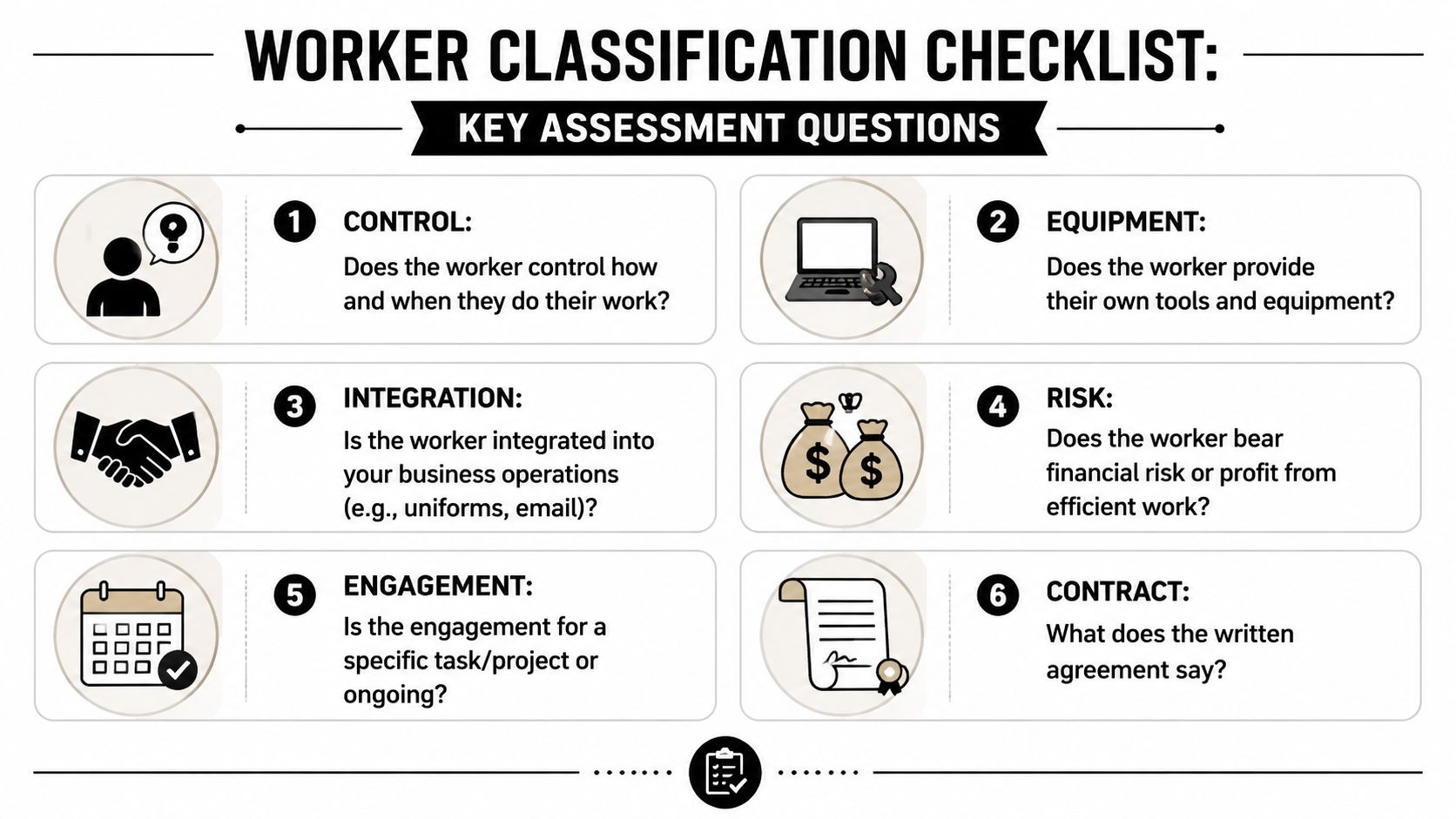
Six questions to ask before you onboard
Ask these in plain English.
Who controls the work: Do you decide their hours, process, and daily priorities, or do they decide how to deliver the outcome?
Who provides the tools: Are they using your laptop, software stack, uniform, or internal systems as their primary work environment?
How embedded are they: Do they appear to customers and staff as part of your team?
Who carries risk: If the job takes longer, needs rework, or runs over budget, who wears that cost?
What are you paying for: Their time each week, or a defined result with a clear scope?
Can they delegate: Can they send someone else if the contract allows, or must they personally do the work?
If most answers point toward control, integration, personal service, and time-based payment, don't get comfort from a contractor label. Review it.
Example one a genuine contractor
A freight business engages a freelance bookkeeper to clean up monthly accounts and prepare management reports. She works remotely, uses her own laptop and software, invoices for defined deliverables, and also services other clients. She schedules her own time and isn't expected to attend internal stand-ups or operate like staff.
That arrangement generally looks contractor-like because the service sits outside the day-to-day business structure. The business is buying a result, not slotting a person into an internal role.
Example two a likely employee despite the label
An ecommerce brand brings in an “operations consultant” four days a week. He works from the company office, uses the company laptop, reports to the operations head, joins recurring internal meetings, and is expected to follow internal workflows. He invoices monthly, but the business is really paying for his ongoing labour inside the team.
That arrangement is much harder to defend as contractor status.
The fastest test is this. If the person disappeared tomorrow and the gap would look like an empty seat in your org chart, not a missing external supplier, you're likely dealing with an employee-style role.
Founders don't need to become employment lawyers to use this checklist well. They just need to stop treating classification as an admin afterthought.
Compliance Obligations What You Owe
A founder approves a contractor invoice for $12,000 and expects the cash impact to stop there. It often does not. If the role has been set up the wrong way, finance can end up carrying super, withholding, insurance, reporting, and cleanup work that was never priced into the job.
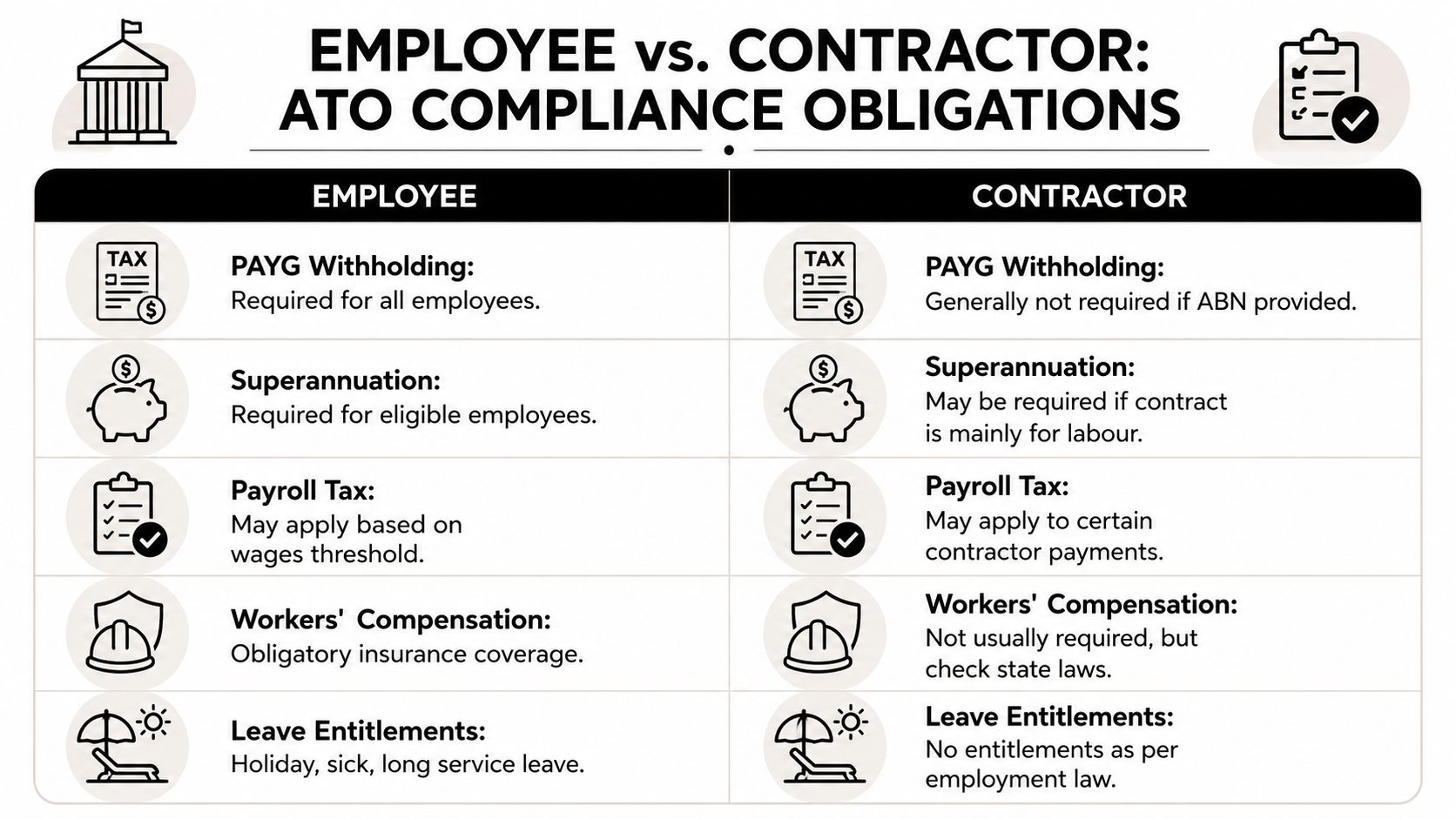
Where cash flow changes immediately
For employees, the wage is only the starting point. The actual cost usually includes PAYG withholding, super, leave loading or leave accruals where applicable, workers' compensation, and sometimes payroll tax depending on your state and wage profile. That matters for pricing, forecasting, and hiring decisions because a role that looks affordable on salary alone can be materially more expensive once on-costs hit the P and L.
Contractors are different, but they are not automatically simpler. A contractor invoice may still carry super exposure if the arrangement is wholly or principally for the person's labour. The current superannuation guarantee rate is 12% (as of 1 July 2025), and that can apply even where everyone has been using contractor language. The ATO's position on that point is outlined in this Australian contractor versus employee tax guidance.
That is where many SMEs get caught. The budget assumes a clean external supplier cost. The actual obligation sits closer to an employment cost.
The obligations that get missed in practice
The mistakes usually show up in operations first.
Super on labour-based contractor arrangements: If you are paying mainly for a person's own labour and skills, check whether super applies even if they invoice through an ABN.
PAYG and payroll setup for employee-style roles: If the worker should be on payroll, the business may need to correct withholding, payslips, and leave treatment, not just update the contract.
Workers' compensation and payroll tax exposure: State based rules can pull in arrangements that founders assume sit outside normal employment costs.
TPAR reporting in relevant industries: The Taxable Payments Annual Report is generally due by 28 August each year for businesses that need to lodge it. Missed reporting is often the first sign that contractor engagement processes are loose.
Fragmented approvals: Operations engages the worker, finance pays the invoice, and nobody owns the classification decision end to end.
The practical fix is to treat worker setup as a finance control, not just an HR or legal form. Build one review point before the first payment. Confirm the contract type, who supplies tools, whether the person can subcontract, whether super needs to be paid, and how the cost will be coded. A stronger process usually starts with tighter tax and compliance for growing businesses, where onboarding, approvals, and reporting are checked together.
Businesses using a blended workforce also need visibility across all non-payroll labour. If different managers engage freelancers, consultants, and project specialists without a common intake process, classification risk spreads subtly through accounts payable. For teams dealing with that issue, this guide to people intelligence for contingent workers is a useful operating reference.
If you discover a worker has likely been set up incorrectly, do not freeze. Quantify the exposure, stop repeating the error on new invoices, gather the contract and payment history, and get advice on the cleanest correction path. The sooner you fix it, the more control you keep over cash flow and the conversation.
The High Cost of Getting It Wrong Risks and Penalties
Misclassification usually hurts twice. First in the liability itself. Then in the disruption of fixing it while still running the business.

Why misclassification hurts twice
If a worker should have been treated as an employee, the exposure can span several areas at once. That can include unpaid super, withholding issues, employee entitlements, and sham contracting concerns under workplace laws. The commercial damage isn't only the amount owed. It's the hit to cash reserves, management time, and confidence in your internal controls.
This is why founders should take the risk seriously even when the worker relationship seems amicable. A dispute, audit, payroll review, or diligence process can force the issue. By then, records are often incomplete and memories are inconsistent.
A useful broader read on this point is Risks of employee misclassification, especially for businesses engaging flexible or distributed talent.
There's also a governance lesson here. Businesses that repeatedly get worker classification wrong usually have other weak spots nearby, such as undocumented approvals, inconsistent contracts, or poor owner oversight. If that sounds familiar, this guide to business risk management for SMEs is a practical next step because classification risk rarely sits alone.
How to Fix a Misclassification A Remediation Plan
If you suspect you've got this wrong, don't panic and don't improvise. Sudden changes made without a review often create more confusion.
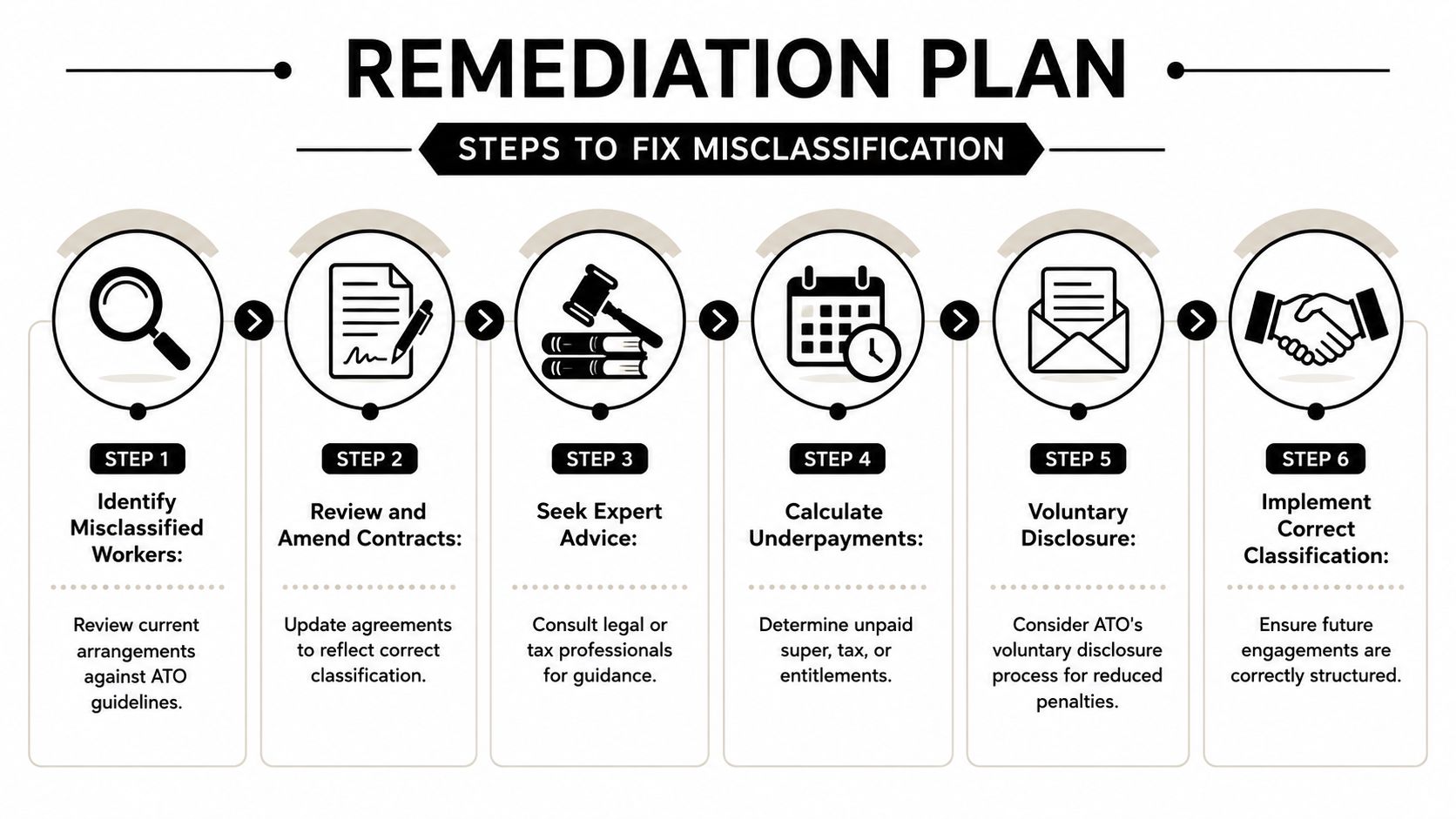
A calm six step reset
Identify the exposed roles
Start with long-term contractors, labour-only arrangements, and anyone embedded in day-to-day operations.Review the actual relationship
Compare the contract against the true working pattern. Don't rely on titles or old assumptions.Get specialist advice early
Tax, employment, and payroll consequences can overlap. A joined-up review is cheaper than a fragmented one.Quantify the liability
Estimate unpaid super, withholding exposure, and any entitlement risk so you can plan the cash impact.Correct the arrangement
That may mean amending the contract, changing the operating model, or moving the worker into employment properly.Consider disclosure and process fixes
If there's a historic problem, deal with it directly. Then tighten onboarding, contract approval, and finance review so it doesn't happen again.
The businesses that recover best are the ones that treat remediation like a finance project. Identify exposure, size the liability, protect cash flow, and fix the process.
If your business uses multiple contractor arrangements, don't review one file and assume the rest are fine. Build a consistent classification workflow into onboarding, approvals, and monthly finance checks. That's where advisory support can make a real difference, especially when worker structure, cash flow, and compliance all intersect. For a broader view of that kind of support, explore accounting and business advisory services for growing companies.
If you want help untangling contractor arrangements, forecasting the cash impact, and building cleaner finance processes around hiring, Nexist can help you turn a compliance risk into a controlled remediation plan.
employee or contractor ato, sham contracting, superannuation guarantee, payg withholding, sme compliance

" width="24px"/><g d="M 0 24.129 L 0 0.129 L 24 0.129 L 24 24.129 Z M 0 24.129 L 0 0.129 L 24 0.129 L 24 24.129 Z M 24 3 C 24 1.344 22.656 0 21 0 L 3 0 C 1.344 0 0 1.344 0 3 L 0 21 C 0 22.656 1.344 24 3 24 L 21 24 C 22.656 24 24 22.656 24 21 Z M 6.883 8.375 L 2.863 8.375 L 2.863 20.467 L 6.883 20.467 Z M 4.899 2.545 C 3.524 2.545 2.625 3.449 2.625 4.634 C 2.625 5.795 3.496 6.724 4.846 6.724 L 4.872 6.724 C 6.273 6.724 7.146 5.795 7.146 4.634 C 7.12 3.449 6.274 2.545 4.899 2.545 Z M 16.747 8.09 C 14.614 8.09 13.659 9.263 13.124 10.086 L 13.124 8.374 L 9.105 8.374 C 9.159 9.508 9.105 20.466 9.105 20.466 L 13.124 20.466 L 13.124 13.713 C 13.124 13.352 13.15 12.99 13.257 12.732 C 13.547 12.01 14.209 11.262 15.319 11.262 C 16.773 11.262 17.355 12.372 17.355 13.996 L 17.355 20.466 L 21.374 20.466 L 21.374 13.532 C 21.374 9.818 19.391 8.09 16.747 8.09 Z" fill="transparent" height="24.12890599668026px" id="dSFdkJotL" width="24px"><path d="M 0 24 L 0 0 L 24 0 L 24 24 Z" fill="transparent" height="24px" id="wscNJE44G" transform="translate(0 0.129)" width="24px"/><g d="M 0 24.129 L 0 0.129 L 24 0.129 L 24 24.129 Z M 24 3 C 24 1.344 22.656 0 21 0 L 3 0 C 1.344 0 0 1.344 0 3 L 0 21 C 0 22.656 1.344 24 3 24 L 21 24 C 22.656 24 24 22.656 24 21 Z M 6.883 8.375 L 2.863 8.375 L 2.863 20.467 L 6.883 20.467 Z M 4.899 2.545 C 3.524 2.545 2.625 3.449 2.625 4.634 C 2.625 5.795 3.496 6.724 4.846 6.724 L 4.872 6.724 C 6.273 6.724 7.146 5.795 7.146 4.634 C 7.12 3.449 6.274 2.545 4.899 2.545 Z M 16.747 8.09 C 14.614 8.09 13.659 9.263 13.124 10.086 L 13.124 8.374 L 9.105 8.374 C 9.159 9.508 9.105 20.466 9.105 20.466 L 13.124 20.466 L 13.124 13.713 C 13.124 13.352 13.15 12.99 13.257 12.732 C 13.547 12.01 14.209 11.262 15.319 11.262 C 16.773 11.262 17.355 12.372 17.355 13.996 L 17.355 20.466 L 21.374 20.466 L 21.374 13.532 C 21.374 9.818 19.391 8.09 16.747 8.09 Z" fill="transparent" height="24.12890599668026px" id="sTpjGo1tb" width="24px"><path d="M 0 24 L 0 0 L 24 0 L 24 24 Z" fill="transparent" height="24px" id="s7ffpmKOD" transform="translate(0 0.129)" width="24px"/><g d="M 24 3 C 24 1.344 22.656 0 21 0 L 3 0 C 1.344 0 0 1.344 0 3 L 0 21 C 0 22.656 1.344 24 3 24 L 21 24 C 22.656 24 24 22.656 24 21 Z M 6.883 8.375 L 2.863 8.375 L 2.863 20.467 L 6.883 20.467 Z M 4.899 2.545 C 3.524 2.545 2.625 3.449 2.625 4.634 C 2.625 5.795 3.496 6.724 4.846 6.724 L 4.872 6.724 C 6.273 6.724 7.146 5.795 7.146 4.634 C 7.12 3.449 6.274 2.545 4.899 2.545 Z M 16.747 8.09 C 14.614 8.09 13.659 9.263 13.124 10.086 L 13.124 8.374 L 9.105 8.374 C 9.159 9.508 9.105 20.466 9.105 20.466 L 13.124 20.466 L 13.124 13.713 C 13.124 13.352 13.15 12.99 13.257 12.732 C 13.547 12.01 14.209 11.262 15.319 11.262 C 16.773 11.262 17.355 12.372 17.355 13.996 L 17.355 20.466 L 21.374 20.466 L 21.374 13.532 C 21.374 9.818 19.391 8.09 16.747 8.09 Z" fill="transparent" height="24.000006px" id="D0ecaHEcW" transform="translate(0 0)" width="24px"><path d="M 24 3 C 24 1.344 22.656 0 21 0 L 3 0 C 1.344 0 0 1.344 0 3 L 0 21 C 0 22.656 1.344 24 3 24 L 21 24 C 22.656 24 24 22.656 24 21 Z" fill="rgb(55, 184, 218)" height="24.000006px" id="IPLFE6zXx" width="24px"/><path d="M 4.02 0 L 0 0 L 0 12.092 L 4.02 12.092 Z" fill="rgb(255, 255, 255)" height="12.09201px" id="FWhtzAyuY" transform="translate(2.863 8.375)" width="4.02px"/><path d="M 2.274 0 C 0.899 0 0 0.904 0 2.089 C 0 3.25 0.871 4.179 2.221 4.179 L 2.247 4.179 C 3.648 4.179 4.521 3.25 4.521 2.089 C 4.495 0.904 3.649 0 2.274 0 Z" fill="rgb(255, 255, 255)" height="4.17876px" id="VmOsKv4kO" transform="translate(2.625 2.545)" width="4.52095px"/><path d="M 7.641 0 C 5.509 0 4.554 1.173 4.019 1.996 L 4.019 0.284 L 0 0.284 C 0.053 1.419 0 12.376 0 12.376 L 4.019 12.376 L 4.019 5.623 C 4.019 5.262 4.045 4.9 4.151 4.642 C 4.442 3.92 5.103 3.172 6.214 3.172 C 7.667 3.172 8.25 4.282 8.25 5.907 L 8.25 12.376 L 12.269 12.376 L 12.269 5.442 C 12.269 1.728 10.286 0 7.641 0 Z" fill="rgb(255, 255, 255)" height="12.37626px" id="n1XUbhaq0" transform="translate(9.105 8.09)" width="12.268830000000001px"/></g></g></g></g></svg>)