Single Touch Payroll Legislation: 2026 Guide for SMEs
Single touch payroll legislation explained for Australian SMEs: Phase 2 rules, deadlines, penalties, and compliance checklist for 2026.
Ansh Malhotra

Single Touch Payroll is a legal requirement to report wages, PAYG withholding and super to the ATO on or before every payday, and Phase 2 expanded the data payload to include income types, employee conditions and tax treatment codes. If your payroll still feels like something you tidy up later in the month, that mindset is already out of date.
You've probably lived the version of Monday where payroll gets run, payslips go out, and everyone moves on because BAS is still weeks away. That quiet routine is exactly what single touch payroll legislation changed. The law turned payroll into a same-day compliance event, which means every setup error, coding mistake, and employee classification issue can flow straight into the ATO's records before the week is even over.
Table of Contents
Implementation Checklist for Small Businesses and Virtual CFOs
When to Keep STP In-House and When to Hand It to a Specialist
The Monday Morning That Changed Payroll in Australia
The old payroll rhythm was simple. You ran the pay, lodged your BAS later, and cleaned up the books when the year ended. That worked when payroll reporting lived in a separate lane from payment processing.
Single Touch Payroll legislation collapsed those lanes into one event. Now the pay run itself is the compliance moment, because wages, withholding and superannuation data have to go to the ATO on or before payday. The government's shift to event-based reporting means payroll is no longer a back-office admin task, it's a live reporting process.
Why that matters on an ordinary Monday
A Monday morning pay run is where most small businesses get exposed. The owner is chasing debtor calls, the bookkeeper is finalising hours, and the payroll file gets edited twice before lunch. Under STP, that's not just a process headache. It's the exact point where bad employee data, wrong pay codes or sloppy super settings become an ATO problem.
The fundamental shift is mental. You're no longer asking whether payroll balances by month end. You're asking whether the file is clean enough to transmit today without creating a correction cycle tomorrow.
Practical rule: if a payroll run needs “we'll fix it next pay” as a normal response, the business is already carrying STP risk.
That's why STP changed compliance culture for SMEs. It forced owners to treat payroll as a control point, not a clerical one. The businesses that handle it well are the ones that stop thinking in terms of reporting season and start thinking in terms of pay-event discipline.
What Single Touch Payroll Legislation Actually Is
STP was legislated through the Budget (Omnibus) Savings Act 2016, and the rollout started with voluntary adoption from 1 July 2017 before becoming mandatory for larger employers from 1 July 2018. The original trigger was the idea of a “substantial employer”, meaning a business with 20 or more employees on the most recent 1 April before the relevant time. That threshold matters because it tied the law to headcount on a specific date, not just to broad business size.
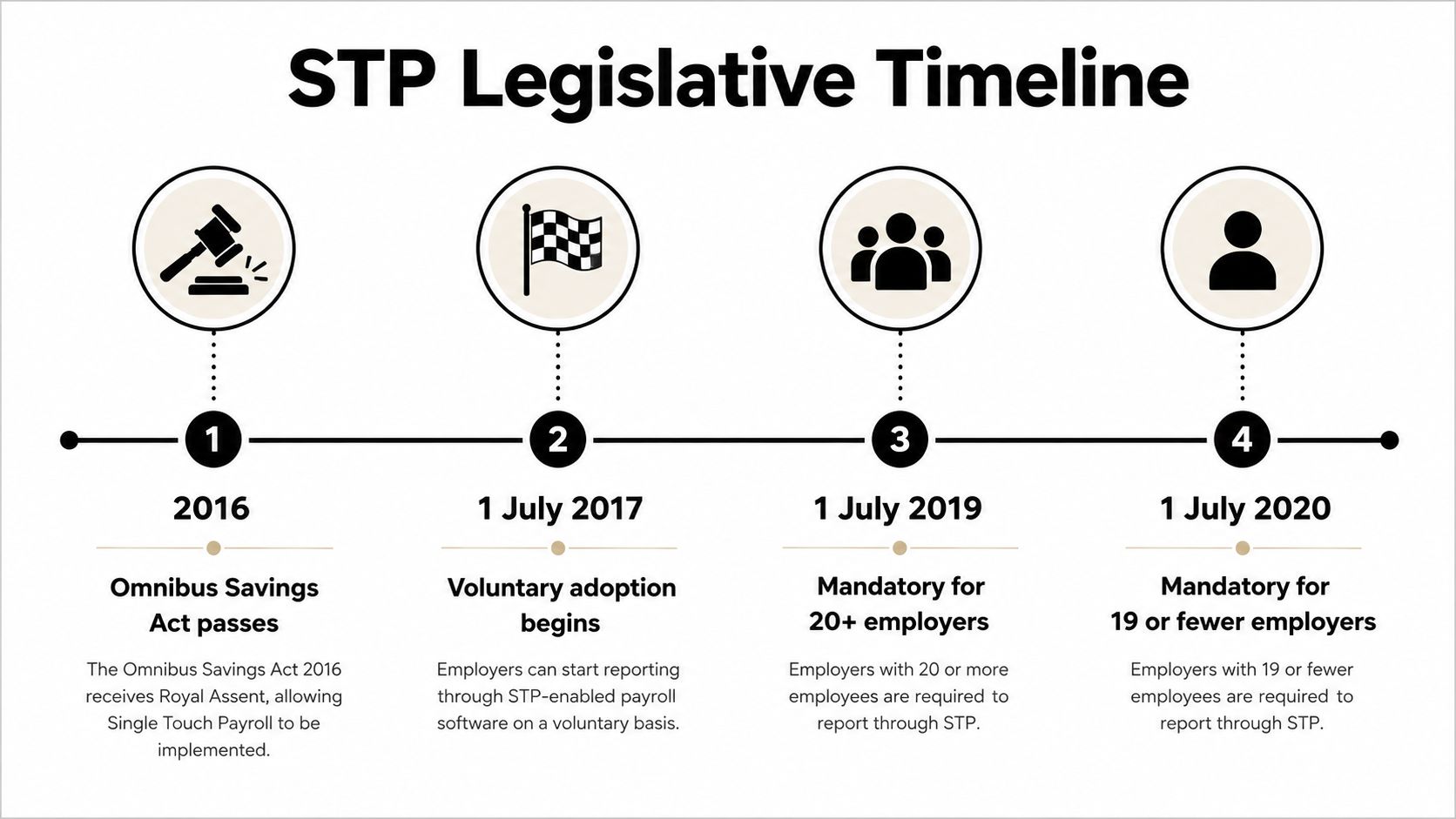
The legal shift in plain English
Before STP, payroll reporting could sit in batches. After STP, reporting became tied to each pay event. Wages and salary amounts had to be reported at pay-time, and withholding amounts by the withholding due date. That's a structural change, not a cosmetic one.
For an SME, the practical question is blunt. Did your headcount cross the threshold, and did your payroll process change with it? Businesses often remember the day they hired “one more person”. They often forget that the reporting obligation changed the same day the headcount moved into the statutory range.
The later rollout removed most of the old size-based comfort zone. Phase 2 came in later, and the system became mandatory across all Australian employers after the initial 20-plus employee rollout. In other words, the market didn't stay split between “big business STP” and “small business not yet”. It converged.
That's why I tell owners not to treat STP as a software feature. It's a legal operating model. The law dictates the timing, the reporting method, and the data quality expectations. Your payroll system just has to keep up.
How STP Phase 2 Expanded the Data You Must Send
STP isn't just wages and tax anymore. The ATO's framework makes clear that employers must send wages, PAYG withholding and superannuation liability data on or before payday, and Phase 2 expanded the payload to include additional employee conditions, income types and tax treatment codes. That extra detail matters because it turns payroll configuration into a compliance decision.
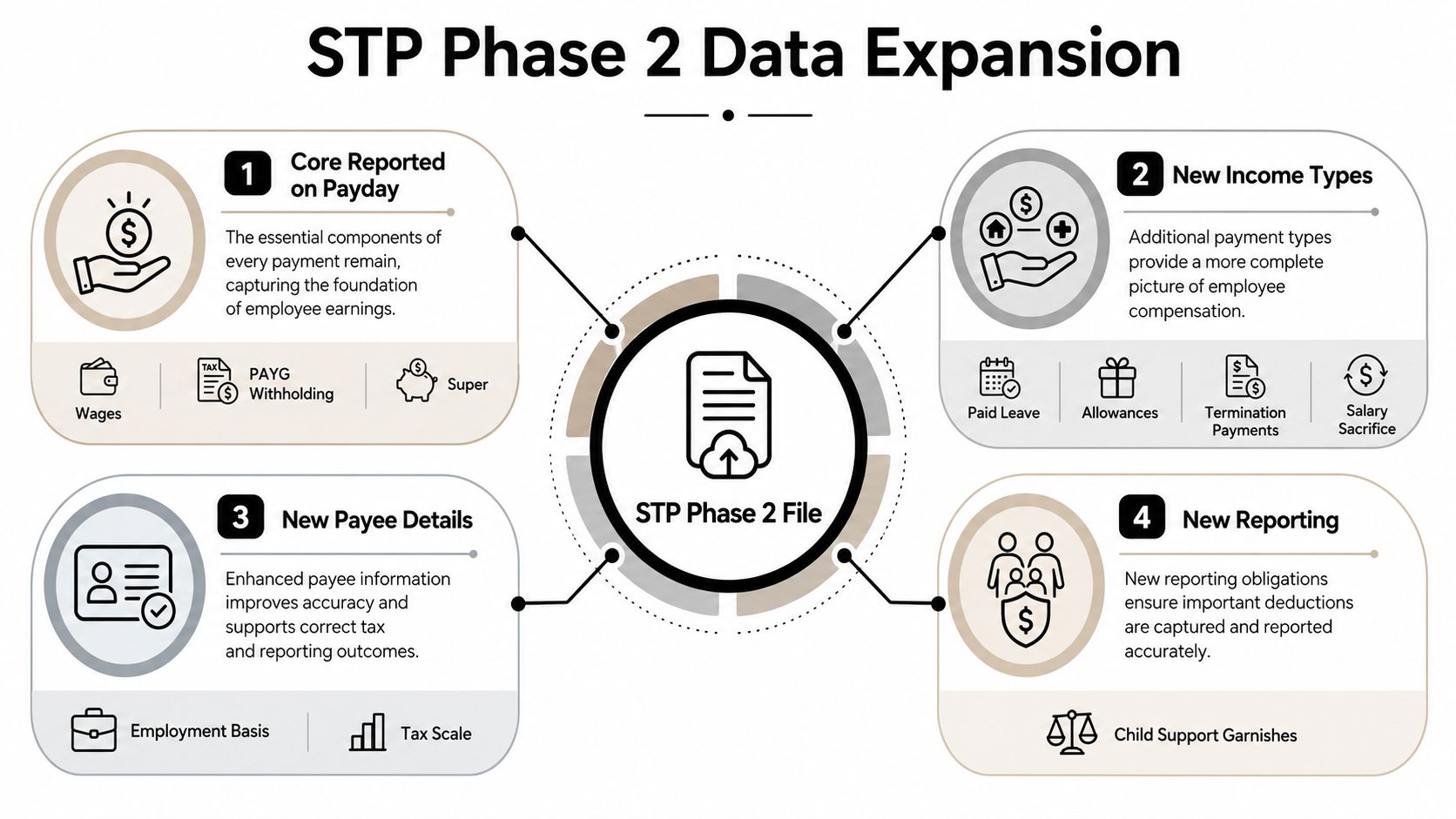
What changed inside the file
Phase 2 pushed payroll teams to classify people and payments more carefully. Income type mapping, employment basis, and tax treatment codes all have to line up with the employee record before the file goes out. If the setup is wrong, the software will still send something, but it won't necessarily send the right thing.
That's why STP-enabled and SBR-enabled software is now the compliance layer, not just a payment engine. The file is built from master data. If the master data is messy, the reporting is messy. If the pay codes are wrong, the ATO receives the wrong classification immediately.
If you want a cleaner payroll process, it's worth reading a solid guide to payroll streamlining and comparing it against your current setup. The useful question isn't whether your software can technically send a file, it's whether the business has built the discipline to keep that file correct every cycle.
Practical rule: the cleaner your pay category mapping, the fewer corrections you'll need after the file hits the ATO.
Many SMEs lose control because they treat payroll as a recurring admin task. However, Phase 2 makes it a data governance task. Every allowance, leave type, termination element and salary sacrifice arrangement has to be set up properly, or the same error can repeat in every pay run.
A Practical Example of a Five-Person SMB Pay Run
Take a small team with five people. One full-time employee, two part-timers, one closely held payee, and one contractor whose pay is structured differently. On payday, the payroll manager doesn't send a generic summary to the ATO later in the quarter. The software transmits the relevant pay-event information as the run is processed, then the ATO receives that data almost immediately.
What the ATO sees in practice
The payroll file has to separate the people who belong in the STP reporting flow from those who need different treatment. The closely held payee is the one that trips up family businesses most often, because owners assume “family” means informal. It doesn't. The reporting rules treat that payee differently, and the EOFY finalisation date can also differ.
Here's the operational reality. Wages and salary amounts are reported at pay-time, while withholding amounts are reported by the withholding due date. That means you can't wait for a monthly tidy-up to fix a broken tax code. You need the file correct before the run, not after it.
For a five-person business, the administrative load is manageable only if the payroll structure is clean. If one person is misclassified, the whole file becomes harder to trust. If super settings are wrong, the problem doesn't stay hidden until year end, it surfaces at the pay event.
The useful mindset is simple. Don't ask, “Can we process payroll?” Ask, “Can we process this payroll in a way that the ATO records match our books the same day?” That's the standard STP set, and it's why small teams often need tighter controls than larger ones.
Beyond the ATO Where STP Data Actually Goes
A lot of business owners still think STP is only about the ATO. That's too narrow. Federal government work to enable STP pre-fill of payroll tax returns was announced in 2022, which means STP data has become an asset for state and territory revenue offices as well. The reporting file is no longer just a federal compliance file, it's part of a wider government data ecosystem.
Why that changes the risk profile
When payroll data gets reused across agencies, bad setup gets amplified. A mistake that once sat in a payroll ledger can now show up in payroll tax reconciliations, pre-fill processes and integrity checks elsewhere. That's a bigger problem for SMEs in payroll-tax states, especially where finance teams already run lean.
This is also why I push clients to reconcile STP against both BAS and payroll tax, not just the payroll journal. If the same employee record feeds multiple reporting streams, the business needs one version of the truth. Otherwise, the owner ends up explaining why one government return says one thing and another says something slightly different.
For a broader finance controls perspective, the tax and compliance guide is useful because the issue is not just payroll reporting, it's how payroll data affects the wider compliance stack. STP is part of that stack now, and the businesses that ignore the knock-on effect usually spend more time cleaning up later than they would have spent getting it right upfront.
Deadlines, Closely Held Payees and Penalty Exposure
The payroll calendar matters as much as the file. Under Phase 2, the standard EOFY finalisation deadline is 14 July each year, with a separate deadline of 30 September for closely held payees such as family businesses, directors, shareholders and trustees. Those dates are not decoration. They tell you when reporting is treated as complete for different payee groups, and they are the first place ATO problems show up when a business is running payroll badly.
What late looks like in real life
Late STP reporting usually does not start with a dramatic failure. It starts with a missed finalisation, an employee record that was never updated, or a pay run that was left alone after a staffing change. Once the payroll file is wrong, every other report becomes harder to trust.
That is why I treat the deadline as a control point, not a filing date. The business needs the payroll setup clean before finalisation, because a messy year-end file creates avoidable clean-up work and exposes the owner to questions that should never have existed in the first place. If you want the wider compliance angle, the tax and compliance guide is the right place to see how payroll sits inside the full reporting stack.
Penalty exposure follows the same pattern. Missing or incorrect reporting creates administrative pain, and manual reconciliations make repeat errors more likely. If payroll is still being pushed through spreadsheets and a basic software login, the business is choosing extra risk for no good reason.
The issue is governance. For owners who want the timing and control detail in context, the virtual CFO and compliance discussion matters because STP only works when someone owns the calendar, the data checks and the sign-off discipline.
My view: if EOFY finalisation sits in someone's inbox instead of a calendar with escalation dates, control has already slipped.
The cleanest approach is simple. One person owns the reporting cadence, one person reviews exceptions, and one person approves finalisation. Small businesses do not need bureaucracy, but they do need accountability. That is what keeps payroll, cashflow and compliance aligned when the ATO is getting the data in near real time.
Implementation Checklist for Small Businesses and Virtual CFOs
STP is easier to control when it runs off a repeatable checklist, not a loose end-of-month habit. Start by confirming the payroll platform is STP-enabled and connected for reporting, because a system that only exports files is not the same thing. Then map Phase 2 income types, employee conditions, and tax treatment codes so the software classifies each payment correctly before anything leaves the payroll file.
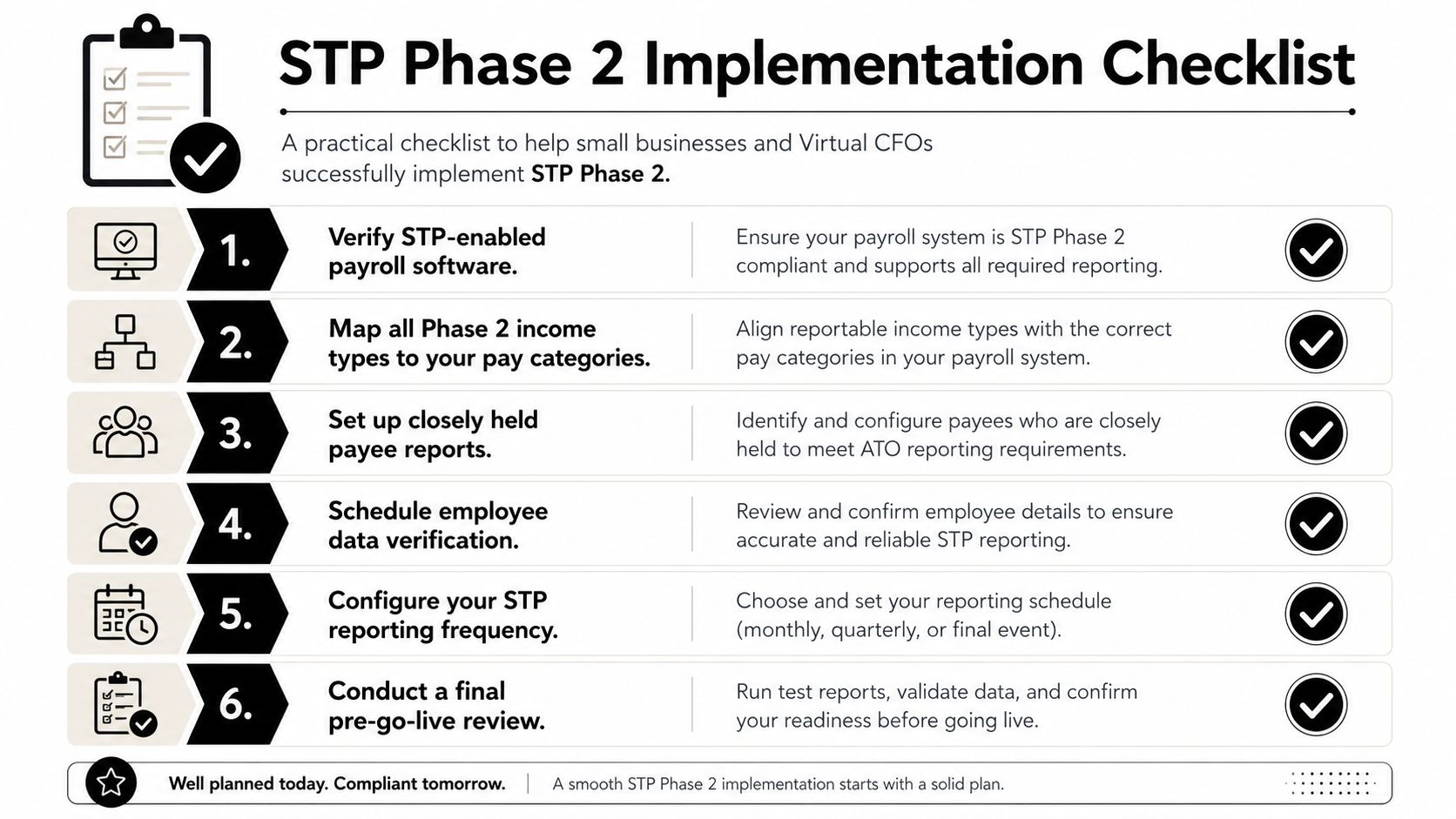
Key validation steps
Verify your software setup. Confirm the payroll platform is STP-enabled and the ATO reporting connection is live.
Map pay categories properly. Align allowances, leave, termination items and salary sacrifice with Phase 2 coding.
Separate closely held payees. Treat family-business payees, directors, shareholders and trustees as a distinct reporting group.
Review employee master data. Check tax treatment, employment basis, super settings and pay codes before the first pay run.
Build a review cadence. Compare STP, BAS and payroll tax records regularly so mismatches are caught early.
Finalise on time. Do not leave EOFY completion to the last minute, especially if the payroll file has been changing during the year.
If you are comparing external support, the cost of PEO HR services is worth lining up against the time your team spends chasing payroll exceptions and correcting files. In growing businesses, that hidden admin load often costs more than the support fee, especially once payroll complexity starts to rise.
A good virtual chief financial officer should sit inside this process, not outside it. The right setup gives one owner for the reporting calendar, one reviewer for exceptions, and one approver for finalisation. That is how payroll stays tied to cashflow and compliance instead of turning into a monthly scramble.
When to Keep STP In-House and When to Hand It to a Specialist
If payroll is simple, in one state, and the data is clean, you can keep STP in-house with a competent bookkeeper and a disciplined review process. If the business has closely held payees, multiple entities, fast hiring, cashflow pressure, or messy employee classification, I'd push for outside oversight.
The decision rule I use
If payroll can't be reconciled within five business days of month end, STP isn't the root problem. It's the symptom. The business has a data discipline problem, a role clarity problem, or both.
That's where a virtual CFO earns their keep. They don't just “do payroll”. They build the control framework around payroll so the file is accurate, the approvals are clear, and the cash impact is visible before payday. If you're still comparing software options, the 2025 payroll software reviews can help you narrow the field, but software alone won't fix a weak process.
For classification issues, the internal employee or contractor ATO guide is a useful companion because misclassification is one of the fastest ways to poison an STP file. Get that wrong, and everything downstream gets harder.
The right benchmark is simple. If your current team can't keep the file clean, keep the reporting internal only if you're willing to tighten controls immediately. If not, hand it to a specialist and stop pretending payroll is just admin.
If you want your payroll process to stop creating avoidable compliance noise, talk to Nexist. We help Australian SMEs tighten payroll controls, improve cashflow visibility, and build finance systems that hold up when the ATO and the rest of government are looking at the same data.
single touch payroll, STP compliance, Australian payroll, payroll legislation, virtual CFO

" width="24px"/><g d="M 0 24.129 L 0 0.129 L 24 0.129 L 24 24.129 Z M 0 24.129 L 0 0.129 L 24 0.129 L 24 24.129 Z M 24 3 C 24 1.344 22.656 0 21 0 L 3 0 C 1.344 0 0 1.344 0 3 L 0 21 C 0 22.656 1.344 24 3 24 L 21 24 C 22.656 24 24 22.656 24 21 Z M 6.883 8.375 L 2.863 8.375 L 2.863 20.467 L 6.883 20.467 Z M 4.899 2.545 C 3.524 2.545 2.625 3.449 2.625 4.634 C 2.625 5.795 3.496 6.724 4.846 6.724 L 4.872 6.724 C 6.273 6.724 7.146 5.795 7.146 4.634 C 7.12 3.449 6.274 2.545 4.899 2.545 Z M 16.747 8.09 C 14.614 8.09 13.659 9.263 13.124 10.086 L 13.124 8.374 L 9.105 8.374 C 9.159 9.508 9.105 20.466 9.105 20.466 L 13.124 20.466 L 13.124 13.713 C 13.124 13.352 13.15 12.99 13.257 12.732 C 13.547 12.01 14.209 11.262 15.319 11.262 C 16.773 11.262 17.355 12.372 17.355 13.996 L 17.355 20.466 L 21.374 20.466 L 21.374 13.532 C 21.374 9.818 19.391 8.09 16.747 8.09 Z" fill="transparent" height="24.12890599668026px" id="dSFdkJotL" width="24px"><path d="M 0 24 L 0 0 L 24 0 L 24 24 Z" fill="transparent" height="24px" id="wscNJE44G" transform="translate(0 0.129)" width="24px"/><g d="M 0 24.129 L 0 0.129 L 24 0.129 L 24 24.129 Z M 24 3 C 24 1.344 22.656 0 21 0 L 3 0 C 1.344 0 0 1.344 0 3 L 0 21 C 0 22.656 1.344 24 3 24 L 21 24 C 22.656 24 24 22.656 24 21 Z M 6.883 8.375 L 2.863 8.375 L 2.863 20.467 L 6.883 20.467 Z M 4.899 2.545 C 3.524 2.545 2.625 3.449 2.625 4.634 C 2.625 5.795 3.496 6.724 4.846 6.724 L 4.872 6.724 C 6.273 6.724 7.146 5.795 7.146 4.634 C 7.12 3.449 6.274 2.545 4.899 2.545 Z M 16.747 8.09 C 14.614 8.09 13.659 9.263 13.124 10.086 L 13.124 8.374 L 9.105 8.374 C 9.159 9.508 9.105 20.466 9.105 20.466 L 13.124 20.466 L 13.124 13.713 C 13.124 13.352 13.15 12.99 13.257 12.732 C 13.547 12.01 14.209 11.262 15.319 11.262 C 16.773 11.262 17.355 12.372 17.355 13.996 L 17.355 20.466 L 21.374 20.466 L 21.374 13.532 C 21.374 9.818 19.391 8.09 16.747 8.09 Z" fill="transparent" height="24.12890599668026px" id="sTpjGo1tb" width="24px"><path d="M 0 24 L 0 0 L 24 0 L 24 24 Z" fill="transparent" height="24px" id="s7ffpmKOD" transform="translate(0 0.129)" width="24px"/><g d="M 24 3 C 24 1.344 22.656 0 21 0 L 3 0 C 1.344 0 0 1.344 0 3 L 0 21 C 0 22.656 1.344 24 3 24 L 21 24 C 22.656 24 24 22.656 24 21 Z M 6.883 8.375 L 2.863 8.375 L 2.863 20.467 L 6.883 20.467 Z M 4.899 2.545 C 3.524 2.545 2.625 3.449 2.625 4.634 C 2.625 5.795 3.496 6.724 4.846 6.724 L 4.872 6.724 C 6.273 6.724 7.146 5.795 7.146 4.634 C 7.12 3.449 6.274 2.545 4.899 2.545 Z M 16.747 8.09 C 14.614 8.09 13.659 9.263 13.124 10.086 L 13.124 8.374 L 9.105 8.374 C 9.159 9.508 9.105 20.466 9.105 20.466 L 13.124 20.466 L 13.124 13.713 C 13.124 13.352 13.15 12.99 13.257 12.732 C 13.547 12.01 14.209 11.262 15.319 11.262 C 16.773 11.262 17.355 12.372 17.355 13.996 L 17.355 20.466 L 21.374 20.466 L 21.374 13.532 C 21.374 9.818 19.391 8.09 16.747 8.09 Z" fill="transparent" height="24.000006px" id="D0ecaHEcW" transform="translate(0 0)" width="24px"><path d="M 24 3 C 24 1.344 22.656 0 21 0 L 3 0 C 1.344 0 0 1.344 0 3 L 0 21 C 0 22.656 1.344 24 3 24 L 21 24 C 22.656 24 24 22.656 24 21 Z" fill="rgb(55, 184, 218)" height="24.000006px" id="IPLFE6zXx" width="24px"/><path d="M 4.02 0 L 0 0 L 0 12.092 L 4.02 12.092 Z" fill="rgb(255, 255, 255)" height="12.09201px" id="FWhtzAyuY" transform="translate(2.863 8.375)" width="4.02px"/><path d="M 2.274 0 C 0.899 0 0 0.904 0 2.089 C 0 3.25 0.871 4.179 2.221 4.179 L 2.247 4.179 C 3.648 4.179 4.521 3.25 4.521 2.089 C 4.495 0.904 3.649 0 2.274 0 Z" fill="rgb(255, 255, 255)" height="4.17876px" id="VmOsKv4kO" transform="translate(2.625 2.545)" width="4.52095px"/><path d="M 7.641 0 C 5.509 0 4.554 1.173 4.019 1.996 L 4.019 0.284 L 0 0.284 C 0.053 1.419 0 12.376 0 12.376 L 4.019 12.376 L 4.019 5.623 C 4.019 5.262 4.045 4.9 4.151 4.642 C 4.442 3.92 5.103 3.172 6.214 3.172 C 7.667 3.172 8.25 4.282 8.25 5.907 L 8.25 12.376 L 12.269 12.376 L 12.269 5.442 C 12.269 1.728 10.286 0 7.641 0 Z" fill="rgb(255, 255, 255)" height="12.37626px" id="n1XUbhaq0" transform="translate(9.105 8.09)" width="12.268830000000001px"/></g></g></g></g></svg>)