Ordinary Time Earnings ATO Guide for Australian SMEs
Master ordinary time earnings ATO rules with clear definitions, worked examples, and compliance checklists to avoid super guarantee penalties.
Ansh Malhotra

You're probably looking at a payroll report that “looks right” until you compare it with the super clearing file. That's where the trouble starts. One wrong assumption about ordinary hours, overtime, allowances, or commissions can distort your super guarantee payments, tie up cash you needed elsewhere, and leave you cleaning up a messy compliance error after the quarter has already closed.
Ordinary Time Earnings is the base you use to work out the minimum super guarantee contribution for an employee. The ATO defines it as the amount paid for an employee's ordinary hours of work, including commissions and shift loadings, and the legal definition sits in the Superannuation Guarantee (Administration) Act 1992. The ATO's ruling SGR 2009/2 also explains that, for superannuation purposes, “earnings” means remuneration paid as a reward for services and broadly covers amounts that are “salary or wages”. In plain English, OTE is not total payroll, and that distinction is where SMEs get hurt.

A practical way to stay on top of this is to treat OTE as a cash flow item, not just a payroll label. If you understate it, you underpay super and create a future liability. If you overstate it, you lock up cash unnecessarily. For payroll managers who want a reliable way to communicate updates and process changes to staff, NewsletterAsAService is a useful reference point for structured employee communication, especially when super settings or award interpretations change.
Table of Contents
Understanding Ordinary Time Earnings and Why It Matters
A founder gets to the end of the quarter, opens the super report, and realises the payroll team treated every dollar of pay as if it all attracted super. That's the kind of mistake that either drains cash or triggers an underpayment review later. Both outcomes are avoidable if you know what belongs in OTE and what doesn't.
OTE is the pay base, not total payroll
The ATO's definition is simple enough to use in practice. OTE is the amount paid for an employee's ordinary hours of work, and it can include commissions and shift loadings. It generally excludes overtime, because overtime sits outside ordinary hours. The key point is that the calculation follows the work pattern, not just the payslip total.
That distinction matters because the super guarantee is built on OTE. The legal framework is in the Superannuation Guarantee (Administration) Act 1992, so this is not a payroll preference or a software setting you can improvise. If a payment belongs to ordinary hours, it may increase super liability. If it belongs to overtime or is more like a termination-style lump sum, it may not.
Practical rule: if the payment would still exist even when the employee worked only their ordinary roster, it probably needs a closer look for OTE purposes.
Why this becomes a cash flow issue fast
OTE errors don't stay theoretical. Understating OTE means you've underpaid compulsory super, which becomes a future cash demand plus compliance cleanup. Overstating OTE means you've funded super from operating cash that didn't need to leave the bank account yet. For small businesses, both are bad. One creates penalties and admin pain, the other starves working capital.
This is why ordinary time earnings ato compliance should sit beside wages forecasting, not after it. If your payroll process doesn't separate ordinary hours from everything else, you're flying blind on employer super cost. For a founder, that's not a technical mistake, it's a margin mistake.
What this guide helps you lock down
The useful questions are practical ones. What payments are included? What's excluded? How do you handle part-timers, casuals, commission-heavy roles, and shift workers? And what do you do if you've already been calculating it wrong?
The ATO's current payment guide for OTE is the main reference point for those classifications, and the payroll logic in this article stays anchored to that rule set. The ATO's list of payments that are ordinary time earnings is the place to verify edge cases before you change your payroll setup.
What Counts as Ordinary Time Earnings and What Doesn't
OTE isn't a blanket label for “wages”. It's a test of whether the payment belongs to ordinary hours. That's the dividing line you need to use, and it's the reason so many SMEs misclassify amounts that look similar on the payslip but have different super treatment.
The payments that usually belong in OTE
Start with the obvious ones. Base salary, ordinary hourly pay, commissions, and shift loadings sit comfortably inside OTE when they relate to ordinary work. Some allowances also belong there if they're part of ordinary-hour remuneration rather than reimbursement for a cost the employee incurred. Regular performance bonuses can also belong in OTE when they're tied to the employee's ordinary work, not to overtime or a separate entitlement.
The logic is straightforward. If the payment rewards the employee for doing their ordinary job, it generally belongs in the OTE base. If it compensates them for extra hours, a business expense, or a termination event, it usually doesn't.
The payments that usually sit outside OTE
Overtime is the common exclusion, and founders should treat that as the default unless a specific award or arrangement says otherwise. Expense reimbursements are also not OTE, because they're not pay for work. Redundancy payments and termination lump sums are outside the normal ordinary-hours test for the same reason. They compensate for loss, separation, or out-of-pocket cost, not ordinary labour.
Leave loading needs care. A 2018 Australian Industry Group submission noted that leave loading paid to award-covered employees is not ordinarily treated as OTE, which reinforces the point that not every extra payment attached to leave belongs in the super base. Annual leave paid on termination and parental leave payments also need to be assessed against the ordinary-hours logic rather than assumed into OTE.
Payment Type | Included in OTE | Notes |
|---|---|---|
Base salary for ordinary hours | Yes | Core ordinary-hours pay |
Ordinary hourly wages | Yes | Include the hours that are genuinely ordinary |
Commissions | Yes | Include when linked to ordinary work |
Shift loadings | Yes | Included when part of ordinary-hour pay |
Ordinary-hour allowances | Usually yes | Check whether it's pay or reimbursement |
Regular performance bonuses | Usually yes | Include when tied to ordinary work |
Overtime | No | Generally excluded from OTE |
Expense reimbursements | No | Not remuneration for services |
Redundancy payments | No | Termination-style amounts |
Leave loading | Usually no | Not ordinarily OTE for award-covered employees |
Termination lump sums | No | Not ordinary-hours remuneration |
For a broader payroll compliance lens, this superannuation obligations guide is useful as a reference point when you're mapping OTE decisions against the rest of your employer duties.
The grey areas that trip people up
The mistake isn't usually ignorance, it's overgeneralising. Payroll teams see a payment type once and then apply it everywhere. That's how leave loading gets treated like wages, or a reimbursement gets coded like a taxable allowance. The better habit is to classify every payment by asking one question. Is this pay for ordinary work, or is it something else?
OTE rules work best when they're built into the payroll chart of accounts, not left to individual judgment at each pay run.
Calculating OTE for Different Employment Types
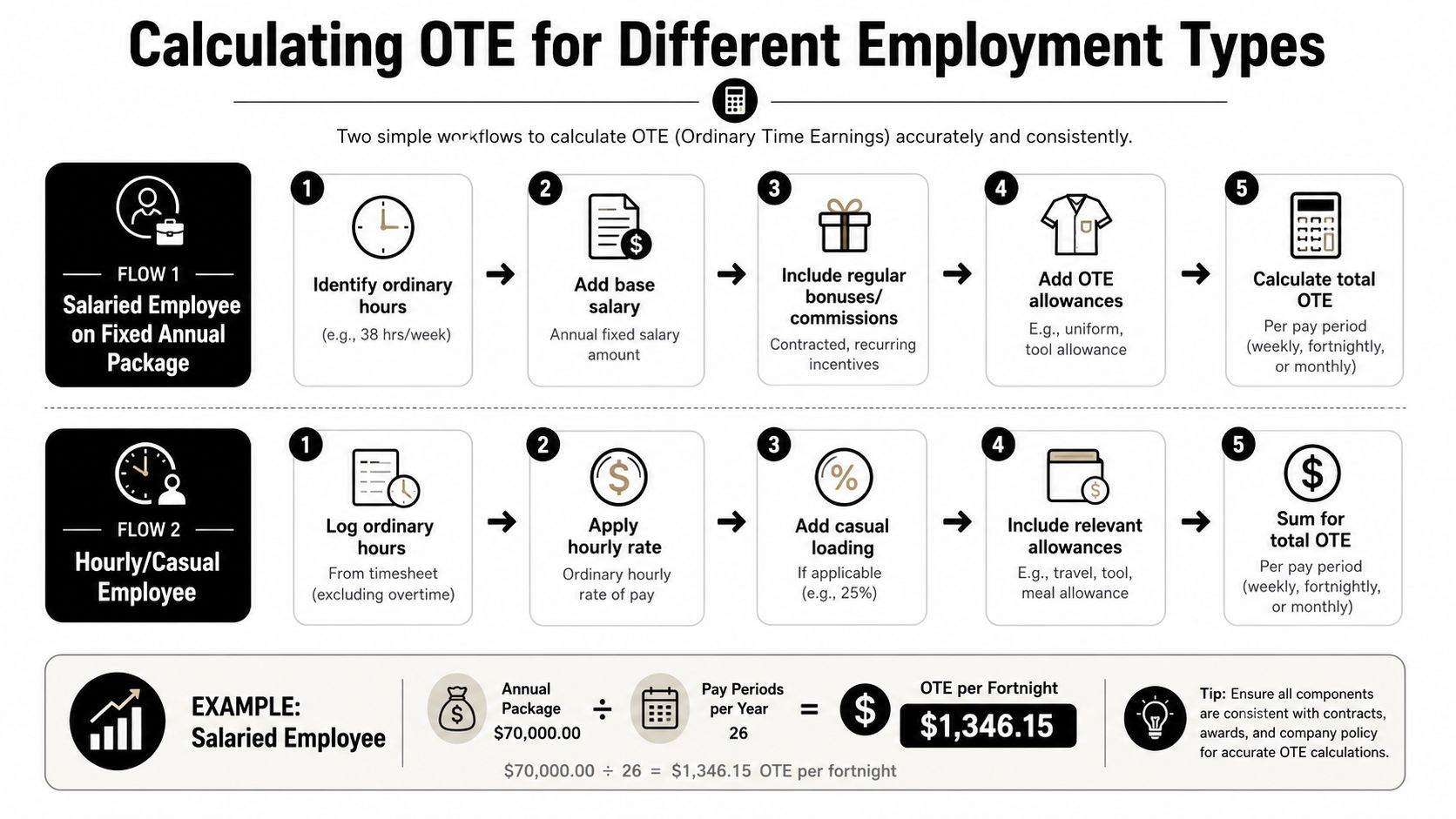
The same rule applies across salary, hourly, casual, commission, and shift work. What changes is how you identify the ordinary-hours portion before you apply the super guarantee rate. Get that split wrong, and the rest of the calculation is meaningless.
Salaried employees need a clean ordinary-hours test
Take a salaried employee on a fixed package. You first identify their ordinary hours, then decide which parts of the package are ordinary-hour remuneration. If the salary covers ordinary work, that amount is the OTE base for the period. Add any commissions or ordinary-hour allowances that belong there, then apply the super guarantee rate.
A simple illustration helps. A salaried employee on a fixed annual package has $1,346.15 OTE per fortnight in the example provided for payroll workflow design. If their package includes ordinary-hour pay only, that fortnightly OTE becomes the base for the super contribution calculation. You then apply the current super guarantee rate to that OTE amount.
Hourly and casual workers need roster discipline
Hourly workers are easier to get right if the timesheet separates ordinary hours from overtime. Pay only the ordinary hours into the OTE base, then add any eligible allowances or loadings that belong to those hours. Casual loading doesn't change the underlying logic, because you still need to identify what part of the pay relates to ordinary work.
The problem comes when rosters are messy. If a manager approves extra hours without tagging them as overtime, payroll can accidentally treat all hours as ordinary and overstate super. That's a cash flow leak, not just a record-keeping error.
Commission and shift-heavy roles need tighter review
Commission-based roles are where many businesses make the weakest assumptions. If the commission is earned through ordinary work, it belongs in OTE. Shift workers are similar. Their shift loading usually sits inside the ordinary-hours calculation when it's part of ordinary remuneration, so payroll needs to apply the rule at pay code level, not by intuition.
For a founder who wants to decide whether a worker is even in the right engagement bucket before calculating super, this employee or contractor resource is the right companion piece. Misclassification creates a bigger problem than OTE alone.
Employment type | Gross pay example | OTE components | OTE total | Super guarantee at current rate |
|---|---|---|---|---|
Salaried employee | Fixed annual package | Ordinary salary, regular commission, ordinary allowances | Calculate from ordinary-hours pay only | Apply current SG rate to OTE |
Hourly worker | Ordinary hours plus overtime | Ordinary hours only, plus eligible allowances | Exclude overtime | Apply current SG rate to OTE |
Casual employee | Casual hourly pay with loading | Ordinary hours at casual rate, plus any eligible loading | Exclude overtime if separately identified | Apply current SG rate to OTE |
Commission role | Base plus sales commission | Base pay, commission linked to ordinary work | Sum ordinary base plus commission | Apply current SG rate to OTE |
Shift worker | Base plus shift loading | Ordinary hours, shift loading | Add shift loading if part of ordinary pay | Apply current SG rate to OTE |
The best payroll process is boring. It should tell you, without debate, which hours are ordinary, which dollars belong in the super base, and which amounts stay out. If staff or payroll software force you to guess, the setup isn't good enough.
Employer Obligations and the Cost of Getting It Wrong
Super is not an optional kindness. If a payment is part of OTE, the employer has an obligation to pay the minimum super guarantee contribution on that base. Miss it, and the liability doesn't disappear. It becomes a formal underpayment problem.
Underpayments turn into a charge, not just a correction
When super is underpaid, the consequence is the super guarantee charge. That charge can include the shortfall amount, interest, and an administration fee. The point is simple, the cost of being late or wrong is more than the original super amount. If you've underpaid across multiple quarters, the accumulated exposure can become uncomfortable very quickly.
The ATO can audit super payments, and employees can report underpayments. That matters because many payroll errors stay hidden until a staff member checks their fund or a regulator asks for records. Once that happens, you're no longer dealing with a small payroll tweak, you're dealing with a compliance file.
Cash flow gets hit twice
Underpayment hurts because you still owe the original super, and then you may owe the charge on top. That's real cash leaving the business after the fact, which is exactly when working capital is already under pressure. Overpayment hurts differently. It doesn't trigger the same compliance risk, but it ties up money that could have gone into inventory, wages, debt servicing, or growth.
The smarter approach is to get OTE right before the funds leave the account. If your payroll process regularly drifts between ordinary pay and extras, the business is effectively funding a series of avoidable corrections.
Reputational damage is part of the cost
Employees notice super errors. They may not understand the full legislative detail, but they know when money hasn't shown up in their fund. That creates distrust fast, and once staff believe payroll is sloppy, every other number gets questioned.
For a practical view of how payroll reporting discipline affects employer compliance, Single Touch Payroll legislation guidance is worth reading alongside your internal controls. STP won't fix bad OTE logic, but it makes sloppy reporting easier to detect.
If your payroll team can't explain why a payment was included or excluded from OTE, the ATO won't be impressed by the spreadsheet.
Common OTE Mistakes and How to Spot Them
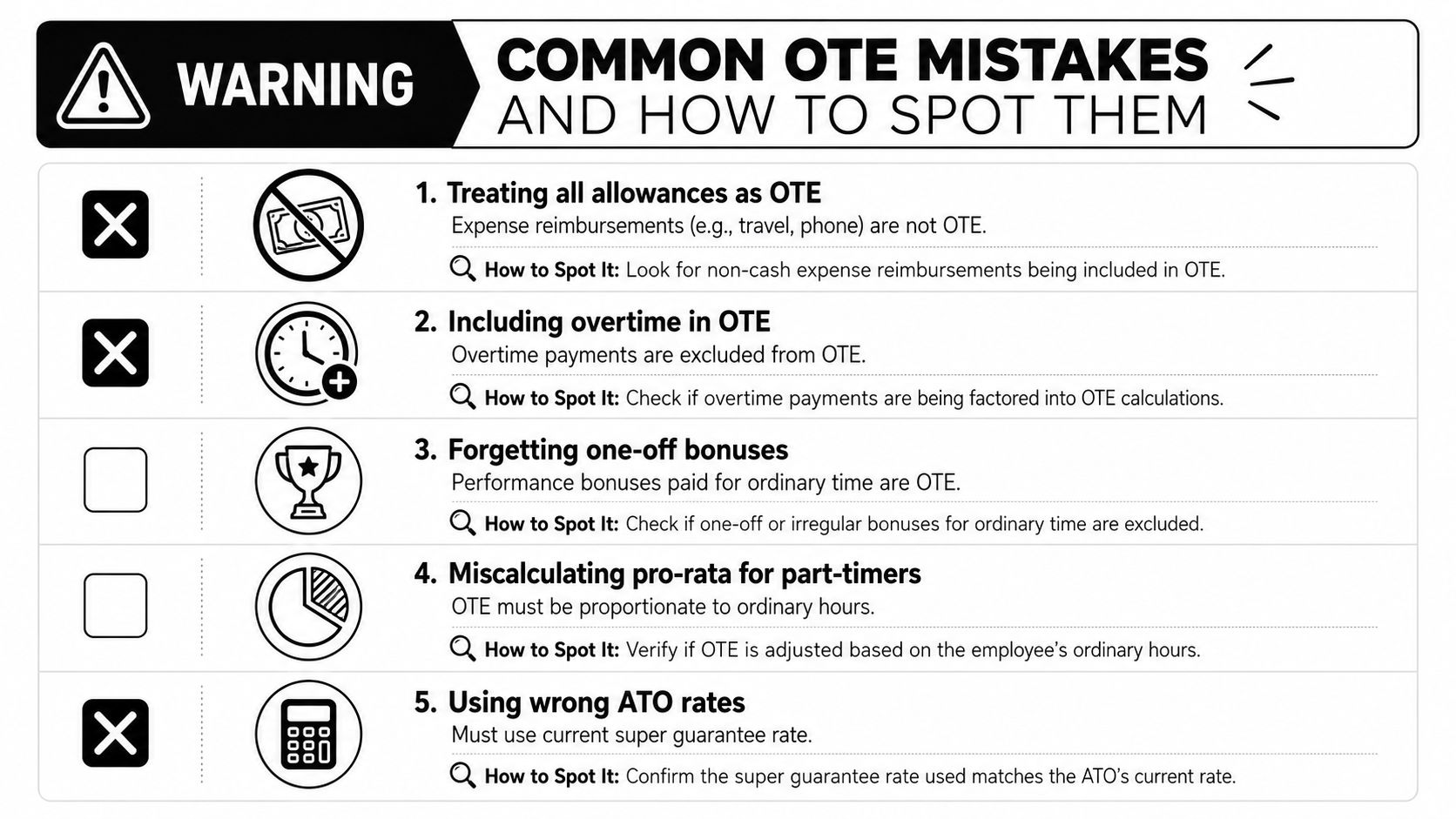
Most OTE errors are predictable. They happen when a business copies the last pay run, changes a few numbers, and assumes the super logic still holds. That's how payroll drifts away from the actual employment arrangement.
The five errors I'd look for first
Treating all allowances as OTE. Expense reimbursements for travel, phone, or similar costs are not remuneration for ordinary work, so they shouldn't be coded as OTE.
Including overtime in OTE. If the hour is overtime, it's generally outside the base.
Forgetting commissions or bonuses. Ordinary-work bonuses and commissions often belong in OTE, and omitting them creates underpayment risk.
Miscalculating part-time hours. OTE has to track ordinary hours proportionately, not the roster total.
Using stale super settings. If payroll software hasn't been updated, the wrong rate or rule set can flow through every pay run.
How to run a quick internal audit
Start with the last four quarters of super payments. Compare what you paid against what each employee's OTE should have been under their actual pay structure. Then isolate the difference by employee and by quarter. That will show you whether the problem is isolated, systemic, or tied to a single pay code.
Red flags usually show up in the same places. Employees who regularly work overtime, complex award interpretations, recent changes to pay structures, and manual payroll processes all deserve closer review. If your pay runs rely on one person remembering which allowance is which, you already have a risk concentration problem.
The fastest way to spot a mismatch
Look for patterns, not just one-off errors. If overtime gets mixed into ordinary hours, the super base is too high. If commissions or shift loadings are being ignored, the super base is too low. If leave loading is being treated inconsistently across staff groups, the payroll logic is probably inconsistent too.
A good audit doesn't start with the ATO's first letter, it starts with your own pay codes and whether they reflect the actual employment contract.
The diagnostic question is blunt. Does every pay component have a written reason for being in or out of OTE? If the answer is no, that's where to focus.
Implementing Correct OTE Processes and Fixing Past Errors
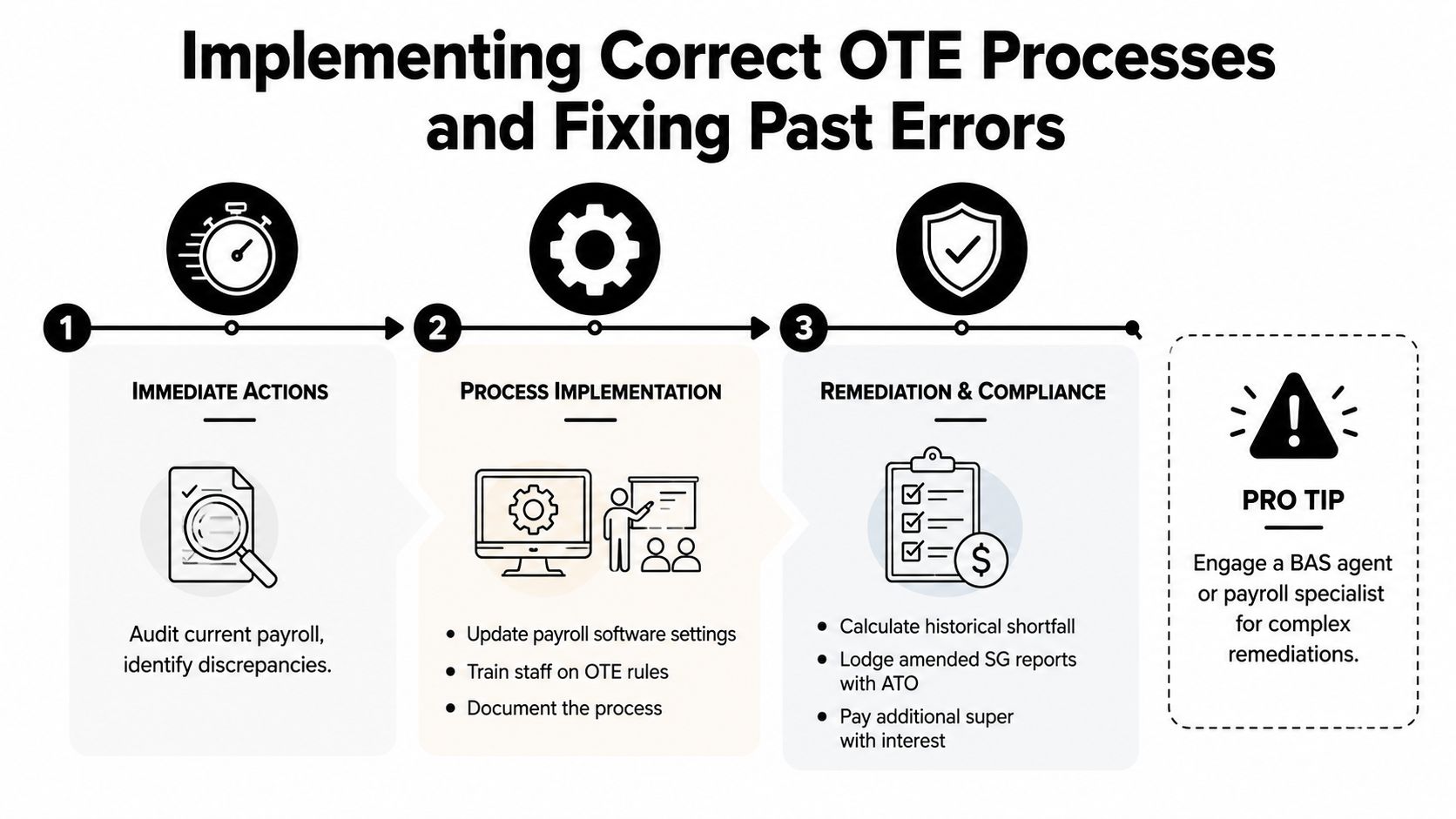
Correcting OTE isn't a finance project you do once and forget. It's a controls project. You need a payroll method that works now, keeps working after staff changes, and tells you what to do when a mistake turns up.
Fix the process first
Review your current payroll settings and map each pay code to a clear OTE rule. That includes allowances, commissions, loadings, overtime, and termination-style items. Document the logic in plain English so payroll staff aren't making judgment calls from memory. If an award interpretation is unclear, resolve it before the next pay run.
Training matters less than consistency. A well-trained payroll officer can still make bad calls if the software defaults are wrong. Put the rule in the system, not just in a folder.
Build a repeatable review cycle
A quarterly review should compare actual OTE against what the system calculated. An annual audit should test whether the classification rules still match the workforce mix. Reassess immediately when you hire differently, change pay structures, or revise award coverage.
A simple compliance checklist keeps this tight:
Quarterly review: Reconcile OTE against super paid for the quarter.
Annual audit: Recheck award interpretations and pay codes.
New hire trigger: Confirm ordinary hours, loading, and allowance treatment before the first pay run.
Change trigger: Reassess when hours, commissions, or salary packaging changes.
Exception review: Investigate any payroll line that doesn't fit the usual rule.
Fix historical errors fast
If you discover past underpayments, calculate the shortfall and work out the super guarantee charge exposure. Then lodge a voluntary disclosure with the ATO and pay the amount due. Don't sit on it and hope the issue disappears. It won't. The longer you wait, the more cash and credibility you put at risk.
For complex remediations, get help from an accountant or payroll specialist who understands super and award logic. That's especially important if the error spans multiple entities, multiple quarters, or a messy contractor arrangement.
The payoff is practical. Better cash flow forecasting. Less audit risk. Fewer employee disputes. And a payroll process that doesn't need firefighting every quarter.
If your payroll process still leaves room for guesswork on super, fix it before the next quarter closes. Nexist helps Australian founders tighten cash flow, clean up payroll processes, and build finance systems that stop small errors from becoming expensive problems. Visit Nexist if you want a sharper payroll control framework and a more reliable handle on compliance.
ordinary time earnings, ATO super guarantee, payroll compliance, SME payroll, super contributions

" width="24px"/><g d="M 0 24.129 L 0 0.129 L 24 0.129 L 24 24.129 Z M 0 24.129 L 0 0.129 L 24 0.129 L 24 24.129 Z M 24 3 C 24 1.344 22.656 0 21 0 L 3 0 C 1.344 0 0 1.344 0 3 L 0 21 C 0 22.656 1.344 24 3 24 L 21 24 C 22.656 24 24 22.656 24 21 Z M 6.883 8.375 L 2.863 8.375 L 2.863 20.467 L 6.883 20.467 Z M 4.899 2.545 C 3.524 2.545 2.625 3.449 2.625 4.634 C 2.625 5.795 3.496 6.724 4.846 6.724 L 4.872 6.724 C 6.273 6.724 7.146 5.795 7.146 4.634 C 7.12 3.449 6.274 2.545 4.899 2.545 Z M 16.747 8.09 C 14.614 8.09 13.659 9.263 13.124 10.086 L 13.124 8.374 L 9.105 8.374 C 9.159 9.508 9.105 20.466 9.105 20.466 L 13.124 20.466 L 13.124 13.713 C 13.124 13.352 13.15 12.99 13.257 12.732 C 13.547 12.01 14.209 11.262 15.319 11.262 C 16.773 11.262 17.355 12.372 17.355 13.996 L 17.355 20.466 L 21.374 20.466 L 21.374 13.532 C 21.374 9.818 19.391 8.09 16.747 8.09 Z" fill="transparent" height="24.12890599668026px" id="dSFdkJotL" width="24px"><path d="M 0 24 L 0 0 L 24 0 L 24 24 Z" fill="transparent" height="24px" id="wscNJE44G" transform="translate(0 0.129)" width="24px"/><g d="M 0 24.129 L 0 0.129 L 24 0.129 L 24 24.129 Z M 24 3 C 24 1.344 22.656 0 21 0 L 3 0 C 1.344 0 0 1.344 0 3 L 0 21 C 0 22.656 1.344 24 3 24 L 21 24 C 22.656 24 24 22.656 24 21 Z M 6.883 8.375 L 2.863 8.375 L 2.863 20.467 L 6.883 20.467 Z M 4.899 2.545 C 3.524 2.545 2.625 3.449 2.625 4.634 C 2.625 5.795 3.496 6.724 4.846 6.724 L 4.872 6.724 C 6.273 6.724 7.146 5.795 7.146 4.634 C 7.12 3.449 6.274 2.545 4.899 2.545 Z M 16.747 8.09 C 14.614 8.09 13.659 9.263 13.124 10.086 L 13.124 8.374 L 9.105 8.374 C 9.159 9.508 9.105 20.466 9.105 20.466 L 13.124 20.466 L 13.124 13.713 C 13.124 13.352 13.15 12.99 13.257 12.732 C 13.547 12.01 14.209 11.262 15.319 11.262 C 16.773 11.262 17.355 12.372 17.355 13.996 L 17.355 20.466 L 21.374 20.466 L 21.374 13.532 C 21.374 9.818 19.391 8.09 16.747 8.09 Z" fill="transparent" height="24.12890599668026px" id="sTpjGo1tb" width="24px"><path d="M 0 24 L 0 0 L 24 0 L 24 24 Z" fill="transparent" height="24px" id="s7ffpmKOD" transform="translate(0 0.129)" width="24px"/><g d="M 24 3 C 24 1.344 22.656 0 21 0 L 3 0 C 1.344 0 0 1.344 0 3 L 0 21 C 0 22.656 1.344 24 3 24 L 21 24 C 22.656 24 24 22.656 24 21 Z M 6.883 8.375 L 2.863 8.375 L 2.863 20.467 L 6.883 20.467 Z M 4.899 2.545 C 3.524 2.545 2.625 3.449 2.625 4.634 C 2.625 5.795 3.496 6.724 4.846 6.724 L 4.872 6.724 C 6.273 6.724 7.146 5.795 7.146 4.634 C 7.12 3.449 6.274 2.545 4.899 2.545 Z M 16.747 8.09 C 14.614 8.09 13.659 9.263 13.124 10.086 L 13.124 8.374 L 9.105 8.374 C 9.159 9.508 9.105 20.466 9.105 20.466 L 13.124 20.466 L 13.124 13.713 C 13.124 13.352 13.15 12.99 13.257 12.732 C 13.547 12.01 14.209 11.262 15.319 11.262 C 16.773 11.262 17.355 12.372 17.355 13.996 L 17.355 20.466 L 21.374 20.466 L 21.374 13.532 C 21.374 9.818 19.391 8.09 16.747 8.09 Z" fill="transparent" height="24.000006px" id="D0ecaHEcW" transform="translate(0 0)" width="24px"><path d="M 24 3 C 24 1.344 22.656 0 21 0 L 3 0 C 1.344 0 0 1.344 0 3 L 0 21 C 0 22.656 1.344 24 3 24 L 21 24 C 22.656 24 24 22.656 24 21 Z" fill="rgb(55, 184, 218)" height="24.000006px" id="IPLFE6zXx" width="24px"/><path d="M 4.02 0 L 0 0 L 0 12.092 L 4.02 12.092 Z" fill="rgb(255, 255, 255)" height="12.09201px" id="FWhtzAyuY" transform="translate(2.863 8.375)" width="4.02px"/><path d="M 2.274 0 C 0.899 0 0 0.904 0 2.089 C 0 3.25 0.871 4.179 2.221 4.179 L 2.247 4.179 C 3.648 4.179 4.521 3.25 4.521 2.089 C 4.495 0.904 3.649 0 2.274 0 Z" fill="rgb(255, 255, 255)" height="4.17876px" id="VmOsKv4kO" transform="translate(2.625 2.545)" width="4.52095px"/><path d="M 7.641 0 C 5.509 0 4.554 1.173 4.019 1.996 L 4.019 0.284 L 0 0.284 C 0.053 1.419 0 12.376 0 12.376 L 4.019 12.376 L 4.019 5.623 C 4.019 5.262 4.045 4.9 4.151 4.642 C 4.442 3.92 5.103 3.172 6.214 3.172 C 7.667 3.172 8.25 4.282 8.25 5.907 L 8.25 12.376 L 12.269 12.376 L 12.269 5.442 C 12.269 1.728 10.286 0 7.641 0 Z" fill="rgb(255, 255, 255)" height="12.37626px" id="n1XUbhaq0" transform="translate(9.105 8.09)" width="12.268830000000001px"/></g></g></g></g></svg>)