Super Contribution Cap 2024: A Guide for Business Owners
Plan around the super contribution cap 2024 with confidence. Concessional, non-concessional, and carry-forward rules explained for Australian business owners.
Ansh Malhotra

Payroll just ran, BAS is out of the way, and now you're staring at the super line wondering whether there's still room for a year-end top-up. That's the super contribution cap 2024 question for founders. Not “what's the cap?” but “how much room do I have after employer super, salary sacrifice, and any carry-forward amounts are already eating into it?”
The headlines made 2024 sound like a simple cap increase. They weren't simple. On 1 July 2024, the concessional cap moved up, the non-concessional cap moved up, and the super guarantee rate moved up too, which changed the maths for anyone who runs payroll, pays directors, or tries to clean up tax at year end. For owner-operators, that means the cap question is really a payroll planning question.
Table of Contents
Why 2024 Changed the Super Cap Game for Founders
The founder I'm thinking of has just finished a payroll run, checked the super totals, and realised the year is no longer a clean slate. The question isn't whether super is important. It's whether the 2024 cap changes, the SG rise, and the balance tests together have changed what's left to contribute before 30 June.
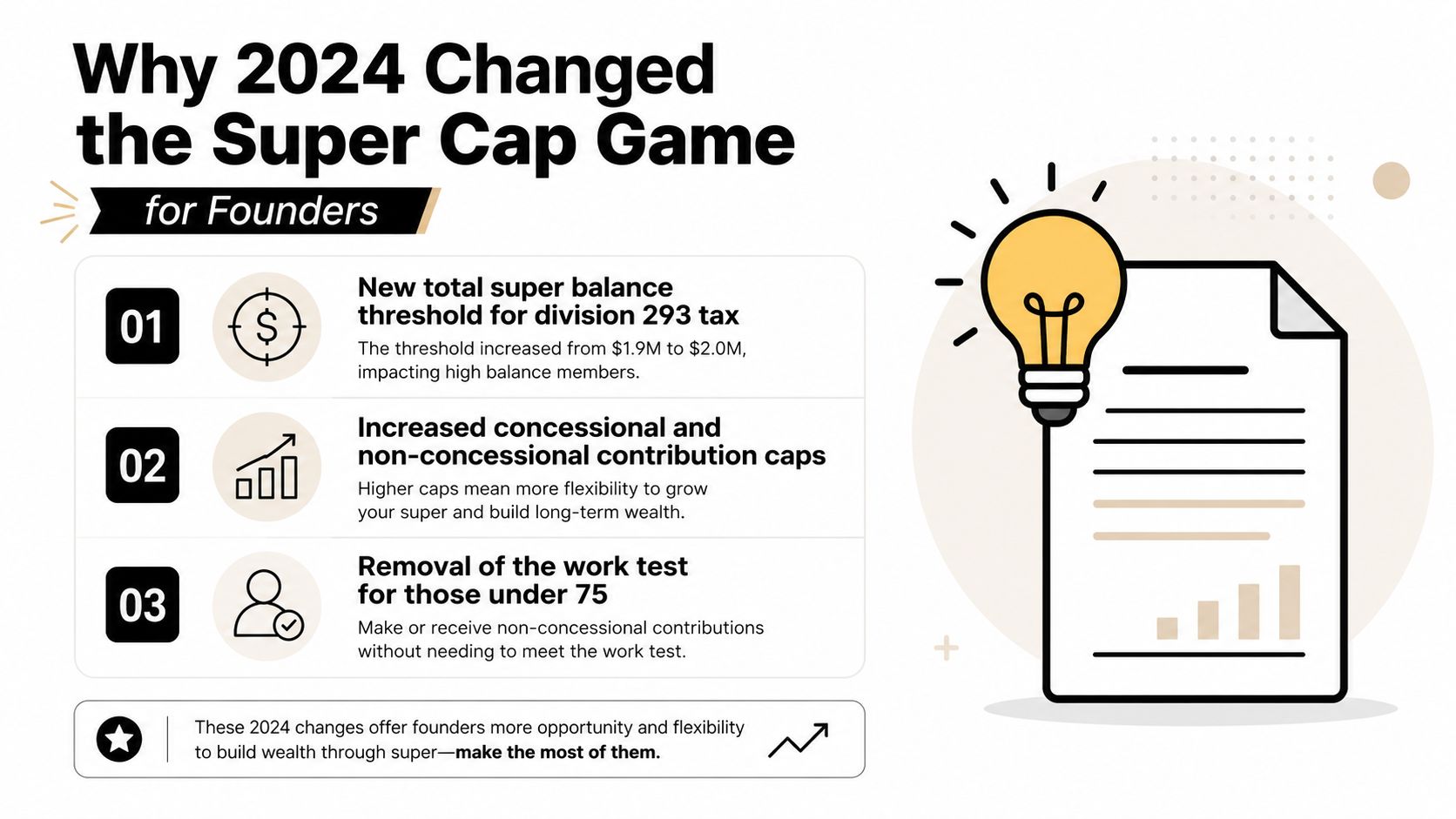
The mistake is reading each change in isolation
A lot of guides treat the super cap like a single number. That's lazy. In 2024, the concessional cap moved from $27,500 to $30,000, the non-concessional cap moved from $110,000 to $120,000, and the SG rate increased from 11% to 11.5%. Those changes landed together, so the practical effect was not just “more room”, it was a different contribution map for owners who pay themselves through wages, dividends, or director fees. ATO concessional contributions cap
The headline that matters is this. If your payroll already had you close to cap in 2023-24, you didn't get a free reset. You got a slightly larger bucket, but the mandatory employer flow also got larger. That's why founders who rely on “I'll top it up at the end of the year” are the ones most likely to overshoot or leave unused space on the table.
Practical rule: in 2024, don't ask whether the cap rose. Ask whether your existing payroll settings already consume most of it.
Why founders feel the change first
The people who feel this first are the ones with variable pay. Directors on fixed salaries, owners using salary sacrifice, and businesses with overtime or bonus swings can all end up with contribution timing that looks fine in July and messy by March. By the time the books are closed, the cap can already be half used by employer super alone.
This is also why the 2024 change matters more than a normal indexation year. The cap movement was tied to AWOTE, which is why the concessional cap moved again later instead of staying frozen. ATO concessional contributions cap
Founders should treat 2024 as a planning year, not a trivia year. If you run payroll, approve director pay, or make personal deductible top-ups, the key question is how the pieces fit together on your own calendar.
The Two Buckets That Drive Every Super Decision
Super contributions fall into two distinct buckets. One is before-tax money, the other is after-tax money. Get the label wrong and you do more than create a clean-up task for the accountant. You can breach the wrong cap and create avoidable problems with contributions that should have been straightforward.
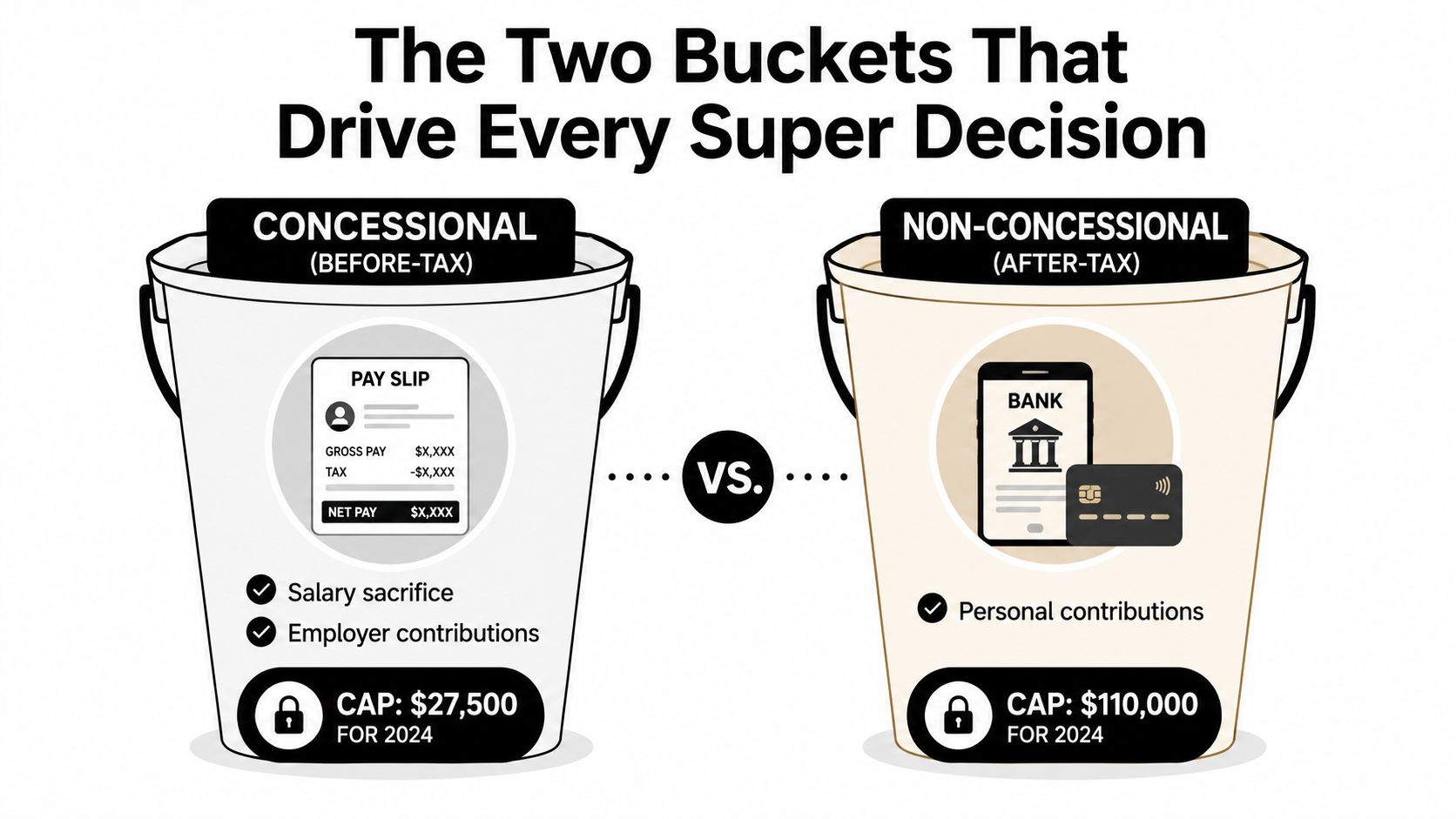
Concessional contributions are the tax-efficient bucket
The concessional bucket is taxed inside the fund. For 2024-25, it covers employer SG contributions, salary sacrifice, and personal deductible contributions. The mechanics are simple. The money goes into super before tax, or it is claimed as a deduction against taxable income, then it is generally taxed at 15% inside the fund. For a founder on a higher marginal rate, that treatment can make a real difference to after-tax cash flow. ATO concessional contributions cap
Founders like this bucket because it turns tax into a planning tool. Payroll makes it look passive, salary sacrifice makes it look small, and a year-end deductible top-up looks harmless. Put them together and the cap fills faster than the headline suggests.
Non-concessional contributions are the after-tax bucket
The non-concessional bucket is money you have already paid tax on. There is no deduction attached to it. It is the route for moving cash from outside super into retirement savings after tax has already been dealt with. For 2024-25, the cap is $120,000, and the standard three-year bring-forward amount is $360,000. Mercer Super on contribution caps
Owners often get it wrong. They treat every contribution as if it sits under one rule. It does not. A post-tax transfer into super is assessed differently from salary sacrifice or a deductible payment. That is why a founder can stay within the concessional cap and still trip the non-concessional rules, or stay within the non-concessional side and blow the concessional cap.
Rule of thumb: label the contribution first, count the number second.
If you remember one thing, make it this. The super contribution cap 2024 is not one number. It is two separate limits, and the right question is always, “Which bucket is this money going into?”
The 2024-25 Numbers and Their Practical Implications
For 2024-25, the headline figures are clear. The concessional cap is $30,000, the non-concessional cap is $120,000, the three-year bring-forward total is $360,000, and the general transfer balance cap is $1.9 million. Founders get caught when they treat those numbers as if they all work the same way. They do not. Contribution type, balance tests, and timing decide what room is left.
What the numbers mean in practice
If you use salary sacrifice, the $30,000 concessional cap is the ceiling for employer SG, sacrifice, and deductible contributions combined. Once compulsory super is flowing, the headroom for voluntary deductible contributions can shrink fast. That is the part headline summaries usually skip.
If your balance is already high, the non-concessional cap is not an open invitation to move extra cash into super. The balance rules still bite. Several Australian super sources note that people with a total super balance at or above $1.9 million at 30 June 2024 could not make non-concessional contributions in 2024-25. That is a hard gate, not a planning preference.
Quick comparison for planning
Limit | 2023-24 | 2024-25 | 2026-27 |
|---|---|---|---|
Concessional cap | $27,500 | $30,000 | $32,500, projected from 1 July 2026 |
Non-concessional cap | $110,000 | $120,000 | $130,000, projected from 1 July 2026 |
Three-year bring-forward total | $330,000 | $360,000 | $390,000, projected from 1 July 2026 |
General transfer balance cap | Not stated here | $1.9 million | Check future indexed settings, projected from 1 July 2026 |
What founders should actually conclude
The cap increase helps, but it does not fix capacity problems on its own. A director package that looked comfortable in 2023 can get tight in 2024 once the higher SG rate starts flowing. A founder with a large balance still has to check whether the balance rules have already closed the door on non-concessional contributions.
The right move is to model headroom from payroll data, not from the headline figure. Start with employer SG, then salary sacrifice, then any deductible top-up, and only then test carry-forward if the balance gate is open. Nexist's carry-forward concessional contributions guide is the cleanest way to work through that sequence without guessing.
Carry-Forward and Bring-Forward Explained as Planning Tools
The planning opportunity in super is not the annual cap. It's the ability to use the rules that let you shift timing. That's where founders can get value, but only if they understand which gates are open and which are shut.

Carry-forward works only if your balance is low enough
Carry-forward concessional contributions let you use unused cap amounts from prior years, but only if your total super balance was under $500,000 at 30 June 2024. You can look back five years for unused concessional amounts. That's a useful tool for founders who had a lumpy income year, but it's not universal. If your balance is too high, the rule is shut.
A practical example. A 45-year-old founder has two years of unused concessional room. That means they may be able to make a larger deductible contribution in 2024-25, but only if the balance gate is open and the contribution lands in time. The better question is not “do I have carry-forward?” It's “how much of my cap is already consumed by compulsory SG this year, and what's still available?” Heffron contributions guide and carry-forward concessional contributions guidance
Bring-forward is a timing tool, not a free bonus
Bring-forward applies to non-concessional contributions. It lets you use future years' room upfront, but only if your balance-based eligibility is intact. For 2024-25, the standard three-year amount is $360,000, but the amount you can access depends on your balance. The balance rules tighten as the super balance rises, and people at the top end can be completely locked out. Mercer Super on contribution caps and Heffron contributions guide
A 55-year-old founder with a sub-$1.68 million balance will often be thinking about whether to trigger bring-forward or keep flexibility. The answer depends on cash flow, planned exits, and whether super is the right place for that money now. If the balance is too close to the threshold, the room available can shrink fast.
Use the tools only when the timing makes sense
Carry-forward and bring-forward are not strategies for the sake of strategy. They're tools for smoothing uneven income, locking in tax benefits, or moving money when the business has surplus cash. If your business is tight on working capital, don't force a super contribution just because the cap exists.
The cleanest rule is this. Use carry-forward when you've got a deductible contribution opportunity and the balance gate is open. Use bring-forward when you've got after-tax cash, room under the thresholds, and a clear reason not to keep that money outside super.
Director Pay, Salary Sacrifice and the 2024 SG Rise
The super cap becomes real for a director not in theory, but when payroll posts, the SG amount lands in the fund, and the remaining headroom is smaller than expected.
A director pay package can fill the cap faster than you think
Take a director on a $260,000 salary-sacrificed package. The employer SG now flows at 11.5% from 1 July 2024, which means the mandatory contribution slice is already larger before any voluntary top-up is added. If that director also salary sacrifices, the concessional cap can get used up long before year end. OnePath on changes to super from 1 July 2024
That's the headline founders miss. The higher cap does offset the SG rise a bit, but not enough to make the issue disappear. A business owner who was planning to add a personal deductible contribution still needs to subtract employer SG and any salary sacrifice already committed through payroll. That's the only way to know what's left.
If you want a practical payroll lens, salary sacrifice should be viewed through the same lens as competitive rewards through salary sacrifice. The idea is simple, but the administration is unforgiving. Every extra dollar directed into concessional super consumes the same limited bucket.
CFO rule: update the payroll projection before you approve the contribution, not after the fund receipt shows up.
The $250,000 threshold changes the conversation
There's another layer here. ATO guidance confirms extra tax may apply when income plus concessional contributions exceed $250,000. For founders, that is not abstract policy. It can mean an additional tax layer on concessional contributions if the year is strong enough. ATO concessional contributions cap
That means the decision is not just “can I contribute more?” It's “should I contribute more this year, or should I leave room for next year and manage taxable income differently?” High-income owner-operators need to model this each quarter, not only at tax time.
For business owners who want to formalise the payroll side, superannuation obligations is the right starting point because the contribution cap only matters after the payroll system is doing the right thing. If the system is wrong, the planning is fiction.
Use quarterly projections, not year-end hope
Here's the method. Start with expected employer SG for the year, add salary sacrifice already locked in, then add any personal deductible contributions you're considering. Compare the total with the $30,000 concessional cap. If the number is already tight in Q1, stop pretending there'll be room later.
That projection is boring. It's also the difference between controlled tax planning and accidental excess contributions.
Penalty Traps and Common Mistakes to Avoid
Founders usually don't get into trouble because they ignore super. They get into trouble because they assume the timing is looser than it is. The ATO doesn't care about your intention if the contribution lands in the wrong bucket or on the wrong date.
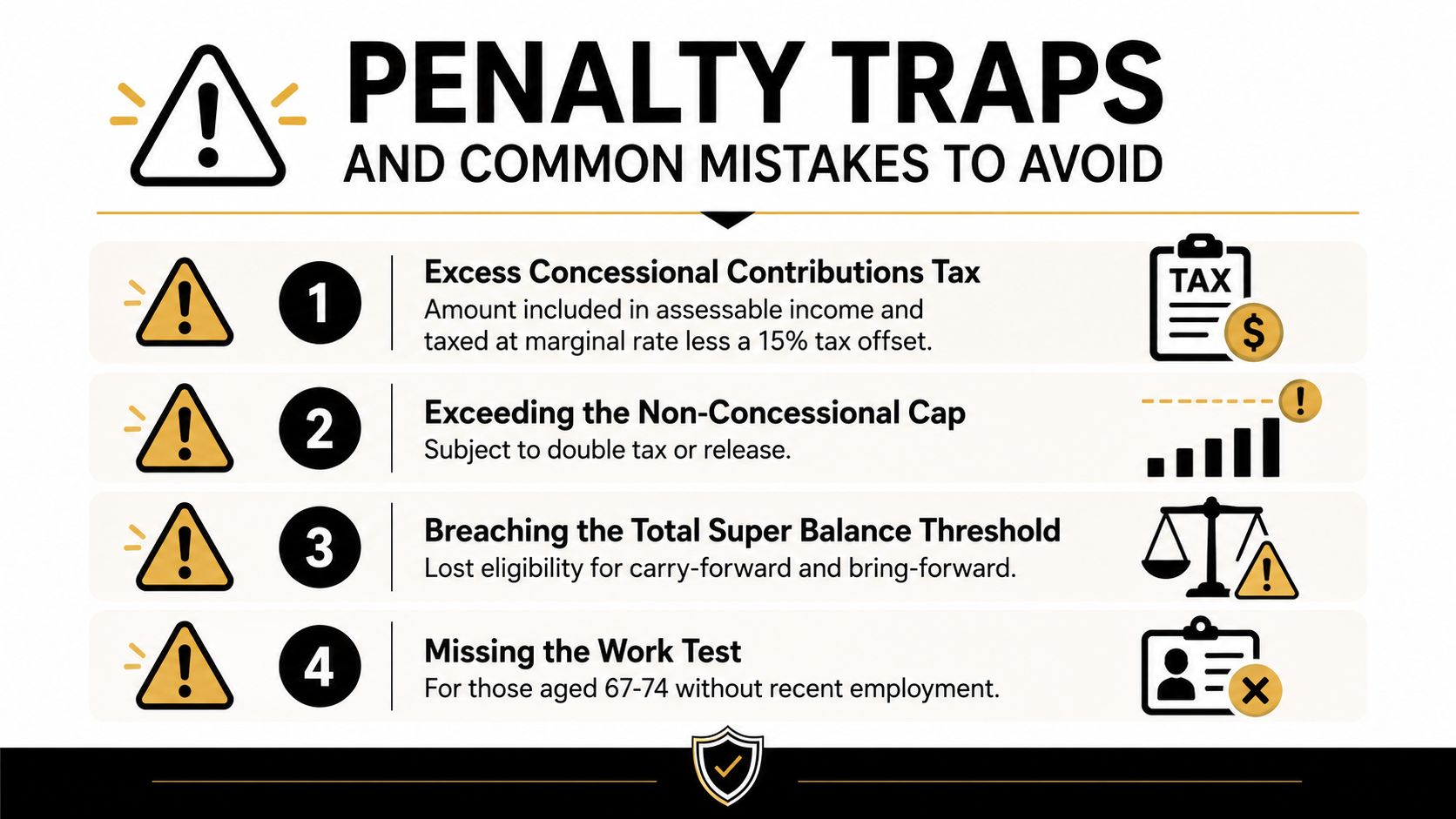
The most expensive errors are predictable
The first trap is excess concessional contributions. If you go over the cap, the excess amount is included in assessable income and taxed at marginal rates, with a 15% offset. That's not a small paperwork issue. It can turn a planned tax benefit into a tax bill you didn't budget for. ATO concessional contributions cap
The second trap is the non-concessional balance gate. The relevant test is not whatever the balance looks like now. For 2024-25, it's the 30 June 2024 total super balance that matters for eligibility. If the balance was too high then, the door to non-concessional contributions may already have been shut. Heffron contributions guide
Timing mistakes cost more than most founders realise
The third trap is personal deductible contributions. Initiating the transfer isn't enough. The fund has to receive the contribution before 30 June if you want it counted in that year. Plenty of owners discover this after their accountant has already closed the file. That's a timing error, not a strategy error.
The fourth trap is ignoring the high-income layer. If income plus concessional contributions push you over the threshold, the extra tax can change the value of the contribution. If you're near that line, read the rules before you treat a deductible top-up as automatic. For a deeper technical view, Division 296 calculator guidance is useful context for how high balances and tax overlays can interact.
A contribution that arrives late is not a contribution that counts this year.
Fix the process, not just the outcome
If a founder ran into one of these traps once, the fix is usually procedural. Put reminder dates into payroll. Get fund confirmations in writing. Check the balance test before approving the transfer. And don't let the bookkeeper become the person who decides the tax strategy without a review from someone who understands the cap rules.
A Founder's Quarterly Action Plan
Super gets easier when you stop treating it like a June problem. Founders who handle this quarterly make fewer mistakes, because they can see the cap pressure before it becomes a year-end surprise.
Start of financial year
Lock in the payroll settings first. Confirm the SG rate, the salary sacrifice arrangement, and how the business will report contributions through payroll. If you're using director fees or variable wages, build the super assumption into the cashflow model before the year starts.
End of Q1
Run a contribution projection against the $30,000 concessional cap. Add employer SG, salary sacrifice, and any planned deductible contribution. If the total is close, stop treating the extra contribution as optional.
End of Q3
Check whether your projected taxable income plus concessional contributions are drifting toward the $250,000 threshold. If they are, talk about whether the contribution still makes sense this year or whether the better move is to preserve cash and manage the tax outcome elsewhere.
Pre-30 June
Finalise the personal deductible contribution early enough for the fund to receive it before year end. Then confirm carry-forward eligibility if you plan to use unused concessional room. The important document pack is simple:
Payroll settings screenshot showing SG and salary sacrifice settings
Cashflow model output showing expected contributions for the year
Fund confirmation of receipt for any personal deductible contribution
Total super balance reading used to test eligibility
Best practice: if you can't prove the timing, assume the timing won't save you.
The next conversation should be a short one with your virtual CFO or super adviser. Ask one question. “What is my actual headroom after employer SG, salary sacrifice, carry-forward, and balance tests, and what needs to happen before 30 June to use it safely?” If that answer isn't on one page, the planning isn't finished.
If you want this turned into a contribution projection that matches your payroll and director pay structure, Nexist can help you work through the cap, the timing, and the cashflow trade-offs without guesswork. Visit Nexist and ask for a review before you lock in your next super top-up.
super contribution cap, Australian superannuation, concessional contributions, non-concessional cap, tax planning

" width="24px"/><g d="M 0 24.129 L 0 0.129 L 24 0.129 L 24 24.129 Z M 0 24.129 L 0 0.129 L 24 0.129 L 24 24.129 Z M 24 3 C 24 1.344 22.656 0 21 0 L 3 0 C 1.344 0 0 1.344 0 3 L 0 21 C 0 22.656 1.344 24 3 24 L 21 24 C 22.656 24 24 22.656 24 21 Z M 6.883 8.375 L 2.863 8.375 L 2.863 20.467 L 6.883 20.467 Z M 4.899 2.545 C 3.524 2.545 2.625 3.449 2.625 4.634 C 2.625 5.795 3.496 6.724 4.846 6.724 L 4.872 6.724 C 6.273 6.724 7.146 5.795 7.146 4.634 C 7.12 3.449 6.274 2.545 4.899 2.545 Z M 16.747 8.09 C 14.614 8.09 13.659 9.263 13.124 10.086 L 13.124 8.374 L 9.105 8.374 C 9.159 9.508 9.105 20.466 9.105 20.466 L 13.124 20.466 L 13.124 13.713 C 13.124 13.352 13.15 12.99 13.257 12.732 C 13.547 12.01 14.209 11.262 15.319 11.262 C 16.773 11.262 17.355 12.372 17.355 13.996 L 17.355 20.466 L 21.374 20.466 L 21.374 13.532 C 21.374 9.818 19.391 8.09 16.747 8.09 Z" fill="transparent" height="24.12890599668026px" id="dSFdkJotL" width="24px"><path d="M 0 24 L 0 0 L 24 0 L 24 24 Z" fill="transparent" height="24px" id="wscNJE44G" transform="translate(0 0.129)" width="24px"/><g d="M 0 24.129 L 0 0.129 L 24 0.129 L 24 24.129 Z M 24 3 C 24 1.344 22.656 0 21 0 L 3 0 C 1.344 0 0 1.344 0 3 L 0 21 C 0 22.656 1.344 24 3 24 L 21 24 C 22.656 24 24 22.656 24 21 Z M 6.883 8.375 L 2.863 8.375 L 2.863 20.467 L 6.883 20.467 Z M 4.899 2.545 C 3.524 2.545 2.625 3.449 2.625 4.634 C 2.625 5.795 3.496 6.724 4.846 6.724 L 4.872 6.724 C 6.273 6.724 7.146 5.795 7.146 4.634 C 7.12 3.449 6.274 2.545 4.899 2.545 Z M 16.747 8.09 C 14.614 8.09 13.659 9.263 13.124 10.086 L 13.124 8.374 L 9.105 8.374 C 9.159 9.508 9.105 20.466 9.105 20.466 L 13.124 20.466 L 13.124 13.713 C 13.124 13.352 13.15 12.99 13.257 12.732 C 13.547 12.01 14.209 11.262 15.319 11.262 C 16.773 11.262 17.355 12.372 17.355 13.996 L 17.355 20.466 L 21.374 20.466 L 21.374 13.532 C 21.374 9.818 19.391 8.09 16.747 8.09 Z" fill="transparent" height="24.12890599668026px" id="sTpjGo1tb" width="24px"><path d="M 0 24 L 0 0 L 24 0 L 24 24 Z" fill="transparent" height="24px" id="s7ffpmKOD" transform="translate(0 0.129)" width="24px"/><g d="M 24 3 C 24 1.344 22.656 0 21 0 L 3 0 C 1.344 0 0 1.344 0 3 L 0 21 C 0 22.656 1.344 24 3 24 L 21 24 C 22.656 24 24 22.656 24 21 Z M 6.883 8.375 L 2.863 8.375 L 2.863 20.467 L 6.883 20.467 Z M 4.899 2.545 C 3.524 2.545 2.625 3.449 2.625 4.634 C 2.625 5.795 3.496 6.724 4.846 6.724 L 4.872 6.724 C 6.273 6.724 7.146 5.795 7.146 4.634 C 7.12 3.449 6.274 2.545 4.899 2.545 Z M 16.747 8.09 C 14.614 8.09 13.659 9.263 13.124 10.086 L 13.124 8.374 L 9.105 8.374 C 9.159 9.508 9.105 20.466 9.105 20.466 L 13.124 20.466 L 13.124 13.713 C 13.124 13.352 13.15 12.99 13.257 12.732 C 13.547 12.01 14.209 11.262 15.319 11.262 C 16.773 11.262 17.355 12.372 17.355 13.996 L 17.355 20.466 L 21.374 20.466 L 21.374 13.532 C 21.374 9.818 19.391 8.09 16.747 8.09 Z" fill="transparent" height="24.000006px" id="D0ecaHEcW" transform="translate(0 0)" width="24px"><path d="M 24 3 C 24 1.344 22.656 0 21 0 L 3 0 C 1.344 0 0 1.344 0 3 L 0 21 C 0 22.656 1.344 24 3 24 L 21 24 C 22.656 24 24 22.656 24 21 Z" fill="rgb(55, 184, 218)" height="24.000006px" id="IPLFE6zXx" width="24px"/><path d="M 4.02 0 L 0 0 L 0 12.092 L 4.02 12.092 Z" fill="rgb(255, 255, 255)" height="12.09201px" id="FWhtzAyuY" transform="translate(2.863 8.375)" width="4.02px"/><path d="M 2.274 0 C 0.899 0 0 0.904 0 2.089 C 0 3.25 0.871 4.179 2.221 4.179 L 2.247 4.179 C 3.648 4.179 4.521 3.25 4.521 2.089 C 4.495 0.904 3.649 0 2.274 0 Z" fill="rgb(255, 255, 255)" height="4.17876px" id="VmOsKv4kO" transform="translate(2.625 2.545)" width="4.52095px"/><path d="M 7.641 0 C 5.509 0 4.554 1.173 4.019 1.996 L 4.019 0.284 L 0 0.284 C 0.053 1.419 0 12.376 0 12.376 L 4.019 12.376 L 4.019 5.623 C 4.019 5.262 4.045 4.9 4.151 4.642 C 4.442 3.92 5.103 3.172 6.214 3.172 C 7.667 3.172 8.25 4.282 8.25 5.907 L 8.25 12.376 L 12.269 12.376 L 12.269 5.442 C 12.269 1.728 10.286 0 7.641 0 Z" fill="rgb(255, 255, 255)" height="12.37626px" id="n1XUbhaq0" transform="translate(9.105 8.09)" width="12.268830000000001px"/></g></g></g></g></svg>)