
Business Decision Making a Practical Guide for Founders
Sharpen your business decision making with proven frameworks, finance-first KPIs, and a 90-day governance roadmap built for Australian founders.
Ansh Malhotra
You're probably making a few big calls this week with partial information, a tired team, and a cash account that won't forgive a bad bet. Maybe it's a price change you've delayed, a hire you're half-convinced on, or stock you've ordered because last month felt strong. In Australian SMEs, that's normal, and it's exactly why business decision making has to be tied to cash, margin and a repeatable governance rhythm, not founder mood.
Table of Contents
The Founder Call That Went Sideways
He signed the warehouse lease on a Thursday afternoon because the broker said the space would be gone by Monday. The logic felt clean enough. More room meant more stock, faster dispatch, fewer bottlenecks, and a better shot at the next growth tier. Then the cash graph bent the wrong way.
Receivables started stretching. Stock moved slower than forecast. The rent hit before the extra sales did, and the founder spent the next quarter chasing money that should've been sitting in the bank. That's the moment this guide is built around, the point where a confident instinct collided with a missing finance lens.
The real problem wasn't instinct
Founders don't usually fail because they lack courage. They fail because they make a decision before they've asked the right cash question. A lease, a hire, a discount, a stock order, each one can look sensible in isolation and still damage the business if it traps working capital or delays recovery.
The hard truth is that many owners run businesses by narrative instead of numbers. That works until the market shifts, a customer pays late, or the next round of stock lands on time but sells slowly. Australian business decisions sit inside a fast-moving environment, with quarterly reporting cycles and macro shifts that can hit demand and financing conditions quickly, as the ABS and Reserve Bank data infrastructure makes clear in practice (Australian business decision making and data cycles).
Practical rule: if a decision changes cash timing, it deserves a finance lens before it gets a green light.
That's the discipline here. Not more spreadsheets for the sake of it, and not slower decision making. Just a way to separate good instincts from expensive guesses.
What Business Decision Making Really Means
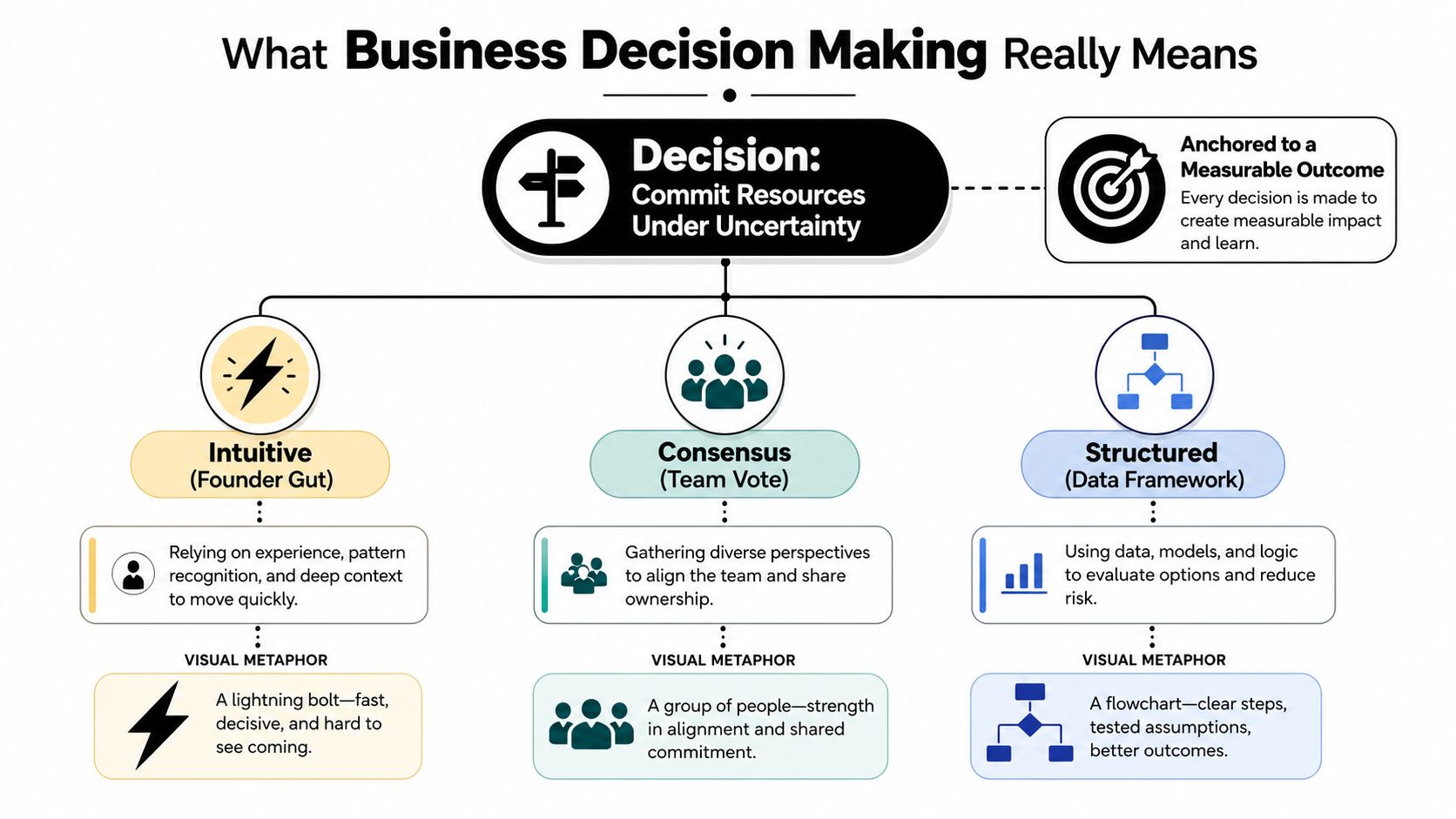
Business decision making is the repeated act of committing cash, time, or attention under uncertainty, then holding that commitment to a measurable result. That is the job. If there is no commitment and no metric, you are just trading opinions.
Three approaches, one outcome
A founder can make a call on instinct, by consensus, or through a structured process. Instinct is fast and often useful when the pattern is familiar. Consensus can surface blind spots, but it can also turn a sharp call into a blurred compromise.
Structured decisions use a framework, evidence, and a clear approval path. That does not make them slow. It means you decide in advance which data matters, who checks it, and what success looks like before the room starts drifting on emotion.
Every decision is a bet on a forecast. If the forecast rests on thin data, the bet is weak no matter how confident the founder sounds. Quality inputs matter more than loud opinions.
If you want a practical legal and structure lens alongside the operational one, browse Coachful's sole proprietorship guide. It is useful context when you are deciding how formal your decision and accountability structure needs to be.
The working definition that holds up
Use this sentence: business decision making is choosing the next cash, time, or attention move under uncertainty, using the best available evidence and a clear owner.
That definition matters because it forces clarity. It tells you whether the decision is about speed, money, or risk. It also keeps you honest about who owns the call and which number will show whether it worked.
Decisions improve when the inputs improve. Better data, better framing, better accountability. That is the lever.
The Four Decision Archetypes Founders Actually Face
Not every decision deserves the same level of rigour. A quick operational fix and a six-figure capital commitment should never be handled with the same process. If you treat them the same, you either waste time or blow up risk.
Decision Archetypes and Rigour Levels | ||||
|---|---|---|---|---|
Archetype | Reversibility | Cash Impact | Data Required | Approval Path |
Reversible operational calls | High | Low to moderate | Light, recent operational data | Owner or team lead |
One-way bets with high capital exposure | Low | High | Scenario model, cash forecast, downside view | Founder plus finance review |
Recurring finance-led calls | Medium | High over time | KPI trend, benchmark, customer behaviour | Weekly or monthly approval rhythm |
Strategic inflection choices | Low | Very high | Market evidence, working capital view, forecast, timing analysis | Founder, finance lead, and key operator |
Use the right amount of process
A reversible call is something like moving a shift, changing a supplier, or adjusting an ad spend test. Make it fast, but still log the decision. If it goes wrong, you need to know why.
A one-way bet is a warehouse, a major equipment buy, or a material systems change. Those decisions need a downside case and a working capital view, not just a growth story. If you can't map the cash downside clearly, you're not ready.
Recurring finance-led calls, like pricing, stock levels, and hiring, need rhythm more than drama. These should live in a weekly or monthly cadence with the same dashboard every time. That's where consistency beats heroics.
Strategic inflection choices are the hardest. They change the shape of the business, so they deserve deliberate challenge. If you want a clean test for whether the concept itself deserves capital, validating your startup idea is a useful framing tool, especially before you scale a new offer or channel.
A one-page rubric to keep on hand
Use this before any material call:
Is it reversible? If yes, move faster.
Does it trap cash? If yes, model the downside.
Is it recurring? If yes, put it on a scorecard.
Does it reshape the business? If yes, require challenge from finance and operations.
That's enough structure for most SMEs. You don't need ceremony. You need the right amount of friction in the right place.
Cognitive Biases That Quietly Drain SME Cash
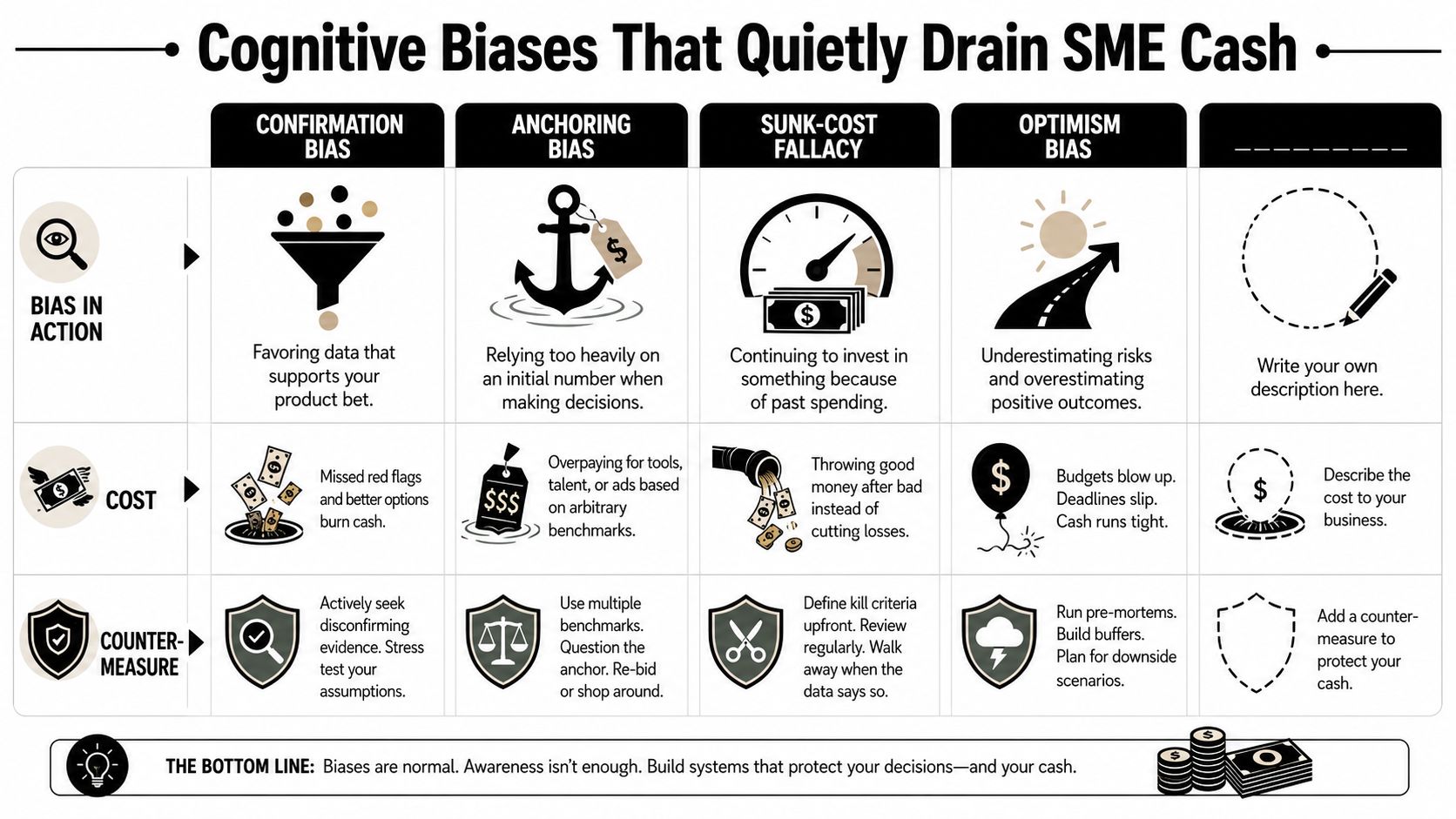
Founders rarely lose money because they can't think. They lose money because their thinking gets distorted at the exact moment a call needs discipline. The five biases below show up constantly in SME decisions, and each one has a cash cost.
The traps that keep repeating
Confirmation bias shows up when a founder backs the product bet that already feels right and ignores the sales data that says otherwise. The guardrail is a written premortem before launch, not after the loss.
Anchoring bias hits when the first supplier quote or first customer offer becomes the mental reference point. The fix is a benchmarked price floor, set from margin, not emotion.
Sunk-cost loyalty keeps weak channels, old stock lines, or stale projects alive because too much has already been spent. Put a kill-date on the line and honour it.
Optimism bias makes a hire look easier than it is. Use a scorecard with clear outcomes, not a chat about “fit”.
Loss aversion pushes owners to protect volume at the expense of margin. Set a floor on gross margin before you approve discounts.
Finance guardrail: if you can name the bias, you can usually name the control that beats it.
The Australian SME setting makes these traps more expensive. Trading conditions, labour pressure, and cash constraints aren't abstract problems, they change how much room you have to be wrong. That's why the answer isn't more analysis. It's better rules.
Use the counter-move, not more debate
You don't need to become a psychology expert. You need a few hard stops:
Premortem before product bets
Floor pricing before discounting
Kill-date on underperforming stock
Hiring scorecard before interviews
Margin floor before volume chasing
That's how you remove bias from the room. You stop asking, “What do I feel?” and start asking, “What rule protects the business if I'm wrong?”
Anchoring Decisions in Cash, Margins and Forecasts
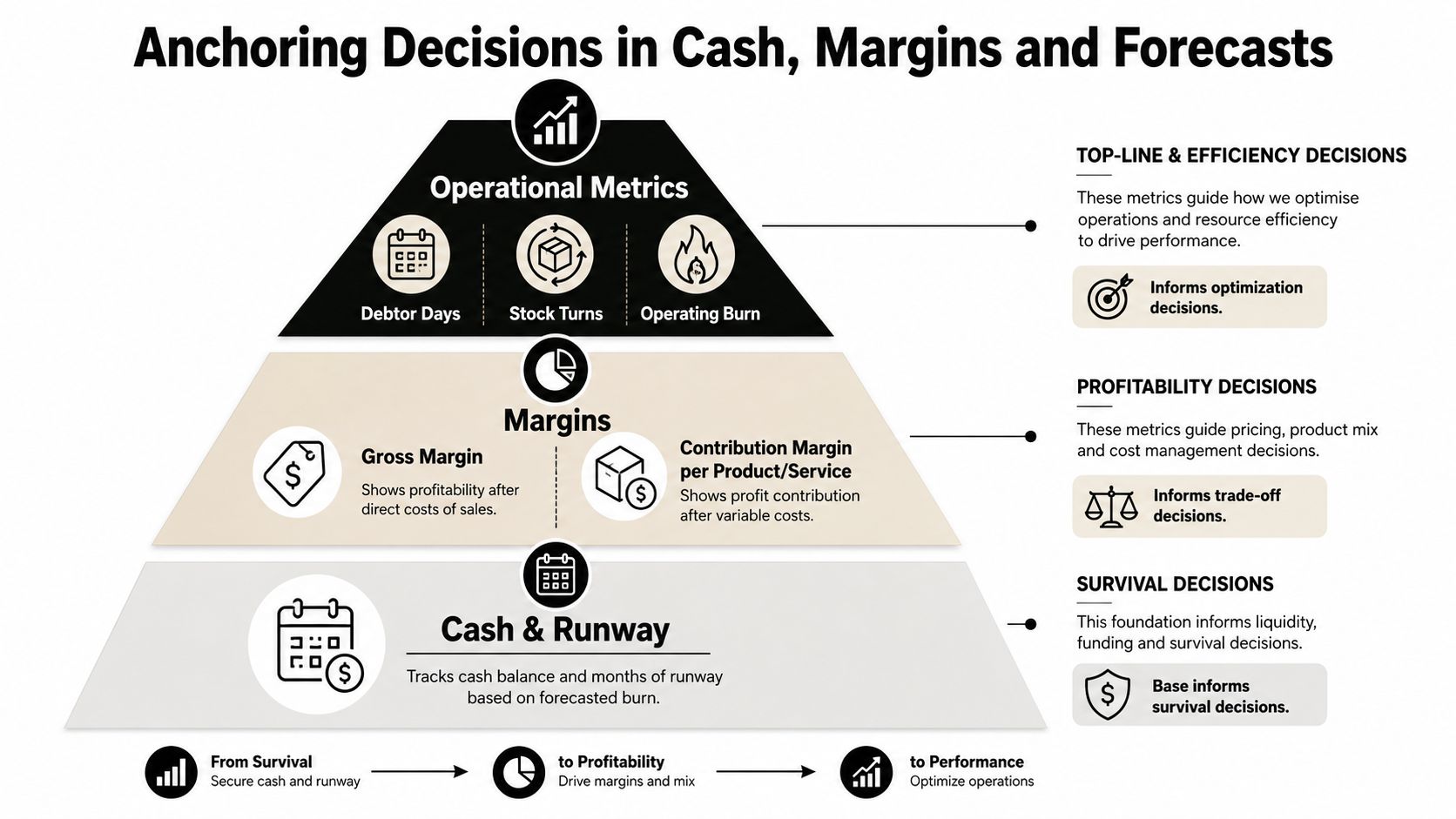
If you're still making decisions mainly from the profit and loss statement, you're flying half-blind. Profit is important, but cash tells you whether the business can absorb a bad month, delayed debtor, or stock overbuy. The decision stack has to start with survival, then profitability, then operations.
Build the weekly snapshot first
Your weekly view should cover cash and runway, gross margin, contribution margin, debtor days, stock turns, and operating burn. Don't spread attention across 40 metrics. Pick the handful that move cash.
The point of this stack is control. Cash and runway tell you if you can survive. Margins tell you whether the business is earning enough on each sale. Operational metrics tell you where the cash is getting trapped.
For a deeper planning rhythm that sits beside this approach, the strategic and financial planning guide is a solid companion read.
Put a forecast behind every meaningful call
A 13-week rolling forecast is the right cadence for most SMEs because it forces discipline without becoming theatre. Update it monthly, and use it to test hiring, stock buys, major payments, and discounting. If the forecast shows a squeeze, the decision changes.
Use simple triggers. If debtor balances are drifting, challenge the customer terms. If stock is sitting too long, slow purchases or discount more intelligently. If operating burn is rising, cut the habit that caused it, not just the symptom.
Rule of thumb: a decision that worsens cash timing should not pass on gut feel alone.
Australian business data also makes external comparison worth the effort. Business investment is concentrated and volatile across sectors, so a decision that looks normal inside your business may be poor relative to the market. Benchmarks matter because they stop you mistaking internal noise for normal performance.
Read the numbers in the right order
Use this sequence every time:
Cash first
Margin second
Operational driver third
Scenario impact last
That order stops profitable businesses from failing. It also stops owners from funding growth that looks good on paper but starves the bank account. If you need a broader management cadence to support that rhythm, quarterly business review is the natural next layer.
Two SMEs Using the Discipline in Real Time
A freight operator with tight margins had a problem that looked like revenue growth but behaved like cash leakage. The owner kept accepting slow-paying customers because the sales story sounded good and the work looked full. In the dashboard, debtor days kept stretching, and the cash account kept feeling the strain.
Freight operator
The trigger was simple. Any customer outside the payment threshold went to review, and any account that drifted too far had a kill-date unless the terms improved. The founder also stopped treating volume as the goal and started treating cash conversion as the goal. The result was not a prettier P&L, it was a stronger bank balance and less weekly firefighting.
The governance change mattered as much as the rule. The finance lead owned the debtor review, the salesperson had to justify exceptions, and the founder stopped overriding the process for “strategic” customers. That was the difference between a policy and a habit.
Ecommerce brand
The second case was an ecommerce brand that kept buying too much of the wrong stock because the founder trusted product intuition more than sell-through. Inventory looked healthy on the shelf and expensive in the bank. Once stock turns became the signal, the owner changed cadence.
Markdowns started earlier. Slow lines were cleared before they became dead money. Purchases slowed on weaker categories and shifted towards lines that converted faster. The cash result was cleaner inventory discipline and less capital locked in the warehouse.
The lesson is blunt. If cash is stuck in customers or stock, growth is not the answer. Decisions are.
The pattern across both businesses is the same. A financial trigger changed the behaviour, and a governance tweak kept it from sliding back. That's what good decision making looks like when it's attached to cash, not just confidence.
A 90-Day Governance Roadmap for Better Decisions
The fastest way to improve decision quality is to install a rhythm that survives founder bandwidth. Don't try to fix every call at once. Put structure around the calls that move cash, then expand.
Weeks 1 to 2
Install a KPI dashboard and a decision log. The dashboard should show the few metrics that matter most to your business, and the log should capture what was decided, who owned it, what evidence was used, and when it gets reviewed. If you want operational support for that setup, Nexist is one option that combines forecasting, KPIs, debt and cashflow management, and hands-on finance execution.
Weeks 3 to 6
Run a weekly 30-minute cash and decisions stand-up. Put the finance chair in the room, even if that's your external adviser or fractional CFO. Keep it tight, review the dashboard, challenge exceptions, and decide what gets actioned before the week ends.
Weeks 7 to 10
Test the framework on one real strategic call. Use the same approval path, the same forecast, and the same challenge questions. Don't rehearse on low-stakes decisions and then freestyle on the one that matters.
Weeks 11 to 13
Lock the cadence and assign an accountability seat. Someone proposes, someone challenges, someone approves. That split should be explicit.
Decision Archetype | Propose | Challenge | Approve |
|---|---|---|---|
Operational calls | Team lead | Finance or ops | Owner or manager |
One-way capital bets | Founder | Finance lead | Founder and finance lead |
Recurring finance calls | Finance chair | Founder | Founder |
Strategic inflection choices | Founder | Finance and key operator | Founder with board or adviser input |
Keep the artefacts visible: decision log, forecast, scorecard, and the review notes. A business that can't explain why a call was made usually can't learn from it later.
Only 36% of organisations in the BARC survey were using KPIs pervasively, even though 79% said they had a defined standard set of KPIs, and the median organisation used 5 internal data sources with only 6% having a single source of truth (KPI governance and data use gaps). That gap is your edge if you close it. Most businesses have the data. Too few have the rhythm.
From Watchman to Visionary Through Better Decisions
The founder who stays in every daily decision becomes a watchman, not a builder. The founder who builds a decision system can step back, delegate the routine calls, and reserve judgment for the few decisions that change the business. That's where time comes back, and cash starts behaving better because the rules are clearer.
The discipline is straightforward. Define the decision, classify it by risk and reversibility, de-bias it with guardrails, anchor it to cash, govern it with a rhythm, and rehearse the hard calls before they get expensive. If you want a broader framework to keep sharpening your own judgement, improve your decision making skills is a useful companion read, and leadership skills development is the management layer that helps those decisions stick.
The aim isn't to become more cautious. It's to stop paying for avoidable mistakes with cash and attention. Build the system once, and you can reclaim hours every week while putting more real money in the bank.
Nexist helps Australian founders turn decision making into a cash discipline, not a slogan. If you want forecasting, KPI rhythm, and a practical finance partner that helps you make cleaner calls on cash, stock, pricing, hiring, and growth timing, visit Nexist and start from the business scorecard.
business decision making, decision framework, SME finance, founder strategy, cash flow KPIs

" width="24px"/><g d="M 0 24.129 L 0 0.129 L 24 0.129 L 24 24.129 Z M 0 24.129 L 0 0.129 L 24 0.129 L 24 24.129 Z M 24 3 C 24 1.344 22.656 0 21 0 L 3 0 C 1.344 0 0 1.344 0 3 L 0 21 C 0 22.656 1.344 24 3 24 L 21 24 C 22.656 24 24 22.656 24 21 Z M 6.883 8.375 L 2.863 8.375 L 2.863 20.467 L 6.883 20.467 Z M 4.899 2.545 C 3.524 2.545 2.625 3.449 2.625 4.634 C 2.625 5.795 3.496 6.724 4.846 6.724 L 4.872 6.724 C 6.273 6.724 7.146 5.795 7.146 4.634 C 7.12 3.449 6.274 2.545 4.899 2.545 Z M 16.747 8.09 C 14.614 8.09 13.659 9.263 13.124 10.086 L 13.124 8.374 L 9.105 8.374 C 9.159 9.508 9.105 20.466 9.105 20.466 L 13.124 20.466 L 13.124 13.713 C 13.124 13.352 13.15 12.99 13.257 12.732 C 13.547 12.01 14.209 11.262 15.319 11.262 C 16.773 11.262 17.355 12.372 17.355 13.996 L 17.355 20.466 L 21.374 20.466 L 21.374 13.532 C 21.374 9.818 19.391 8.09 16.747 8.09 Z" fill="transparent" height="24.12890599668026px" id="dSFdkJotL" width="24px"><path d="M 0 24 L 0 0 L 24 0 L 24 24 Z" fill="transparent" height="24px" id="wscNJE44G" transform="translate(0 0.129)" width="24px"/><g d="M 0 24.129 L 0 0.129 L 24 0.129 L 24 24.129 Z M 24 3 C 24 1.344 22.656 0 21 0 L 3 0 C 1.344 0 0 1.344 0 3 L 0 21 C 0 22.656 1.344 24 3 24 L 21 24 C 22.656 24 24 22.656 24 21 Z M 6.883 8.375 L 2.863 8.375 L 2.863 20.467 L 6.883 20.467 Z M 4.899 2.545 C 3.524 2.545 2.625 3.449 2.625 4.634 C 2.625 5.795 3.496 6.724 4.846 6.724 L 4.872 6.724 C 6.273 6.724 7.146 5.795 7.146 4.634 C 7.12 3.449 6.274 2.545 4.899 2.545 Z M 16.747 8.09 C 14.614 8.09 13.659 9.263 13.124 10.086 L 13.124 8.374 L 9.105 8.374 C 9.159 9.508 9.105 20.466 9.105 20.466 L 13.124 20.466 L 13.124 13.713 C 13.124 13.352 13.15 12.99 13.257 12.732 C 13.547 12.01 14.209 11.262 15.319 11.262 C 16.773 11.262 17.355 12.372 17.355 13.996 L 17.355 20.466 L 21.374 20.466 L 21.374 13.532 C 21.374 9.818 19.391 8.09 16.747 8.09 Z" fill="transparent" height="24.12890599668026px" id="sTpjGo1tb" width="24px"><path d="M 0 24 L 0 0 L 24 0 L 24 24 Z" fill="transparent" height="24px" id="s7ffpmKOD" transform="translate(0 0.129)" width="24px"/><g d="M 24 3 C 24 1.344 22.656 0 21 0 L 3 0 C 1.344 0 0 1.344 0 3 L 0 21 C 0 22.656 1.344 24 3 24 L 21 24 C 22.656 24 24 22.656 24 21 Z M 6.883 8.375 L 2.863 8.375 L 2.863 20.467 L 6.883 20.467 Z M 4.899 2.545 C 3.524 2.545 2.625 3.449 2.625 4.634 C 2.625 5.795 3.496 6.724 4.846 6.724 L 4.872 6.724 C 6.273 6.724 7.146 5.795 7.146 4.634 C 7.12 3.449 6.274 2.545 4.899 2.545 Z M 16.747 8.09 C 14.614 8.09 13.659 9.263 13.124 10.086 L 13.124 8.374 L 9.105 8.374 C 9.159 9.508 9.105 20.466 9.105 20.466 L 13.124 20.466 L 13.124 13.713 C 13.124 13.352 13.15 12.99 13.257 12.732 C 13.547 12.01 14.209 11.262 15.319 11.262 C 16.773 11.262 17.355 12.372 17.355 13.996 L 17.355 20.466 L 21.374 20.466 L 21.374 13.532 C 21.374 9.818 19.391 8.09 16.747 8.09 Z" fill="transparent" height="24.000006px" id="D0ecaHEcW" transform="translate(0 0)" width="24px"><path d="M 24 3 C 24 1.344 22.656 0 21 0 L 3 0 C 1.344 0 0 1.344 0 3 L 0 21 C 0 22.656 1.344 24 3 24 L 21 24 C 22.656 24 24 22.656 24 21 Z" fill="rgb(55, 184, 218)" height="24.000006px" id="IPLFE6zXx" width="24px"/><path d="M 4.02 0 L 0 0 L 0 12.092 L 4.02 12.092 Z" fill="rgb(255, 255, 255)" height="12.09201px" id="FWhtzAyuY" transform="translate(2.863 8.375)" width="4.02px"/><path d="M 2.274 0 C 0.899 0 0 0.904 0 2.089 C 0 3.25 0.871 4.179 2.221 4.179 L 2.247 4.179 C 3.648 4.179 4.521 3.25 4.521 2.089 C 4.495 0.904 3.649 0 2.274 0 Z" fill="rgb(255, 255, 255)" height="4.17876px" id="VmOsKv4kO" transform="translate(2.625 2.545)" width="4.52095px"/><path d="M 7.641 0 C 5.509 0 4.554 1.173 4.019 1.996 L 4.019 0.284 L 0 0.284 C 0.053 1.419 0 12.376 0 12.376 L 4.019 12.376 L 4.019 5.623 C 4.019 5.262 4.045 4.9 4.151 4.642 C 4.442 3.92 5.103 3.172 6.214 3.172 C 7.667 3.172 8.25 4.282 8.25 5.907 L 8.25 12.376 L 12.269 12.376 L 12.269 5.442 C 12.269 1.728 10.286 0 7.641 0 Z" fill="rgb(255, 255, 255)" height="12.37626px" id="n1XUbhaq0" transform="translate(9.105 8.09)" width="12.268830000000001px"/></g></g></g></g></svg>)