Strategic Plan for Business: A Cash-First Guide for 2026
Build a strategic plan for business that prioritizes cash flow. Practical advice for Australian SMEs to thrive in 2026.
Ansh Malhotra

You can have a decent-looking strategic plan and still be bleeding cash every week. The trap is obvious when you're in it, sales are coming in, the team is busy, and yet the bank balance never seems to catch up with the effort. That's usually not a sales problem. It's a planning problem, and more specifically, a cash control problem.
In Australia, that matters more than most founders realise. Small businesses make up about 97% of all businesses and employ around 42% of the private-sector workforce according to the Australian Government's Treasury, so the way SMEs plan, price, hire, stock, and collect money has economy-wide weight (Australian Government Treasury context). If your plan doesn't protect margin and cash, it's not strategy. It's paperwork.
Table of Contents
Why Most Strategic Plans Fail Australian SMEs
Most founders think a strategic plan fails because it isn't ambitious enough. In practice, it fails because it's built like a presentation, not an operating system. A vision statement, a SWOT grid, and a few annual goals won't save a business that's short on cash, losing margin in pricing, or drowning in owner-led decisions.
The Australian environment makes that mistake expensive. Strategy here is increasingly tied to measurable digital and productivity milestones, not just broad ambition. The Australian Government set a goal for Australia to become a top-10 digital economy and society by 2030, and the point is clear, execution now matters more than storytelling (Digital Economy Strategy context). If your plan doesn't translate into real KPIs, process discipline, and working-capital control, it won't survive contact with the week-to-week reality of an SME.
Practical rule: if a strategic plan can't tell you how cash moves through the business, it's not finished.
The wrong kind of planning feels busy
A lot of owners mistake activity for control. They hold the offsite, write the goals, assign a few initiatives, and feel organised for a month or two. Then receivables drift, inventory swells, supplier terms tighten, and the founder ends up back in the middle of every decision.
That's because the actual job of a strategic plan for business is not to describe the future. It's to force better decisions today. For Australian SMEs, that means the plan has to shape pricing, hiring, inventory, debt, and management cadence in a way that protects cash before it protects ego.
Deliberate plans beat reactive management
A deliberate strategy only works when people know what they're trying to achieve and what they're accountable for. Harvard Business School's strategy material makes the same point, strategy depends on conscious action, data, and clear alignment, not vague intent (Harvard Business School Online). That matters in SMEs because most of the damage happens in the gaps between intention and execution.
If you're running a small or medium business, your strategy should do three things. It should set financial direction, define what gets measured, and specify how often the team will review it. Anything less is a hope document, not a plan.
Diagnosing the Cash and Margin Leaks in Your Business
Before you set targets, look for the holes. Most businesses don't collapse because one big thing went wrong. They leak through a dozen smaller failures, weak pricing, slow debt collection, excess stock, poor job costing, and process friction that chews up time and labour.
The Australian Taxation Office's June 2025 small-business benchmarks update uses industry financial ratios to help owners compare performance and spot margin leakage, which is a blunt reminder that ratio control is not optional (ATO benchmark update context). If your numbers look “fine” but your cash feels tight, the benchmark view is usually where the truth shows up first.
Start with the four leak points that matter most
Pricing discipline is the first place to look. If you're discounting to win work, bundling too much into fixed quotes, or carrying stale pricing from two years ago, you're donating margin to the market. That shows up late, usually after payroll has already been approved.
Receivables are the next stress point. If invoices sit too long before being collected, the business can look profitable on paper and still struggle to fund wages, tax, and stock. The same goes for supplier terms, because mismatched inflows and outflows create pressure even when sales are growing.
Inventory and process bottlenecks hide in plain sight
Stock-heavy businesses often overestimate how much growth they can fund. The issue isn't just whether the product sells, it's how long cash stays trapped in shelves, pallets, and slow movers before it returns to the bank account. If you want a practical framework for this, use the cash conversion cycle as a control lens, not a finance textbook concept.
Service and trade businesses have their own leak. The waste is usually in quoting, rework, scheduling gaps, unbilled variations, and owner involvement in approvals that should be standardised. Those businesses often look efficient because the work is visible, but the margin leak sits in the admin trail.
CFO lens: busy does not equal profitable. A full calendar with weak job costing is just controlled chaos.
Use a short audit, not a sprawling review
A useful diagnostic doesn't need a hundred metrics. It needs a disciplined scan of the numbers and the workflow. Check pricing, stock, debtor ageing, supplier timing, overhead creep, and any recurring manual task that burns hours without improving customer value.
Pricing: identify lines or jobs where the gross margin is consistently weaker than expected.
Receivables: flag invoices that are habitually delayed or disputed.
Stock: look for slow-moving items, over-ordering, and obsolete inventory.
Supplier terms: test whether payment timing is helping or hurting cash pressure.
Process bottlenecks: note where founder approvals, rework, or manual reporting slow delivery.
That kind of audit gives you a priority list. Once you know where cash leaks, the strategic plan stops being aspirational and starts becoming corrective.
Setting 12 to 36 Month Profit and Cash Targets
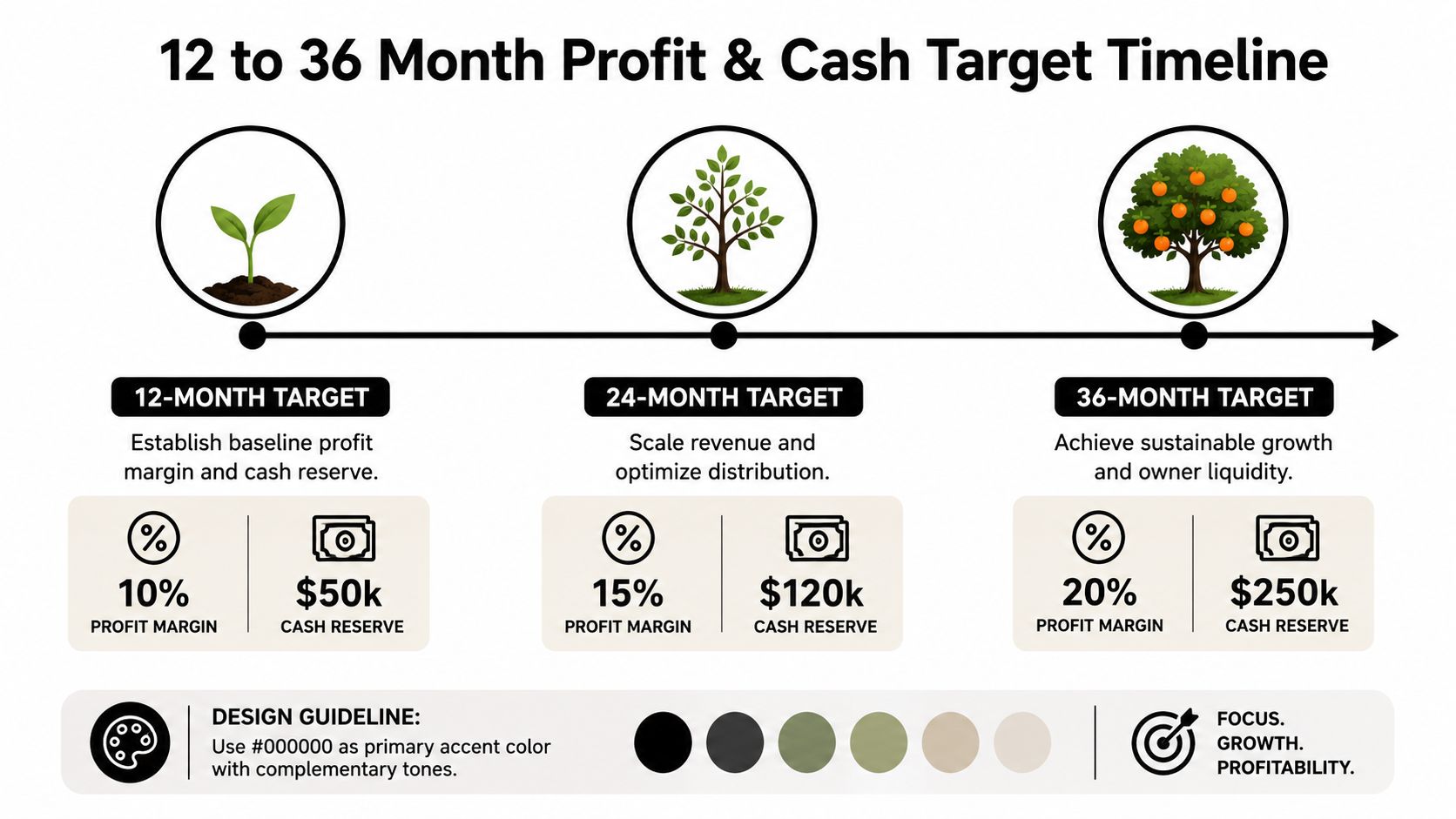
A serious strategic plan needs time-bound financial targets, not just growth language. If the target is “grow the business”, no one can make decisions against it. If the target is defined around profit, cash reserves, and owner distributions, the team can steer toward it.
The cleanest way to do this is to set a 12-month baseline, a 24-month scale-up target, and a 36-month stability target, then pressure-test each one against capacity, debt, and working capital. The timeline should reflect what the business can fund, not what sounds impressive in the boardroom.
Build the targets from the balance sheet outward
Start with the cash balance you need to operate safely, then work backwards through margin and operating rhythm. That order matters. Too many founders pick a revenue number first and assume profit and cash will somehow appear later.
A better scorecard links revenue, gross margin, stock turns, debtor days, and cash balance in one view. That way you can see whether growth is creating liquidity or scaling stress. If a sales increase pushes up receivables and stock faster than margin improves, the business is growing, but not necessarily getting healthier.
Keep the scorecard small enough to use
There's no prize for building a dashboard nobody opens. Choose a short list of leading indicators that tell you whether the plan is working before the month ends. For most SMEs, that means the metrics that drive cash, not a long list of vanity numbers.
Revenue quality: focus on the mix that produces margin.
Gross margin: watch the spread between selling price and direct cost.
Debtor days: know how quickly money returns after the sale.
Stock turns: track whether inventory is moving or sitting.
Cash balance: treat this as a hard control, not a comfort metric.
Stress-test the plan before you commit
Good targets survive uncomfortable scenarios. Supplier prices rise, demand slows, stock builds up, or a key staff member leaves. If your plan breaks the moment one assumption changes, it was never a plan, it was a forecast fantasy.
A real strategic plan for business should answer one direct question. What happens to cash and margin if the business underperforms for a quarter? If you can't answer that quickly, your targets are too loose.
Building an Execution Roadmap with SOPs and AI Enablement
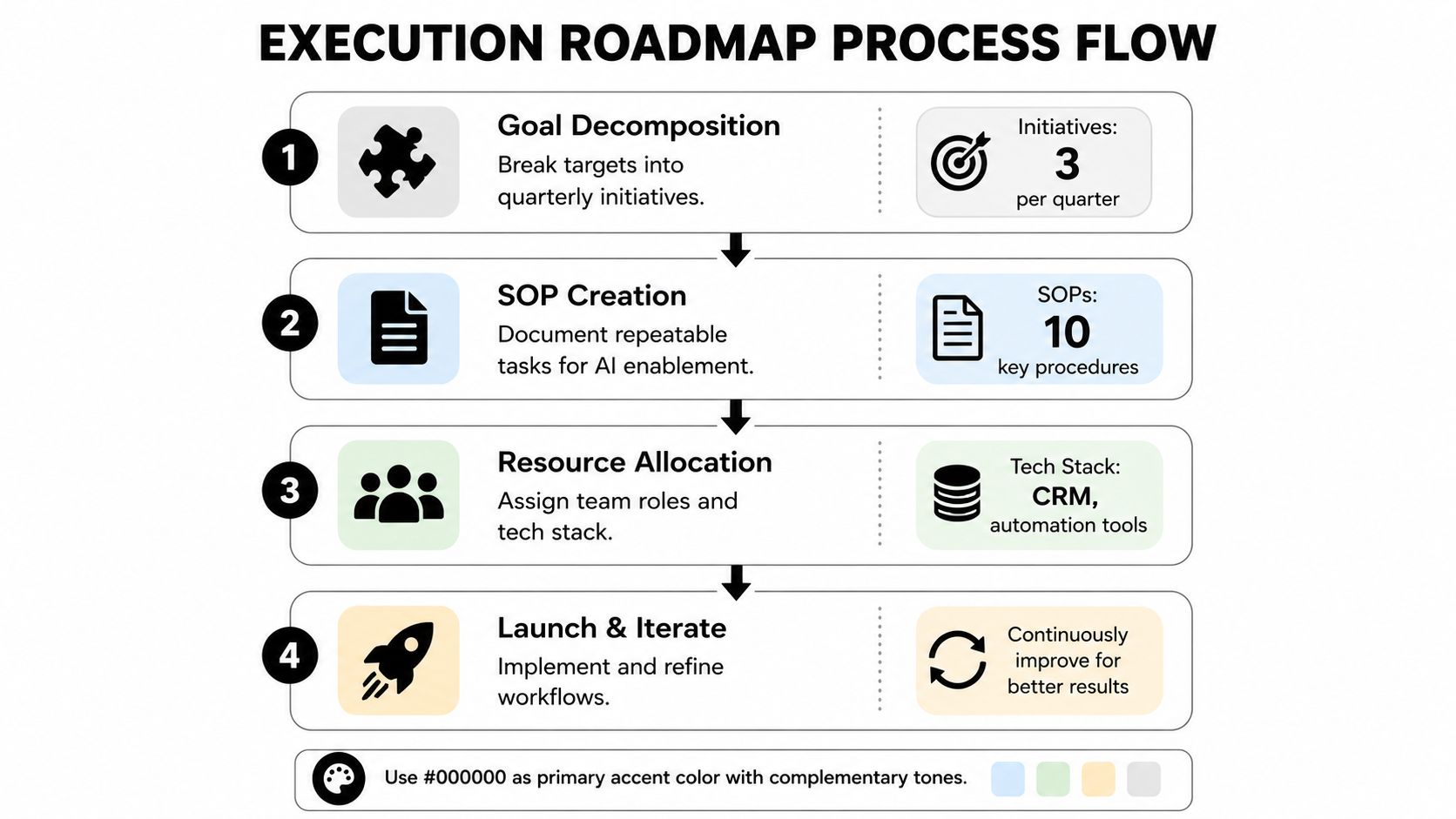
Targets without execution discipline just create frustration. If the team doesn't know what to do differently on Monday morning, the strategy hasn't moved past the PDF stage. The fix is a roadmap that breaks the financial targets into actions, owners, deadlines, and repeatable processes.
The Balanced Scorecard Institute frames strategic planning as a cycle of mission, situational analysis, goals, initiatives, and review, while Gartner's guidance pushes leadership to pressure-test the direction first and then hand execution design to the people closest to the work (Balanced Scorecard Institute). For SMEs, that sequencing is the point. Get the direction right, then turn it into operating rules.
Convert goals into quarterly initiatives
The roadmap should not be a wish list. It should be a small set of initiatives that can be delivered, measured, and reviewed. If you've got ten priorities, you've got none.
For many Australian SMEs, the right sequence is simple. Tighten invoicing, clean up stock controls, standardise quoting or job costing, and reduce owner approvals wherever rules can replace judgement. Those actions improve cash faster than a new brand campaign ever will.
Standard operating procedures create leverage
SOPs are how strategy becomes repeatable. If a task happens more than once and the outcome matters, it needs a documented process. That includes invoicing, credit follow-up, payroll checks, purchasing approvals, customer handovers, and month-end close.
If you need a practical starting point for operational documentation, standard operating procedures for ecommerce is a useful reference because it shows how repeatable work can be packaged without overcomplicating it. The lesson is broader than ecommerce, though. Good SOPs make performance less dependent on memory and more dependent on systems.
AI should remove friction, not add noise
The Australian Bureau of Statistics reported that in 2024-25, 25% of employing businesses used AI, with adoption much more common in larger firms than in smaller ones, and the Reserve Bank of Australia has also pointed to weak productivity growth by historical standards (ABS AI usage context). That means AI in an SME plan should be treated as a productivity tool, not a novelty.
Start with repetitive finance, HR, and workflow tasks. Use automation where the task is rules-based, high-volume, and prone to human delay. Then link each initiative to a measurable outcome, fewer errors, faster cash collection, less owner time on admin, or cleaner reporting.
You can see this approach in Nexist's broader work on automating business processes, where the point is to reduce manual friction and create cleaner operating rhythms (Nexist on automating business processes). That kind of implementation only works when the workflow, the owner, and the metric are all defined before the tool goes live.
Owner: assign one accountable person for each initiative.
Deadline: set a real launch date, not “soon”.
Measure: tie every project to a cash, margin, or time-saving result.
Review: kill or adjust anything that doesn't move the scorecard.
Designing a Monitoring Cadence That Keeps the Plan Alive
A plan that gets reviewed once a year is already dead. The business will have moved on, the risks will have changed, and the team will be operating off memory instead of evidence. The answer is a cadence that matches the speed of the business.
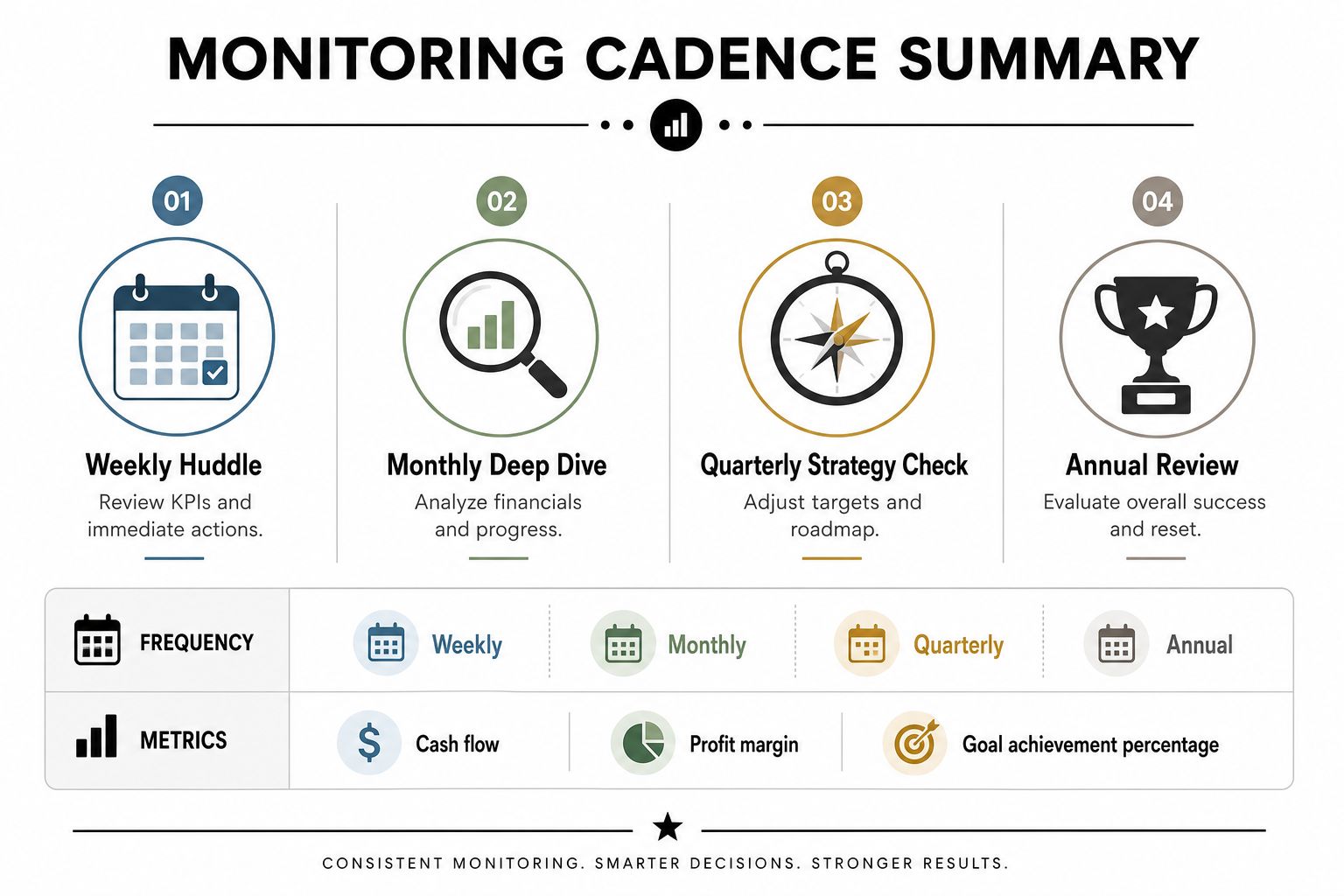
Weekly, monthly, quarterly
Weekly meetings should be short and brutal. Look at cash movement, immediate blockers, and the handful of actions that need to happen before the next check-in. If the team is discussing strategy for half an hour while receivables are overdue, the meeting is upside down.
Monthly meetings should go deeper. Review profit, margin, debtor position, stock movement, and progress against the scorecard. That's where you spot drift before it becomes a tax-time surprise.
Quarterly reviews should adjust the roadmap. Good businesses don't wait until the year end to correct course. They tighten, reallocate, and reset based on what the numbers and the workflow are saying.
Escalate early, not late
The best cadence doesn't just review. It forces action. If margin starts slipping, the response should be immediate, not philosophical. If cash tightens, the founder needs to know which lever is underperforming, pricing, collection, stock, or cost control.
Don't let your leadership meetings become performance theatre. They should end with decisions, owners, and due dates.
That discipline is what makes a plan alive. It turns reporting into management and management into correction. The quarterly business review model at Nexist's quarterly business review guide fits neatly here because it puts rhythm around accountability rather than treating review as an annual event.
Keep the scorecard visible
A monitoring cadence only works if people can see the scorecard and understand it. Use a small set of metrics, stick with them, and make the review process boring in the best possible way. Predictable beats chaotic every time.
If the team knows what gets reviewed, when it gets reviewed, and what happens when a number slips, behaviour changes quickly. That's the value of cadence. It creates pressure without drama.
Real-World Scenarios for Australian SME Strategic Plans
An ecommerce business doesn't need the same plan as a plumbing company, and a hospitality venue shouldn't copy a wholesale distributor's metrics. The framework is the same, but the pressure points are different. The strategic plan should reflect where cash gets trapped and where margin gets lost.
An inventory-heavy business
An online retailer or wholesaler should put stock discipline at the centre of the plan. That means tighter purchasing rules, clearer reorder logic, and a close eye on how fast inventory turns back into cash. If stock is expanding faster than sales quality, the business is funding growth with working capital it may not have.
The scorecard should lean on gross margin, stock movement, debtor control, and cash balance. The roadmap should focus on purchasing rules, supplier terms, and order fulfilment automation. If the business uses AI, it should support product forecasting, admin reduction, and customer service triage, not just content generation.
A hospitality venue
Hospitality lives and dies on labour productivity and margin per service window. A plan that ignores rostering discipline and waste control won't last long. The owner needs a simple operating rhythm around roster reviews, menu costing, cash handling, and supplier price movement.
Here the strategic plan should be narrower, not broader. A venue doesn't need twenty KPIs. It needs a handful that show whether each service session is profitable enough to justify the effort. If staff scheduling and ordering are reactive, the numbers will drift before management notices.
A trade or services business
A trade business should focus on quote quality, job costing, variation control, and receivables. Too many operators think the job is won when the quote is accepted. It isn't. The job is won when the work is delivered profitably and the invoice is collected without fuss.
Service businesses need process discipline around handovers, scope control, and invoicing. If the founder is still the main solver of every issue, the business is depending on heroics. A strong plan replaces that with rules, templates, and escalation points.
Simple test: if the owner disappears for a week and the business falls apart, the strategic plan is too dependent on personality and not dependent enough on process.
Across these scenarios, the same principle holds. Strategy should be specific to the cash mechanics of the business. The sector changes, but the need for control doesn't.
Moving from Watchman to Visionary Leader
The founder's job is not to watch every leak forever. It's to build a business that leaks less because the rules, systems, and review cadence are already in place. Once the plan is cash-first, the owner stops being the only person who notices problems.
That shift matters. A strong strategic plan for business gives you clearer targets, cleaner reporting, and fewer surprises. It also creates room to think about growth, product, people, and customer experience without being trapped in reactive firefighting.
If your business still depends on you to chase invoices, approve every purchase, and interpret every number, the plan isn't doing enough. The fix is usually a mix of forecasting, KPI discipline, SOPs, and AI-enabled automation tied back to cash and margin. That's the work that turns a watchman into a leader.
Nexist helps Australian founders build cash-first plans, clean up margin leaks, and set the operating rhythms that make growth manageable. If you want a strategic plan that links forecasts, KPIs, SOPs, and automation to real cash outcomes, visit Nexist and start with a conversation about where your business is leaking time and money.
strategic plan for business, SME strategy, cash flow planning, virtual CFO, business roadmap

" width="24px"/><g d="M 0 24.129 L 0 0.129 L 24 0.129 L 24 24.129 Z M 0 24.129 L 0 0.129 L 24 0.129 L 24 24.129 Z M 24 3 C 24 1.344 22.656 0 21 0 L 3 0 C 1.344 0 0 1.344 0 3 L 0 21 C 0 22.656 1.344 24 3 24 L 21 24 C 22.656 24 24 22.656 24 21 Z M 6.883 8.375 L 2.863 8.375 L 2.863 20.467 L 6.883 20.467 Z M 4.899 2.545 C 3.524 2.545 2.625 3.449 2.625 4.634 C 2.625 5.795 3.496 6.724 4.846 6.724 L 4.872 6.724 C 6.273 6.724 7.146 5.795 7.146 4.634 C 7.12 3.449 6.274 2.545 4.899 2.545 Z M 16.747 8.09 C 14.614 8.09 13.659 9.263 13.124 10.086 L 13.124 8.374 L 9.105 8.374 C 9.159 9.508 9.105 20.466 9.105 20.466 L 13.124 20.466 L 13.124 13.713 C 13.124 13.352 13.15 12.99 13.257 12.732 C 13.547 12.01 14.209 11.262 15.319 11.262 C 16.773 11.262 17.355 12.372 17.355 13.996 L 17.355 20.466 L 21.374 20.466 L 21.374 13.532 C 21.374 9.818 19.391 8.09 16.747 8.09 Z" fill="transparent" height="24.12890599668026px" id="dSFdkJotL" width="24px"><path d="M 0 24 L 0 0 L 24 0 L 24 24 Z" fill="transparent" height="24px" id="wscNJE44G" transform="translate(0 0.129)" width="24px"/><g d="M 0 24.129 L 0 0.129 L 24 0.129 L 24 24.129 Z M 24 3 C 24 1.344 22.656 0 21 0 L 3 0 C 1.344 0 0 1.344 0 3 L 0 21 C 0 22.656 1.344 24 3 24 L 21 24 C 22.656 24 24 22.656 24 21 Z M 6.883 8.375 L 2.863 8.375 L 2.863 20.467 L 6.883 20.467 Z M 4.899 2.545 C 3.524 2.545 2.625 3.449 2.625 4.634 C 2.625 5.795 3.496 6.724 4.846 6.724 L 4.872 6.724 C 6.273 6.724 7.146 5.795 7.146 4.634 C 7.12 3.449 6.274 2.545 4.899 2.545 Z M 16.747 8.09 C 14.614 8.09 13.659 9.263 13.124 10.086 L 13.124 8.374 L 9.105 8.374 C 9.159 9.508 9.105 20.466 9.105 20.466 L 13.124 20.466 L 13.124 13.713 C 13.124 13.352 13.15 12.99 13.257 12.732 C 13.547 12.01 14.209 11.262 15.319 11.262 C 16.773 11.262 17.355 12.372 17.355 13.996 L 17.355 20.466 L 21.374 20.466 L 21.374 13.532 C 21.374 9.818 19.391 8.09 16.747 8.09 Z" fill="transparent" height="24.12890599668026px" id="sTpjGo1tb" width="24px"><path d="M 0 24 L 0 0 L 24 0 L 24 24 Z" fill="transparent" height="24px" id="s7ffpmKOD" transform="translate(0 0.129)" width="24px"/><g d="M 24 3 C 24 1.344 22.656 0 21 0 L 3 0 C 1.344 0 0 1.344 0 3 L 0 21 C 0 22.656 1.344 24 3 24 L 21 24 C 22.656 24 24 22.656 24 21 Z M 6.883 8.375 L 2.863 8.375 L 2.863 20.467 L 6.883 20.467 Z M 4.899 2.545 C 3.524 2.545 2.625 3.449 2.625 4.634 C 2.625 5.795 3.496 6.724 4.846 6.724 L 4.872 6.724 C 6.273 6.724 7.146 5.795 7.146 4.634 C 7.12 3.449 6.274 2.545 4.899 2.545 Z M 16.747 8.09 C 14.614 8.09 13.659 9.263 13.124 10.086 L 13.124 8.374 L 9.105 8.374 C 9.159 9.508 9.105 20.466 9.105 20.466 L 13.124 20.466 L 13.124 13.713 C 13.124 13.352 13.15 12.99 13.257 12.732 C 13.547 12.01 14.209 11.262 15.319 11.262 C 16.773 11.262 17.355 12.372 17.355 13.996 L 17.355 20.466 L 21.374 20.466 L 21.374 13.532 C 21.374 9.818 19.391 8.09 16.747 8.09 Z" fill="transparent" height="24.000006px" id="D0ecaHEcW" transform="translate(0 0)" width="24px"><path d="M 24 3 C 24 1.344 22.656 0 21 0 L 3 0 C 1.344 0 0 1.344 0 3 L 0 21 C 0 22.656 1.344 24 3 24 L 21 24 C 22.656 24 24 22.656 24 21 Z" fill="rgb(55, 184, 218)" height="24.000006px" id="IPLFE6zXx" width="24px"/><path d="M 4.02 0 L 0 0 L 0 12.092 L 4.02 12.092 Z" fill="rgb(255, 255, 255)" height="12.09201px" id="FWhtzAyuY" transform="translate(2.863 8.375)" width="4.02px"/><path d="M 2.274 0 C 0.899 0 0 0.904 0 2.089 C 0 3.25 0.871 4.179 2.221 4.179 L 2.247 4.179 C 3.648 4.179 4.521 3.25 4.521 2.089 C 4.495 0.904 3.649 0 2.274 0 Z" fill="rgb(255, 255, 255)" height="4.17876px" id="VmOsKv4kO" transform="translate(2.625 2.545)" width="4.52095px"/><path d="M 7.641 0 C 5.509 0 4.554 1.173 4.019 1.996 L 4.019 0.284 L 0 0.284 C 0.053 1.419 0 12.376 0 12.376 L 4.019 12.376 L 4.019 5.623 C 4.019 5.262 4.045 4.9 4.151 4.642 C 4.442 3.92 5.103 3.172 6.214 3.172 C 7.667 3.172 8.25 4.282 8.25 5.907 L 8.25 12.376 L 12.269 12.376 L 12.269 5.442 C 12.269 1.728 10.286 0 7.641 0 Z" fill="rgb(255, 255, 255)" height="12.37626px" id="n1XUbhaq0" transform="translate(9.105 8.09)" width="12.268830000000001px"/></g></g></g></g></svg>)