SME Compliance Checklist: 7 Essential Australian Resources
Stay ahead with our 2026 Australian SME compliance checklist. Discover 7 essential government tools for tax, HR, safety, and privacy to avoid costly penalties.
Ansh Malhotra

You've lodged your BAS, paid the tax, and your books look tidy. Then a Fair Work letter lands, or a WHS inspector asks for records, or a privacy complaint shows up because a contractor had access to customer data. That's the gap many Australian SMEs live with, compliant in one lane, exposed in the others.
This guide keeps it practical. Instead of a generic to-do list, it pulls together the official government-issued compliance checklist tools and self-assessment resources that regulators themselves publish or recommend, so you can use the same frameworks they expect to see. For founders, operators, and finance leads, that means less guesswork, cleaner evidence, and a better shot at turning compliance into an advantage rather than a drag. If you're also tightening your startup documents, the startup trademark and policy guide is a useful companion.
Table of Contents
2. Fair Work Commission, Small Business Fair Dismissal Code and Checklist
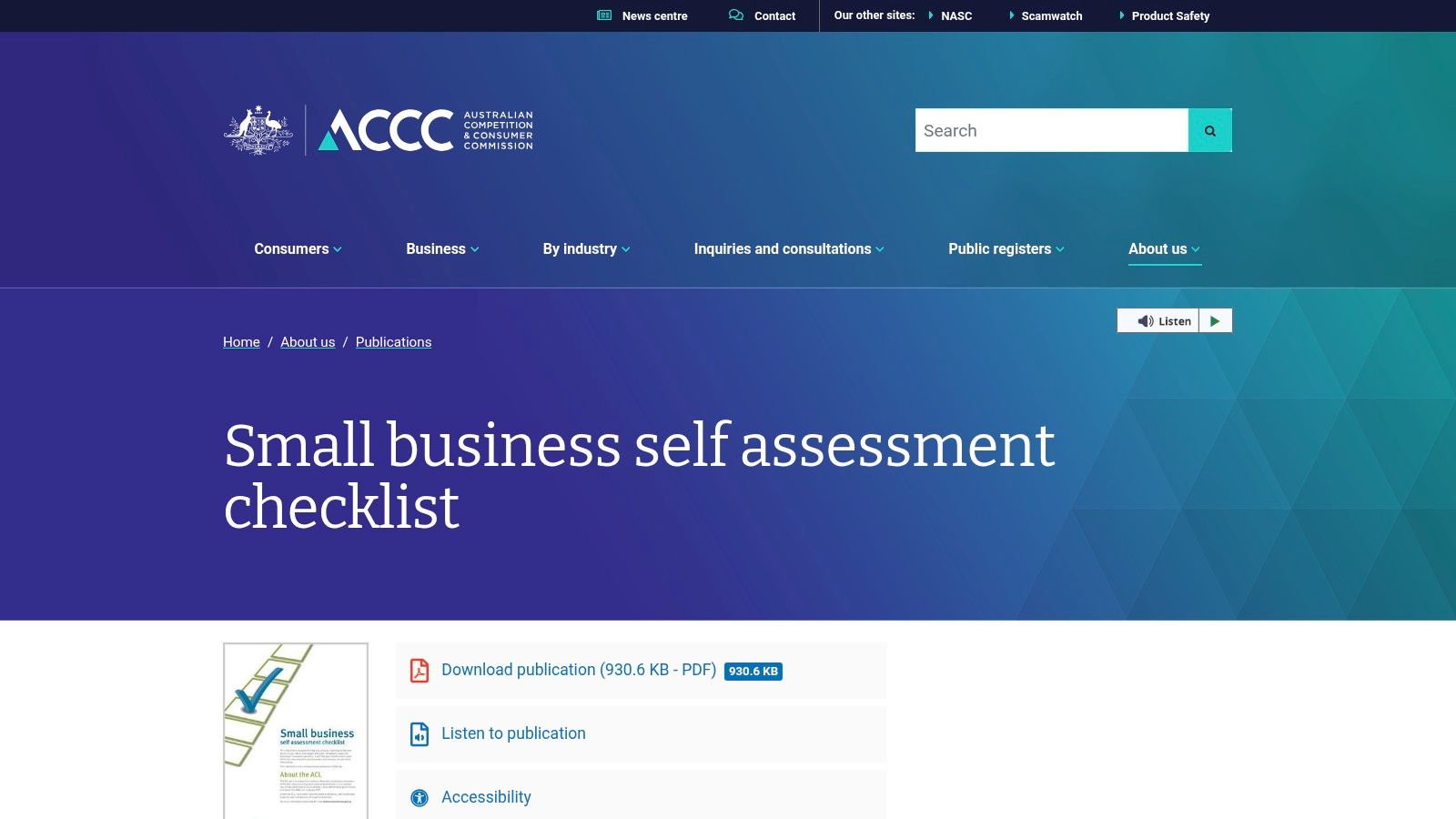
5. ACCC, Small business self-assessment checklist for Australian Consumer Law
6. ASD/ACSC, Essential Eight Maturity Model and Assessment Process Guide
7. AUSTRAC, AML/CTF program quick-guide and essentials checklist
1. Fair Work Ombudsman, Small business checklist
For most SMEs, this is the right place to start because it forces the basics into the open. The Fair Work Ombudsman's small business checklist walks through hiring, pay, record-keeping, leave, award coverage, casual conversion, and ending employment in plain English. It's the kind of tool a time-poor owner can use before a dispute gets expensive.
The value here is not just compliance hygiene, it's evidence discipline. The checklist pushes you to ask whether you've got the right award, whether payslips are correct, whether records exist, and whether employment terms match the work being done. That matters because a compliant payroll process can still fail if the worker is misclassified, so pair this tool with the employee or contractor ATO guide before you lock in engagement terms.
Practical rule: If you can't show the record, assume the control will be treated as weak.
What works and what doesn't
What works is the regulator tone. Owners and office managers can move through the questions without translating legal language into something usable. The checklist also links into awards, agreements, calculators, templates, and best-practice material, so it's more than a static document.
What doesn't work is expecting it to do the whole job. It's broad, not industry-specific, so retail, hospitality, building, and professional services all need their own award overlays and internal notes. It also doesn't automate evidence capture, which is where many businesses fall over during an audit or a wage review.
A good virtual CFO approach is to treat this as the front door, then build a file behind it. Save the checklist, note who reviewed each section, and attach the pay runs, onboarding records, and termination notes that prove the answers were real. That turns a general compliance checklist into something an auditor can follow.
2. Fair Work Commission, Small Business Fair Dismissal Code and Checklist
Dismissal is where many small businesses get caught out, not because they acted maliciously, but because they acted quickly and documented poorly. The Fair Work Commission's Small Business Fair Dismissal Code and checklist is narrowly focused, which is exactly why it's useful. If you have fewer than 15 employees, this is the tool to open before you end employment.
The format is deliberately simple. It asks a series of “did you?” questions that separate summary dismissal from conduct or capacity issues, and that structure matters if the decision is later tested. A completed PDF on file can support your notes, but only if the decision-making trail is consistent with what happened on the ground.
Keep the file tidy before the conversation starts
Don't leave dismissal compliance until the meeting is already booked. The strongest files usually include the warning history, incident notes, performance concerns, and who approved the decision, all before the termination conversation begins. If those documents are scattered across email and chat, the checklist loses a lot of its value.
The trade-off is scope. This is a strong termination-specific tool, but it doesn't cover the wider HR system around recruitment, award compliance, leave, or payroll. That means a business can use it properly and still have a broader employment problem elsewhere.
For owners, the advantage is discipline. The checklist slows the rush to action and forces one final review of facts, timing, and process. In a small team, that pause can save you from an avoidable claim later.
A dismissal checklist is only as good as the notes behind it. If you can't explain why the decision was made, the form won't rescue you.
3. SafeWork NSW, Easy to do WHS small-business toolkit
Safety compliance often gets treated like a poster on the wall until someone is injured, or a hazard report goes unanswered. The SafeWork NSW Easy to do WHS toolkit is better than that because it gives small businesses practical forms for inspections, risk registers, training, incident handling, and emergency planning. It's a solid fit for trades, hospitality, retail, warehousing, and any site with rotating workers or physical risk.
The strongest part is its plain-language structure. You're not being asked to become a safety lawyer, you're being asked to identify hazards, consult workers, record controls, and keep the paperwork straight. It also recognises psychosocial hazards, which is important because WHS obligations are no longer only about slips, trips, and machine guards.
Use it as a working file, not a shelf resource
This toolkit works when someone owns it. That person should inspect the site, update the risk register, chase training sign-offs, and keep incident notes in one place. If the documents live in separate folders, the process becomes hard to defend and easy to neglect.
The limitation is obvious. It's not software, so there's no automatic reminder engine, no version control, and no live audit trail. For a multi-site business or a team with contractors coming and going, that manual load can become messy fast.
Still, as a government-backed compliance checklist resource, it has real operational value. It helps you build a record that shows hazard identification, consultation, and response, not just a policy that says you care. That's the difference between looking compliant and being able to prove it.
4. OAIC, Privacy Foundations Self-Assessment Tool
Privacy risk sits everywhere now, in customer databases, marketing tools, payroll systems, and outsourced finance stacks. The OAIC's Privacy Foundations Self-Assessment Tool gives you a structured way to test privacy maturity against the Australian Privacy Principles and then map next steps. For SMEs handling customer data, HR files, or e-commerce transactions, it's one of the clearest starting points available.
The tool is useful because it moves the conversation from vague concern to specific controls. You're looking at governance, privacy practices, systems, training, and incident readiness, then turning that into an action plan. The linked OAIC guidance and privacy management resources make it easier to move from diagnosis to implementation.
The image below is worth a look if you want to see how the OAIC presents the tool in practice.
Why finance and operations teams should care
Privacy checks are not just for lawyers. If your bookkeeper, outsourced payroll team, or CRM vendor touches personal information, the controls need to be visible in the business process. A score can help you prioritise, but it's still only an indicator, not a full audit.
That matters even more now that Australian privacy reform is moving toward more technical proof of control, with mandatory, regular, documented privacy risk assessments for high-risk activity and stronger expectations around retention, third-party disclosure, and automated decision-making. In practice, that means your checklist should collect evidence, not just policy acknowledgements. A breach response file, retention schedule, vendor due diligence note, and decision log belong in the same working system as the self-assessment.
If a breach has already happened, the checklist should point straight to breach remediation steps for IT teams. If it hasn't, this is the right time to lock down who can access data, why they need it, and how long they keep it.
5. ACCC, Small business self-assessment checklist for Australian Consumer Law
Marketing teams can create ACL risk faster than finance teams can catch it. The ACCC's small business self-assessment checklist is the regulator's own triage tool for issues like misleading claims, pricing, warranties, unfair contract terms, and product safety. If you sell online, quote for services, or run campaigns that promise outcomes, this is a good first pass.
The strength of the tool is its speed. It helps non-lawyers spot the rough edges before an ad goes live or a sales script gets repeated across the team. That makes it ideal for onboarding, because sales and marketing staff often understand the business promise but not the legal boundaries around that promise.
The weakness is depth. High-level triage is helpful, but tricky warranty claims, bundled offers, refund terms, and cross-channel promotions still need review from someone who understands the risk in context. A checklist can flag a problem, but it can't rewrite a bad offer structure.
Tighten the commercial language before it becomes a problem
The best use of this checklist is to connect it directly to your sales process. If your website says one thing, your contract says another, and your support team says a third, the business will drift into inconsistency. That's where ACL exposure usually starts.
A useful habit is to review claims, refunds, guarantees, and product safety statements together, not separately. That prevents the common trap where the website is updated, but the email sequence, invoice wording, and onboarding script are left behind. The same rule applies to promotions, especially if they're time-limited or tied to exclusions.
For SMEs, this checklist is less about legal theory and more about commercial discipline. It keeps the conversation focused on what the customer sees, and that's where the regulator usually looks first.
6. ASD/ACSC, Essential Eight Maturity Model and Assessment Process Guide
Cyber compliance needs more than a yes-or-no checklist. The ASD/ACSC Essential Eight Maturity Model and Assessment Process Guide gives you a defensible way to assess baseline mitigation strategies across maturity levels. For a business that wants to withstand customer diligence, insurer questions, or board scrutiny, this is the local reference point that matters.
The quality here is in the method. The Assessment Process Guide includes example test plans and a report template, which means you're not just saying controls exist, you're showing how they were tested and what was found. That's the difference between a security policy and an evidence pack.
Operational rule: If a control isn't tested and recorded, treat it as unproven.
The catch is effort. A proper assessment can take time, especially if the team lacks tooling or an external partner to coordinate evidence, scope, and remediation. It is also not a certification, so some customers may still ask for ISO 27001 or a similar framework on top.
If your team is still building the basics, the cybersecurity for business guide is worth pairing with the Essential Eight material because it helps translate the framework into day-to-day controls. That matters for SMEs where the finance lead, office manager, or operations manager ends up owning the process.
Upside is credibility. When you use a recognised local assessment method, buyers and insurers can see that your controls were reviewed systematically, not guessed at. That can shorten back-and-forth and expose weak spots before they become a business problem.
7. AUSTRAC, AML/CTF program quick-guide and essentials checklist
If your business sits in a regulated money flow, the AUSTRAC AML/CTF program guidance is not optional reading, it's the operating model. The official resources lay out the core pieces, risk assessment, AML/CTF program, compliance officer, KYC and CDD, ongoing monitoring, reporting, staff training, and independent review. For reporting entities, this is the compliance checklist that governs whether the business can keep operating cleanly.
The useful part is that AUSTRAC doesn't present this as a one-line reminder. It breaks the work into program components and support material, which makes it easier to build a working folder instead of a single policy file. That matters because AML/CTF compliance is about the flow of decisions and records, not just the existence of a document.
There's also a clear finance angle here. If your team is trying to reconcile tax, payments, and regulatory obligations, the tax and compliance guide can sit alongside this material as a process reminder, especially where recordkeeping and approval trails overlap. For owners, that linkage matters because one weak register often shows up in several parts of the business at once.
Build the evidence pack early
The most common failure point is fragmentation. One person owns onboarding, another owns training, another handles reporting, and the audit trail ends up scattered. A good compliance checklist closes that gap by assigning names, dates, and evidence to each control.
If your sector is affected by crypto transfer obligations, the Travel Rule guidance from BroLabel is a useful external reference point for adjacent compliance thinking. But for AUSTRAC purposes, keep the focus on your own risk assessment, your program, and the proof that monitoring and reporting happened.
7-Point Compliance Checklist Comparison
Resource / Tool | Implementation complexity 🔄 | Resource requirements ⚡ | Expected outcomes ⭐📊 | Ideal use cases 💡 | Key advantages ⭐ |
|---|---|---|---|---|---|
Fair Work Ombudsman – Small business checklist | Low, step‑by‑step Qs 🔄 | Minimal, review time, basic admin ⚡ | Basic employment compliance; audit readiness ⭐📊 | Small employers for onboarding, pay, records | Official regulator guidance; actionable links |
Fair Work Commission – Small Business Fair Dismissal Code and Checklist | Very low, one‑page checklist 🔄 | Minimal, complete & retain PDF ⚡ | Reduced unfair dismissal risk; evidentiary file note ⭐📊 | Employers (<15 staff) before termination decisions | FWC‑recognised; quick to complete and retain |
SafeWork NSW – "Easy to do WHS" small‑business toolkit | Low–Moderate, multiple checklists/forms 🔄 | Low, manual documentation, staff time ⚡ | Improved hazard identification & WHS records; psychosocial risks covered ⭐📊 | Trades, hospitality, retail, warehouses; duty‑of‑care compliance | Practical plain‑language forms; regulator‑backed; psychosocial focus |
OAIC – Privacy Foundations Self‑Assessment Tool | Moderate, scored assessment & planning 🔄 | Low–Moderate, internal review, policy work ⚡ | Privacy maturity score and prioritized action plan ⭐📊 | SMEs handling customer data, e‑commerce, HR files | APP‑aligned, authoritative guidance with templates |
ACCC – Small business self‑assessment checklist (ACL) | Low, concise triage checklist 🔄 | Minimal, awareness for marketing/sales teams ⚡ | Identification of ACL risk areas; guidance pointers ⭐📊 | E‑commerce, retail, online advertising and sales ops | Regulator‑issued; good for onboarding non‑finance staff |
ASD/ACSC – Essential Eight Maturity Model & Assessment Guide | High, maturity model + assessor process 🔄 | Moderate–High, technical effort, tooling or partner ⚡ | Defensible cyber assessment and documented maturity levels ⭐📊 | SMEs preparing for customer, insurer or board scrutiny | Gold‑standard guidance; assessor templates and reports |
AUSTRAC – AML/CTF program quick‑guide & essentials checklist | Moderate, multiple program components 🔄 | Moderate, training, KYC/CDD, monitoring, documentation ⚡ | AML/CTF program readiness and audit‑ready documentation ⭐📊 | Reporting entities, finance, crypto‑related services; compliance prep | Current official guidance; supports operational workflows |
From Checklist to System, Automating Your Compliance
These resources are strong starting points, but they only work if someone owns them. A manual compliance checklist can tell you what to do, yet it won't remind you, reconcile it, or produce the evidence pack when an auditor asks. That's where most SMEs lose time, and where avoidable risk builds across payroll, WHS, privacy, cyber, and customer-facing operations.
The best businesses treat compliance as part of their operating system. They fold the checklist into SOPs, assign owners, attach proof to each control, and review the file on a set cadence instead of waiting for a problem to appear. That's also why the move toward cloud-based checklist tooling makes sense for smaller organisations, because the dominant model is already moving toward version control, audit trails, and accessible workflows rather than static spreadsheets. The broader market trend and automation data support that direction, even if your business keeps the actual control library lean.
From a virtual CFO's point of view, compliance should protect margin and free up management time. It should reduce rework, tighten approval chains, and stop small issues turning into expensive ones. If you run a growing Australian SME, Nexist can help you build that finance-and-operations backbone so your compliance work is documented, visible, and tied to real business decisions.
If you want help turning these official tools into a live operating system, speak with Nexist. We help Australian founders build the finance, payroll, and process controls that sit behind a defensible compliance checklist. If you want cleaner evidence, fewer surprises, and a system your team can run, start there.
compliance checklist, small business compliance, australian business law, sme regulations, business checklist

" width="24px"/><g d="M 0 24.129 L 0 0.129 L 24 0.129 L 24 24.129 Z M 0 24.129 L 0 0.129 L 24 0.129 L 24 24.129 Z M 24 3 C 24 1.344 22.656 0 21 0 L 3 0 C 1.344 0 0 1.344 0 3 L 0 21 C 0 22.656 1.344 24 3 24 L 21 24 C 22.656 24 24 22.656 24 21 Z M 6.883 8.375 L 2.863 8.375 L 2.863 20.467 L 6.883 20.467 Z M 4.899 2.545 C 3.524 2.545 2.625 3.449 2.625 4.634 C 2.625 5.795 3.496 6.724 4.846 6.724 L 4.872 6.724 C 6.273 6.724 7.146 5.795 7.146 4.634 C 7.12 3.449 6.274 2.545 4.899 2.545 Z M 16.747 8.09 C 14.614 8.09 13.659 9.263 13.124 10.086 L 13.124 8.374 L 9.105 8.374 C 9.159 9.508 9.105 20.466 9.105 20.466 L 13.124 20.466 L 13.124 13.713 C 13.124 13.352 13.15 12.99 13.257 12.732 C 13.547 12.01 14.209 11.262 15.319 11.262 C 16.773 11.262 17.355 12.372 17.355 13.996 L 17.355 20.466 L 21.374 20.466 L 21.374 13.532 C 21.374 9.818 19.391 8.09 16.747 8.09 Z" fill="transparent" height="24.12890599668026px" id="dSFdkJotL" width="24px"><path d="M 0 24 L 0 0 L 24 0 L 24 24 Z" fill="transparent" height="24px" id="wscNJE44G" transform="translate(0 0.129)" width="24px"/><g d="M 0 24.129 L 0 0.129 L 24 0.129 L 24 24.129 Z M 24 3 C 24 1.344 22.656 0 21 0 L 3 0 C 1.344 0 0 1.344 0 3 L 0 21 C 0 22.656 1.344 24 3 24 L 21 24 C 22.656 24 24 22.656 24 21 Z M 6.883 8.375 L 2.863 8.375 L 2.863 20.467 L 6.883 20.467 Z M 4.899 2.545 C 3.524 2.545 2.625 3.449 2.625 4.634 C 2.625 5.795 3.496 6.724 4.846 6.724 L 4.872 6.724 C 6.273 6.724 7.146 5.795 7.146 4.634 C 7.12 3.449 6.274 2.545 4.899 2.545 Z M 16.747 8.09 C 14.614 8.09 13.659 9.263 13.124 10.086 L 13.124 8.374 L 9.105 8.374 C 9.159 9.508 9.105 20.466 9.105 20.466 L 13.124 20.466 L 13.124 13.713 C 13.124 13.352 13.15 12.99 13.257 12.732 C 13.547 12.01 14.209 11.262 15.319 11.262 C 16.773 11.262 17.355 12.372 17.355 13.996 L 17.355 20.466 L 21.374 20.466 L 21.374 13.532 C 21.374 9.818 19.391 8.09 16.747 8.09 Z" fill="transparent" height="24.12890599668026px" id="sTpjGo1tb" width="24px"><path d="M 0 24 L 0 0 L 24 0 L 24 24 Z" fill="transparent" height="24px" id="s7ffpmKOD" transform="translate(0 0.129)" width="24px"/><g d="M 24 3 C 24 1.344 22.656 0 21 0 L 3 0 C 1.344 0 0 1.344 0 3 L 0 21 C 0 22.656 1.344 24 3 24 L 21 24 C 22.656 24 24 22.656 24 21 Z M 6.883 8.375 L 2.863 8.375 L 2.863 20.467 L 6.883 20.467 Z M 4.899 2.545 C 3.524 2.545 2.625 3.449 2.625 4.634 C 2.625 5.795 3.496 6.724 4.846 6.724 L 4.872 6.724 C 6.273 6.724 7.146 5.795 7.146 4.634 C 7.12 3.449 6.274 2.545 4.899 2.545 Z M 16.747 8.09 C 14.614 8.09 13.659 9.263 13.124 10.086 L 13.124 8.374 L 9.105 8.374 C 9.159 9.508 9.105 20.466 9.105 20.466 L 13.124 20.466 L 13.124 13.713 C 13.124 13.352 13.15 12.99 13.257 12.732 C 13.547 12.01 14.209 11.262 15.319 11.262 C 16.773 11.262 17.355 12.372 17.355 13.996 L 17.355 20.466 L 21.374 20.466 L 21.374 13.532 C 21.374 9.818 19.391 8.09 16.747 8.09 Z" fill="transparent" height="24.000006px" id="D0ecaHEcW" transform="translate(0 0)" width="24px"><path d="M 24 3 C 24 1.344 22.656 0 21 0 L 3 0 C 1.344 0 0 1.344 0 3 L 0 21 C 0 22.656 1.344 24 3 24 L 21 24 C 22.656 24 24 22.656 24 21 Z" fill="rgb(55, 184, 218)" height="24.000006px" id="IPLFE6zXx" width="24px"/><path d="M 4.02 0 L 0 0 L 0 12.092 L 4.02 12.092 Z" fill="rgb(255, 255, 255)" height="12.09201px" id="FWhtzAyuY" transform="translate(2.863 8.375)" width="4.02px"/><path d="M 2.274 0 C 0.899 0 0 0.904 0 2.089 C 0 3.25 0.871 4.179 2.221 4.179 L 2.247 4.179 C 3.648 4.179 4.521 3.25 4.521 2.089 C 4.495 0.904 3.649 0 2.274 0 Z" fill="rgb(255, 255, 255)" height="4.17876px" id="VmOsKv4kO" transform="translate(2.625 2.545)" width="4.52095px"/><path d="M 7.641 0 C 5.509 0 4.554 1.173 4.019 1.996 L 4.019 0.284 L 0 0.284 C 0.053 1.419 0 12.376 0 12.376 L 4.019 12.376 L 4.019 5.623 C 4.019 5.262 4.045 4.9 4.151 4.642 C 4.442 3.92 5.103 3.172 6.214 3.172 C 7.667 3.172 8.25 4.282 8.25 5.907 L 8.25 12.376 L 12.269 12.376 L 12.269 5.442 C 12.269 1.728 10.286 0 7.641 0 Z" fill="rgb(255, 255, 255)" height="12.37626px" id="n1XUbhaq0" transform="translate(9.105 8.09)" width="12.268830000000001px"/></g></g></g></g></svg>)