Retained Earnings Explained for Australian SMEs
Learn how retained earnings work for Australian SMEs. Covers the formula, cash flow traps, dividend impacts, and practical strategies to grow your business.
Ansh Malhotra

You can have a solid profit on paper and still feel squeezed every Friday. Suppliers want payment, payroll is due, stock needs to be reordered, and the bank balance looks far thinner than the month-end reports suggested. That gap is where a lot of Australian founders get caught out, because retained earnings are not cash in the bank, they're the record of profit you've kept inside the business.
Table of Contents
Why Retained Earnings Matter for Australian Founders
A founder rings me up after month-end and says the same thing in different words, “We made money, so why does the bank account feel empty?” That question usually points to retained earnings, because this line on the balance sheet shows the cumulative profits a company has kept after dividends, sitting inside equity rather than cash. The accounting logic is simple, but the business implication is bigger, because retained earnings tell you how much profit has been left in the company to support operations, not just how much was earned in one period. The balance builds over time instead of resetting, which is why Australian financial reporting treats it as a running record of reinvested history, not a one-off result. The retained earnings framework used in financial reporting makes that cumulative logic clear.
What the balance actually tells you
For an Australian SME, this figure matters because it often becomes the internal funding source for working capital, stock growth, and debt reduction. If you're bootstrapping, the number also tells you whether you've kept enough profit in the business to avoid leaning on external finance for every decision. That's why lenders care about it alongside debt-based measures. A stronger retained earnings balance usually means the business has kept more of its own profits available to absorb shocks and fund the next move.
Practical rule: if profit is rising but retained earnings are flat, someone is extracting too much or the business is absorbing losses elsewhere.
Why founders should watch it closely
The mistake is treating retained earnings like a compliance line item that the accountant handles at year-end. In practice, it's a direct signal of how disciplined your capital allocation has been. A founder who keeps paying out too much, or keeps funding growth with ad hoc transfers, will often see this balance stagnate even when the business looks busy.
That matters in founder-led companies because cash discipline, dividend policy, and reinvestment decisions all land in the same place, the balance sheet. If you want a clean read on how profit flows through the business, pair retained earnings with your profit and loss statement and stop looking at the P&L in isolation. The P&L tells you whether you earned it. Retained earnings tell you whether you kept it.
The Retained Earnings Formula and Journal Entries
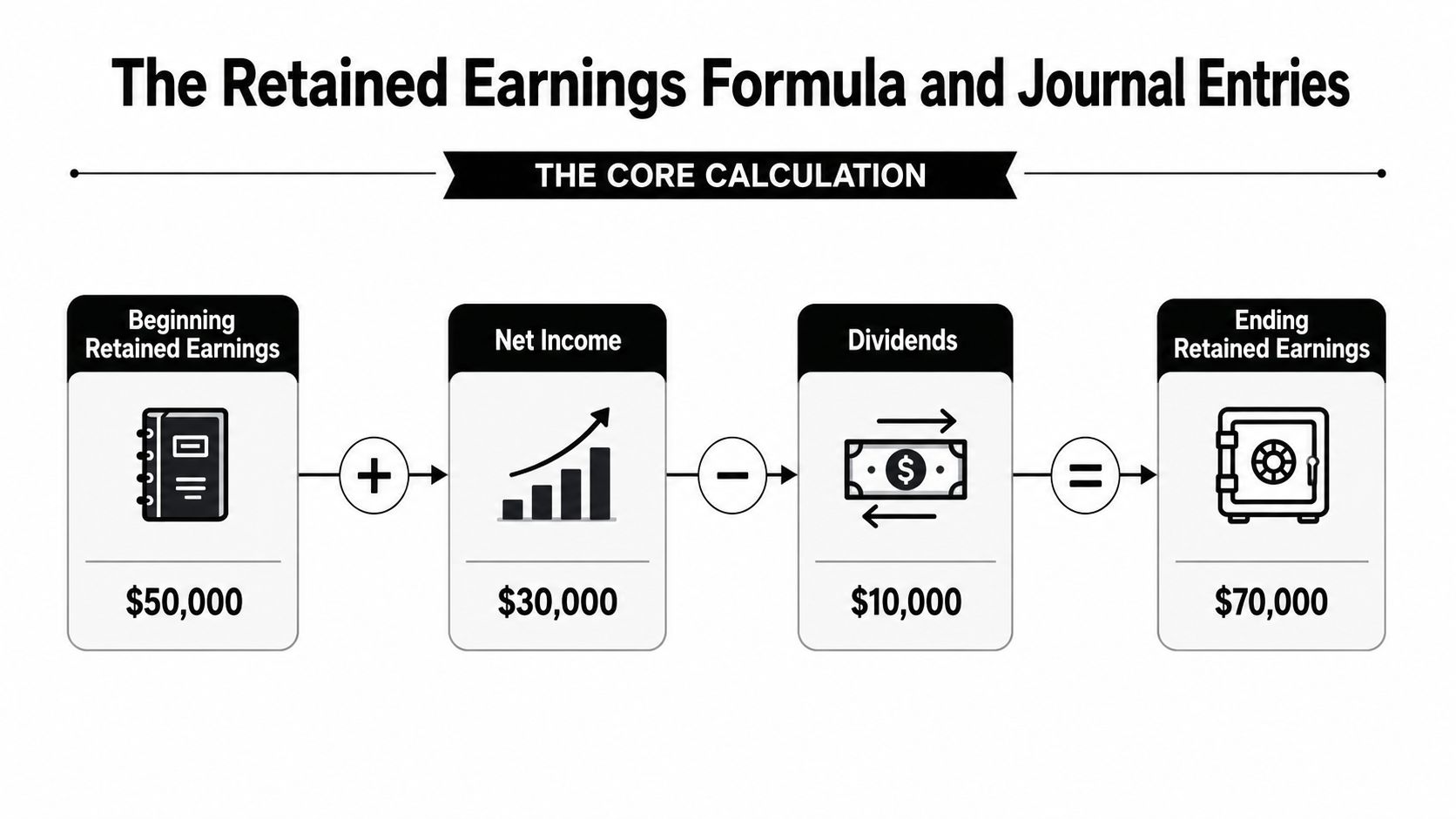
The formula is straightforward, and it's the one I want every founder to memorise: Beginning retained earnings + Net income − Dividends = Ending retained earnings. That's the whole game. If you know those three moving parts, you can read the balance sheet without waiting for someone else to translate it for you. A strong shortcut for the broader accounting logic is to master the accounting equation, because retained earnings sits inside equity and moves the way equity moves.
A simple SME example
Say your business started the year with $50,000 in retained earnings. It then earns $30,000 in net income and pays $10,000 in dividends. The ending balance is $70,000. That's not magic, it's just the cumulative result of profit kept inside the company after owner distributions.
The point of the example is not the numbers themselves. It's to show that retained earnings go up only when you generate profit and keep some of it in the company. If you pay out too much, the balance doesn't build. If you make losses, it can go backwards.
How the journals move the balance
At year-end, accounting systems close the period's net profit into retained earnings. The profit and loss account doesn't stay open forever, it rolls into equity so the company's cumulative profit position is preserved. Dividends do the opposite, they reduce retained earnings when they're declared and paid.
That's why the balance can look different from what a founder expects. You might have a profitable year and still see a lower-than-expected retained earnings figure because earlier losses or distributions have already eaten into the balance. If you're checking this monthly, you're doing it right. If you only look at it at tax time, you're already late.
Retained earnings are cumulative, so one strong month doesn't fix a weak distribution policy.
Reading the figure properly
If you want the formula to mean something in real life, stop reading it in isolation. Look at where the closing balance came from. Was it built by steady profit, or propped up by one-off gains? Was it eroded by losses, owner drawings, or aggressive dividends? That context is what turns a balance sheet line into a decision tool.
The cleanest habit is to compare the retained earnings movement against profit and cash movement together. That way, you can see whether the business is becoming stronger or just looking better on paper.
Retained Earnings Are Not the Same as Cash
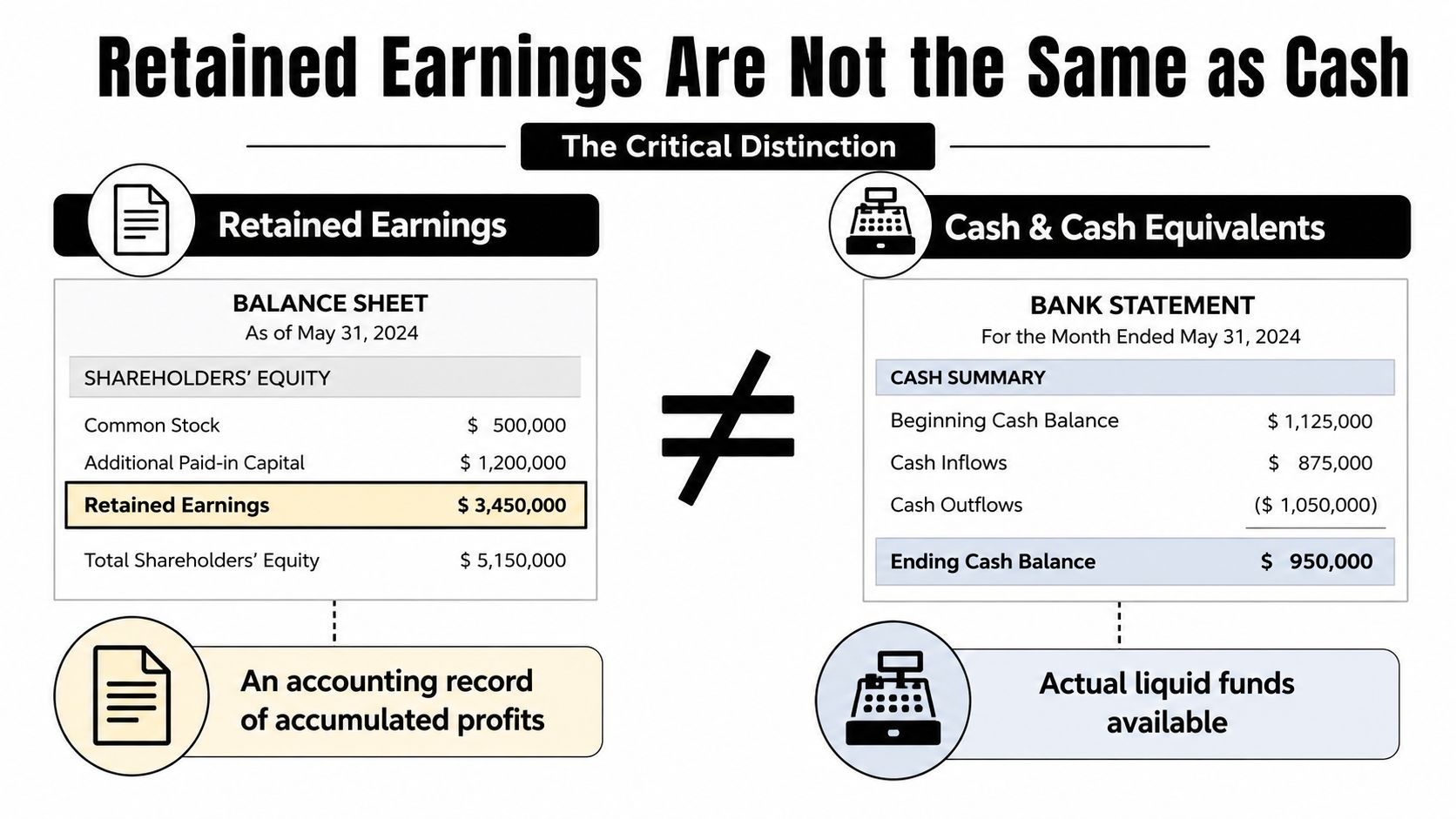
This is the trap that catches even experienced founders. Retained earnings can rise while cash falls, and that's especially common in stock-heavy, fast-growing, or invoicing-driven businesses. Profit gets recorded when it's earned, but cash gets delayed when money is sitting in inventory, receivables, tax obligations, or capital expenditure. Generic explainers rarely deal with that gap, but it's the whole story for a lot of Australian SMEs. The working-capital angle is why I'd also keep an eye on the cash conversion cycle rather than assuming profit automatically means liquidity.
Where the cash disappears
An ecommerce operator can book a healthy profit while cash gets tied up in stock sitting on a shelf. A wholesaler can sell well and still run short because customers pay late. A trade business can show decent margins and still feel broke because materials, wages, and tax bills land before the invoices are settled.
That's the difference between an accounting result and a cash result. Retained earnings measure reinvested profit. Cash measures what you can spend today.
Practical rule: if your cash balance keeps shrinking, don't ask first whether profit is up. Ask where the money is trapped.
Why the ATO and working capital matter
Australian SMEs know this pressure well because tax obligations don't wait for your cash cycle to catch up. When a business carries tax debt or payment-plan balances, it's a sign that reported profit hasn't translated neatly into free cash. That's not a theory, it's a working-capital problem.
The fix is not to stare harder at the balance sheet. It's to understand the cycle that converts profit into cash. If inventory is rising faster than sales, if receivables are stretching, or if capex is swallowing too much of the operating surplus, retained earnings can look healthy while the bank account stays thin.
The operating test founders should use
I'd use one blunt question. Can the business self-fund the next round of stock, wages, and tax without scrambling? If the answer is no, then retained earnings are not doing enough practical work.
That's why I push founders to separate profitability, liquidity, and solvency in their minds. Profitability tells you the model can work. Liquidity tells you whether you can survive the month. Retained earnings sit in the middle, but they don't replace cash.
How Dividends and Drawings Affect Retained Earnings
Owners often treat profit extraction as a reward. Fair enough, but once you pull too much out, the business loses part of its own funding base. In a company structure, dividends reduce retained earnings. In other structures, drawings create the same pressure by removing cash the business needed for working capital. The accounting entries differ, but the outcome is the same, less profit stays inside the business to support growth.
The core trade-off
Every dollar taken out is a dollar that cannot pay suppliers, build stock, reduce debt, or buffer a weak month. That is why dividend policy matters more than many founders realise. If you keep extracting profits without checking the balance sheet, you can end up with a business that looks successful and behaves undercapitalised.
There is also a tax layer here. Australian founders need to think carefully about how profit is extracted, because dividend franking credits, entity structure, and distribution timing all affect the after-tax result. The right answer depends on whether you operate through a company, trust, or another structure, and many SME groups use more than one.
What good policy looks like
A sustainable policy is boring, and boring is good. Set a distribution rhythm that leaves enough inside the business to fund normal trading and a buffer for surprises. Do not decide owner pay based only on last month's profit. Decide it against cash flow, debt commitments, and upcoming stock or capex needs.
A business that pays out everything it earns is not disciplined, it is exposed.
For family businesses, resentment can start if the policy is vague. One owner wants drawings now, another wants reinvestment, and the balance sheet ends up carrying the argument. Put the rule in writing and review it against actual performance, not mood.
The point is to stop treating distributions like spare change. If the business needs retained earnings to fund the next stage, pull less. If the company is cash-rich after proper forecasting, pay more. That starts with a clear funding plan, like the one set out in funding the business, and it only works if you fix inconsistent board data before owners start making distribution calls.
Using Retained Earnings to Fund Growth and Improve Cashflow
Used properly, retained earnings are a funding source, not a historical trophy. They can support working capital, stock purchases, debt reduction, and capital expenditure without forcing the business into expensive external finance. That matters because lenders look at equity strength, and retained earnings is one of the equity accounts that helps shape borrowing capacity. One practical SME finance benchmark says banks commonly lend about three to four times equity, which is a reminder that retained earnings can affect debt and growth funding in a very real way. Borrowing capacity and retained earnings are connected more tightly than most founders realise.

Put the balance to work on purpose
The question is not whether to retain earnings. The question is what they should do. If the business is tight on cash, the first use should usually be working capital, because that keeps trading stable. If the balance is strong and debt is expensive, debt reduction can free up future cash flow. If the business is growing and stock turns are tight, inventory funding may be the right move.
The mistake is letting retained earnings sit there without a decision framework. That's how founders end up with a “healthy” equity balance and no operational gain. Money needs a job.
Use forecasting to stop guessing
A proper forecast changes the conversation. If you map retained earnings alongside rolling cash flow, debt service, and inventory needs, you can see whether reinvestment is improving the business. That's also where board reporting gets useful. If your reports are messy or inconsistent, fix inconsistent board data before you make serious capital decisions off the numbers.
A good forecast should answer three things. How much cash is likely to be left after trading? What has to be reserved for tax, wages, and supplier payments? What can be retained and deployed without creating stress?
Tie it to the KPIs that matter
I'd track retained earnings against a small set of operational measures, not dozens of vanity metrics. Focus on margin quality, inventory pressure, debtor days, and debt repayment capacity. If those numbers improve while retained earnings rise, the business is becoming stronger. If they don't, the money is being retained in name only.
That's the practical way to use this line item. Treat it as the source of internal capital, then prove it through cash flow and operating KPIs.
Common Retained Earnings Mistakes and How to Fix Them
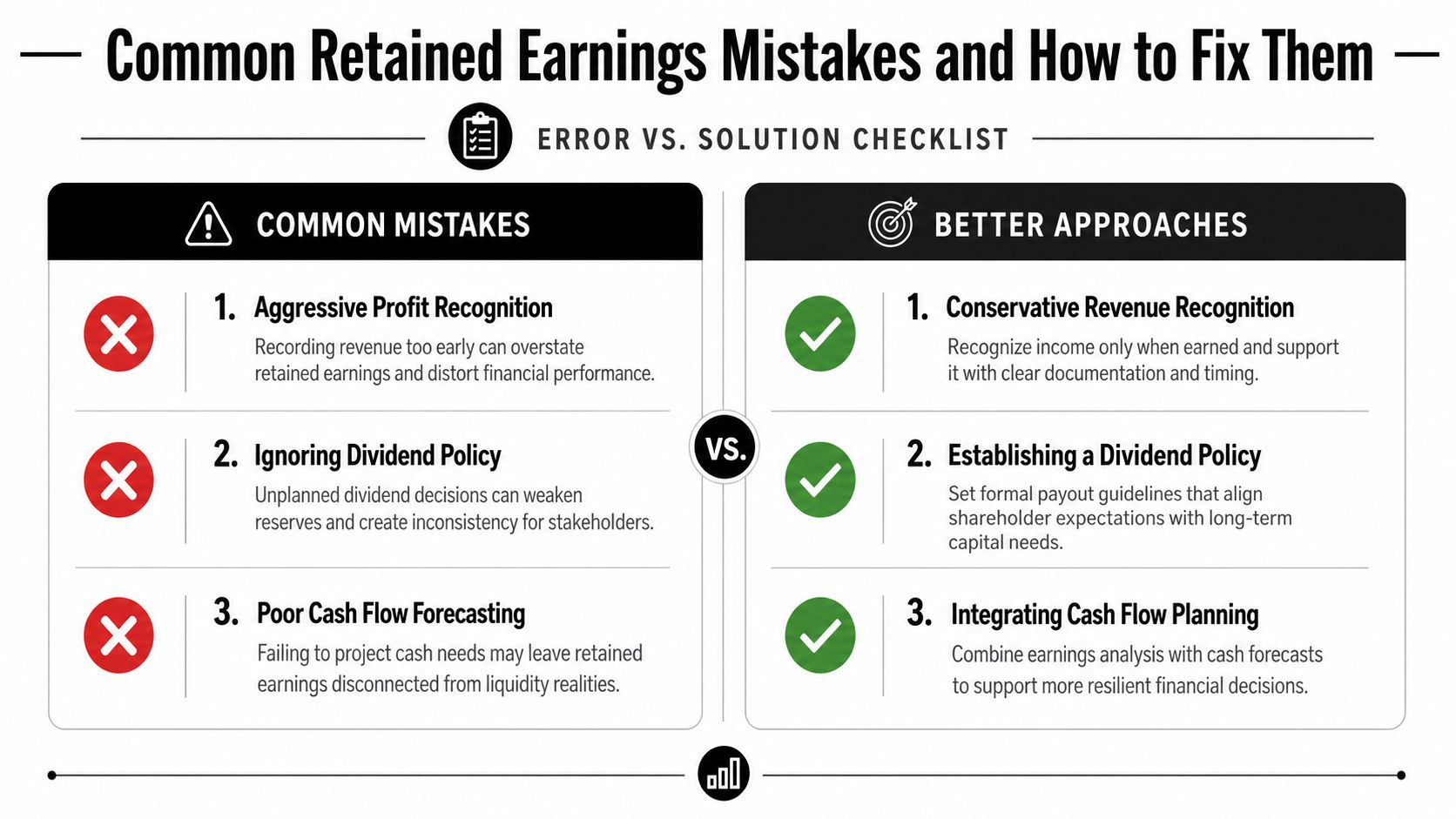
The biggest mistake is simple, founders pull profit out too fast and then act surprised when the business starts gasping for cash. The second mistake is the opposite, they let retained earnings build on paper but never convert that into an actual liquidity plan. The third is worse, they never forecast the balance at all, so they only discover the problem after a supplier starts chasing payment. If you want a more technical analogy for how hidden friction affects outcomes, fix Shopify Core Web Vitals is a useful reminder that small bottlenecks can drag down the whole system, even when the top-line looks fine.
Mistake versus better approach
Common mistakes | Better approaches |
|---|---|
Aggressive profit recognition. You celebrate reported profit before checking whether the cash will arrive in time. | Conservative revenue recognition. Only treat earnings as real when the timing and collectability are clear. |
Ignoring dividend policy. Owners pull money out because the year looked strong, not because the business can spare it. | Establishing a dividend policy. Set rules that preserve enough equity for working capital and growth. |
Poor cash flow forecasting. The balance sheet looks fine until a rent, tax, or supplier payment lands. | Integrating cash flow planning. Forecast the cash impact before deciding how much can be retained or distributed. |
What negative retained earnings can mean
Negative or declining retained earnings are not always just a story about past losses. They can point to financing strain, an aggressive payout strategy, or a business that has been extracting too much and reinvesting too little. In a pressure environment, that matters more than the textbook definition.
For an Australian SME, declining retained earnings should trigger a hard review of cash generation, debt service, and owner withdrawals. If the business is still trading but the balance keeps slipping, don't hide behind the phrase “we'll make it up next quarter.” That's not a plan.
The founder checklist
Use this as a clean check against reality.
Review distributions early: Don't approve drawings or dividends without checking the forecasted cash balance first.
Watch stock and receivables together: Rising retained earnings won't help if inventory and debtor balances are absorbing the operating surplus.
Ask what the balance funds: If the retained earnings figure isn't supporting debt reduction, growth, or resilience, it's just sitting there.
The fix is usually boring and effective. Tighten forecasting, define distribution rules, and stop treating profit extraction like an afterthought.
Turning Retained Earnings into a Strategic Advantage
The best founders use retained earnings as a decision signal. They know that a rising balance should reflect real reinvestment, stronger cash discipline, and a business that can fund its own next step. They also know that if the number is rising but cash is not, something is leaking in working capital, inventory, receivables, or process. That's where a virtual CFO or growth accountant earns their keep, because they can turn the balance sheet into action instead of hindsight.
The right move is to connect retained earnings to forecasting, KPI tracking, and capital allocation. Then test whether the business is building resilience or just carrying an accounting balance. If the numbers don't line up, the answer is usually in operations, not in the ledger.
Nexist helps Australian founders get that gap under control by linking profit, cash flow, margins, and operations into one clear plan. If your retained earnings are climbing but the bank balance isn't, visit Nexist and get a sharper view of where the cash is getting stuck and what to fix first.
retained earnings, SME accounting, cash flow, dividends Australia, virtual CFO

" width="24px"/><g d="M 0 24.129 L 0 0.129 L 24 0.129 L 24 24.129 Z M 0 24.129 L 0 0.129 L 24 0.129 L 24 24.129 Z M 24 3 C 24 1.344 22.656 0 21 0 L 3 0 C 1.344 0 0 1.344 0 3 L 0 21 C 0 22.656 1.344 24 3 24 L 21 24 C 22.656 24 24 22.656 24 21 Z M 6.883 8.375 L 2.863 8.375 L 2.863 20.467 L 6.883 20.467 Z M 4.899 2.545 C 3.524 2.545 2.625 3.449 2.625 4.634 C 2.625 5.795 3.496 6.724 4.846 6.724 L 4.872 6.724 C 6.273 6.724 7.146 5.795 7.146 4.634 C 7.12 3.449 6.274 2.545 4.899 2.545 Z M 16.747 8.09 C 14.614 8.09 13.659 9.263 13.124 10.086 L 13.124 8.374 L 9.105 8.374 C 9.159 9.508 9.105 20.466 9.105 20.466 L 13.124 20.466 L 13.124 13.713 C 13.124 13.352 13.15 12.99 13.257 12.732 C 13.547 12.01 14.209 11.262 15.319 11.262 C 16.773 11.262 17.355 12.372 17.355 13.996 L 17.355 20.466 L 21.374 20.466 L 21.374 13.532 C 21.374 9.818 19.391 8.09 16.747 8.09 Z" fill="transparent" height="24.12890599668026px" id="dSFdkJotL" width="24px"><path d="M 0 24 L 0 0 L 24 0 L 24 24 Z" fill="transparent" height="24px" id="wscNJE44G" transform="translate(0 0.129)" width="24px"/><g d="M 0 24.129 L 0 0.129 L 24 0.129 L 24 24.129 Z M 24 3 C 24 1.344 22.656 0 21 0 L 3 0 C 1.344 0 0 1.344 0 3 L 0 21 C 0 22.656 1.344 24 3 24 L 21 24 C 22.656 24 24 22.656 24 21 Z M 6.883 8.375 L 2.863 8.375 L 2.863 20.467 L 6.883 20.467 Z M 4.899 2.545 C 3.524 2.545 2.625 3.449 2.625 4.634 C 2.625 5.795 3.496 6.724 4.846 6.724 L 4.872 6.724 C 6.273 6.724 7.146 5.795 7.146 4.634 C 7.12 3.449 6.274 2.545 4.899 2.545 Z M 16.747 8.09 C 14.614 8.09 13.659 9.263 13.124 10.086 L 13.124 8.374 L 9.105 8.374 C 9.159 9.508 9.105 20.466 9.105 20.466 L 13.124 20.466 L 13.124 13.713 C 13.124 13.352 13.15 12.99 13.257 12.732 C 13.547 12.01 14.209 11.262 15.319 11.262 C 16.773 11.262 17.355 12.372 17.355 13.996 L 17.355 20.466 L 21.374 20.466 L 21.374 13.532 C 21.374 9.818 19.391 8.09 16.747 8.09 Z" fill="transparent" height="24.12890599668026px" id="sTpjGo1tb" width="24px"><path d="M 0 24 L 0 0 L 24 0 L 24 24 Z" fill="transparent" height="24px" id="s7ffpmKOD" transform="translate(0 0.129)" width="24px"/><g d="M 24 3 C 24 1.344 22.656 0 21 0 L 3 0 C 1.344 0 0 1.344 0 3 L 0 21 C 0 22.656 1.344 24 3 24 L 21 24 C 22.656 24 24 22.656 24 21 Z M 6.883 8.375 L 2.863 8.375 L 2.863 20.467 L 6.883 20.467 Z M 4.899 2.545 C 3.524 2.545 2.625 3.449 2.625 4.634 C 2.625 5.795 3.496 6.724 4.846 6.724 L 4.872 6.724 C 6.273 6.724 7.146 5.795 7.146 4.634 C 7.12 3.449 6.274 2.545 4.899 2.545 Z M 16.747 8.09 C 14.614 8.09 13.659 9.263 13.124 10.086 L 13.124 8.374 L 9.105 8.374 C 9.159 9.508 9.105 20.466 9.105 20.466 L 13.124 20.466 L 13.124 13.713 C 13.124 13.352 13.15 12.99 13.257 12.732 C 13.547 12.01 14.209 11.262 15.319 11.262 C 16.773 11.262 17.355 12.372 17.355 13.996 L 17.355 20.466 L 21.374 20.466 L 21.374 13.532 C 21.374 9.818 19.391 8.09 16.747 8.09 Z" fill="transparent" height="24.000006px" id="D0ecaHEcW" transform="translate(0 0)" width="24px"><path d="M 24 3 C 24 1.344 22.656 0 21 0 L 3 0 C 1.344 0 0 1.344 0 3 L 0 21 C 0 22.656 1.344 24 3 24 L 21 24 C 22.656 24 24 22.656 24 21 Z" fill="rgb(55, 184, 218)" height="24.000006px" id="IPLFE6zXx" width="24px"/><path d="M 4.02 0 L 0 0 L 0 12.092 L 4.02 12.092 Z" fill="rgb(255, 255, 255)" height="12.09201px" id="FWhtzAyuY" transform="translate(2.863 8.375)" width="4.02px"/><path d="M 2.274 0 C 0.899 0 0 0.904 0 2.089 C 0 3.25 0.871 4.179 2.221 4.179 L 2.247 4.179 C 3.648 4.179 4.521 3.25 4.521 2.089 C 4.495 0.904 3.649 0 2.274 0 Z" fill="rgb(255, 255, 255)" height="4.17876px" id="VmOsKv4kO" transform="translate(2.625 2.545)" width="4.52095px"/><path d="M 7.641 0 C 5.509 0 4.554 1.173 4.019 1.996 L 4.019 0.284 L 0 0.284 C 0.053 1.419 0 12.376 0 12.376 L 4.019 12.376 L 4.019 5.623 C 4.019 5.262 4.045 4.9 4.151 4.642 C 4.442 3.92 5.103 3.172 6.214 3.172 C 7.667 3.172 8.25 4.282 8.25 5.907 L 8.25 12.376 L 12.269 12.376 L 12.269 5.442 C 12.269 1.728 10.286 0 7.641 0 Z" fill="rgb(255, 255, 255)" height="12.37626px" id="n1XUbhaq0" transform="translate(9.105 8.09)" width="12.268830000000001px"/></g></g></g></g></svg>)