
Construction Accounting: A Practical Guide for Builders
Construction accounting explained for Australian builders. Learn job costing, WIP, progress billing, retentions, BAS, KPIs, and cash flow fixes that turn
Ansh Malhotra

You can have three jobs running, the lads are flat out, the invoices are moving, and the P&L still says the business is in the black. Then Friday hits, wages are due, a supplier is chasing, and the bank balance tells a different story. That's the moment most builders realise construction accounting isn't really about neat reports. It's about whether profitable work turns into cash fast enough to keep the crew moving.
Table of Contents
Why Construction Accounting Breaks for Growing Builders
A builder I'd call a few months late on decisions, and early on stress, had three live jobs, a healthy-looking margin on paper, and a ute full of reasons why the bank balance should have been better. The numbers weren't lying exactly. They were just speaking the wrong language for a business that lives on stage payments, retentions, and trades that need paying before the client's next claim clears.
That's where generic bookkeeping falls apart. In construction, each job is its own financial unit, and job costing plus WIP reporting are the tools that tell you what's happening on site and in the ledger, not just at company level. As noted in the earlier section's source material, construction accounting has shifted from simple cash tracking to progress-based accounting because billing rarely matches work completed month by month, especially on commercial, infrastructure, and fit-out work. For Australian builders, that matters in a sector that contributes around 7% of gross value added in recent years, according to ABS national accounts referenced in the construction accounting guide from Construction Executive.
The real break point is cash timing
A job can look profitable and still starve payroll if the claim cycle is slow, the retention is stuck, and subcontractors are billing faster than clients are paying. That's not a software problem first. It's a cash-conversion problem dressed up as an accounting problem.
Practical rule: if the office can't answer “what cash comes in from each job over the next few weeks”, the P&L is too late to help.
One useful place to start is the operational side of your accounting stack. If you're comparing software, the ERP for construction industry growth discussion is worth a look because it sits closer to the project-to-cash workflow than a generic accounts package. The same principle applies whether you're on Xero, a construction ERP, or a patchwork of spreadsheets, the question is always how quickly the job data turns into usable cash decisions.
For growing builders, the failure mode is predictable. The work gets bigger, billing gets slower, and the business starts relying on hope instead of timing. Construction accounting only works when the office can see the lag between work done, money claimed, money held back, and cash banked.
Job Costing and WIP Reporting Explained
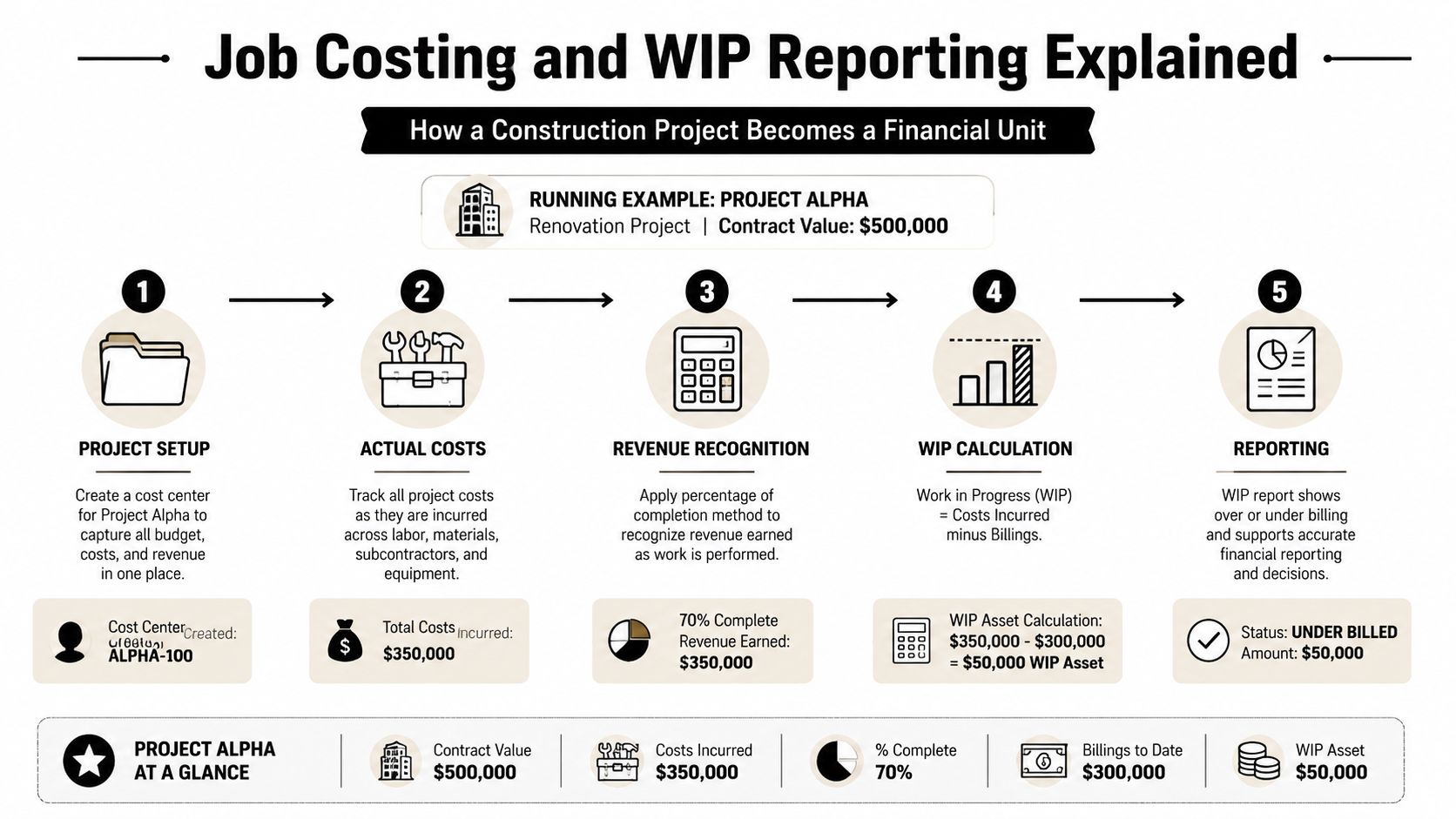
Start with one project, not the whole business. That's the only way job costing makes sense in construction. A renovation or new build becomes its own cost centre, and every dollar of labour, materials, plant, subcontractors, and allocated overhead gets pushed against that one job, not lost in a general ledger bucket. That project-level structure is exactly why WIP reports matter, because they compare earned revenue with billed revenue and show whether you've overbilled or underbilled the job.
How the project turns into a financial unit
Take a house build broken into slab, frame, lock-up, fit-out, and handover. The estimator sets the budget. The site team books hours and materials against cost codes. Subbies invoice against the same job. The accounts team then rolls those costs into a running picture of what the project has really consumed.
The key is that WIP doesn't ask, “what did we invoice?” It asks, “what revenue have we earned so far?” That's why the budgeting for real labour costs resource from Pebb is relevant. Labour is rarely as simple as the hourly rate on a timesheet. On a live job, direct labour has to be tracked with the right overhead allocation, or the margin report becomes wishful thinking.
A clean WIP schedule usually shows:
Contract value and approved variations
Costs incurred to date by cost code
Estimated cost to complete
Percentage complete
Revenue earned to date
Billings to date
Overbilling or underbilling position
That last line is the one that changes decisions. If the job is underbilled, earned revenue is ahead of invoices, so the balance sheet is carrying cash pressure. If it's overbilled, the client has paid ahead of progress, which can look healthy until the work catches up and the margin has to be delivered.
A WIP report isn't there to flatter the job. It's there to tell you whether the job is funding itself.
The internal system matters too. If your project data lives in one place and your accounting lives elsewhere, the month-end close becomes a scavenger hunt. The project accounting software guide is a useful companion if you're trying to decide how much of this can be automated without losing control.
Percentage of Completion Versus Completed Contract
For long jobs, the riskiest decision isn't the invoice format. It's the timing of revenue recognition. In Australian construction accounting, the main methods are Percentage-of-Completion and Completed Contract, and the one you choose changes the shape of profit, tax timing, and working capital signals.
Side by side is the only honest comparison
With Percentage-of-Completion, revenue and expenses are recognised as the project progresses. That fits longer commercial, infrastructure, and fit-out work because the job is producing value before final handover. It also gives the owner and the accountant a live view of margin drift, which matters when variations, delays, and rework start chewing through the original estimate.
With Completed Contract, revenue and expenses are held back until the job is finished. That can suit shorter, lower-risk residential work where the reporting burden of progress recognition doesn't buy much extra insight. It also defers recognition, which some operators prefer when the project is simple and the risk of bad estimates is low.
Here's the trade-off in plain English. Percentage-of-completion gives you a more realistic picture while the job is in flight, but it depends on strong cost-to-complete estimates. Completed contract is simpler during the build, but it can hide the true position until the end, which is a poor outcome if you need to manage payroll, materials, and supplier terms before practical completion.
If the job spans months and the billing never lines up neatly with the work, deferring revenue usually makes the business look calmer than it really is.
The earlier source material from NetSuite's construction accounting overview notes that underbilling means earned revenue exceeds billings, while overbilling means billings exceed earned revenue. That distinction is why method choice matters so much. It changes not just what your P&L says, but how your working capital looks to you, your bank, and anyone else reading the numbers.
For most growing Australian builders, Percentage-of-Completion is the more useful management tool because it exposes margin slippage while there's still time to fix it. Completed Contract is more niche, and if it's chosen, it should be because the job profile supports it, not because someone wants the books to look tidy for another month.
Progress Claims, Retentions and the Cash Reality
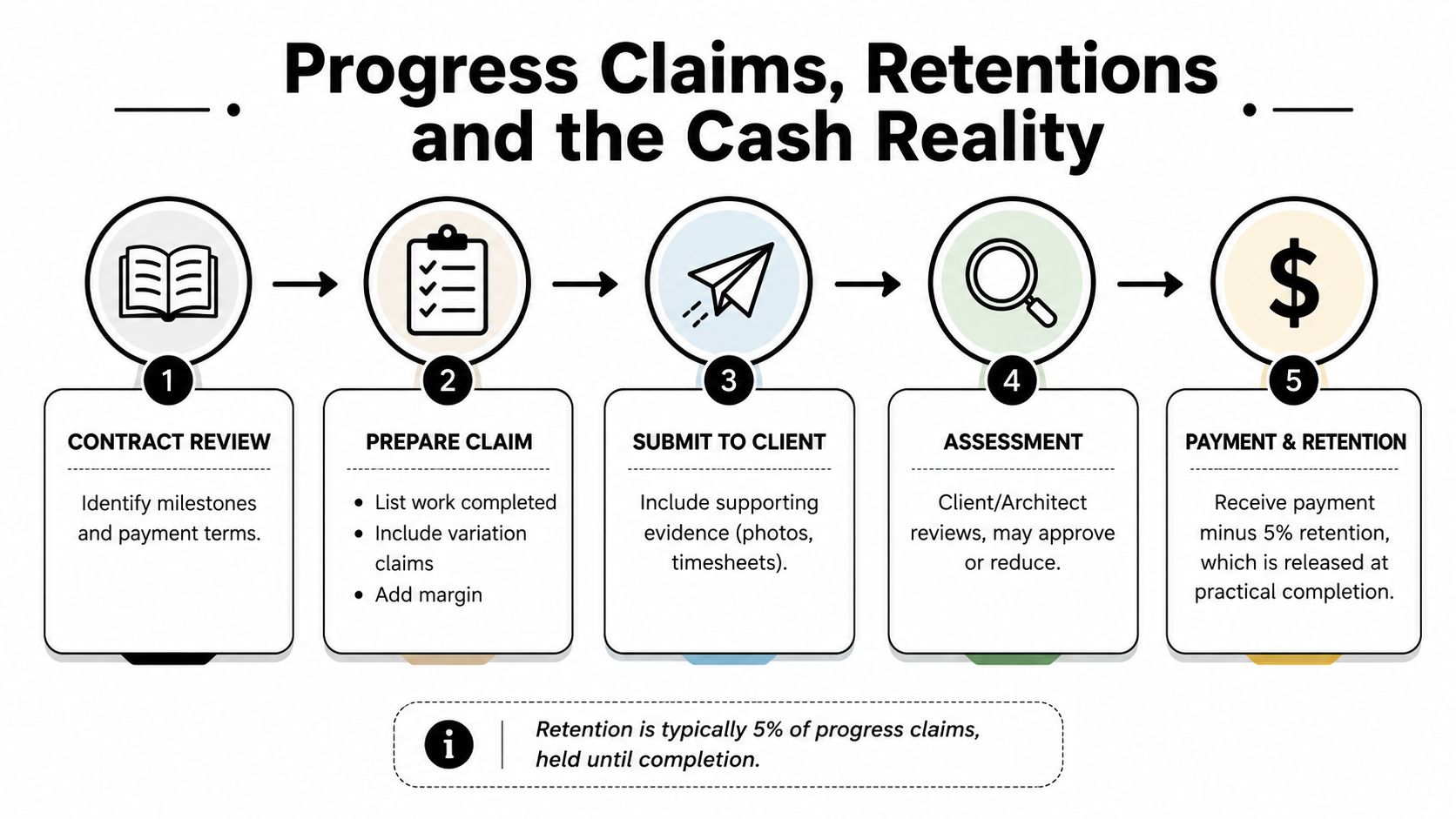
A progress claim is where completed work turns into cash flow, or fails to. For a builder, that claim is not a paper exercise, it is the bridge between site activity and payroll, supplier payments, and the next subcontractor invoice. If the claim goes in late, is missing backup, or leaves variations undercooked, the cash cycle stretches and the business ends up funding the job for longer than planned. The accounts team sees a receivable. The site team feels the squeeze through labour, plant, and supplier pressure.
Retention is cash that was earned but not released
Retention is the part that catches most owners off guard. A client can approve the claim, pay most of it, and still hold back the retention until practical completion or defects expiry, depending on the contract. On a $500,000 job, a 10% retention leaves $50,000 sitting out of reach, and the earlier brief's example shows that money not being released for six months can force the builder to fund finishing trades and defect rectification from somewhere else.
That changes the question. It is not “did we make a margin?”. It is “when does that margin become spendable cash?”. A stack of profitable jobs can still create a tight week if too much value is locked in retention, unpaid claims, or variations that are still waiting on sign-off.
The traffic controller hourly pay guide is a reminder that labour pricing moves with the market, and that matters on site. If labour is getting harder to secure, claim timing needs to stay tight as well, because payroll does not wait for the client's internal approval cycle.
What softens the squeeze
Retention bonds: These can sometimes replace cash retention and keep more money in the business.
Escrow or separate handling: In some contract setups, retention management becomes more transparent when it is isolated.
Faster claim cycles: Weekly or more disciplined claim submission reduces the gap between earning and collecting.
Variation discipline: Unsupported extras are where a lot of margin disappears.
The operating habit matters more than the theory. Claims need evidence, variations need prompt pricing, and retention needs its own ledger treatment. If retention sits in a general reconciliation pile, it will eventually show up as a cash problem.
If you want a broader view of how builders handle tax and reporting, the small business taxation guide is a useful companion because it is closer to how an actual small business runs than a software brochure is.
Australian GST, BAS and Payroll Essentials
GST, BAS, and payroll are where construction accounting becomes real compliance rather than project theory. If those three aren't tight, the business can be profitable on paper and still create headaches with the ATO, staff, and subcontractors. For an SME builder, the question isn't whether the rules are annoying. It's whether the team can run them without scrambling at the end of every period.
GST follows the tax invoice and the claim cycle
On progress billing, the practical habit is simple, issue the tax invoice correctly, track the claim, and make sure GST is accounted for in the right reporting period. The timing can get messy if claims are paid late or partially disputed, so the bookkeeper needs a clean link between progress claims, receipts, and BAS reporting.
If you're still trying to make sense of the compliance load, the small business taxation guide is a sensible next step because it sits closer to how builders experience tax, not how software vendors describe it. The same applies to GST on retention, variations, and progress claims, the ledger has to mirror the contract reality.
BAS cadence changes the cash rhythm
Monthly BAS gives you faster visibility and more frequent remittance pressure. Quarterly BAS gives you more breathing room, but it can also hide bad habits longer if the bookkeeping is sloppy. Either way, the builder should know what's coming before the BAS is due, not after the quarter has closed.
Payroll is where missed detail hurts fastest
Construction payroll is more than wages. It includes PAYG withholding, superannuation, and the classification difference between employees and subcontractors. Super on ordinary time has to be treated carefully, and STP reporting needs to stay current so the payroll record matches what's being paid.
Action this week: reconcile one live job's claim, its GST treatment, and the payroll entries for the same period. If those three don't line up, the cash forecast won't either.
The practical test is whether you can read one month of construction activity and see the tax impact without having to rebuild the ledger. If not, the compliance stack is too loose for the business size.
Reading WIP Reports and Building a 13-Week Cash Forecast
A WIP report only earns its keep when someone uses it to predict cash. The report tells you where revenue sits versus billings. The forecast tells you whether that position will fund wages, suppliers, BAS, and retention timing over the next few weeks. Builders who rely on a monthly P&L are usually late to the problem because the biggest bill often lands on Friday, not month-end.
What to scan first in the WIP
Start with four lines, overbilling or underbilling by job, percentage complete, gross margin to date, and forecast final margin. If one job is sitting close to completion but the final claim hasn't gone out, that's a warning flag. If retention receivables keep growing faster than revenue, the business is carrying more cash strain than the P&L suggests.
The earlier section on WIP explained the accounting mechanics. The decision point is different here. You're looking for jobs where cost-to-complete estimates are moving up month after month, because that usually means the original margin is being eaten by scope creep, labour drag, or price movement.
How the 13-week forecast should behave
A useful 13-week cash forecast lists expected progress claims, retention releases, supplier payments, payroll, and BAS outflows. It doesn't need to be fancy. It does need to be updated often enough that the owner can act before the bank account becomes the only source of truth.
The infographic data supplied for this guide shows the line dipping in the middle weeks and recovering later, which is exactly how a live builder's forecast should be read, not as a straight line but as a timing map. If the dip is deeper than expected, the team has to decide whether it's caused by slow claims, payroll overlap, or a supplier run that arrived before the next client payment.
A weekly forecast beats a monthly P&L because it answers the question the owner actually has, “Can I pay everyone next Friday?”
A builder doesn't need more reports. A builder needs the report that names the week where cash gets tight and the job that caused it. That's the whole point of tying WIP to cash.
Common Problems and the SOPs That Fix Them
The same problems keep showing up in builder businesses because the process behind them is vague. Cost codes drift between jobs, variations get priced late, retention sits in a black hole, and subcontractor invoices arrive without clean matching to claims. Those aren't personality flaws in the team. They're SOP problems.
Fix the process before you blame the margin
If cost-code drift is happening, the estimator, site supervisor, and bookkeeper aren't using the same job structure. The fix is a standard job setup checklist, not another reminder email. If variations are leaking margin, you need a rule that no extra work starts without a logged price or written approval path, even if the commercial reality on site is messy.
If retention is disappearing into the background, it needs its own ledger view and its own monthly chase process. If subcontractor invoices aren't matching claims, the accounts team needs a three-way check between purchase order, site progress, and supplier bill. And if month-end close is taking too long, the close itself needs a calendar, an owner, and an exception list.
A few software categories help here, but software alone won't fix a loose handover. The virtual chief financial officer model is often the point where a builder gets the discipline to set the workflow, not just record the outcome. That's especially true when the business has outgrown a bookkeeper but isn't ready for a full finance hire.
What to prioritise over the next 90 days
Next 30 days: Standardise job setup, claim formatting, and variation approval.
Next 60 days: Separate retention tracking and tighten subcontractor invoice matching.
Next 90 days: Shorten month-end close and build exception reporting for jobs slipping on margin.
The right fix depends on the gap. Some builders need better software and a stronger bookkeeper. Others need someone to own the forecasting and push back when the numbers don't make sense. The trick is knowing which one you are before the cash pain gets louder.
Turning Profit Into Cash With a Virtual CFO
A builder can be profitable on paper and still struggle to pay wages on Friday. Construction cash is tied up in progress claims, retentions, supplier terms, and WIP timing, so the number that matters most is cash conversion. If those moving parts are out of sync, the P&L can look healthy while the bank account stays tight.
What a virtual CFO changes
A good virtual CFO in construction does not replace the bookkeeper. They review the weekly cash forecast, challenge the monthly WIP, reforecast job budgets when costs move, and test pricing and margin assumptions before the next round of work is sold. That separates bookkeeping from running the business.
The role is most useful when the business has enough jobs and moving parts that an admin-only finance function cannot keep up, but not enough scale to justify a full-time finance lead. At that point, the owner needs a sharper view of cash, margin, and job risk than a monthly management pack can provide.
Practical rule: if the owner is still surprised by payroll or BAS, the finance rhythm is too loose for the size of the pipeline.
For builders comparing support models, the Nexist virtual chief financial officer service fits naturally here because it covers forecasting, cashflow management, reporting, and the operating discipline around numbers, not just the accounting entry. In construction, that can be the difference between having reports and having control.
The honest trade-off
A virtual CFO is not free, and it should not be sold as a magic fix. It takes time to set the reporting cadence, and it takes money to get proper oversight. What it can recover is usually better cash timing, cleaner pricing, and fewer surprises when work is already underway.
Construction accounting gets easier when someone owns the link between job profit and spendable cash. That is the outcome worth paying for.
construction accounting, job costing, WIP reporting, progress billing, cashflow management

" width="24px"/><g d="M 0 24.129 L 0 0.129 L 24 0.129 L 24 24.129 Z M 0 24.129 L 0 0.129 L 24 0.129 L 24 24.129 Z M 24 3 C 24 1.344 22.656 0 21 0 L 3 0 C 1.344 0 0 1.344 0 3 L 0 21 C 0 22.656 1.344 24 3 24 L 21 24 C 22.656 24 24 22.656 24 21 Z M 6.883 8.375 L 2.863 8.375 L 2.863 20.467 L 6.883 20.467 Z M 4.899 2.545 C 3.524 2.545 2.625 3.449 2.625 4.634 C 2.625 5.795 3.496 6.724 4.846 6.724 L 4.872 6.724 C 6.273 6.724 7.146 5.795 7.146 4.634 C 7.12 3.449 6.274 2.545 4.899 2.545 Z M 16.747 8.09 C 14.614 8.09 13.659 9.263 13.124 10.086 L 13.124 8.374 L 9.105 8.374 C 9.159 9.508 9.105 20.466 9.105 20.466 L 13.124 20.466 L 13.124 13.713 C 13.124 13.352 13.15 12.99 13.257 12.732 C 13.547 12.01 14.209 11.262 15.319 11.262 C 16.773 11.262 17.355 12.372 17.355 13.996 L 17.355 20.466 L 21.374 20.466 L 21.374 13.532 C 21.374 9.818 19.391 8.09 16.747 8.09 Z" fill="transparent" height="24.12890599668026px" id="dSFdkJotL" width="24px"><path d="M 0 24 L 0 0 L 24 0 L 24 24 Z" fill="transparent" height="24px" id="wscNJE44G" transform="translate(0 0.129)" width="24px"/><g d="M 0 24.129 L 0 0.129 L 24 0.129 L 24 24.129 Z M 24 3 C 24 1.344 22.656 0 21 0 L 3 0 C 1.344 0 0 1.344 0 3 L 0 21 C 0 22.656 1.344 24 3 24 L 21 24 C 22.656 24 24 22.656 24 21 Z M 6.883 8.375 L 2.863 8.375 L 2.863 20.467 L 6.883 20.467 Z M 4.899 2.545 C 3.524 2.545 2.625 3.449 2.625 4.634 C 2.625 5.795 3.496 6.724 4.846 6.724 L 4.872 6.724 C 6.273 6.724 7.146 5.795 7.146 4.634 C 7.12 3.449 6.274 2.545 4.899 2.545 Z M 16.747 8.09 C 14.614 8.09 13.659 9.263 13.124 10.086 L 13.124 8.374 L 9.105 8.374 C 9.159 9.508 9.105 20.466 9.105 20.466 L 13.124 20.466 L 13.124 13.713 C 13.124 13.352 13.15 12.99 13.257 12.732 C 13.547 12.01 14.209 11.262 15.319 11.262 C 16.773 11.262 17.355 12.372 17.355 13.996 L 17.355 20.466 L 21.374 20.466 L 21.374 13.532 C 21.374 9.818 19.391 8.09 16.747 8.09 Z" fill="transparent" height="24.12890599668026px" id="sTpjGo1tb" width="24px"><path d="M 0 24 L 0 0 L 24 0 L 24 24 Z" fill="transparent" height="24px" id="s7ffpmKOD" transform="translate(0 0.129)" width="24px"/><g d="M 24 3 C 24 1.344 22.656 0 21 0 L 3 0 C 1.344 0 0 1.344 0 3 L 0 21 C 0 22.656 1.344 24 3 24 L 21 24 C 22.656 24 24 22.656 24 21 Z M 6.883 8.375 L 2.863 8.375 L 2.863 20.467 L 6.883 20.467 Z M 4.899 2.545 C 3.524 2.545 2.625 3.449 2.625 4.634 C 2.625 5.795 3.496 6.724 4.846 6.724 L 4.872 6.724 C 6.273 6.724 7.146 5.795 7.146 4.634 C 7.12 3.449 6.274 2.545 4.899 2.545 Z M 16.747 8.09 C 14.614 8.09 13.659 9.263 13.124 10.086 L 13.124 8.374 L 9.105 8.374 C 9.159 9.508 9.105 20.466 9.105 20.466 L 13.124 20.466 L 13.124 13.713 C 13.124 13.352 13.15 12.99 13.257 12.732 C 13.547 12.01 14.209 11.262 15.319 11.262 C 16.773 11.262 17.355 12.372 17.355 13.996 L 17.355 20.466 L 21.374 20.466 L 21.374 13.532 C 21.374 9.818 19.391 8.09 16.747 8.09 Z" fill="transparent" height="24.000006px" id="D0ecaHEcW" transform="translate(0 0)" width="24px"><path d="M 24 3 C 24 1.344 22.656 0 21 0 L 3 0 C 1.344 0 0 1.344 0 3 L 0 21 C 0 22.656 1.344 24 3 24 L 21 24 C 22.656 24 24 22.656 24 21 Z" fill="rgb(55, 184, 218)" height="24.000006px" id="IPLFE6zXx" width="24px"/><path d="M 4.02 0 L 0 0 L 0 12.092 L 4.02 12.092 Z" fill="rgb(255, 255, 255)" height="12.09201px" id="FWhtzAyuY" transform="translate(2.863 8.375)" width="4.02px"/><path d="M 2.274 0 C 0.899 0 0 0.904 0 2.089 C 0 3.25 0.871 4.179 2.221 4.179 L 2.247 4.179 C 3.648 4.179 4.521 3.25 4.521 2.089 C 4.495 0.904 3.649 0 2.274 0 Z" fill="rgb(255, 255, 255)" height="4.17876px" id="VmOsKv4kO" transform="translate(2.625 2.545)" width="4.52095px"/><path d="M 7.641 0 C 5.509 0 4.554 1.173 4.019 1.996 L 4.019 0.284 L 0 0.284 C 0.053 1.419 0 12.376 0 12.376 L 4.019 12.376 L 4.019 5.623 C 4.019 5.262 4.045 4.9 4.151 4.642 C 4.442 3.92 5.103 3.172 6.214 3.172 C 7.667 3.172 8.25 4.282 8.25 5.907 L 8.25 12.376 L 12.269 12.376 L 12.269 5.442 C 12.269 1.728 10.286 0 7.641 0 Z" fill="rgb(255, 255, 255)" height="12.37626px" id="n1XUbhaq0" transform="translate(9.105 8.09)" width="12.268830000000001px"/></g></g></g></g></svg>)