
How to Increase Margin Without Killing Sales
Learn how to increase margin with pricing, cost control and cash flow fixes. Practical guide for Australian founders to boost gross and net margins.
Ansh Malhotra

A founder checks the sales dashboard and sees a healthy month. Orders are moving, utilisation looks strong, and turnover has climbed. Then the bank account tells a different story. Stock has been paid for, customers are still waiting to pay invoices, discounts have absorbed the markup, and the team is spending hours correcting avoidable errors. Revenue is up, but usable profit is barely moving.
That's the situation behind many Australian SME margin problems. Increasing margin isn't primarily about selling more. It's about keeping more of what each sale already produces, then releasing the cash trapped in receivables, inventory and inefficient processes.
Table of Contents
Why More Sales Does Not Always Mean More Profit
A sale only helps when the contribution left after direct costs can cover labour, overheads, finance costs and owner expectations. Gross margin measures what remains after direct costs such as materials, stock or delivery inputs. Net margin measures what remains after the wider cost base has been paid.
A wholesaler can increase orders while buying too much stock. A trade business can fill its calendar with underquoted jobs. A service firm can add clients while its team loses capacity to rework, manual reporting and unpaid scope changes. In each case, the top line looks positive while profit per unit of effort declines.
This is why understanding what revenue really says matters. Revenue tells you the value of sales recorded. It doesn't tell you whether those sales were priced properly, collected promptly or delivered efficiently.
The three places margin leaks first
Most margin leakage begins in one of three areas:
Pricing: discounts, weak quoting, uncharged variations and prices that no longer reflect value.
Direct costs: supplier increases, freight, wastage, subcontractor costs and product specifications that are more expensive than necessary.
Cash conversion: slow customer payments, aged stock and administration that delays invoicing or creates rework.
Cash conversion deserves more attention than it gets. The Australian Productivity Commission reported that multifactor productivity declined by 0.5% in 2024–25, while labour productivity was flat in the December quarter and rose only 1.0% over the year to December 2025. The figures are reported in Australian business inventory data, and they reinforce a practical point for owners: broad productivity growth won't rescue a business with loose processes.
Finance-first rule: Don't chase another sale until you know what each sale contributes, how quickly the cash arrives and how much operational effort it consumes.
The right response isn't an across-the-board price rise or a blunt round of cost cutting. It's a controlled margin system that identifies the leak, protects valuable capacity and improves cash conversion. That approach suits ecommerce, retail, wholesale, manufacturing, trades and professional services because it starts with the mechanics of the business, not a generic target.
How to Diagnose Where Your Margin Is Leaking
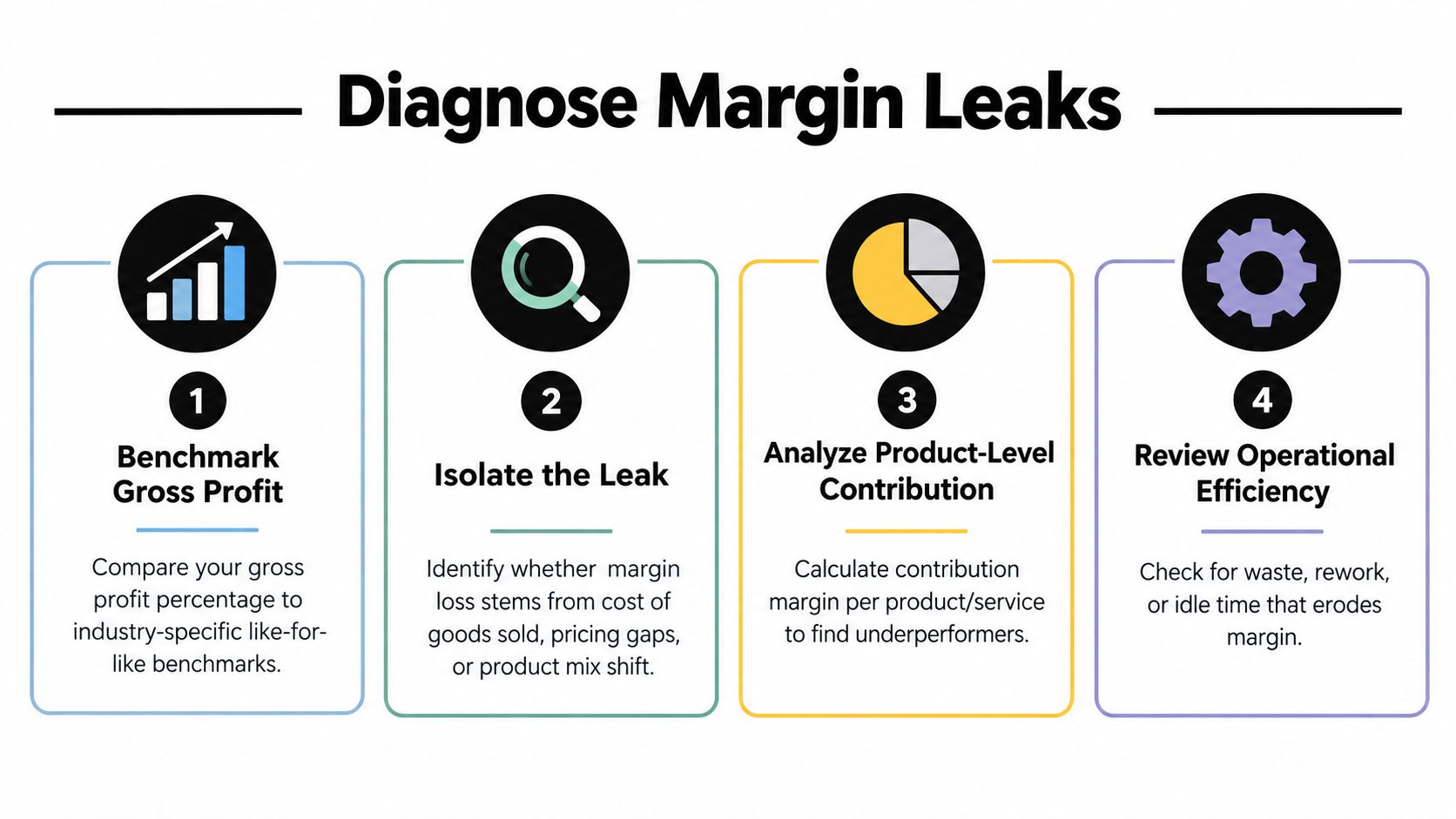
Start with evidence, not instinct. Pull the latest management accounts, sales by product or service, direct costs, payroll, inventory reports and aged receivables. Then separate reported profitability from economic contribution.
A business can report a respectable gross margin while losing money on a particular customer, channel or job type. For example, a product may have a reasonable markup but require frequent picking, returns, special freight or customer support. A service package may look profitable until unpaid meetings and revisions are included.
Benchmark like for like
The Australian Taxation Office provides small business benchmark data across 100 sectors. Use those benchmarks as a starting point, not as a universal target. Services generally produce stronger gross margins than product businesses, so comparing a consultancy with a wholesaler creates a useless conclusion.
Compare your business with the closest available industry category, then ask:
Is gross profit weak because prices are too low?
Are direct costs rising faster than prices?
Has the product or customer mix shifted?
Is inventory carrying cost hiding inside overheads?
Are labour hours being consumed by rework or low-value administration?
Build a margin health check
Track a compact set of measures each month:
Measure | What it reveals |
|---|---|
Gross margin | Whether pricing and direct costs are producing enough contribution |
Net margin | Whether the whole operating model converts sales into profit |
Contribution by product, job or service | Which work deserves more capacity |
Inventory days and stock turns | Whether cash is sitting in slow-moving stock |
Debtor days | How quickly recorded revenue becomes usable cash |
Labour cost ratio | Whether delivery effort is consuming the contribution |
For a trade business, estimating discipline can expose margin loss before a job starts. A tool such as Exayard plumbing estimating software can support more consistent job estimates, provided the owner reviews actual material, labour and variation performance afterwards.
For a deeper explanation of how to structure the numbers, use this profitability analysis guide. The output shouldn't be a long report. It should be a prioritised list of leaks, ranked by cash impact, ease of correction and risk to customer experience.
Smarter Pricing and Product Mix That Protects Margin
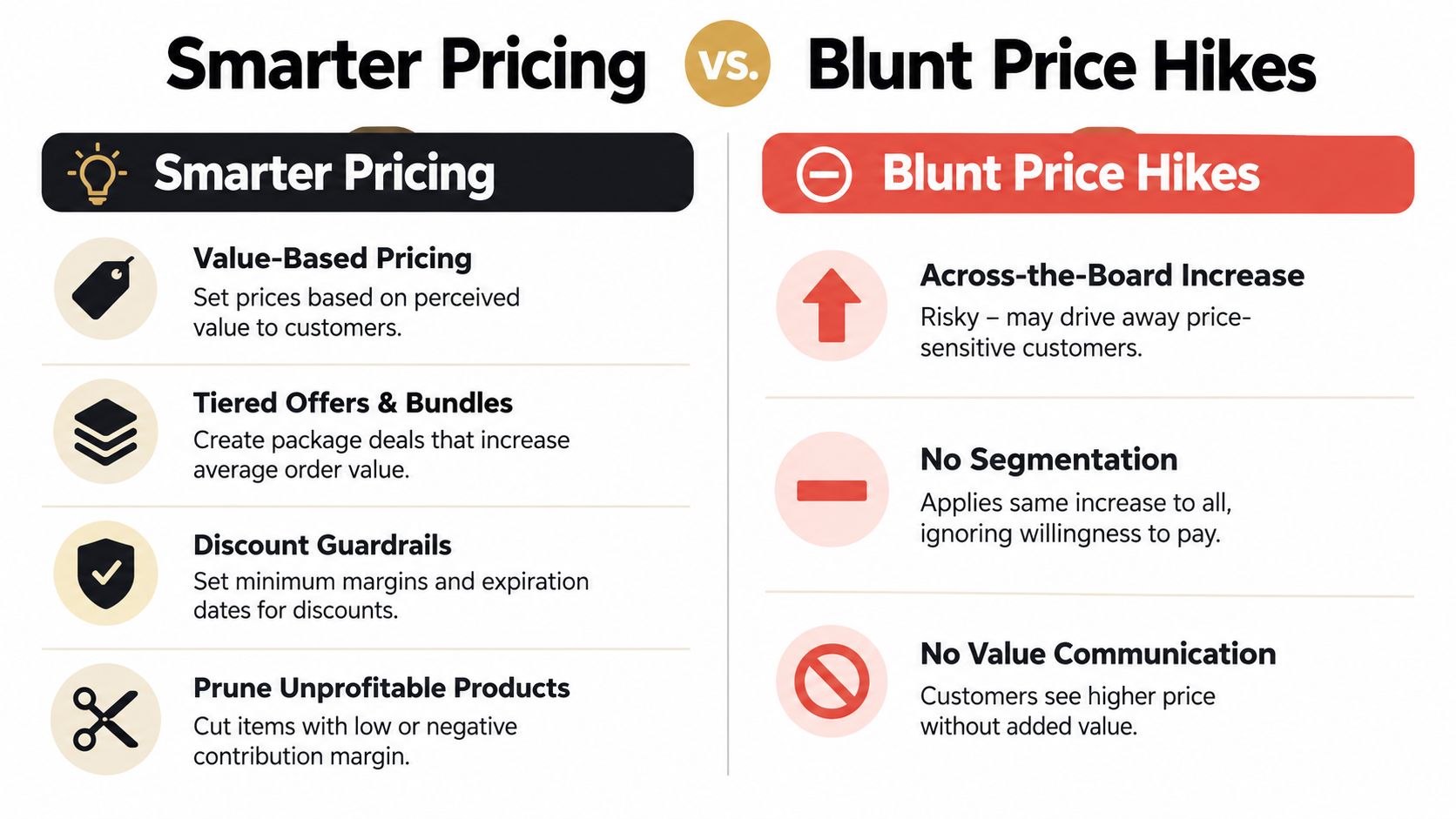
Pricing is important, but blunt price rises are usually a lazy first move. They treat every customer, product and service as if they have identical value and identical price sensitivity. Better pricing starts by understanding what the buyer is paying to avoid, achieve or simplify.
A professional services firm might separate advice, implementation and ongoing support instead of bundling unlimited access into one fee. An ecommerce brand could offer a core product, a better-value bundle and a premium option with added convenience. A plumbing business might quote clearly for standard work, then define what counts as an additional issue rather than absorbing every complication.
Design offers around contribution
Use three questions for every major product or service:
What problem does this solve? Translate features into time saved, risk reduced, convenience gained or an outcome delivered.
What does delivery really consume? Include materials, fulfilment, support, revisions, freight and payment costs.
What should the customer choose next? Create a clear upgrade, bundle or recurring option.
A bundle can improve contribution without making the customer feel charged more for the same item. Pair a high-margin accessory with a hero product, package implementation with training, or offer scheduled maintenance alongside a project. The bundle must still have a floor margin. Never use a discount to disguise an unprofitable combination.
Put guardrails around discounts
Every discount should have an owner, a reason and an expiry. Record the original price, direct cost, expected contribution and commercial purpose. If a discount is intended to clear aged stock, measure whether it released cash. If it's intended to win a strategic account, price the extra service burden before approval.
Product mix often creates the fastest improvement. Rank products, customers or job types by contribution rather than revenue. A low-revenue service with clean delivery and strong contribution may deserve more attention than a high-revenue line that consumes senior staff and generates complaints.
Use value-based pricing strategy guidance to separate perceived value from internal cost. Cost still sets the minimum viable price, but it shouldn't be the only reason a customer pays. Remove products or services that repeatedly produce negative contribution unless they have a documented strategic role.
Cutting Costs Without Cutting Capability
Cost control should remove waste, not weaken the capability customers pay for. Cutting a skilled coordinator may reduce payroll while increasing missed deadlines, billing delays and owner workload. Removing quality checks may lower immediate expense and create returns, rework or reputational damage.
Run a rapid cost audit across three layers: direct costs, labour and overheads. Assign an owner to each category and record the decision, expected saving, implementation date and effect on service.
Tighten direct costs first
Review the last supplier invoices against current price lists, purchase orders and quoted assumptions. Look for freight surcharges, minimum order quantities, packaging changes, rush fees and materials that teams substitute without updating the job cost.
Negotiate from evidence rather than asking vaguely for a better rate:
Volume: Can orders be consolidated without creating excess stock?
Specification: Can an equivalent material or component meet the same customer requirement?
Terms: Can payment timing reflect actual customer collections?
Service: Which delivery promises create premium freight or unnecessary handling?
Accountability: Who approves exceptions and records the reason?
Supplier consolidation can simplify administration, but don't trade resilience for a small unit-cost reduction. Keep alternatives for critical inputs where disruption would damage delivery.

Make labour capacity visible
Labour is often the largest controllable cost, but the answer isn't fewer people. Map where paid hours go. Separate productive delivery, sales, administration, rework, waiting and owner intervention.
Then standardise repeatable work. A written quoting checklist, purchase-order process, job close-out routine or invoice approval path can stop experienced staff from solving the same issue repeatedly. Rostering should match demand patterns, not habit. Service teams need protected delivery time, while inventory businesses need receiving, picking and replenishment schedules that reduce interruptions.
Remove overhead drift
Review software subscriptions, freight accounts, insurance, merchant fees, rent, waste disposal and outsourced services. Cancel duplication, but don't remove systems that provide financial control. An inexpensive accounting platform still produces weak decisions if nobody reconciles it or reviews exceptions.
Track savings in the management accounts. A cancelled subscription isn't a margin improvement until the expense disappears, the workflow still works and the saving reaches operating profit. Repeat the review quarterly, with owner-level approval for new recurring costs and any discount that takes contribution below the agreed floor.
Fix Inventory, Receivables and Operations to Release Hidden Margin
A business can report a healthy profit and still face a cash squeeze. Cash trapped in stock and receivables reduces the practical value of reported profit, while manual workflows consume labour needed for purchasing, pricing and customer decisions. Treat margin improvement as a cash-conversion problem first. Reduce debtor days, inventory days and process friction before depending on price rises.
Inventory-heavy businesses should treat stock as working capital, not as a success metric. Australian working-capital data reported average days inventory on hand of 97.1 days in FY23. It also showed that reducing DIO by 13.1 days cut days of working capital by 1.3 days, even as customer and supplier payment movements accelerated. See the Australian working capital analysis for the underlying figures.
Control stock before it becomes a discount
Classify inventory by movement, contribution and strategic importance. Aged stock requires a decision, not another reorder. Use bundling, alternate-channel sales, supplier returns, refurbishment or a controlled clearance plan, depending on the product and its recovery value.
Improve replenishment decisions with actual demand, lead times, minimum order quantities and stockout costs. Fewer stockouts matter, yet purchases that sit idle can later require markdowns. Track inventory days, aged stock value, stock turns and write-offs together. A single measure can reward the wrong behaviour, such as buying larger quantities to improve unit cost while cash remains tied up.
Collect revenue while it still matters
A business can invoice promptly and still collect slowly when terms are vague, invoices omit purchase-order details or nobody owns follow-up. The Payment Times Reporting Scheme says 80% of small business invoices were paid in 37 days and 95% within 56 days, while a January 2026 regulator update reported that the slowest payments worsened to 64 days from 58 days. Use the Payment Times Reporting Scheme data when setting collection expectations.
Independent Australian data recorded average full payment at 20.3 days from invoice issue in June 2026, with invoices paid 4.3 days after their due date on average. The same dataset reported Australia as the fastest among five countries tracked. For an SME funding payroll, stock and supplier bills before customer cash arrives, that delay still carries a real cost.
Make accounts receivable an operating control:
Before work starts: Confirm terms, billing milestones, purchase-order requirements and credit limits.
At completion: Close jobs promptly and issue accurate invoices with supporting documents.
Before due date: Send a confirmation and resolve disputes early.
After due date: Escalate by value and age, with a named owner for every overdue account.
Use this accounts receivable management resource to establish a repeatable collections process instead of relying on the owner's occasional chase.
Remove process friction with targeted automation
Automate work that is repetitive, rules-based and easy to verify. Invoice capture, bank matching, reconciliations, order processing, recurring reports and exception alerts are suitable candidates. Keep judgement-heavy decisions with a responsible person.
Deloitte Australia's modelling found that moving SMBs from basic to intermediate AI maturity could lift profitability by about 45%, while moving from intermediate to fully enabled AI could deliver roughly a 111% uplift. These figures come from Deloitte's Australian AI analysis. Standardise the process first, define the KPI, then automate stable steps. Buying a tool before fixing the workflow makes a poor process run faster.
Lever | What to measure | Typical Australian benchmark | Margin impact |
|---|---|---|---|
Receivables | Debtor days, overdue ageing and disputes | Average full payment was 20.3 days in June 2026, with payment 4.3 days after due date on average, according to Australian invoice data | Releases cash and reduces avoidable finance pressure |
Inventory | DIO, aged stock, stock turns and write-offs | Average DIO was 97.1 days in FY23, as reported above | Reduces carrying costs, markdowns and cash tied up in stock |
Productivity | Rework, manual hours and exception volume | Multifactor productivity declined by 0.5% in 2024–25, according to reported Australian productivity data | Protects capacity without relying on additional labour |
AI maturity | Automated transactions, exception rates and decision turnaround | Deloitte modelled profitability uplift of about 45% from basic to intermediate maturity, and roughly 111% from intermediate to fully enabled maturity, as reported above | Removes low-value administration and improves control |
Your Margin Improvement Plan and KPIs to Track
Margin improvement fails when it lives in the owner's head. Put the measures on one dashboard, assign an accountable person and review movement against the operating plan. The dashboard should show gross margin, net margin, contribution by product or service, debtor days, inventory days and labour cost ratio.
Don't wait for month-end to discover drift. Use a weekly cash and operations review for invoices, collections, stock exceptions, purchasing and major labour variances. Use the monthly management meeting for profitability by product, customer, channel or job type. The owner should make decisions from the same definitions each time.
A practical 30-day reset
Days 1 to 7: Establish the baseline. Reconcile sales, direct costs, inventory, receivables and payroll. Identify the five largest customers, products or jobs by revenue and compare them with contribution.
Days 8 to 14: Attack immediate leakage. Follow up overdue invoices, freeze unnecessary purchasing, review active discounts and flag aged stock. Assign an owner to every exception.
Days 15 to 21: Implement structural fixes. Update quoting templates, supplier approval rules, reorder points, billing milestones and standard operating procedures. Select one stable administrative workflow for automation.
Days 22 to 30: Review the result and lock in cadence. Confirm which actions changed cash or contribution, record trade-offs and set the next reporting cycle. If an action didn't move the numbers, diagnose why before adding another initiative.
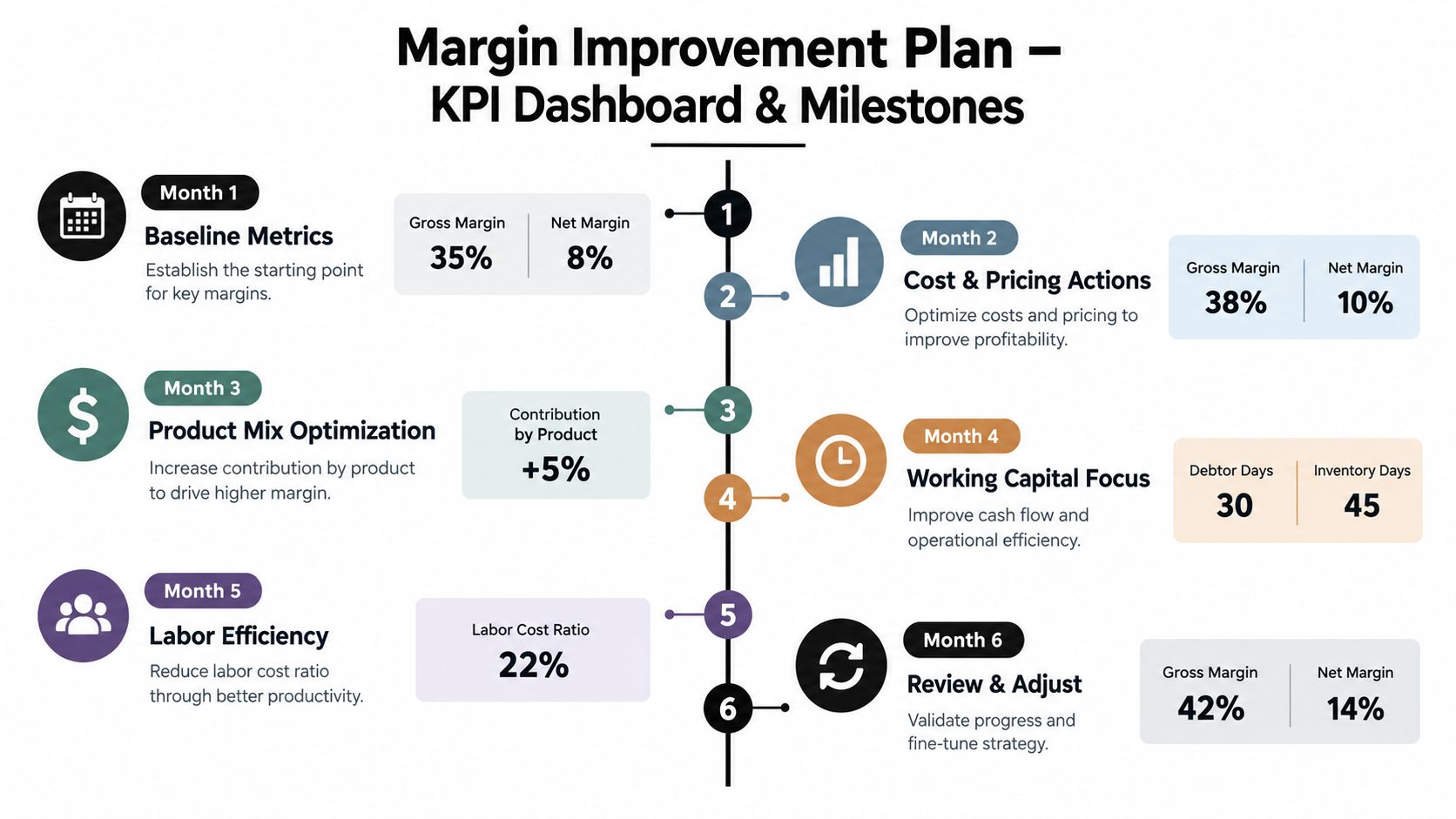
The dashboard should distinguish quick wins from structural work. Faster collection may improve cash quickly, while better purchasing, pricing architecture or AI-enabled workflows require governance and follow-through. Both matter, but they shouldn't be confused.
A margin problem rarely needs more motivational advice. It needs clean numbers, disciplined decisions and someone accountable for execution. If your business has profit trapped in stock, slow receivables or manual finance work, visit Nexist to discuss virtual CFO support, cash-flow forecasting, KPI reporting and hands-on process improvement. Start with a practical review of where your margin is leaking and what can put more cash in the bank.
how to increase margin, profit margin tips, pricing strategy, cost control, cash flow management

" width="24px"/><g d="M 0 24.129 L 0 0.129 L 24 0.129 L 24 24.129 Z M 0 24.129 L 0 0.129 L 24 0.129 L 24 24.129 Z M 24 3 C 24 1.344 22.656 0 21 0 L 3 0 C 1.344 0 0 1.344 0 3 L 0 21 C 0 22.656 1.344 24 3 24 L 21 24 C 22.656 24 24 22.656 24 21 Z M 6.883 8.375 L 2.863 8.375 L 2.863 20.467 L 6.883 20.467 Z M 4.899 2.545 C 3.524 2.545 2.625 3.449 2.625 4.634 C 2.625 5.795 3.496 6.724 4.846 6.724 L 4.872 6.724 C 6.273 6.724 7.146 5.795 7.146 4.634 C 7.12 3.449 6.274 2.545 4.899 2.545 Z M 16.747 8.09 C 14.614 8.09 13.659 9.263 13.124 10.086 L 13.124 8.374 L 9.105 8.374 C 9.159 9.508 9.105 20.466 9.105 20.466 L 13.124 20.466 L 13.124 13.713 C 13.124 13.352 13.15 12.99 13.257 12.732 C 13.547 12.01 14.209 11.262 15.319 11.262 C 16.773 11.262 17.355 12.372 17.355 13.996 L 17.355 20.466 L 21.374 20.466 L 21.374 13.532 C 21.374 9.818 19.391 8.09 16.747 8.09 Z" fill="transparent" height="24.12890599668026px" id="dSFdkJotL" width="24px"><path d="M 0 24 L 0 0 L 24 0 L 24 24 Z" fill="transparent" height="24px" id="wscNJE44G" transform="translate(0 0.129)" width="24px"/><g d="M 0 24.129 L 0 0.129 L 24 0.129 L 24 24.129 Z M 24 3 C 24 1.344 22.656 0 21 0 L 3 0 C 1.344 0 0 1.344 0 3 L 0 21 C 0 22.656 1.344 24 3 24 L 21 24 C 22.656 24 24 22.656 24 21 Z M 6.883 8.375 L 2.863 8.375 L 2.863 20.467 L 6.883 20.467 Z M 4.899 2.545 C 3.524 2.545 2.625 3.449 2.625 4.634 C 2.625 5.795 3.496 6.724 4.846 6.724 L 4.872 6.724 C 6.273 6.724 7.146 5.795 7.146 4.634 C 7.12 3.449 6.274 2.545 4.899 2.545 Z M 16.747 8.09 C 14.614 8.09 13.659 9.263 13.124 10.086 L 13.124 8.374 L 9.105 8.374 C 9.159 9.508 9.105 20.466 9.105 20.466 L 13.124 20.466 L 13.124 13.713 C 13.124 13.352 13.15 12.99 13.257 12.732 C 13.547 12.01 14.209 11.262 15.319 11.262 C 16.773 11.262 17.355 12.372 17.355 13.996 L 17.355 20.466 L 21.374 20.466 L 21.374 13.532 C 21.374 9.818 19.391 8.09 16.747 8.09 Z" fill="transparent" height="24.12890599668026px" id="sTpjGo1tb" width="24px"><path d="M 0 24 L 0 0 L 24 0 L 24 24 Z" fill="transparent" height="24px" id="s7ffpmKOD" transform="translate(0 0.129)" width="24px"/><g d="M 24 3 C 24 1.344 22.656 0 21 0 L 3 0 C 1.344 0 0 1.344 0 3 L 0 21 C 0 22.656 1.344 24 3 24 L 21 24 C 22.656 24 24 22.656 24 21 Z M 6.883 8.375 L 2.863 8.375 L 2.863 20.467 L 6.883 20.467 Z M 4.899 2.545 C 3.524 2.545 2.625 3.449 2.625 4.634 C 2.625 5.795 3.496 6.724 4.846 6.724 L 4.872 6.724 C 6.273 6.724 7.146 5.795 7.146 4.634 C 7.12 3.449 6.274 2.545 4.899 2.545 Z M 16.747 8.09 C 14.614 8.09 13.659 9.263 13.124 10.086 L 13.124 8.374 L 9.105 8.374 C 9.159 9.508 9.105 20.466 9.105 20.466 L 13.124 20.466 L 13.124 13.713 C 13.124 13.352 13.15 12.99 13.257 12.732 C 13.547 12.01 14.209 11.262 15.319 11.262 C 16.773 11.262 17.355 12.372 17.355 13.996 L 17.355 20.466 L 21.374 20.466 L 21.374 13.532 C 21.374 9.818 19.391 8.09 16.747 8.09 Z" fill="transparent" height="24.000006px" id="D0ecaHEcW" transform="translate(0 0)" width="24px"><path d="M 24 3 C 24 1.344 22.656 0 21 0 L 3 0 C 1.344 0 0 1.344 0 3 L 0 21 C 0 22.656 1.344 24 3 24 L 21 24 C 22.656 24 24 22.656 24 21 Z" fill="rgb(55, 184, 218)" height="24.000006px" id="IPLFE6zXx" width="24px"/><path d="M 4.02 0 L 0 0 L 0 12.092 L 4.02 12.092 Z" fill="rgb(255, 255, 255)" height="12.09201px" id="FWhtzAyuY" transform="translate(2.863 8.375)" width="4.02px"/><path d="M 2.274 0 C 0.899 0 0 0.904 0 2.089 C 0 3.25 0.871 4.179 2.221 4.179 L 2.247 4.179 C 3.648 4.179 4.521 3.25 4.521 2.089 C 4.495 0.904 3.649 0 2.274 0 Z" fill="rgb(255, 255, 255)" height="4.17876px" id="VmOsKv4kO" transform="translate(2.625 2.545)" width="4.52095px"/><path d="M 7.641 0 C 5.509 0 4.554 1.173 4.019 1.996 L 4.019 0.284 L 0 0.284 C 0.053 1.419 0 12.376 0 12.376 L 4.019 12.376 L 4.019 5.623 C 4.019 5.262 4.045 4.9 4.151 4.642 C 4.442 3.92 5.103 3.172 6.214 3.172 C 7.667 3.172 8.25 4.282 8.25 5.907 L 8.25 12.376 L 12.269 12.376 L 12.269 5.442 C 12.269 1.728 10.286 0 7.641 0 Z" fill="rgb(255, 255, 255)" height="12.37626px" id="n1XUbhaq0" transform="translate(9.105 8.09)" width="12.268830000000001px"/></g></g></g></g></svg>)