Accounts Payable Outsourcing Guide for Australian SMEs
Step-by-step accounts payable outsourcing guide for Australian SMEs covering vendor selection, costs, controls, transition checklists and KPI tracking.
Ansh Malhotra

At 7:42 on Monday morning, three suppliers are chasing overdue invoices, an early-payment discount expired on Friday, and a ledger entry from 2024 is still sitting in the AP file. Your operations manager is searching email for an approval that may never have been recorded, while you're trying to work out how much cash will leave the business this week.
That isn't a people problem. It's a process problem. Manual accounts payable creates a hidden tax on growth through repeated data entry, late-payment disputes, weak cash visibility and avoidable rework. Accounts payable outsourcing can remove the grind, but only if you outsource the processing while keeping the critical controls inside the business.
The model I recommend to Australian SMEs is simple: let a provider capture invoices, code them, match them and route exceptions, while your business retains supplier-change approval and payment authority. This guide covers the Australian cost bands, partner due diligence, migration controls, approval design and reporting discipline that make the arrangement defensible.
Table of Contents
The Monday Morning AP Problem and Why Smart Founders Outsource It
The founder in this situation usually doesn't have an AP department. They have a shared inbox, an administrator who is already covering payroll, and a bookkeeper who catches up when the month-end pressure eases. Invoices arrive as PDFs, photos and forwarded emails. Some have purchase orders. Others rely on someone remembering whether the work was authorised.
That arrangement survives while the business is small and the founder can personally recognise most suppliers. It breaks when invoice volume grows, staff change, multiple entities are involved or purchasing decisions move away from the owner. The business keeps paying for AP, but nobody owns the entire workflow from receipt to reconciliation.
A useful primer on the underlying process is this guide to what accounts payable involves. The important point is that AP isn't just data entry. It includes invoice capture, supplier validation, coding, matching, approval, payment scheduling and recordkeeping.
My operating rule: outsource repetitive handling, not accountability.
The Australian market has already treated outsourced finance work as a normal operating model for years. A CPA Australia-cited report from Business Fitness found that 30% of Australian accounting firms were already outsourcing work in 2014, while 39% planned to start or continue outsourcing. That historical baseline matters. Delegating finance operations isn't a fringe experiment, and AP remains one of the functions businesses commonly delegate.
The smart reason to outsource is control recovery. A managed team can follow documented coding rules, chase missing approvals, identify exceptions and keep the ledger current. Your staff regain time for customer work, receivables and commercial decisions, while you gain a process that can be measured instead of a queue that feels urgent.
What AP Outsourcing Actually Costs an Australian SME
The first mistake founders make is comparing an outsourcing quote with an employee's salary. That comparison is incomplete. The in-house cost includes supervision, leave coverage, software, training, corrections, month-end rework and the time a senior finance person spends resolving exceptions.
Australian guidance commonly places traditional invoice processing at about $27 to $30 per invoice, while e-invoicing can reduce the processing burden substantially, as outlined in this Australian AP automation guide. That figure describes traditional processing, not a universal outsourced fee, so use it as a warning about manual work rather than as a quote benchmark.
A second Australian source reports that AP automation can reduce processing to roughly AUD $2 to $6 per invoice and capture around 80% of manual labour savings in mature deployments. The exact result depends on invoice quality, approval discipline, supplier behaviour and exception volume. A clean system with standardised suppliers behaves very differently from a shared inbox full of non-PO invoices.
Compare the full cycle cost
Your financial comparison should include four buckets:
Processing labour: invoice capture, coding, matching and filing.
Control labour: approvals, duplicate checks, supplier changes and payment review.
Rework: corrected coding, disputed invoices, missing purchase orders and month-end clean-up.
Opportunity cost: staff time that could support collections, reporting or customer delivery.
Australian provider guidance places offshore AP specialists at AUD $25,000 to $40,000 fully loaded per year, compared with AUD $65,000 to $85,000 for a comparable local hire. Hourly offshore rates are often cited in the AUD $18 to $35 range, although the delivery model and scope matter more than the headline rate. Those bands are detailed in this Australian accounts payable outsourcing cost guide.
The cheapest quote isn't automatically the lowest-cost option. A low fee can become expensive when the provider misses approvals, creates duplicate suppliers or sends back poorly coded invoices. Ask for a per-invoice price, fixed fees, exception fees, implementation charges and payment-control responsibilities in writing.
Use the Australian market context properly
Australia had 2,729,648 actively trading businesses at 30 June 2025, according to ABS data cited by the Australian AP automation source. That scale explains why AP technology and outsourcing serve a broad SME market, but it doesn't tell you whether outsourcing suits your business. Your decision turns on transaction complexity, control maturity and the value of internal finance capacity.
Treat the quote as a decision about total cycle cost. If outsourcing removes avoidable rework and gives the owner reliable payment visibility, it can be worthwhile even when the invoice fee isn't the absolute lowest available.
Choosing the Right AP Outsourcing Partner
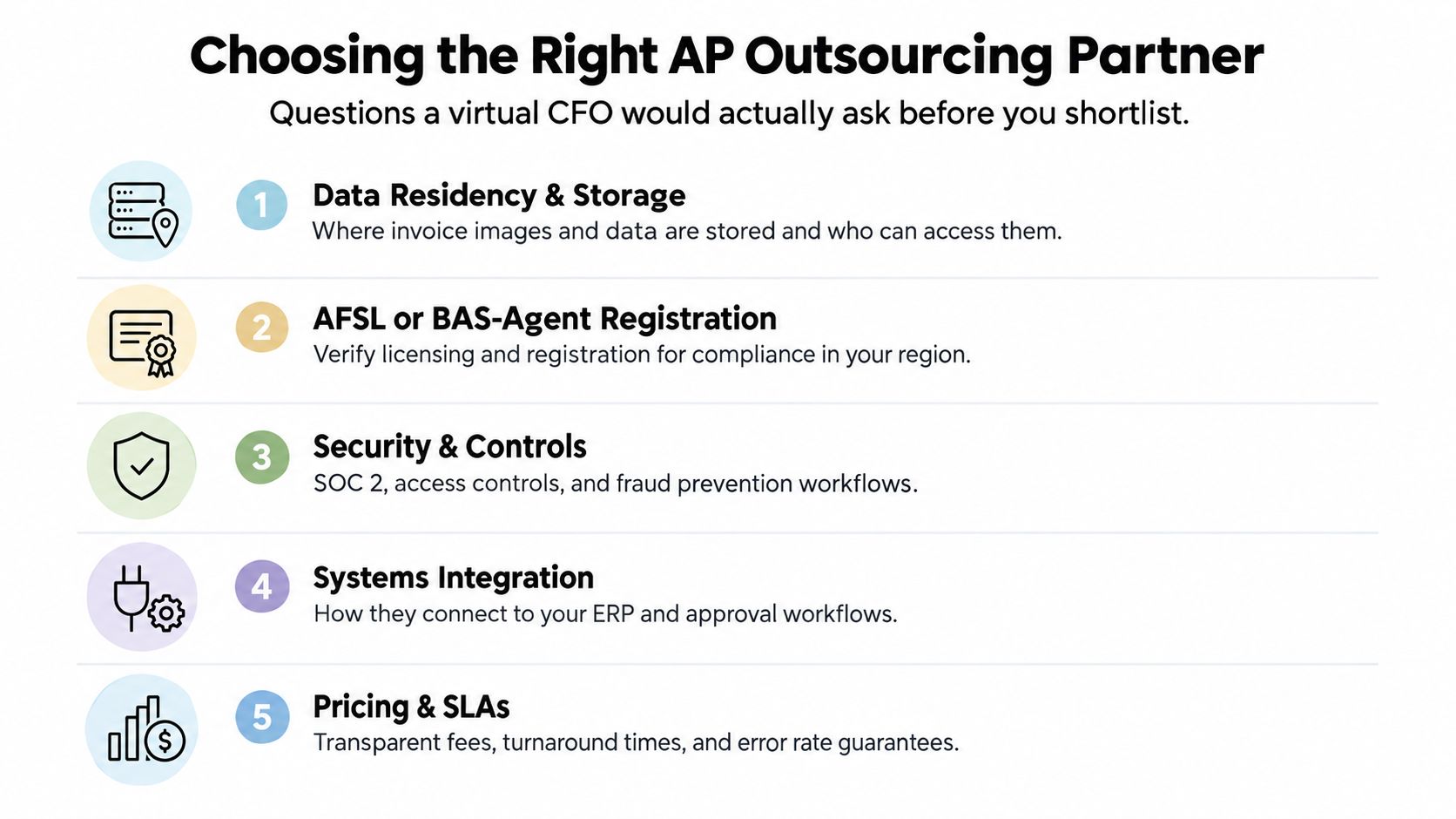
Don't shortlist providers from price sheets. Shortlist them from their answers to control questions. A provider that can process invoices quickly but can't explain supplier-master governance is a liability with a polished interface.
Ask where the data lives
Start with data residency and storage. Ask where invoice images, supplier records and exported reports are stored, who can access them, how access is revoked and what happens when the contract ends. You need a practical answer, not a generic statement that the platform is secure.
If the provider touches GST coding or other regulated accounting work, verify the relevant Australian registrations and credentials. Ask whether the entity or individuals involved are appropriately registered as BAS agents where required. For broader tax and compliance considerations, this Cloudvara compliance guide for accountants provides useful context for evaluating an outsourced arrangement.
Then test segregation of duties. The person who processes an invoice shouldn't automatically control supplier creation, approve the spend and release the payment. Ask for a role map showing who can capture, code, approve, edit supplier details and authorise bank files.
Demand integration proof
A provider should demonstrate its workflow in your actual environment, not show a generic presentation. Require evidence of integration with Xero, MYOB or NetSuite, depending on your stack, including coding dimensions, purchase-order matching, approval routing, GST treatment and reconciliation outputs.
The Australian guide to AP automation is useful for framing the capabilities you should test. Focus on what happens when the invoice doesn't match, the purchase order is missing or the supplier's bank details change. Happy-path demonstrations tell you almost nothing about operational risk.
This video can help you visualise the type of workflow questions to raise during provider discussions.
Run a controlled selection process
Score three finalists using a weighted matrix. Give the most weight to control design and integration depth, then assess Australian references, reporting quality, service levels and exit terms. A provider should also explain duplicate-payment detection, exception escalation and supplier onboarding without hiding behind software terminology.
Be wary of any vendor that:
Controls supplier creation: Supplier changes should require an internal approval trail.
Cannot explain duplicate checks: Ask which fields are compared and how exceptions are reviewed.
Offers an implausibly low offshore price: A quote below AUD $1.50 per invoice should trigger a scope and quality investigation, not excitement.
Locks data into a proprietary portal: Your contract should require clean, open-format exports of invoices, coding, approvals and supplier master files.
Run a paid pilot on one entity or supplier segment before signing a long-term agreement. The pilot should test ordinary invoices, credit notes, missing purchase orders, disputed amounts, new suppliers and payment-file approval. Provider selection is procurement on the surface, but underneath it's a control-design decision.
Transition Plan That Protects Your Ledger
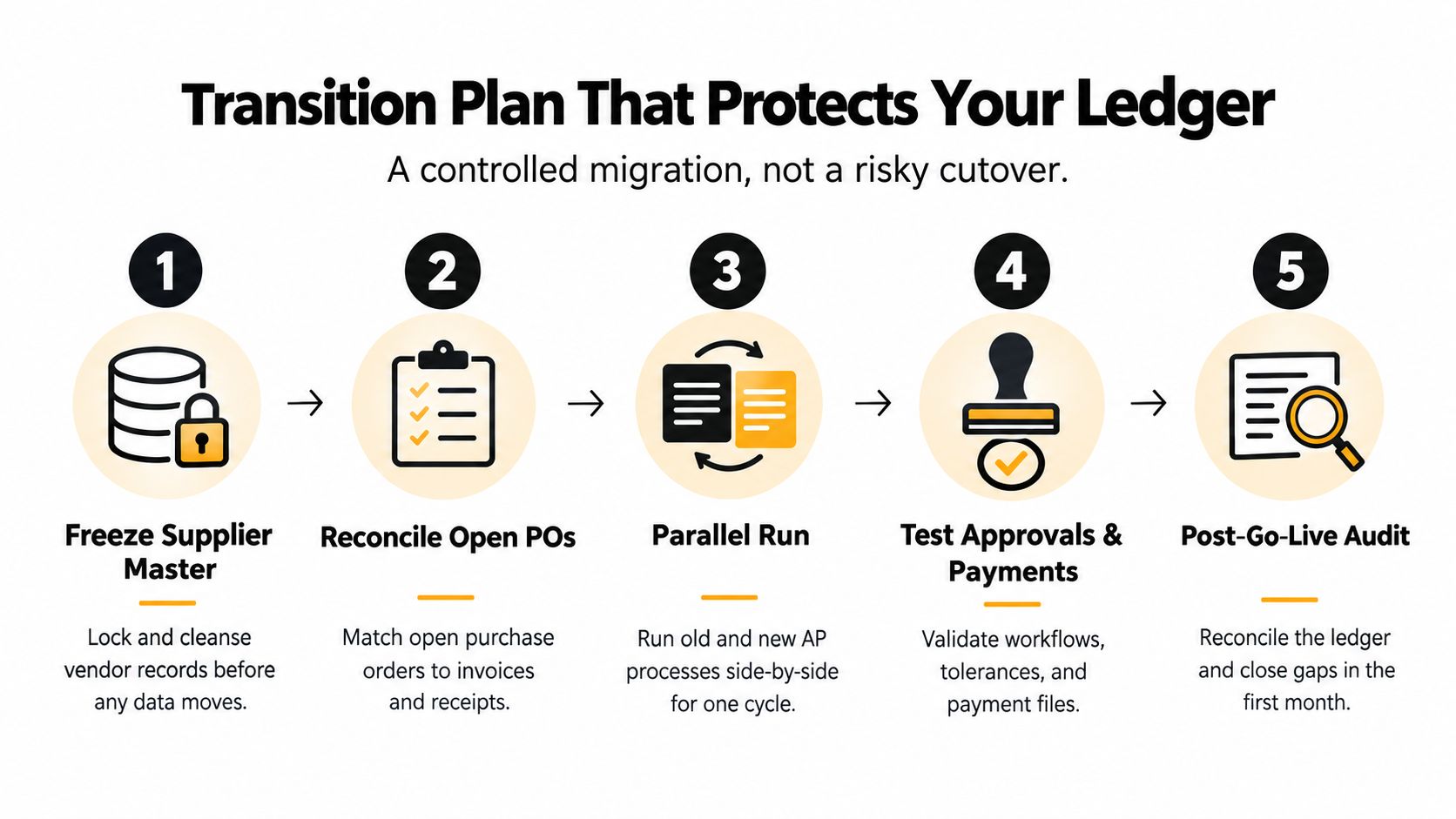
A rushed cutover can damage a clean ledger faster than a weak provider can. Treat the move as a controlled migration, with evidence at every handoff and a clear owner for each unresolved item.
Prepare the data before anyone processes invoices
Freeze the supplier master before migration. Export the current records, identify duplicates, confirm active suppliers and document which fields can change. Don't allow the incoming provider to inherit years of unreviewed supplier data and then blame the system for the resulting exceptions.
Reconcile open purchase orders, unpaid invoices, credit notes and the suspense account. Confirm that historical coding, cost centres and GST treatment will carry across consistently from Xero or MYOB. Agree the export format early, including invoice images and approval history, so you're not trapped in a portal when the engagement ends.
Design the controls during parallel running
Run the provider in shadow mode for a full processing cycle. Your existing team and the provider should process the same invoices, then reconcile coding, matching, approvals, due dates and proposed payment batches. This work feels redundant, but it exposes mismatched rules before the new process becomes the official ledger.
Use the parallel period to finalise the approval matrix. Decide who approves each category, who handles exceptions and who holds payment authority. Don't postpone those decisions until go-live, because ambiguity at the payment stage creates pressure to bypass controls.
Make cutover boring
Your cutover checklist should cover supplier communications, access removal, banking credential rotation, two-factor authentication handover and the first payment batch. Keep payment authority inside the business, and ensure the provider can't use a processing role to release funds without internal approval.
After go-live, hold a 14-day hyper-care window with daily variance reviews. Compare invoice counts, rejected items, duplicate alerts, approval ageing, payment files and general-ledger postings. A founder shouldn't need to inspect every invoice forever, but someone senior must review the first live exceptions closely.
Practical rule: parallel running is cheaper than repairing an inherited ledger.
Most failed migrations skip shadow processing because the business sees it as paying two teams for the same task. That saving is false. The parallel cycle is where you find supplier duplicates, broken integrations, missing cost centres and approval gaps while the old process can still correct them.
Controls, Approvals and the SOPs You Keep In-House
The most dangerous AP outsourcing model gives the provider control over the entire chain. When one external team can create a supplier, process an invoice, approve the spend and release payment, the business has outsourced its defence against duplicate payments and fraudulent changes.
Keep payment authority, supplier-master approval and final spend approval in-house. The provider can receive invoices, extract data, code transactions, match documents, chase approvals and prepare a payment batch. Your finance lead or founder should approve the batch through the bank, with dual authorisation where the banking platform supports it.
Write a short SOP people will use
Your SOP shouldn't be a large policy document that nobody opens. Keep it operational and specific. It should define:
Approval thresholds: Every spend category has a named owner and a limit.
Matching rules: State what happens when an invoice doesn't match a purchase order or receipt.
Duplicate checks: Define the fields checked, including supplier, invoice number, date and amount.
Supplier onboarding: Require independent verification of supplier identity and bank-detail changes.
GST treatment: Document the treatment for common transaction types and escalation rules for unusual items.
Exception handling: Set out who resolves disputes and when an item returns to the finance lead.
Payment release: Require internal authorisation before any bank file is submitted.
For a deeper explanation of why duties should be split, use this guide to segregation of duties. The principle is straightforward. The maker prepares the transaction, the approver confirms the business purpose, and the bank signatory releases the cash.
Use an approval matrix
Below is a practical starting point. Replace the roles with names, then adjust thresholds to your risk profile and spend categories.
Spend Category | Approval Threshold (AUD) | Primary Approver | Secondary Approver |
|---|---|---|---|
Office and operating expenses | Up to AUD 1,000 | Department manager | Finance lead |
Supplier purchases | Up to AUD 5,000 | Operations manager | Finance lead |
Inventory and production inputs | Up to AUD 10,000 | Operations manager | Founder |
Contractors and professional services | Up to AUD 10,000 | Functional owner | Founder |
Capital expenditure | Any amount requiring capital approval | Founder | Finance lead |
The table is a framework, not a substitute for judgement. High-risk categories, unusual suppliers and changes to bank details should receive additional review regardless of the invoice value.
Give the provider read-only access to the bank environment where possible. Require change tickets for supplier edits, retain the approval record and review the SOP quarterly. Controls decay when nobody checks whether the team still follows them.
KPIs and Reporting That Prove the Model Works
An outsourced AP function without reporting is just an expense line with a supplier attached. Start measurement in the first month, before the provider has time to redefine success as “we processed the inbox”.
The most useful dashboard combines speed, cost, quality and cash discipline. Keep it on one page in Xero, MYOB or a shared reporting sheet, then review it during the monthly finance meeting.
Measure the operating outcome
Track these four indicators:
Invoice cycle time: Measure the days from invoice receipt to approval. The Australian AP automation benchmark cited by Nexist reports manual cycles at roughly 14.6 days per invoice, while automated teams can process more than 23,000 invoices per employee annually, compared with about 6,000 in manual setups. See the Australian AP automation benchmark for the source context.
Cost per invoice: Include provider fees, software charges, internal review time and exception handling. An Australian source reports manual costs of about US$15 per invoice, while automated processing can reduce costs from approximately AUD $20 to $25 to AUD $2 to $6, depending on deployment maturity. The figures appear in this Australian AP automation analysis.
Exception rate: Count invoices requiring manual intervention, then classify the cause. A high rate usually points to poor supplier data, unclear coding rules, missing purchase orders or weak matching tolerances.
On-time payment rate: Compare actual payment dates with due dates every week. This reveals whether the process protects supplier relationships and captures available payment terms.
KPI | Manual Baseline | Target After 90 Days | How to Measure |
|---|---|---|---|
Invoice cycle time | Use your measured pre-outsourcing baseline | Set a reduction target after the shadow cycle | Receipt timestamp to approval timestamp |
Cost per invoice | Include labour, tools and rework | Compare total operating cost with the provider quote | Monthly AP cost divided by invoices processed |
Exception rate | Establish from the first parallel cycle | Reduce recurring causes through rule and data fixes | Exceptions divided by total invoices |
On-time payment rate | Measure against supplier due dates | Set a target that reflects agreed terms | Payments made by due date divided by payments due |
Put the SLA behind the numbers
Your service agreement should define turnaround times, escalation windows, error handling, reporting frequency and the treatment of rework. Tie service credits or remediation obligations to measurable failures, not to vague dissatisfaction.
A provider can process invoices quickly while your cash controls deteriorate. That's why speed alone isn't success. The model works when the ledger is accurate, approvals are visible, exceptions fall, and payments leave the bank deliberately.
Common Pitfalls and How to Avoid Them
Founders often assume outsourcing reduces risk because a specialist handles the work. It can, but only when the SME keeps the right decisions and evidence inside the organisation. Otherwise, the provider processes bad data faster.
The failures appear after the contract is signed
Duplicate payments often begin with uncleared supplier records, inconsistent invoice numbers or multiple email channels. Run a supplier de-duplication review before migration, then require the provider to flag matching names, bank details, invoice numbers and amounts before posting.
Supplier-master drift is just as serious. If the outsourcer can add or edit suppliers without an internal ticket, nobody can distinguish a legitimate change from a compromised request. Keep supplier creation and bank-detail approval in-house, and make every change traceable.
Scope creep causes a different kind of damage. Providers may price invoice processing separately from credit notes, purchase-order exceptions, supplier queries, reporting or payment-file preparation. Put the scope, volume assumptions, per-supplier limits and exception fees into the contract.
Protect the exit before you need it
Avoid portals that make your business dependent on one vendor's proprietary workflow. Your agreement should require usable exports of the supplier master, invoice images, coding, approvals, payment records and open exceptions. Confirm the format during onboarding, not after a dispute.
Australian businesses also need a clear compliance process for taxable supplier data. Schedule regular ABN and TFN reconciliation where relevant to your obligations, retain audit evidence and make the provider's responsibilities explicit. For practical guidance on responding to suspicious invoices or recovery activity, review these 2026 invoice fraud recovery steps.
Pitfall | Symptom in Month 1–3 | Mitigation |
|---|---|---|
Duplicate payments | The same supplier or invoice appears more than once | Clean the supplier master and require duplicate checks before posting |
Supplier-master drift | Bank details or supplier records change without an internal record | Use change tickets, internal approval and restricted access |
Scope creep | Extra fees appear for exceptions, queries or credit notes | Define inclusions, caps and rework terms in the contract |
Portal lock-in | The provider can't produce complete records in a usable format | Require open-format exports and test them before go-live |
Approval bypass | Invoices reach payment without the required owner's sign-off | Enforce the approval matrix and retain evidence |
Compliance gaps | Supplier tax records or coding remain incomplete | Assign ownership and reconcile records on a scheduled basis |
Run a 30-day post-go-live review before the first quarterly supplier review. Check duplicate alerts, supplier changes, unresolved exceptions, approval evidence, payment authority, export quality and ledger reconciliations. If any of those controls are unclear, stop expanding the scope until the process is fixed.
Nexist helps Australian SMEs redesign AP workflows, capture and digitise supplier invoices, automate matching and standardise approval rules while keeping payment decisions under business control. If your ledger is carrying duplicate-payment risk or your team is losing time to invoice chasing, visit Nexist and start with a practical review of the process.
accounts payable outsourcing, AP automation Australia, outsource AP, SME cash flow, virtual CFO

" width="24px"/><g d="M 0 24.129 L 0 0.129 L 24 0.129 L 24 24.129 Z M 0 24.129 L 0 0.129 L 24 0.129 L 24 24.129 Z M 24 3 C 24 1.344 22.656 0 21 0 L 3 0 C 1.344 0 0 1.344 0 3 L 0 21 C 0 22.656 1.344 24 3 24 L 21 24 C 22.656 24 24 22.656 24 21 Z M 6.883 8.375 L 2.863 8.375 L 2.863 20.467 L 6.883 20.467 Z M 4.899 2.545 C 3.524 2.545 2.625 3.449 2.625 4.634 C 2.625 5.795 3.496 6.724 4.846 6.724 L 4.872 6.724 C 6.273 6.724 7.146 5.795 7.146 4.634 C 7.12 3.449 6.274 2.545 4.899 2.545 Z M 16.747 8.09 C 14.614 8.09 13.659 9.263 13.124 10.086 L 13.124 8.374 L 9.105 8.374 C 9.159 9.508 9.105 20.466 9.105 20.466 L 13.124 20.466 L 13.124 13.713 C 13.124 13.352 13.15 12.99 13.257 12.732 C 13.547 12.01 14.209 11.262 15.319 11.262 C 16.773 11.262 17.355 12.372 17.355 13.996 L 17.355 20.466 L 21.374 20.466 L 21.374 13.532 C 21.374 9.818 19.391 8.09 16.747 8.09 Z" fill="transparent" height="24.12890599668026px" id="dSFdkJotL" width="24px"><path d="M 0 24 L 0 0 L 24 0 L 24 24 Z" fill="transparent" height="24px" id="wscNJE44G" transform="translate(0 0.129)" width="24px"/><g d="M 0 24.129 L 0 0.129 L 24 0.129 L 24 24.129 Z M 24 3 C 24 1.344 22.656 0 21 0 L 3 0 C 1.344 0 0 1.344 0 3 L 0 21 C 0 22.656 1.344 24 3 24 L 21 24 C 22.656 24 24 22.656 24 21 Z M 6.883 8.375 L 2.863 8.375 L 2.863 20.467 L 6.883 20.467 Z M 4.899 2.545 C 3.524 2.545 2.625 3.449 2.625 4.634 C 2.625 5.795 3.496 6.724 4.846 6.724 L 4.872 6.724 C 6.273 6.724 7.146 5.795 7.146 4.634 C 7.12 3.449 6.274 2.545 4.899 2.545 Z M 16.747 8.09 C 14.614 8.09 13.659 9.263 13.124 10.086 L 13.124 8.374 L 9.105 8.374 C 9.159 9.508 9.105 20.466 9.105 20.466 L 13.124 20.466 L 13.124 13.713 C 13.124 13.352 13.15 12.99 13.257 12.732 C 13.547 12.01 14.209 11.262 15.319 11.262 C 16.773 11.262 17.355 12.372 17.355 13.996 L 17.355 20.466 L 21.374 20.466 L 21.374 13.532 C 21.374 9.818 19.391 8.09 16.747 8.09 Z" fill="transparent" height="24.12890599668026px" id="sTpjGo1tb" width="24px"><path d="M 0 24 L 0 0 L 24 0 L 24 24 Z" fill="transparent" height="24px" id="s7ffpmKOD" transform="translate(0 0.129)" width="24px"/><g d="M 24 3 C 24 1.344 22.656 0 21 0 L 3 0 C 1.344 0 0 1.344 0 3 L 0 21 C 0 22.656 1.344 24 3 24 L 21 24 C 22.656 24 24 22.656 24 21 Z M 6.883 8.375 L 2.863 8.375 L 2.863 20.467 L 6.883 20.467 Z M 4.899 2.545 C 3.524 2.545 2.625 3.449 2.625 4.634 C 2.625 5.795 3.496 6.724 4.846 6.724 L 4.872 6.724 C 6.273 6.724 7.146 5.795 7.146 4.634 C 7.12 3.449 6.274 2.545 4.899 2.545 Z M 16.747 8.09 C 14.614 8.09 13.659 9.263 13.124 10.086 L 13.124 8.374 L 9.105 8.374 C 9.159 9.508 9.105 20.466 9.105 20.466 L 13.124 20.466 L 13.124 13.713 C 13.124 13.352 13.15 12.99 13.257 12.732 C 13.547 12.01 14.209 11.262 15.319 11.262 C 16.773 11.262 17.355 12.372 17.355 13.996 L 17.355 20.466 L 21.374 20.466 L 21.374 13.532 C 21.374 9.818 19.391 8.09 16.747 8.09 Z" fill="transparent" height="24.000006px" id="D0ecaHEcW" transform="translate(0 0)" width="24px"><path d="M 24 3 C 24 1.344 22.656 0 21 0 L 3 0 C 1.344 0 0 1.344 0 3 L 0 21 C 0 22.656 1.344 24 3 24 L 21 24 C 22.656 24 24 22.656 24 21 Z" fill="rgb(55, 184, 218)" height="24.000006px" id="IPLFE6zXx" width="24px"/><path d="M 4.02 0 L 0 0 L 0 12.092 L 4.02 12.092 Z" fill="rgb(255, 255, 255)" height="12.09201px" id="FWhtzAyuY" transform="translate(2.863 8.375)" width="4.02px"/><path d="M 2.274 0 C 0.899 0 0 0.904 0 2.089 C 0 3.25 0.871 4.179 2.221 4.179 L 2.247 4.179 C 3.648 4.179 4.521 3.25 4.521 2.089 C 4.495 0.904 3.649 0 2.274 0 Z" fill="rgb(255, 255, 255)" height="4.17876px" id="VmOsKv4kO" transform="translate(2.625 2.545)" width="4.52095px"/><path d="M 7.641 0 C 5.509 0 4.554 1.173 4.019 1.996 L 4.019 0.284 L 0 0.284 C 0.053 1.419 0 12.376 0 12.376 L 4.019 12.376 L 4.019 5.623 C 4.019 5.262 4.045 4.9 4.151 4.642 C 4.442 3.92 5.103 3.172 6.214 3.172 C 7.667 3.172 8.25 4.282 8.25 5.907 L 8.25 12.376 L 12.269 12.376 L 12.269 5.442 C 12.269 1.728 10.286 0 7.641 0 Z" fill="rgb(255, 255, 255)" height="12.37626px" id="n1XUbhaq0" transform="translate(9.105 8.09)" width="12.268830000000001px"/></g></g></g></g></svg>)