Bookkeeper vs Accountant: A Founder's Guide for 2026
Bookkeeper vs accountant? This guide for Australian SMEs breaks down roles, fees, and when to hire each. Essential for inventory-heavy businesses.
Ansh Malhotra

You're probably in one of two situations right now.
Either your books are behind, BAS is creeping up, payroll feels fragile, and you're spending late nights inside Xero wondering why sales look decent but cash feels tight. Or the basics are technically “done”, yet you still can't answer the question that matters: are you actually making money, and where is it leaking out?
That's the core bookkeeper vs accountant decision. It isn't a semantics exercise. It's a hiring decision that affects compliance, cash flow, and how fast you can grow without breaking the business.
For Australian founders, especially in ecommerce, retail, wholesale, and other stock-heavy businesses, the wrong hire creates a nasty pattern. The bookkeeper keeps the ledger tidy. The accountant appears at tax time. Meanwhile, stock sits too long, margins get chewed up, receivables drift, and no one gives you a hard view on what to fix first.
If you need a quick primer on understanding financial recording and analysis, that resource is useful. But most founders don't need more theory. They need a practical decision.
This guide gives you that decision.
Table of Contents
The Crossroads Every Founder Faces
A founder launches with good intentions. They invoice customers, pay suppliers, run payroll, and promise themselves they'll “sort the finance side properly next month”. Then next month becomes quarter-end, BAS is due, stock has arrived, and cash is tighter than expected.
Now they're reacting to numbers instead of running the business.
That's the crossroads. Bookkeeper vs accountant sounds like an admin question, but it's really a control question. Who's keeping the records current? Who's checking whether those records mean trouble? Who's telling you if your pricing is off, your stock is stale, or your tax position needs attention before it becomes expensive?
Most founders don't have a finance problem first. They have a visibility problem.
I see the same pattern constantly in Australian SMEs. The owner thinks they need “someone for the books”. Sometimes they do. But just as often, they need someone to translate activity into decisions. A clean ledger won't tell you whether to cut a product line, tighten purchasing, or change payment terms.
That's why hiring the wrong person creates frustration on both sides. A bookkeeper gets blamed for not giving strategic advice they were never hired or qualified to provide. An accountant gets dragged into basic cleanup work that burns time and budget.
Here's the blunt version:
If your records are late or messy, start with a bookkeeper.
If your records are current but you still don't trust the numbers, bring in an accountant.
If you're growing and major decisions feel too risky to make from hindsight, you're moving beyond both and into Virtual CFO territory.
Founders lose time when they treat these roles as interchangeable. They're not.
The Core Roles at a Glance
The fastest way to understand bookkeeper vs accountant is this.
A bookkeeper is your financial historian. They record what happened.
An accountant is your financial strategist. They interpret what happened and help you decide what to do next.
That mental model clears up most confusion.

The simplest side by side view
Area | Bookkeeper | Accountant |
|---|---|---|
Primary role | Records transactions and keeps records current | Analyses records and turns them into decisions |
Time horizon | Daily and weekly | Monthly, quarterly, annual, and forward-looking |
Focus | Accuracy, coding, reconciliation, process | Compliance, interpretation, planning, risk |
Typical tools | Xero, MYOB, QuickBooks, payroll and receipt tools | Same core systems plus reporting, tax, forecasting, and advisory workflows |
Best use case | You need order in the numbers | You need judgement from the numbers |
What a bookkeeper actually does
A strong bookkeeper keeps the machine running. They usually handle the repetitive but essential finance tasks that founders either neglect or do badly under pressure.
That includes things like:
Transaction recording: Sales, purchases, expenses, and payments get entered properly.
Bank reconciliation: The books match the bank, not your memory.
Accounts admin: Supplier bills, customer invoices, and overdue balances stay visible.
Payroll support: Wages, super, and recurring pay processes stay organised.
BAS preparation support: The records are kept in shape for BAS work.
What an accountant actually does
An accountant steps back and asks harder questions. Are the books accurate enough for reporting? Is the business structure still right? Are margins slipping? Is tax being managed properly? Are you funding growth with profit or panic?
A clean ledger tells you what happened. An accountant should tell you what it means.
In practice, that means an accountant is far more useful when you need judgement, not just data entry. They're there to prepare and review financial reporting, deal with tax matters, assess compliance, and help you think beyond the next due date.
One more practical point matters in Australia. The workforce mix already leans heavily toward higher-level finance roles. The Future Skills Organisation's analysis reports approximately 490,000 professionals in payroll, bookkeeping, and accounting occupations in 2024, including 199,000 accountants and 94,000 bookkeepers, with 145,000 accounting clerks in the broader mix, which means the market is weighted toward higher-level advisory and compliance capability rather than pure transaction processing according to the Future Skills Organisation Needs and Gaps Analysis.
That doesn't mean every founder needs an accountant first. It means you should be clear about what problem you're trying to solve.
A Detailed Comparison of Responsibilities and Compliance
The overlap between these roles is what confuses founders. Both touch the numbers. Both may work inside Xero or MYOB. Both may talk to the ATO. But the boundary matters, especially once compliance or business complexity rises.
Daily work and outputs
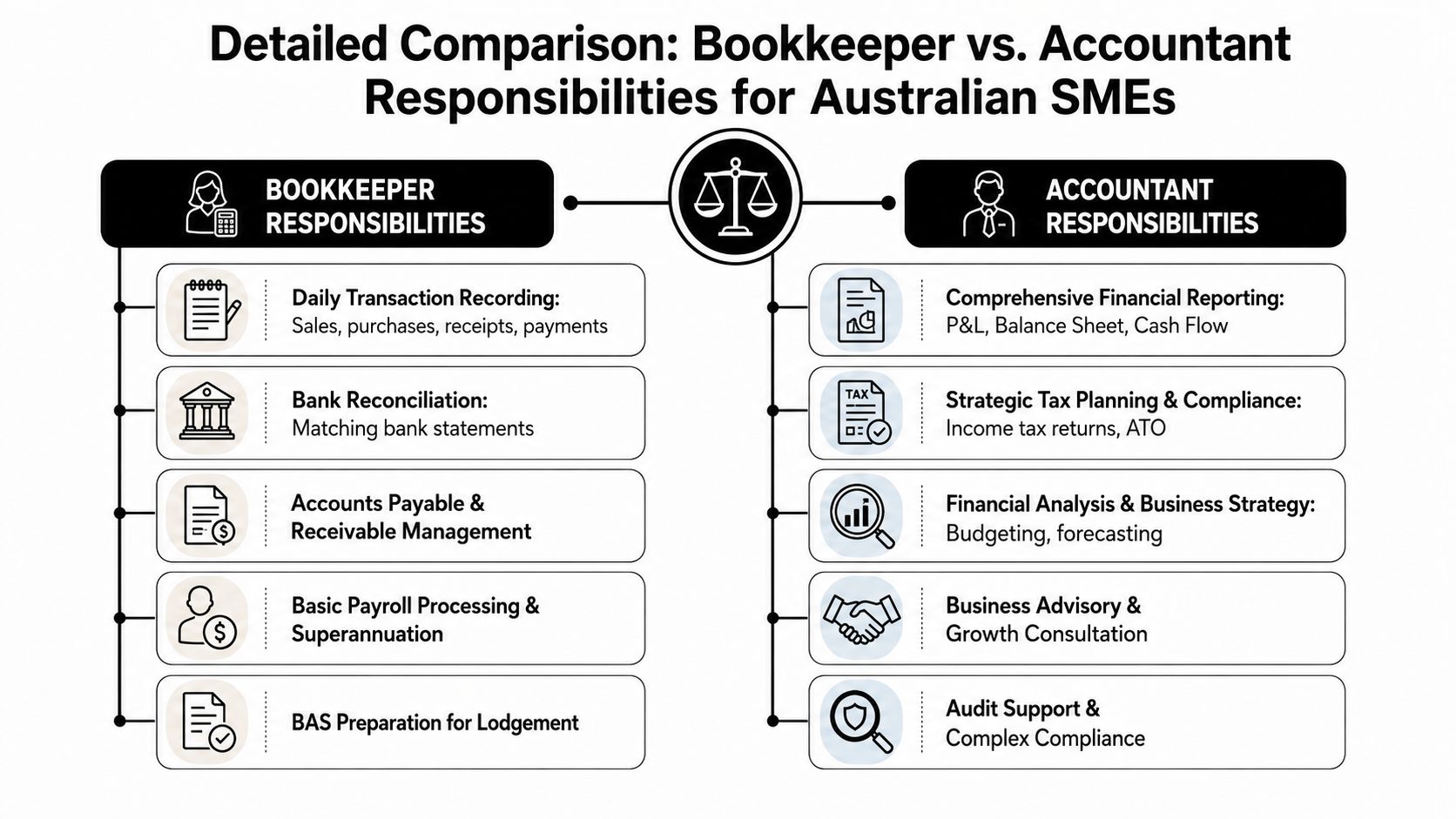
Bookkeepers live in the operational detail. They keep source records current, categorise transactions, reconcile accounts, and maintain the ledger so the business has an up-to-date financial base. If invoices are missing, payroll is inconsistent, or the bank account doesn't reconcile, your bookkeeper is the person closest to that problem.
Accountants work one level up. They use those records to prepare meaningful reports, test whether the outputs are reliable, and identify issues that affect compliance or decisions. If you want a proper profit and loss, balance sheet, tax planning, or a serious view on cash flow, you've crossed into accounting work.
A practical split looks like this:
Bookkeeper work: day-to-day transaction capture, reconciliations, payroll processing, ledger maintenance, BAS-ready records.
Accountant work: financial statement preparation, income tax work, forecasting, business structure advice, strategic review.
Training and judgement
The qualification gap is real. In Australia, accountants generally need a bachelor's degree in accounting and often go on to professional pathways such as CPA or CA, with continuing professional development obligations. Bookkeepers usually don't need a government-accredited degree and often qualify through experience or software-based certifications such as Xero or QuickBooks, as outlined in this Australian overview of accounting and bookkeeping qualifications.
That education gap matters because finance isn't just software proficiency. It's judgement.
A founder can train someone to process invoices. They can't casually outsource tax interpretation, financial forecasting, or advice on cost structure to someone who isn't trained for it.
Practical rule: If the task requires interpretation, not just recording, you're usually outside basic bookkeeping.
The legal line in Australia
Founders get themselves into trouble at this point.
In Australia, only a registered tax agent can lodge an income tax return, while a registered BAS agent can prepare and lodge Business Activity Statements for GST, not income tax, as explained in this guide to Australian tax agent and BAS agent boundaries.
That's not a minor technicality. It's the legal dividing line.
So if you're asking who should help with what, use this test:
Need | Bookkeeper | Accountant |
|---|---|---|
Keep records current | Yes | Sometimes |
Process payroll and maintain ledgers | Yes | Sometimes |
Prepare BAS-related records | Yes, if appropriately registered for BAS work | Yes |
Lodge income tax return | No | Yes, if registered tax agent |
Advise on tax structure and planning | No | Yes |
Founders also underestimate the compliance spillover from poor financial process. If your records are weak, audit prep, tax reviews, and document checks become expensive and stressful. A practical checklist for preventing audit fines and issues is worth reviewing alongside your own compliance habits. And if tax obligations are already getting messy, this overview of tax and compliance support for small business is the type of issue you should be solving before deadlines pile up.
The Financial Investment What to Expect in Fees
Fees matter, but most founders ask the wrong question.
They ask, “Who's cheaper?”
The better question is, “What level of problem am I paying to solve?”
What bookkeepers usually cost
In Australia, bookkeeping rates are materially lower than accounting rates. According to this breakdown of Australian bookkeeper, accountant, and BAS agent pricing, Sydney bookkeepers typically charge $50 to $80 per hour, Melbourne bookkeepers $45 to $75, and regional bookkeepers $35 to $60.
That same source says monthly bookkeeping retainers for small businesses usually range from $200 to $600.
For many early-stage businesses, that's sensible spend. If your pain is unreconciled bank accounts, overdue invoice processing, payroll admin, or poor record-keeping, a bookkeeper usually gives you the best immediate return.
Why accountants cost more
The same pricing source reports Sydney accountants at $200 to $400 per hour, Melbourne accountants at $180 to $350, and regional accountants at $120 to $250, with annual accounting packages for tax returns and financial statements typically ranging from $800 to $2,500.
Yes, the gap is large. That source states the increase can be up to 500% in Sydney. But the comparison is misleading if you think both roles are interchangeable.
You're not paying more for someone to process the same work more expensively. You're paying for different work.
An accountant should earn their fee by handling problems a bookkeeper shouldn't be solving:
Tax complexity: Income tax, structure, deductions, and compliance judgement.
Financial reporting: Proper statements that support lenders, investors, and decision-making.
Forward planning: Budgets, forecasting, and strategic trade-offs.
Risk reduction: Identifying issues before the ATO, lender, or owner discovers them the hard way.
If your business only needs tidy records, don't overspend on an accountant. If your business needs real financial judgement, don't underhire and expect a bookkeeper to bridge the gap.
That's where founders burn money. Not on fees alone, but on mismatch.
When to Hire Who A Decision Framework for Your Business
Most founders don't need a philosophical answer. They need a hiring trigger.
Use this one.

When a bookkeeper is the right hire
Hire a bookkeeper when the core problem is operational finance hygiene.
That usually looks like this:
You're behind on admin: Bank accounts aren't reconciled, receipts are scattered, and the ledger is unreliable.
Payroll feels shaky: You need recurring wage and super processes to happen properly.
BAS prep is stressful: The records exist, but they're disorganised.
You're doing low-value finance work yourself: Founders shouldn't spend prime hours coding transactions.
A bookkeeper is the right first hire when your numbers are too messy to trust at all.
To sharpen that judgement, it helps to understand how Australian finance roles are trained and where the responsibility line sits. This short video gives a useful overview:
When an accountant becomes necessary
Bring in an accountant when the books are no longer the main problem. The decisions are.
You've reached that point if:
You need tax judgement: Not just clean data, but advice on what to do with it.
You want reliable reporting: You need someone to review performance properly, not just produce software outputs.
You're making bigger calls: Expansion, funding, restructuring, hiring, or margin pressure.
You want planning: Budgeting, forecasting, and performance analysis need a higher skill level.
An accountant becomes necessary when hindsight isn't enough.
Why inventory businesses hit this wall sooner
Inventory-heavy businesses should be more aggressive about this upgrade.
Why? Because stock creates a blind spot that basic bookkeeping rarely fixes. A founder sees purchases, sales, and bank movement. But that doesn't automatically reveal whether cash is trapped in slow-moving inventory, whether pricing covers real stock costs, or whether buying decisions are damaging margin.
A specific Australian pain point stands out here. For inventory-heavy SMEs, guidance on bookkeeping and accounting services for stock-based businesses notes that founders often assume bookkeepers can manage complex stock valuation and strategic stock issues, yet those stock traps can leave up to 40% of potential cash flow locked in unsold goods.
That's why ecommerce, retail, wholesale, and manufacturing founders often outgrow pure bookkeeping earlier than service businesses.
If stock is your biggest use of cash, you need someone who can interpret inventory, not just record it.
You'll also get more value if your finance systems are set up properly from the start. Choosing the right stack matters, especially if you want cleaner stock, payroll, and reporting workflows. This guide to small business finance software options is a useful place to review the systems side before complexity gets worse.
From Accountant to Virtual CFO When to Upgrade Your Strategy
There's another shift founders miss. They upgrade from bookkeeper to accountant, then assume the finance function is “handled”.
Often it isn't.
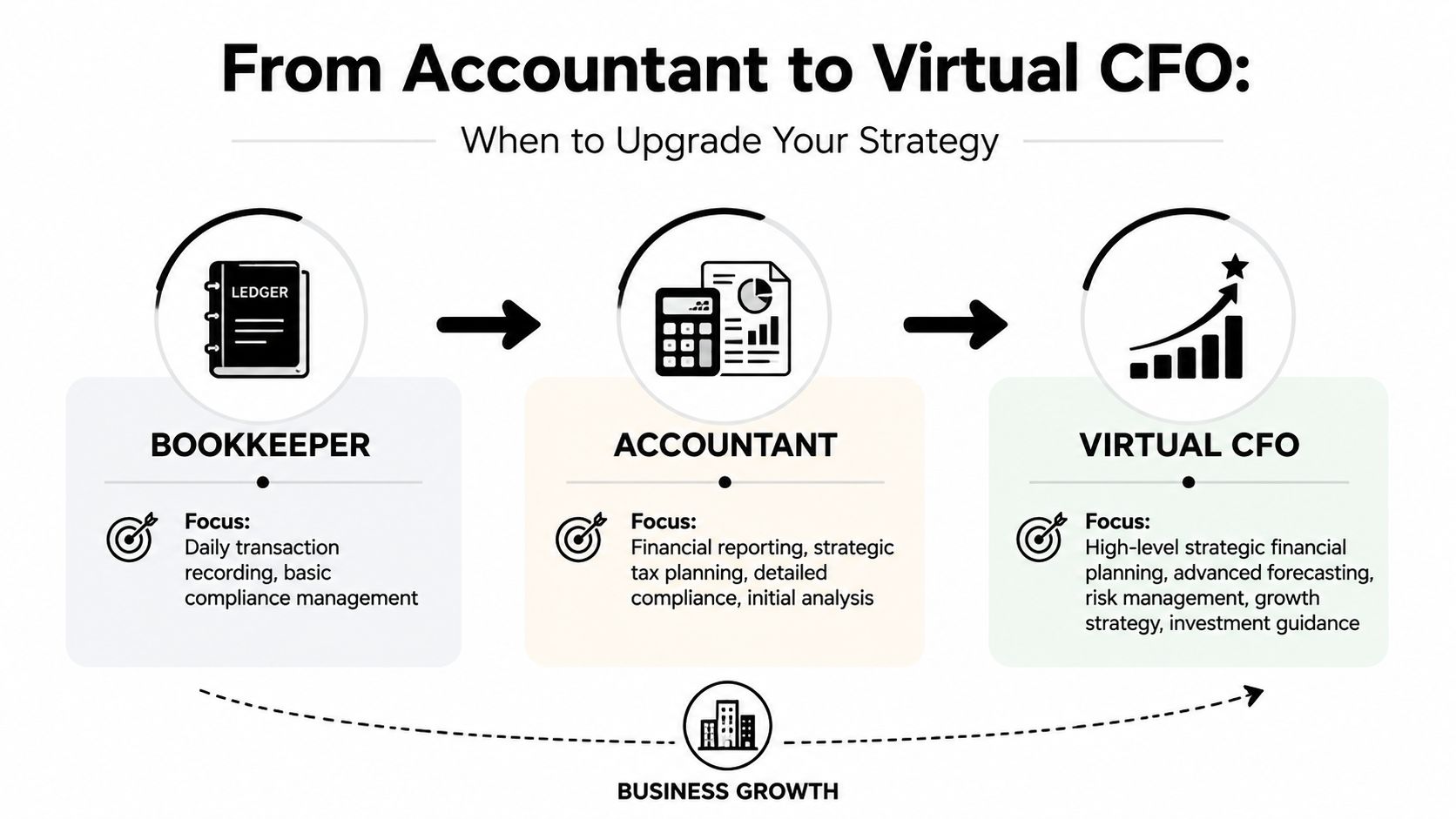
An accountant is vital for reporting, tax, and compliance. But growth-stage businesses usually need something more active. They need a finance partner who helps drive decisions in real time.
What changes at the next stage
A Virtual CFO sits further forward than a traditional accountant.
The role usually includes things like:
Cash flow forecasting: Not just reporting what happened, but planning what's coming.
KPI visibility: Setting performance measures that connect sales, margin, stock, labour, and cash.
Pricing and margin analysis: Working out where profit is leaking.
Decision support: Helping with debt, hiring, expansion, and operating trade-offs.
Systems and automation: Reducing manual finance work so the business can scale cleanly.
A founder who only gets year-end commentary from an accountant is still managing from the rear-view mirror.
The trigger points to stop thinking small
There are clear signs you've outgrown basic support. Guidance on when a bookkeeper stops being enough for growth points to a common ceiling when a business exceeds $500k in revenue or manages complex payroll, because the $60–$120+ hourly cost of a bookkeeper no longer delivers the forecasting and KPI-driven roadmap required for scale.
That threshold won't apply identically to every business, but the logic is sound.
You should start thinking Virtual CFO when:
You're growing but cash still feels unpredictable
Gross profit exists on paper, yet bank balance stays under pressure
You're managing stock, payroll, suppliers, and debt at the same time
You need weekly or monthly decision support, not annual commentary
A Virtual CFO isn't there to replace bookkeeping or accounting. They organise both into a finance function that effectively helps you lead.
If you're at that stage, this overview of a Virtual Chief Financial Officer role for growing businesses gives a good picture of what the upgrade should look like.
Making Your Decision Your Action Plan
If you're still stuck on bookkeeper vs accountant, strip the emotion out of it and answer the operational question in front of you.
Use this checklist
My records are a mess. Start with a bookkeeper.
My books are current, but I don't know what the numbers mean. Hire an accountant.
I'm worried about tax, structure, or compliance risk. Hire an accountant.
Cash is tight because stock keeps eating it. You likely need an accountant, and possibly more than that.
I need forecasts, margin decisions, KPI visibility, and leadership support. Move to a Virtual CFO.
Hire for the bottleneck you have now, not the title that sounds more impressive.
Founders waste time when they expect one role to solve every finance problem. A bookkeeper won't give you strategic financial leadership. An accountant shouldn't spend their time untangling basic admin if the ledger is a mess. And neither role, on its own, guarantees you'll get a clear plan for cash, margin, and growth.
The right sequence is simple. Clean the records. Interpret the numbers. Then use those numbers to drive decisions.
That's how you stop reacting and start leading.
If you want help figuring out whether you need bookkeeping cleanup, stronger accounting, or a proper finance partner, Nexist helps Australian founders get clear on the core issue fast. The goal isn't more reports. It's better cash flow, tighter margins, and a finance function that gives you time back.
bookkeeper vs accountant, small business finance, australian bas agent, virtual cfo australia, inventory accounting

" width="24px"/><g d="M 0 24.129 L 0 0.129 L 24 0.129 L 24 24.129 Z M 0 24.129 L 0 0.129 L 24 0.129 L 24 24.129 Z M 24 3 C 24 1.344 22.656 0 21 0 L 3 0 C 1.344 0 0 1.344 0 3 L 0 21 C 0 22.656 1.344 24 3 24 L 21 24 C 22.656 24 24 22.656 24 21 Z M 6.883 8.375 L 2.863 8.375 L 2.863 20.467 L 6.883 20.467 Z M 4.899 2.545 C 3.524 2.545 2.625 3.449 2.625 4.634 C 2.625 5.795 3.496 6.724 4.846 6.724 L 4.872 6.724 C 6.273 6.724 7.146 5.795 7.146 4.634 C 7.12 3.449 6.274 2.545 4.899 2.545 Z M 16.747 8.09 C 14.614 8.09 13.659 9.263 13.124 10.086 L 13.124 8.374 L 9.105 8.374 C 9.159 9.508 9.105 20.466 9.105 20.466 L 13.124 20.466 L 13.124 13.713 C 13.124 13.352 13.15 12.99 13.257 12.732 C 13.547 12.01 14.209 11.262 15.319 11.262 C 16.773 11.262 17.355 12.372 17.355 13.996 L 17.355 20.466 L 21.374 20.466 L 21.374 13.532 C 21.374 9.818 19.391 8.09 16.747 8.09 Z" fill="transparent" height="24.12890599668026px" id="dSFdkJotL" width="24px"><path d="M 0 24 L 0 0 L 24 0 L 24 24 Z" fill="transparent" height="24px" id="wscNJE44G" transform="translate(0 0.129)" width="24px"/><g d="M 0 24.129 L 0 0.129 L 24 0.129 L 24 24.129 Z M 24 3 C 24 1.344 22.656 0 21 0 L 3 0 C 1.344 0 0 1.344 0 3 L 0 21 C 0 22.656 1.344 24 3 24 L 21 24 C 22.656 24 24 22.656 24 21 Z M 6.883 8.375 L 2.863 8.375 L 2.863 20.467 L 6.883 20.467 Z M 4.899 2.545 C 3.524 2.545 2.625 3.449 2.625 4.634 C 2.625 5.795 3.496 6.724 4.846 6.724 L 4.872 6.724 C 6.273 6.724 7.146 5.795 7.146 4.634 C 7.12 3.449 6.274 2.545 4.899 2.545 Z M 16.747 8.09 C 14.614 8.09 13.659 9.263 13.124 10.086 L 13.124 8.374 L 9.105 8.374 C 9.159 9.508 9.105 20.466 9.105 20.466 L 13.124 20.466 L 13.124 13.713 C 13.124 13.352 13.15 12.99 13.257 12.732 C 13.547 12.01 14.209 11.262 15.319 11.262 C 16.773 11.262 17.355 12.372 17.355 13.996 L 17.355 20.466 L 21.374 20.466 L 21.374 13.532 C 21.374 9.818 19.391 8.09 16.747 8.09 Z" fill="transparent" height="24.12890599668026px" id="sTpjGo1tb" width="24px"><path d="M 0 24 L 0 0 L 24 0 L 24 24 Z" fill="transparent" height="24px" id="s7ffpmKOD" transform="translate(0 0.129)" width="24px"/><g d="M 24 3 C 24 1.344 22.656 0 21 0 L 3 0 C 1.344 0 0 1.344 0 3 L 0 21 C 0 22.656 1.344 24 3 24 L 21 24 C 22.656 24 24 22.656 24 21 Z M 6.883 8.375 L 2.863 8.375 L 2.863 20.467 L 6.883 20.467 Z M 4.899 2.545 C 3.524 2.545 2.625 3.449 2.625 4.634 C 2.625 5.795 3.496 6.724 4.846 6.724 L 4.872 6.724 C 6.273 6.724 7.146 5.795 7.146 4.634 C 7.12 3.449 6.274 2.545 4.899 2.545 Z M 16.747 8.09 C 14.614 8.09 13.659 9.263 13.124 10.086 L 13.124 8.374 L 9.105 8.374 C 9.159 9.508 9.105 20.466 9.105 20.466 L 13.124 20.466 L 13.124 13.713 C 13.124 13.352 13.15 12.99 13.257 12.732 C 13.547 12.01 14.209 11.262 15.319 11.262 C 16.773 11.262 17.355 12.372 17.355 13.996 L 17.355 20.466 L 21.374 20.466 L 21.374 13.532 C 21.374 9.818 19.391 8.09 16.747 8.09 Z" fill="transparent" height="24.000006px" id="D0ecaHEcW" transform="translate(0 0)" width="24px"><path d="M 24 3 C 24 1.344 22.656 0 21 0 L 3 0 C 1.344 0 0 1.344 0 3 L 0 21 C 0 22.656 1.344 24 3 24 L 21 24 C 22.656 24 24 22.656 24 21 Z" fill="rgb(55, 184, 218)" height="24.000006px" id="IPLFE6zXx" width="24px"/><path d="M 4.02 0 L 0 0 L 0 12.092 L 4.02 12.092 Z" fill="rgb(255, 255, 255)" height="12.09201px" id="FWhtzAyuY" transform="translate(2.863 8.375)" width="4.02px"/><path d="M 2.274 0 C 0.899 0 0 0.904 0 2.089 C 0 3.25 0.871 4.179 2.221 4.179 L 2.247 4.179 C 3.648 4.179 4.521 3.25 4.521 2.089 C 4.495 0.904 3.649 0 2.274 0 Z" fill="rgb(255, 255, 255)" height="4.17876px" id="VmOsKv4kO" transform="translate(2.625 2.545)" width="4.52095px"/><path d="M 7.641 0 C 5.509 0 4.554 1.173 4.019 1.996 L 4.019 0.284 L 0 0.284 C 0.053 1.419 0 12.376 0 12.376 L 4.019 12.376 L 4.019 5.623 C 4.019 5.262 4.045 4.9 4.151 4.642 C 4.442 3.92 5.103 3.172 6.214 3.172 C 7.667 3.172 8.25 4.282 8.25 5.907 L 8.25 12.376 L 12.269 12.376 L 12.269 5.442 C 12.269 1.728 10.286 0 7.641 0 Z" fill="rgb(255, 255, 255)" height="12.37626px" id="n1XUbhaq0" transform="translate(9.105 8.09)" width="12.268830000000001px"/></g></g></g></g></svg>)