
Financial Planning of a Company: A 2026 Guide
Master financial planning of a company with our 2026 SME playbook, covering cash flow, budgeting, and sustainable growth strategies.
Ansh Malhotra

You can have a month that looks solid on paper, the sales team is celebrating, and the bank balance still feels tight. Suppliers want payment, payroll is due, BAS is looming, and a customer invoice from six weeks ago still hasn't cleared. That's the challenge many Australian founders are facing, and it's why financial planning of a company has to start with cash, not just profit.
In Australia, small businesses were paid in 53.4 days on average in 2024, versus 47.4 days for the broader economy, according to Xero's Small Business Insights data cited by Accounting Department's summary of those figures. That gap matters because it shows how quickly profits can get trapped in working capital. If you run an inventory-heavy or service business, the timing mismatch between money out and money in can turn a healthy month into a scramble.
Table of Contents
Why Profitable Companies Still Run Out of Cash
A founder I'd recognise anywhere is the one looking at a tidy profit-and-loss statement on Friday afternoon, then staring at the bank account on Monday wondering how to pay the next supplier run. Revenue has landed, orders are moving, and the team is busy. Cash is still trapped in debtors and stock, so the business ends up funding its own growth with pressure instead of spare capacity.
That gap between profit and cash is why annual budgeting alone falls short. The numbers that matter day to day are collections, stock movement, wage timing, GST and BAS timing, and supplier terms. Profit can flatter a business while cash tightens.
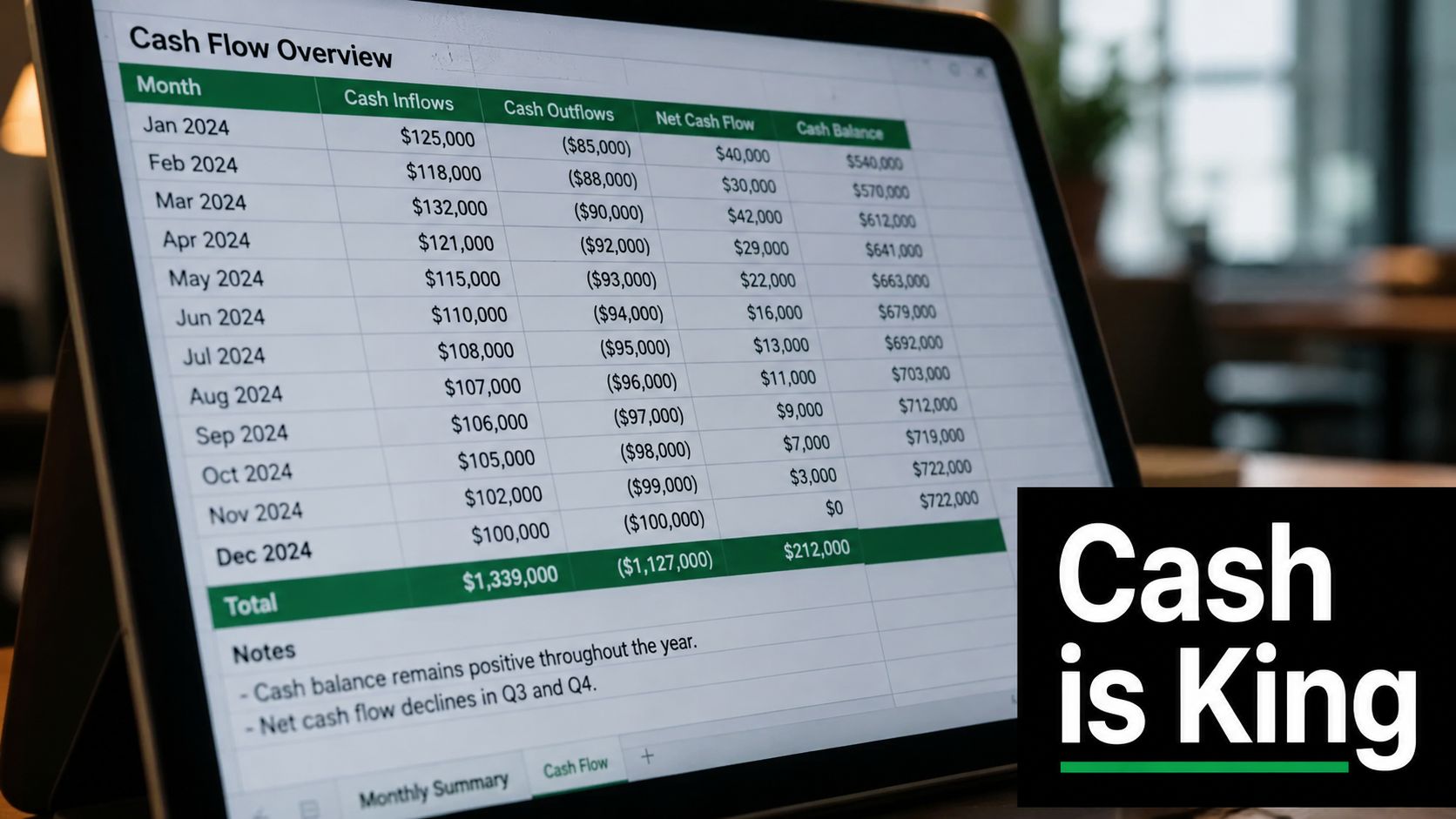
Profit is not the same as liquidity
The practical mistake is treating the P&L as the operating truth. It isn't. A company can look profitable and still miss payroll if collections slip and inventory has already been paid for.
Australian payment delays make that gap harder to ignore. Xero's data shows small-business payment times were still 6.0 days slower than the national average in 2024, as summarised in Accounting Department's summary. That delay hits cash on hand, supplier payment timing, and the room you have to grow.
Practical rule: if the business needs customer receipts to fund next month's wages, the business doesn't have a profit problem first, it has a cash conversion problem first.
The answer is a planning system that sees the timing gap early enough to do something about it. That means receivables tracking, forward cash visibility, and a model that shows when cash lands, not just when revenue is earned. A three-way forecast, like the one outlined in Nexist's three-way forecast guide, gives you a clearer read on profit, cash, and balance sheet pressure together.
Building a Driver-Based Monthly Financial Model
A useful model starts with clean history, not optimistic assumptions. If last year's figures include one-off freight spikes, irregular contractor spend, or a temporary rent relief period, those items need to be separated before they distort the forecast. Otherwise the plan becomes a memorial to bad data.
The right structure is monthly and driver-based. Revenue should be tied to the operational levers that move it, such as units sold, customer count, order value, or project volume. Costs should follow the drivers too, especially COGS, freight, labour, and fulfilment.
Clean the history before you forecast
Historical cleanup is boring, but it saves you from false confidence. Scrub the data, strip out noise, and split recurring spend from inconsistent spend before you build any projections. That's the same logic used in modern FP&A planning blueprints, which emphasise data scrubbing, identifying consistent spend, and ongoing monitoring as the core workflow, as outlined in Mosaic's financial planning blueprint.
Once the data is clean, build the forecast around operational drivers. If sales volumes rise, does freight rise with them? If the business grows, does headcount step up in a block or gradually? If a product line slows, which costs fall, and which ones don't?
A practical model should let you answer those questions quickly. It should also be easy to refresh every month, because the point isn't to create a perfect spreadsheet once, it's to keep a living forecast aligned with reality. If you want a deeper framework for how to connect those pieces, this three-way forecast guide is a useful companion.
A good monthly model doesn't try to predict everything. It makes the big assumptions visible, so you can see which one changed before the bank account does.
Build the forecast from operating decisions
The strongest models link management choices to financial outcomes. If you increase ad spend, what happens to sales volume and cash collection timing? If you extend payment terms to win a bigger account, what happens to debtors and working capital? If freight costs rise, what margin can you still protect before prices need to move?
That's why monthly beats annual. Annual totals can hide a lot of pain. Month-by-month planning forces the business to confront timing, not just totals, and timing is where most SME cash problems begin.
Cash Flow Forecasting Under Late-Payment Pressure
A profitable Australian SME can still hit a cash wall when customers stretch terms and stock sits too long on the shelf. That gap between earning the sale and collecting the cash is what usually strains the bank account first. Profit looks healthy on paper, yet payroll, tax, freight, and supplier payments all want cash now.
A rolling cash forecast gives you the clearest view of that pressure. Build it over 12 months, then update it with actuals each month so you can see receipts, supplier payments, wages, tax, debt service, and planned spending before the account gets tight. It also lets you test what happens when receipts land late again, because that is often the pattern.
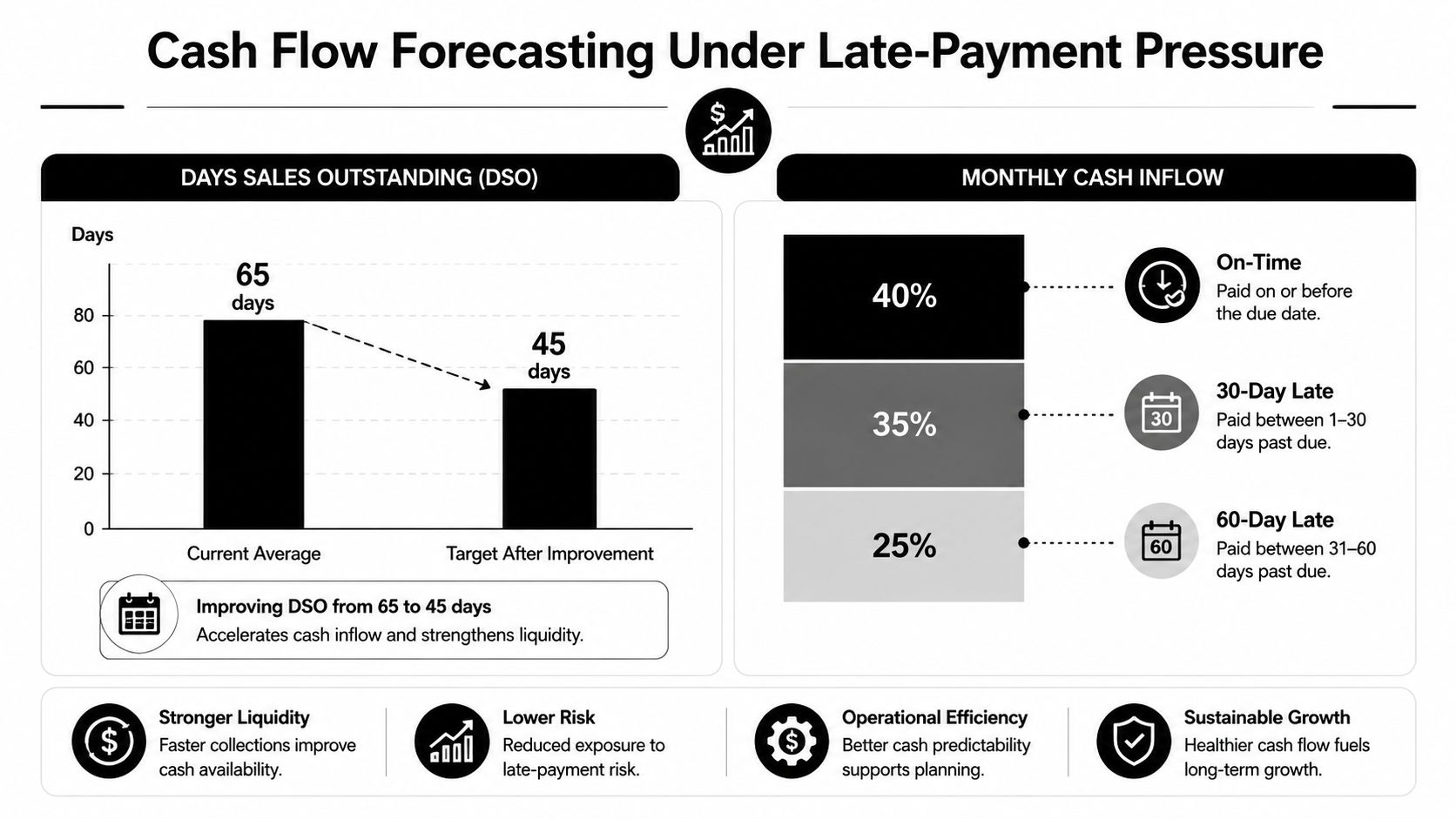
The forecast should not be a spreadsheet exercise for its own sake. It should show when the business is heading into a squeeze, so you can slow stock purchases, tighten collections, or cut discretionary spend before the pressure turns urgent. That matters most in inventory-heavy businesses, where supplier invoices often go out long before customer cash comes back in.
Build buffers around real-world timing
For small-business cash planning, a reserve equal to 3-6 months of operating expenses is a practical benchmark cited in Texas Capital Bank's business planning guidance. That does not mean every SME can hold that buffer immediately. It means the business needs to know the gap, measure it accurately, and build toward a reserve that matches how uneven the cash cycle really is.
Scenario planning deserves the same attention. Best, base, and worst cases force you to test what happens if customers pay later than promised, sales soften, or freight costs bite harder than expected. If the worst case breaks the business, the forecast is not doing its job.
Receivables discipline is where the highest-impact area often starts. Which invoices are late, why are they late, and what is the recovery path? A strong AR process shortens the cash gap by making collections active rather than passive, and accounts receivable management gives a practical starting point for that side of the ledger.
Use the right controls, not just more spreadsheets
Automation helps, but only when it reinforces discipline. Automated invoicing, payment reminders, and clear terms can reduce friction, yet they will not fix weak credit control. The forecast still needs realistic assumptions about who pays on time, who does not, and how much slack the business can afford.
Inventory-heavy sellers also need a sharper view of stock timing, which is why the Online Brand Growth inventory forecast is a useful reference. If your cash cycle is being squeezed by stock orders that arrive long before sales do, that is the part of the model that needs the most attention.
Optimising Margins and Inventory for Real Cash Release
Cash doesn't only improve when sales rise. It improves when margin leaks stop and stock stops sitting around without turning back into money. In many SMEs, the biggest cash release comes from fixing the business model underneath the reporting, not from adding more revenue on top of the same structure.
Price, stock, and terms are one system
Pricing changes should be treated as cash decisions, not just revenue decisions. If a product line earns volume but weak margin, it can consume working capital faster than it creates it. The same logic applies to slow-moving stock, which ties up cash on the shelf while also creating the risk of markdowns later.
Supplier terms matter for the same reason. If you can extend payment timing without damaging the relationship or losing buying power, you've improved the cash cycle. That's not about delaying everything, it's about matching outflows more intelligently to inflows.
For more detail on how stock flows through the accounts, inventory valuation methods is a useful reference point. The accounting treatment matters because it shapes how visible stock costs are, but the operational question is still the same, how fast does each dollar in inventory come back?
The fastest cash release usually isn't a dramatic restructure. It's a series of small moves, tighter stock orders, clearer pricing, and better debtor follow-up.
Find the leaks before you scale
The most common cash leaks sit in four places, pricing, inventory, receivables, and process friction. A product can sell well and still drain cash if the order cycle is too long, the stock policy is loose, or the collection process is passive. Service businesses have their own version of the same problem, where unbilled work or slow invoicing creates an invisible drain.
Real-time visibility helps. A real time financial reporting guide is useful if you're trying to get faster read-through on what's changing week to week. The point isn't to drown the team in dashboards. It's to spot the decisions that affect cash while there's still time to act.
A founder should ask three blunt questions each month. Which stock is moving too slowly? Which accounts are drifting late? Which margin lines are too thin to justify the working capital they consume? Once those answers are visible, the cash release opportunities usually become obvious.
KPIs and Reporting That Drive Decisions Not Just Dashboards
Most reporting is too backward-looking to help. By the time a profit report lands, the business has already made the decision it should have been using the report to influence. A better rhythm is shorter, simpler, and tied directly to the plan.
The KPI set needs to match the business model. For a stock-heavy business, cash conversion, stock turn, and debtor timing matter more than a polished dashboard full of vanity measures. For a service business, pipeline quality and utilisation may matter more, but the principle is the same, every metric should connect to cash, margin, or capacity.
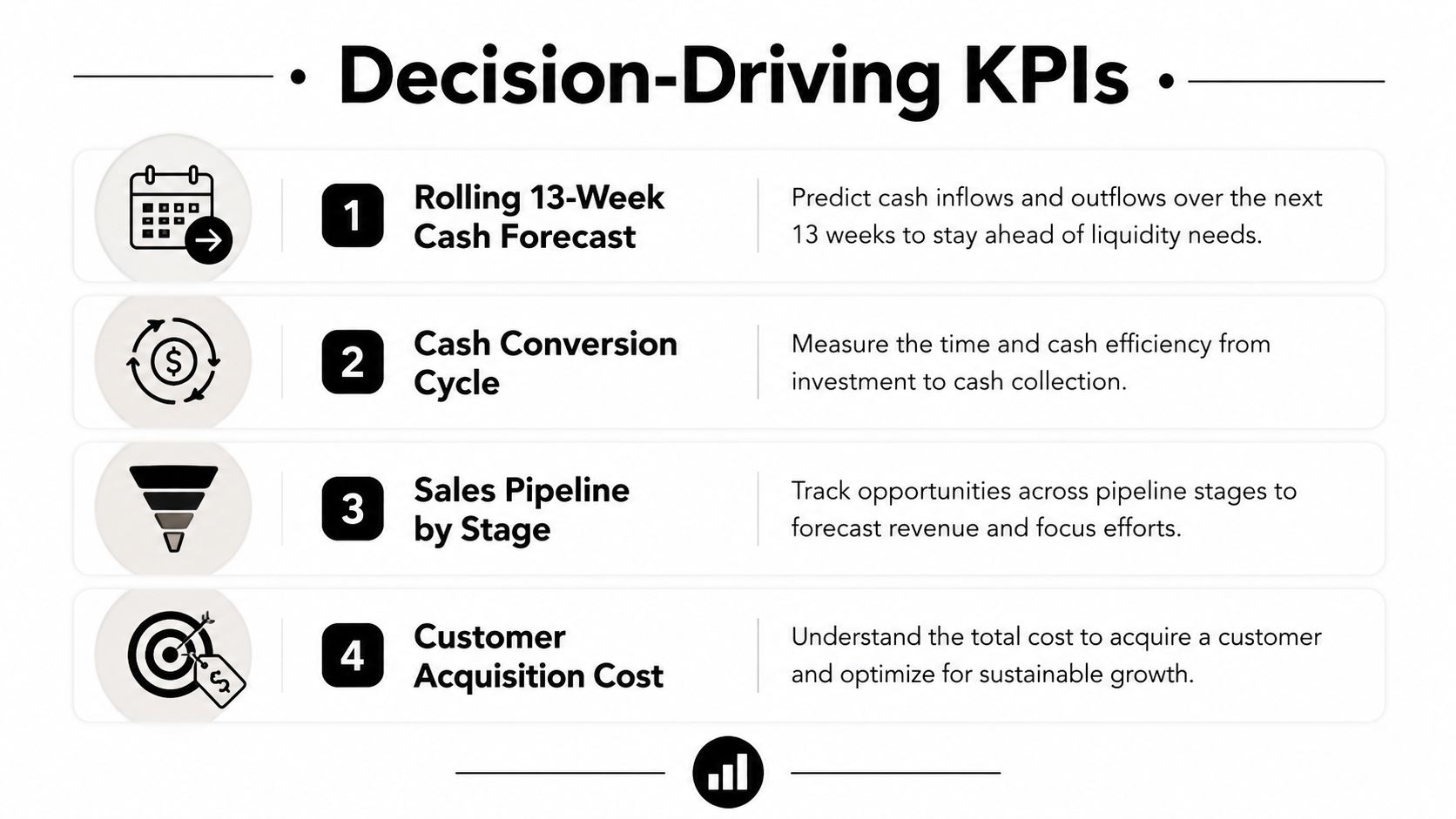
Choose metrics that force action
A useful reporting pack usually includes a rolling cash view, a receivables picture, a stock movement view if relevant, and a sales or pipeline summary if growth is still being built. The point is not to report everything. The point is to report the numbers that change decisions.
For a practical distinction between measures and true KPIs, Oviond's guide on KPIs versus metrics is a helpful reference. The distinction matters because a business can drown in activity measures and still miss the one metric that changes behaviour.
Build the monthly rhythm around variance
The reporting rhythm should feed the forecast, not sit beside it. Compare actuals against plan, ask where the gap came from, and decide whether the gap is one-off noise or a sign the model needs updating. That's how reporting becomes a control system instead of a history lesson.
If a monthly report doesn't change a decision, it's probably too long, too late, or tracking the wrong thing.
Keep the meeting short and focused. Review the KPI set, identify the variance, and assign an owner to fix the issue before the next cycle. That discipline is what turns numbers into action, and action into better cash.
Choosing Tools and Support for Lean Finance Teams
Australian SMEs rarely have large finance teams. That means the tools have to suit the business stage, the founder's own fluency with numbers, and the amount of operational complexity sitting in the background. A clean spreadsheet may be enough for an early-stage service firm, but it won't stay enough for long if inventory, payroll, and collections are all moving at once.
The benchmark is clear. In a 2024 Gartner-based snapshot cited by Cube Software, the median organisation spent 1.26% of company revenue on finance overall, with 24% of finance spend going to accounting and reporting, 20% to transactional finance, and 19% to FP&A, according to Cube's FP&A statistics summary. The same summary notes that organisations with under US$250 million in revenue employed 131.5 full-time finance staff per US$1 billion of revenue, and AFP's 2025 data showed 100% of FP&A professionals used spreadsheets for planning and reporting at least quarterly, while 66% used workflow automation tools at least quarterly, also cited in that source. The message is simple, spreadsheets are universal, but they're no longer the whole answer.
Compare the common support models
Approach | Best For | Typical Cost Range | Key Limitation |
|---|---|---|---|
In-house bookkeeper plus spreadsheet model | Very small businesses with simple operations | Lower cost, but often time-intensive | Limited forecasting depth and weak scenario discipline |
Spreadsheet plus workflow automation | SMEs with recurring reporting and regular invoicing | Moderate software and setup cost | Still depends on good process design and clean inputs |
Virtual CFO support | Founders who need strategic cash, margin, and planning oversight | Ongoing advisory cost | Less useful if the business won't implement actions |
Full planning platform plus finance advisor | Businesses with multiple drivers, stock, or fast growth | Higher combined cost | More setup effort and stronger data discipline required |
The right choice depends on what's hurting most. If reporting is late but simple, better automation may be enough. If decisions keep being made without a clear cash view, strategic finance support is probably the gap.
Nexist is one option in that support mix, because it combines planning, cashflow management, reporting, and operational finance work into one advisory model for Australian founders. That kind of setup makes sense when the problem isn't just software, it's the discipline to keep the model current and the business decisions aligned.
Making Financial Planning Your Operating System
Financial planning of a company works when it stops being an annual event and becomes part of how the business runs. The useful shift is from reactive bookkeeping to a steady operating rhythm, where cash, margin, and working capital get reviewed before they become a crisis. That's the difference between a business that reacts and a business that can steer.
Start with the cash conversion gap. Build a rolling forecast, make one owner responsible for debtor timing, and review the numbers monthly against the plan. If the business is inventory-heavy, stock decisions need to sit in the same conversation as cash, not in a separate operational silo.
Progress beats perfection here. A rough forecast that gets updated and used will outperform a polished one that nobody opens. Once the rhythm is in place, the planning system starts giving back time, because there are fewer surprises and less firefighting.
If you want this turned into a working finance rhythm for your business, Nexist can help build the cash forecast, reporting cadence, and decision structure around how your company trades. The goal is to put more real cash in the bank, reduce the weekly scramble, and give you a planning system you'll use.
financial planning, cash flow forecasting, SME finance, virtual CFO, business budgeting

" width="24px"/><g d="M 0 24.129 L 0 0.129 L 24 0.129 L 24 24.129 Z M 0 24.129 L 0 0.129 L 24 0.129 L 24 24.129 Z M 24 3 C 24 1.344 22.656 0 21 0 L 3 0 C 1.344 0 0 1.344 0 3 L 0 21 C 0 22.656 1.344 24 3 24 L 21 24 C 22.656 24 24 22.656 24 21 Z M 6.883 8.375 L 2.863 8.375 L 2.863 20.467 L 6.883 20.467 Z M 4.899 2.545 C 3.524 2.545 2.625 3.449 2.625 4.634 C 2.625 5.795 3.496 6.724 4.846 6.724 L 4.872 6.724 C 6.273 6.724 7.146 5.795 7.146 4.634 C 7.12 3.449 6.274 2.545 4.899 2.545 Z M 16.747 8.09 C 14.614 8.09 13.659 9.263 13.124 10.086 L 13.124 8.374 L 9.105 8.374 C 9.159 9.508 9.105 20.466 9.105 20.466 L 13.124 20.466 L 13.124 13.713 C 13.124 13.352 13.15 12.99 13.257 12.732 C 13.547 12.01 14.209 11.262 15.319 11.262 C 16.773 11.262 17.355 12.372 17.355 13.996 L 17.355 20.466 L 21.374 20.466 L 21.374 13.532 C 21.374 9.818 19.391 8.09 16.747 8.09 Z" fill="transparent" height="24.12890599668026px" id="dSFdkJotL" width="24px"><path d="M 0 24 L 0 0 L 24 0 L 24 24 Z" fill="transparent" height="24px" id="wscNJE44G" transform="translate(0 0.129)" width="24px"/><g d="M 0 24.129 L 0 0.129 L 24 0.129 L 24 24.129 Z M 24 3 C 24 1.344 22.656 0 21 0 L 3 0 C 1.344 0 0 1.344 0 3 L 0 21 C 0 22.656 1.344 24 3 24 L 21 24 C 22.656 24 24 22.656 24 21 Z M 6.883 8.375 L 2.863 8.375 L 2.863 20.467 L 6.883 20.467 Z M 4.899 2.545 C 3.524 2.545 2.625 3.449 2.625 4.634 C 2.625 5.795 3.496 6.724 4.846 6.724 L 4.872 6.724 C 6.273 6.724 7.146 5.795 7.146 4.634 C 7.12 3.449 6.274 2.545 4.899 2.545 Z M 16.747 8.09 C 14.614 8.09 13.659 9.263 13.124 10.086 L 13.124 8.374 L 9.105 8.374 C 9.159 9.508 9.105 20.466 9.105 20.466 L 13.124 20.466 L 13.124 13.713 C 13.124 13.352 13.15 12.99 13.257 12.732 C 13.547 12.01 14.209 11.262 15.319 11.262 C 16.773 11.262 17.355 12.372 17.355 13.996 L 17.355 20.466 L 21.374 20.466 L 21.374 13.532 C 21.374 9.818 19.391 8.09 16.747 8.09 Z" fill="transparent" height="24.12890599668026px" id="sTpjGo1tb" width="24px"><path d="M 0 24 L 0 0 L 24 0 L 24 24 Z" fill="transparent" height="24px" id="s7ffpmKOD" transform="translate(0 0.129)" width="24px"/><g d="M 24 3 C 24 1.344 22.656 0 21 0 L 3 0 C 1.344 0 0 1.344 0 3 L 0 21 C 0 22.656 1.344 24 3 24 L 21 24 C 22.656 24 24 22.656 24 21 Z M 6.883 8.375 L 2.863 8.375 L 2.863 20.467 L 6.883 20.467 Z M 4.899 2.545 C 3.524 2.545 2.625 3.449 2.625 4.634 C 2.625 5.795 3.496 6.724 4.846 6.724 L 4.872 6.724 C 6.273 6.724 7.146 5.795 7.146 4.634 C 7.12 3.449 6.274 2.545 4.899 2.545 Z M 16.747 8.09 C 14.614 8.09 13.659 9.263 13.124 10.086 L 13.124 8.374 L 9.105 8.374 C 9.159 9.508 9.105 20.466 9.105 20.466 L 13.124 20.466 L 13.124 13.713 C 13.124 13.352 13.15 12.99 13.257 12.732 C 13.547 12.01 14.209 11.262 15.319 11.262 C 16.773 11.262 17.355 12.372 17.355 13.996 L 17.355 20.466 L 21.374 20.466 L 21.374 13.532 C 21.374 9.818 19.391 8.09 16.747 8.09 Z" fill="transparent" height="24.000006px" id="D0ecaHEcW" transform="translate(0 0)" width="24px"><path d="M 24 3 C 24 1.344 22.656 0 21 0 L 3 0 C 1.344 0 0 1.344 0 3 L 0 21 C 0 22.656 1.344 24 3 24 L 21 24 C 22.656 24 24 22.656 24 21 Z" fill="rgb(55, 184, 218)" height="24.000006px" id="IPLFE6zXx" width="24px"/><path d="M 4.02 0 L 0 0 L 0 12.092 L 4.02 12.092 Z" fill="rgb(255, 255, 255)" height="12.09201px" id="FWhtzAyuY" transform="translate(2.863 8.375)" width="4.02px"/><path d="M 2.274 0 C 0.899 0 0 0.904 0 2.089 C 0 3.25 0.871 4.179 2.221 4.179 L 2.247 4.179 C 3.648 4.179 4.521 3.25 4.521 2.089 C 4.495 0.904 3.649 0 2.274 0 Z" fill="rgb(255, 255, 255)" height="4.17876px" id="VmOsKv4kO" transform="translate(2.625 2.545)" width="4.52095px"/><path d="M 7.641 0 C 5.509 0 4.554 1.173 4.019 1.996 L 4.019 0.284 L 0 0.284 C 0.053 1.419 0 12.376 0 12.376 L 4.019 12.376 L 4.019 5.623 C 4.019 5.262 4.045 4.9 4.151 4.642 C 4.442 3.92 5.103 3.172 6.214 3.172 C 7.667 3.172 8.25 4.282 8.25 5.907 L 8.25 12.376 L 12.269 12.376 L 12.269 5.442 C 12.269 1.728 10.286 0 7.641 0 Z" fill="rgb(255, 255, 255)" height="12.37626px" id="n1XUbhaq0" transform="translate(9.105 8.09)" width="12.268830000000001px"/></g></g></g></g></svg>)