Business Risk Management for SMEs: Build Resilience
Learn practical business risk management for Australian SMEs. Identify, assess, and mitigate risks to protect cash flow, inventory, and profits. Build
Ansh Malhotra

Many founders think they have a risk problem when their actual problem is cash.
It usually shows up the same way. Sales are moving, the team is busy, invoices are going out, and the business looks fine from the outside. Then payroll week lands at the same time as a supplier bill, a BAS obligation, and a customer who still hasn't paid. Suddenly the pressure isn't abstract. It's immediate, personal, and sitting in your bank account.
That's why business risk management matters. Not as a compliance exercise. Not as a boardroom document that gets updated once a quarter. It matters because risk is what drains cash, traps working capital, slows decisions, and forces founders to delay growth.
Australian SMEs feel this directly. 61% of Australian small businesses report cash flow as their primary risk, and 47% of Australian businesses cancelled growth plans due to cash flow uncertainty, according to Nexist's summary of the 2025 NAB SME Survey. Those numbers explain why many founders feel busy but not secure. The problem isn't only profit. It's exposure.
A stock ordering mistake ties up cash. Weak receivables follow-up stretches collection times. One cyber incident creates recovery costs you didn't budget for. A key staff absence slows delivery and pushes invoices out by another week. None of that looks like “risk management” on paper. In real business, it's exactly what it is.
Business risk management works when it answers one question fast: what could hit cash next, and what control do we have over it?
If you want a practical starting point, build your thinking around reserves, liquidity, and timing, not just policy. A useful companion to that is this guide on cash reserves for business, because resilience starts with cash you can access when something goes wrong.
Table of Contents
The Four Stages of a Risk Management Framework
A useful risk framework should feel less like paperwork and more like navigation.
Think of your business as a vessel crossing open water. Conditions change. Suppliers miss dates. customers pay late. Systems fail. Staff leave. You don't control the weather, but you do control whether you've checked the horizon, adjusted course, and prepared the crew.
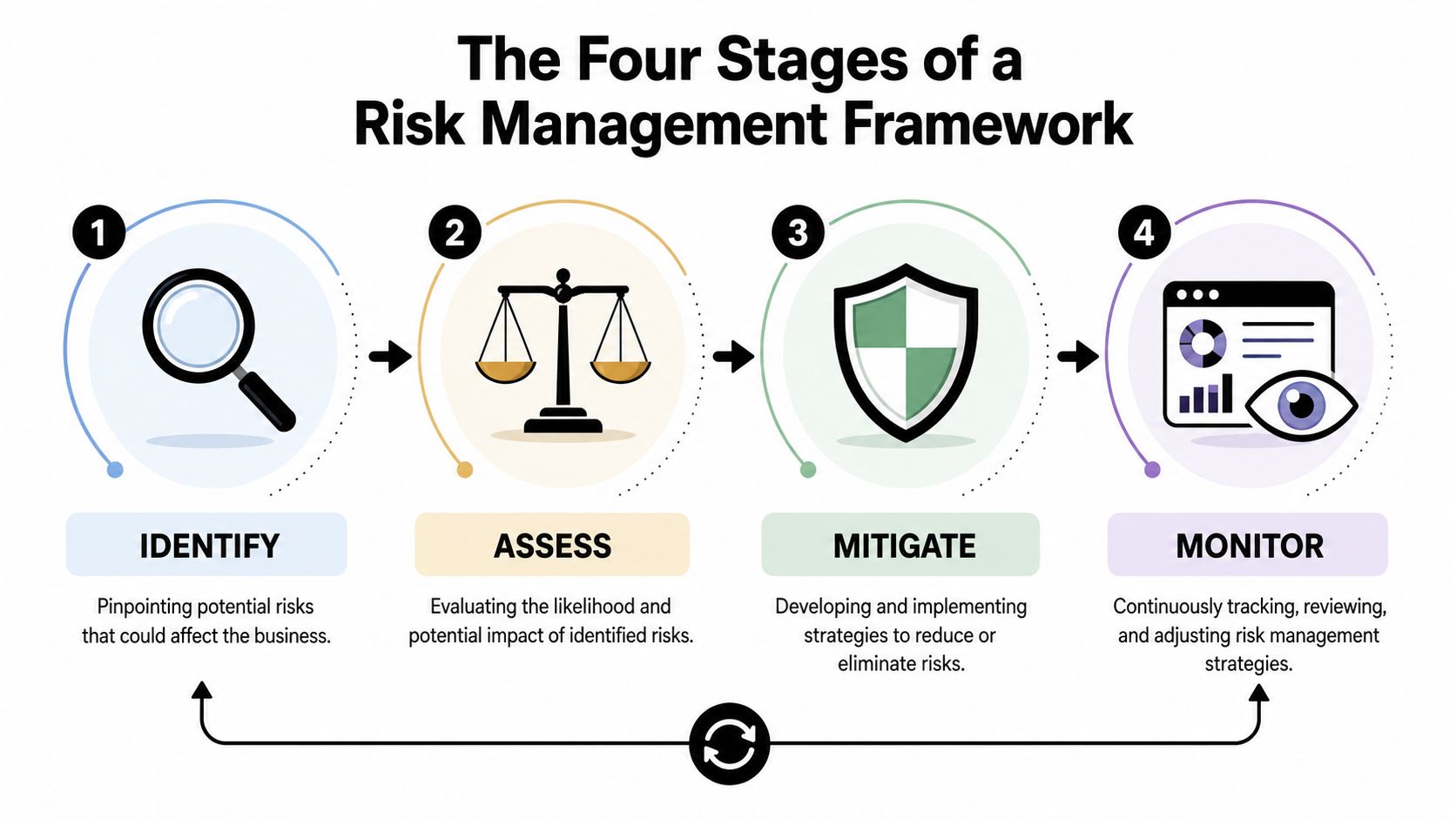
Identify what can actually hurt the business
This is the horizon scan.
Founders often start too broadly and end up with a useless list: recession, competition, regulation, staffing, technology. That isn't wrong, but it doesn't help anyone act. Good identification is specific. Which customer concentration could create a cash gap? Which supplier delay would stop delivery? Which single person holds a process in their head?
A practical way to identify risk is to walk through the business by function:
Sales and revenue: Pipeline quality, pricing discipline, customer concentration
Operations: Delivery bottlenecks, supplier dependence, workflow breakdowns
Finance: Receivables ageing, margin leakage, reporting delays
People: Key-person reliance, training gaps, unsafe work practices
Systems: Access control, backups, approvals, cyber exposure
Assess the size and timing of the hit
Once a risk is visible, the next question is simple. If this happens, what does it do to cash, margin, and time?
Many teams assess risk in vague language such as high, medium, or low and stop there. That's not enough. A founder needs to know whether the impact is immediate or slow, recoverable or compounding, isolated or business-wide.
Use two filters:
Filter | What to ask |
|---|---|
Likelihood | How plausible is this in normal trading conditions? |
Impact | If it happens, what gets hit first: cash, gross margin, delivery, compliance, or team capacity? |
A late-paying customer might look manageable until you map the timing against wages and supplier terms. A minor system issue might be tolerable until you realise it stops invoicing for two days.
Practical rule: If a risk can't be translated into an operational or financial consequence, it's still too vague.
Mitigate with controls people will actually use
Mitigation is where many risk programmes fail. The control exists, but no one follows it because it's too complex, too slow, or owned by nobody.
Good controls are plain. They fit normal workflows. They reduce dependency on memory and heroics. Examples include approval thresholds, reorder triggers, customer credit limits, documented handovers, bank reconciliation routines, and incident playbooks.
The test is practical. If your operations manager is away, can someone else still follow the process without guessing?
Monitor before small issues become cash events
Monitoring is what keeps the framework alive.
This isn't about holding more meetings. It's about watching the few indicators that show whether risk is rising. A founder doesn't need fifty dashboards. They need early warning signs. Debtors stretching. Gross margin drifting. Stock ageing. A spike in exceptions. Too many manual overrides.
A simple monthly cadence works for most SMEs:
Review movements: What changed since last month?
Check controls: Which controls failed, stalled, or were ignored?
Escalate quickly: Which issue now needs a decision, not more reporting?
Update ownership: Who fixes it, and by when?
That cycle keeps business risk management grounded in action. Not theory.
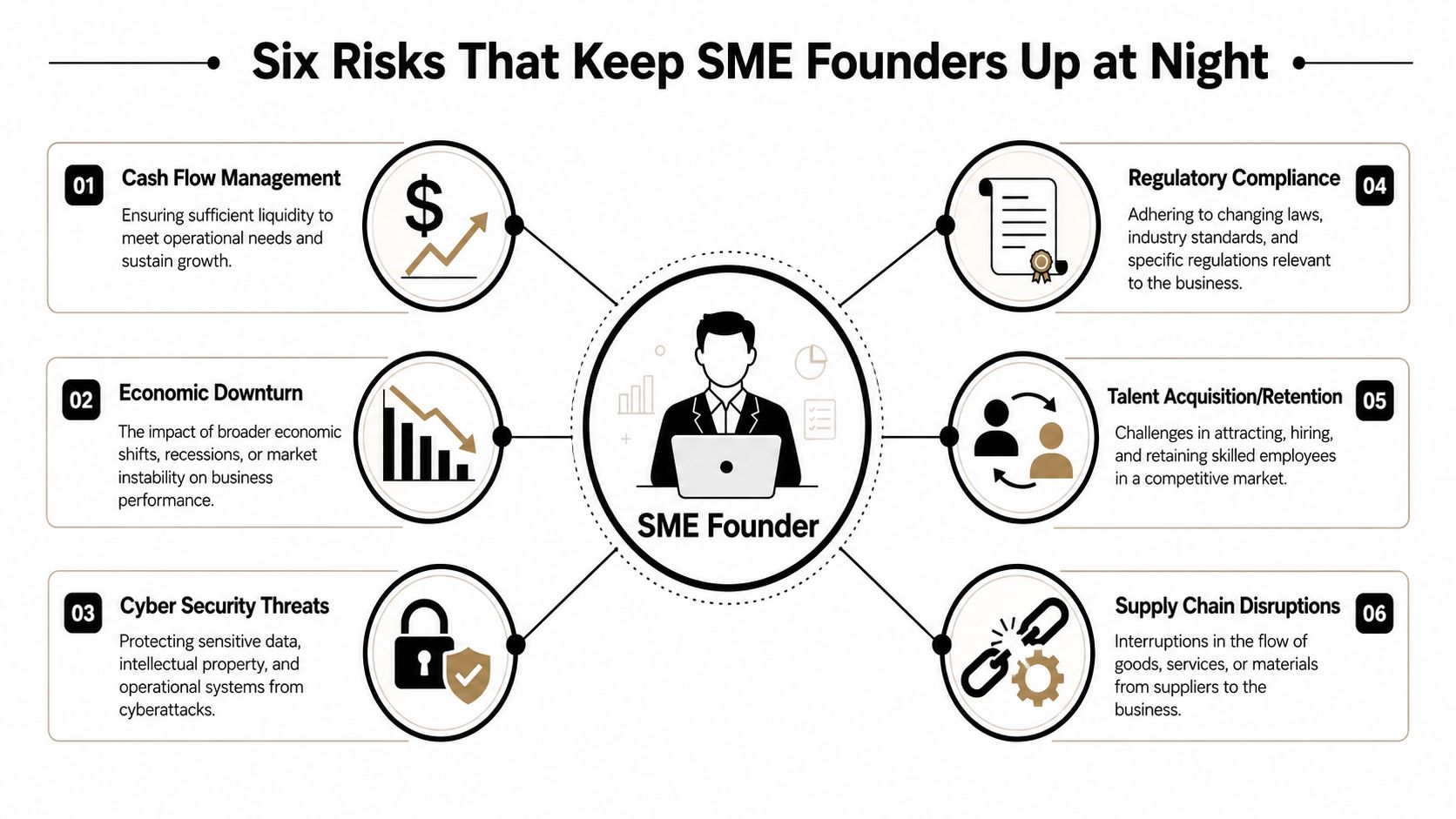
Six Risks That Keep SME Founders Up at Night
It's 4:30 pm on a Thursday. Payroll is due tomorrow, two customer payments have slipped, one supplier is chasing an overdue bill, and your best operations person is off sick. Nothing has "gone wrong" in a dramatic sense. But cash is tighter than it should be, decisions are slower, and the week starts to run the business instead of the other way around.
That's how risk shows up in most SMEs. Founders rarely talk about strategic, operational, or compliance categories. They feel risk through delayed cash, trapped working capital, missed delivery dates, and time lost fixing preventable issues.
Cash flow risk
Cash flow risk is usually the first pressure point and the fastest way to lose options.
A business can look busy and still be under strain. Margin slips on a few jobs. Debtor days stretch. Payroll rises ahead of revenue. GST, super, and supplier payments arrive on schedule, even when customer cash does not. The gap gets funded somewhere, usually from the owner's sleep, the overdraft, or both.
The practical question is simple. How many weeks of weak collections can the business absorb before you need to delay something important?
Inventory risk
Inventory risk ties up cash steadily.
Founders often spot obvious overstock, but the bigger issue is usually mix. Too much money sitting in slow-moving lines. Reorders based on habit instead of demand. Purchasing decisions made to avoid stockouts, then left untouched while sales patterns shift.
On the balance sheet, inventory still looks like an asset. In real terms, it can be cash you cannot use for wages, marketing, tax, or debt reduction. If stock is ageing, discounting later usually means margin pain on top of cash pressure.
Supply chain risk
Supply chain risk affects timing first, then margin, then customer confidence.
One late component can hold up an entire production run. A missed delivery window can push revenue into next month. A quality failure from a supplier creates rework inside your business, not theirs. The direct cost is only part of the problem. Teams spend hours rescheduling jobs, explaining delays, and patching customer relationships.
For many SMEs, exposure is concentration. If one supplier, one route, or one imported part carries too much of the operation, a small disruption becomes a revenue problem fast.
Receivables risk
Receivables risk is what happens when profit stays trapped in someone else's bank account.
This usually comes from process drift, not bad intent. Invoices go out late. Payment terms get negotiated in practice but not on paper. Disputes sit unresolved because sales, operations, and finance each assume someone else is handling them. The business books revenue, but cash arrives too slowly to fund the next cycle.
This is one of the highest-return fixes for founder-led businesses. Faster invoicing, tighter credit checks, clearer collection ownership, and earlier escalation often improve cash flow more than another software subscription.
Compliance and cyber risk
Compliance and cyber risk hit cash in a different way. They create sudden losses, downtime, cleanup cost, and management distraction.
For a smaller business, a systems issue is rarely just an IT problem. It can stop invoicing, block payments, interrupt service delivery, or expose customer data. The financial damage comes from lost trading time as much as remediation cost. If your business runs on cloud apps, shared files, remote access, and online banking approvals, internal access controls need regular review. Teams that want a practical way to test those exposures can use MSP Pentesting's internal testing to assess what an attacker or insider could reach inside the environment.
Compliance has the same pattern. A missed lodgement, weak approval workflow, or poor recordkeeping often looks administrative until it leads to penalties, delays, or a preventable fraud event.
People and workplace risk
People risk sits in dependency. Workplace risk sits in disruption and cost.
A founder usually knows who the business cannot afford to lose for two weeks. That person holds supplier context, customer history, pricing logic, system knowledge, or approval authority that no one else fully has. If they leave, burn out, or are unavailable, work slows immediately. A key-person risk guide is a useful reminder that single-person dependency is a business design issue, not a sign of commitment.
Workplace risk has a similar financial effect. Injuries, fatigue, unclear processes, and poor handovers create absence, rework, overtime, and delays. Even without a formal claim, the cost lands in lower output, more supervision, and lost management time.
Founders do not need to rank these risks by theory. They need to know which ones can drain cash, trap capital, or force rushed decisions in the next 90 days. That is the priority list that matters.
How to Build Your Risk Management Toolkit
On Monday, the debtor report looks manageable. By Thursday, a late customer payment, an urgent stock reorder, and a payroll run all hit at once. That is when risk stops being a policy topic and becomes a cash problem.
A useful toolkit gives founders earlier warning and faster decisions. The goal is not to document every possible issue. The goal is to spot what can interrupt cash flow, tie up capital, or burn management time, then put a repeatable response around it.

Start with a live risk register
The risk register is the core tool. It gives one clear view of what could hurt the business, who owns it, and what control exists today.
Keep it practical. If the register takes too long to update, nobody will touch it after the first month.
Typical columns should include:
Risk event: What might happen
Area affected: Cash, operations, people, compliance, systems
Owner: One person, not a department
Trigger or warning sign: What tells you the risk is rising
Current control: What is already in place
Next action: What still needs doing
A founder should be able to scan the register and answer two questions quickly. What needs attention this month? If one issue hit tomorrow, where would the cash effect show up first?
Score risk in financial language
Scoring helps the team separate background noise from issues that deserve time and money.
Many SMEs start with red, amber, and green. That is workable, but it gets more useful when each rating links to a financial consequence. A delayed debtor can push out payroll timing or supplier payments. A stockout can turn into missed revenue, expedite freight, and customer churn. A system outage can cost a day of invoicing and collections, not just create IT frustration.
A simple scoring method usually combines:
Element | Example of what to measure |
|---|---|
Likelihood | Rare, occasional, recurring |
Impact | Cash interruption, margin loss, operational downtime, compliance breach |
Speed | Immediate, gradual, seasonal |
Control strength | Strong, partial, weak |
Finance discipline matters here because someone needs to translate operational disruption into expected cash effect, forecast pressure points, and decision thresholds. For businesses without that capability in-house, a virtual chief financial officer service can add that structure without hiring a full internal finance team.
The scoring method only matters if it changes behaviour. If the ratings do not influence purchasing, collections, hiring, or approval limits, the framework is still too abstract.
Turn controls into repeatable playbooks
Controls fail when they live in one person's memory.
If a customer dispute delays payment, who contacts the customer, who pauses further work, and who updates the cash forecast? If stock drops below a threshold, who reviews reorder quantities against current sales, not supplier pressure? If a suspicious login appears, who shuts access, who checks backups, and who informs customers if needed? Those steps should be written down in short playbooks.
Cyber is a good example because the financial impact is rarely limited to the technical fix. The cost usually shows up in downtime, delayed billing, management distraction, external support, and customer confidence. A written response plan shortens the time between detection, containment, and recovery.
Useful playbooks are short and operational:
Trigger: What event activates the playbook
First response: What gets checked or paused immediately
Escalation path: Who decides, who communicates, who documents
Recovery steps: How normal operations resume
Review: What changes after the event
The best toolkit is not the one with the most templates. It is the one your team can use under pressure, with clear owners and actions tied to cash, stock, and time.
A practical explainer can help teams visualise how risk thinking translates into day-to-day controls:
Risk Management in Action Short Case Examples
Theory matters less when a founder can see the operational trade-off clearly. These are the kinds of situations where business risk management stops being a document and starts behaving like a finance tool.
Ecommerce and trapped stock
An ecommerce owner had plenty of sales history but poor purchasing discipline. Fast movers sold through, slow movers piled up, and cash stayed buried in shelves and storage.
The fix wasn't a dramatic system change. The business built a simple stock review rhythm by SKU group, tightened reorder decisions, and linked purchasing approvals to actual sales patterns instead of supplier pressure. Once the owner saw inventory as a cash decision rather than a buying decision, margins became easier to defend and day-to-day liquidity improved.
Freight and operating volatility
A freight operator had good revenue but fragile planning. Fuel shifts, route changes, maintenance timing, and customer payment delays kept colliding.
The business introduced scenario planning around a few key drivers: delayed receipts, cost spikes, and vehicle downtime. It also defined early triggers for action, such as pausing non-essential spend or renegotiating timing with suppliers before pressure built. The breakthrough wasn't predicting every problem. It was knowing what decision would be made under each condition.
Founders don't need perfect certainty. They need pre-agreed responses to predictable stress.
Services and receivables discipline
A service firm kept missing its own cash expectations despite healthy monthly billings. The issue wasn't demand. It was process. Work was completed before paperwork was finalised, invoices went out inconsistently, and no one owned collection conversations once an invoice aged.
The business set one invoicing standard, clarified approval cut-offs, and gave one team member responsibility for weekly follow-up. It also flagged repeat customer friction early so disputes didn't linger unresolved for weeks. That changed the pattern from reactive chasing to controlled collections.
These examples all share one trait. The strongest improvement came from linking risk to a specific financial mechanism: stock holding, cost timing, or collections discipline. That's where founders get traction.
How Nexist Turns Risk Management into a Growth Engine
A founder can feel busy and still miss the risk building inside the numbers. Sales are landing, the team is stretched, and cash looks acceptable on the surface. Then margin slips, stock sits longer than planned, invoices age, and small control failures start tying up capital.
A finance-first operating model changes that. Risk stops being a side conversation and becomes part of how the business reviews cash flow, sets targets, approves work, and spots pressure early.

From scattered issues to one operating view
The four stages only produce results when one system connects them.
That means identifying risk through clearer operational visibility, assessing it in dollar terms, mitigating it with defined controls and SOPs, and monitoring it through current reporting instead of year-end clean-up. Nexist applies that model through virtual CFO support, scorecards, workflow improvement, and AI-enabled process visibility so operational issues are tied back to margin, working capital, and decision timing.
In founder-led businesses, the payoff is practical. Abstract risk gets translated into a shorter list of financial questions. What is slowing collections? Where is capital trapped? Which process failure is creating write-offs, delays, or avoidable admin time?
The answer often sits in a few repeat problem areas:
Pricing leakage across quotes, discounts, or job changes that reduces gross profit
Receivables drift that leaves revenue on the P&L but not in the bank
Inventory build-up that absorbs cash and hides purchasing mistakes
Approval gaps that increase fraud, error, and rework costs
Process bottlenecks that delay invoicing, fulfilment, or month-end reporting
Founders do not need a bigger register for its own sake. They need a clearer link between operational weak points and the cash consequences that follow.
Where AI fits and where it doesn't
AI helps when the rules are clear, the owners are named, and the underlying process is stable.
Used well, it can surface exceptions faster, flag anomalies before lodgement, and reduce the manual review load in finance admin. Used badly, it speeds up a broken process and gives the team more noise to sort through.
A sensible use of AI in business risk management looks like this:
Monitoring exceptions: Flag unusual transactions, duplicate entries, or missing approvals
Forecast support: Surface pressure in collections, payroll timing, or supplier payments earlier
Inventory oversight: Review reorder patterns and demand shifts before excess stock builds
Compliance checks: Catch BAS or bookkeeping anomalies before submission
Workflow escalation: Alert the right person when a task stalls and starts affecting cash timing
Use AI to improve speed and coverage. Keep judgement, ownership, and escalation with the team.
That is what turns risk management into a growth tool. The business spends less time cleaning up avoidable issues, frees up trapped cash, and makes decisions with better timing.
Your First Steps to Building a Resilient Business
Resilient businesses don't avoid all risk. They get faster at spotting it, pricing it, and responding before it becomes a cash crisis.
That shift matters. Founders often think business risk management means adding policy, meetings, and admin. The better version does the opposite. It removes surprises, sharpens decisions, and protects time.
Start small and keep it operational:
List your top exposures: Write down the five events most likely to disrupt cash in the next quarter.
Build one simple register: Use a spreadsheet if needed. Add owner, trigger, current control, and next action.
Run a one-hour what-if session: Review late payments, stock build-up, supplier delays, and key-person gaps.
Create one playbook: Pick the risk most likely to cause immediate disruption and document the first response.
Tighten document checks: If your team handles onboarding, finance admin, or HR paperwork, this guide for finance and HR teams is a useful reference for reducing document-related fraud and verification risk.
The aim isn't a perfect framework on day one. It's a business that sees problems earlier and reacts with less stress.
If you're serious about building resilience, start where the pressure shows up first: cash flow timing, working capital visibility, and the controls around the few processes that matter most.
If you want a practical next step, book a 30-minute Business Scorecard with Nexist. It's a straightforward way to pinpoint where cash is leaking, where risk is building, and which operational fixes are worth doing first.
business risk management, risk management framework, sme risk australia, cash flow management, virtual cfo

" width="24px"/><g d="M 0 24.129 L 0 0.129 L 24 0.129 L 24 24.129 Z M 0 24.129 L 0 0.129 L 24 0.129 L 24 24.129 Z M 24 3 C 24 1.344 22.656 0 21 0 L 3 0 C 1.344 0 0 1.344 0 3 L 0 21 C 0 22.656 1.344 24 3 24 L 21 24 C 22.656 24 24 22.656 24 21 Z M 6.883 8.375 L 2.863 8.375 L 2.863 20.467 L 6.883 20.467 Z M 4.899 2.545 C 3.524 2.545 2.625 3.449 2.625 4.634 C 2.625 5.795 3.496 6.724 4.846 6.724 L 4.872 6.724 C 6.273 6.724 7.146 5.795 7.146 4.634 C 7.12 3.449 6.274 2.545 4.899 2.545 Z M 16.747 8.09 C 14.614 8.09 13.659 9.263 13.124 10.086 L 13.124 8.374 L 9.105 8.374 C 9.159 9.508 9.105 20.466 9.105 20.466 L 13.124 20.466 L 13.124 13.713 C 13.124 13.352 13.15 12.99 13.257 12.732 C 13.547 12.01 14.209 11.262 15.319 11.262 C 16.773 11.262 17.355 12.372 17.355 13.996 L 17.355 20.466 L 21.374 20.466 L 21.374 13.532 C 21.374 9.818 19.391 8.09 16.747 8.09 Z" fill="transparent" height="24.12890599668026px" id="dSFdkJotL" width="24px"><path d="M 0 24 L 0 0 L 24 0 L 24 24 Z" fill="transparent" height="24px" id="wscNJE44G" transform="translate(0 0.129)" width="24px"/><g d="M 0 24.129 L 0 0.129 L 24 0.129 L 24 24.129 Z M 24 3 C 24 1.344 22.656 0 21 0 L 3 0 C 1.344 0 0 1.344 0 3 L 0 21 C 0 22.656 1.344 24 3 24 L 21 24 C 22.656 24 24 22.656 24 21 Z M 6.883 8.375 L 2.863 8.375 L 2.863 20.467 L 6.883 20.467 Z M 4.899 2.545 C 3.524 2.545 2.625 3.449 2.625 4.634 C 2.625 5.795 3.496 6.724 4.846 6.724 L 4.872 6.724 C 6.273 6.724 7.146 5.795 7.146 4.634 C 7.12 3.449 6.274 2.545 4.899 2.545 Z M 16.747 8.09 C 14.614 8.09 13.659 9.263 13.124 10.086 L 13.124 8.374 L 9.105 8.374 C 9.159 9.508 9.105 20.466 9.105 20.466 L 13.124 20.466 L 13.124 13.713 C 13.124 13.352 13.15 12.99 13.257 12.732 C 13.547 12.01 14.209 11.262 15.319 11.262 C 16.773 11.262 17.355 12.372 17.355 13.996 L 17.355 20.466 L 21.374 20.466 L 21.374 13.532 C 21.374 9.818 19.391 8.09 16.747 8.09 Z" fill="transparent" height="24.12890599668026px" id="sTpjGo1tb" width="24px"><path d="M 0 24 L 0 0 L 24 0 L 24 24 Z" fill="transparent" height="24px" id="s7ffpmKOD" transform="translate(0 0.129)" width="24px"/><g d="M 24 3 C 24 1.344 22.656 0 21 0 L 3 0 C 1.344 0 0 1.344 0 3 L 0 21 C 0 22.656 1.344 24 3 24 L 21 24 C 22.656 24 24 22.656 24 21 Z M 6.883 8.375 L 2.863 8.375 L 2.863 20.467 L 6.883 20.467 Z M 4.899 2.545 C 3.524 2.545 2.625 3.449 2.625 4.634 C 2.625 5.795 3.496 6.724 4.846 6.724 L 4.872 6.724 C 6.273 6.724 7.146 5.795 7.146 4.634 C 7.12 3.449 6.274 2.545 4.899 2.545 Z M 16.747 8.09 C 14.614 8.09 13.659 9.263 13.124 10.086 L 13.124 8.374 L 9.105 8.374 C 9.159 9.508 9.105 20.466 9.105 20.466 L 13.124 20.466 L 13.124 13.713 C 13.124 13.352 13.15 12.99 13.257 12.732 C 13.547 12.01 14.209 11.262 15.319 11.262 C 16.773 11.262 17.355 12.372 17.355 13.996 L 17.355 20.466 L 21.374 20.466 L 21.374 13.532 C 21.374 9.818 19.391 8.09 16.747 8.09 Z" fill="transparent" height="24.000006px" id="D0ecaHEcW" transform="translate(0 0)" width="24px"><path d="M 24 3 C 24 1.344 22.656 0 21 0 L 3 0 C 1.344 0 0 1.344 0 3 L 0 21 C 0 22.656 1.344 24 3 24 L 21 24 C 22.656 24 24 22.656 24 21 Z" fill="rgb(55, 184, 218)" height="24.000006px" id="IPLFE6zXx" width="24px"/><path d="M 4.02 0 L 0 0 L 0 12.092 L 4.02 12.092 Z" fill="rgb(255, 255, 255)" height="12.09201px" id="FWhtzAyuY" transform="translate(2.863 8.375)" width="4.02px"/><path d="M 2.274 0 C 0.899 0 0 0.904 0 2.089 C 0 3.25 0.871 4.179 2.221 4.179 L 2.247 4.179 C 3.648 4.179 4.521 3.25 4.521 2.089 C 4.495 0.904 3.649 0 2.274 0 Z" fill="rgb(255, 255, 255)" height="4.17876px" id="VmOsKv4kO" transform="translate(2.625 2.545)" width="4.52095px"/><path d="M 7.641 0 C 5.509 0 4.554 1.173 4.019 1.996 L 4.019 0.284 L 0 0.284 C 0.053 1.419 0 12.376 0 12.376 L 4.019 12.376 L 4.019 5.623 C 4.019 5.262 4.045 4.9 4.151 4.642 C 4.442 3.92 5.103 3.172 6.214 3.172 C 7.667 3.172 8.25 4.282 8.25 5.907 L 8.25 12.376 L 12.269 12.376 L 12.269 5.442 C 12.269 1.728 10.286 0 7.641 0 Z" fill="rgb(255, 255, 255)" height="12.37626px" id="n1XUbhaq0" transform="translate(9.105 8.09)" width="12.268830000000001px"/></g></g></g></g></svg>)