Debt Management for Businesses: An Australian SME Playbook
Practical debt management for businesses in Australia, with cashflow triage, creditor negotiation, refinancing and clear signs it is time to seek help.
Ansh Malhotra

Sales may be recovering, but your bank balance can still be moving backwards. A large customer pays late, stock sits on shelves, BAS and super fall due, and trade suppliers start calling at the same time. The profit and loss statement says the business had a good month. The cash account says otherwise.
That's why debt management for businesses must start with operations, not loan products. Debtor days, stock turn, pricing, payment terms and tax discipline determine whether borrowing supports the business or merely keeps an inefficient operating cycle alive. This Australian SME playbook shows how to triage the cash position, rank liabilities, assess refinancing, use formal pathways and decide when a virtual CFO or insolvency advisor needs to be involved.
Table of Contents
What Australian Founders Are Facing Right Now
A manufacturer can post a strong invoicing month and still miss payroll. Materials have been purchased, wages carried, and a major customer has yet to approve its invoice. The overdraft bridges the gap until the BAS arrives, superannuation falls due and two suppliers stop releasing stock. The business may still be profitable on paper. It has become cash poor at the wrong point in its operating cycle.
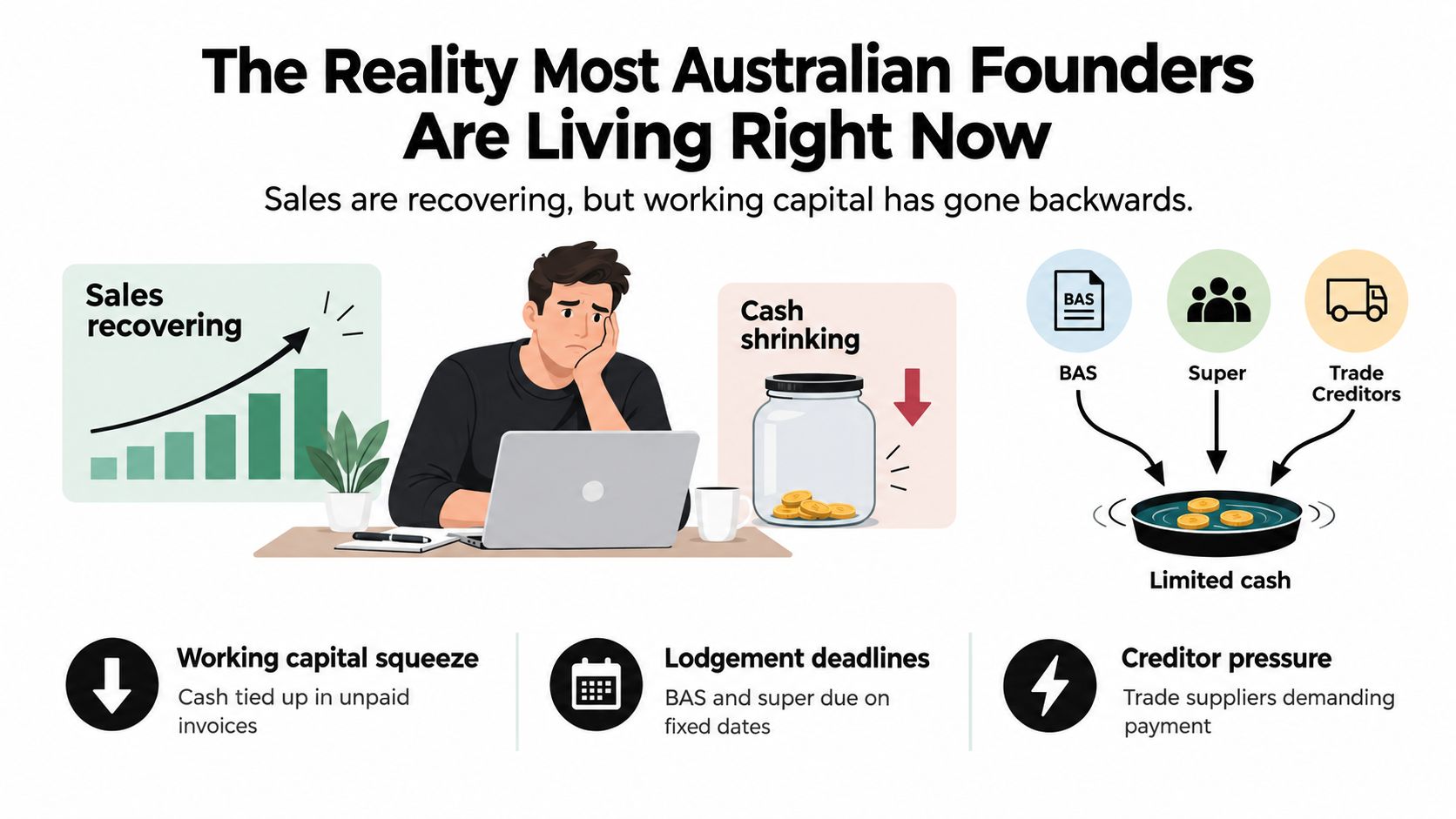
The usual response is another facility. That may create breathing room, but it does not fix slow collections, excess inventory or margins that fail to cover delivery costs. A single late customer can turn a profitable month into a funding emergency, especially when ATO arrears are already attracting additional charges.
Debt usually signals operating drag
Start with the operating cycle, not the lender shortlist. Ask:
Receivables: Which invoices are overdue, and who owns each collection conversation?
Inventory: Which stock is consuming cash without producing timely sales?
Pricing: Does each product, project or service cover labour, overhead and finance costs?
Payables: Which obligations carry legal or employee risk, which protect supply, and which can be renegotiated?
Forecasting: What will the bank balance show after every committed receipt and payment?
Industry exposure matters. Manufacturers, construction businesses and other firms with long delivery cycles can carry substantial working-capital pressure before they collect revenue. Tax arrears make that pressure harder to control because the ATO remains a priority creditor and penalties increase the cost of delay.
Australian insolvency data reinforces the risk. The Reserve Bank of Australia reported that more than three-quarters of recent company insolvencies involved small businesses with fewer than 20 employees, while around 20% involved small business restructures. Its analysis recorded collectable insolvency debt holdings of small businesses at $8.7 billion in 2023/24, compared with $3.9 billion in 2018/19. See the RBA analysis of company insolvencies and financial stability for context.
Bring in a virtual CFO when weekly cash visibility is poor, creditors are being paid reactively or borrowing is masking an operating deficit. Engage an insolvency advisor promptly if tax and super arrears are growing, payment demands are escalating or the forecast shows no credible path to meeting debts as they fall due.
Practical rule: Repair the weekly operating rhythm before restructuring debt. A new loan cannot compensate for late invoices, unplanned stock purchases or unsustainable pricing.
Assess and Prioritise Every Dollar You Owe
Start with one debt register. Don't rely on bank statements, memory or a list of direct debits. Export the loan accounts, supplier balances, tax accounts, lease schedules, payroll liabilities and director-related transactions into a single document that shows the full exposure.
Build the register before negotiating
Record these fields for every liability:
Creditor and debt type: ATO, superannuation, secured bank debt, unsecured trade debt, hire purchase or related-party funding.
Balance and repayment: Include the current balance, minimum payment, due date and expected final repayment.
Cost: Record the interest rate, fees, penalties and any default pricing.
Security and recourse: Note mortgages, personal guarantees, PPSR registrations and whether the creditor can demand repayment.
Consequence of default: Separate legal escalation, loss of supply, employee exposure and ordinary collection pressure.
Put tax and superannuation at the top of the first review. Business-related personal insolvencies represented 28.8% of new personal insolvency cases in 2024–25 but 78.8% of new liabilities, according to AFSA's state of the personal insolvency system report. As at 30 June 2025, those cases represented about $15.4 billion of $19.3 billion in active liabilities. The same report identified excessive borrowing as the leading self-reported cause of insolvency at 37.3%.
The priority isn't based only on the highest interest rate. A tax or super obligation can create consequences that are more serious than a supplier invoice with the same balance. Get an accountant or insolvency practitioner to review director exposure rather than guessing.
Use a practical priority matrix
Priority Tier | Debt Type | Why It Sits Here | First Action |
|---|---|---|---|
Tier one | ATO and superannuation | Tax enforcement, employee obligations and potential director exposure make delay dangerous | Confirm lodgements, calculate the arrears and request a realistic payment arrangement |
Tier two | Secured bank and asset finance | Default can threaten essential property, equipment or operating capacity | Review covenants, security and refinance options before a breach |
Tier three | Critical trade creditors | Losing supply can stop revenue even when the debt is unsecured | Call the supplier, explain the plan and agree staged payments |
Tier four | Non-critical unsecured and related-party debt | These obligations still matter, but may offer more negotiation room | Document terms and defer payments only with an agreed timetable |
AFSA also reported that the Small Business Debt Helpline recorded a 66% increase in cases in 2024, with ATO debt the most common issue for 61% of its small business and sole trader clients. Don't wait for a creditor to force the order of priorities. Complete the register with your bookkeeper in one afternoon, highlight the next escalation date for each account and assign one owner to every action.
A 14-Day Cashflow Triage That Actually Moves the Needle
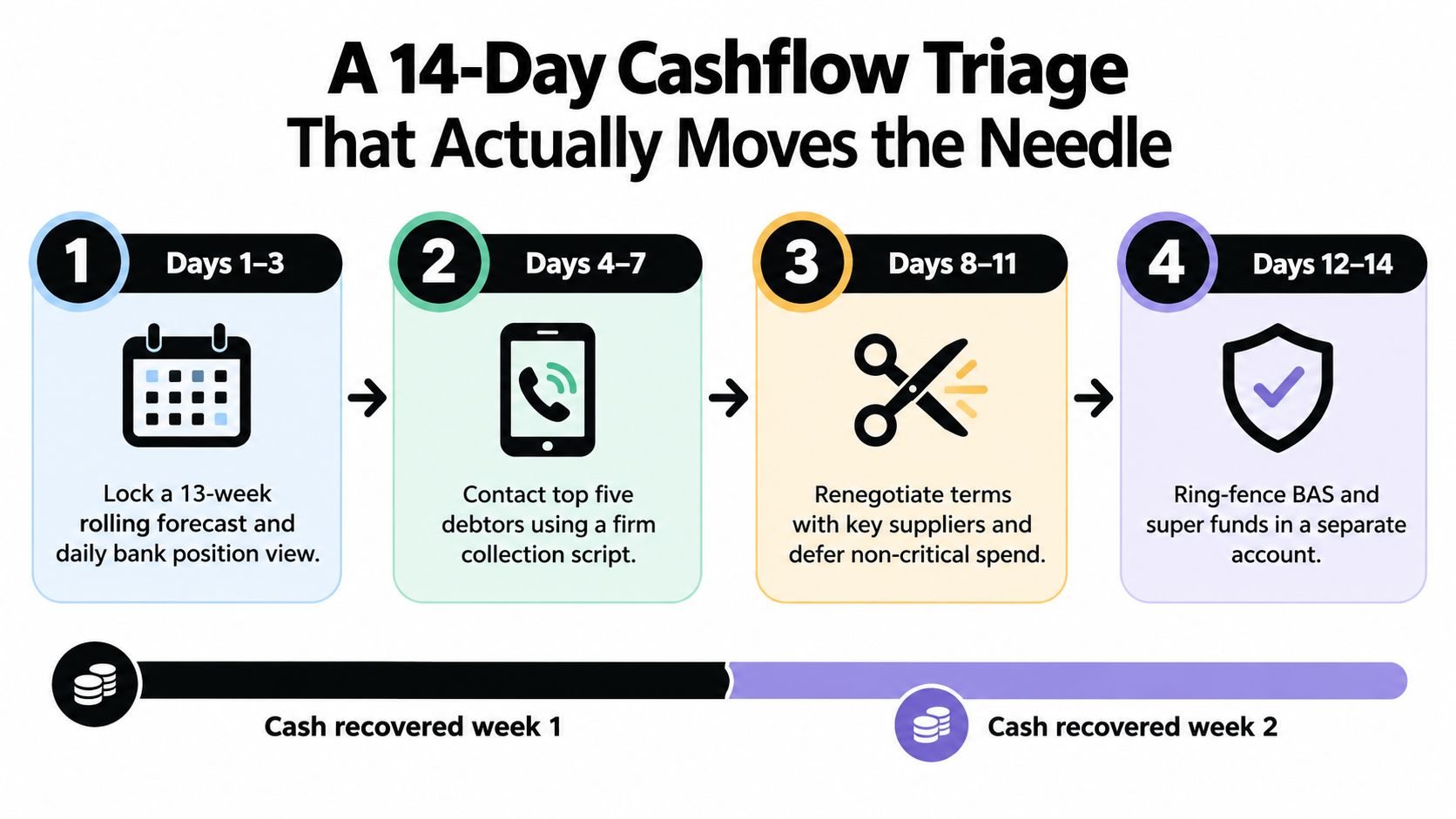
A cash crisis needs a short operating sprint, not a vague instruction to “watch expenses”. For the next 14 days, measure every expected receipt and payment against the opening bank position. Set a weekly cash-release target in dollars based on the shortfall you need to close, and record the amount recovered.
Days one to seven create visibility and collect cash
Days one to three are for control. Build a 13-week rolling forecast with weekly opening cash, confirmed receipts, probable receipts, payroll, tax, suppliers, finance payments and essential operating costs. Add a daily bank position view. Use three scenarios, base, best and worst, and update the forecast every morning.
Then freeze non-essential spending. No discretionary software, equipment, stock order or owner distribution should leave the account until the forecast shows that essential obligations are covered.
Days four to seven focus on the top five debtors. Call the person who controls payment, not only the general accounts inbox. Use a firm script:
“We're reconciling outstanding invoices today. Invoice [number] is overdue. Can you confirm the exact payment date and amount? If there's an approval issue, tell me what must be resolved today.”
Ask for a part payment immediately where a full payment isn't available. Follow every call with a written confirmation. Don't offer an open-ended discount unless you know the margin and the cash benefit.
The small business cash flow guidance from Nexist is useful when you need to diagnose whether the gap comes from receivables, inventory, pricing or payment timing.
Days eight to fourteen stop the next cash leak
Days eight to ten are for suppliers. Call the suppliers that protect revenue first. Propose a specific arrangement, such as staged payments on named invoices or a fortnightly run with a fixed amount. If a supplier refuses, don't promise an amount the forecast can't support. Ask what minimum payment would restore supply, then decide whether to substitute the input, pause the work or escalate the commercial decision.
Days eleven to twelve are for inventory. Run an aged-stock report and mark items that have been sitting beyond the business's normal sales cycle. Create a clearance plan, return eligible stock, cancel pending orders and stop replenishment until the category earns its place in the forecast.
Days thirteen to fourteen are for tax arrears. Confirm that every return is lodged, calculate the amount owing and contact the ATO about a payment plan if arrears exist. Keep BAS and super funds separate from general operating cash from this point forward.
At the end of the fortnight, report four figures: cash collected from debtors, spending deferred, cash released from stock and new commitments accepted. If the target isn't met, stop calling the situation a temporary timing issue. It needs a deeper review of margin, viability and formal options.
Reading Your Debt Stack Like a Lender Would
A lender doesn't view all debt as one balance. It looks at security, recourse, callability and repayment capacity. You should do the same.
Secured lending can be cheaper because the creditor has a stronger recovery position. The RBA reports that small-business loans secured by residential property carry rates around 50 basis points lower than loans secured by other assets on average, and roughly 3 percentage points lower than unsecured loans, as set out in its recent small business finance research.
That price difference doesn't make secured borrowing automatically safe. Using the family home or another essential asset to fund recurring losses can turn an operating problem into a personal financial crisis.
Map each layer of pressure
Debt type | Typical rate (p.a.) | Security | Callability | Priority in default |
|---|---|---|---|---|
Property-secured business loan | Lower than comparable unsecured borrowing | Residential or commercial property | Usually subject to facility terms and covenant triggers | High |
Asset finance | Depends on the asset and facility | Financed equipment or vehicle | May accelerate after default | High |
Unsecured overdraft or card debt | Higher than secured facilities | Often personal guarantee or no specific asset | Can be reduced, frozen or called | Very high |
Trade credit | Usually no stated interest, but may include collection and supply costs | Often unsecured, sometimes PPSR-supported | Supplier can stop supply or demand payment | Medium to high |
ATO arrears | General Interest Charge and enforcement consequences | Statutory and director-related exposure may apply | Escalates through collection processes | Very high |
Related-party loan | Agreed or no stated rate | Usually equity-like or subordinated in practice | Depends on the agreement | Lower commercially, but still material |
The rates in the table are deliberately described by relative position where a single current rate doesn't apply to every facility. For market context, one Australian business lending comparison reports small-business lending around 7.46% and unsecured business finance averaging about 15.95% p.a., although the actual offer depends on the borrower, security and product. See the business loan interest rate comparison before treating an advertised rate as the cost of your own facility.
PPSR registrations, employee-related claims and tax obligations can affect recovery order. Don't assume the creditor with the loudest phone calls has the strongest legal position. Review every facility's security, guarantee, covenant, repayment, default interest and trigger clauses.
A useful lender-style exercise is to produce one page showing each liability, its monthly cash requirement, security position, rate, maturity and default trigger. Add a note explaining what happens to revenue if that creditor stops funding or supplying you. Use financial ratio analysis for Australian SMEs to test whether the business can service debt from operations rather than from another facility.
Refinancing and Consolidation Options Worth Considering
Refinancing works when it changes the cash profile of a viable business. It fails when it gives a loss-making business a longer runway without changing the loss.
Option | What it can solve | What it can't solve | Trap to avoid |
|---|---|---|---|
Consolidate overdrafts and short-term loans | Reduces payment fragmentation and may smooth cash flow | Weak pricing, poor collections or unprofitable sales | Securing old operating losses against essential personal assets |
Asset finance | Matches equipment repayments to the asset's useful life | A machine that doesn't generate adequate contribution margin | Extending repayments beyond the asset's productive life |
Property-secured refinance | May reduce the cost of expensive unsecured borrowing | Structural cash burn or an unsustainable business model | Using property equity to fund recurring losses |
Invoice finance | Bridges eligible receivables and shortens the cash wait | Customers who dispute invoices or consistently pay late | Funding invoices without fixing billing and contract terms |
Merchant cash advance | Provides fast working capital where conventional lending is unavailable | Margin weakness and poor operating discipline | Accepting an expensive repayment structure that drains daily sales |
ATO payment plan | Converts tax arrears into scheduled payments | Missing lodgements or insufficient future cash generation | Agreeing to instalments that the forecast can't support |
The right question is, “What operating event will make this debt repayable?” If the answer is a confirmed customer payment, an asset with demonstrable capacity or a short-term timing mismatch, refinancing may be sensible. If the answer is “we need sales to improve”, stop and test the downside case first.
Apply a decision filter before signing
Reject a proposal unless you can answer all of these questions:
Cash impact: Does the new repayment fit the base and worst-case forecast?
Total cost: Have you included establishment fees, broker fees, default pricing and early repayment costs?
Security: What new asset or personal guarantee is being offered?
Purpose: Is the facility funding a defined working-capital gap or covering ongoing losses?
Exit: What will allow the business to repay, refinance or reduce the balance?
Behaviour: Will the old facility be closed, or can the business draw both facilities and increase total debt?
A lower rate isn't enough. A longer term isn't automatically relief. Consolidation helps when it replaces expensive, callable debt with a payment the operating business can sustain and when the old borrowing stops being available. It merely hides the problem when the owner uses personal borrowing to pay suppliers, delays an unavoidable loss and avoids discussing capacity with the lender.
Legal and Tax Pathways Australian SMEs Can Use
A business can look profitable on paper and still be unable to pay the ATO, employees or suppliers on time. Do not wait for a statutory demand before examining your options. By then, missed lodgements, depleted cash reserves and unpaid obligations may have reduced your negotiating power.
Start with compliance and cash visibility. Lodge every outstanding return, reconcile the ATO account and request a payment plan that fits the 13-week forecast. A revised arrangement can address a timing gap. It cannot rescue a business that lacks enough cash to cover ordinary expenses, tax payments and the agreed instalments.
Know when restructuring becomes relevant
Australia introduced the Small Business Restructuring regime on 1 January 2021. It covers eligible incorporated businesses with liabilities under $1 million and allows a restructuring practitioner to help develop a formal plan while directors continue running the company. The same reforms created a simplified liquidation process for eligible companies within that liability range. The RBA's explanation of recent insolvency policy and small business restructures outlines the policy context.
SBR is not a cheaper ATO payment plan. It is a formal process with eligibility tests, creditor consequences and professional fees. Ask a registered restructuring practitioner to assess the company before presenting any proposal to creditors. If the business operates in construction, hospitality, retail or another sector exposed to slow collections and thin margins, obtain that advice earlier. Working-capital drag can turn manageable arrears into an insolvency problem quickly.
Treat these signs as escalation points
Superannuation arrears: Overdue employee super can expose directors to serious personal consequences. Address it immediately.
Repeated failed lodgements: A payment agreement is weak if new tax and reporting obligations continue to go unfiled.
Creditor statutory demand: Obtain legal and insolvency advice promptly, and do not miss the response deadline.
Inability to pay debts when due: Section 95A of the Corporations Act focuses on whether a company can pay debts as they fall due, not whether its accounts show a profit.
New borrowing for old obligations: Using one creditor to pay another without a credible repayment source signals that the operating model may no longer support the debt.
Before meeting a virtual CFO, solicitor or insolvency advisor, prepare management accounts, bank statements, aged receivables, aged payables, ATO account details, loan agreements, asset registers, payroll liabilities and a current cash forecast. Early advice gives the business more time to preserve records, negotiate with creditors and consider safe harbour options. Ask how communications and documents will be handled, because confidentiality depends on the professional relationship and advice provided.
KPIs, Forecasting Cadence and When to Bring in a Virtual CFO
Debt control fails when the owner sees only the bank balance. The bank balance is an outcome. Weekly management needs the indicators that explain why it is rising or falling.
Track these six measures:
Cash conversion cycle: Monitor the time between paying for inputs and collecting customer cash. Break it into debtor days, stock days and creditor days.
Current ratio: Compare current assets with current liabilities, then investigate whether the assets are actually liquid. A warehouse full of unsold stock doesn't pay the BAS.
Debt service coverage: Test operating cash available for debt payments against scheduled principal and interest. Use actual cash generation, not an optimistic budget.
ATO ageing bucket: Separate current tax obligations from older arrears. A single total conceals escalation risk.
Superannuation payable ageing: Track employee super by due date and payment status. Never treat it as ordinary working capital.
Trade payables beyond terms: Show which suppliers are overdue, which have stopped supply and which debts are supported by a negotiated agreement.
Use one forecast with three realities
Your 13-week forecast should have these columns for every week:
Forecast line | Base case | Best case | Worst case |
|---|---|---|---|
Opening bank balance | Confirmed | Confirmed | Confirmed |
Customer receipts | Expected receipts | Earlier or additional receipts | Delayed or disputed receipts |
Essential operating payments | Committed costs | Committed costs | Committed costs plus known shocks |
Tax and super | Lodged obligations | Lodged obligations | Lodged obligations with no funding assumption |
Debt repayments | Contractual payments | Contractual payments | Contractual payments and possible arrears |
Closing bank balance | Calculated | Calculated | Calculated |
Update the file when an invoice is paid, a customer delays payment, a supplier changes terms or a lender changes the repayment. A forecast that stays untouched is a report, not a control system.
The cash-management cadence should be equally firm:
Weekly: Review the bank position, collections, overdue suppliers, tax reserve, stock purchases and every payment due before the next review.
Every 30 days: Reprice weak-margin work, review facility utilisation, test covenant compliance and remove costs that don't support revenue or delivery.
Every 60 days: Reassess the debt stack, refinance opportunities, customer concentration and inventory exposure.
Every 90 days: Decide whether the business is stabilising, needs formal restructuring advice or should exit an unviable activity.
Set clear intervention triggers
Bring in a virtual CFO when any of these conditions appears:
Two consecutive weeks of negative cash movement.
ATO debt older than 90 days.
A supplier places the account on credit hold.
A covenant breach appears likely.
One customer represents more than 30% of revenue.
The owner can't explain the next six weeks of cash movement without reconstructing it manually.
These are management triggers, not legal tests. A business can be solvent and still need specialist help before a liquidity squeeze becomes a default.
A virtual CFO should deliver practical outputs, not only commentary. In the first 30 days, expect a verified debt register, a 13-week forecast, a cash-release plan, lender-ready reporting and a list of immediate operating actions. By 60 days, the work should include collection discipline, supplier negotiations, covenant tracking, margin review and a tested refinancing or repayment pathway. By 90 days, the owner should have a repeatable reporting cadence, documented scenarios and a clear recommendation to stabilise, restructure, refinance or wind down.
For founders weighing that appointment, this guide on when to hire a fractional CFO is a useful way to distinguish a temporary capability gap from a problem that needs ongoing financial leadership. A virtual CFO can also work alongside the bookkeeper, accountant, lender and insolvency advisor. The roles aren't interchangeable. Bookkeeping records what happened, while CFO work turns the numbers into decisions and accountability.
Use the virtual CFO services overview to compare the type of forecasting, KPI reporting and cashflow support available from an external finance team.
Separate a liquidity squeeze from insolvency risk
Ask four questions in order:
Can the business pay debts as they fall due if confirmed receipts arrive? If yes, the problem may be timing, collections or working capital.
Does each core product, project or service generate a sustainable contribution? If no, more funding will increase the loss.
Can the business meet new tax, payroll and supplier obligations while clearing old arrears? If no, obtain insolvency advice rather than relying on another facility.
Is there a credible action that changes cash generation quickly? If yes, document it and measure it weekly. If no, escalate now.
Debt management for businesses is ultimately a discipline of choosing what the next dollar must do. Fund a profitable operating cycle, protect tax and employee obligations, remove cash trapped in receivables and stock, and negotiate before default. If the numbers still don't add up after those actions, treat that conclusion as useful information and obtain formal advice before creditors make the decision for you.
Nexist helps Australian SMEs build cashflow forecasts, debt registers, KPI reporting and practical repayment strategies, while identifying operating leaks in receivables, inventory and pricing. Visit Nexist to request a clearer view of your cash position and decide whether the next step is operational repair, lender negotiation or formal restructuring advice.
debt management for businesses, small business debt, ATO debt help, cashflow triage, virtual CFO Australia

" width="24px"/><g d="M 0 24.129 L 0 0.129 L 24 0.129 L 24 24.129 Z M 0 24.129 L 0 0.129 L 24 0.129 L 24 24.129 Z M 24 3 C 24 1.344 22.656 0 21 0 L 3 0 C 1.344 0 0 1.344 0 3 L 0 21 C 0 22.656 1.344 24 3 24 L 21 24 C 22.656 24 24 22.656 24 21 Z M 6.883 8.375 L 2.863 8.375 L 2.863 20.467 L 6.883 20.467 Z M 4.899 2.545 C 3.524 2.545 2.625 3.449 2.625 4.634 C 2.625 5.795 3.496 6.724 4.846 6.724 L 4.872 6.724 C 6.273 6.724 7.146 5.795 7.146 4.634 C 7.12 3.449 6.274 2.545 4.899 2.545 Z M 16.747 8.09 C 14.614 8.09 13.659 9.263 13.124 10.086 L 13.124 8.374 L 9.105 8.374 C 9.159 9.508 9.105 20.466 9.105 20.466 L 13.124 20.466 L 13.124 13.713 C 13.124 13.352 13.15 12.99 13.257 12.732 C 13.547 12.01 14.209 11.262 15.319 11.262 C 16.773 11.262 17.355 12.372 17.355 13.996 L 17.355 20.466 L 21.374 20.466 L 21.374 13.532 C 21.374 9.818 19.391 8.09 16.747 8.09 Z" fill="transparent" height="24.12890599668026px" id="dSFdkJotL" width="24px"><path d="M 0 24 L 0 0 L 24 0 L 24 24 Z" fill="transparent" height="24px" id="wscNJE44G" transform="translate(0 0.129)" width="24px"/><g d="M 0 24.129 L 0 0.129 L 24 0.129 L 24 24.129 Z M 24 3 C 24 1.344 22.656 0 21 0 L 3 0 C 1.344 0 0 1.344 0 3 L 0 21 C 0 22.656 1.344 24 3 24 L 21 24 C 22.656 24 24 22.656 24 21 Z M 6.883 8.375 L 2.863 8.375 L 2.863 20.467 L 6.883 20.467 Z M 4.899 2.545 C 3.524 2.545 2.625 3.449 2.625 4.634 C 2.625 5.795 3.496 6.724 4.846 6.724 L 4.872 6.724 C 6.273 6.724 7.146 5.795 7.146 4.634 C 7.12 3.449 6.274 2.545 4.899 2.545 Z M 16.747 8.09 C 14.614 8.09 13.659 9.263 13.124 10.086 L 13.124 8.374 L 9.105 8.374 C 9.159 9.508 9.105 20.466 9.105 20.466 L 13.124 20.466 L 13.124 13.713 C 13.124 13.352 13.15 12.99 13.257 12.732 C 13.547 12.01 14.209 11.262 15.319 11.262 C 16.773 11.262 17.355 12.372 17.355 13.996 L 17.355 20.466 L 21.374 20.466 L 21.374 13.532 C 21.374 9.818 19.391 8.09 16.747 8.09 Z" fill="transparent" height="24.12890599668026px" id="sTpjGo1tb" width="24px"><path d="M 0 24 L 0 0 L 24 0 L 24 24 Z" fill="transparent" height="24px" id="s7ffpmKOD" transform="translate(0 0.129)" width="24px"/><g d="M 24 3 C 24 1.344 22.656 0 21 0 L 3 0 C 1.344 0 0 1.344 0 3 L 0 21 C 0 22.656 1.344 24 3 24 L 21 24 C 22.656 24 24 22.656 24 21 Z M 6.883 8.375 L 2.863 8.375 L 2.863 20.467 L 6.883 20.467 Z M 4.899 2.545 C 3.524 2.545 2.625 3.449 2.625 4.634 C 2.625 5.795 3.496 6.724 4.846 6.724 L 4.872 6.724 C 6.273 6.724 7.146 5.795 7.146 4.634 C 7.12 3.449 6.274 2.545 4.899 2.545 Z M 16.747 8.09 C 14.614 8.09 13.659 9.263 13.124 10.086 L 13.124 8.374 L 9.105 8.374 C 9.159 9.508 9.105 20.466 9.105 20.466 L 13.124 20.466 L 13.124 13.713 C 13.124 13.352 13.15 12.99 13.257 12.732 C 13.547 12.01 14.209 11.262 15.319 11.262 C 16.773 11.262 17.355 12.372 17.355 13.996 L 17.355 20.466 L 21.374 20.466 L 21.374 13.532 C 21.374 9.818 19.391 8.09 16.747 8.09 Z" fill="transparent" height="24.000006px" id="D0ecaHEcW" transform="translate(0 0)" width="24px"><path d="M 24 3 C 24 1.344 22.656 0 21 0 L 3 0 C 1.344 0 0 1.344 0 3 L 0 21 C 0 22.656 1.344 24 3 24 L 21 24 C 22.656 24 24 22.656 24 21 Z" fill="rgb(55, 184, 218)" height="24.000006px" id="IPLFE6zXx" width="24px"/><path d="M 4.02 0 L 0 0 L 0 12.092 L 4.02 12.092 Z" fill="rgb(255, 255, 255)" height="12.09201px" id="FWhtzAyuY" transform="translate(2.863 8.375)" width="4.02px"/><path d="M 2.274 0 C 0.899 0 0 0.904 0 2.089 C 0 3.25 0.871 4.179 2.221 4.179 L 2.247 4.179 C 3.648 4.179 4.521 3.25 4.521 2.089 C 4.495 0.904 3.649 0 2.274 0 Z" fill="rgb(255, 255, 255)" height="4.17876px" id="VmOsKv4kO" transform="translate(2.625 2.545)" width="4.52095px"/><path d="M 7.641 0 C 5.509 0 4.554 1.173 4.019 1.996 L 4.019 0.284 L 0 0.284 C 0.053 1.419 0 12.376 0 12.376 L 4.019 12.376 L 4.019 5.623 C 4.019 5.262 4.045 4.9 4.151 4.642 C 4.442 3.92 5.103 3.172 6.214 3.172 C 7.667 3.172 8.25 4.282 8.25 5.907 L 8.25 12.376 L 12.269 12.376 L 12.269 5.442 C 12.269 1.728 10.286 0 7.641 0 Z" fill="rgb(255, 255, 255)" height="12.37626px" id="n1XUbhaq0" transform="translate(9.105 8.09)" width="12.268830000000001px"/></g></g></g></g></svg>)