
What Is Financial Forecasting: A Founder's Guide
What is financial forecasting? Learn how founders can predict revenue, manage cash flow, and make data-driven decisions with this practical guide for 2026.
Ansh Malhotra

Financial forecasting is estimating future income, expenses and cash position to guide decisions. In Australia, the immediate problem is timing: paying wages, GST, super and suppliers on time even when customer revenue arrives unevenly.
A profitable business can still feel broke. A customer pays late, a stock order arrives early and the BAS obligation lands on schedule, regardless of what the profit and loss statement says. That's why financial forecasting isn't an annual finance exercise. It's a practical cash-management discipline that tells you what will happen to the bank balance before the pressure arrives.
Table of Contents
What Financial Forecasting Really Means for a Growing Business
Building a Rolling 13-Week Cash Forecast That Actually Works
Why Forecasting Matters Most for Growth-Stage Australian SMEs
A Worked Example of a 13-Week Forecast for an Inventory-Heavy SME
From Forecast to Action Becoming a Founder Who Leads the Numbers
What Financial Forecasting Really Means for a Growing Business
Financial forecasting is the practice of mapping expected cash receipts and payments by date, so hiring, stock and tax decisions are based on forward cash rather than profit alone. It answers practical questions before they become urgent: Should you hire now, wait for the next customer payment, buy stock, chase a debtor, negotiate supplier terms or preserve cash?
A forecast gives you a forward view of likely bank movements. That makes it a short-horizon operating discipline, not an annual planning document. A rolling 13-week view is particularly useful because it exposes timing pressure while there is still time to act. Guidance on Australian Government's business guidance on cash-flow forecasting also separates budgeting from forecasting.
A budget sets the yearly plan for income and spending. A forecast updates that plan using current financial data, recent trends and changed assumptions. The budget records what you intended to happen. The forecast shows what is likely to happen now.
Cash timing matters more than accounting profit
Australian founders should put these dates into the model:
Payroll dates: Wages leave the account whether a major customer has paid or not.
GST and BAS obligations: Tax payments follow their required schedule, not your preferred cash cycle.
Superannuation timing: Super is budgeted at 12% for 2025-26, and Payday Super is scheduled to require payment within 7 days of each pay run from July 2026, as outlined in Australian budgeting guidance covering the change.
Supplier terms: A supplier may require payment before your customer settles the related invoice.
Put these commitments on the same weekly timeline. The model then shows the week when payroll, BAS, super and supplier payments compete for the same cash.
Practical rule: Forecast cash movements by date, not just costs by category.
Update the model whenever sales, debtor timing, stock purchases or operating costs change. If it signals a shortage, act early: collect an overdue invoice, delay a discretionary purchase, revise an order or arrange funding. Resources such as avoid costly cash shortages with forecasting explain the mechanics. The operating principle is straightforward: forecast the bank account, then act on the warning.
The Main Types of Financial Forecast You Should Know
Most founders don't need a complicated finance department to forecast well. They need the right forecast for the decision in front of them. These five types cover the core questions a growing Australian SME has to answer.
Cash flow forecast
This tracks expected cash receipts and payments, usually in a 13-week weekly view for operational control. An ecommerce business uses it to see whether customer receipts will cover a supplier run, payroll and upcoming tax obligations.
Revenue forecast
A revenue forecast estimates future sales by product, channel, customer group or contract. A direct-to-consumer brand can use it to test whether a new SKU launch is likely to support its planned stock commitment.
Expense forecast
This maps fixed and variable expenses against expected activity. A service firm can use it to see whether additional contractors, software subscriptions and sales costs are pushing margins down before the impact becomes obvious in monthly reporting.
Rolling forecast
A rolling forecast keeps extending the outlook as actual results arrive. Instead of relying on a static annual plan, the founder refreshes the forward view whenever sales, costs, debtor timing or operating assumptions change.
Scenario forecast
Scenario planning creates alternative outcomes around a named decision. A retailer might compare the cash effect of ordering stock now, ordering less or waiting for stronger sales evidence.
Forecast Type | Purpose | Typical Horizon | Australian SME Trigger Example |
|---|---|---|---|
Cash flow forecast | Show when cash enters and leaves the bank account | Weekly near-term view | Payroll, BAS, supplier and debtor timing |
Revenue forecast | Estimate sales by channel, product or customer | Monthly or quarterly | New product launch or sales pipeline change |
Expense forecast | Project operating and delivery costs | Monthly or quarterly | Hiring, contractor use or rising input costs |
Rolling forecast | Keep the forward outlook current | Ongoing forward view | Actual results diverge from the annual budget |
Scenario forecast | Compare outcomes under different assumptions | Decision-specific | Stock buy, facility drawdown or new hire |
The mistake is treating these as competing systems. A practical model combines them. Revenue and expense assumptions feed the cash forecast, while scenario planning tests the decisions that could change the result.
Start with cash flow. A founder who knows the expected bank position can make better use of every other forecast.
Forecasting Methods and the Right Time Horizon for Each
The method should match the decision. A simple approach is often more useful than a complex model built on weak inputs.
Straight-line extrapolation extends a recent run rate into the near future. It suits a stable professional services business with recurring work and limited seasonality. Use it for a short operational view, such as assessing whether the next few months support a planned expense.
Moving averages smooth recent history to reduce the effect of one-off spikes. A café or retailer can use a recent average to avoid treating one unusually strong trading period as the new normal. This method is useful for near-term planning when demand is broadly stable but individual months fluctuate.
Driver-based forecasting starts with the operational inputs that create the financial result. A consultancy might model billable hours, utilisation and average hourly value. An online retailer might model units sold, average order value, advertising spend and unit cost. This is the right approach for a new product, a new hire or a changed sales process because it makes assumptions explicit.
Scenario planning tests a decision against several plausible conditions. Instead of producing one confident answer, you can model a stronger sales outcome, a base case and a weaker outcome around factors such as customer churn, supplier delay or slower debtor collection.
Method | Best use | Suitable horizon | Decision it supports |
|---|---|---|---|
Straight-line extrapolation | Stable recurring activity | Next 3 months | Continue or pause a predictable expense |
Moving average | Smoothing irregular history | Next 3 months | Set a more balanced trading expectation |
Driver-based forecast | New operational assumptions | Next 12 months | Hire, launch, price or invest |
Scenario planning | High-impact uncertainty | Decision-specific | Commit stock, seek funding or change pace |

Don't use a moving average to decide whether a major inventory commitment is safe. Don't use a complex driver model when a stable recurring-revenue business only needs a clean near-term cash view. Match precision to consequence.
Building a Rolling 13-Week Cash Forecast That Actually Works
A 13-week rolling cash forecast should be the operating core of an Australian SME's finance routine. It gives you a clear view of the next quarter without pretending that assumptions made months ago will remain accurate.
Each week, close the completed week using actual bank movements. Then add a new future week at the end and re-forecast the remaining period. Layer a 12-month monthly outlook above it for hiring, expansion and funding decisions, but use the weekly model for immediate commitments.
Feed the model with operational evidence
Your forecast should pull from the records that determine cash timing:
Bank feeds and card transactions: Confirm what cleared, not what the accounting system expected.
Debtor ageing: Separate invoices that are likely to pay from invoices that are already late.
Payroll calendar: Include weekly and fortnightly wages, plus super obligations aligned to the relevant payment timing.
Supplier terms: Record expected payment dates rather than only recording the expense.
BAS and GST dates: Put lodgement and payment obligations directly into the weekly grid.
ATO instalments and finance repayments: Include tax instalments, loans, leases and other fixed commitments.
Stock commitments: Add purchase orders when they become likely cash events, not only when goods arrive.
A useful cash-flow forecasting guide for Australian SMEs reinforces the need to connect the model to actual working-capital movements rather than relying on a static annual budget.
Run a simple weekly cadence
Owners should update actuals every Monday, compare actual results with the forecast on Tuesday and decide corrective actions by Wednesday. Log unusual items separately, including a large stock purchase, an unexpected tax bill or a major customer payment, so the model explains the variance instead of drifting without explanation.
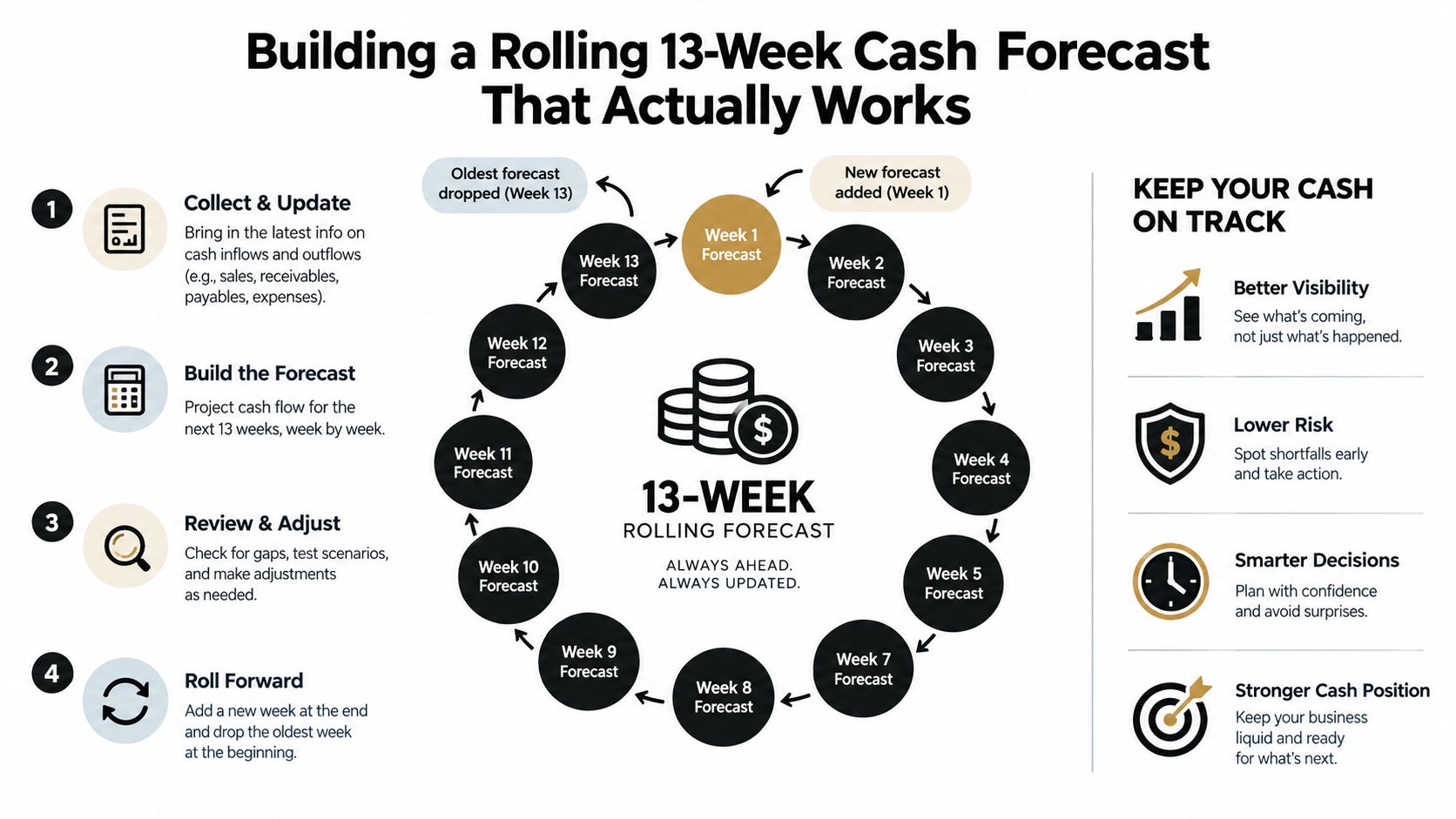
The model doesn't need to predict every transaction perfectly. Its job is to reveal pressure early enough for you to change the timing, amount or funding source.
A short video can help teams visualise the rolling process:
Why Forecasting Matters Most for Growth-Stage Australian SMEs
Growth creates financial complexity before it creates financial safety. Revenue can rise while cash control weakens because the business carries more stock, grants longer customer terms, hires staff and commits to larger supplier orders.
Australian businesses are facing pressure from higher operating costs, weaker revenue in some cases and tighter financial commitments. Those conditions make cash timing a management issue, not a year-end reporting exercise. A cash-flow forecasting guide for Australian SMEs also reinforces the need to connect forecasts with actual cash movements.
Annual budgets smooth away the timing that causes trouble. They can show a profitable year while missing the week when slow debtors, a BAS payment, payroll and a stock order all compete for the same bank balance. Build a 13-week rolling forecast and review it every week.
The decisions an annual budget smooths away
Decision | Annual Budget Shows | 13-Week Rolling Forecast Shows |
|---|---|---|
Hiring | The expected annual payroll cost | The week payroll, Payday Super and other obligations begin |
Stock purchase | The planned cost and expected margin | The cash dip caused by the payment date |
Debtor terms | Revenue and gross profit | The period cash remains tied up in receivables |
Funding | Annual interest and repayment assumptions | The week available cash reaches a pressure point |
BAS payment | Tax provision in the full-year plan | The actual cycle and week the cash leaves the account |
Payday Super makes payroll timing more important for eligible employers. BAS cycles create another predictable cash event. Put both into the rolling model from day one, alongside supplier payments, loan repayments and other committed outflows.
The RBA assessment of Australian households and businesses identifies continuing financial stress for smaller businesses, particularly in construction, hospitality and retail, where debt and unpaid GST obligations can increase pressure. Funding conditions matter as well, so do not wait for a cash shortfall before speaking with your lender.
A rolling forecast turns pressure into decisions. It shows whether to delay a hire, collect a debtor earlier, reduce an order or arrange funding before the choice becomes urgent. Annual budgets set direction. The 13-week model protects the cash that keeps growth operating.
A Worked Example of a 13-Week Forecast for an Inventory-Heavy SME
Consider an Australian wholesale business with several million dollars in revenue, a 45-day debtor cycle, seasonal stock building ahead of a spring peak and a team of six paid weekly or fortnightly. The business is profitable, but cash is committed well before all customer invoices are collected.
The owner builds a 13-week grid. Week 4 contains BAS and related tax cash movements. Week 6 includes a Payday Super-related outflow in the model. Week 8 contains a planned stock purchase. Receipts remain delayed because customers continue to pay on their established terms.
The snapshot below shows how the pressure emerges. The amounts are illustrative, so the lesson is the timing pattern, not a benchmark balance.
Week | Opening Balance | Receipts | Payroll + Super | Stock & Suppliers | BAS / Tax | Closing Balance |
|---|---|---|---|---|---|---|
5 | $320,000 | $92,000 | $28,000 | $54,000 | $0 | $330,000 |
6 | $330,000 | $76,000 | $41,000 | $62,000 | $0 | $303,000 |
7 | $303,000 | $88,000 | $28,000 | $48,000 | $0 | $315,000 |
8 | $315,000 | $70,000 | $29,000 | $145,000 | $0 | $211,000 |
9 | $211,000 | $58,000 | $41,000 | $118,000 | $0 | $110,000 |
10 | $110,000 | $84,000 | $28,000 | $44,000 | $0 | $122,000 |
The business remains above zero, but week 9 falls below the buffer its bank expects the owner to maintain. The annual P&L still says the stock purchase supports a profitable spring season. The weekly cash view says the timing creates a funding problem before the stock can generate its return.
The decision tree
The founder has several levers while there's still time:
Renegotiate the stock order so part of the payment moves beyond the low point.
Pull forward a debtor by offering a prompt-payment arrangement or escalating collection.
Draw a small line of credit before the forecasted dip, rather than seeking emergency funding after it appears.
Review inventory days and the purchase sequence using a practical inventory days calculation guide.
The annual budget says profitable. The 13-week forecast says stretched. Only the second view tells the founder when to act.
Tools, KPIs and a Practical Roadmap to Adopt Forecasting
You can start with a spreadsheet, provided the data is clean and someone owns the weekly update. A common Australian stack might combine Xero or MYOB with Fathom or Spotlight, then add a cash tool such as Float or Pulse. The right choice depends on transaction volume, integrations and how many people need to work with the forecast.
Track KPIs that force different decisions:
Cash conversion cycle: Shows how long cash is tied up between paying suppliers and collecting customers.
Debtor days: Signals whether sales are turning into cash at the expected pace.
Runway in weeks: Shows how long current cash can support planned commitments.
Gross margin percentage: Identifies whether price, product mix or input costs are weakening contribution.
BAS cash reserve: Keeps expected GST and related obligations visible before lodgement.
Payroll-to-revenue ratio: Shows whether staffing costs are moving ahead of sales capacity.
For practical dashboard inspiration, analytics dashboard examples for resellers can help you think about how operational and financial measures should sit together.
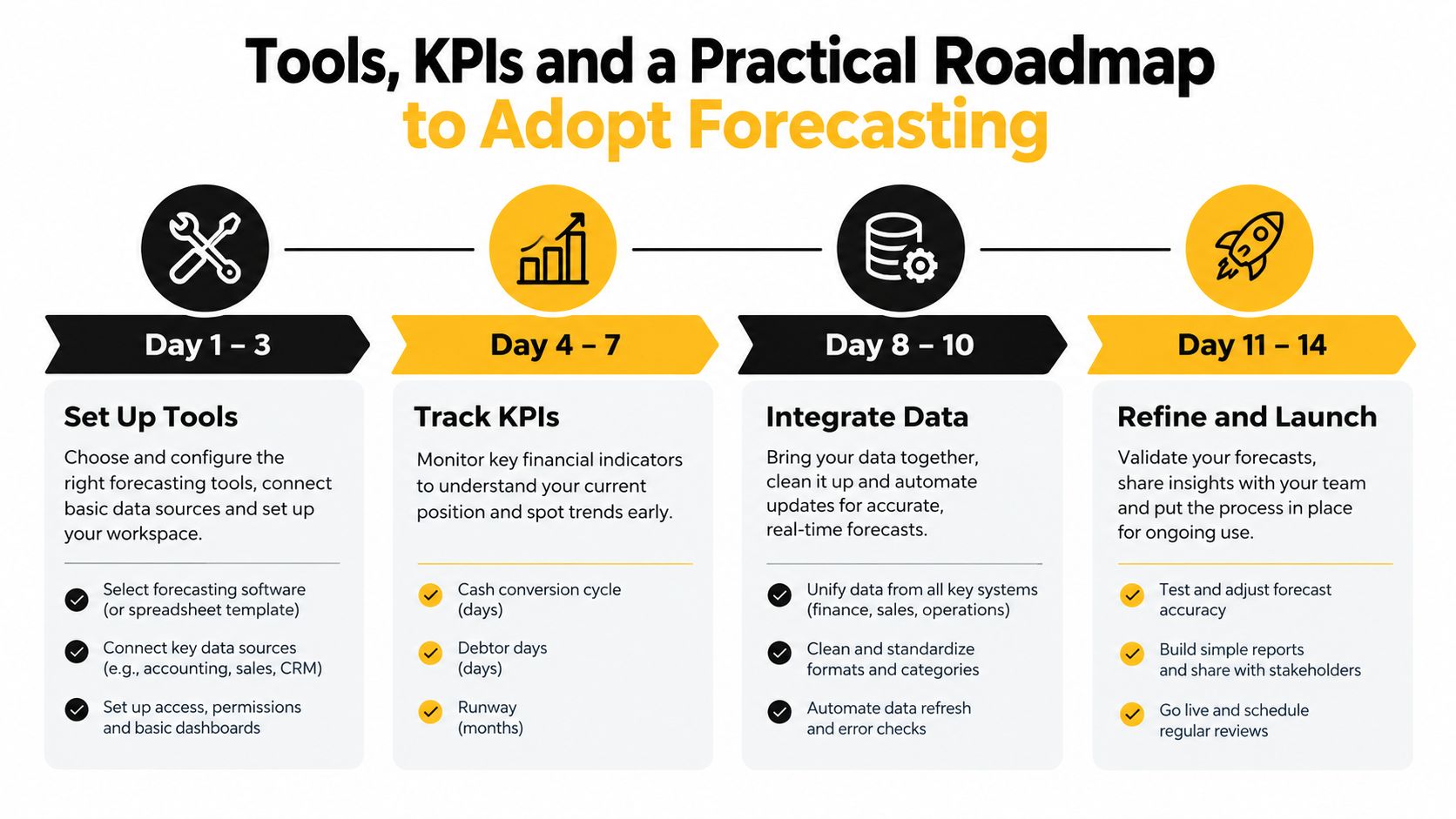
A 14-day adoption plan
Days 1 to 3: Connect bank feeds, accounting records, debtor ageing and payroll data. Establish one source for opening cash and one owner for the forecast.
Days 4 to 7: Build the 13-week sheet. Enter actual payment dates, supplier terms, BAS obligations, finance repayments and known stock commitments.
Days 8 to 10: Add scenario toggles for slower debtor collection, a delayed supplier payment, a lower sales outcome or a new hire.
Days 11 to 14: Run the first weekly review and record every variance. A financial forecasting template for Australian SMEs can provide a starting structure.
Bring in a growth accountant for review once the weekly model is influencing hiring, pricing or purchasing. A virtual CFO becomes useful when the founder is making substantial hire-or-hold, buy-or-finance or expansion decisions and needs the forecast connected to the profit and loss and balance sheet.
Nexist is one option for hands-on support, combining cash-flow forecasting, performance reporting, KPIs and finance operations for Australian SMEs. The warning signs that a spreadsheet has outgrown itself are clear: duplicated versions, unexplained variances, manual rekeying, missing owners and decisions being made from different numbers.
From Forecast to Action Becoming a Founder Who Leads the Numbers
Your job isn't to produce a beautiful forecast. Your job is to use it to make three to five consequential decisions each month.
Should you hire now or hold? Should you buy stock, split the order or finance it? Should you chase a debtor today? Should you draw on a facility? Should you accelerate a growth bet or protect the cash position? The forecast earns its place when it changes one of those decisions.
The behavioural shift matters. Reactive founders watch the bank balance and respond to whatever has already happened. Proactive founders review the coming weeks, test the assumptions and move before the cash gap becomes unavoidable.
Use a 15-minute Monday cash review to confirm opening cash, expected receipts, committed payments and new risks. Hold a 45-minute monthly scenario meeting to test hiring, purchasing, pricing and funding decisions against updated assumptions.
This week, open last month's bank statement and list every cash outflow that surprised you. Put each item into a rolling 13-week sheet with its expected date, owner and trigger. The aim isn't perfect prediction. It's making the timing problem visible while you can still do something about it.
If your business needs a working cash model tied to payroll, BAS, debtors, suppliers and stock, Nexist can help build the forecast and turn it into a weekly decision routine. Visit Nexist to start with a clearer view of cash, margins and the actions required for controlled growth.
financial forecasting, cash flow forecast, rolling forecast, scenario planning, virtual CFO

" width="24px"/><g d="M 0 24.129 L 0 0.129 L 24 0.129 L 24 24.129 Z M 0 24.129 L 0 0.129 L 24 0.129 L 24 24.129 Z M 24 3 C 24 1.344 22.656 0 21 0 L 3 0 C 1.344 0 0 1.344 0 3 L 0 21 C 0 22.656 1.344 24 3 24 L 21 24 C 22.656 24 24 22.656 24 21 Z M 6.883 8.375 L 2.863 8.375 L 2.863 20.467 L 6.883 20.467 Z M 4.899 2.545 C 3.524 2.545 2.625 3.449 2.625 4.634 C 2.625 5.795 3.496 6.724 4.846 6.724 L 4.872 6.724 C 6.273 6.724 7.146 5.795 7.146 4.634 C 7.12 3.449 6.274 2.545 4.899 2.545 Z M 16.747 8.09 C 14.614 8.09 13.659 9.263 13.124 10.086 L 13.124 8.374 L 9.105 8.374 C 9.159 9.508 9.105 20.466 9.105 20.466 L 13.124 20.466 L 13.124 13.713 C 13.124 13.352 13.15 12.99 13.257 12.732 C 13.547 12.01 14.209 11.262 15.319 11.262 C 16.773 11.262 17.355 12.372 17.355 13.996 L 17.355 20.466 L 21.374 20.466 L 21.374 13.532 C 21.374 9.818 19.391 8.09 16.747 8.09 Z" fill="transparent" height="24.12890599668026px" id="dSFdkJotL" width="24px"><path d="M 0 24 L 0 0 L 24 0 L 24 24 Z" fill="transparent" height="24px" id="wscNJE44G" transform="translate(0 0.129)" width="24px"/><g d="M 0 24.129 L 0 0.129 L 24 0.129 L 24 24.129 Z M 24 3 C 24 1.344 22.656 0 21 0 L 3 0 C 1.344 0 0 1.344 0 3 L 0 21 C 0 22.656 1.344 24 3 24 L 21 24 C 22.656 24 24 22.656 24 21 Z M 6.883 8.375 L 2.863 8.375 L 2.863 20.467 L 6.883 20.467 Z M 4.899 2.545 C 3.524 2.545 2.625 3.449 2.625 4.634 C 2.625 5.795 3.496 6.724 4.846 6.724 L 4.872 6.724 C 6.273 6.724 7.146 5.795 7.146 4.634 C 7.12 3.449 6.274 2.545 4.899 2.545 Z M 16.747 8.09 C 14.614 8.09 13.659 9.263 13.124 10.086 L 13.124 8.374 L 9.105 8.374 C 9.159 9.508 9.105 20.466 9.105 20.466 L 13.124 20.466 L 13.124 13.713 C 13.124 13.352 13.15 12.99 13.257 12.732 C 13.547 12.01 14.209 11.262 15.319 11.262 C 16.773 11.262 17.355 12.372 17.355 13.996 L 17.355 20.466 L 21.374 20.466 L 21.374 13.532 C 21.374 9.818 19.391 8.09 16.747 8.09 Z" fill="transparent" height="24.12890599668026px" id="sTpjGo1tb" width="24px"><path d="M 0 24 L 0 0 L 24 0 L 24 24 Z" fill="transparent" height="24px" id="s7ffpmKOD" transform="translate(0 0.129)" width="24px"/><g d="M 24 3 C 24 1.344 22.656 0 21 0 L 3 0 C 1.344 0 0 1.344 0 3 L 0 21 C 0 22.656 1.344 24 3 24 L 21 24 C 22.656 24 24 22.656 24 21 Z M 6.883 8.375 L 2.863 8.375 L 2.863 20.467 L 6.883 20.467 Z M 4.899 2.545 C 3.524 2.545 2.625 3.449 2.625 4.634 C 2.625 5.795 3.496 6.724 4.846 6.724 L 4.872 6.724 C 6.273 6.724 7.146 5.795 7.146 4.634 C 7.12 3.449 6.274 2.545 4.899 2.545 Z M 16.747 8.09 C 14.614 8.09 13.659 9.263 13.124 10.086 L 13.124 8.374 L 9.105 8.374 C 9.159 9.508 9.105 20.466 9.105 20.466 L 13.124 20.466 L 13.124 13.713 C 13.124 13.352 13.15 12.99 13.257 12.732 C 13.547 12.01 14.209 11.262 15.319 11.262 C 16.773 11.262 17.355 12.372 17.355 13.996 L 17.355 20.466 L 21.374 20.466 L 21.374 13.532 C 21.374 9.818 19.391 8.09 16.747 8.09 Z" fill="transparent" height="24.000006px" id="D0ecaHEcW" transform="translate(0 0)" width="24px"><path d="M 24 3 C 24 1.344 22.656 0 21 0 L 3 0 C 1.344 0 0 1.344 0 3 L 0 21 C 0 22.656 1.344 24 3 24 L 21 24 C 22.656 24 24 22.656 24 21 Z" fill="rgb(55, 184, 218)" height="24.000006px" id="IPLFE6zXx" width="24px"/><path d="M 4.02 0 L 0 0 L 0 12.092 L 4.02 12.092 Z" fill="rgb(255, 255, 255)" height="12.09201px" id="FWhtzAyuY" transform="translate(2.863 8.375)" width="4.02px"/><path d="M 2.274 0 C 0.899 0 0 0.904 0 2.089 C 0 3.25 0.871 4.179 2.221 4.179 L 2.247 4.179 C 3.648 4.179 4.521 3.25 4.521 2.089 C 4.495 0.904 3.649 0 2.274 0 Z" fill="rgb(255, 255, 255)" height="4.17876px" id="VmOsKv4kO" transform="translate(2.625 2.545)" width="4.52095px"/><path d="M 7.641 0 C 5.509 0 4.554 1.173 4.019 1.996 L 4.019 0.284 L 0 0.284 C 0.053 1.419 0 12.376 0 12.376 L 4.019 12.376 L 4.019 5.623 C 4.019 5.262 4.045 4.9 4.151 4.642 C 4.442 3.92 5.103 3.172 6.214 3.172 C 7.667 3.172 8.25 4.282 8.25 5.907 L 8.25 12.376 L 12.269 12.376 L 12.269 5.442 C 12.269 1.728 10.286 0 7.641 0 Z" fill="rgb(255, 255, 255)" height="12.37626px" id="n1XUbhaq0" transform="translate(9.105 8.09)" width="12.268830000000001px"/></g></g></g></g></svg>)