What Is a Director in a Company? an Australian Guide 2026
What is a director in a company in Australia? Our guide explains legal duties under the Corporations Act, liabilities, and practical advice for SME founders.
Ansh Malhotra

You've built the business. You know the customers, the delivery headaches, the hiring gaps, and the weeks when cash looks healthy until BAS, payroll, stock, and supplier terms all collide at once. Then someone says, “Let's just make them a director.” It sounds tidy. It feels like recognition. For many founders, it also sounds like the natural next step for a spouse, co-founder, investor, or long-serving operations lead.
That's usually the moment questions start. Is a director just a more senior title. Is it basically the same as being an owner. If they're helping make decisions already, does formal appointment change much. In practice, it changes a lot.
For an Australian SME, a director isn't just a trusted adviser with a better business card. A director sits at the point where strategy, cash flow, risk, tax, solvency, and accountability meet. If you want the practical answer to what is a director in a company, it's this: a director is one of the people legally responsible for governing the company, and that responsibility shows up in the numbers and decisions of ordinary trading life.
Table of Contents
From Business Partner to Company Director What It Really Means
The Legal Bedrock Your Core Duties as an Australian Director
From Business Partner to Company Director What It Really Means
A common SME story goes like this. The founder starts alone, then brings in a key person who becomes central to sales, operations, or delivery. After a while, the founder wants to reward loyalty and share decision-making. So they consider appointing that person as a director.
The mistake is treating the appointment like a promotion. It isn't. A director role changes the legal character of the relationship. The person stops being only a manager, employee, adviser, or shareholder and becomes part of the governing body responsible for the company's direction and oversight.
That matters most when the business is under pressure. During a clean growth run, everyone feels aligned. When gross margin slips, debtors stretch, inventory builds up, or the tax account falls behind, the difference between “helping run the business” and “being legally responsible for governance” becomes very real.
The founder assumption that causes problems
Founders often assume three things:
Trust is enough: If someone is smart and loyal, they'll naturally be a good director.
Ownership and directorship are interchangeable: If they hold shares, they should probably sit on the board.
Formality can wait: The business is small, so informal conversations should be enough.
Those assumptions usually create mess later. Good directors need judgement, not just loyalty. Shareholders and directors do different jobs. Informal decisions are hard to defend when someone later asks who approved what, based on which information.
Practical rule: Appoint someone as a director only when you want them sharing governance responsibility, not when you simply want to reward contribution.
This is also why board structure matters earlier than most founders expect. If you're already thinking about delegated authority, reporting lines, and who gets final say, it helps to review broader ideas around structuring for business scalability. Governance problems often start as organisation design problems.
What changes on day one
Once someone becomes a director, the role carries stewardship. They're expected to ask questions, read the financials, challenge assumptions, and pay attention to risk. They can't stay passive because another founder “handles the numbers”.
That's the answer to what a director is in a company for an SME. It's not a badge of seniority. It's the point where influence becomes accountability.
The Legal Bedrock Your Core Duties as an Australian Director
Australian director duties sit on a legal foundation, not custom or title inflation. The Corporations Act 2001 (Cth) sets the framework, and it captures more people than founders often realise.
Who counts as a director
In Australia, the legal meaning of a company director is set out in the Corporations Act 2001 (Cth), which defines a director to include not only a formally appointed director but also someone who acts in the position of director or whose instructions the board is accustomed to follow, as discussed in this reference on the national director framework and legal definition in the Corporations Act analysis.
That means the law looks at conduct, not just paperwork. If a person effectively directs board decisions, they may carry director-like exposure even if ASIC records don't show their name.
Early in the conversation, many founders benefit from plain-English commentary such as Stewart Accounting's director duties insights. The core point is simple. If you function like a director, the law may treat you like one.
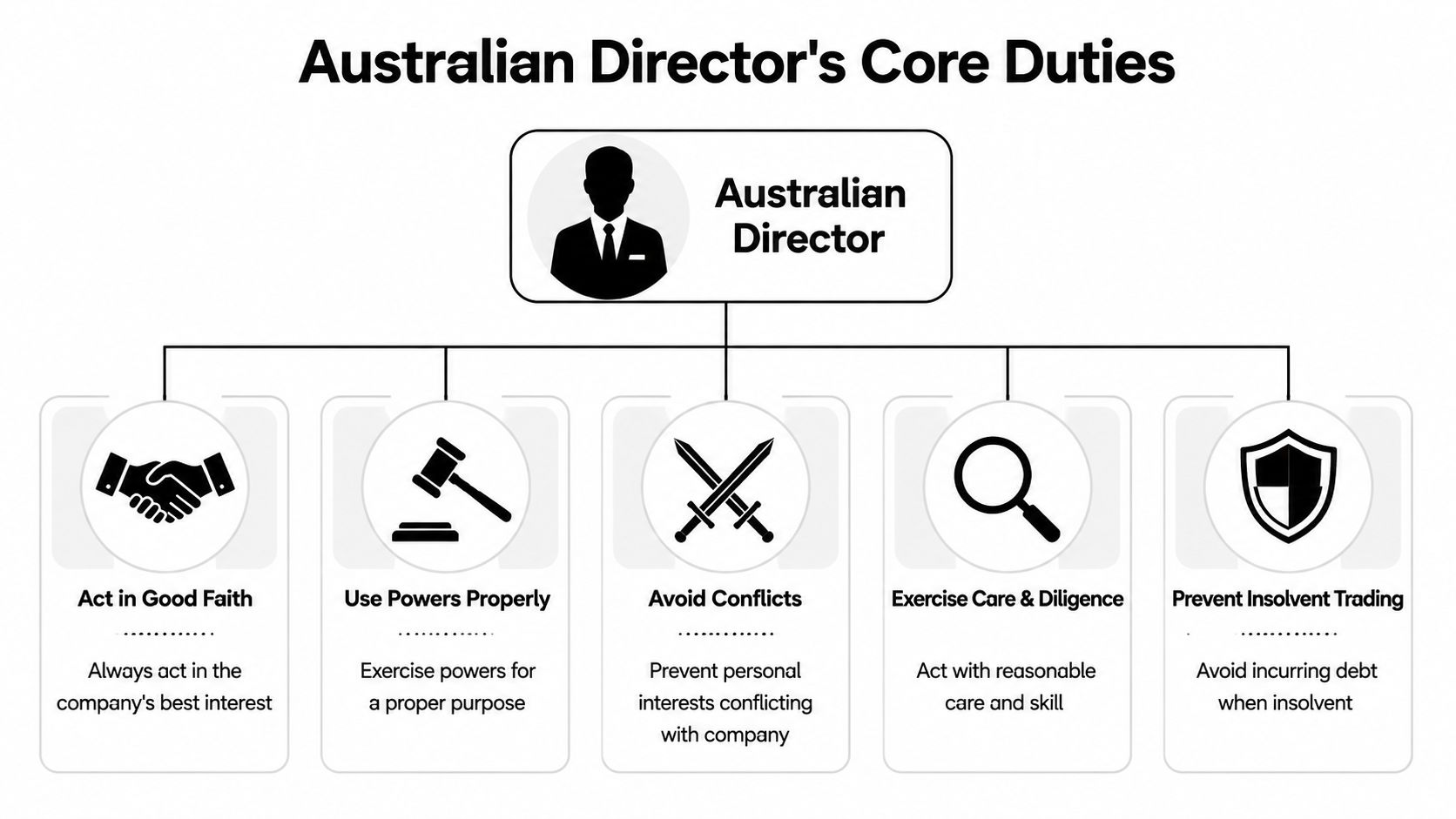
Here's a visual summary of those duties.
What the core duties look like in practice
Think of a director like the captain of a vessel. They don't do every technical task personally, but they are responsible for whether the ship is being run with proper oversight, competent information, and lawful decisions.
The core duties usually land in five practical buckets:
Care and diligence: Directors must pay attention. In an SME, that means reading the board pack, understanding the cash position, and asking why margin has moved or why payroll is tight.
Good faith in the company's best interests: Decisions must serve the company, not a private side deal, family preference, or founder ego.
Proper purpose: You can't use director powers for reasons outside the company's legitimate interests.
Avoiding conflicts: If a personal interest collides with the company's interests, that must be managed properly.
Watching solvency: Directors can't ignore whether the company can meet its obligations as they fall due.
A board minute isn't admin clutter. It's part of the evidence trail showing a director considered the issue, the risks, and the basis for the decision.
Legal duty transforms into finance discipline. Board packs, approvals, delegated authorities, and written resolutions aren't corporate theatre. They're how directors show they exercised judgement. For founders who want that governance tied back to finance operations, a practical place to start is tax and compliance for growing businesses.
Later in the same rhythm, video explainers can help directors understand how legal duty maps to board behaviour.
What doesn't work
What fails in SMEs is rarely a lack of effort. It's usually a lack of structure.
Directors get into trouble when they rely on:
Verbal updates only: “We talked about it” is weak evidence.
Selective reporting: Looking only at sales while ignoring cash conversion, tax, and creditor pressure.
Founder overconfidence: Assuming business intuition replaces formal oversight.
A capable director doesn't need to be a lawyer. But they do need a repeatable decision process and enough financial visibility to know when the business is drifting into risk.
Decoding the Boardroom Director vs Shareholder Roles
Founders mix up these roles all the time because the same person often wears both hats. But they are not the same hat.
Ownership and governance are different jobs
A shareholder owns part of the company. A director governs the company. Ownership gives you an economic interest. Governance gives you decision-making responsibility and legal exposure.
A simple analogy helps. If a company were a commercial building, the shareholder would own the asset. The director would be responsible for making sure the building is run properly, key risks are managed, and major decisions are made in the company's interests.
Aspect | Company Director | Shareholder |
|---|---|---|
Main role | Governs the company | Owns equity in the company |
Focus | Strategy, oversight, risk, approvals | Return on investment and ownership rights |
Day-to-day involvement | May be involved, but always has governance responsibility | May have no operational involvement at all |
Legal duties | Owes duties tied to the office | Doesn't govern by default just by owning shares |
Decision type | Board decisions and formal oversight | Voting on shareholder matters under the constitution and law |
Exposure | Can face personal consequences for breaches of duty | Generally exposed through investment position, not board governance |
This distinction matters in founder-led businesses. A passive investor may own shares and still have no board seat. A working founder may hold shares and also serve as a director. A senior manager may be a director without owning much equity at all.
Executive non-executive and shadow directors
There are also different forms of director involvement.
An executive director has a board role and an operational role. Think founder-CEO, managing director, or a finance lead who also sits on the board. They're close to the daily numbers and decisions.
A non-executive director sits on the board but isn't involved in daily management. Their value often comes from challenge, independence, pattern recognition, and governance discipline.
Then there's the shadow director. This is the person who isn't formally appointed but whose instructions the board routinely follows. In SMEs, that can be a dominant founder, a spouse closely involved in decisions, or an investor who effectively calls the shots from outside formal appointments.
If someone regularly makes board-level decisions without the title, that doesn't mean they're invisible to the law.
When founders ask what is a director in a company, this is one of the most useful clarifications. It's not just who holds the title. It's who governs, who influences, and who bears responsibility for company-level decisions.
The practical takeaway is simple. Be clear about which hat each person is wearing in each meeting. Ownership discussions, employment matters, and board decisions shouldn't blur into one informal chat over coffee.
Making It Official How to Appoint and Remove Directors
Informal arrangements create expensive confusion. If you're appointing a director, do it properly from the start.
A practical appointment sequence
For an Australian SME, the usual sequence is straightforward:
Check eligibility first. Make sure the person can act as a director and that the appointment fits the company's constitution and any shareholders agreement.
Get written consent. Don't rely on verbal acceptance.
Confirm Director ID requirements are handled. This is now part of basic appointment hygiene.
Record the appointment properly. Use a board resolution or other valid company process.
Notify ASIC on time and update company records. The internal register matters as much as the outward filing.
Founders often overlook address details during setup. If you're sorting out the administrative side of the appointment, practical guidance on setting up your official director address can help avoid sloppy records from day one.

Australian boards at the listed-company end are relatively compact but influential. Reporting cited in this board composition discussion notes that ASX-listed boards average roughly 7 to 8 directors, and women make up about 35% of ASX 300 directors in recent reporting periods, highlighting how concentrated board decision-making is in practice in this board composition analysis.
SMEs usually have much smaller boards, which makes each appointment even more consequential. In a two-director or three-director setup, one weak appointment can distort every major decision.
Resignation and removal
Removal is where founders discover whether they've treated governance seriously. If a director resigns, you need the resignation documented, the records updated, and external notifications handled properly. If shareholders remove a director, the company must follow the constitution, any shareholder agreements, and statutory process.
A few practical points keep this clean:
Document timing clearly: Record the exact effective date.
Check authority: Confirm who has the power to appoint or remove under your constitution.
Update the register immediately: Internal records should match the current reality.
Secure handover items: Board papers, access rights, approvals, and signing authorities should all be reviewed.
Bad exits usually come from lazy setup. Good exits are boring, documented, and unsurprising.
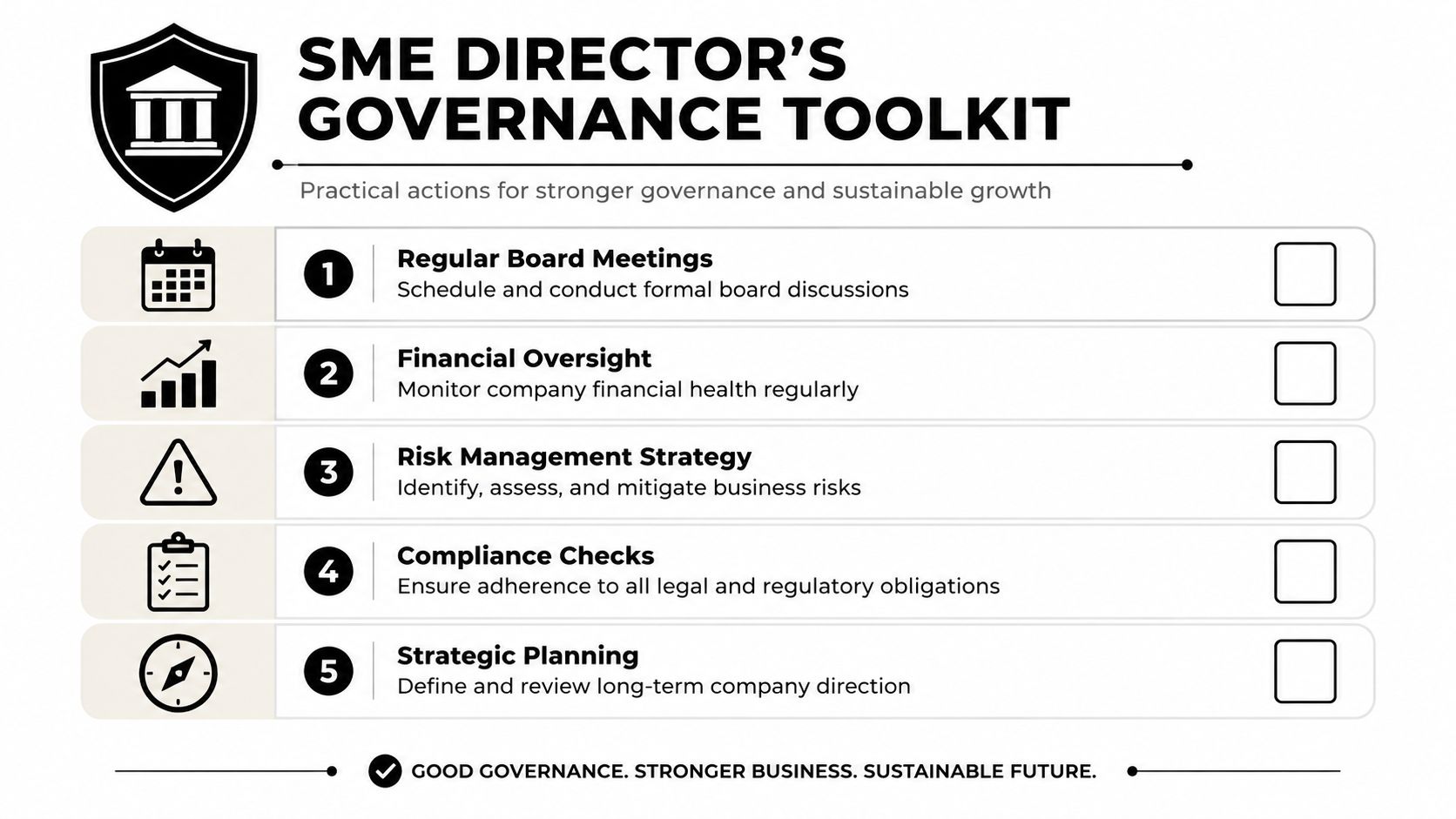
The SME Director's Toolkit A Practical Governance Checklist
Most founders don't need a heavier governance model. They need a usable one. A good SME board rhythm should help directors spot pressure early, make cleaner decisions, and prove they exercised care and diligence if anyone later asks.
In Australia, the director role is legally operational, not ceremonial. Under the Corporations Act 2001 (Cth), a director is an office holder with duties to act with care and diligence. ASIC can pursue civil penalties and, for serious breaches, disqualification. This means a director must be able to evidence oversight of cash flow, solvency, and tax lodgements through repeatable board packs, KPI reporting, and signed resolutions, as stated in this reference discussing the operational nature of the role and consequences for breaches in this director duties overview.
What should be in your board pack
For a founder-led SME, a workable monthly board pack should usually include:
Profit and loss statement: Not just revenue. Directors should understand gross margin, overhead movement, and whether profit quality is improving or weakening.
Balance sheet: Hidden pressure sits within the balance sheet. Inventory bloat, aged debtors, tax liabilities, and loan movements often show up here before they become obvious elsewhere.
Cash flow forecast: The cash flow forecast is the survival document. It tells you whether the company can absorb wage growth, stock purchases, debt repayments, and seasonal softness.
KPI dashboard: Choose operational measures that drive the financial outcome. That might be utilisation, job margin, stock turn, average order value, debtor days, or labour recovery.
Decision log and resolutions: Important approvals should be visible and signed off.
Board habit worth keeping: If a number surprises the board in the meeting, the pack was probably too weak or too late.
The point isn't volume. It's clarity. A bloated report no one reads is worse than a concise pack that surfaces actual risks.
The habits that protect directors
Good governance in an SME is mostly rhythm and discipline.
Start with regular board meetings, even if the board is only two founders. Put them in the calendar. Use an agenda. Keep minutes that record the issue, the discussion, the challenge points, and the decision.
Then tighten the operational basics:
Review solvency actively: Don't assume that profitable trading means safe cash.
Track tax lodgements and payment plans: Directors should know where obligations stand, not hear about them after they're overdue.
Document delegated authority: Clarify who can hire, sign contracts, approve spend, and commit the business.
Keep risk visible: Cyber, WHS, supplier concentration, and key-person dependency all belong in governance, not just operations.
Consider D&O insurance carefully: Insurance doesn't replace good conduct, but founders should understand where it fits.
If key people carry too much operational knowledge or customer dependency, that's a board issue too. A useful related lens is key person risk in growing businesses.
Some SMEs also need help turning reporting into governance. That's where an external accountant, lawyer, chair, or virtual CFO can add structure. Nexist is one example of a firm that helps founders build reporting rhythms, forecasting, KPI visibility, and decision processes so directors can govern from current numbers instead of instinct alone.
What works and what doesn't
What works is simple, current, and documented. What doesn't is reactive governance built from inbox searches and memory.
Directors don't need a listed-company board pack. They do need enough evidence to show they understood the company's financial position and acted on it.
Red Flags Common Director Pitfalls and When to Get Help
Most director problems in SMEs don't begin with fraud or recklessness. They start with delay. The founder sees pressure building, tells themselves next month will be better, and keeps trading without confronting what the numbers are saying.
How trouble usually starts
Consider a fictional trade business. Sales are still coming in. The team is busy. The owner feels reassured because the workshop is full and the phone keeps ringing. But debtors are stretching, supplier pressure is increasing, payroll is tight, and tax obligations are slipping. To keep jobs moving, the company keeps ordering materials and taking on commitments.
That's how risk builds. Not through drama, but through ordinary decisions made without a clear view of solvency.
Other common pitfalls sit alongside that pattern:
Conflicts of interest: Related-party deals, family employment arrangements, or using the company to support personal priorities without proper process.
Poor record keeping: Decisions made in chat threads, verbal approvals, and missing board minutes.
Ignoring advice selectively: Asking the accountant, lawyer, or adviser for input, then discarding it because the answer is inconvenient.
Founder dominance: One person effectively decides everything while the rest of the board nods it through.
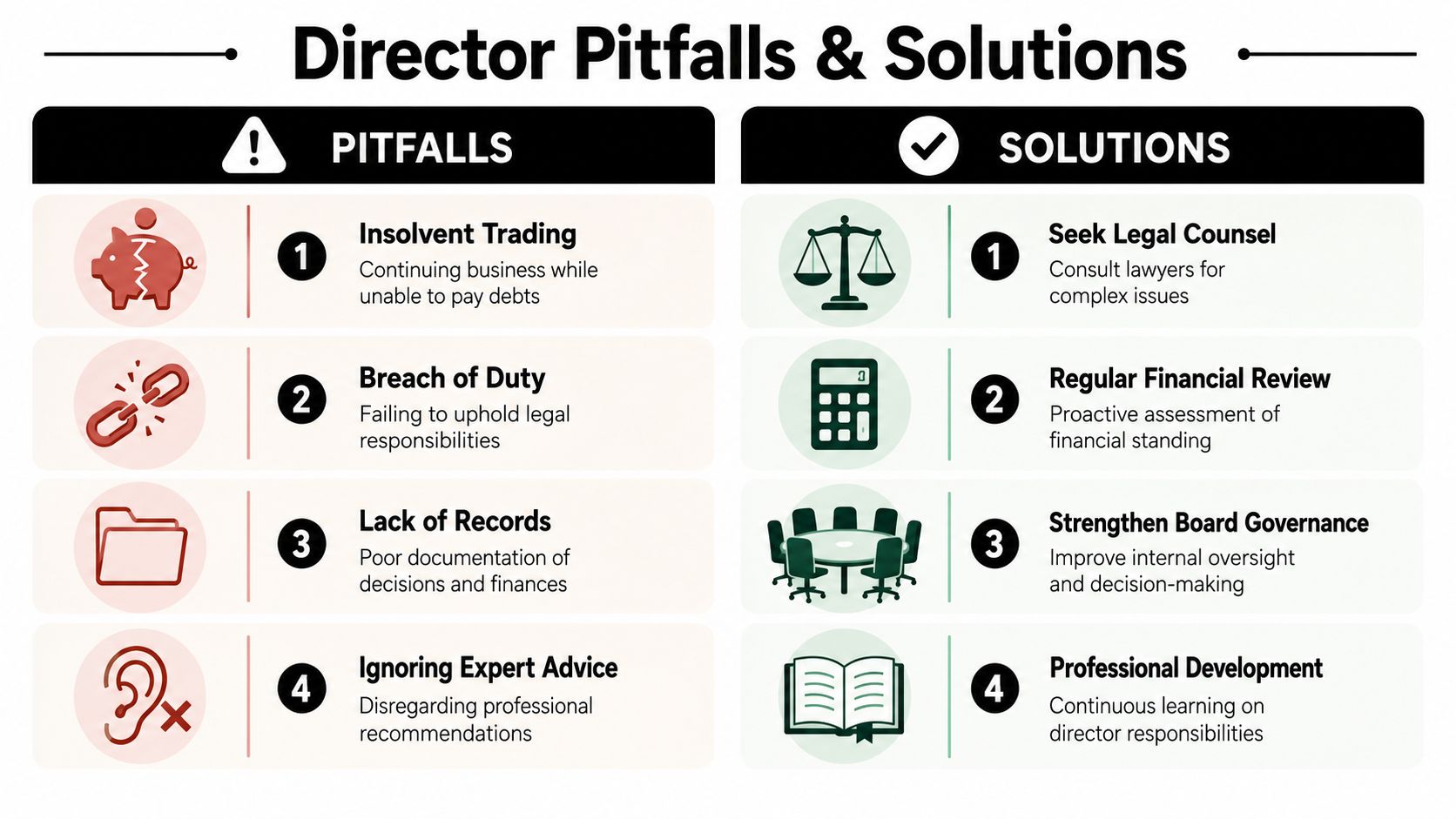
Trouble rarely arrives as a single bad event. It usually appears as a sequence of tolerated warning signs.
When outside support becomes necessary
Founders should get help earlier when any of these show up:
Cash uncertainty: You can't answer, with confidence, what the next few weeks or months of cash pressure look like.
Weak visibility: Financial reports arrive late, don't reconcile, or don't explain why cash and profit are moving differently.
Decision fatigue at the top: The board discusses symptoms every month but never reaches disciplined decisions.
Risk concentration: One customer, one supplier, one senior operator, or one founder carries too much of the business.
That support might come from a company lawyer, insolvency practitioner, external accountant, or a virtual CFO depending on the issue. A good adviser won't just give opinions. They'll help tighten forecasts, reporting cadence, risk controls, and approval discipline.
If your board is trying to separate operational noise from real exposure, it helps to bring risk into a structured conversation through a framework such as business risk management for SMEs.
The practical test is simple. If the directors can't quickly see the company's true financial position and current commitments, they're already governing with impaired vision.
Director FAQs Your Questions Answered
Can I be both an employee and a director
Yes. That's common in founder-led companies. But the roles are different. As an employee, you perform an operational job. As a director, you govern the company and owe duties tied to that office.
Do directors have personal exposure
Yes, that's the part many founders underestimate. Australian company directors aren't just senior leaders. They are legally accountable officers. A useful question is, “What does being a director personally expose me to, and what compliance tasks must I do each year?” That question matters because it affects cash flow, governance, and risk decisions, as noted in this practical discussion of director accountability in this company director guide.
Do I need to be good with numbers to be a director
You don't need to be the bookkeeper or accountant. You do need to understand enough to challenge what you're seeing. If you can't follow the cash position, debt load, tax status, and key risks, you're not in a safe governance position.
Is a shareholder automatically a director
No. Shareholders own. Directors govern. One person can be both, but one role doesn't automatically create the other.
How many directors should an SME have
That depends on the company type, constitution, and needs of the business. For most founders, the better question isn't “what's the minimum?” It's “who will improve judgement, oversight, and accountability around this table?”
What should I do every year as a director
At a minimum, stay current on filings, financial oversight, tax and compliance obligations, governance records, and key risk reviews. If you don't have a recurring annual checklist, create one. Directors get into trouble when compliance lives in someone's memory instead of a system.
If you're carrying director responsibility but still making decisions from delayed reports, patchy cash visibility, or founder instinct, Nexist can help put structure around the job. That usually means cleaner board packs, tighter forecasting, better KPI visibility, and operating systems that let directors govern from facts instead of firefighting.
what is a director in a company, company director australia, director duties corporations act, asic director guide, sme governance

" width="24px"/><g d="M 0 24.129 L 0 0.129 L 24 0.129 L 24 24.129 Z M 0 24.129 L 0 0.129 L 24 0.129 L 24 24.129 Z M 24 3 C 24 1.344 22.656 0 21 0 L 3 0 C 1.344 0 0 1.344 0 3 L 0 21 C 0 22.656 1.344 24 3 24 L 21 24 C 22.656 24 24 22.656 24 21 Z M 6.883 8.375 L 2.863 8.375 L 2.863 20.467 L 6.883 20.467 Z M 4.899 2.545 C 3.524 2.545 2.625 3.449 2.625 4.634 C 2.625 5.795 3.496 6.724 4.846 6.724 L 4.872 6.724 C 6.273 6.724 7.146 5.795 7.146 4.634 C 7.12 3.449 6.274 2.545 4.899 2.545 Z M 16.747 8.09 C 14.614 8.09 13.659 9.263 13.124 10.086 L 13.124 8.374 L 9.105 8.374 C 9.159 9.508 9.105 20.466 9.105 20.466 L 13.124 20.466 L 13.124 13.713 C 13.124 13.352 13.15 12.99 13.257 12.732 C 13.547 12.01 14.209 11.262 15.319 11.262 C 16.773 11.262 17.355 12.372 17.355 13.996 L 17.355 20.466 L 21.374 20.466 L 21.374 13.532 C 21.374 9.818 19.391 8.09 16.747 8.09 Z" fill="transparent" height="24.12890599668026px" id="dSFdkJotL" width="24px"><path d="M 0 24 L 0 0 L 24 0 L 24 24 Z" fill="transparent" height="24px" id="wscNJE44G" transform="translate(0 0.129)" width="24px"/><g d="M 0 24.129 L 0 0.129 L 24 0.129 L 24 24.129 Z M 24 3 C 24 1.344 22.656 0 21 0 L 3 0 C 1.344 0 0 1.344 0 3 L 0 21 C 0 22.656 1.344 24 3 24 L 21 24 C 22.656 24 24 22.656 24 21 Z M 6.883 8.375 L 2.863 8.375 L 2.863 20.467 L 6.883 20.467 Z M 4.899 2.545 C 3.524 2.545 2.625 3.449 2.625 4.634 C 2.625 5.795 3.496 6.724 4.846 6.724 L 4.872 6.724 C 6.273 6.724 7.146 5.795 7.146 4.634 C 7.12 3.449 6.274 2.545 4.899 2.545 Z M 16.747 8.09 C 14.614 8.09 13.659 9.263 13.124 10.086 L 13.124 8.374 L 9.105 8.374 C 9.159 9.508 9.105 20.466 9.105 20.466 L 13.124 20.466 L 13.124 13.713 C 13.124 13.352 13.15 12.99 13.257 12.732 C 13.547 12.01 14.209 11.262 15.319 11.262 C 16.773 11.262 17.355 12.372 17.355 13.996 L 17.355 20.466 L 21.374 20.466 L 21.374 13.532 C 21.374 9.818 19.391 8.09 16.747 8.09 Z" fill="transparent" height="24.12890599668026px" id="sTpjGo1tb" width="24px"><path d="M 0 24 L 0 0 L 24 0 L 24 24 Z" fill="transparent" height="24px" id="s7ffpmKOD" transform="translate(0 0.129)" width="24px"/><g d="M 24 3 C 24 1.344 22.656 0 21 0 L 3 0 C 1.344 0 0 1.344 0 3 L 0 21 C 0 22.656 1.344 24 3 24 L 21 24 C 22.656 24 24 22.656 24 21 Z M 6.883 8.375 L 2.863 8.375 L 2.863 20.467 L 6.883 20.467 Z M 4.899 2.545 C 3.524 2.545 2.625 3.449 2.625 4.634 C 2.625 5.795 3.496 6.724 4.846 6.724 L 4.872 6.724 C 6.273 6.724 7.146 5.795 7.146 4.634 C 7.12 3.449 6.274 2.545 4.899 2.545 Z M 16.747 8.09 C 14.614 8.09 13.659 9.263 13.124 10.086 L 13.124 8.374 L 9.105 8.374 C 9.159 9.508 9.105 20.466 9.105 20.466 L 13.124 20.466 L 13.124 13.713 C 13.124 13.352 13.15 12.99 13.257 12.732 C 13.547 12.01 14.209 11.262 15.319 11.262 C 16.773 11.262 17.355 12.372 17.355 13.996 L 17.355 20.466 L 21.374 20.466 L 21.374 13.532 C 21.374 9.818 19.391 8.09 16.747 8.09 Z" fill="transparent" height="24.000006px" id="D0ecaHEcW" transform="translate(0 0)" width="24px"><path d="M 24 3 C 24 1.344 22.656 0 21 0 L 3 0 C 1.344 0 0 1.344 0 3 L 0 21 C 0 22.656 1.344 24 3 24 L 21 24 C 22.656 24 24 22.656 24 21 Z" fill="rgb(55, 184, 218)" height="24.000006px" id="IPLFE6zXx" width="24px"/><path d="M 4.02 0 L 0 0 L 0 12.092 L 4.02 12.092 Z" fill="rgb(255, 255, 255)" height="12.09201px" id="FWhtzAyuY" transform="translate(2.863 8.375)" width="4.02px"/><path d="M 2.274 0 C 0.899 0 0 0.904 0 2.089 C 0 3.25 0.871 4.179 2.221 4.179 L 2.247 4.179 C 3.648 4.179 4.521 3.25 4.521 2.089 C 4.495 0.904 3.649 0 2.274 0 Z" fill="rgb(255, 255, 255)" height="4.17876px" id="VmOsKv4kO" transform="translate(2.625 2.545)" width="4.52095px"/><path d="M 7.641 0 C 5.509 0 4.554 1.173 4.019 1.996 L 4.019 0.284 L 0 0.284 C 0.053 1.419 0 12.376 0 12.376 L 4.019 12.376 L 4.019 5.623 C 4.019 5.262 4.045 4.9 4.151 4.642 C 4.442 3.92 5.103 3.172 6.214 3.172 C 7.667 3.172 8.25 4.282 8.25 5.907 L 8.25 12.376 L 12.269 12.376 L 12.269 5.442 C 12.269 1.728 10.286 0 7.641 0 Z" fill="rgb(255, 255, 255)" height="12.37626px" id="n1XUbhaq0" transform="translate(9.105 8.09)" width="12.268830000000001px"/></g></g></g></g></svg>)