
Business Health Check: Reclaim Profit & Time in 2026
Conduct a step-by-step business health check to find hidden cash leaks & build an actionable roadmap. Aussie founders, reclaim profit & time in 2026!
Ansh Malhotra

You're probably in one of two positions right now.
Either cash feels tighter than it should, despite decent sales. Or the business is “busy” all the time, yet you still can't clearly explain where profit is going, why stock keeps chewing cash, or why your team needs you to unblock every decision.
That's when a proper business health check matters. Not a cosmetic review of last month's P&L. Not a quick look at your bank balance. A real diagnostic that shows where cash is leaking, where time is being wasted, and whether your business can execute the fixes you already know it needs.
Table of Contents
Why Your Business Needs More Than a Balance Sheet Check-up
Most founders wait too long to look properly at the business.
They review the BAS, glance at the balance sheet, ask whether sales are up, then go back to operations. That's not management. That's surveillance. You're watching the business, not steering it.
A real business health check looks wider and deeper. It asks whether your pricing still works, whether your stock is turning, whether your invoicing process is too slow, whether your team is clear on priorities, and whether the business can handle change without dropping service, cash, or control.
As of 30 June 2025, there were 2,729,648 actively trading businesses in Australia, with 16.4% entering and 13.9% exiting the market in the prior year according to the Australian Bureau of Statistics business counts release. That matters because a lot of businesses don't fail from one dramatic event. They fail from a run of ignored signals. Margin erosion. Slow collections. Too much stock. No forecast. No operating discipline.
The balance sheet won't tell you enough on its own
A balance sheet is useful. It isn't the diagnosis.
It shows position at a point in time. It doesn't tell you why stock is bloated, why debtors are stretching out, why payroll keeps rising faster than output, or why the owner is still approving every small purchase. If you need a practical way to organise the underlying numbers before reviewing them, tools that find balance sheet solutions can help you get cleaner inputs. But don't confuse cleaner reporting with strategic clarity.
Practical rule: If you only review historical reports, you'll spot problems after cash has already left the business.
Resilience is built before the crunch
The businesses that hold up under pressure usually aren't lucky. They've built habits. They forecast. They review stock movement. They tighten receivables. They know which products, jobs, or customers carry the margin. They don't rely on instinct once complexity rises.
That's especially important in Australia, where the business base is huge and dynamic. If new entrants want to avoid becoming part of the exit count, they need discipline early, not later. The founders who move from watchman to leader are the ones who stop asking “How did this happen?” and start asking “Where exactly is the leak, who owns the fix, and when do we review progress?”
Here's my view. If cash feels vague, if profit has slipped, or if your week disappears into reactive work, a business health check isn't optional. It's overdue.
Gathering Your Tools and Mindset for the Diagnostic
Most business reviews fail before they start because the owner walks in with incomplete reports and a defensive mindset.
You can't diagnose properly from a summary P&L and gut feel. You need evidence. And you need the discipline to look at what's there without trying to explain it away.

Start with evidence not opinions
Pull the reports that show how the business behaves.
At minimum, gather:
Profit and loss by month: Don't use a single annual report. You need trend movement.
Balance sheet: Useful for context, especially stock, debtors, creditors, debt, and owner drawings.
Cash flow report: This shows whether accounting profit is turning into actual cash.
Aged receivables and aged payables: These expose who owes you, who you owe, and where timing pressure sits.
Inventory report: Include slow-moving, obsolete, and negative stock if your system can show it.
Sales by product, service, or customer: Margin problems often sit in the mix, not total revenue.
Payroll summary: Useful for checking labour creep and role overlap.
Process maps or even rough workflow notes: Order-to-cash, procure-to-pay, stock receipting, fulfilment, quoting, invoicing.
If you don't have all of this neatly packaged, that's not a reason to skip the review. It's part of the diagnosis. Missing visibility is itself a management problem.
Use the three phase method properly
The Victorian Government guidance is clear. A formal business health check follows a three-phase risk management methodology: identify potential risks by auditing finances and operations, analyse risk levels to determine urgency, and evaluate risks to decide on mitigation actions. It also notes that businesses with a profit decline in the last 6 months are prime candidates for the diagnostic, as outlined in the Business Victoria guide to small business health checks.
That framework works because it forces sequence.
Identify what's happening. Don't jump to solutions.
Analyse which issues are dangerous, expensive, or urgent.
Evaluate what you'll do, in what order, with what trade-offs.
Don't ask “What should we do first?” until you've asked “What is actually broken, and how do we know?”
A useful diagnostic mindset is objective curiosity. Not blame. Not optimism. Not panic.
If your gross margin is down, don't assume suppliers are the problem. Check discounting, freight recovery, write-offs, job costing, and product mix. If receivables are out, don't assume clients are slow. Check whether invoices go out late, contain errors, or get stuck waiting for approvals.
Short version. Bring the reports. Accept the facts. Follow the method. That's how you get a business health check that leads to action instead of another vague discussion.
Financial Deep Dive Uncovering Hidden Cash Leaks
Founders usually get the biggest surprise at this point.
They expect the issue to be “sales”. Often it isn't. The issue is that cash gets trapped between sale and collection, margin gets chipped away by bad pricing or hidden costs, and stock or rework absorbs profit that should be in the bank.
Start with the mechanics. Then go hunting.

Cash flow is movement not a snapshot
A bank balance tells you where you are today. It doesn't tell you how fragile that position is.
Review the path from quote to cash. For a service business, that means lead time to complete work, invoice timing, client approval delays, and collection follow-up. For a product business, it means purchase timing, inbound delays, stock holding, fulfilment speed, returns, and debtor collection.
If you want a sharper way to inspect that timing, study the cash conversion cycle breakdown. It forces you to look at how long cash is tied up across stock, receivables, and payables instead of just staring at month-end balances.
A few common leaks show up fast:
Invoices sent late: Work is complete, but cash collection hasn't even started.
Deposits not collected upfront: You fund the customer's project or order.
Stock bought too early: Cash sits on shelves instead of funding growth.
Supplier terms ignored: You pay faster than you need to.
Returns and credits buried in admin: Margin disappears without a clear owner.
Here's the practical test. If revenue is growing but cash feels worse, your timing is broken somewhere.
For a deeper operational perspective, some founders find external reading on eCommerce business growth strategies useful because it pushes margin analysis below the headline sales number and into SKU, fulfilment, and cost structure decisions.
Margin leaks usually hide in plain sight
Most pricing reviews are too shallow.
Founders look at average gross margin and assume they understand profitability. They don't. You need to split margin by product line, service type, customer type, sales channel, or job category. The profitable business on paper often contains a handful of underpriced offers doing most of the damage.
Look for these patterns:
Leak area | What to check | What it often means |
|---|---|---|
Pricing drift | Discounts, old price lists, custom deals | Margin loss disguised as “sales activity” |
Cost recovery gaps | Freight, packaging, merchant fees, rework | You're subsidising delivery or complexity |
Product mix | Fast sellers versus profitable sellers | Revenue is growing in the wrong places |
Labour intensity | Extra touchpoints, handoffs, customisation | Jobs look profitable until time is counted |
The big miss in Australia is that many businesses never run a proper leak audit at all. According to the Women's Network summary citing sector benchmark findings, 68% of Australian agri-food businesses lose between $200K and $500K annually to untracked inventory and pricing inefficiencies, yet only 12% conduct granular cash leak audits. Even if you're not in agri-food, the lesson is obvious. Hidden leakage is common, and most owners aren't measuring it with enough detail.
If stock, pricing, and process friction aren't reviewed together, you'll understate the problem.
A retailer might think margin is the issue when the actual problem is stale stock forcing markdowns. A manufacturer might blame overheads when the issue is inaccurate BOM costing or too many production interruptions. A trade business might think clients are unprofitable when the actual culprit is variation work not invoiced properly.
Receivables and payables tell you who controls the timing
This part is boring until cash gets tight. Then it becomes urgent.
Read your aged receivables line by line. Not just the total. Identify which debts are disputed, which are slow because invoices were wrong, and which clients have trained you to tolerate delays. On the payables side, check whether you're using supplier terms intentionally or paying reactively because no one owns the calendar.
Here's a blunt operating standard:
Invoice on completion: Not at month-end because it's convenient.
Use automated reminders: Manual chasing is inconsistent.
Escalate old debt quickly: Silence is expensive.
Review supplier terms actively: Good terms are a financing tool.
Separate credit control ownership: If everyone owns it, no one does.
This short video gives a useful visual prompt for thinking about business review discipline before you finalise your own leak audit.
A proper business health check doesn't stop at “cash flow is tight”. It identifies exactly where cash is getting delayed, diluted, or trapped.
Auditing Your Operations People and Technology
If finance shows the symptoms, operations usually shows the cause.
I've seen businesses with acceptable sales and decent reported margin still feel chaotic every week because their workflow is clumsy, stock data is unreliable, team roles overlap, and software has become a patchwork of workarounds. The owner experiences that as stress. The business experiences it as cost.

Inventory and workflow are joined at the hip
Inventory isn't just a finance item. It's an operating behaviour.
If purchasing buys without good demand visibility, warehouse teams receive stock without discipline, and sales teams promise dates without checking capacity, you get the same result every time. Too much cash tied up in the wrong items and too much firefighting around the right ones.
Walk one real order all the way through the business. Start at demand signal. Then check purchasing, receipting, storage, picking, fulfilment, invoicing, and returns. You'll usually find at least one step where data is late, duplicated, or manually corrected.
A simple operational audit should ask:
Where does work queue up: Quoting, approvals, dispatch, invoicing?
Where is rekeying happening: Spreadsheet to system, email to ERP, paper to Xero?
Where can one person halt the process: Founder sign-off, warehouse knowledge, finance override?
Where does stock truth break down: Wrong counts, delayed receipting, missing write-offs?
People problems are usually process problems first
Founders often label an issue as “staff performance” when the process is the actual culprit.
If two people own the same task, work gets missed. If no one owns the handoff between sales and operations, clients get inconsistent information. If onboarding lives in someone's head, every new hire takes too long to become effective.
That's why I still tell founders to understand the financial picture, including the basics of understanding profit and loss statements, while also mapping who does what and when. Labour cost only makes sense when you tie it to workflow.
Use this quick operating lens:
Area | Red flag | What to fix first |
|---|---|---|
Roles | Tasks bounce between people | Clarify single-point ownership |
SOPs | Team asks the same questions repeatedly | Document repeatable steps |
Approvals | Founder is required for routine decisions | Set limits and rules |
Handoffs | Jobs stall between departments | Standardise triggers and checklists |
The team can't execute consistently if the process changes depending on who is available that day.
Technology should remove effort not create new admin
A lot of SMEs have too much software and not enough system design.
They've added apps over time. Inventory here, job tracking there, approvals in email, notes in WhatsApp, reporting in spreadsheets. Nothing is fully broken, but nothing is joined up. That creates hidden labour cost because staff spend time chasing information instead of completing work.
The audit question is simple. Does each tool reduce manual effort or just relocate it?
Check for repetitive actions that should already be automated:
Invoice reminders and payment follow-up
Purchase order approvals
Data transfer between ecommerce, inventory, and accounting
Staff onboarding and leave workflows
Recurring reporting and KPI dashboards
If you need a practical reference point, review examples of automating business processes and compare them against your own workflow. Don't automate a bad process blindly. Clean the sequence first, then automate the repeatable parts.
Operational friction rarely sits in one box. Poor SOPs lead to stock errors. Stock errors cause urgent purchasing. Urgent purchasing disrupts cash. Cash pressure triggers short-term decisions. Then the owner steps back in and the business becomes dependent again.
That's why a business health check has to cover operations, people, and technology together. Treating them separately misses the chain reaction.
Building Your Prioritised Action Roadmap
A diagnosis without a roadmap is just expensive self-awareness.
Once you've identified the leaks and bottlenecks, don't dump them into a giant improvement list. That overwhelms the team and guarantees drift. You need a short, hard-edged roadmap that deals with impact, effort, and your actual ability to follow through.
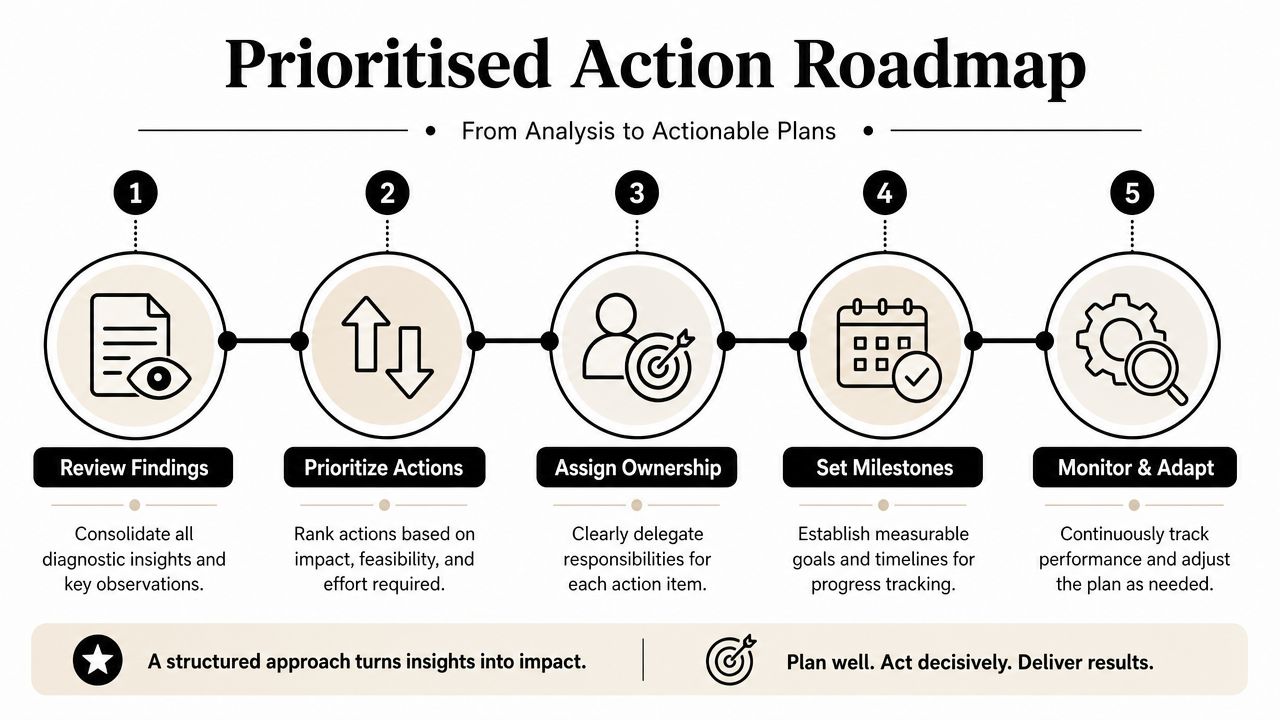
The reason this matters is simple. According to FIAL's business health check guidance, 75% of SMEs participating in a structured health check identify at least three high-priority improvement areas, and businesses using a Growth and Profit Solutions diagnostic achieve a 40% higher probability of successful change initiatives. The message isn't “do more”. It's “prioritise better”.
Sort issues by impact effort and readiness
I use a three-part filter.
First, rank each issue by impact. Will fixing it improve cash, margin, owner time, delivery reliability, or reporting clarity?
Second, judge effort. Does it require a policy change, a system rebuild, staff retraining, supplier renegotiation, or just discipline?
Third, assess readiness. This is the part most businesses skip. Can your team implement the change right now? A good plan that the business can't absorb is still a bad plan.
Here's a practical way to sort the list:
Do now: High impact, low effort, strong readiness.
Plan next: High impact, moderate effort, acceptable readiness.
Sequence carefully: High impact, high effort, low readiness.
Ignore for now: Low impact, distracting, or cosmetic.
Good roadmaps protect focus. They don't reward enthusiasm.
Turn findings into owned actions
Every action needs an owner, a deadline, and a metric. If any of those are missing, it's not an action. It's a wish.
A workable roadmap for the next quarter should look more like this:
Issue | Action | Owner | Deadline | KPI |
|---|---|---|---|---|
Slow debtor collections | Send invoices on completion and automate reminders | Finance lead | End of month | Faster collections and fewer overdue invoices |
Margin erosion on custom jobs | Review pricing rules and approval thresholds | Founder plus sales lead | Within 30 days | Improved gross margin by job type |
Excess stock | Freeze selected purchasing and clear obsolete items | Operations lead | Within 45 days | Lower stock held and better stock movement |
Founder bottleneck on approvals | Delegate routine approvals with clear limits | Founder | Immediate | Fewer daily escalations |
Review this roadmap regularly through a disciplined quarterly business review process. Quarterly is long enough to see real movement and short enough to correct drift before it becomes another quarter of excuses.
One more point. Don't build a roadmap around ideal conditions. Build it around the team, systems, and management capacity you have today. Ambition is useful. Capacity decides whether the plan survives contact with reality.
The Quick-Win Playbook and Business Health Scorecard
Most founders need momentum first.
Not a giant transformation project. Not a six-month strategy deck. Momentum. A few clear moves that improve visibility, tighten cash control, and lower operational noise within days.
What to do in the next 48 hours
Pick a handful of actions and complete them fast.
Run the aged receivables report: Call out disputed invoices, overdue amounts, and clients who need escalation.
List your top margin risks: Write down the products, jobs, or services you suspect are underpriced or over-serviced.
Review slow-moving stock: Mark what shouldn't be reordered until existing units move.
Map one broken workflow: Choose quoting, fulfilment, invoicing, or purchasing. Write the current steps on one page.
Set one approval rule: Remove yourself from a routine decision the team should already own.
Turn on one automation: Invoice reminders, supplier approval routing, or recurring KPI reporting.
Schedule the monthly review: If it isn't in the calendar, it won't happen.
These aren't glamorous. They work because they force decisions.
A simple monthly scorecard that keeps you honest
You don't need a giant dashboard to manage the business better. You need a one-page scorecard that gets reviewed every month without fail.
Use this as your working template.
Business Health Scorecard Template
Health Pillar | Key Metric | Last Month | This Month | Target | Notes/Action |
|---|---|---|---|---|---|
Cash flow | Cash buffer days | ||||
Profitability | Gross profit margin | ||||
Receivables | Overdue invoices | ||||
Payables | Supplier payment discipline | ||||
Inventory | Inventory turnover | ||||
Operations | Order or job cycle time | ||||
Team | Key role ownership gaps | ||||
Technology | Manual tasks eliminated | ||||
Leadership | Founder approvals still required | ||||
Planning | Forecast accuracy |
Fill it in monthly. Keep the commentary blunt. If a metric worsens, write the corrective action beside it and assign an owner. If a metric improves, don't just celebrate it. Lock in the process that caused the improvement.
A business health check only creates value when it changes how you run the business after the review. Better numbers are the outcome. Better operating discipline is the mechanism.
If you want an external view that cuts through the noise and turns scattered reports into a clear cash, margin, and operations plan, Nexist helps Australian founders do exactly that. The focus is practical: find the leaks, prioritise the fixes, build the finance and operating rhythm, and give you back control of cash in the bank and time in your week.
business health check, cash flow management, virtual cfo, business diagnostics, SME growth strategy

" width="24px"/><g d="M 0 24.129 L 0 0.129 L 24 0.129 L 24 24.129 Z M 0 24.129 L 0 0.129 L 24 0.129 L 24 24.129 Z M 24 3 C 24 1.344 22.656 0 21 0 L 3 0 C 1.344 0 0 1.344 0 3 L 0 21 C 0 22.656 1.344 24 3 24 L 21 24 C 22.656 24 24 22.656 24 21 Z M 6.883 8.375 L 2.863 8.375 L 2.863 20.467 L 6.883 20.467 Z M 4.899 2.545 C 3.524 2.545 2.625 3.449 2.625 4.634 C 2.625 5.795 3.496 6.724 4.846 6.724 L 4.872 6.724 C 6.273 6.724 7.146 5.795 7.146 4.634 C 7.12 3.449 6.274 2.545 4.899 2.545 Z M 16.747 8.09 C 14.614 8.09 13.659 9.263 13.124 10.086 L 13.124 8.374 L 9.105 8.374 C 9.159 9.508 9.105 20.466 9.105 20.466 L 13.124 20.466 L 13.124 13.713 C 13.124 13.352 13.15 12.99 13.257 12.732 C 13.547 12.01 14.209 11.262 15.319 11.262 C 16.773 11.262 17.355 12.372 17.355 13.996 L 17.355 20.466 L 21.374 20.466 L 21.374 13.532 C 21.374 9.818 19.391 8.09 16.747 8.09 Z" fill="transparent" height="24.12890599668026px" id="dSFdkJotL" width="24px"><path d="M 0 24 L 0 0 L 24 0 L 24 24 Z" fill="transparent" height="24px" id="wscNJE44G" transform="translate(0 0.129)" width="24px"/><g d="M 0 24.129 L 0 0.129 L 24 0.129 L 24 24.129 Z M 24 3 C 24 1.344 22.656 0 21 0 L 3 0 C 1.344 0 0 1.344 0 3 L 0 21 C 0 22.656 1.344 24 3 24 L 21 24 C 22.656 24 24 22.656 24 21 Z M 6.883 8.375 L 2.863 8.375 L 2.863 20.467 L 6.883 20.467 Z M 4.899 2.545 C 3.524 2.545 2.625 3.449 2.625 4.634 C 2.625 5.795 3.496 6.724 4.846 6.724 L 4.872 6.724 C 6.273 6.724 7.146 5.795 7.146 4.634 C 7.12 3.449 6.274 2.545 4.899 2.545 Z M 16.747 8.09 C 14.614 8.09 13.659 9.263 13.124 10.086 L 13.124 8.374 L 9.105 8.374 C 9.159 9.508 9.105 20.466 9.105 20.466 L 13.124 20.466 L 13.124 13.713 C 13.124 13.352 13.15 12.99 13.257 12.732 C 13.547 12.01 14.209 11.262 15.319 11.262 C 16.773 11.262 17.355 12.372 17.355 13.996 L 17.355 20.466 L 21.374 20.466 L 21.374 13.532 C 21.374 9.818 19.391 8.09 16.747 8.09 Z" fill="transparent" height="24.12890599668026px" id="sTpjGo1tb" width="24px"><path d="M 0 24 L 0 0 L 24 0 L 24 24 Z" fill="transparent" height="24px" id="s7ffpmKOD" transform="translate(0 0.129)" width="24px"/><g d="M 24 3 C 24 1.344 22.656 0 21 0 L 3 0 C 1.344 0 0 1.344 0 3 L 0 21 C 0 22.656 1.344 24 3 24 L 21 24 C 22.656 24 24 22.656 24 21 Z M 6.883 8.375 L 2.863 8.375 L 2.863 20.467 L 6.883 20.467 Z M 4.899 2.545 C 3.524 2.545 2.625 3.449 2.625 4.634 C 2.625 5.795 3.496 6.724 4.846 6.724 L 4.872 6.724 C 6.273 6.724 7.146 5.795 7.146 4.634 C 7.12 3.449 6.274 2.545 4.899 2.545 Z M 16.747 8.09 C 14.614 8.09 13.659 9.263 13.124 10.086 L 13.124 8.374 L 9.105 8.374 C 9.159 9.508 9.105 20.466 9.105 20.466 L 13.124 20.466 L 13.124 13.713 C 13.124 13.352 13.15 12.99 13.257 12.732 C 13.547 12.01 14.209 11.262 15.319 11.262 C 16.773 11.262 17.355 12.372 17.355 13.996 L 17.355 20.466 L 21.374 20.466 L 21.374 13.532 C 21.374 9.818 19.391 8.09 16.747 8.09 Z" fill="transparent" height="24.000006px" id="D0ecaHEcW" transform="translate(0 0)" width="24px"><path d="M 24 3 C 24 1.344 22.656 0 21 0 L 3 0 C 1.344 0 0 1.344 0 3 L 0 21 C 0 22.656 1.344 24 3 24 L 21 24 C 22.656 24 24 22.656 24 21 Z" fill="rgb(55, 184, 218)" height="24.000006px" id="IPLFE6zXx" width="24px"/><path d="M 4.02 0 L 0 0 L 0 12.092 L 4.02 12.092 Z" fill="rgb(255, 255, 255)" height="12.09201px" id="FWhtzAyuY" transform="translate(2.863 8.375)" width="4.02px"/><path d="M 2.274 0 C 0.899 0 0 0.904 0 2.089 C 0 3.25 0.871 4.179 2.221 4.179 L 2.247 4.179 C 3.648 4.179 4.521 3.25 4.521 2.089 C 4.495 0.904 3.649 0 2.274 0 Z" fill="rgb(255, 255, 255)" height="4.17876px" id="VmOsKv4kO" transform="translate(2.625 2.545)" width="4.52095px"/><path d="M 7.641 0 C 5.509 0 4.554 1.173 4.019 1.996 L 4.019 0.284 L 0 0.284 C 0.053 1.419 0 12.376 0 12.376 L 4.019 12.376 L 4.019 5.623 C 4.019 5.262 4.045 4.9 4.151 4.642 C 4.442 3.92 5.103 3.172 6.214 3.172 C 7.667 3.172 8.25 4.282 8.25 5.907 L 8.25 12.376 L 12.269 12.376 L 12.269 5.442 C 12.269 1.728 10.286 0 7.641 0 Z" fill="rgb(255, 255, 255)" height="12.37626px" id="n1XUbhaq0" transform="translate(9.105 8.09)" width="12.268830000000001px"/></g></g></g></g></svg>)