Business Cash Flow Problems: Causes, Fixes and Recovery
Solve business cash flow problems with proven triage steps, forecasting tactics and sector-specific fixes for Australian SMEs, ecommerce and trades.
Ansh Malhotra

You've had a strong month. Sales are up, the order book looks healthy and your profit report doesn't look alarming. Yet the bank balance keeps falling. Payroll is approaching, a supplier wants payment, and several customers still haven't paid invoices issued weeks ago.
That isn't unusual. Business cash flow problems usually begin as a timing mismatch, not as a dramatic collapse in demand. Cash arrives after the business has already paid wages, rent, stock, tax, suppliers and loan obligations. If you manage only profit, you can miss the week when the bank account runs out.
Table of Contents
What Business Cash Flow Problems Actually Mean
A founder can make a sale today and still have no usable cash today. The accounting system may record revenue when the work is completed or the invoice is issued, while the bank account changes only when the customer pays. At the same time, wages, rent, inventory purchases and supplier bills leave the account on fixed dates.
That gap creates the classic profitable-but-cash-poor business. The owner sees healthy sales and a positive margin, but the cash conversion cycle is too slow to fund daily operations. A growing business can make the problem worse because growth often requires more stock, staff, equipment and delivery capacity before customers settle their accounts.
The practical test: Profit tells you whether the business model can work. Cash flow tells you whether the business can survive the next payment date.
A cash flow statement separates operating cash movements from accounting profit, helping you see where money enters and leaves the business. The cash flow statement guide from Nexist is a useful reference if your reports show profit but you can't explain the bank balance.
Profit and liquidity answer different questions
Profit asks whether income exceeds expenses over an accounting period. Liquidity asks whether you can pay obligations when they fall due. Both matter, but they require different decisions.
Consider a trade business that completes a large project. The job may be profitable, yet the business must fund materials, subcontractors and wages before receiving the final payment. An ecommerce operator faces a similar issue when purchasing stock in advance of sales. A hospitality venue can record steady revenue while labour, rent and supplier payments consume cash every week.
Australian businesses have faced this structural pressure for years. In the 2017–18 period, payments from large businesses to small businesses were worth around AU$281 billion, and around AU$77 billion was paid later than 30 days, according to the Australian SME cash-flow data summary. The same review reported that 53% of trade credit payments were late, and late payments averaged 23 days overdue.
That's why a shrinking bank balance deserves attention even when sales look strong. You need to understand the timing of confirmed receipts, expected receipts and unavoidable payments, not just the revenue line.
The Six Root Causes of Cash Flow Strain
Most cash shortages have a traceable cause. The mistake is treating the bank balance as the problem instead of identifying the process that keeps pulling cash out faster than it returns.

1. Late customer payments
Receivables are often the largest leak in service, trade and wholesale businesses. If your terms allow payment beyond 30 days, every delayed invoice forces you to finance the customer's business while covering your own costs.
The Australian data is blunt. Around 53% of trade credit payments were paid late, and late payments averaged 23 days overdue in the government review cited above. Recent reporting also found that 63% of Australian businesses were losing money to late payments overall in 2025, while 17% of small and medium businesses were losing more than AU$2,500 per month, up from 11% in 2024. Those figures appear in Xero's Australian late-payment guide.
2. Overtrading during growth
More orders don't automatically mean more financial strength. A wholesaler may accept a major order, buy additional stock, increase labour and pay freight before collecting the first invoice. The margin can be sound, but the working capital requirement becomes unsustainable.
Growth needs a funding plan. If you can't model the cash required to fulfil additional sales, you're taking on commitments without knowing whether the bank account can support them.
3. Poor inventory management
Stock converts cash into products, then converts products back into cash only after sale. Slow-moving or poorly forecast inventory traps money on shelves and creates pressure elsewhere.
Ecommerce and retail operators should examine stock by product, age and sales velocity. Discounting dead stock may reduce margin, but holding it indefinitely can create a worse outcome because the cash remains unavailable.
4. High overhead costs
Fixed costs continue when sales slow and often rise before revenue arrives. Rent, software, vehicles, insurance, salaried staff and finance repayments can consume cash regardless of weekly sales.
Hospitality operators need particular discipline because labour and perishables must be managed alongside fluctuating demand. A busy venue can still struggle if roster decisions, purchasing and supplier schedules don't match the cash coming in.
5. Lack of forecasting
Without a forward cash view, founders discover a shortage only when the account is already under pressure. A forecast should list expected receipts by likely payment date, then map them against wages, tax, suppliers, rent, debt and other committed outflows.
6. Seasonal fluctuations and debt servicing
Seasonality creates predictable troughs, but owners often budget around annual revenue rather than the months when cash is weakest. Debt repayments add another fixed drain, particularly when interest and input costs rise.
Australian insolvency research indicates that at least three-quarters of insolvencies involve small businesses, with quarterly insolvency incidence around 0.15% of operating businesses in the RBA's analysis. Hospitality and construction have a higher share of companies entering insolvency, especially among smaller firms, as reported in the Equifax Business Market Pulse report. The lesson is clear: revenue growth can't compensate for weak timing, thin margins and fixed obligations.
Warning Signs and 48-Hour Cash Triage
Cash flow rarely fails without warning. Founders usually see the signals first, then explain them away because sales remain active.
Watch for a bank balance that declines despite steady invoicing, credit facilities that remain near capacity, suppliers asking for updates, overdue receivables ageing without a collection owner, and new commitments being approved without checking available cash. Another warning sign is using personal funds or expensive short-term credit to cover routine expenses.

The first 24 hours
Stop guessing. Export the current bank balances, accounts receivable, accounts payable, payroll commitments, tax obligations, loan repayments and scheduled purchases.
Then build a short list:
Expected inflows: Record only receipts with a credible payment date, not the full value of every outstanding invoice.
Non-negotiable outflows: Include wages, critical suppliers, rent, tax, finance repayments and operational essentials.
Deferrable spending: Pause discretionary marketing, equipment purchases, subscriptions, stock orders and owner drawings until the position is clear.
Receivables ownership: Assign a person to contact overdue customers and record a specific payment commitment for each account.
The next 24 hours
Call the customers who owe the largest or oldest balances. A direct conversation is more useful than another automated reminder when the business needs certainty.
Speak with critical suppliers before the due date. Ask for a realistic extension, staged payment or revised schedule, and explain what you can pay rather than making a promise you can't keep. Protect the relationships that keep the business operating, but don't spread limited cash across every creditor without prioritising essential supply.
Track the cash position every morning during the triage period. The objective isn't to solve every structural weakness in two days. It's to prevent an avoidable payment failure while you build a reliable forecast.
Immediate Relief Versus Long-Term Cash Flow Strategy
Emergency measures and sustainable improvements serve different purposes. Confusing them creates expensive habits.
If payroll or a critical supplier payment is imminent, immediate relief may include aggressive collections, a short-term facility, invoice finance, a negotiated supplier extension or a temporary spending freeze. These actions can protect continuity, but they carry trade-offs. Invoice finance reduces the waiting period for cash at a cost, while short-term credit adds repayment pressure and may conceal weak margins.
Use relief to buy time, not to avoid diagnosis
A collections sprint can recover overdue cash quickly. It won't fix invoices being issued late, unclear terms or customers who consistently pay outside agreed conditions. Likewise, a cost freeze can protect the bank account for a short period, but it won't correct excess inventory or pricing that fails to cover the true cost of delivery.
Founders should separate the immediate question, “How do we get through the next payment cycle?” from the strategic question, “Why does this gap keep returning?”
Immediate relief | Long-term strategy |
|---|---|
Chase overdue invoices and secure payment commitments | Automate invoicing and reminders at the point of delivery |
Freeze discretionary spending | Review recurring costs and supplier agreements systematically |
Use short-term finance where the repayment is understood | Build a rolling cash forecast tied to operational drivers |
Negotiate urgent extensions | Align supplier terms with customer collection timing |
Reduce or defer stock purchases | Set inventory rules based on demand and cash availability |
A transport or field-service business should also review operating costs that recur around vehicles and equipment. Practical fuel maintenance and compliance cost tips can help identify avoidable fleet outflows, but the same rule applies: don't cut a safety or compliance requirement because cash is tight.
Build the operating system after stabilisation
Once the immediate pressure has eased, install a rolling forecast, an aged receivables review, payment approval rules and a weekly cash meeting. Track leading indicators such as invoices issued, overdue balances, stock purchases, gross margin by job and upcoming fixed commitments.
Pricing deserves direct attention. If a job requires long payment terms, substantial materials or repeated rework, the price must reflect the cash burden. A sale that produces accounting profit but repeatedly creates a funding gap isn't commercially healthy.
Sector-Specific Cash Flow Patterns and Solutions
The right fix depends on what your business must pay before it gets paid. An ecommerce operator shouldn't use the same cash controls as a hospitality venue, and a trade business needs a different receivables process again.
Sector | Primary cash flow challenge | Key timing issue | Priority solution |
|---|---|---|---|
Ecommerce and retail | Cash trapped in stock | Suppliers are paid before inventory sells | Set reorder rules, review slow-moving products and match purchases to demand |
Hospitality | Labour, perishables and fixed premises costs | Wages and supplier bills arrive regardless of daily demand | Review the cash position frequently, roster to demand and control purchasing |
Trades and project services | Materials, subcontractors and equipment | Costs arise before progress or final invoices are paid | Use deposits, progress claims and written variation approvals |
Wholesale | Large orders and customer credit | Stock and freight are funded before collection | Set customer limits, confirm payment history and negotiate supplier alignment |
Inventory-heavy operators
Inventory is a timing decision disguised as a purchasing decision. Buying more units may lower the unit cost, but it also removes cash from the account before the sale is certain. Separate fast-moving core products from seasonal, experimental and ageing stock, then make purchasing rules visible to whoever approves orders.
Don't judge inventory success only by sales volume. Measure whether stock converts back to cash quickly enough to fund the next operating cycle.
Hospitality businesses
Hospitality needs a short feedback loop. Review daily takings, wages, supplier purchases, wastage, bookings and upcoming commitments. A venue that waits for the monthly profit report may discover a cash issue after the purchasing and rostering decisions have already been made.
The fix isn't cutting labour. Poor rostering can damage service and revenue. Match staffing to demand patterns, control menu purchasing and identify the products that produce acceptable margin after waste and labour.
Trades and services
Trades often appear cash-rich when the order book is full. The danger sits in unbilled work, variations, retention amounts, materials purchased on behalf of a customer and invoices that remain unresolved.
Require deposits for material-heavy work where commercially appropriate. Issue progress claims promptly, document variations before doing the extra work and review every overdue account during the weekly operations meeting. For project businesses, the person managing delivery must understand the payment milestones, not just the job schedule.
When to Hire a Virtual CFO
Bookkeeping records what happened. A virtual CFO helps you decide what to do next and builds the reporting rhythm required to act earlier.
DIY bookkeeping is reasonable when transactions are straightforward, reports are current and you can explain the relationship between profit, working capital and bank movements. It stops being sufficient when you're spending substantial owner time preparing reports, can't produce a credible forecast, or make hiring, pricing, purchasing and borrowing decisions without reliable figures.
The decision criteria
You should look for outside finance leadership when:
Forecasting feels impossible: You can't identify the likely cash gap before it arrives.
Reports don't drive decisions: You receive a profit and loss statement but can't connect it to pricing, stock or payment timing.
Collections lack ownership: Overdue invoices remain open because nobody has a consistent process.
Growth increases stress: Sales are rising, but each new order consumes more cash than expected.
Debt decisions are reactive: You approach lenders only after the bank account becomes urgent.
Financial work consumes founder capacity: Your time is being pulled into reconciliations, follow-up and spreadsheet repair instead of operating the business.
A capable virtual CFO should review the cash conversion cycle, aged receivables, supplier terms, margin by product or job, debt commitments and forecast assumptions. They should then help implement the changes, not send a report that sits unread.
If external finance is part of your funding plan, compare repayment structure and total cost carefully. A practical SBA loan broker guide can provide useful background on broker involvement, although Australian businesses still need advice suited to Australian lending, tax and employment obligations.
Nexist offers virtual CFO services that can include forecasting, KPI reporting, working-capital reviews and finance process support. The commercial test is simple: the recovered cash, avoided waste and founder time should justify the engagement cost. If the adviser can't identify the decisions they'll improve, don't hire them.
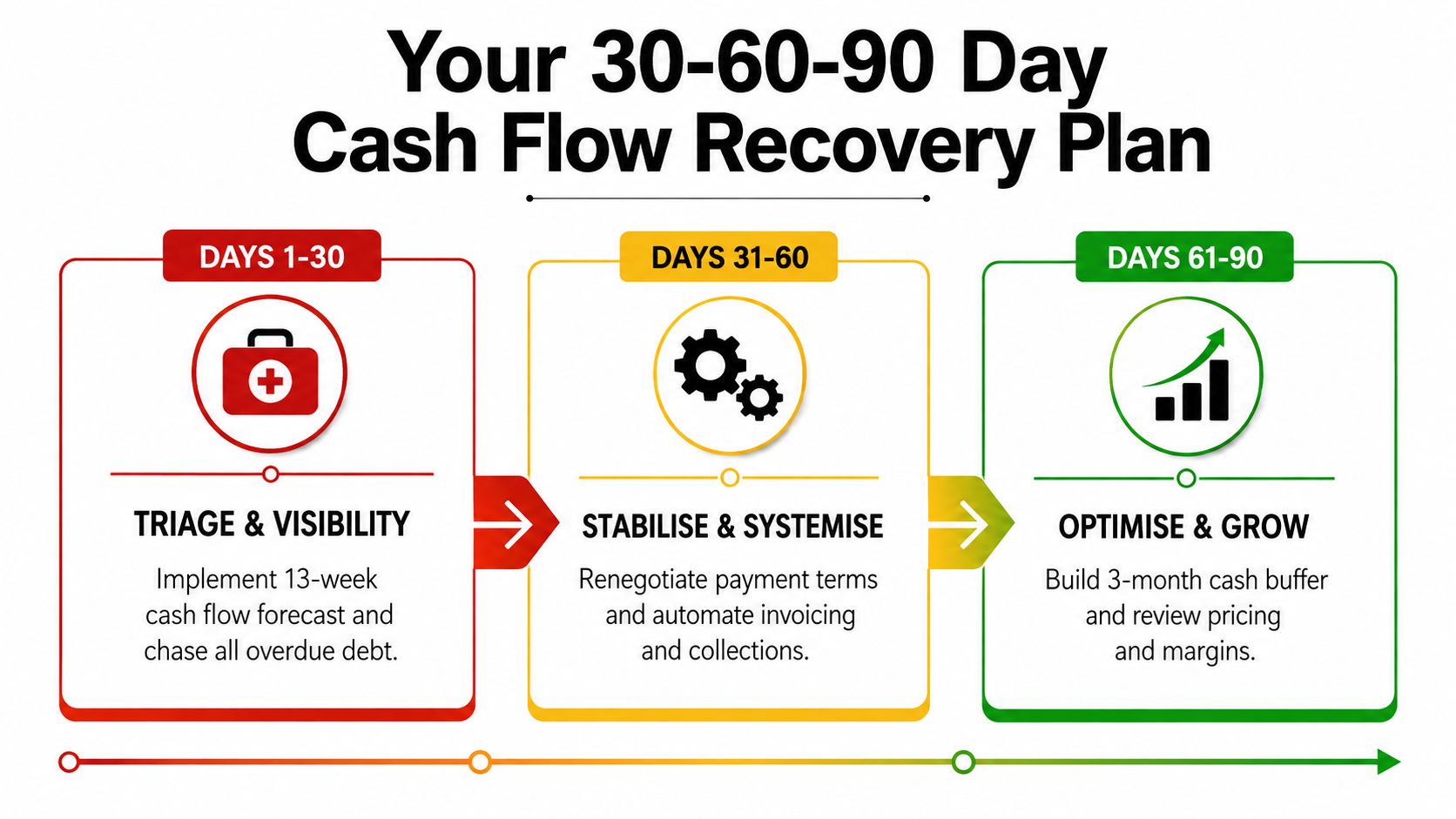
Your 30-60-90 Day Cash Flow Recovery Plan
A recovery plan needs owners, dates and evidence. Don't start by redesigning every finance process. Stabilise the bank account first, then build the controls that prevent the same gap from returning.
Days 1 to 30, triage and visibility
Create a rolling cash view that lists confirmed receipts, realistic expected receipts and committed outflows. Review it weekly, and update it whenever a customer changes a payment date, a supplier changes terms or a new commitment is approved.
Your first milestones are:
Identify three leaks: Choose the largest problems from receivables, inventory, overhead, pricing, debt or process delays.
Chase overdue balances: Assign owners, call priority accounts and record promised payment dates.
Review commitments: Pause non-essential purchases and cancel or defer costs that don't support near-term operations.
Set a weekly meeting: Review the opening bank position, receipts, payments, exceptions and decisions.
Use the cash flow forecast template from Nexist as a starting structure, then connect it to your actual sales, payroll, purchasing and debt information.
Days 31 to 60, stabilise and systemise
Automate invoice creation and payment reminders where your accounting platform supports it. Tighten approval rules for purchasing, require evidence for variations and align supplier payment dates with realistic customer collection dates.
For inventory businesses, classify stock by movement and set replenishment rules. For service businesses, define when work becomes billable and who approves the invoice. For hospitality, connect purchasing and rostering reviews to expected demand rather than habit.
Track a small set of KPIs consistently: overdue receivables, invoices issued on time, gross margin by offering, stock ageing, committed outflows and forecast variance. The useful metric is the one that changes a decision.
Days 61 to 90, optimise and grow
Review pricing against actual delivery costs, payment timing and working-capital requirements. Document the processes that now work, including invoicing, collections, purchasing, payroll approvals and weekly cash reviews.
Then decide how much growth the business can safely fund. Expansion should follow evidence from the forecast, not optimism from the sales pipeline. If the cash position remains fragile after process changes, address capital structure and operating margins before taking on more volume.
Nexist helps Australian founders find cash leaks across receivables, inventory, pricing and operating processes, then turn the findings into forecasts, KPIs and practical finance systems. Visit Nexist to organise a clearer cash-flow plan and decide which actions should happen first.
business cash flow problems, cash flow management, virtual CFO, SME finance, cash flow forecasting

" width="24px"/><g d="M 0 24.129 L 0 0.129 L 24 0.129 L 24 24.129 Z M 0 24.129 L 0 0.129 L 24 0.129 L 24 24.129 Z M 24 3 C 24 1.344 22.656 0 21 0 L 3 0 C 1.344 0 0 1.344 0 3 L 0 21 C 0 22.656 1.344 24 3 24 L 21 24 C 22.656 24 24 22.656 24 21 Z M 6.883 8.375 L 2.863 8.375 L 2.863 20.467 L 6.883 20.467 Z M 4.899 2.545 C 3.524 2.545 2.625 3.449 2.625 4.634 C 2.625 5.795 3.496 6.724 4.846 6.724 L 4.872 6.724 C 6.273 6.724 7.146 5.795 7.146 4.634 C 7.12 3.449 6.274 2.545 4.899 2.545 Z M 16.747 8.09 C 14.614 8.09 13.659 9.263 13.124 10.086 L 13.124 8.374 L 9.105 8.374 C 9.159 9.508 9.105 20.466 9.105 20.466 L 13.124 20.466 L 13.124 13.713 C 13.124 13.352 13.15 12.99 13.257 12.732 C 13.547 12.01 14.209 11.262 15.319 11.262 C 16.773 11.262 17.355 12.372 17.355 13.996 L 17.355 20.466 L 21.374 20.466 L 21.374 13.532 C 21.374 9.818 19.391 8.09 16.747 8.09 Z" fill="transparent" height="24.12890599668026px" id="dSFdkJotL" width="24px"><path d="M 0 24 L 0 0 L 24 0 L 24 24 Z" fill="transparent" height="24px" id="wscNJE44G" transform="translate(0 0.129)" width="24px"/><g d="M 0 24.129 L 0 0.129 L 24 0.129 L 24 24.129 Z M 24 3 C 24 1.344 22.656 0 21 0 L 3 0 C 1.344 0 0 1.344 0 3 L 0 21 C 0 22.656 1.344 24 3 24 L 21 24 C 22.656 24 24 22.656 24 21 Z M 6.883 8.375 L 2.863 8.375 L 2.863 20.467 L 6.883 20.467 Z M 4.899 2.545 C 3.524 2.545 2.625 3.449 2.625 4.634 C 2.625 5.795 3.496 6.724 4.846 6.724 L 4.872 6.724 C 6.273 6.724 7.146 5.795 7.146 4.634 C 7.12 3.449 6.274 2.545 4.899 2.545 Z M 16.747 8.09 C 14.614 8.09 13.659 9.263 13.124 10.086 L 13.124 8.374 L 9.105 8.374 C 9.159 9.508 9.105 20.466 9.105 20.466 L 13.124 20.466 L 13.124 13.713 C 13.124 13.352 13.15 12.99 13.257 12.732 C 13.547 12.01 14.209 11.262 15.319 11.262 C 16.773 11.262 17.355 12.372 17.355 13.996 L 17.355 20.466 L 21.374 20.466 L 21.374 13.532 C 21.374 9.818 19.391 8.09 16.747 8.09 Z" fill="transparent" height="24.12890599668026px" id="sTpjGo1tb" width="24px"><path d="M 0 24 L 0 0 L 24 0 L 24 24 Z" fill="transparent" height="24px" id="s7ffpmKOD" transform="translate(0 0.129)" width="24px"/><g d="M 24 3 C 24 1.344 22.656 0 21 0 L 3 0 C 1.344 0 0 1.344 0 3 L 0 21 C 0 22.656 1.344 24 3 24 L 21 24 C 22.656 24 24 22.656 24 21 Z M 6.883 8.375 L 2.863 8.375 L 2.863 20.467 L 6.883 20.467 Z M 4.899 2.545 C 3.524 2.545 2.625 3.449 2.625 4.634 C 2.625 5.795 3.496 6.724 4.846 6.724 L 4.872 6.724 C 6.273 6.724 7.146 5.795 7.146 4.634 C 7.12 3.449 6.274 2.545 4.899 2.545 Z M 16.747 8.09 C 14.614 8.09 13.659 9.263 13.124 10.086 L 13.124 8.374 L 9.105 8.374 C 9.159 9.508 9.105 20.466 9.105 20.466 L 13.124 20.466 L 13.124 13.713 C 13.124 13.352 13.15 12.99 13.257 12.732 C 13.547 12.01 14.209 11.262 15.319 11.262 C 16.773 11.262 17.355 12.372 17.355 13.996 L 17.355 20.466 L 21.374 20.466 L 21.374 13.532 C 21.374 9.818 19.391 8.09 16.747 8.09 Z" fill="transparent" height="24.000006px" id="D0ecaHEcW" transform="translate(0 0)" width="24px"><path d="M 24 3 C 24 1.344 22.656 0 21 0 L 3 0 C 1.344 0 0 1.344 0 3 L 0 21 C 0 22.656 1.344 24 3 24 L 21 24 C 22.656 24 24 22.656 24 21 Z" fill="rgb(55, 184, 218)" height="24.000006px" id="IPLFE6zXx" width="24px"/><path d="M 4.02 0 L 0 0 L 0 12.092 L 4.02 12.092 Z" fill="rgb(255, 255, 255)" height="12.09201px" id="FWhtzAyuY" transform="translate(2.863 8.375)" width="4.02px"/><path d="M 2.274 0 C 0.899 0 0 0.904 0 2.089 C 0 3.25 0.871 4.179 2.221 4.179 L 2.247 4.179 C 3.648 4.179 4.521 3.25 4.521 2.089 C 4.495 0.904 3.649 0 2.274 0 Z" fill="rgb(255, 255, 255)" height="4.17876px" id="VmOsKv4kO" transform="translate(2.625 2.545)" width="4.52095px"/><path d="M 7.641 0 C 5.509 0 4.554 1.173 4.019 1.996 L 4.019 0.284 L 0 0.284 C 0.053 1.419 0 12.376 0 12.376 L 4.019 12.376 L 4.019 5.623 C 4.019 5.262 4.045 4.9 4.151 4.642 C 4.442 3.92 5.103 3.172 6.214 3.172 C 7.667 3.172 8.25 4.282 8.25 5.907 L 8.25 12.376 L 12.269 12.376 L 12.269 5.442 C 12.269 1.728 10.286 0 7.641 0 Z" fill="rgb(255, 255, 255)" height="12.37626px" id="n1XUbhaq0" transform="translate(9.105 8.09)" width="12.268830000000001px"/></g></g></g></g></svg>)